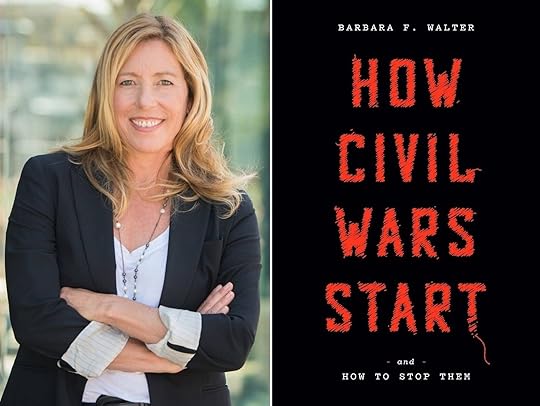
This book was on track to be 4 or 5 stars until the final three chapters at which point the author lets all of her political biases loose and the book falls off a cliff.
To start with, the good:
Walter does a good job presenting the latest research regarding how civil war starts. She mentions how, rather recently, a number of large datasets have been compiled to use for research on civil wars. The datasets include quantifiable metrics of how democratic or autocratic a country is. Walter points out what the important factors making civil war most likely are. She also points out that some things that people expect to be important factors, like wealth inequality, turned out not to be. The rather unfortunate conclusion from all this is that there are times when a country is particularly vulnerable: When trying to move too fast from autocratic to democratic; and when starting to slip from democratic into autocratic. The other big factors are factionalization, loss of status by a faction which previously had political power, and loss of hope that peaceful means can be used to resolve grievances.
Walter provides many examples of civil wars demonstrating what she is talking about. The history of Serbia + Bosnia + Croatia is particularly interesting. She also discusses the statistics regarding likelihood of civil
war. Her chapter on how social media is accelerating the frequency of civil wars is particularly strong.
The problems:
In most cases, the author is talking about civil wars I am not familiar with, so I cannot comment on the historical accuracy overall. In areas I am familiar with, however, I noticed some errors. In the case of North Ireland she portrays Catholics as peaceful for decades until attacked by police at the end of the Irish civil rights movement. Here she completely omits the violent history of the IRA before this. She also fails to document how northern protestants feared uniting with Ireland and thus becoming a minority even though this was always an explicit goal of the IRA from the end of the Irish Civil War until the Good Friday Agreement. She also mischaracterizes what finally led to peace. It was not so much that the IRA had won better treatment for Catholics but that both sides realized they were in a stalemate and the IRA realized continued violence without progress was causing them to loose support.
Another mistake Walter makes is a claim that the Republican platform going into the United States Civil War included abolition of slavery. The truth, however, is that it merely included not allowing slavery to expand into the west. There was nothing in the platform to end slavery in the South.
The historical mistakes are rather minor problems compared to the bias and terrible fact checking she shows in the final three chapters. Walter seems to take many things leftist media has said as fact even though they have been proven false. She also provides statements which are technically true, but misleading. Examples:
- the Jan 6 rioters did not bring zip ties to the Capitol to handcuff members of Congress but rather they were taken from police on that day to prevent handcuffing of rioters
- although five people did die on Jan 6 only one, a rioter, was due to causes which were not natural
- she refers to "automatic weapons" present on Jan 6: the best I can find, even checking her references, is some semi-automatic weapons
- she cites 14% of those arrested on Jan 6 as "having ties" to the police or military but this is not much different from the general population, especially given that most of those arrested were men
With regard to Trump, even though this book was published very recently there are a number of thoroughly debunked claims regarding him:
- The mention of "very fine people" at Charlottesville was explicitly qualified, at the time it was said, as not applying to the racists who Trump said must be condemned in the harshest of terms
- Lafayette Square was not cleared of protesters so Trump could take a photo op at a church
Although not checking these claims reveals the author's bias it is even clearer in her characterization of Republicans. Her bar for being racist, apparently, is rather low: If you oppose black people receiving special treatment (presumably referring to things like reduced admission standards to college and other affirmative action) that makes you "anti-black". The author seems particularly contemptuous of those who live in rural areas and mentions them as likely to slip further behind as urbanization increases. She does not mention, however, that due to increased work from home opportunities, unaffordable prices in large cities, and, yes, a desire for more traditional value and less big government many people are now fleeing urban areas for more rural.
The biggest problem:
The author's biggest problem is that her bias prevents her from seeing how leftists often provide at least as good as, and often better, examples of what she says shows signs of pending civil war. Nearly all her examples (probably at least 95%) involve those on the right. For example, she mentions trying to exclude another group from political power through policy as contributing to civil war. The best example of this in the United States, however, is effectively opening the borders to allow more potential voters who are likely to vote Democratic in. Although Walter is correct to point out the "massive election fraud" non-sense as an example of an attempt to convince partisans that the system is stacked against them, the left also does much to portray the system as stacked against the those they want to appeal to. Derek Bell (father of CRT) and Michelle Alexander (author of the New Jim Crow) have explicitly said that things have not and never will get better for black people in the United States because of the adaptability of racism: Fix it in one manifestation and it will come back in another equally bad one. Similarly, Nikole Hannah Jones has written that it is impossible for black people to do anything to raise their lot collectively without reparations. Although Walter mentions refusing to associate with those of other factions as a sign of being on the road to civil war it is actually Democrats who are more likely to say they would refuse to marry, be friends with, or hire Republicans than vice-versa.
In the final chapter Walter mentions solutions many of which seem counter-productive. For example she mentions getting rid of the electoral college since it favors white rural voters. This despite the fact that a central part of her thesis is that a sense of losing political representation in an important step toward civil war. The truth is that, if this were to happen, many states would say they originally entered the union because there were provisions to make sure that urban areas would not have all the power: things like the electoral college and the Senate. If these were taken away there would be a good case for no longer wishing to be part of the union. Generally Walter's solutions involve more socialism. This points to her biggest misunderstanding: It is not women, people of color and other minorities that Republicans are worried about: it is socialism. If she thinks Republicans just say it is socialism when it is, in fact, racism, sexism, and various "phobias" at play she needs to present non-cherry picked data and make the case.
One thing that Walter thinks would particularly help get the United States off the course to a potential civil war is regulating social media to prevent the spread of misinformation. There is no discussion of how this would be done given the first amendment prevents the government from regulating speech. Legality aside, she does not discuss the fact that the majority of the country considers free speech to be an American value and clamping down on it might actually play into the hands of those wanting things to turn violent.
Overall, the book definitely has good information regarding how civil wars start. Some of the information in here could likely be part of a solution. Unfortunately the way Walter lets her biases loose, blaming nearly everything on the right, it will likely just lead to further factionalization and, thus, be part of the problem.