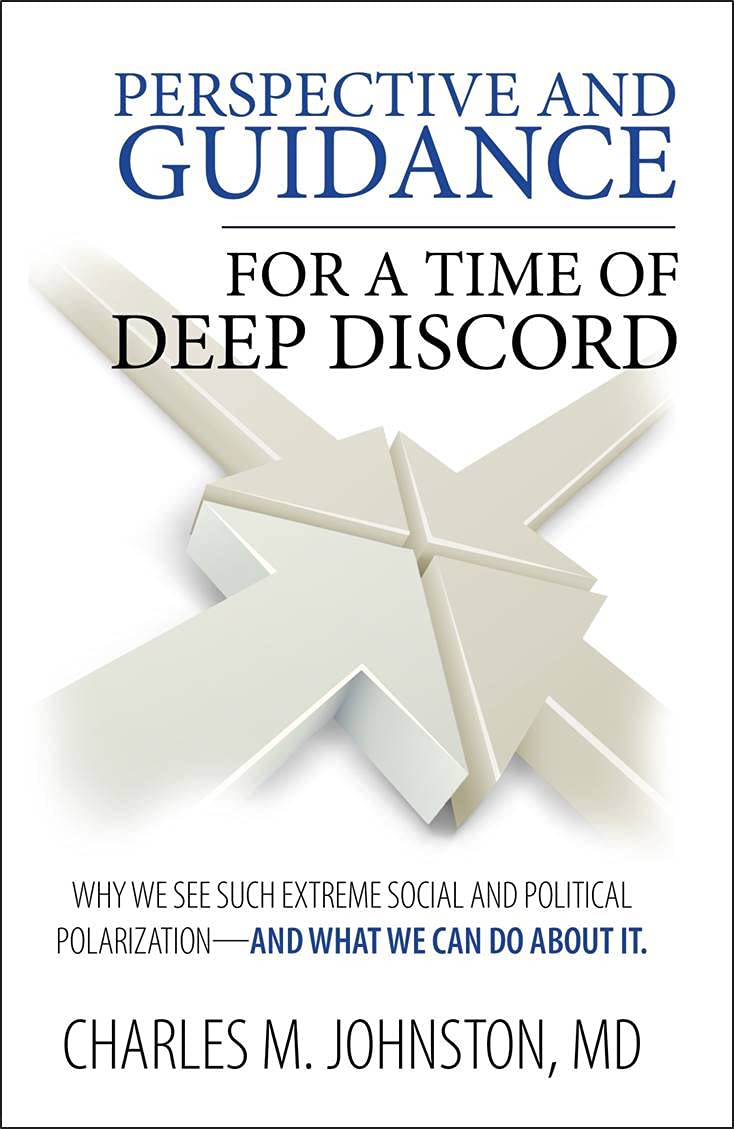
Perspective and Guidance for a Time of Deep Discord confronts the very real dangers that come with today’s extreme social and political polarization. And it examines what will be needed to effectively address what we see. From the book’s back “Social and political polarization has become so extreme that conversation about the simplest of issues is today often close to impossible. And polarized thinking—from both the Right and the Left—is not just putting civil conversation in jeopardy, it is getting in the way of addressing essential questions that our future well-being will depend on.“In Perspective and Guidance for a Time of Deep Discord, one of our times most innovative social thinkers argues that what we see is a product not just of what we think but how we think. He describes what the greater maturity of understanding needed to get beyond warring ideological purities requires of us. And he looks closely at what such understanding looks like when applied to critical concerns where divisiveness too often war and peace, climate change, health care, immigration, abortion, bigotry, the relationship of science and faith, and conflicting views on the nature of progress.”
Charles Johnston (1867-1931) was steeped in the wisdom of eastern traditions, having translated also the ten Principle Upanishads of the Vedanta, the Bhagavad Gita, the Tao Teh King of Lao Tse, and the Crest-Jewel of Wisdom of Sankaracharya. Johnston brings his in-depth understanding of the Vedanta to reveal the core meaning of Patanjali's sutras: the birth of the Spiritual Man.
From Wikipedia: He was born on 17 February 1867 in the small village of Ballykilbeg (in Downpatrick), County Down, Northern Ireland. His father, William Johnston (1829–1902), was an Irish politician, a Member of Parliament from South Belfast, and a member of the Orange Order.
Charles Johnston studied Oriental Studies, and learned Sanskrit, Russian and German. Among his classmates were William Butler Yeats and George William Russell, with whom he shared an interest in the occult.
Later, he worked as a journalist. In 1884, he read Alfred Percy Sinnett's work Occult World and founded, together with Yeats and Russell on 16 June 1885, the Hermetic Society in Dublin. He was responsible for introducing W. B. Yeats to Madame Blavatsky in spring 1887.
After 1885 he also joined the Theosophical Society, and co-founded in April/June 1886 the Theosophical Lodge in Dublin. (Later when the Theosophical Society split in 1895, he followed the direction of William Quan Judge and was a member of the Theosophical Society in America (TGinA).)
On 14 October 1888 he married Vera Vladimirovna de Zhelihovsky (1864-1923) the niece of Helena Blavatsky.
He also entered the Indian Civil Service the same year, and later served in the British Bengal Service.
He translated several works from Sanskrit and Russian. As an author, he devoted himself primarily to philosophical and theosophical topics.
I really wanted to like this book. I desperately seek answers to the current issue of political polarization and the deepening divide between factions that no longer appear to believe in compromise.
However, this book really turned me off. It seems that much of it was written to simply reference the author's previous works, and I felt that the author did a poor job of laying out his points in simple, easy-to-understand language that would have made the book for more accessible.
I do applaud the author for saying that the current political problem can be blamed on one political party as much as the other; that's sure to cause disagreement and put off roughly 50% of the audience, but it shows that the author is not trying to please anyone.
That said, I found this book difficult to finish, which was all the more disappointing because I was so excited to read it.
Very interesting. I enjoyed the authors perspective and expertise. I regret that I am not as optimistic as he is regarding the behavior of humanity in the future but, realizing I see this from an American perspective, I can see how other countries and cultures might take the lead and eventually we could possibly follow. Regardless, there is a wealth of information and understanding to be found in this book and I’m am a wiser person for having read it. I hope to read others by this author when time permits.