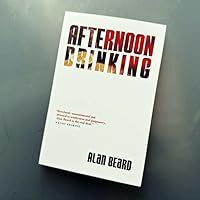
Eric is 29, a debt counselor, and his life is a lie. When he's not busy getting the debt of the dispossessed of West Cumbria's written off, he's bouncing the cost of his increasingly excessive lifestyle between several unsavory accounts. His girlfriend Charlotte has no idea how imperiled their home is. Until he starts receiving photos of a caravan, each with a sinister world on the back; Coerce. Harassment. Distress. Eric has a frightening puzzle to solve while juggling his finances. And life gets more complicated as he reconnects with the old love of his life in Julie, a strange, fragile body artist. When his loanshark starts making sinister threats to Julie, Eric hatches a scheme with one of his clients. Not only does he need the money, but he'd do anything to stop Julie from going away again.
Story of Eric – a Debt Advisor in an Advice Centre who is himself in severe debt and who makes dubious use of the skills and inside knowledge he has picked up both on legislation but also on how creditors will act, to keep the knowledge from his girlfriend (who believes him to be more of a corporate tax advisor) and fund a reasonably comfortable lifestyle on a small salary.
During the course of the story, Eric’s situation increasingly comes to a head (mainly as one creditor decides to get a sale order against his house) and he moves to blatantly illegal schemes (in particular working with a client Doreen to spend as much as she can on the various credit lines she has secured, selling or using the goods, all prior to declaring bankruptcy and then later working with her on the submission of a fake funding request for a new style advice centre) while at the same time receiving increasingly bizarre and dangerous caravan-themed threats from an unknown source.
The story of Eric’s debt advice and own financial shenanigans is interwoven with two other accounts – one of a man and a woman trying unsuccessfully to kill a man they have taken hostage (at the end of the story it becomes clear the hostage is Eric, the man [and blackmailer] is a loan shark Mr Friday who Eric has put out of business by counselling all his clients that his loan agreements are unenforceable, and the woman Doreen) the other of his teenage friend the bizarre punk Spangles/Julie who wants him to trepan her and then gets in contact again at the time of the story to request this again (he tries and fails and she then tries with a drill and kills herself).
The main part of the story is very entertaining. Details of Eric’s debt advice (financial statements, creditor offers, and bankruptcies) are very familiar. His own exploitation of his techniques (e.g. taking his main account up to just before when the bank start bouncing direct debits, then cancelling these and any payments in the account but making use of the many cheque books he ordered just before this and the guarantee card he still has, then offering them a 50% settlement funded from his next account) are almost painful to read. However the Mr Friday and particularly Julie stories are simply bizarre and too farfetched.
A mixed bag. On the one hand, this was at times witty and certainly was interesting - following the trouble that Eric, a debt advisor, gets into when he himself gets into financial arrears. There was plenty that held my attention, childhood reminisces and a side story which only gets explained at the end. However, there's something about my views on debt and living on credit, my ideas about self-reliance versus the benefits system, that made some of this just feel alien to me and something I didn't empathise with naturally. It was also all a bit grim, and I didn't really enjoy seeing the characters' lives unravelling.
I've yet to read a bad book from the Tindal Street Press, and this book continued that trend. Like all their books it has a 'regional' flavour, set in Cumbria. It's not all lakes and sheep - though they do feature - it's more a world where people have crippling debts, where even money-lenders need the services of a debt counsellor, and even debt counsellors are being pursued by the bailiffs. I liked the humour most of all - the author has a great way of translating the nuances of body language into text form - and the willingness to bring the ridiculous to life. Somehow he managed to create a scenario where a character is pursued to a council meeting by a giant Jif lemon, and make it utterly believable.
A series of scenes depicting slightly cartoonish violence are interspersed with the main story, and the reader is unsure of the identities of those involved, until the end of the book - this added an interesting dimension, as it is not clear whether we are supposed to be rooting for the perpetrators or the victim. Very clever. I was less convinced by the ending. Given that the book had reached such highs along the way I was expecting something less conventional, less guessable. I'd say just enjoy the journey!
Eric is a debt counsellor, based in an advice centre in the run-down West Cumbrian town of Cleator Moor. He spends his days helping his clients to work the benefit and courts systems, to juggle their debts and to minimise any repayments they do make by taking full advantage of myriad loopholes in the regulations. However, rather in the manner of “poacher turned gamekeeper”, he is even more mired in debt than they are, and has to become increasingly adept and “creative” at working the system to his own benefit. Eventually all his juggling starts to catch up with him, and all the thrill and excitement of “living on the edge” gradually takes a darker and more threatening turn. I thought that this was a very cleverly-told story, and that the author’s own experience of working as a debt counsellor certainly informed his writing. (I just wonder about his decision to set it in his home town!) He all too vividly showed the realities of living with debt, of loan sharks and of the complex nature of the benefits system, although there were times when I thought he seemed to glamorise it, without showing the miseries that many families in debt face. He has described his book as “a comic thriller set in the public sector world” and I think that this fairly accurately describes it. Humour, albeit rather black, abounds, and there is a gradual escalation of intimidation and violence. There are three plot lines/voices which represent different periods in time but, as the story develops, the links between these become ever clearer. All the characters are vibrant individuals, leading chaotic lives – not always particularly likeable, but certainly recognisable – and David Gaffney brilliantly portrays the increasing norm of a debt-consumed culture, as well as the implications of unaffordable consumerism. This was an uncomfortable read (maybe particularly so for people who live in Cleator Moor!), and one which is bound to divide opinion, but the book’s basic message is certainly very pertinent to the times in which we live.
some very funny scenes (e.g. soy sauce instead of vinegar in the 'Jesus' scene) and accurate description (e.g.the man's glasses with the green mould) but overall I couldn't engage with the characters and it was overlong, suprisingly for an author known for his ultra short fiction (Sawn Off Tales).
Having previously read David Gaffney's "Sawn Off Tales", I had high hopes for this book. It was good and it was funny, but it wasn't as compelling as I'd like a book to be.