

What do you think?
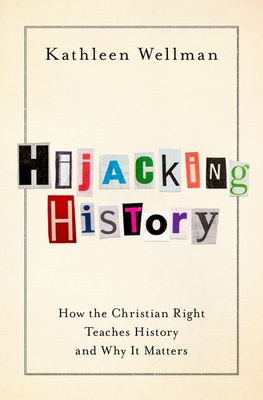
Hijacking History: How the Christian Right Teaches History and Why It Matters
The teaching of history has long been the subject of partisan warfare. Religion often plays a prominent role in these debates, as secular progressives and conservative Christians disagree over which historical figures are worthy of study, how (or whether) certain events should be portrayed, and ultimately how tax dollars should be spent. But what about students who are educated outside the public schools, either in religious schools or at home? How are they learning history, and what effect does that have on our democracy? Hijacking History analyzes the high school world history textbooks produced by the three most influential publishers of Christian educational materials. In these books, the historian, informed by his faith, tells the allegedly unbiased story of God's actions as interpreted through the Bible. History becomes a weapon to judge and condemn civilizations that do not accept the true God or adopt biblical positions. In their treatment of the modern world, these texts identify ungodly ideas to be vanquished--evolution, humanism, biblical modernism, socialism, and climate science among them.
384 pages, Hardcover
First published January 1, 2021
Ratings & Reviews
Friends & Following
Create a free account to discover what your friends think of this book!
Community Reviews
Displaying 1 - 11 of 11 reviews

December 29, 2021
Insightful look at conservative histories
I do not completely agree with the author on some things. For example, I do not believe the theory of evolution and it's counterparts needs to be part of a history book. Those are scientific issues and should be left there. However, this book does an excellent job of evaluating several homeschool and private school high school curriculums. It puts into words things that I had already noticed but had not been able to explain. History can be used to promote ones worldview. The curriculum that is evaluated is promoting a conservative, and at times somewhat contradictory view of history where God is the primary actor, sin is the cause of all problems, and capitalism is God-ordained.
My critique would be that at times the evaluation and the comparison of a what critical historians would say is not clearly marked. That may be because I was reading the kindle version and not a hard copy.
I would recommend this book for anyone teaching history to understand what these curriculums are teaching and to more critically evaluate what they teach in their classrooms,
I do not completely agree with the author on some things. For example, I do not believe the theory of evolution and it's counterparts needs to be part of a history book. Those are scientific issues and should be left there. However, this book does an excellent job of evaluating several homeschool and private school high school curriculums. It puts into words things that I had already noticed but had not been able to explain. History can be used to promote ones worldview. The curriculum that is evaluated is promoting a conservative, and at times somewhat contradictory view of history where God is the primary actor, sin is the cause of all problems, and capitalism is God-ordained.
My critique would be that at times the evaluation and the comparison of a what critical historians would say is not clearly marked. That may be because I was reading the kindle version and not a hard copy.
I would recommend this book for anyone teaching history to understand what these curriculums are teaching and to more critically evaluate what they teach in their classrooms,
January 1, 2026
For several years, I attended a Christian school that used the curriculum assessed in this book. Since that time, I have often felt misled and deceived by the distortions, cherry-picked information, and sometimes flat-out falsehoods I was taught. But I had not put together some of the effects these curricula have had in conservative Christian circles and politics today. This book illuminates the misinformation, disinformation, and agendas promoted in these textbooks, which are commonly used in homeschools and private schools and influence school boards and secular publishers as well. These ideas are becoming more and more common in evangelical culture as well.
The author, Kathleen Wellman, is the Dedman Family Distinguished Professor of History and Altshuler Distinguished Teaching Professor at Southern Methodist University, and has written multiple articles and books in this discipline. The first portions of this book introduce the situation, identify the problem, and provide pertinent definitions. The remaining chapters examine the discrepancies and biases in the world and US history presented in the curricula in a roughly chronological order.
“I found that these curricula [Abeka Books, Bob Jones University Press, and Accelerated Christian Education (ACE)] articulated an idiosyncratic but generally consistent narrative fundamentally at odds with that of the historical profession (pxi).”
“This book raises an alarm about a deliberately constructed and promoted Christian, right-wing historical narrative, one that is not only inaccurate, but dangerous as well (p1).”
“Despite their fundamentalist roots, these textbooks are consistently promoted as ‘Christian’ rather than fundamentalist (p37).” “As a result, today more evangelicals hold to extreme views than they did in earlier periods, and thus some formerly fundamentalist views, notably on evolution, the age of the earth, and Christian nationalism, have become for them more central landmarks of what it means to be a Christian (p38).”
“Jesus is never presented as a model of Christian conduct, nor is the gospel cited as the heart of the Christian message (p48).”
“Disparaging academic historians as left-leaning suggests that they, like these textbooks’ authors, begin with fundamental preconceptions they intend to corroborate. Quite the contrary, Historians instead gather relevant evidence to address the questions they ask to better understand the past (p53).”
“Opposition to the geological dating of the earth with its corollary acceptance of evolution became ‘creation science’ when Morris promulgated a pseudoscience, which claimed that the recent, supernatural creation of the earth was supported by geological evidence, including that fossil-laden strata were the result of the biblical flood. … While the scientific community either ignored or vehemently rejected Whitcomb and Morris’s work, many evangelicals eagerly embraced it (p62).”
“Their [the Christian textbooks’] understanding [of the Bible] is very much at odds with a long tradition of how the Bible has been studied and understood (p76).”
“In part, these textbooks’ disparagement of the classical period reflects a deep distrust of education and an underlying anti-intellectualism (p80).”
“These world histories … place Catholics firmly in the category of un-American and unacceptable ‘other’ (p109).”
“Another striking omission in these textbooks is their failure recognize that leaders of emerging Protestant movement were committed to neither biblical inerrancy nor literalism (p124).”
“ACE continues to teach the patently false claim that Columbus was one of the few who believed that the world was round (p131).”
“Like all secondary-school materials, these curricula must simplify this complex period in intellectual and cultural history, but they do so with an explicit end: to trace a trajectory of evil from the Enlightenment through the French Revolution, to Darwin, to Hitler, to communism, as their treatment of modern history will document (p148).”
“It presents a fairy tale rather than a history. The narrative these textbooks promote is not returning to ‘true’ history or merely presenting an optimistic account instead of the supposedly cranky pessimism of professional historians (p157).”
“These textbooks largely ignore that relations between colonists and Native Americans were hostile primarily because colonists appropriated Native American lands (p163).”
“They underreport the negative effects of colonization on the colonized, who faced massive dislocation of populations, dispossession of lands, and, in some cases, ethnic cleansing. … These curricula do not recognize the enormous financial benefits colonizers derived from goods and raw materials or the humanitarian disasters they produced (p199).”
“The effort to scrub US history of slavery or downplay its negative impact is disturbing particularly because it resonates in the current national conversation about race and social welfare (p203).”
“The strong stances these curricula take against evolution, higher criticism, and the Social Gospel were those Southern evangelicals took in the late nineteenth century and stipulated as Christian orthodoxy (p216).”
“For these textbooks and many modern evangelicals, systemic failures of capitalism do not reflect sin, although individual economic failures do (p236).”
“This narrative is a most striking misrepresentation of Latin American politics and US involvement in Latin America. … The treatment of India is similarly distorted, viewed through the lens of these curricula’s commitment to Christian proselytizing and capitalism (p261).”
“The historical narrative of these textbooks, despite the interest of evangelicals in proselytizing across the globe, isolates the United States, walling it off from problems we will face as the twenty-first century unfolds – problems that will require both knowledge of the rest of the world and its history and an ability to work globally to solve them (p292).”
“The Christianity found in these educational materials seems wedded more to capitalism than the New Testament: God rewards Christians with wealth; poverty is His punishment. Any economic development that serves the rich and punishes the poor can be construed as fulfilling God’s intentions. … The Christianity these textbooks avow is devoid of the Gospel and intolerant and inhumane (p294).”
“Bad history matters. … Bad history can reshape our national identity by discrediting expert knowledge and mobilizing racism and anti-immigration sentiment. It can serve explicit political campaigns, including attacks on the need to address climate change or public health care with collective action. By identifying such efforts with sin or by conflating social welfare with totalitarianism, as these textbooks do (pp298-299).”
My final thoughts:
This is a must-read book for people who select curricula and for those interested in understanding the alliance between evangelicals and right-wing politics, such as Christian nationalism, white supremacy, racism, patriarchy, capitalism, and anti-intellectualism (including science denial). It has also helped me understand why evangelical MAGAs aren’t bothered by Trump’s infidelity, sexual predation, and pedophilia. Patriarchy and purity culture ensure that women are blamed for all sexual sins and, as these curricula teach, the real morals that need protection are capitalism and wealth accumulation for white men. Since I have some familiarity with these curricula from years ago when I attended a Christian school, I see the importance of raising awareness of the deceit, inaccuracies, and unkindness to others that are being presented to children in the name of Jesus. This should not be, and I implore anyone using these or similar textbooks to evaluate and select more truthful and less harmful options. These ideas have permeated evangelical culture and are causing real harm to people God loves.
The author, Kathleen Wellman, is the Dedman Family Distinguished Professor of History and Altshuler Distinguished Teaching Professor at Southern Methodist University, and has written multiple articles and books in this discipline. The first portions of this book introduce the situation, identify the problem, and provide pertinent definitions. The remaining chapters examine the discrepancies and biases in the world and US history presented in the curricula in a roughly chronological order.
“I found that these curricula [Abeka Books, Bob Jones University Press, and Accelerated Christian Education (ACE)] articulated an idiosyncratic but generally consistent narrative fundamentally at odds with that of the historical profession (pxi).”
“This book raises an alarm about a deliberately constructed and promoted Christian, right-wing historical narrative, one that is not only inaccurate, but dangerous as well (p1).”
“Despite their fundamentalist roots, these textbooks are consistently promoted as ‘Christian’ rather than fundamentalist (p37).” “As a result, today more evangelicals hold to extreme views than they did in earlier periods, and thus some formerly fundamentalist views, notably on evolution, the age of the earth, and Christian nationalism, have become for them more central landmarks of what it means to be a Christian (p38).”
“Jesus is never presented as a model of Christian conduct, nor is the gospel cited as the heart of the Christian message (p48).”
“Disparaging academic historians as left-leaning suggests that they, like these textbooks’ authors, begin with fundamental preconceptions they intend to corroborate. Quite the contrary, Historians instead gather relevant evidence to address the questions they ask to better understand the past (p53).”
“Opposition to the geological dating of the earth with its corollary acceptance of evolution became ‘creation science’ when Morris promulgated a pseudoscience, which claimed that the recent, supernatural creation of the earth was supported by geological evidence, including that fossil-laden strata were the result of the biblical flood. … While the scientific community either ignored or vehemently rejected Whitcomb and Morris’s work, many evangelicals eagerly embraced it (p62).”
“Their [the Christian textbooks’] understanding [of the Bible] is very much at odds with a long tradition of how the Bible has been studied and understood (p76).”
“In part, these textbooks’ disparagement of the classical period reflects a deep distrust of education and an underlying anti-intellectualism (p80).”
“These world histories … place Catholics firmly in the category of un-American and unacceptable ‘other’ (p109).”
“Another striking omission in these textbooks is their failure recognize that leaders of emerging Protestant movement were committed to neither biblical inerrancy nor literalism (p124).”
“ACE continues to teach the patently false claim that Columbus was one of the few who believed that the world was round (p131).”
“Like all secondary-school materials, these curricula must simplify this complex period in intellectual and cultural history, but they do so with an explicit end: to trace a trajectory of evil from the Enlightenment through the French Revolution, to Darwin, to Hitler, to communism, as their treatment of modern history will document (p148).”
“It presents a fairy tale rather than a history. The narrative these textbooks promote is not returning to ‘true’ history or merely presenting an optimistic account instead of the supposedly cranky pessimism of professional historians (p157).”
“These textbooks largely ignore that relations between colonists and Native Americans were hostile primarily because colonists appropriated Native American lands (p163).”
“They underreport the negative effects of colonization on the colonized, who faced massive dislocation of populations, dispossession of lands, and, in some cases, ethnic cleansing. … These curricula do not recognize the enormous financial benefits colonizers derived from goods and raw materials or the humanitarian disasters they produced (p199).”
“The effort to scrub US history of slavery or downplay its negative impact is disturbing particularly because it resonates in the current national conversation about race and social welfare (p203).”
“The strong stances these curricula take against evolution, higher criticism, and the Social Gospel were those Southern evangelicals took in the late nineteenth century and stipulated as Christian orthodoxy (p216).”
“For these textbooks and many modern evangelicals, systemic failures of capitalism do not reflect sin, although individual economic failures do (p236).”
“This narrative is a most striking misrepresentation of Latin American politics and US involvement in Latin America. … The treatment of India is similarly distorted, viewed through the lens of these curricula’s commitment to Christian proselytizing and capitalism (p261).”
“The historical narrative of these textbooks, despite the interest of evangelicals in proselytizing across the globe, isolates the United States, walling it off from problems we will face as the twenty-first century unfolds – problems that will require both knowledge of the rest of the world and its history and an ability to work globally to solve them (p292).”
“The Christianity found in these educational materials seems wedded more to capitalism than the New Testament: God rewards Christians with wealth; poverty is His punishment. Any economic development that serves the rich and punishes the poor can be construed as fulfilling God’s intentions. … The Christianity these textbooks avow is devoid of the Gospel and intolerant and inhumane (p294).”
“Bad history matters. … Bad history can reshape our national identity by discrediting expert knowledge and mobilizing racism and anti-immigration sentiment. It can serve explicit political campaigns, including attacks on the need to address climate change or public health care with collective action. By identifying such efforts with sin or by conflating social welfare with totalitarianism, as these textbooks do (pp298-299).”
My final thoughts:
This is a must-read book for people who select curricula and for those interested in understanding the alliance between evangelicals and right-wing politics, such as Christian nationalism, white supremacy, racism, patriarchy, capitalism, and anti-intellectualism (including science denial). It has also helped me understand why evangelical MAGAs aren’t bothered by Trump’s infidelity, sexual predation, and pedophilia. Patriarchy and purity culture ensure that women are blamed for all sexual sins and, as these curricula teach, the real morals that need protection are capitalism and wealth accumulation for white men. Since I have some familiarity with these curricula from years ago when I attended a Christian school, I see the importance of raising awareness of the deceit, inaccuracies, and unkindness to others that are being presented to children in the name of Jesus. This should not be, and I implore anyone using these or similar textbooks to evaluate and select more truthful and less harmful options. These ideas have permeated evangelical culture and are causing real harm to people God loves.

August 13, 2024
The author examines three Christian educational publishing houses and their material for primarily high school history courses. These three publishers produce almost all of the material used by Christian homeschoolers and by private, conservative, Protestant schools. A few million children use this material every year.
Wellman does not look at the textbooks that discuss science, which would also be interesting. She only examines textbooks and teaching material concerning world history and US history. The results are concerning to say the least!
The telling of history varies according to what the authors choose to tell, interpretation of the history, and simply getting the facts right (i.e., accuracy). All historians will have some disagreements over which events, people, and so forth should be emphasized in the telling of history. Historians will disagree over the interpretations of the events. Certainly, major people and events need to be included, and adding very minor events and people needs to be justified in some manner. This can be done, and some legitimate historians will do so. Interpretations do need to fit the facts! The historian cannot simply throw in their ideologies and ignore the facts. And finally, any legitimate historian must stick to the facts of history - you cannot just make stuff up.
These histories seem to fail on all three accounts. Minor events and people are frequently thrown in and major events are minimized with little to no reason given. Interpretations often do not meet the requirement of fitting the facts, but reflect the publishers needs to promote a certain Christian viewpoint. (I should add that these publishers promote Christian Nationalism or Christian Dominionism, the idea that Christians should rule in the nation.) Sometimes, the publishers simply change the "facts" when they don't suit their view of the world.
It is sad and frightening as some of these students may become future leaders.
Wellman does not look at the textbooks that discuss science, which would also be interesting. She only examines textbooks and teaching material concerning world history and US history. The results are concerning to say the least!
The telling of history varies according to what the authors choose to tell, interpretation of the history, and simply getting the facts right (i.e., accuracy). All historians will have some disagreements over which events, people, and so forth should be emphasized in the telling of history. Historians will disagree over the interpretations of the events. Certainly, major people and events need to be included, and adding very minor events and people needs to be justified in some manner. This can be done, and some legitimate historians will do so. Interpretations do need to fit the facts! The historian cannot simply throw in their ideologies and ignore the facts. And finally, any legitimate historian must stick to the facts of history - you cannot just make stuff up.
These histories seem to fail on all three accounts. Minor events and people are frequently thrown in and major events are minimized with little to no reason given. Interpretations often do not meet the requirement of fitting the facts, but reflect the publishers needs to promote a certain Christian viewpoint. (I should add that these publishers promote Christian Nationalism or Christian Dominionism, the idea that Christians should rule in the nation.) Sometimes, the publishers simply change the "facts" when they don't suit their view of the world.
It is sad and frightening as some of these students may become future leaders.
June 13, 2022
I grew up in Christian schools, went to a Christian college, and taught in Christian schools for a number of years. I am still an evangelical, and most would consider me a theologically conservative one.
The author summarizes very accurately how various Christian school curriculums portray history. It's absolutely atrocious. She also calls out modern conservatives for conserving relatively new positions while jettisoning antenicene traditions which were integral to the church. From someone steeped in this culture, I can vouch her analysis of what it teaches.
My big pushback would be that there are a few moments in the book where the author seems naive to her own position. She would never say this, but the way she talks makes clear that she thinks that a liberal background or exposure to academia strip an assessment of subjectivity and bias. There are moments of self-righteousness and naivete of this sort, and I'm always wary of playing ping pong between two polarized positions. Nevertheless, those moments are relatively rare and the information she presents is very good.
The author summarizes very accurately how various Christian school curriculums portray history. It's absolutely atrocious. She also calls out modern conservatives for conserving relatively new positions while jettisoning antenicene traditions which were integral to the church. From someone steeped in this culture, I can vouch her analysis of what it teaches.
My big pushback would be that there are a few moments in the book where the author seems naive to her own position. She would never say this, but the way she talks makes clear that she thinks that a liberal background or exposure to academia strip an assessment of subjectivity and bias. There are moments of self-righteousness and naivete of this sort, and I'm always wary of playing ping pong between two polarized positions. Nevertheless, those moments are relatively rare and the information she presents is very good.

August 17, 2023
Dr. Wellman's book explores alternative version of American history, told through the lens of the major conservative/fundamentalist religious education entities out there--Abeka, Bob Jones U., etc.
There is clearly a danger for such versions of history gaining intellectual currency. As we have seen, such histories tend to eschew normal historical methodology in favor of a highly providential, mythologized history that does not consider contingency or human motivations. You don't question or explore this history, you accept it outright. It is of course tied in with some specific political motivations and presumptions, as Wellman spools out over the book. Hijacking History will serve as a primer for those concerned about this possibility.
In terms of facing this sort of mythologized history, or even combating it, Hijacking History could use more in terms of what exactly the best arguments against it are. Of course most historians and learned history people will know the basics, but the book needs more granular detail. Very much recommend this work.
There is clearly a danger for such versions of history gaining intellectual currency. As we have seen, such histories tend to eschew normal historical methodology in favor of a highly providential, mythologized history that does not consider contingency or human motivations. You don't question or explore this history, you accept it outright. It is of course tied in with some specific political motivations and presumptions, as Wellman spools out over the book. Hijacking History will serve as a primer for those concerned about this possibility.
In terms of facing this sort of mythologized history, or even combating it, Hijacking History could use more in terms of what exactly the best arguments against it are. Of course most historians and learned history people will know the basics, but the book needs more granular detail. Very much recommend this work.
July 21, 2026
Hijacking History: How the Christian Right Teaches History and Why It Matters is a thought-provoking and meticulously researched examination of history education, religion, and politics in the United States.
Kathleen Wellman carefully analyzes influential Christian history textbooks, exploring how historical narratives are shaped by religious ideology and the broader implications for civic education and democracy. Insightful, balanced, and well documented, the book makes an important contribution to discussions of education, historical interpretation, and public discourse. It is essential reading for historians, educators, and students.
Kathleen Wellman carefully analyzes influential Christian history textbooks, exploring how historical narratives are shaped by religious ideology and the broader implications for civic education and democracy. Insightful, balanced, and well documented, the book makes an important contribution to discussions of education, historical interpretation, and public discourse. It is essential reading for historians, educators, and students.

July 10, 2022
Generally pretty good, although some objectively incorrect bits here and there (Such as failing the 'Stop conflating the Taliban with the Mujahideen please' challenge) which did slightly mar points, but they don't impact the general thrust of the book with feels pretty on point.

February 25, 2024
An important book. Provides insights to some of the current political situation in the U.S. I recognize many many of these view/positions but did not know the history.
The book is fairly academic and dry and so it is a bit tough slogging at times.
The book is fairly academic and dry and so it is a bit tough slogging at times.

May 17, 2025
A good analysis - with much better historiographical work than the textbooks it critiques. But I repeatedly wished that Wellman had better recognized that all histories are biased and that cultural and religious viewpoints can (or inevitably will) affect historical and other interpretations.

July 4, 2022
Very interesting and Informative book giving good information on Christian Nationalism and the goals and purposes of the Christian right.
Displaying 1 - 11 of 11 reviews