Documenting a year of dedication to a one-acre plot of land, a writer tells the story of homesteading in the suburbs, maintaining and learning from a bee hive, a full-scale vegetable garden, a fish pond, and ducklings. IP.
Judith Moffett was born in Louisville in 1942 and grew up in Cincinnati. She is an English professor, a poet, a Swedish translator, and the author of twelve books in six genres. These include two volumes of poetry, two of Swedish poetry in formal translation, four science-fiction novels plus a collection of stories, a volume of creative nonfiction, and a critical study of James Merrill's poetry; she has also written an unpublished memoir of her long friendship with Merrill. Her work in poetry, translation, and science fiction has earned numerous awards and award nominations, including an NEA Creative Writing Fellowship in Poetry, an NEH Translation Grant, the Swedish Academy's Tolkningspris (Translation Prize), and in science fiction the John W. Campbell Award for Best New Writer and the Theodore Sturgeon Award for the year's best short story. Two of her novels were New York Times Notable Books.
Moffett earned a doctorate in American Civilization from the University of Pennsylvania, with a thesis on Stephen Vincent Benét's narrative poetry, directed by Daniel Hoffman. She taught American literature and creative writing at several colleges and universities, including the Iowa Writers' Workshop, the University of Kentucky, and for fifteen years the University of Pennsylvania. She has lived for extended periods in England (Cambridge) and Sweden (Lund and Stockholm), as well as around the US, living/teaching/writing in Kentucky, Ohio, Indiana, Colorado, Wisconsin, Iowa, Pennsylvania, and Utah. In 1983 she married Medievalist Edward B. Irving, Jr., her colleague at Penn. Widowed in 1998, Judy now divides her year between Swarthmore PA and her hundred-acre recovering farm in Lawrenceburg KY, sharing both homes with her standard poodles, Fleece and Corbie.
If you want to learn about raising ducks, fish, and bees than this is the book for you. Being a faculty member in the English department one would think she would do more research into a topic she " planned to spend the next year developing. More "Green Acres" than I cared to read.
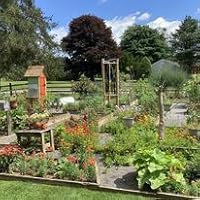
This is Judith Moffett's account of the year (more or less) she and her husband Ted spent experimenting with self-sufficiency agriculture in their suburban Philadelphia backyard. It's really Judith's baby, but the patient and loyal Ted is always willing to pitch in. They have a big vegetable garden, fruit trees, berry bushes, a fish pond, a flock of ducks and some honeybee hives. They even try their hand at tapping their maple tree for syrup. Unlike a lot of "hobby farmers" Moffett doesn't take herself too seriously. She completely lacks the smug, I'm-greener-than-you-are vibe you can see so much of on hipster-hippie blogs these days. She is concerned about her impact on the environment and wants to be able to raise her crops organically, but she understands that sometimes this is impractical for any number of reasons. (Chiefly among them being that if you can't control your garden pests and diseases you won't get to use all your produce and will have to buy it, which isn't something self-sufficiency types like to do.) Moffett and her husband, often helped out by their neighbors and friends, work hard throughout 1992, coping with that summer's cool temperatures and too much rain, worrying over their bees' propensity for swarming, raising baby ducks, and cultivating a wide variety of garden foods which they also preserve themselves, all the while continuing their regular work, she as a writer and part-time writing instructor, he as a college professor. There are successes, like their honey harvest, and there are failures, such as the poor showing made by their apple trees. The book is both highly detailed and very accessible. Maybe I didn't need to know every in and out of hive maintenance, but I was never bored by her descriptions.
Interesting to read about a garden so nearby to one's own. This is pretty much a journal with little embellishment, though. I get the impression she kept a log of her homestead year, then went back over it to make it slightly more readable. It's certainly not a memoir or anything introspective.
I did appreciate the upfront attitude about her failures. It's easier to see in this day-to-day record what the hard parts were, and where she seemed to spend a lot of her time. And boy did she spend a lot of time worrying about bees. She clearly had no idea what she was doing and was not asking for enough help from her friends who did know things. It definitely made me feel I'd want to have someone on speed dial if I were to try beekeeping.
It's also interesting to think how far we've come from the early nineties in what is available for homesteading. She has to start many things from seed because there just isn't much variety in the plants available for purchase. She orders terrible-sounding hybrids like Jazzer cucumbers and Gurney Girl tomatoes because she can't find non-hybrids with disease resistance. She mostly uses Burpee.
The way we find information is so different now, too. She has all these articles she has saved on beekeeping and duck husbandry, and she has to call the companies she orders from to find out information about their products. The internet has put all that at our fingertips--though sometimes I wonder if it's worth the tradeoff: the quality of information for masses of it from crap sites like Hunker and The Spruce.
Anyone fascinated by gardening, beekeeping or raising ducks as a small attempt at self-sufficiency would enjoy Moffett’s account of a year spent focusing on this enterprise on a suburban lot. She is forthright about successes and failures: the later particularly with the frustrating, but often charming ducks, and the many learning errors with the bees whose intents to swarm despite Moffett’s efforts keep her on guard. I couldn’t put down Homestead Year told in an engaging voice.
I found this an interesting day-by-day account of a one year attempt to be more self-sufficient. Truthfully, I found it more inspiring than informational. It made me feel less nervous and less embarassed about my overall lack of skills and more understanding that some skills just need to be practiced to be truly developed. Sometimes you have to do to learn. Experience is the best teacher and all...
I am really interested in this topic, so I wish the book itself were not quite so dull. A sample paragraph: "I scrubbed out the dirty flowerpots that had been soaking overnight in Spic n Span, to kill any malingering disease organisms from previous years, and carried them out to dry in the sunshine." Um, ok. Thanks.
An interesting account of a year on a suburban homestead. I would have appreciated more reflection on the experience from the author at the end. There was a short epilogue but I felt like I wanted more.
It was just okay. Of course, it was written in the early '90s so there's been a lot of advancement in gardening/back-to-the-land movement. It was dry reading. However, I appreciated the detailed illustrations of her beehives and the explanations of beekeeping.
This was a really easy read... not a ton of 'meaty, how-to' info, more like a journal of her experience. (It would have made a great blog if there was such a thing when she wrote the book!)