

What do you think?

Anatomy
La vida en el océano: Secretos y curiosidades del mundo marino
Julia Rothman’s best-selling illustrated Anatomy series takes a deep dive into the wonders of the sea with Ocean Anatomy. Follow Rothman’s inquisitive mind and engaging artwork along shorelines, across the open ocean, and below the waves to explore the hows and whys of the watery universe, from how the world’s oceans formed to why the sea is salty. Oceanic phenomena such as rogue waves, anatomical profiles of sea creatures from crustacean to cetacean, surveys of seafaring vessels and lighthouses, and the impact of plastic and warming water temperatures are just part of this compendium of curiosities that will entertain and educate readers of all ages.
208 pages, Paperback
First published April 28, 2020
Ratings & Reviews
Friends & Following
Create a free account to discover what your friends think of this book!
Community Reviews
Displaying 1 - 30 of 178 reviews

January 16, 2020
Almost perfect*
This is a solid overview of the ocean environment that should appeal to both visual and book learners. Done in a very friendly format mix of text and colorful doodlesque-pictures, one could read a little or a lot at a time. It's also a book that does a nice job of transcending an age target. I'd comfortably give this to a nine-year-old who was interested in the ocean, but equally, I plan to buy and re-read it myself as an ocean primer. As a swimmer and a snorkeler, much of my information on the ocean has been picked up in a hodge-podge of areas, so I think a solid overview is worth the investment.
The sections include:
1. The ocean: why is it salty, the speed of sound, trade winds, the ocean floor, tides, currents, waves
2. Fish: food chain, bioluminescence, fish anatomy, schools, shark anatomy, jellyfish anatomy, deep sea creatures
3. Whales: anatomy, size comparison, bubble-net feeding, dolphins, echolocation, species, manatees
4. Beaches: sand, tide pools ecosystem, shell anatomy, seaweed, shore birds, ocean birds, crab anatomy, snails and scallops
5. The depths: ocean floor, sea cucumbers, fishes, hunting, octopus, squids, lobster, starfish, anemones, turtles, migrations
6. Reefs: zones, polyps, coral, fish support, the Great Barrier Reef, sea horses, sponges, grasses, nudibranches
7. The arctic: ice, glaciers, icebergs, sea lions and seals, narwhals, penguins, polar bears)
8. Humans and the sea: low and high impact fishing, lighthouses, studying the ocean, studying the sea, sea commerce, climate change, good news.
It also includes a bibliography and recommended reading.
Some of the material is strictly factual presentation (with pictures) that might appeal to readers who like numbers, or who do not already have an appreciation of scale. For instance, the two pages on 'Oceans' describe the maximum depth of each ocean and a fun fact or two.
"Atlantic Ocean: covers 20 percent of the Earth's surface
*slowly growing outward...
*average depth 11,000 feet."
However, it isn't just a litany of numbers. There's description as well, such as how sand can be made of coral, volcanic rock, quartz or seashells, with drawings that illustrate how the textures and sizes differ. Charts are interesting, such as the one that compares types of seashells, or types/sizes of whales and types of dolphins.
Rothman clearly understands that part of the draw of the ocean is its animals, and significant space is devoted to the classic favorites (whales, dolphins, penguins, sea horses) as well as some more unusual and fun creatures (sea cucumbers, nudibranches).
The pictures enable potential intimidating sciencey-stuff (tides, world current flow) seem accessible. The text and mix of information types makes the pictures, and what could be just an encyclopedia of creatures, be more contextual and less overwhelming. Overall, an extremely well done book that I'll look forward to seeing in print.
*my one caveat is that the text--probably in an effort to be fun and add variety--is occasionally in cursive. it's the least readable of the variety of the fonts in this book, not only because it's cursive, but it's a couple grades above physician-level-cursive. I also had to laugh when I saw it, because the State of WI government just had a dust-up over whether or not to mandate schools include cursive writing in their curriculum.
**I'll come back and add pictures after I buy and after publication date
My thanks to NetGalley for the ARC, and to Fran for reviewing and bringing it to my attention.
This is a solid overview of the ocean environment that should appeal to both visual and book learners. Done in a very friendly format mix of text and colorful doodlesque-pictures, one could read a little or a lot at a time. It's also a book that does a nice job of transcending an age target. I'd comfortably give this to a nine-year-old who was interested in the ocean, but equally, I plan to buy and re-read it myself as an ocean primer. As a swimmer and a snorkeler, much of my information on the ocean has been picked up in a hodge-podge of areas, so I think a solid overview is worth the investment.
The sections include:
1. The ocean: why is it salty, the speed of sound, trade winds, the ocean floor, tides, currents, waves
2. Fish: food chain, bioluminescence, fish anatomy, schools, shark anatomy, jellyfish anatomy, deep sea creatures
3. Whales: anatomy, size comparison, bubble-net feeding, dolphins, echolocation, species, manatees
4. Beaches: sand, tide pools ecosystem, shell anatomy, seaweed, shore birds, ocean birds, crab anatomy, snails and scallops
5. The depths: ocean floor, sea cucumbers, fishes, hunting, octopus, squids, lobster, starfish, anemones, turtles, migrations
6. Reefs: zones, polyps, coral, fish support, the Great Barrier Reef, sea horses, sponges, grasses, nudibranches
7. The arctic: ice, glaciers, icebergs, sea lions and seals, narwhals, penguins, polar bears)
8. Humans and the sea: low and high impact fishing, lighthouses, studying the ocean, studying the sea, sea commerce, climate change, good news.
It also includes a bibliography and recommended reading.
Some of the material is strictly factual presentation (with pictures) that might appeal to readers who like numbers, or who do not already have an appreciation of scale. For instance, the two pages on 'Oceans' describe the maximum depth of each ocean and a fun fact or two.
"Atlantic Ocean: covers 20 percent of the Earth's surface
*slowly growing outward...
*average depth 11,000 feet."
However, it isn't just a litany of numbers. There's description as well, such as how sand can be made of coral, volcanic rock, quartz or seashells, with drawings that illustrate how the textures and sizes differ. Charts are interesting, such as the one that compares types of seashells, or types/sizes of whales and types of dolphins.
Rothman clearly understands that part of the draw of the ocean is its animals, and significant space is devoted to the classic favorites (whales, dolphins, penguins, sea horses) as well as some more unusual and fun creatures (sea cucumbers, nudibranches).
The pictures enable potential intimidating sciencey-stuff (tides, world current flow) seem accessible. The text and mix of information types makes the pictures, and what could be just an encyclopedia of creatures, be more contextual and less overwhelming. Overall, an extremely well done book that I'll look forward to seeing in print.
*my one caveat is that the text--probably in an effort to be fun and add variety--is occasionally in cursive. it's the least readable of the variety of the fonts in this book, not only because it's cursive, but it's a couple grades above physician-level-cursive. I also had to laugh when I saw it, because the State of WI government just had a dust-up over whether or not to mandate schools include cursive writing in their curriculum.
**I'll come back and add pictures after I buy and after publication date
My thanks to NetGalley for the ARC, and to Fran for reviewing and bringing it to my attention.

December 24, 2019
Incredibly informative and beautifully illustrated.
This is my first book from Julia Rothman's hugely successful 'Anatomy' series, but I already checked my library and am on the list for her Nature Anatomy.
The content covers every imaginable angle of the world related to oceans and marine life. The information is presented in extremely clear and accessible way and is bound to appeal to both children and adults who love to learn something new every day. Ideal for homeschoolers, but also any classroom or household where curiosity and research is encouraged.
Thank you to NetGallley and Storey Publishing for the ARC provided in exchange for an honest opinion.
This is my first book from Julia Rothman's hugely successful 'Anatomy' series, but I already checked my library and am on the list for her Nature Anatomy.
The content covers every imaginable angle of the world related to oceans and marine life. The information is presented in extremely clear and accessible way and is bound to appeal to both children and adults who love to learn something new every day. Ideal for homeschoolers, but also any classroom or household where curiosity and research is encouraged.
Thank you to NetGallley and Storey Publishing for the ARC provided in exchange for an honest opinion.
July 11, 2021
I initially thought that this would be a book for children. But while it is mainly aimed at those, it is definitely a great book for everyone that is interested in the ocean.
It covers a lot of things, from waves, currents, wind and deep-sea sediments to all sorts of marine life. Sharks, whales, jellyfish, crabs, squid, starfish, sea turtles, seals, penguins. They are all here. And a lot more. It’s a very comprehensive guide to everything related to the ocean. Including fishing practices, studying the ocean as a profession, lighthouses, the effects of climate change etc.
The charming illustrations and some fun facts keep, what is essentially a huge amount of information, lively enough, so that you can read the whole book in only a couple of days without feeling overwhelmed. But it’s probably better suited to be read a little at a time. I will certainly revisit it in the future, going a little more slowly then.
Adults may feel like photos would be nice, instead of only having illustrations. But personally, I didn’t mind. I like the look of this book and some of it was just super cute.
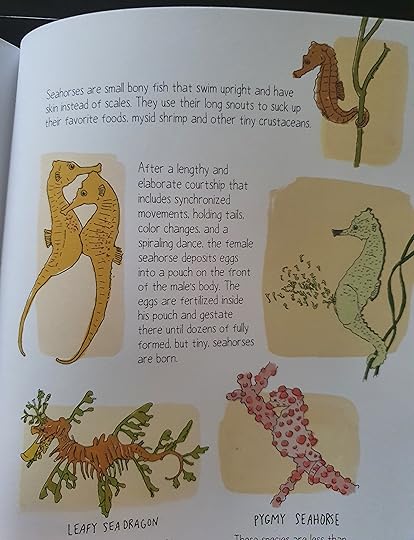
What I am not a huge fan of is the occasional use of cursive text. I mean, most of the time it was fine.
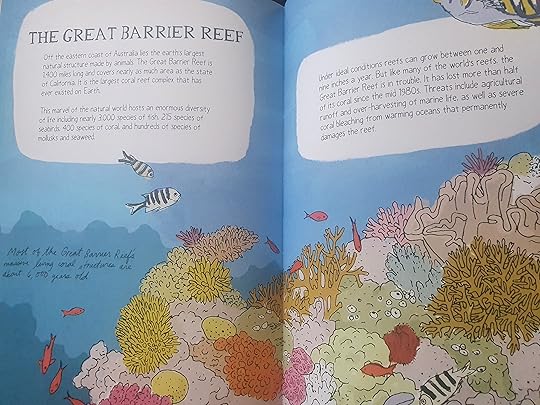

But it can become a problem when either the font size gets smaller or the text contains new vocabulary. I wonder if kids might struggle with this.
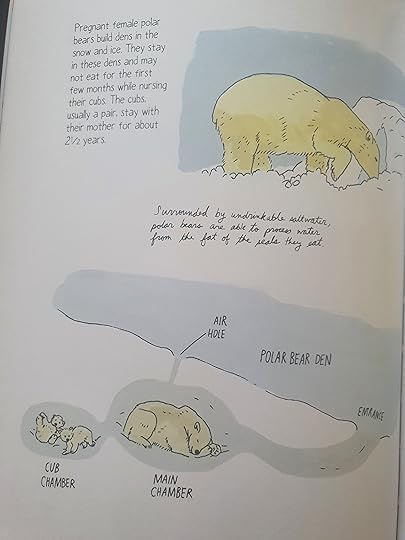

Occasionally I also wished that there were a little more information on a particular subject, while at other times I didn’t feel like reading the names of, for instance, sixty different types of shells. But that’s bound to happen with a book like this, and overall I was happy with the choices made by the author.
Recommended for kids and adults alike.
I will have a look at Rothman’s other books in the ‘Anatomy’ series.
It covers a lot of things, from waves, currents, wind and deep-sea sediments to all sorts of marine life. Sharks, whales, jellyfish, crabs, squid, starfish, sea turtles, seals, penguins. They are all here. And a lot more. It’s a very comprehensive guide to everything related to the ocean. Including fishing practices, studying the ocean as a profession, lighthouses, the effects of climate change etc.
The charming illustrations and some fun facts keep, what is essentially a huge amount of information, lively enough, so that you can read the whole book in only a couple of days without feeling overwhelmed. But it’s probably better suited to be read a little at a time. I will certainly revisit it in the future, going a little more slowly then.
Adults may feel like photos would be nice, instead of only having illustrations. But personally, I didn’t mind. I like the look of this book and some of it was just super cute.
What I am not a huge fan of is the occasional use of cursive text. I mean, most of the time it was fine.
But it can become a problem when either the font size gets smaller or the text contains new vocabulary. I wonder if kids might struggle with this.
Occasionally I also wished that there were a little more information on a particular subject, while at other times I didn’t feel like reading the names of, for instance, sixty different types of shells. But that’s bound to happen with a book like this, and overall I was happy with the choices made by the author.
Recommended for kids and adults alike.
I will have a look at Rothman’s other books in the ‘Anatomy’ series.

December 30, 2019
I loved this book and enjoyed every minute I passed engrossed in its pages. Through the years, I’ve read a whole lot of books about the ocean and this one took me by surprise, quickly taking a place among my favorites. But let me give you a bit of history to put in context how much I liked it:
I was 5 years old and had recently learned to read when my mother took me to a bookstore. She had to attend some event, the nanny hadn’t come, and it was getting late. I got my jacket, jumped in the backseat of the car, and Mom hoped I would be entertained enough among the many books to let her listen to whoever she was going there to see.
Two hours (or perhaps more, I was only five you can’t ask me to be precise) she came to find me sitting in a corner reading a book. It was not a children’s book, it was a book about whales. And the ocean. And currents. And waves. It was a heavy book—I nearly topped backwards getting it off the shelf—and it was full of the most wonderful pictures I’d ever seen.
The words were hard for me, many I didn’t know, but I pushed through and managed to read a few pages. But the event was over and it was time to leave. So then and there, I decided I wasn’t leaving this wonderful book behind. It was coming with me. Mom wasn’t thrilled. The book was expensive, and she couldn’t imagine I would have much use for in it once other more suitable activities would be available. She took the book from me and put it back in the shelf. It didn’t go well. I cried, and begged and held my breath. She simply pulled me up into her arms and started walking towards the exit. But fate has its tricks and a friend of my mom came to say goodbye, noticing my tears she asked why? I explained about the wonderful book and all, and she said (yes, this I remember very well): “I wished my children cried for books instead of throwing tantrums about TV or candy.” That was enough. Mom felt guilty (or so she says). After all, she had dragged her five year old to a bookstore on a Saturday afternoon to an event that was absolutely not child friendly. So I got my book and it has been a long time, a very long time, since a book about the ocean had have such a big impact on me. A long time until I started reading Ocean Anatomy by Julia Rothman.
This book is a joy to read. In fact, just looking at the wonderful and colorful illustrations was enough for me to relived that joy I first felt as a five year old learning about the ocean. Now, bear in mind my love affair with books about the ocean (and the ocean itself) is a long one, one that led me to become an oceanographer and make my living studying the oceans. So, as I said, I’ve read plenty of books on the matter, some for fun, some because I had too, but not many of the I have found as entertaining and beautiful as this one.
Rothman has chosen among the many topics concerning the ocean to offer the reader an interesting selection that includes many facts about the living parts of the ocean—like algae and fish and plankton and seals and whales and birds—as well as some of its non-living but very animated components—like waves and currents and wind and chemical composition and deep-sea sediments—without forgetting to explain how we collect and generate new knowledge about all those many things.
I love that page 119 is dedicated to what I do, but the whole of this book is packed with information, offering something for every taste. Significantly, as the many concepts presented are explained in such a way they’re easy to understand, learning doesn’t feel like a chore but becomes a pleasure. A trait highlighted by the scientifically correct but also exquisite illustrations filling each page and accompanying each topic.
I got to read this book before its publication date thanks to NetGalley, but I liked it so much I already preorder me a hard copy.
I was 5 years old and had recently learned to read when my mother took me to a bookstore. She had to attend some event, the nanny hadn’t come, and it was getting late. I got my jacket, jumped in the backseat of the car, and Mom hoped I would be entertained enough among the many books to let her listen to whoever she was going there to see.
Two hours (or perhaps more, I was only five you can’t ask me to be precise) she came to find me sitting in a corner reading a book. It was not a children’s book, it was a book about whales. And the ocean. And currents. And waves. It was a heavy book—I nearly topped backwards getting it off the shelf—and it was full of the most wonderful pictures I’d ever seen.
The words were hard for me, many I didn’t know, but I pushed through and managed to read a few pages. But the event was over and it was time to leave. So then and there, I decided I wasn’t leaving this wonderful book behind. It was coming with me. Mom wasn’t thrilled. The book was expensive, and she couldn’t imagine I would have much use for in it once other more suitable activities would be available. She took the book from me and put it back in the shelf. It didn’t go well. I cried, and begged and held my breath. She simply pulled me up into her arms and started walking towards the exit. But fate has its tricks and a friend of my mom came to say goodbye, noticing my tears she asked why? I explained about the wonderful book and all, and she said (yes, this I remember very well): “I wished my children cried for books instead of throwing tantrums about TV or candy.” That was enough. Mom felt guilty (or so she says). After all, she had dragged her five year old to a bookstore on a Saturday afternoon to an event that was absolutely not child friendly. So I got my book and it has been a long time, a very long time, since a book about the ocean had have such a big impact on me. A long time until I started reading Ocean Anatomy by Julia Rothman.
This book is a joy to read. In fact, just looking at the wonderful and colorful illustrations was enough for me to relived that joy I first felt as a five year old learning about the ocean. Now, bear in mind my love affair with books about the ocean (and the ocean itself) is a long one, one that led me to become an oceanographer and make my living studying the oceans. So, as I said, I’ve read plenty of books on the matter, some for fun, some because I had too, but not many of the I have found as entertaining and beautiful as this one.
Rothman has chosen among the many topics concerning the ocean to offer the reader an interesting selection that includes many facts about the living parts of the ocean—like algae and fish and plankton and seals and whales and birds—as well as some of its non-living but very animated components—like waves and currents and wind and chemical composition and deep-sea sediments—without forgetting to explain how we collect and generate new knowledge about all those many things.
I love that page 119 is dedicated to what I do, but the whole of this book is packed with information, offering something for every taste. Significantly, as the many concepts presented are explained in such a way they’re easy to understand, learning doesn’t feel like a chore but becomes a pleasure. A trait highlighted by the scientifically correct but also exquisite illustrations filling each page and accompanying each topic.
I got to read this book before its publication date thanks to NetGalley, but I liked it so much I already preorder me a hard copy.

November 24, 2019
I have always been fascinated by the ocean. It has so many bizarre creatures that are perfectly adapted to the part of the ocean they inhabit. Some of them look more like plants or rocks than the animals they are. It's almost as if the deep sea is another planet altogether, or something from a fantasy. The circle of life in the ocean, who preys upon whom, and how they do so, seems otherworldly.
I was drawn to this book by the charming cover art. When I saw the impressive amount of information covered in such an accessible way, I knew I had to read it. It really does feel like it's a book for all ages. I'm an old fogey with a fair amount of knowledge about the ocean, and I learned quite a bit. It's written and illustrated in a way that will be very appealing to children, especially those who are old enough to read and understand the larger vocabulary and more involved scientific concepts. But tiny kids can enjoy it too, looking at the illustrations with a parent nearby to help them learn the names of the creatures.
For a fairly short book, this covers a lot of ground. Not only the plants and animals in the various ocean zones, but also beach life, shore birds, tide pools, weather patterns, ocean floor features, and how human activities like shipping affect the ocean life. I was not previously familiar with Julia Rothman's work, and I fell in love with her simple yet instructive style of illustration. I especially enjoyed the pages showing the many varieties of sea shells. I had never realized there were that many different kinds.
I highly recommend this book for either casual or serious study.
**spoiler alert**
Here are a few tidbits I learned from the book. If you're an info nerd, read on:
The barnacle has the longest penis of any animal relative to its size.
Octopuses in captivity can unscrew lids and open latches.
Polar bears can smell seals hidden under the snow from as far as a mile away.
Cetaceans (whales, dolphins, and porpoises) were four-legged land mammals tens of millions of years ago.
Sharks have a hunting superpower -- a network of electro-receptive pores on their heads that helps them sense the electrical fields of their prey. They can even detect the beating heart of a fish that isn't moving.
Natural pearls are quite rare. Typically only one natural pearl is found per thousand oysters.
The Great Barrier reef has lost more than half of its coral since the mid-1980s, due in part to pollution and warming ocean water.
Genetically a killer whale (orca) is actually a dolphin. Killer whales are the only mammals known to spend their entire lives with their mothers. (Tell that to the lady with her grown son still living in the basement.)
The manatee's closest living relative is the elephant.
Sea otters use kelp blades to anchor their babies while they dive for red urchins.
Sound waves move through water 4 times faster than through air. Sound moves about one mile per second in 70 degree (Fahrenheit) water. That's why some whale species can communicate over thousands of miles.
*Note: If you want to get more of a feel for her art, you can enlarge and look at the covers of her other books here:
https://www.goodreads.com/author/show...
I was drawn to this book by the charming cover art. When I saw the impressive amount of information covered in such an accessible way, I knew I had to read it. It really does feel like it's a book for all ages. I'm an old fogey with a fair amount of knowledge about the ocean, and I learned quite a bit. It's written and illustrated in a way that will be very appealing to children, especially those who are old enough to read and understand the larger vocabulary and more involved scientific concepts. But tiny kids can enjoy it too, looking at the illustrations with a parent nearby to help them learn the names of the creatures.
For a fairly short book, this covers a lot of ground. Not only the plants and animals in the various ocean zones, but also beach life, shore birds, tide pools, weather patterns, ocean floor features, and how human activities like shipping affect the ocean life. I was not previously familiar with Julia Rothman's work, and I fell in love with her simple yet instructive style of illustration. I especially enjoyed the pages showing the many varieties of sea shells. I had never realized there were that many different kinds.
I highly recommend this book for either casual or serious study.
**spoiler alert**
Here are a few tidbits I learned from the book. If you're an info nerd, read on:
The barnacle has the longest penis of any animal relative to its size.
Octopuses in captivity can unscrew lids and open latches.
Polar bears can smell seals hidden under the snow from as far as a mile away.
Cetaceans (whales, dolphins, and porpoises) were four-legged land mammals tens of millions of years ago.
Sharks have a hunting superpower -- a network of electro-receptive pores on their heads that helps them sense the electrical fields of their prey. They can even detect the beating heart of a fish that isn't moving.
Natural pearls are quite rare. Typically only one natural pearl is found per thousand oysters.
The Great Barrier reef has lost more than half of its coral since the mid-1980s, due in part to pollution and warming ocean water.
Genetically a killer whale (orca) is actually a dolphin. Killer whales are the only mammals known to spend their entire lives with their mothers. (Tell that to the lady with her grown son still living in the basement.)
The manatee's closest living relative is the elephant.
Sea otters use kelp blades to anchor their babies while they dive for red urchins.
Sound waves move through water 4 times faster than through air. Sound moves about one mile per second in 70 degree (Fahrenheit) water. That's why some whale species can communicate over thousands of miles.
*Note: If you want to get more of a feel for her art, you can enlarge and look at the covers of her other books here:
https://www.goodreads.com/author/show...

April 29, 2020
Ocean Anatomy is touted as a stunning, all-encompassing nonfiction read tailored specifically towards those of a younger age and it proves to be a comprehensive, accessible and riveting whilst educational. It is thoroughly entertaining and this coupled with the fact that it captures your attention with intriguing facts and figures and more in-depth information make it a must-read for everyone who is interested in our vast oceans. In some ways, I feel that the publishers have very much sold themselves short as this is not only a book for youngsters to thoroughly enjoy but it holds the exact same merits when it comes to adult readers who will appreciate it a lot more than perhaps they expected when reading it alongside a child; I learned a lot and loved every second of it.
It covers pretty much every topic regarding our oceans that you could imagine and is not only wonderfully interesting and breathtaking from the first page but bright, vibrant and visually stimulating too. Because of this, I feel strongly that it is one of the best children nature books I have ever come across and is worth every bit of the modest price tag. This is part of a superb series, and I am now eager to pick up the rest of them. These are books for parents and children to marvel at together and a benchmark for all similar books striving to whet the appetite for reading early on in life and igniting an intense spark of passion for the natural world and our earthly environment in young hearts and minds. A detailed, thrilling and absolutely delightful book. Highly recommended. Many thanks to Storey Publishing for an ARC.
It covers pretty much every topic regarding our oceans that you could imagine and is not only wonderfully interesting and breathtaking from the first page but bright, vibrant and visually stimulating too. Because of this, I feel strongly that it is one of the best children nature books I have ever come across and is worth every bit of the modest price tag. This is part of a superb series, and I am now eager to pick up the rest of them. These are books for parents and children to marvel at together and a benchmark for all similar books striving to whet the appetite for reading early on in life and igniting an intense spark of passion for the natural world and our earthly environment in young hearts and minds. A detailed, thrilling and absolutely delightful book. Highly recommended. Many thanks to Storey Publishing for an ARC.

December 29, 2019
My favourite book of 2019! I even preordered the hardcopy version. Really loved this, the drawings are very fun, cute, colourful and well done. A lot of things around ocean-life are explained in an easy to read manner. It's a great book for adults and older children who are interested in ocean life. This is one I will keep going back to!
Thank you publisher and NetGalley for the ARC.
Thank you publisher and NetGalley for the ARC.
![Profile Image for laurel [the suspected bibliophile].](https://i.gr-assets.com/images/S/compressed.photo.goodreads.com/users/1645808644i/7494844._UX200_CR0,6,200,200_.jpg)
November 12, 2024
A delightfully illustrated and developed broad overview of the ocean and its many, many wonders.
My library has these cataloged in adult nonfiction, but I can easily see these being DEVOURED by middle grade readers (and they have been!). You're not going to be a marine biologist after reading this—and that is NOT the point—but it is going to bring a vast sense of just how expansively vibrant and diverse our little planetary spaceship is. How unique. How weird. How precious. How endangered because of our actions.
Anywho, it's delightful. It's sparked wonder. I must read more.
My library has these cataloged in adult nonfiction, but I can easily see these being DEVOURED by middle grade readers (and they have been!). You're not going to be a marine biologist after reading this—and that is NOT the point—but it is going to bring a vast sense of just how expansively vibrant and diverse our little planetary spaceship is. How unique. How weird. How precious. How endangered because of our actions.
Anywho, it's delightful. It's sparked wonder. I must read more.

November 28, 2019
I received a copy of this book to read in exchange for an honest review via netgalley and the publishers.
This book is a beautifully illustrated book jam packed with information about different sea creatures, fish, rocks, sand, oceans, mammals, sharks, whales, icebergs, pollution etc. Its an amazing source of information for children and adults. I found I learned a lot of pieces of information during my time reading this book.
This book is a beautifully illustrated book jam packed with information about different sea creatures, fish, rocks, sand, oceans, mammals, sharks, whales, icebergs, pollution etc. Its an amazing source of information for children and adults. I found I learned a lot of pieces of information during my time reading this book.

December 5, 2019
I really like all of Rothman's books but I think this may be my new favorite. It is so packed with fantastic illustrations and information about oceans, ocean animals and everything a child (or adult) could want to learn about anything in them. A must-have for homeschoolers, school libraries, or any family who lives near or cares about the ocean (that should be all of us). This would also make a fantastic coffee table book for properties near the ocean. It's so interesting to flip through and the art is phenomenal.
Rothman also goes into explanations about how things like climate change and overfishing affect ocean life, with sections on issues like the floating garbage patches and rising sea levels. This is done in an informative way without weighing down the subject matter.
I will probably be purchasing this one for our homeschool library.
I read a digital ARC of this book for the purpose of review.
Rothman also goes into explanations about how things like climate change and overfishing affect ocean life, with sections on issues like the floating garbage patches and rising sea levels. This is done in an informative way without weighing down the subject matter.
I will probably be purchasing this one for our homeschool library.
I read a digital ARC of this book for the purpose of review.


June 6, 2022
ended up skimming some of it. did not hold my interest as well as Food Anatomy but i think that's just a personal preference. it was still charming with some good fun facts, and i look forward to reading her others!
November 26, 2019
3,5/5. Good documentary for kids about ocean. It cover its subject very well and even if I would have like a couple of pictures instead of just illustrations, this documentary is well done!

April 28, 2020
This was decently interesting - I shared bits with my almost 7 year old as I read and she enjoyed the information and was able to read most of it. My biggest complaint is the fonts chosen - I'm unsure if it was just in the epub form and would be fine in a physical book, but I had a very hard time reading it. I asked her about that font and she said it was pretty, but that she couldn't read it because she isn't great at decoding cursive-like fonts yet. I'd like my child to be able to find information and peruse the book at her leisure, as well as be read to, and that made it difficult. I love the idea of something like this, and I would probably borrow it from the library, but I'm unsure if it's one we would choose to own.

August 4, 2025
I would highly recommend this book to anyone wanting to learn more about the ocean! The content is geared toward scientists and non scientists alike, providing engaging illustrations that make the information presented easy to understand. This book is perfect for kids and adults alike.

March 9, 2026
I absolutely loved this book and its illustrations! Also really liked the inclusion of a recommended reading list at the end. I need to read all of Julia Rothman’s books!

August 26, 2022
A beginners guide to the stuff that makes up most of our terraqueous globe, both the oceans themselves and the critters within. Although this is presumably intended for younger readers, I learned a few things despite being a heavy reader of pop science!

July 15, 2022
Wonderful overview of ocean science with beautiful detailed illustrations.
The reason I demoted to 4 ⭐️ is because some information is missing here and there, could be better organized, and most importantly, there is at least one incorrect fact in the book.
1. In the Whale section, the whales should have been grouped into 2 groups- baleen and toothed. The whales are listed in a random fashion with size and weight, and humpbacks are not in the size and weight section. Also, not listed in size order.
It also would have helped when mentioning the humpback in the later migration section, to add a page number to the previous mentions about humpbacks (anatomy and bubble net feeding).
2. In the section on octopus, squid, cuttlefish and nautilus, the word "cephalopod" is mentioned in the description of nautilus, but cephalopod is not defined nor is it stated in the beginning that the octopuses, squid, cuttlefish are all cephalopods with the nautilus.
Same for other sections- cnidarians should have had page numbers for the other cnidarians in the book, and the echinoderms (sea Cucumbers, sea stars, sea urchins), Pinnipeds for seals, sea lions, walruses. Each section should have been titled with these names and definitions followed by the animals in each group.
3. In the migration section, the locations for humpback Whale migration leaves out much of the areas where they migrate back and forth. It only mentions 2 areas. This is inaccurate, and at the least it should have said "2 of the migration areas of many are______." Meanwhile, the blue lines on the map representing the whales DO show more routes. I was curious about this, so Googled the humpback Whale migration map, and viola!
4. There is a mistake in the migration section. It says that the longest mammal migration in the world is by the humpback whales. This is incorrect, in 2015, and then again confirmed in 2021, the Gray whales traveled further than the humpback whales which travel about 6000 miles. The Gray whales travel 10-12,000 miles every year, and one was recorded traveling over 16,000 miles in 2021. In 2015 one was recorded traveling over 13,000 miles. Humpback whales are actually the 2nd longest mammal migration not the 1st longest. This data was available well before this book was published! Facts like these should be checked for accuracy.
The "Starfish" section left me wondering if the actual correct name is sea star, and if so, shouldn't the section have been called Sea Stars? 🤔
The chill chapter was interesting with lots of new knowledge to me. The sea ice and under the ice sections were great, especially the brinicle- I Googled it and found an excellent video narrated by David Attenborough. I found the comparison of sea lions v. Seals informative and useful. Also didn't say that sea lions are actually called eared seals, while the non eared seals are true seals.
The author failed to mention that there is one species of penguin that doesn't live in the cold- the Galapagos penguin. No mention of Adelie penguins sadly.
No mention of monk seals at all, which are critically endangered. I think they should have been included with a description of their Endangered status (1400 Hawaiian left, 600 Mediterranean left).
I didn't know that there were 5 garbage patches floating in the oceans. I knew about the Great Pacific Garbage Patch. The book should have mentioned the important and promising clean up of the garbage patch and other garbage in global waterways using brilliant machines invented by Boyan Slat, a young Dutch man, who also runs the Ocean Cleanup (Google it for more information) which is making wonderful progress cleaning up the ocean.
I also think a glossary is needed.
I enjoyed reading this, and learned some new things about ocean science.
The reason I demoted to 4 ⭐️ is because some information is missing here and there, could be better organized, and most importantly, there is at least one incorrect fact in the book.
1. In the Whale section, the whales should have been grouped into 2 groups- baleen and toothed. The whales are listed in a random fashion with size and weight, and humpbacks are not in the size and weight section. Also, not listed in size order.
It also would have helped when mentioning the humpback in the later migration section, to add a page number to the previous mentions about humpbacks (anatomy and bubble net feeding).
2. In the section on octopus, squid, cuttlefish and nautilus, the word "cephalopod" is mentioned in the description of nautilus, but cephalopod is not defined nor is it stated in the beginning that the octopuses, squid, cuttlefish are all cephalopods with the nautilus.
Same for other sections- cnidarians should have had page numbers for the other cnidarians in the book, and the echinoderms (sea Cucumbers, sea stars, sea urchins), Pinnipeds for seals, sea lions, walruses. Each section should have been titled with these names and definitions followed by the animals in each group.
3. In the migration section, the locations for humpback Whale migration leaves out much of the areas where they migrate back and forth. It only mentions 2 areas. This is inaccurate, and at the least it should have said "2 of the migration areas of many are______." Meanwhile, the blue lines on the map representing the whales DO show more routes. I was curious about this, so Googled the humpback Whale migration map, and viola!
4. There is a mistake in the migration section. It says that the longest mammal migration in the world is by the humpback whales. This is incorrect, in 2015, and then again confirmed in 2021, the Gray whales traveled further than the humpback whales which travel about 6000 miles. The Gray whales travel 10-12,000 miles every year, and one was recorded traveling over 16,000 miles in 2021. In 2015 one was recorded traveling over 13,000 miles. Humpback whales are actually the 2nd longest mammal migration not the 1st longest. This data was available well before this book was published! Facts like these should be checked for accuracy.
The "Starfish" section left me wondering if the actual correct name is sea star, and if so, shouldn't the section have been called Sea Stars? 🤔
The chill chapter was interesting with lots of new knowledge to me. The sea ice and under the ice sections were great, especially the brinicle- I Googled it and found an excellent video narrated by David Attenborough. I found the comparison of sea lions v. Seals informative and useful. Also didn't say that sea lions are actually called eared seals, while the non eared seals are true seals.
The author failed to mention that there is one species of penguin that doesn't live in the cold- the Galapagos penguin. No mention of Adelie penguins sadly.
No mention of monk seals at all, which are critically endangered. I think they should have been included with a description of their Endangered status (1400 Hawaiian left, 600 Mediterranean left).
I didn't know that there were 5 garbage patches floating in the oceans. I knew about the Great Pacific Garbage Patch. The book should have mentioned the important and promising clean up of the garbage patch and other garbage in global waterways using brilliant machines invented by Boyan Slat, a young Dutch man, who also runs the Ocean Cleanup (Google it for more information) which is making wonderful progress cleaning up the ocean.
I also think a glossary is needed.
I enjoyed reading this, and learned some new things about ocean science.

August 27, 2020
A reference guide to all sorts of things related to the ocean, from various critters that live there, to ocean landforms, to environmental issues.
Julia Rothman's books are the perfect thing for curious readers of all ages. They are a little eclectic in that she gets to choose what to put in and leave out, and covers a broad range of topics. The book is organized into sections of related material. Her illustrations are beautiful to look at and accompanied by bite size informative text. Hand this to fact sponges you know of any age.
Notes on content: No language issues. There's some animal breeding info/reproductive structures in diagrams, but nothing graphic or detailed. No graphic violence depicted in illustrations. Threats to animal safety are mentioned, but only one seal being eaten by a polar bear depicted.
Julia Rothman's books are the perfect thing for curious readers of all ages. They are a little eclectic in that she gets to choose what to put in and leave out, and covers a broad range of topics. The book is organized into sections of related material. Her illustrations are beautiful to look at and accompanied by bite size informative text. Hand this to fact sponges you know of any age.
Notes on content: No language issues. There's some animal breeding info/reproductive structures in diagrams, but nothing graphic or detailed. No graphic violence depicted in illustrations. Threats to animal safety are mentioned, but only one seal being eaten by a polar bear depicted.
May 17, 2026
4.75⭐️
I absolutely loved the illustrations in this book and I think it’s a great introduction to marine biology and ocean sciences.
-.25⭐️ because the classification of orcas could have been better explained and the added cursive writing mixed in the with the type just didn’t aesthetically work for me and may be hard to read for younger readers.
I will be looking into this authors other anatomy books!
I absolutely loved the illustrations in this book and I think it’s a great introduction to marine biology and ocean sciences.
-.25⭐️ because the classification of orcas could have been better explained and the added cursive writing mixed in the with the type just didn’t aesthetically work for me and may be hard to read for younger readers.
I will be looking into this authors other anatomy books!

July 21, 2025
The art is the best part of this book for me. It is written for middle grade, I think, but also for anyone who is interested in the ocean but isn’t looking for in depth -ology information. I found it to be interesting and engaging even as an ology loving adult.
I did find the cursive/handwritten text to be hard to read. There were a few words I didn’t figure out.
I did find the cursive/handwritten text to be hard to read. There were a few words I didn’t figure out.
January 4, 2026
Definitely not just for kids, but for anyone interested in the ocean! It’s really informative, and I loved how obviously hand-drawn the artwork and even some of the words are, it’s so refreshing in this era of AI. I would read this again and again just to appreciate the art and to truly absorb the info.

September 10, 2020
Rothman's "Anatomy" books are always a feast for the eyes, and this is no exception. A really fun dive (pardon the pun), especially for younger readers.

December 11, 2020
Just amazing. My son and I have learnt more from this book about ocean animals than from any other source so far. He even gave a lecture to his teacher and classmates about crabs today. Lol. Love it!

December 3, 2024
Absolutely beautiful illustrations, a really delightful nonfiction if you’ve ever had an interest in marine sciences and you want something light (made for preteens)!
June 19, 2025
O-fish-ally love this book!

March 15, 2026
had so much fun with this! the illustrations are gorgeous. it's super thorough and i learned so much

January 16, 2026
Dünyanın en iyi kitaplarından olabilir. Sadece okyanus hayatı ve canlıları ile ilgilen kişiler için değil, çocuklar hatta bu konuya merak salmayan insanların bile okuyabileceği pamuk şeker gibi bir kitap. Bol görselli ve anlatım biçimi çok sade. Yazı boyutu ve biçimi asla göz yormuyor. İsteyen tek başına bir kaç gün içinde bitirir, isteyen çocuğuna okur, isteyen arkadaşları ile birlikte kültürlenir. Herkese okumasını tavsiye edebileceğim bir kitap.
Tek kelime ile bayıldım.
Tek kelime ile bayıldım.

June 1, 2020
4.5 stars
RTC
RTC

May 8, 2024
What a great book to read for ocean knowledge. I have my degree in marine science and really enjoyed this. The illustrations are so incredible.
Displaying 1 - 30 of 178 reviews