This delightful book describes and interprets a series of forty full-color paintings for each day of Lent. Artists often address subjects that our culture seeks to avoid, and the brilliant and perceptive reflections from nun and art historian Sister Wendy Beckett will help you to read these paintings with a more discerning eye and encounter deeper levels of spiritual meaning than may at first appear.
Sister Wendy Beckett was a South African-born British art expert, Roman Catholic nun, and contemplative hermit who became an unlikely celebrity during the 1990s, presenting a series of acclaimed art history documentaries for the BBC.
Another fine book to use when going through Lent, this book is full of great paintings (mostly Western). Each painting is accompanied by a short commentary; after first four paintings, the rest are arranged into themed weeks, ending with Easter Day.
The paintings vary: from traditional to modern, some clearly religious and some not, some very colorful and some very plain. But all pack inside great moods, and fit well into the collection and the theme of Lent. It is a short book, but very easy to treasure and use, both during Lent and outside it.
I really loved Jane Williams' The Art of Advent, so I was extra disappointed by the vague banality of The Art of Lent. Certain weeks' themes were not particularly Lenten (joy? confidence?) and the reflections were too brief and, like I said, vague and banal. I felt like this was made for someone who is not particularly religious and does not want to do Lent but has to do a devotional--weird and not a realistic situation. The final few days, the Triduum and Easter, were the strongest part of the whole book. Overall, not recommended (but do check out The Art of Advent) though I have liked Sister Wendy's material elsewhere.
An excellent book to add to one's Lenten reading. I really enjoyed Sister Wendy's reflections. Her inclusion of different schools of art, particularly abstract art, was very interesting. Recommended.
I have not had a ton of art exposure so I really enjoyed the visual walk through Lent. Art appreciation is obviously something I need to grow in because I really struggled to follow/see what she said the painting was saying. 😅
I really wanted to like this (or even love it!), and I did add a few book darts here and there. But I didn't agree with her interpretations of many of the paintings and felt some of them were a little forced in relation to the weekly themes. I still love Sister Wendy, though!
I got a head start on Lent this year with the arrival of two beautifully illustrated little books from the creative heart of Sister Wendy Beckett (1930-2018), who, according to the Washington Post, “became a TV star by describing art with a mixture of glee, ecstasy, and wonder.” Now, through this posthumous project, she leads her readers on a journey through Lent. Short devotional passages shed light on the spirituality behind some of the greatest works in history—and some that are quite unknown but well worth knowing.
Although I don’t recall seeing the term in either book, The Art of Lent: A Painting a Day from Ash Wednesday to Easter and The Art of Holy Week and Easter: Meditations on the Passion and Resurrection of Jesus are an invitation into the practice of Visio Divina (sacred seeing), a slow and prayerful pondering of visual images (paintings, photographs, sculpture, etc.), noticing the details that catch our attention and draw us into conversation and communion with God. Under Sister Wendy’s tutelage, each painting becomes a shaft of light, illuminating some spiritual truth suggested by the artist’s work or life.
She begins Ash Wednesday with the reassuring truth from Romans 8—even my need for repentance from continual transgressions can never separate me from the love of Christ. This is a powerful lesson on its own but set against the image of The Great Wave by Katsushika Hokusai, it’s clear that however fragile my righteousness compares with the unpredictable risk of just-plain-living, God will not allow my frail vessel to capsize.
As a Lenten practice, a painting a day from Ash Wednesday to Easter (The Art of Lent) provides a daily pause over spiritual truth and some very surprising works of art. The more intensely focused The Art of Holy Week and Easter picks up at the Triumphal Entry in Part One. Parts Two and Three portray violence and betrayal as Christ is “bruised for our iniquity,” but Part Four illustrates and narrates resurrection reassurance, all through traditional paintings that correlate with the specific event.
I was pleased to note that the story wasn’t cut abruptly with the empty tomb, but continued on to the Ascension, illustrated by the disciples crowding together and craning upwards, a watchfulness fueled by love. Certainly, time spent in meditation over the life and sacrifice of Christ provides a solid emotional link with our Savior and a reminder of our own waiting posture and the work he has left for us to accomplish until he comes.
Really loved this as a way to celebrate Lent. I love the way Wendy Beckett selected the images (many of which aren't religious paintings, but some of them are) and the way she interpreted those / connected them to the themes she was discussing. It was a good balance of initial responses I had to the painting that she framed the same way, and then some where I didn't have that response but then enjoyed seeing the way she interpreted the painting.
Recommend this if you're looking for this kind of book!
This book was not quite what I was hoping for but perhaps for the right cast of mind it would be very enriching.
Sister Wendy writes simply for a few paragraphs about a subject and a painting (ancient or modern, biblical or other). The book is themed by weeks: Silence, Contemplation, Peace, Joy, Confidence and Love. Her style is subtle and bears rereading a few times. The weakness of this book for me is that for a spiritual book it stays 'earthbound', it is largely a mulling over of human experience - with the the divine only implicit.
I think the picture serves her message rather than starts it, which is probably sound, but contrary to how most people might want to read a book like this (look a painting, reflect on it oneself and then read another's comments).
There's a wide selection of artwork here that makes for a nice Lenten time of slowing down and practicing silence. However, the writings with each picture don't have a whole lot of depth, aren't especially religious, and feel repetitive after a while. This would be a nice extra during Lent, but isn't a great book for your main Lenten devotional.
The book didn’t engage with me like I hoped it would. Many of the reflections on the paintings were superficial and not very deep. I did include some of my favorite images below.
🎨 The Harvest is the End of the World and the Reapers are Angels 🎨 Rainbow Landscape 🎨 Children on the Seashore 🎨 Chasing the Butterfly 🎨 Crucifixion by Craigie Aitchison
This was a different way for me to engage with lent. Several of the paintings chosen really ministered to me. I actually ordered a framed print of one. I didn’t realize the actual book was so small in size...it made it harder to look at the paintings. Overall, I enjoyed it.
A tiny square book where each day of the Lenten season provides a spread that is part artwork of the masters and part contemplative reflection on said art in conjunction with the weekly themes of the liturgical calendar. It is a deceptively simple tool that uses mediums many may not be accustomed to or exposed to often as a means of directing our worship in this season.
I got rather ahead of the plan to read this one page and painting at a time (even though that’s what you’re supposed to do) because I cannot get enough of the way that Sister Wendy describes art. It’s never simply a formal analysis; rather, she captures the heart and soul of each image through a gloriously descriptive vocabulary that never ceases to amaze me. Since I read this as an e-book, I read the description first, and then I turned the page and saw the work of art. I never know how she saw what she did in these paintings, but the humanity and the spiritual depths that she brings forth is honestly breathtaking and amazing to read. This will likely be a yearly read for me, and I look forward, as always, to reading more Sister Wendy, soon. 5/5 stars.
I was introduced to Sister Wendy Beckett by way of teaching an art appreciation lecture course. While doing research in order to help formulate my class syllabus I came across her book “The Story of Painting,” and then her BBC video series by the same name. As a painter myself, I found her overview of themes and analysis to be helpful in describing the themes to my own students. I ended up using her book “The Story of Painting”, as the supplemental textbook for the class and modeled my syllabus on the structure she laid out; starting with the Lascaux cave paintings and then moving through the history of (mainly) Western art. Because I was so impressed by her simple and highly educated style — which helped people to locate their focus on the images themselves and then extrapolate their meaning from what IS there — I became open to the other books she had written.
As lent was approaching, I was incredibly excited to have found a Lenten devotional book written by Sister Wendy and quickly snatched it up through Nav’s press.
The devotional “The Art of Lent” takes the reader from Ash Wednesday, through the five weeks of Lent, Holy Week, and ends with the Resurrection. The contents are divided into weekly thematic sections that frame the paintings and devotional readings starting with: silence, contemplation, peace, joy, confidence, and love. The book provides a daily devotional for everyday of the week except Sunday, and consists of one painting and Sister Wendy’s short reflection. The reflections are just that however, they are not meant to be— from what I can tell— formal analysis, or critical interpretations. Nor are they heady theological reflections full of biblical references and footnotes.
At first, I was somewhat disappointed by this, but as lent progressed I decided to shift my perspective and use the devotional in conjunction with “The Book of Common Prayer.” For me this was the key, I could now appreciate it as a supplemental to a meatier Lenten prayer devotion. As an artist and educator, I found the devotionals to be short and fun. It was just what I needed. Thus I found that many times her short devotions, along with the paintings helped me to gain a profound truth. In particular the section on peace was very much impactful to me. She reflects on how to find peace when we don’t get exactly what we wanted, hoped, or prayed for. She talks about having our desires re-aligned by Christ and quips, “Our spirit is too great for small and specific happinesses: our potential is infinite.” From this I realized that I too was often tempted to pray for specific outcomes to situations and put my hopes in God on whether or not He granted those. This reframing of letting Christ realign our desires with his and in letting go of specific outcomes, all while choosing peace, allowed to be more thankful for the many gifts that were coming to me daily in my walk, but had gone largely unnoticed because I was too focused on not getting this very specific thing I was praying about.
I’d certainly recommend this book, because I think Sister Wendy Beckett was a incredible gift to the world. It has an extra level of prescience in light of her recent passing. She had such a sweet, unassuming way about her that makes even seemingly inaccessible artworks accessible and mineable. She was a humble teacher and a unique person who found her love and calling as an art historian in a non-traditional way and I think can guide people into a love for God and the arts.
I wish I’d kept a journal as I read The Art of Lent! I enjoy thinking about how art speaks to us on a spiritual level. I’m not a Christian, but some things are universal.
I left author Sylvain Reynard a comment on one of his blog posts about the book:
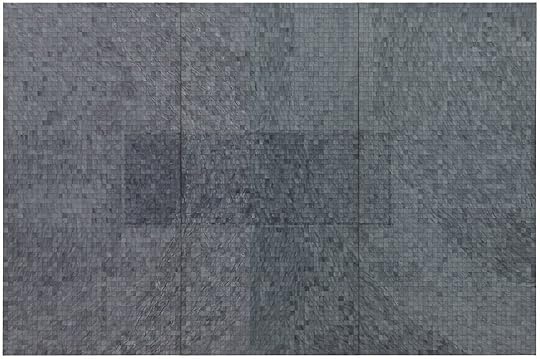
Rebecca Salter’s painting, “J1 1994” (and Yuko Shiraishi’s “Three Greys”), speaks to me in unexpected ways. I love everything Sister Wendy says about the painting, about how Salter “seems to have painted silence itself.” I can hear and feel the silence when I look at the painting; it transports me through time, back to the 90s, before I had internet, when I’d turn on the TV late at night and see and hear static noise. I had so much hope then. I knew I wasn’t supposed to be awake, but it was nice to be alone in my quiet bedroom—the static noise a comforting soundtrack to my thoughts and plans.
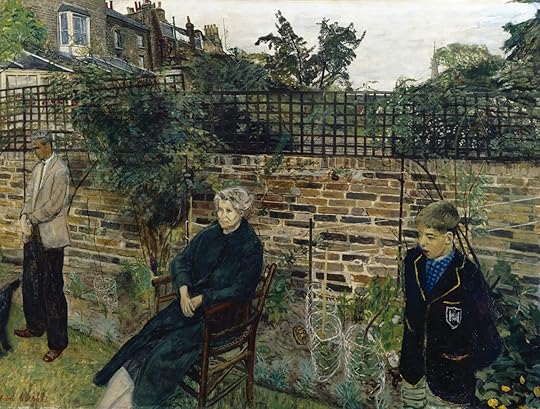
I love what Sister Wendy says about “The Silence” by Carel Weight: “To isolate oneself is not to be at peace.” As an adult, I’m alone with my thoughts a little too much, as I fear we all are. The world is more connected than ever, yet we’re all so disconnected. I’d love to be the woman in Hammershoi’s “Interior”: seated alone, in a room, before several open doors and a brightly-lit window. She has options; I feel she isn’t alone too much.
*
I’m thinking about reading Sister Wendy’s The Art of Christmas this December. I have Jane Williams’s book, but I have a feeling I’ll miss Sister Wendy’s commentary. (Of course, I could always read both!)
I was so excited about this book, but sadly, it was an utter disappointment. First, it is WAY too small to be an art book, only measuring about 5x5, and most of the paintings don't take up the entire page due to their size, so the details of most of them are lost. Secondly, some of Sister Wendy's commentary is just down right strange and most of it has nothing to do with Lent. Thirdly, many of the painting selections are bizarre. I was anticipating Christian, religious art that spanned the ages. Many of the paintings are portraits and abstracts, and she even includes mythical gods and goddesses. I don't mind the art of pagans, except when I'm expecting paintings that are in keeping with the title of the book about Lent. I did like the way that the book was formatted by weeks and the page layout was nice visually. I wanted to give it 2 stars, but she did include some wonderful artwork, so I bumped it up to 3. Overall, I would not recommend it.
Call me a philistine, but I have a hard time believing that anyone can have a deep and genuine feeling for the Old Masters, and at the same time set a C20th painting of three plain grey stripes alongside them, as equally worthwhile and interesting. But I'll say this for Sister Wendy: she's never going to convince me that such simple abstracts are great art but she makes a good case that they can be used as a basis for religious meditation - even if one suspects that almost any object in the world, a spoon, certainly a flower, would do just as well.
The other problem with this book is it could have done with being twice the size: at 6" by 5", it reproduces the paintings on a vanishingly small scale, and the small, faint print too is a little difficult for me - at least, with bleary eyes, first thing in the morning!
I so enjoyed Sister Wendy's The Story of Painting many years ago. And I do enjoy reflecting on art as a means to connect with God. As a collection of suggested art for reflection, this was a great resource.
However, the art reproduction in this little book is rather dark and muted. I ended up looking the pieces up on the internet instead of spending much time with the images in the book. Though online images are not perfect, they definitely are more engaging than the book's versions.
Sister Wendy's comments were also hit and miss for me. Some felt profound and insightful. Some were not as helpful.
All in all, working through the book was a worthwhile Lenten practice that I will likely revisit another year. Just wish I could do that with the book alone rather than having to consult my computer.
I really wanted to love this book, but it ended up falling flat for me (so much so that I went ahead and read the Holy Week section in one sitting just to declare it done). The book itself is tiny, making the paintings cramped and harder to see. Some painting selections were amazing and beautifully fit the short meditation that Beckett penned to go with them... others were utterly uninspiring. Overall, the book felt like it was trying too hard. The idea is lovely. The execution just didn't quite work for me.
It's a small enough book, though, that I think I can find a spot for it on my Christmas-Lent-Easter bookshelf and I may try pulling it out again in a couple years to see if my mind has changed.
I’ve always thought of “art books” as merely or mostly “coffee table books.” But in this little volume, I have been enriched - with the author’s helpful observations and reflections - pondering truths about ourselves or the divine. It’s been a beautiful way to slow down, and end my day appreciating the works of Monet, Michelangelo, Vermeer, Renoir, Hokusai, Rembrandt and many more, contemplating themes of silence, peace, joy, confidence, and love. Another reviewer of this book used the term “visio divina” a way to encounter the divine through images. Only a few of the images were explicitly religious, but all led to contemplation, a meditation on eternal truths.
The art presented is, of course, exquisite, which is why I gave 3 stars. However, Sister Wendy’s reflections for most of the days were not really a devotional at all, let alone a Lenten devotional. They may be considered good commentary on the art itself, but didn’t really deepen my understanding of God or His work through Jesus’s life, death, and resurrection. I had really looked forward to going through this book during Lent; I had hoped it would be a better experience.
Not sure what I expected but it didn’t move me as I had hoped. Really enjoyed all the paintings but felt the narrative was frequently a stretch. Another thing that was disappointing was the print. I had the paperback, don’t remember there being a hard cover for this edition, but the print was way too small and very difficult to read. It was also too faint. Bold black and larger would have been helpful.
Sister Wendy Beckett chose a painting for each day of Lent and Easter. Her choices spanned the centuries and schools of art, and included works that did not necessarily depict religious subjects. Her inspiring interpretation of each piece of artwork deepened my understanding and enhanced my Lenten journey. I highly recommend this wonderful book.
I was rather disappointed in this. The art weighed too heavily towards modern art, though not exclusively. It was very small, maybe 6"x6" for a book intended to be meditations in art. The theology of the author was profoundly discordant with my own, so the devotions were not very insightful. Definitely not what I hoped.
I'm reviewing this book, even though I have not finished reading every page/devotional yet. A small book, about 5" x 5", with a painting and a short devotional for each day, this is a book you can easily leave out in the living room.
I plan to have this little book out for Lent each year now.
These were beautiful and short, which was great for a busy season. I loved her insights and how she dovetailed the themes/weeks ago well together. I think the first and last week were the strongest, but Contemplation and Silence were also great. I'll use this again and recommend it.