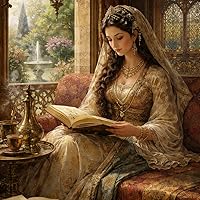
The Story of Medieval England: From King Arthur to the Tudor Conquest tells the remarkable story of a tumultuous thousand-year period. Dominated by war, conquest, and the struggle to balance the stability brought by royal power with the rights of the governed, it was a period that put into place the foundation of much of the world we know today.
Taught by Professor Jennifer Paxton, an honored scholar and award-winning teacher at Georgetown University and The Catholic University of America, The Story of Medieval England's 36 lectures feature a level of detail and attention to key figures that set this course apart from those with a more narrow focus.
Dr. Jennifer Paxton is Professorial Lecturer in History at Georgetown University, where she has taught for more than a decade, and Visiting Assistant Professor of History at The Catholic University of America. The holder of a doctorate in history from Harvard University, where she has also taught and earned a Certificate of Distinction, Professor Paxton is both a widely published award-winning writer and a highly regarded scholar, earning both a Mellon Fellowship in the Humanities and a Frank Knox Memorial Traveling Fellowship. She lectures regularly on medieval history at the Foreign Service Institute in Arlington, Virginia, and has also been invited to speak on British history at the Smithsonian Institution and the Shakespeare Theatre in Washington, DC. Professor Paxton’s research focuses on England from the reign of King Alfred to the late 12th century, particularly the intersection between the authority of church and state and the representation of the past in historical texts, especially those produced by religious communities. She is currently completing a book, Chronicle and Community in Twelfth Century England, that will be published by Oxford University Press. It examines how monastic historians shaped their narratives to project present polemical concerns onto the past.
Jennifer is the daughter of well-known folk singer Tom Paxton.
This lecture series covers England during the Middle Ages which encompasses the period after the Romans abandoned Britannia through 1485, the year of the Tudor conquest. The lectures move along in sequential order except for every 4th or 5th lecture, which is dedicated to some aspect of Medieval life in general. With the large scope of this course (It covers 1000 years of English history in 36 lectures), I thought the instructor did a good job of summarizing the major events and painting a vivid picture of this era. There are lots of dates and names to remember, which can get overwhelming at times, but if you are looking for an intro to Medieval England, I would recommend this course as a good place to start.
This 36 lecture history of England from the Roman times up to the Battle of Bosworth Field, where the Yorkist King, Richard III is killed and the Tudor Dynasty begins under Henry VII is an excellent way to understand an overview of early English history through the Middle Ages. The professor, Jennifer Paxton is an engaging lecturer, she speaks in a clear manner and is to the point. She knows her history well, is clearly passionate about her subject, and knows how to tell a good story. With English history as her canvass, she paints a stimulating portrait of a country on the verge of political greatness. I would rate her as amongst the best of the professors in the Great Courses classes, alongside Robert Bucholz and Elizabeth Vandiver as one of the very best.
The course starts out with The Roman conquest of Britain. This is the time period of English history I was the least familiar with. We learn about who King Arthur is and what the latest scholarship says about him. Then its onto the Anglo-Saxon period and the rise of the political kingdoms within Britain. This the period of Viking invasions and the famous resistance led by King Alfred.
In 1066, the Norman invasion comes and the listener can expect a lot of political information as we get a litany of kings seeking to expand their power and ward off the grasping efforts of the nobility. Paxton pauses the political parade from time to time to give us insight into the cultural aspects of English history, with lectures on such topics as Courtly Love, The Flowering of Chivalry, and the Black Death. The final lecture examines the state of England in 1485 as the Tudors come to power.
I really enjoyed listening to these lectures, and although I knew a good deal about this topic already, Paxton enriched my understanding and told a very interesting history. I would highly recommend this series of lectures!
I absolutely loved this series of lectures by Jennifer Paxton. Her enthusiasm and delivery made every single episode (lecture) riveting and exciting for me. I'm such a nerd for medieval history. I felt like Dr. Paxton was speaking right to me through the speakers in my car as I listened here and there over the past five months. She discussed everything-kings and their queens, politics, the economics of the time. Fantastic, fantastic, fantastic.
I finished the last lecture and then immediately bought another of hers to listen to.
Audiobook Notes: This is not a novel with a narrative. This is a very well-done audio recording of Dr. Jennifer Paxton speaking in 30-minute lectures about various topics in medieval English history. She delivers the lectures clearly and concisely, and it is impossible not to get swept up in the times with her obvious love for this history. I wholeheartedly recommend this listen for people who love British history and/or all things medieval. So, so good!
Title: The Story of Medieval England: From King Arthur to the Tudor Conquest Narrator: Jennifer Paxton Length: 19 hours, 7 minutes Publisher: The Great Courses
Have been watching this since January and really didn't finish the last of the six discs. Lecturer did an excellent job; her voice was easy to listen to and the programs were well organized. This was just a long time period to cover so not a lot of depth to any time period.
My chief interest was the Celtic/Saxon centuries up until the Norman conquest and I listened to a couple of lectures twice, trying to get the Saxon history into my head. That was the time period I was most interested in & also that I knew the least about.
This is 4th or 5th Teaching Company series I've watched; all have been good.
A good, concise overview of English history in the medieval era. It’s difficult not to get lost in the names and family trees in the various succession conflicts over the throne, but Professor Paxton doesn’t get bogged down in these. A good starter course on the subject.
Good overview of the ages after the fall of the Roman empire until the 16th century. For the sake of approx. 18h of lectures, speed is of the essence and details are few. The listener familiar with the early history of England won't pick up anything insightful.
Paxton is an engaging lecturer skilled at conveying plenty of information and her passion for her subject at the same time. Interesting despite the fact that I was familiar with pretty much all of this. She does seem strangely allergic to the notion that any medieval English monarch could conceivably have been anything other than straight... but then she was also convinced that ascribing Richard III any physical deformities must have been vicious slander.
Medieval England survey...context Date:August 3, 2016 " Audio download. Overall, this series of lectures is very good (4.5 is a good number). Professor Paxton is well organized and clear-speaking, but more importantly, is entertaining in a way that first teaches you something about the early history of England, and keeps your interest. Dr Paxton's presentation style is informal...I like that...more like a conversation rather than a recitation (she may be reading from a script, but I couldn't tell...it's obvious that she knows the material). The guidebook (some 200 pages), including the timeline, is a useful tool and should not be ignored (but is it asking too much for a map or two?). Too often, we tend to depend on the lecturer too much, expecting them to do all the work...we need to be a bit more proactive and actually use the reference material, rather than complain about what is or is not being presented to us. For those considering buying/listening to this set (no long-winded book report here), please consider the lectures as part of an overall study of medieval (western) Europe, meant to complement lectures by Daileader, Harl, Armstrong and Ruiz. Each lecture set is not a complete history...detailed, but not too detailed...just a series of survey courses to help the student (mostly us senior citizen-types) understand that part of the world's history. Good news is that these lectures are often on sale, and, with the proper coupon, can be had for about $0.72/ lecture. I recommend Paxton's lectures to the casual scholar whose interests are widely varied, and seeks a good companion on the treadmill. "
This lecture series was quite intriguing; it didn't have quite the same level of excitement as the series on the French Revolution and Napoleon, but was enjoyable and helpful none-the-less. This series covered a huge stretch of time and paused in several important eras and on several important people to give a deeper sense as to what was happening and why, Paxton also stops at several points to look into what the life of every day English people looked like at different periods.
Contrasting with the series on the French that I recently listened to, the English are for less volatile, pretty much all through their history and, while that makes the French history more exciting, it also makes it much more troubling.
Looking at both of these histories; however, gave me a much greater appreciation for the relative stability that our government was able to establish, I have no doubt, largely by looking back on the blunders of these two great, European nations.
A couple of things I found particularly fascinating about this lecture series: I had no idea how muddled up English heritage was; just a big mix of Germanics, Vikings, and French. And on that note, probably the most interesting thing to me, about the whole period here, was when the Normans conquered England. What happened wasn't a Frenchification of England and a growing of the French empire, but the conquerors became subsumed by the land and the people that they conquered and England was the greater for it.
I enjoyed this lecture series and am looking forward to more of the Great Courses.
Very enjoyable listen. Prof. Paxton is a great lecturer with a nice flow and style.
I am surprised she did not update the information on Richard 3's exhumation and the proof that he did indeed have scoliosis, or curved spine. This new information was available before th is series went to print, as it were. https://en.m.wikipedia.org/wiki/Exhum...
I love these courses! This is a brilliant look at English History, totally captivating and worth every effort. The lecturer is not only knowledgeable but thoroughly clear and interesting.
This is a long but generally fascinating series of lectures which covers a period in English history of more than a thousand years. Given the length of time, some of the detail is skipped over pretty quickly but what shines through in every lecture is the professor's love for her subject.
I don't know how you summarize all of the events of medieval England into just one course but Paxton did an incredible job of it. It was absolutely fascinating.
The Story of Medieval England: From King Arthur to the Tudor Conquest by Jennifer Paxton brings Medieval English history to life. It contains 36 lectures covering the following topics:
LECTURE 1 From Britannia to Britain LECTURE 2 Roman Britain and the Origins of King Arthur LECTURE 3 The Early Anglo-Saxon Kingdoms LECTURE 4 The Conversion of the Anglo-Saxons LECTURE 5 Work and Faith in Anglo-Saxon England LECTURE 6 The Viking Invasions LECTURE 7 Alfred the Great LECTURE 8 The Government of Anglo-Saxon England LECTURE 9 The Golden Age of the Anglo-Saxons LECTURE 10 The Second Viking Conquest LECTURE 11 The Norman Conquest LECTURE 12 The Reign of William the Conqueror LECTURE 13 Conflict and Assimilation LECTURE 14 Henry I—The Lion of Justice LECTURE 15 The Anarchy of Stephen’s Reign LECTURE 16 Henry II—Law and Order LECTURE 17 Henry II—The Expansion of Empire LECTURE 18 Courtly Love LECTURE 19 Richard the Lionheart and the Third Crusade LECTURE 20 King John and the Magna Carta LECTURE 21 Daily Life in the 13th Century LECTURE 22 The Disastrous Reign of Henry III LECTURE 23 The Conquests of Edward I LECTURE 24 Edward II—Defeat and Deposition LECTURE 25 Edward III and the Hundred Years’ War LECTURE 26 The Flowering of Chivalry LECTURE 27 The Black Death LECTURE 28 The Peasants’ Revolt of 1381 LECTURE 29 Chaucer and the Rise of English LECTURE 30 The Deposition of Richard II LECTURE 31 Daily Life in the 15th Century LECTURE 32 Henry V and the Victory at Agincourt LECTURE 33 Henry VI—Defeat and Division LECTURE 34 The Wars of the Roses LECTURE 35 Richard III—Betrayal and Defeat LECTURE 36 England in 1485
If you love history, want tertiary level lectures that are well presented then I would 100% would recommend!
In the Middle Ages to be a successful king you had to: a) look the part, so tall, reasonably comely, and at least a wee bit charismatic b) win at everything: battles and land and the good will of the barons, people, clergy; like manly sports and do at least OK at them. etc. c) produce an heir e.g. Lesser but desirable: Marry someone all your subjects like; even better marry someone you like; having a relatively functional family group helps--sons who won't compete to the death or a queen who doesn't like you and plots for your downfall. To exercise with caution: going against the barons, over-taxing (get your $ from winning battles), or doing anything that gets your hands dirty like killing too many close relatives or, say, gardening. Too much of one makes your subjects uneasy, too much of the other is just plain unkingly.
I love Jennifer Paxton -- she is clear, concise, and humorous in just the right places. While I know she simplifies many things, she does not do this in a way that is condescending. The implication is that if something she talks about interests you, you will dig deeper on your own. I don't know how she does this, but all those Henrys, Edwards, and Richards are, for the moment, quite straight in my head. She ends with the succession of Henry VIII as the beginning of the 'modern' period, e.g. The Renaissance. *****
1,000 Years of Conflict over the Rule of England - It's Messy But Engrossing After getting through this series of engaging letters by Jennifer Paxton, you'll see why Game of Thrones is actually just British Medieval History with dragons and white walkers and some magic thrown in. The endless scheming, betrayals, warring dynasties, battles, sacking of towns, besieging of castles, rape and pillage, and general mayhem come straight from the pages of English history. No need for fictional treatment or embellishment - it's bloody and dramatic and shocking throughout. In fact, it's hard to believe that anything good came out of it, but it did produce the Magna Carta and Parliamentary System, both to keep power-mad tyrants in check. And seeing just how much the Normans dominated the early centuries under the Plantagenets is eye-opening, as French was the language of royalty and nobility. So much conflict between England and France, and conquests and exiles and escapes and returns and double-crosses and imprisonments and beheadings, it really puts Game of Thrones to shame. Really fascinating stuff, and puts our modern world in perspective - thinks were pretty brutal back then among warring dynasties, and commoners always lost out.
This introductory history of England from roughly 500 A.D. to the ascension of the Tudors in the mid 15th century worked for me, until it didn't, sometime after the section on the Norman conquest in 1066. The lecture series was steaming right along, doing the best that could be expected considering so large a topic was being condensed into such itty bitty bite-sized pieces until the author suddenly decided to leave off discussing the social, religious, economic, artistic, and military aspects of the subject matter and instead beat me about the head and neck with endless narrative and exposition concerning the dynastic struggles that form merely a part of one area of interest in one category of historical inquiry on the subject. Don't get me wrong, the dynastic politics were well done, but I was hoping for something with a little more depth and breadth in a lecture series purporting to give a general picture of England. If you're looking for something on the subject that utilizes all the tools and perspectives which the most Auguste intellectual pursuit that is History can offer in medieval studies; I suggest you consider other offerings.
This is an excellent overview of the history of England from the days of the Romans to the triumph of Henry Tudor. I have read a lot of these histories and am always pleased when a new one teaches me something. While it mostly tracks political history, it also deals with social, cultural, and literary developments. The problem with a brief survey like this is that you don’t get a lot of depth. For example, Paxton embraces the traditional Shakespearian narrative of evil King Richard murdering the princes in the tower, and while she mentions that not everyone agrees with this interpretation, she doesn’t go into any of the reasons that support the counter narrative that Henry Tudor was their killer. But to her credit, she does then point out that Henry killed all of the other possible claimants to the English throne—apparently without recognizing that this strengthens the case against him and weakens her.
But little annoyances like this aside, this is a really good overview that everyone interested in English history should enjoy.
A very nice coverage of how England got to be a representative democracy and developed the rule of law. The key in this is the invention of the parliament and it's progressive gain in power over the thousand years covered in these lectures. The professor attributes this gain in power to the need of the kings to go to parliament to raise taxes. The puzzling thing is this didn't happen anywhere else in the world. Elsewhere in the world rulers taxed their lands and people directly and did not allow anything like parliaments to arise. Therefore representative democracies and the rule of law did not arise anywhere but England until very recently, with the one exception of the United States where King George thought he could rule without parliament. So I continue to wonder how this strange idea of democracy and the rule of law came about and I will continue to seek the answer.
I'm not sure you could do much better with a concise history of such a long time period. This course starts with the birth of England and continues through the end of the War of the Roses. I really appreciated how Paxton included several lectures about popular literature at the time as well as what life was like for the English people, rather than only talking about the kings. Her narration is also excellent as well. The only section that I partially zoned out on was the War of the Roses because there are just so many people involved that it was hard to keep up and so I should probably re-listen to that section, but otherwise I followed all of the kings very easily.
This isn’t a book, it’s a lecture series. A damn good lecture series! Paxton is incredibly knowledgeable and packs this series to the goddamn brim with facts. It’s focus is so wide that in a way it’s kinda tough to really remember a lot of the finer details she gives you. But I didn’t listen to this to have a perfect understanding of medieval England, I don’t think any one book could give you that. What it is great at is being a fantastic guideline that will help me contextualize all future readings on this brilliant era!