When an explosion occurs in front of Dr. Chester Limhuatco’s condominium, events unfold leading to his discovery of Emily, the “white lady” he has been having visions of. To discover her identity, he enlists the help of former classmate Jefferson Po, a government agent Emily works closely with. Together, Chester and Jefferson pursue the mystery surrounding Emily and her involvement with Tata Peping, a modern day “Itim na Nazareno” or Black Christ.
Set in the midst of Quiapo, the heart of the frenzied devotion and veneration of the statue of the Black Nazarene, White Lady, Black Christ is a high-stakes pursuit of the truth behind a strange brotherhood and the rituals surrounding blind devotion and the search for salvation as told by a masterful storyteller.
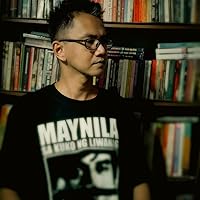
Charlson L. Ong , resident fellow of the Institute of Creative Writing and fictionist/scriptwriter/singer extraordinaire, was born on July 6, 1960. He obtained an A.B. in Psychology from the University of the Philippines in 1977, and currently teaches literature and creative writing under UP's Department of English and Comparative Literature. He has joined several writers' workshops here and abroad, and has acquired numerous grants and awards for his fiction, including the Palanca, Free Press, Graphic, Asiaweek, National Book Award, and the Dr. Jose P. Rizal Award for Excellence. His novel, Embarrassment of Riches published by UP Press in 2002, won the Centennial Literary Prize. In addition to this, Ong has served as co-editor of the Likhaan Book of Poetry and Fiction His short stories range from parodies of well-loved Filipino texts to insightful treatments of Chinese-Filipino culture. These have been collected into Men of the East and Other Stories (1990 and 1999), Woman of Am-Kaw and Other Stories (1993) and Conversion and Other Fictions (1996). His second novel is due for publication this year.
not to get into identity politics, but i’ve been reading so many books by writers from marginalized communities that i kind of forgot what it was like to read a book written primarily from the perspective of a cis het man, and this book reminded me very strongly of what that’s like
it’s a perfectly fine suspenseful crime novel, i just think that it did not deliver on its premise of cultural exploration. the characters are kind of flat and one-dimensional, and mostly serve to forward the plot as opposed to being compelling people themselves. the first portion of the book also kind of left a bad taste in my mouth since it’s essentially a 50 year old man (heart surgeon, no less) abducting an unconscious woman off the streets
i also think its rather tragic that the women are relegated to their usual patriarchal roles of “born sexy yesterday”, “mother who will do anything for her child”, “independent daughter who turns into nothing but a love interest at the end”, and “i’m queer so i’ll be dead five pages after i’m introduced”, so just know that my criticism against this book’s patriarchal perspective is not based entirely on the identity of its narrator and primary characters
With all the things I did last October, I finally finished "White Lady, Black Christ" by Charlson Ong today. The language used in the novel was quite simple; I just got busy, which is why it took me a month to finish it.
Quiapo, the Black Nazarene, a self-proclaimed Black Christ who established a cult that operates as a vigilante—these are what you can expect while reading this novel.
In his book "White Lady, Black Christ," Charlson Ong recounted different stories and tragedies from our country's past. I appreciated how he introduced his characters and their backgrounds one by one, which was important due to the numerous characters in the book. At times, the story moved too quickly and I struggled to keep up. However, in the last few chapters, the action suddenly disappeared, and the pace slowed down, which was disappointing. There might have been more to the story because many questions remained unanswered. The ending felt abrupt. I also couldn't vividly imagine Quiapo, even though it was the book's setting. There were also some scenes that were problematic for me. For instance, why did you rescue a woman from a stampede just because you saw her through your vision and take her to your condo when there was a rescue team available? But in general, it was a good story when it comes to the plot, but it was missing something. I will still wait for the sequel of this novel, if there's any.
Good work, overall. Though I find how Quiapo Church was used as a setting, it focuses more on the nature of cults and the fanaticism that energizes it. There are some scenes and narrative movement which seem to be too fast and sudden, but overall one gets an impression of how these vents have affected the lives of many in the story.
I bought this years ago during a Komiket, I was hooked by the concept of a thriller with religious themes set in the Philippines. I admired the setting being Quiapo and how the book did touch on how indigenous culture and christian culture have intermingled in history to become what is our modern fiestas and parades. I think that if someone picked up this book who wasn't familiar with our practices, they would be enthralled by the concept of a culture that is able to have such opposing ideas of spirituality hold hands in the contemporary world.
However, my main gripe with this book is its large cast and absurd logistics that seem reminiscent of classic Filipino evening teleseryes. It seemed like every character was treated solely as a tool for the plot instead of being given their respective character arcs that would have been just as, if not more, effective. In fact, I found myself pulling out my pen and paper just to map out how each person was connected to help me remember which person had which convoluted backstory and how any of them were in the same room at once. At some point, I realized that the story barely even had a main character; it barely touched on anyone's internal motives for more than one chapter to serve their purpose. Then, when a character had done their deed, they would continue to linger on in the room instead of exiting. It created such a muddied image of the events that I would forget to visualize certain characters until they were named in the next paragraph.
[SPOILERS]
Jefferson randomly proclaims love for Emily despite no other allusion to their relationship besides them knowing each other. The title is White Lady, Black Christ yet besides the introduction of Chester's white lady sightings, there is no other explanation or further speculation of why Chester had been seeing Emily. It is likely that we are supposed to connect the supernaturality of it to everything else that has happened throughout the book, but there are no strings tying white lady sightings to the religious fanaticism and supposed divine miracles of Peping.
Carmen is introduced solely to keep Chester a part of the story, which perfectly illustrates how flat the characters all are. There is no development for Chester, he is just an uptight old man going through an existential crisis whose recurring concern is his adult daughter running around with suspicious men. We never got any meaningful scenes between the father and daughter, beyond corny Star Wars references, that would compel me to believe they weren't estranged for a good number of years. Carmen is also just a blank cardboard cut-out, propped up next to an unmarried man just for the sake of giving her something to do. Besides her tendency to rationalize every single event to her father, she isn't given any other show of credibility to her interest in anthropology. We literally get nothing else from her except her juxtaposition to the men in the story.
In fact, the women in the story truly do not get much sway in the story; they are all just whisked away by the plot and the men in the story. They have no agency whatsoever.
One other issue I had with the story is that though most of the story is about the cult of Peping, we don't get much of a deep dive into the depth of the cult. We are told that they have ties in the police and higher spaces, but it never truly felt that way. They were eerie and threatening, but the fear of everything amounting to nothing because of their underground power never truly felt real.
The writing itself was dialogue-heavy, making it a quick read. However, the lack of much internal monologuing or atmospheric descriptors took away so much of the story's ambience and depth. It felt half-baked at certain points because it was like the characters were simply brought into one big room to talk about the events instead of having them go through the events.
The book also had the tendency to dress up its info-dumping as backstories. I appreciated the heavy backstory given to every character caught in the web of events, but I would have much more appreciated it if these backstories were told alongside the main chronology of events instead of flashbacks to explain where certain characters were picked up from. The way each character had their separate chapter to explain how they got tangled up in the mess is exactly why it feels like nobody in the group ever really had meaningful ties to each other. It made the stakes so much lower than they should've felt for a thriller.
In some way, the story was constructed in a way that felt like walking into a middle-class Filipino home with the maximalist tendency to hoard random knick-knacks with seemingly low value and no organization, except that those homes actually felt lived-in while this story felt mostly like a storage room.
From a quiet, philosophical beginning, this book develops into a riveting tale of mystery and suspense. Along the way, we encounter a multitude of characters representing Filipinos from all walks of life and a wide variety o0f Filipino quirks and cultural aspects are examined. The focus, as the title suggests is mysticism. As with most of Charlson's fiction, Chinese-Filipino culture is featured but this time does not dominate. Rather, folk Catholicism and tribal animism are highlighted as an intricate conspiracy is slowly revealed. While some things remain mysterious, the ending is satisfying. We may be left with a few questions, but they may yet be answered in a sequel.
I really like the whole package of this book from book cover to the last page. I enjoyed it so much especially the religious aspect that happened in my favorite church in old Manila.
I quite enjoyed the backstories and how fleshed out most of the characters were. Unfortunately, I got a bit lost in the plot, especially towards the ending. Really good crime-thriller though!
2nd review: Idk if I can't read fiction, but only few fiction books really immerses me. Those with distinct character voices, that even if I haven't picked up the book for weeks, I'd seamlessly enter its world again by recognizing immediately each character. Recently, I'm like that with Dostoevsky, or Ricky Lee. Unfortunately not with this book. Idk if I'm excited to read more Charles Ong after this as, nearing the end, when more than 3 characters are exchanging dialogues, I just can't distinguish who's who. It ruins my focus even on how the plot progress. Sure, it's easy to read. I drift along the pages so smoothly, but also the plot, the story, the point slides smoothly over my head. I'm glad I got my copy preloved, at more than 80% off. Because, sorry, I wouldn't pay more than a hundred pesos for this.
1st review: Filipino writers in english have this distinct filipino-ness on their syntax... not the writer of this book. This is my first Charles Ong. His writing has this international (read: western) taste in it which might catch a wider net of readers. I don't mind it but with the way he describes scenarios, and parodies news or new urban legends, it manages to be entertaining but it doesn't give me fresh imaginings of its chosen setting: good old Quiapo. Using a real life setting, I expected it to give a new perspective of Quiapo, just like how Tony Perez rebuilds the image of Cubao with horror happenings, with how the book dives into cult culture, it personally fails to excite me as it is more of an archive of new folktales and urban legends than a creation of new one. Seen in this light, I might enjoy it as a sort of review of past and recent happenings but I really hope to get something new once I finish the book.
A culturally enriching yet imperfect read, this novel takes you on a journey to untangle the mysteries surrounding the “White Lady” — a Belgian-Filipina with amnesia named Emily — and the “Black Christ” — an African-American-Filipino cop-turned-cult leader called “Tata Peping.” I found most of the cultural and historical trivia interesting. However, a major flaw of the novel is the excessive number of subplots, which made the overall plot messy and absurd. The Pope was even randomly inserted at one point. I was weirded out by two indecisive and macho old men (one of them with a duck gait) lusting after a younger woman. To be honest, the cast of characters seemed too old for such an adventure-packed narrative. Where did they get all that energy and naivety? If the author had written the middle-aged characters as teenagers or young adults, and the senior-aged ones as middle-aged instead, the narrative might have made more sense to me.
3.5 ⭐️ "I think nurture plays a big, if not a bigger, role than nature. Faith is culture, mostly."
White Lady, Black Christ is a high-stakes pursuit of the truth behind a strange brotherhood and the rituals surrounding blind devotion and the search for salvation. Set in the middle of Quiapo where devotees pray to the Black Nazarene, a group of people who got their lives tangled to each other discover the real mystery behind Tata Peping, a modern day "Itim na Nazareno" who leads a cult.
I was honestly very hooked to this book. I love the plot and the unique idea behind the story. However, I also had a difficult time following the sequence of events and who exactly was saying their thoughts in certain chapters. I feel like it would've been an easier read if some parts were more comprehensive. Overall, it was a good book that made me nervous by the page. And the twists kept making my jaw drop as I progressed through it.