

What do you think?

Ex Libris
Ex Libris revolves around a character trapped in a room with nothing but a futon and a bookcase full of comics. As they peruse covers, read stories and fragments of stories, they begin to suspect that the comics contain hidden messages and… a threat. Fiction and reality blur; sanity and madness become increasingly intertwined as the reader becomes convinced the key to their predicament is to be found between the panels of the strange books. With a dizzying array of inventive visual and narrative styles, Ex Libris continues the line of exploration and play that Madden initiated with 99 Ways to Tell a Story: Exercises in Style. Ex Libris is a tribute to the meta-fictional tradition of writers like Jorge Luis Borges, Julio Cortázar, Vladimir Nabokov, and Italo Calvino (whose novel, If on a Winter's Night a Traveler, was the inspiration).
105 pages, Hardcover
First published January 1, 2022
About the author
Matt Madden
42 books26 followersMatt Madden is an American cartoonist as well as comics teacher, editor and translator. He is best known for the book 99 Ways to Tell a Story: Exercises in Style (2005), an experimental comic based on the idea of Raymond Queneau's Exercises in Style.
Madden was born in New York City in 1968 and has lived in Michigan, Texas, Pennsylvania, and abroad in Mexico and France. From 2012 to 2016 he had an extended residency at La Maison des Auteurs in Angoulême, France. He has also received the title of knight in the Order of Arts and Letters of the French Republic. Since 2016 Madden lives in Philadelphia with his wife, fellow cartoonist Jessica Abel, and children.
As a translator, Madden has translated graphic novels from Spanish and French for American publishers First Second and New York Comics Review. He also teaches comics at the School of Visual Arts in NYC and at Yale University.
Madden was born in New York City in 1968 and has lived in Michigan, Texas, Pennsylvania, and abroad in Mexico and France. From 2012 to 2016 he had an extended residency at La Maison des Auteurs in Angoulême, France. He has also received the title of knight in the Order of Arts and Letters of the French Republic. Since 2016 Madden lives in Philadelphia with his wife, fellow cartoonist Jessica Abel, and children.
As a translator, Madden has translated graphic novels from Spanish and French for American publishers First Second and New York Comics Review. He also teaches comics at the School of Visual Arts in NYC and at Yale University.
Ratings & Reviews
Friends & Following
Create a free account to discover what your friends think of this book!
Community Reviews
Displaying 1 - 30 of 80 reviews

June 26, 2022
I first read Matt Madden’s 99 Ways to Tell a Story: Exercises in Style, adapting Raymond Queneau’s Exercises in Style. I used that book in teaching a comics class a few years ago. Madden, a comics artist and teacher, got a residence at La Maison des Auteurs in France, where he completed this short book, which I read in one sitting. Madden here makes his contribution to both meta-fiction and comics history, and I bet will already have been reviewed with relish by the philosopher and comics teacher Scott McCloud (Understanding Comics).
Madden’s Ex Libris features a book as main character, locked in a room with a book shelf full of only comics pamphlets and books. When he opens these comics he illustrates styles from a range of maybe seventy years of comics. And the metafictional work of Italo Calvino (If On a Winter’s Night a Traveler) and philosophers of language are also peppered throughout. It’s mainly an episode of Kafka, where a kind of story runs through it is recounted in various ways, the story of a broken relationship told in different styles. So it’s yet another version of 99 Ways. A playful moment of surrealism with a touch of Harold and the Purple Crayon.
Madden’s Ex Libris features a book as main character, locked in a room with a book shelf full of only comics pamphlets and books. When he opens these comics he illustrates styles from a range of maybe seventy years of comics. And the metafictional work of Italo Calvino (If On a Winter’s Night a Traveler) and philosophers of language are also peppered throughout. It’s mainly an episode of Kafka, where a kind of story runs through it is recounted in various ways, the story of a broken relationship told in different styles. So it’s yet another version of 99 Ways. A playful moment of surrealism with a touch of Harold and the Purple Crayon.

February 16, 2022
A metafiction tribute, homage, and satire of comic books and graphic novels finds the narrator stuck in a room filled with them. Things get surreal as the books, illustrated in a variety of genres and forms -- alternative comix, graphic literature, manga, superhero and crime and horror comics -- start to reflect the narrator's own confusion at the situation and the heartbreak from a recent relationship.
Interesting exercise, but it drags after a while and doesn't really go anywhere.
Interesting exercise, but it drags after a while and doesn't really go anywhere.

September 14, 2023
This graphic novel tried very hard and very nearly succeeded.

December 1, 2021
2.5 stars
Ambitious, yet sort of aimless overview of various comics styles of the last 100 years.
While I admire Madden’s ability to mimic all these different types of graphic storytelling, the thread tying them all together seemed arbitrary, and I couldn’t help but feel like Grant Morrison did this all a lot better decades ago in a few issues of Animal Man…
Ambitious, yet sort of aimless overview of various comics styles of the last 100 years.
While I admire Madden’s ability to mimic all these different types of graphic storytelling, the thread tying them all together seemed arbitrary, and I couldn’t help but feel like Grant Morrison did this all a lot better decades ago in a few issues of Animal Man…

September 16, 2023
Am I reading this book or am I in it? Is the character in the book just reading it, or living it, or actually writing it? Questions like these are the point of this metafictional graphic novel, which strikes a resonant chord of quizzical interest in me going way back to Tristram Shandy and my long-ago interest in Julio Cortazar. It is also what kept me interested and curious and reading this book.
The author/artist uses many different artistic styles to provide a sort of historical overview of graphic storytelling which is why I’ll rate this book a 3+ because it is impressive. But the resolution of the book’s plot line is so-so for me and inclines me toward a 2. (Although I must admit that I find almost all endings to these kind of brain-teaser, what-is-real-and-what-is-not stories disappointing.)
The author/artist uses many different artistic styles to provide a sort of historical overview of graphic storytelling which is why I’ll rate this book a 3+ because it is impressive. But the resolution of the book’s plot line is so-so for me and inclines me toward a 2. (Although I must admit that I find almost all endings to these kind of brain-teaser, what-is-real-and-what-is-not stories disappointing.)

February 20, 2022
The back cover describes this as a “tribute to the metafictional tradition of writers like Jorge Luis Borges, Julio Cortazar, Vladimir Nabokov, and Italo Calvino…” To that end, the varying styles Madden uses to catalogue the unnamed protagonist’s exploration of a bookshelf of comics in a barren room seems to succeed. An impressive array of drawing styles and lettering fills the book. As a tribute to those styles of storytelling, it makes the point.
But it lacks in its own storytelling. It seems to be a vehicle for style, but with that, one is left with a superficial visual without anything more to grasp on to. Maybe that was the point. Maybe it is meant to just be a survey of style. I may be in the wrong for looking for more, but I was admittedly disappointed.
But it lacks in its own storytelling. It seems to be a vehicle for style, but with that, one is left with a superficial visual without anything more to grasp on to. Maybe that was the point. Maybe it is meant to just be a survey of style. I may be in the wrong for looking for more, but I was admittedly disappointed.

July 19, 2022
I thought this an okay graphic novel. It was a bit confusing about what is going on. I know that the main character was going through something difficult and thought all they need is this room. When they found the bookshelf and the comics began reading them and trying to find their life within these comics. I just found this book to be a boring and dragged out.

October 17, 2022
In this meta graphic novel about graphic novels, the reader is put in the POV of a person who is trapped in a room filled with graphic novels of every type. As they navigate a variety of story genres and styles, they attempt to escape the room. This was a fun exploration, although felt a little bit aimed at non-graphic novel readers. I enjoyed the variety of artistic styles used.

September 1, 2023
I’m a sucker for comics about comics.
January 18, 2024
3.5/5.0
November 27, 2025
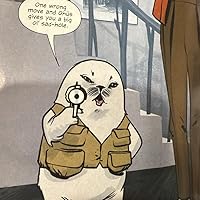
Really neat concept that never really lands unfortunately

January 8, 2026
A very cool work of meta fiction as well a mini lesson about comics.

February 5, 2022
Note to readers: This review contains major spoilers.
This is from my feview of Ex Libris on my substack, The Great God Pan Is Dead. https://thegreatgodpanisdead.substack...
Madden got involved with OuLiPo, the French literary movement that sought to provoke creativity by putting arbitrary constraints on writers. This movement was founded by Raymond Queneau and included such notable members as Georges Perec and Italo Calvino. Perhaps the most famous Oulipo book is Perec’s A Void, a novel written without the letter “e” (which is the most common letter in French and English). Madden was quite impressed by Queneau’s Exercises in Style, in which Queneau recounted the same banal episode in 99 different styles. This influenced Madden’s next book, 99 Ways to Tell a Story: Exercises in Style, where he wrote a banal episode, starring himself and Abel, and drew 99 versions of it. In a way, it was an educational book—each of the different versions taught the reader a little about the mechanics of comics.
His new book, Ex Libris, takes off from 99 Ways to Tell a Story but instead of telling the same story over and over again, the protagonist is inexplicably trapped in a room with a bookshelf full of comics—some in the pamphlet form that was the one of the most common ways for comics to exist in the USA from the late 30s until about 2010. The rest of the shelf is full of squarebound comics.
The unnamed protagonist can’t seem to leave the room, which might remind one of The Exterminating Angel by Luis Buñuel, in which the well-bred attendees of a dunner party find that for a surreal reason that they can’t leave the room they are in. Our protagonist has it worse, they are alone. All they can do is read some of the comics. They know nothing about comics and have no interest in them.
The first books she looks at features protagonists who can’t escape the situation they are in. Not the books they want to read.
In these two examples, we can see Madden taking on different creative personas and drawing styles. The protagonist subsequently finds a group of books that have post-it notes in them that seem to be leading the them toward something—perhaps a way out.
But instead it leads the protagonist to a horror comic based around getting trapped in a room—done in the style of class EC Comics horror. Here is an example of Madden drawing a pastiche of a type of comic what is beyond his talents as a draughtsman.
That is part of what’s tricky about this book (as well as his previous one, 99 Ways to Tell A Story: Exercises in Style). Because he’s trying to evoke other comics, he has to adjust his drawing style to match. But the problem is that although Madden is perfectly competent to draw like Madden, he is not competent to draw like, say, “ghastly” Graham Ingels or Naoki Urasawa. This is what’s tricky about doing parodies and pastiches in comics—to do it well requires almost superhuman drawing ability. Think of Wally Wood’s brilliant parodies of comic strips for MAD Magazine.
Eventually the protagonist discovers a sketchbook. A previous occupant had started it as a way of drawing his way out of the room. The protagonist is not an artist, but after reading so many comics decides to draw one for themselves, with them as the protagonist of this comic within a comic. This is where we finally learn that the protagonist is female.
She draws herself finding comics on the bookshelf that guide her out. She draws a door and walks through it. The comic she is drawing becomes the comic we are reading. This infection of the real world with the comics world recalls the Borges story “Tlön, Uqbar, Orbis Tertius”, in which Borges discovers that the reality of the world has been replaced by the world Tlön, which turns out to have been a prank of sorts perpetrated by various bibliophiles and book collectors in Argentina and Brazil.
Then in the epilogue, another person has been deposited in the room, and he (or she) finds the comics—including the one you are currently reading.
Ex Libris is clever and amusing, but it doesn’t go very deep. We learn that the protagonist is leaving a relationship gone bad, but really there is little humanity here to grab onto. The whole thing feels a little mind-gamey, which I’d say is a fault common in postmodern art (whether literature or film or any other narrative form). But not all postmodernists lack connection with their characters. I mentioned Georges Perec earlier—his most important book, Life: A Users Manual, is another Oulipo experiment, but readers are deeply invested in the character of Bartlebooth. I wish Madden cared as much about the protagonist as Perec cared about Bartlebooth. Ex Libris feels too much like a bloodless experiment.
Nonetheless, I enjoyed it. It is fun to see Madden assay all the disparate comics styles—indeed that becomes the greatest pleasure the book has to offer. I say this even though Madden seems only partly able to succeed. But the attempt is what is pleasing, knowing that each page may bring you a totally different comic reading experience.
This is from my feview of Ex Libris on my substack, The Great God Pan Is Dead. https://thegreatgodpanisdead.substack...
Madden got involved with OuLiPo, the French literary movement that sought to provoke creativity by putting arbitrary constraints on writers. This movement was founded by Raymond Queneau and included such notable members as Georges Perec and Italo Calvino. Perhaps the most famous Oulipo book is Perec’s A Void, a novel written without the letter “e” (which is the most common letter in French and English). Madden was quite impressed by Queneau’s Exercises in Style, in which Queneau recounted the same banal episode in 99 different styles. This influenced Madden’s next book, 99 Ways to Tell a Story: Exercises in Style, where he wrote a banal episode, starring himself and Abel, and drew 99 versions of it. In a way, it was an educational book—each of the different versions taught the reader a little about the mechanics of comics.
His new book, Ex Libris, takes off from 99 Ways to Tell a Story but instead of telling the same story over and over again, the protagonist is inexplicably trapped in a room with a bookshelf full of comics—some in the pamphlet form that was the one of the most common ways for comics to exist in the USA from the late 30s until about 2010. The rest of the shelf is full of squarebound comics.
The unnamed protagonist can’t seem to leave the room, which might remind one of The Exterminating Angel by Luis Buñuel, in which the well-bred attendees of a dunner party find that for a surreal reason that they can’t leave the room they are in. Our protagonist has it worse, they are alone. All they can do is read some of the comics. They know nothing about comics and have no interest in them.
The first books she looks at features protagonists who can’t escape the situation they are in. Not the books they want to read.
In these two examples, we can see Madden taking on different creative personas and drawing styles. The protagonist subsequently finds a group of books that have post-it notes in them that seem to be leading the them toward something—perhaps a way out.
But instead it leads the protagonist to a horror comic based around getting trapped in a room—done in the style of class EC Comics horror. Here is an example of Madden drawing a pastiche of a type of comic what is beyond his talents as a draughtsman.
That is part of what’s tricky about this book (as well as his previous one, 99 Ways to Tell A Story: Exercises in Style). Because he’s trying to evoke other comics, he has to adjust his drawing style to match. But the problem is that although Madden is perfectly competent to draw like Madden, he is not competent to draw like, say, “ghastly” Graham Ingels or Naoki Urasawa. This is what’s tricky about doing parodies and pastiches in comics—to do it well requires almost superhuman drawing ability. Think of Wally Wood’s brilliant parodies of comic strips for MAD Magazine.
Eventually the protagonist discovers a sketchbook. A previous occupant had started it as a way of drawing his way out of the room. The protagonist is not an artist, but after reading so many comics decides to draw one for themselves, with them as the protagonist of this comic within a comic. This is where we finally learn that the protagonist is female.
She draws herself finding comics on the bookshelf that guide her out. She draws a door and walks through it. The comic she is drawing becomes the comic we are reading. This infection of the real world with the comics world recalls the Borges story “Tlön, Uqbar, Orbis Tertius”, in which Borges discovers that the reality of the world has been replaced by the world Tlön, which turns out to have been a prank of sorts perpetrated by various bibliophiles and book collectors in Argentina and Brazil.
Then in the epilogue, another person has been deposited in the room, and he (or she) finds the comics—including the one you are currently reading.
Ex Libris is clever and amusing, but it doesn’t go very deep. We learn that the protagonist is leaving a relationship gone bad, but really there is little humanity here to grab onto. The whole thing feels a little mind-gamey, which I’d say is a fault common in postmodern art (whether literature or film or any other narrative form). But not all postmodernists lack connection with their characters. I mentioned Georges Perec earlier—his most important book, Life: A Users Manual, is another Oulipo experiment, but readers are deeply invested in the character of Bartlebooth. I wish Madden cared as much about the protagonist as Perec cared about Bartlebooth. Ex Libris feels too much like a bloodless experiment.
Nonetheless, I enjoyed it. It is fun to see Madden assay all the disparate comics styles—indeed that becomes the greatest pleasure the book has to offer. I say this even though Madden seems only partly able to succeed. But the attempt is what is pleasing, knowing that each page may bring you a totally different comic reading experience.

April 1, 2022
Fun mind-twisting comics and comix and graphic meta-storytelling, that is actually about something… an impressive achievement.

Read
May 8, 2022(A version of this review appeared, in German, in the Swiss comics journal STRAPAZIN.)
I don’t know where it was —probably at the Small Press Expo in Bethesda, Maryland in the mid-1990’s, at the height of the explosion of the “mini-comics movement” in the United States—but I vividly recall my first meeting with Matt Madden. He was a quiet but intellectually intense young man, sitting at a table selling copies of his mini-comics. What struck me most was his unwavering confidence in comics: after just moments of speaking with him it became powerfully clear that this was a guy who truly BELIEVED in the art of comics. We talked about his latest project (eventually published as BLACK CANDY in 1998), and between some pages he showed me and his pitch, I couldn’t recall ever being so excited to read a book before it had even been finished.
In the almost three decades since, Madden has written himself into the history of comics with that same quiet intensity. He has published graphic novels; served as a comics editor, translator, and critic; taught at the School of Visual Arts; become the US Correspondent of OuBaPo (thanks in part to his comics adaptation of Raymond Queneau); created (with his wife, the cartoonist Jessica Abel) two textbooks on how to make comics.; and done an extended residency at La Maison des auteurs in Angoulême, during which time he was granted a knighthood in the French Ordre des Arts et des Lettres (!).
That’s a heck of a resume, and Madden’s newest book, EX LIBRIS, is to some extent the culmination of all he has done and been. Imagine a locked-room mystery created in comics form by Italo Calvino or Jorge Luis Borges; a story that demonstrates a deep love of the history of comics in the vein of Dylan’s Horrocks’ Hicksville and Marc-Antoine Mathieu’s fascination with the visual language of comics. (Madden slyly credits each author along the way). EX LIBRIS is a celebration of what comics can do that no other medium can, while also telling a poignant story about self-discovery and psychic healing. (Too often conceptual literature or art can come across as hermetic, nourishing the brain and not the spirit; Madden doesn’t fall into that trap.)
If you’re a comics fan you’ll delight in the way Madden channels so many cartoonists who came before him: it’s great fun trying to puzzle out which artists or books he’s referencing as he takes his protagonist through a veritable history of the medium. I counted nods to Dan Clowes, Julie Doucet, George Herriman, Jacques de Loustal, David Mazzuchelli, Frank Miller, Art Spiegelman, Osamu Tezuka, Lynd Ward, and the masters of EC Comics, among others (including, perhaps, Madden’s own earlier work!). On my first reading, I was worried that Madden wouldn’t be able to pull his trick off (in fact, early on his narrator is a bit too heavy-handed—explaining just a bit too much—presumably for the sake of readers not familiar with comics), but by the second half of the book I was in a breathless rush to finish it (the ending is exceedingly clever) and I turned it right over and started again from the beginning.
With EX LIBRIS Matt Madden has added his own classic to the bookshelf of great graphic novels. And if you read this book you may find yourself believing in comics even more truly and deeply.
I don’t know where it was —probably at the Small Press Expo in Bethesda, Maryland in the mid-1990’s, at the height of the explosion of the “mini-comics movement” in the United States—but I vividly recall my first meeting with Matt Madden. He was a quiet but intellectually intense young man, sitting at a table selling copies of his mini-comics. What struck me most was his unwavering confidence in comics: after just moments of speaking with him it became powerfully clear that this was a guy who truly BELIEVED in the art of comics. We talked about his latest project (eventually published as BLACK CANDY in 1998), and between some pages he showed me and his pitch, I couldn’t recall ever being so excited to read a book before it had even been finished.
In the almost three decades since, Madden has written himself into the history of comics with that same quiet intensity. He has published graphic novels; served as a comics editor, translator, and critic; taught at the School of Visual Arts; become the US Correspondent of OuBaPo (thanks in part to his comics adaptation of Raymond Queneau); created (with his wife, the cartoonist Jessica Abel) two textbooks on how to make comics.; and done an extended residency at La Maison des auteurs in Angoulême, during which time he was granted a knighthood in the French Ordre des Arts et des Lettres (!).
That’s a heck of a resume, and Madden’s newest book, EX LIBRIS, is to some extent the culmination of all he has done and been. Imagine a locked-room mystery created in comics form by Italo Calvino or Jorge Luis Borges; a story that demonstrates a deep love of the history of comics in the vein of Dylan’s Horrocks’ Hicksville and Marc-Antoine Mathieu’s fascination with the visual language of comics. (Madden slyly credits each author along the way). EX LIBRIS is a celebration of what comics can do that no other medium can, while also telling a poignant story about self-discovery and psychic healing. (Too often conceptual literature or art can come across as hermetic, nourishing the brain and not the spirit; Madden doesn’t fall into that trap.)
If you’re a comics fan you’ll delight in the way Madden channels so many cartoonists who came before him: it’s great fun trying to puzzle out which artists or books he’s referencing as he takes his protagonist through a veritable history of the medium. I counted nods to Dan Clowes, Julie Doucet, George Herriman, Jacques de Loustal, David Mazzuchelli, Frank Miller, Art Spiegelman, Osamu Tezuka, Lynd Ward, and the masters of EC Comics, among others (including, perhaps, Madden’s own earlier work!). On my first reading, I was worried that Madden wouldn’t be able to pull his trick off (in fact, early on his narrator is a bit too heavy-handed—explaining just a bit too much—presumably for the sake of readers not familiar with comics), but by the second half of the book I was in a breathless rush to finish it (the ending is exceedingly clever) and I turned it right over and started again from the beginning.
With EX LIBRIS Matt Madden has added his own classic to the bookshelf of great graphic novels. And if you read this book you may find yourself believing in comics even more truly and deeply.

November 5, 2023
An interesting and surreal comic - I enjoyed the different art styles, but the story drags on a bit.
April 17, 2023
Exercice de style qui reprend le concept de Si par une nuit d'hiver un voyageur d'Italo Calvino. C'est une gimmick mais Madden réussit a la dépasser tout en faisant un hommage à la bande dessinée sous toutes ses formes, ou presque.

Read
March 24, 2024How? Randomly saw on the shelf while at the library.
What? An unnamed character is undergoing a crisis, comes to a weird room or apartment, decides to read the books on the shelves, but they're all comic books. Slowly we learn the narrator is an ex grad student or academic whose lover is a much more successful academic, and all the books they pick up are talking directly to her in a way about the impossibility of escape until she decides to pick up a pencil and draw her own way out.
Yeah, so? The story here is skeletal, and uninteresting -- until one moment. The real point of the book seems to be in the many ways you can represent a certain feeling of being trapped, and sections of the book are given over to drawing whatever the narrator is reading in a variety of styles. So a large part of this book is asking questions like "what would it be like if Frank Miller's superheroes were undergoing an existential crisis? OK, now do a manga style. OK, now do, etc., etc." It's one of those thrilling exercises in skill and attention that also really fails to connect or build up a lot of steam.
Until one moment where the author is reading a book about someone approaching a door and it's their own door and there's a genuine moment of terror that doesn't really require much in the way of backstory. That one moment got me. (I read a review of this book recently that pointed out how the writing in the words had all these infelicities and maybe another reason this moment got me is the narrator is writing the words in the balloons of an already-drawn comic, and so of course the infelicities are part of her trying to figure out how to write a comic book.)
What? An unnamed character is undergoing a crisis, comes to a weird room or apartment, decides to read the books on the shelves, but they're all comic books. Slowly we learn the narrator is an ex grad student or academic whose lover is a much more successful academic, and all the books they pick up are talking directly to her in a way about the impossibility of escape until she decides to pick up a pencil and draw her own way out.
Yeah, so? The story here is skeletal, and uninteresting -- until one moment. The real point of the book seems to be in the many ways you can represent a certain feeling of being trapped, and sections of the book are given over to drawing whatever the narrator is reading in a variety of styles. So a large part of this book is asking questions like "what would it be like if Frank Miller's superheroes were undergoing an existential crisis? OK, now do a manga style. OK, now do, etc., etc." It's one of those thrilling exercises in skill and attention that also really fails to connect or build up a lot of steam.
Until one moment where the author is reading a book about someone approaching a door and it's their own door and there's a genuine moment of terror that doesn't really require much in the way of backstory. That one moment got me. (I read a review of this book recently that pointed out how the writing in the words had all these infelicities and maybe another reason this moment got me is the narrator is writing the words in the balloons of an already-drawn comic, and so of course the infelicities are part of her trying to figure out how to write a comic book.)

October 20, 2022
Intriguing graphic novel. A narrator who has fallen on hard times, experiencing poor mental health, rents a flophouse room to hopefully regroup. The narrator feels disoriented and trapped. The speaker finds a well-stocked shelf of graphic novels in the room. Oddly, every one of them seems to reflect elements and events from the narrator’s own life and current situation. Is the narrator sane or insane? Is there a way out of all the chaos in their mind? The basic conceit feels a little stilted, but that’s often the way with metafiction ruminations, so I let that go. What is amazing about this book is that it’s a tour de force of GN styles: each story the narrator picks up cascades and morphs into another, the genres and drawing styles constantly changing. It’s no surprise that the author/illustrator, Matt Madden, credits Calvino’s If On A Winter’s Night… (fantastic book!) as the inspiration for this graphic novel. Side note: I love a book where the title has some extra resonance, and Ex Libris is an old Latin book plate phrase meaning “out of/from the library of” so is fitting with the personalized GN library on the bookshelf and the themes of trying to escape from that library/room and from the story of one’s own life and choices…plus @ExLibrisMrHunt is my Teacher-Librarian Twitter and Instagram handle, so there’s that!

December 1, 2021
Matt Madden is at top form in Ex Libris, a comic quite magical in style and substance.
The story reveals a character wondering if they are literally lost. We've seen this device before, even in beginning readers. Mo Willems' Elephant and Piggie ask themselves similar questions. Ex Libris transcends the trope and draws out a story with every imaginable comic book device. One page is pure elegance, the next is screwball, somehow it is all quilted together with fantastic verve.
At the halfway mark, I thought I should shut this book and save some for tomorrow, but I got caught in the momentum and finished it one sitting. I can read it again tomorrow. I am sure I missed something.
Ex Libris will appeal most to folks who know comics. Some of the jokes can seem like inside baseball. In the first full-color panel there is a reference to Dr. Martin. I took this as a reference to Dr. Martin's dyes, once a staple at every cartoonist's drawing board.
It is worth noting this book is exquisitely designed. The spot varnish on the cover is the first sign of its high production value. But you need to open up Ex Libris and test yourself. See if you can put the book down without finishing it. I couldn't.
The story reveals a character wondering if they are literally lost. We've seen this device before, even in beginning readers. Mo Willems' Elephant and Piggie ask themselves similar questions. Ex Libris transcends the trope and draws out a story with every imaginable comic book device. One page is pure elegance, the next is screwball, somehow it is all quilted together with fantastic verve.
At the halfway mark, I thought I should shut this book and save some for tomorrow, but I got caught in the momentum and finished it one sitting. I can read it again tomorrow. I am sure I missed something.
Ex Libris will appeal most to folks who know comics. Some of the jokes can seem like inside baseball. In the first full-color panel there is a reference to Dr. Martin. I took this as a reference to Dr. Martin's dyes, once a staple at every cartoonist's drawing board.
It is worth noting this book is exquisitely designed. The spot varnish on the cover is the first sign of its high production value. But you need to open up Ex Libris and test yourself. See if you can put the book down without finishing it. I couldn't.

March 1, 2022
A gorgeous production and meditation on the purpose, execution, style, and metaphysics of the comic form. This four-part oversized graphic novel is a gorgeous love letter to the art form and transcendental relationship we have with the medium and the art. It tells the story of an unnamed narrator as they fall into a variety of comic texts to explore precisely how to engage with the text, and in doing so, the artist finds themself illustrating the various visual tropes and styles we have had with the medium for the past century and a half. It was a really cool book, and truly a masterwork of Madden’s adeptness at executing the styles of recognizable artists and franchises. Motifs of substance abuse, mental illness, trauma, abusive relationships, and other common aspects of a troubled life enter as mysteriously as they leave, and the overwhelmingly efficient momentum of the text keeps it engaging and fluid regardless of much of it being left unidentified. All in all, it is about the malleability and adaptation we all have the power to make in our stories and our lives. I don’t think I have ever read a release from Uncivilized Books before, and this is a gorgeous, well-made first impression. Enjoyable beginning to end.

February 28, 2022
Like the books that the narrator read in the graphic novel, I wasn’t sure where the ending was headed. I feel like I need to reread it to better understand the intention. I really felt the spiraling that the narrator felt, and I wasn’t quite sure what details were real and which ones were real through the eyes of the narrator. Lots of brain work before noon today.
The ending feeling I got was empowerment to be in charge of your own narrative, but I also think that darker themes slipped by. Like the escape, abandonment, and lack of confidence in your own perception. Or is it just a metaphor for how we find ourselves in the books we read? Are humans drawn to relatable characters? Or do we look for something so very different from ourselves? Or do we think we’re looking for something different but really subconsciously tie ourselves to characters and interpret details to be related to us? Well if these brain breaking thoughts are any indication, this book is successful in what it was trying to do. (Or what I thought it was trying to do 😉).
Wild and great illustrations. 10/10
The ending feeling I got was empowerment to be in charge of your own narrative, but I also think that darker themes slipped by. Like the escape, abandonment, and lack of confidence in your own perception. Or is it just a metaphor for how we find ourselves in the books we read? Are humans drawn to relatable characters? Or do we look for something so very different from ourselves? Or do we think we’re looking for something different but really subconsciously tie ourselves to characters and interpret details to be related to us? Well if these brain breaking thoughts are any indication, this book is successful in what it was trying to do. (Or what I thought it was trying to do 😉).
Wild and great illustrations. 10/10

September 9, 2022
One of Matt Madden's biggest strengths is the ability to cartoon effectively in so many different styles (one of the reasons why I liked 99 Ways to Tell a Story: Exercises in Style so much). Here, Madden writes a story that uses that strength; our protagonist is in a room filled with graphic novels and reads many of them (thus producing changes in tone), with some of them being exploration of still more comics and cartoons. It's all very meta, and that's part of why I ended up disliking the book so much. There is the bare bones of a plot (who is our protagonist? why are they in the room? what happened in their failed relationship?), but the conceit of showing all the different comic genres and art robs much of the emotion out of the text. Once you add to that a vague and repetitive narration, I pretty much wanted the book to end.

January 18, 2022
This isn't so much a story as an opportunity for the artist (and the reader) to try out different artistic styles. The story is an odd meta-type set-up. It wraps up, but then the epilogue seems to indicate the story starts over with a new character who will go through the same journey. However, the way out won't be available to this second character because of the first character's actions to escape... it's like a time-travel story that falls apart upon inspection.
Not for me, but suggest to meta-fiction readers who liked Redshirts and the like.
Not for me, but suggest to meta-fiction readers who liked Redshirts and the like.

November 2, 2022
The cover suggests some sort of ontological vertigo resulting from not knowing where the frame of reference rests anymore - not knowing who is the narrator and who is being narrated, and potentially including the reader in the story frame. But just like in The Saragossa Manuscript, one always knows where one stands, and things only get slightly entangled after page 80-something. Before that, Ex Libris is just a not particularly interesting attempt at displaying different styles of comics, which has been done several times before (including, so I hear, by Madden himself). I rarely buy recently released books but I couldn't resist the hype about an Oulipo-inspired comic and the references to Borges and Calvino. As usual, the hype was unjustified. Still, a decent attempt.
September 3, 2023
This book is very meta, and I enjoyed that about it. I certainly enjoyed the references I picked up, but I'm sure many more sailed right past me without my knowing it. That's okay, it was a highly enjoyable read whether I got the references or not.
Went to the library to pick up something else (the documentary about the rock band Fanny, which you should watch if you haven't already), and came across this while perusing the staff recommendations. Always a fan of serendipity, as well as of graphic novels/comix, I decided to read it.
Just read that it was inspired by Italo Calvino's "If on a Winter's Night a Traveler," which makes sense. Looks dark and metaphysical, but ends up being funny and worth going along for the ride.
Went to the library to pick up something else (the documentary about the rock band Fanny, which you should watch if you haven't already), and came across this while perusing the staff recommendations. Always a fan of serendipity, as well as of graphic novels/comix, I decided to read it.
Just read that it was inspired by Italo Calvino's "If on a Winter's Night a Traveler," which makes sense. Looks dark and metaphysical, but ends up being funny and worth going along for the ride.

June 19, 2024
I've had this book sitting unread on my shelf for a long time, and finally decided to pick it up at random yesterday. I honestly wasn't even sure what the story was supposed to be going into it, but I enjoyed this very meta comic story. It follows a narrator who finds themselves stuck in a room with a bookshelf full of comics, and ends up being kind of a review of comic styles and history. I found myself wondering who the audience is supposed to be. As I was reading I thought it might be nice to give this to friends who don't already read comics, as kind of an introduction to what comics can be, but at the same time, I think it's almost too highbrow and meta for new readers. I do think it would be great for a graphic novels class!

August 5, 2024
The protagonist of this graphic novel is struggling and ends up in a locked room with bookshelves filled with graphic novels. He thinks the key to his escape (from the room and from his personal difficulties) might lie between the pages of the books. Each book he picks up is a different style of art/story and each snippet potentially mirrors the main characters' dilemmas (one of the first he picks up includes a character trapped inside a comic's panels). It's a fun concept that also showcases the history of comics and graphic novels and the range of stories and art to be found within them, but I wanted more character exploration.
June 27, 2022
Me regalaron este cómic por mi cumpleaños porque estoy intentando escribir uno, y en este aparecen muchos estilos creativos. Resulta que, si tanta gente se pone a escribir cómics ahora, al final habrá más personajes que autores, por lo que sería más fácil, estadísticamente hablando, que nosotros mismos fuéramos un personaje creado por alguien que un autor... ¡Metaliteratura! Historias dentro de historias dentro de historias, como si de un cuadro de Escher se tratase. Cuanto menos he de decir que es curioso.

March 9, 2026
As much as I enjoyed Madden's 99 Ways to Tell a Story: Exercises in Style textbook, this attempt to take those skills and turn them into a narrative fell a little flat for me. The story itself is uninteresting, so the sole enjoyment seeing Madden effortlessly ape a lot of different comic styles. It's nice to see his skills on display, but this isn't a textbook or an art book, and so ultimately it isn't something I could get too excited about. As a technical exercise, it succeeds; as a narrative, it is its own worst enemy.
Displaying 1 - 30 of 80 reviews