

What do you think?

Seed
Seed’s narrator is on the threshold of adulthood, living in an English valley in the late 1980s when life is overshadowed by fears of nuclear contagion, AIDS and CJD. Composed in narrative threads of poetic prose, Seed explores universal themes of restriction and desire, delving deep into the narrator’s subjective consciousness and demonstrating the polyphonic discourse – fashion magazines, art, public health advice – and relationships that shape her becoming.
- GenresFiction
200 pages, Paperback
First published April 1, 2017
About the author
Joanna Walsh
19 books179 followersJOANNA WALSH is a British writer. Her work has appeared in Granta Magazine, gorse journal, The Stinging Fly, and many others and has been anthologized in Dalkey's Best European Fiction 2015, Best British Short Stories 2014 and 2015, and elsewhere. Vertigo and Hotel were published internationally in 2015. Fractals, was published in the UK in 2013, and Hotel was published internationally in 2015. She writes literary and cultural criticism for The Guardian, The New Statesman, and others, is edits at 3:am Magazine, and Catapult, and created and runs the Twitter hashtag #readwomen, heralded by the New York Times as “a rallying cry for equal treatment for women writers.”
Ratings & Reviews
Friends & Following
Create a free account to discover what your friends think of this book!
Community Reviews
Displaying 1 - 9 of 9 reviews

January 13, 2022
There’s rosemary, that’s for remembrance. Pray you, love, remember. And there is pansies, that’s for thoughts.
There’s fennel for you, and columbines.—There’s rue for you, and here’s some for me. We may call it “herb of grace” o' Sundays.—Oh, you must wear your rue with a difference.—There’s a daisy. I would give you some violets, but they withered all when my father died.
Ophelia in Hamlet
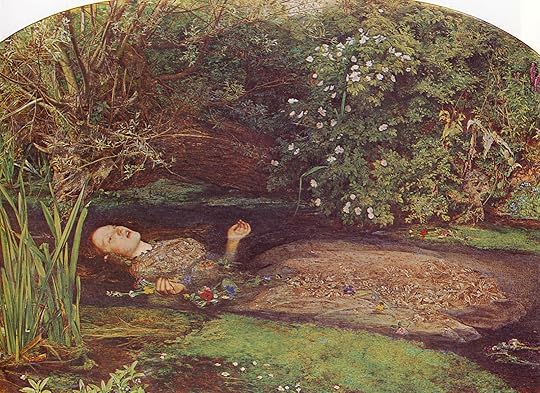
There is another painting. It is on my teacher’s wall in her school office.
When we are in the stream me and Rosemary we do not swim, we pretend. It is too shallow. We lie in it the cold covering our backs and our sides sometimes letting the water snake its way around our fronts between our legs over our waists where they dip. If we push our hair out behind us it flows to show the stream’s still flowing. We are just like the painting.
She is a teacher of English Literature. On her office wall which is the office wall of the English Department is a girl lying in a stream. It is pasted onto board and varnished, bright. You can see all the small leaves as if you could focus everywhere at once. The girl looks neither happy nor unhappy. She looks incapable of her own distress. She looks up into air. Her mouth is open, catching flies.
Seed by Joanna Walsh was originally published in 2017, and is still available, as a digital novel, wonderfully illustrated by Charlotte Hicks - https://seed-story.com/contents - the story, told in a series of 70 or so vignettes navigable by a series of different story vines, entangled so that sometimes the same vignette featured in more than one vine.
It has now been published in a more conventional linear print form by Belfast's No Alibis Press, although the novel is also available in a limited edition which includes six illustrated chapbooks, each 'a disentangled narrative vine from the novel' (https://www.noalibispress.com/news/ne...)
The novel is narrated by an 18 year-old girl, a modern-day Ophelia, living in an English valley, in a almost-entirely white community, on the outskirts of a town, the area a mixture of rural and industrial. It is set in 1988, specifically May ('O rose of May') to September as she prepares to start at University, while working at a cattery, and hanging-out with her friend Rosemary and her sister, whose Dad is an "entrepreneur" (I do not know what an entrepreneur is, not exactly. Men are
entrepreneurs. Entrepreneur is one of the many things I don’t know about men.) and is divorced (I do not know anyone else who is divorced, only on the telly ... Rosemary’s father lives with his girlfriend. Father is not a word that goes with “girlfriend”.)
The novel wonderfully, and realistically, captures the naivety of the narrator in her rather sheltered semi-rural mono-cultural setting, her main source of advice, in those pre-internet days, on topics ranging from fashion to sex (she is exploring both, and also her sexuality, as she moves to adulthood), teen and women's fashion magazines.
I am waiting for the bus to the Old Town. Just being in the Old Town is exciting. There is a green there, with something wooden. It looks like a gate with a roof on it. It does not lead into anywhere. It excites me because I don’t understand it. In the Old Town there is also the posh kind of supermarket and shops selling women’s dresses with hats, and shops where you can sell your own women’s dresses if they are the kind of thing that isn’t worn out and other women can wear again. And there are estate agents, in every estate agent’s window different ways to live, the houses in the windows the smartest. And there are men wearing suits. They’re estate agents perhaps. Some of the men have cars. I don’t know how old they are. I don’t know how old you have to be to be a man or perhaps it’s that you have to have a suit. Some of the estate agents look not much older than me. When you look at them carefully they have cuts where shaving has knocked the tops off their spots. But they have suits. Some of the cars are black with long noses. Some of the cars are low and shiny. Some of the suits of the men are black or, not black the word might be ‘charcoal’. There are also pubs on the river. I want an estate agent to pick me up in his clean car and take me to a pub on the river. I am not allowed to ask them to do this but I am standing here on the green by the bus stop so one can see me and take me. I know in my heart I am not quite right for them to take me: I have to be older or, not older… different.
And indeed the fractured and polyphonic narrative voice (I don't know who’s the ‘I’ that writes this) includes extract from these magazines, alongside news reports and official documents, pop songs and even the words of Ophelia from Hamlet. Walsh has also said the novel's text contains a hidden constraint, which remained hidden from me - my guess that it might involve using all the words of Ophelia (there is at one stage a rather gratuitous reference to Denmark for example) not being borne out.
The novel is also rich in descriptions of flowers and plants (reminding the reader of Ophelia's grief-stricken ramblings) and tactile sensations of the era (taping songs from the radio, phones with dials, Walkmen with headphones with foam that barely covers the hard metal underneath, the novelty of duvets etc).
It also wonderfully evokes the odd sense of threat that characterised that year in particular. The Cold War was coming to an end, but no-one then realised quite how quickly it would, so nuclear war remained a concern, but so much else as well.
One of the shortest vines in the e-version of the book, "Read", consists of the chapters "Fear", "Alarm", "Factory" and Prion (and I would add Thunder). Reading just that vine (<10% of the novel) the reader experiences concerns about the aftermath of Chernobyl (1986) and the consequent worries about Sizewell B, plans if there is a leak of gas from the local chemical plant due to memories of the Bhopal disaster (1984), the risk of factory-farmed eggs (although Edwina Currie's samonella remarks were to come in December 1988), Mad-Cow Disease and CJD (although Selwyn Gummer force-feeding his daughter a burger wasn't until 1990) and AIDS/HIV (“Killer blood,” it said. “They look just the same as anybody else.).
As the narrator remarks in Thunder:
I think I am afraid. I think everyone here is afraid. We stay here only with each other, not letting anyone in, not going outside the valley. But these things we are told have no borders.
One slight disappointment was that the vines weren't preserved in the standard (rather than special edition) novel - it would have seemed possible to number the vignettes and then suggest different paths through for the reader, and indeed I ended up using the digital edition to try that for myself. Without that it turns a literary experiment into something closer to a conventional novel.
But still highly worthwhile.
There’s fennel for you, and columbines.—There’s rue for you, and here’s some for me. We may call it “herb of grace” o' Sundays.—Oh, you must wear your rue with a difference.—There’s a daisy. I would give you some violets, but they withered all when my father died.
Ophelia in Hamlet
There is another painting. It is on my teacher’s wall in her school office.
When we are in the stream me and Rosemary we do not swim, we pretend. It is too shallow. We lie in it the cold covering our backs and our sides sometimes letting the water snake its way around our fronts between our legs over our waists where they dip. If we push our hair out behind us it flows to show the stream’s still flowing. We are just like the painting.
She is a teacher of English Literature. On her office wall which is the office wall of the English Department is a girl lying in a stream. It is pasted onto board and varnished, bright. You can see all the small leaves as if you could focus everywhere at once. The girl looks neither happy nor unhappy. She looks incapable of her own distress. She looks up into air. Her mouth is open, catching flies.
Seed by Joanna Walsh was originally published in 2017, and is still available, as a digital novel, wonderfully illustrated by Charlotte Hicks - https://seed-story.com/contents - the story, told in a series of 70 or so vignettes navigable by a series of different story vines, entangled so that sometimes the same vignette featured in more than one vine.
It has now been published in a more conventional linear print form by Belfast's No Alibis Press, although the novel is also available in a limited edition which includes six illustrated chapbooks, each 'a disentangled narrative vine from the novel' (https://www.noalibispress.com/news/ne...)
The novel is narrated by an 18 year-old girl, a modern-day Ophelia, living in an English valley, in a almost-entirely white community, on the outskirts of a town, the area a mixture of rural and industrial. It is set in 1988, specifically May ('O rose of May') to September as she prepares to start at University, while working at a cattery, and hanging-out with her friend Rosemary and her sister, whose Dad is an "entrepreneur" (I do not know what an entrepreneur is, not exactly. Men are
entrepreneurs. Entrepreneur is one of the many things I don’t know about men.) and is divorced (I do not know anyone else who is divorced, only on the telly ... Rosemary’s father lives with his girlfriend. Father is not a word that goes with “girlfriend”.)
The novel wonderfully, and realistically, captures the naivety of the narrator in her rather sheltered semi-rural mono-cultural setting, her main source of advice, in those pre-internet days, on topics ranging from fashion to sex (she is exploring both, and also her sexuality, as she moves to adulthood), teen and women's fashion magazines.
I am waiting for the bus to the Old Town. Just being in the Old Town is exciting. There is a green there, with something wooden. It looks like a gate with a roof on it. It does not lead into anywhere. It excites me because I don’t understand it. In the Old Town there is also the posh kind of supermarket and shops selling women’s dresses with hats, and shops where you can sell your own women’s dresses if they are the kind of thing that isn’t worn out and other women can wear again. And there are estate agents, in every estate agent’s window different ways to live, the houses in the windows the smartest. And there are men wearing suits. They’re estate agents perhaps. Some of the men have cars. I don’t know how old they are. I don’t know how old you have to be to be a man or perhaps it’s that you have to have a suit. Some of the estate agents look not much older than me. When you look at them carefully they have cuts where shaving has knocked the tops off their spots. But they have suits. Some of the cars are black with long noses. Some of the cars are low and shiny. Some of the suits of the men are black or, not black the word might be ‘charcoal’. There are also pubs on the river. I want an estate agent to pick me up in his clean car and take me to a pub on the river. I am not allowed to ask them to do this but I am standing here on the green by the bus stop so one can see me and take me. I know in my heart I am not quite right for them to take me: I have to be older or, not older… different.
And indeed the fractured and polyphonic narrative voice (I don't know who’s the ‘I’ that writes this) includes extract from these magazines, alongside news reports and official documents, pop songs and even the words of Ophelia from Hamlet. Walsh has also said the novel's text contains a hidden constraint, which remained hidden from me - my guess that it might involve using all the words of Ophelia (there is at one stage a rather gratuitous reference to Denmark for example) not being borne out.
The novel is also rich in descriptions of flowers and plants (reminding the reader of Ophelia's grief-stricken ramblings) and tactile sensations of the era (taping songs from the radio, phones with dials, Walkmen with headphones with foam that barely covers the hard metal underneath, the novelty of duvets etc).
It also wonderfully evokes the odd sense of threat that characterised that year in particular. The Cold War was coming to an end, but no-one then realised quite how quickly it would, so nuclear war remained a concern, but so much else as well.
One of the shortest vines in the e-version of the book, "Read", consists of the chapters "Fear", "Alarm", "Factory" and Prion (and I would add Thunder). Reading just that vine (<10% of the novel) the reader experiences concerns about the aftermath of Chernobyl (1986) and the consequent worries about Sizewell B, plans if there is a leak of gas from the local chemical plant due to memories of the Bhopal disaster (1984), the risk of factory-farmed eggs (although Edwina Currie's samonella remarks were to come in December 1988), Mad-Cow Disease and CJD (although Selwyn Gummer force-feeding his daughter a burger wasn't until 1990) and AIDS/HIV (“Killer blood,” it said. “They look just the same as anybody else.).
As the narrator remarks in Thunder:
I think I am afraid. I think everyone here is afraid. We stay here only with each other, not letting anyone in, not going outside the valley. But these things we are told have no borders.
One slight disappointment was that the vines weren't preserved in the standard (rather than special edition) novel - it would have seemed possible to number the vignettes and then suggest different paths through for the reader, and indeed I ended up using the digital edition to try that for myself. Without that it turns a literary experiment into something closer to a conventional novel.
But still highly worthwhile.

December 27, 2021
The coming of age story is quite a tricky one in lit, mainly because it follows the same tropes: child starts off innocent, receives an awakening of some sort, comes to a realisation and then understand that that there is an adult world and they are ready to encounter all the challenges that are present. It makes one wonder if the genre can be tackled differently.
Joanna Walsh’s Seed was originally a mobile app but then later found it’s way into book form later on in 2021. If one takes a look through the app, one notices the stories develop and branch out, not unlike a seed taking root and growing. The book itself is comprised of different sections with paragraphs all recalling events in non chronological order. The more one reads, the more the reader can put everything together.
The setting is the summer and the narrator has a job looking after cats in a cattery. Throughout the book she remembers her attraction to a girl and various other rites of passage she experiences: seeing condoms, trying on women’s clothing and viewing rude graffiti en route to her place. Infused in the narrative is the past, present and future.
The advantage of this is that Joanna Walsh is able to add other elements. Seed is about realising that one is queer (but , as stressed, Seed is not a coming out story, rather one of self-discovery) it also about the environment and fear of the future – the end result is a rich book which surprises the reader with every paragraph. Personally I saw Seed as a refreshing take on the coming of age genre.
At times playful, at times poetic, Seed is a beautiful, brainy piece of work that needs to be read.
Joanna Walsh’s Seed was originally a mobile app but then later found it’s way into book form later on in 2021. If one takes a look through the app, one notices the stories develop and branch out, not unlike a seed taking root and growing. The book itself is comprised of different sections with paragraphs all recalling events in non chronological order. The more one reads, the more the reader can put everything together.
The setting is the summer and the narrator has a job looking after cats in a cattery. Throughout the book she remembers her attraction to a girl and various other rites of passage she experiences: seeing condoms, trying on women’s clothing and viewing rude graffiti en route to her place. Infused in the narrative is the past, present and future.
The advantage of this is that Joanna Walsh is able to add other elements. Seed is about realising that one is queer (but , as stressed, Seed is not a coming out story, rather one of self-discovery) it also about the environment and fear of the future – the end result is a rich book which surprises the reader with every paragraph. Personally I saw Seed as a refreshing take on the coming of age genre.
At times playful, at times poetic, Seed is a beautiful, brainy piece of work that needs to be read.

December 31, 2021
Restrained, genius

March 22, 2022
Seed is described on its cover as a "polyphonic novel". It is told with two voices that jar with one another, a story of a protagonist that is becoming an adult. Her experiences as a woman are often stomach-churning, and there is a constant tension of threat that hangs over the words in this book, such as in an early passage describing the flowing yellow plant: "rape is an unnatural thing". That tension is effective in creating fear of violence constantly to the reader.
Unfortunately, the method of writing becomes too disconnected as the book continues. The voices tell too much and show too little, and the rhythm is slowed by the story. A story of sexual oppression of women is not really analogy here, just reality with a small bit of narrative tacked on, and that narrative gets repetitive and uninteresting quickly. The grittiness of threat of violence doesn't really need the imagination of a novel when told this way.
Unfortunately, the method of writing becomes too disconnected as the book continues. The voices tell too much and show too little, and the rhythm is slowed by the story. A story of sexual oppression of women is not really analogy here, just reality with a small bit of narrative tacked on, and that narrative gets repetitive and uninteresting quickly. The grittiness of threat of violence doesn't really need the imagination of a novel when told this way.
October 10, 2025
A series of fractured impressions telling of a teenage girl's burgeoning sexuality mixed in with period references to indicate it's that odd late 80s/early 90s moment in Britain (I think) characterised by a sense of doom (CJD, AIDS, Chernobyl) - if nothing else it's accurately diaristic in that it's a set of non linear present tense reflections which don't quite add up to a compelling story.

January 9, 2024
I found out after finishing this book that it was originally an experimental digital piece, later adapted into book form, and I wish I'd read it in the original form. It might have felt less disjointed then---or rather, with a clearer artistic conceit behind the disjointedness.
January 24, 2026
Super fun concept, took me a while to read as is formatted only for mobile phones in a kind of choose your own adventure style, perfect for moments when I didn't have a book to hand.

Read
December 29, 2025this reads like the notes app poetry of a 13 year old girl who spends too much time on tumblr. that might’ve been the intention but that doesn’t make it any less painful to read lmao 0 stars

December 5, 2024
Excellent
Displaying 1 - 9 of 9 reviews