Jump to ratings and reviews
Rate this book

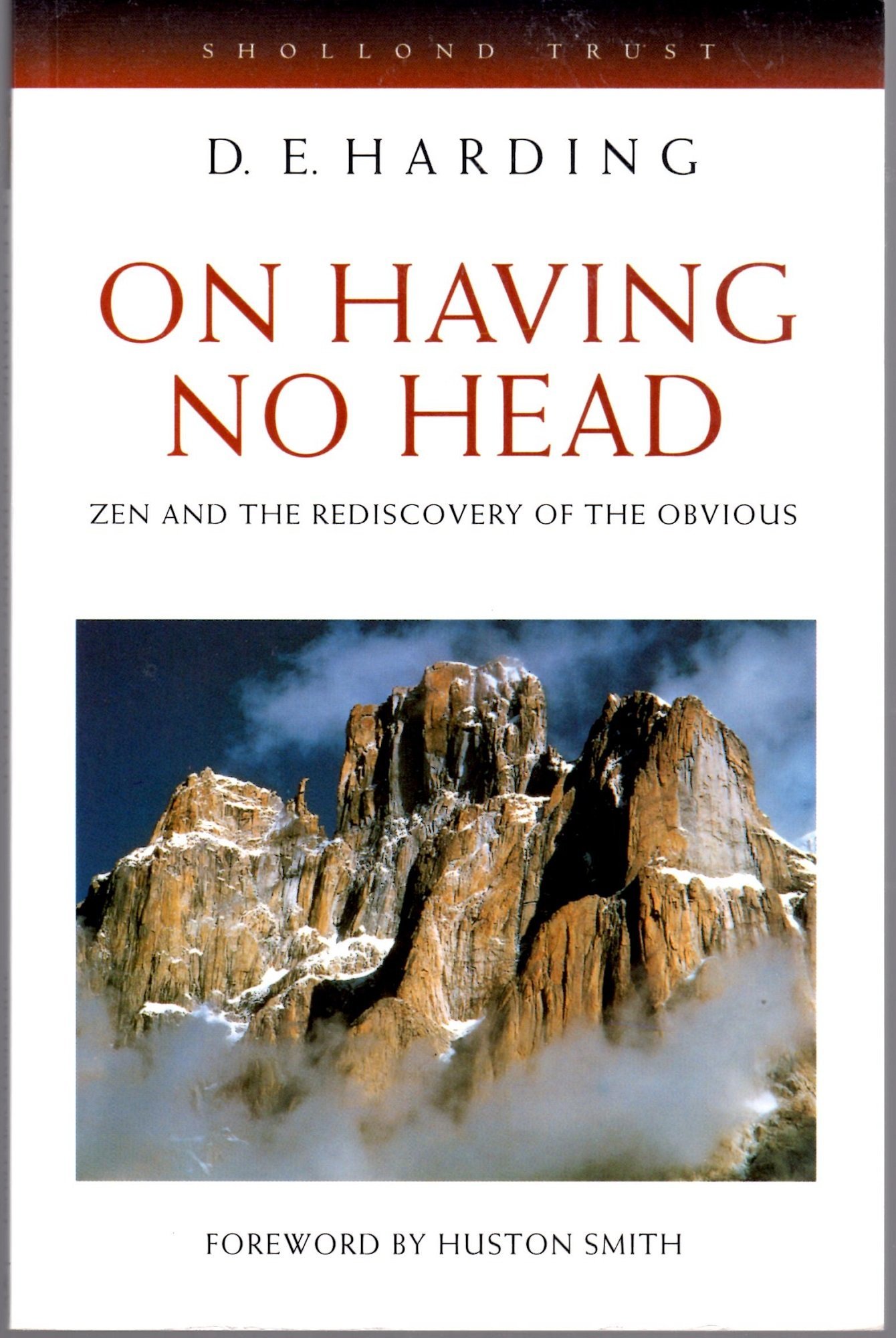
On Having No Head: Zen & the Rediscovery of the Obvious

Rate this book

Headlessness, the experience of "no-self" that mystics of all times have aspired to, is an instantaneous way of "waking up" and becoming fully aware of one's real and abiding nature. Douglas Harding, the highly respected mystic-philosopher, describes his first experience of headlessness in "On Having No Head," the classic work first published in 1961. In this book, he conveys the immediacy, simplicity, and practicality of the "headless way," placing it within a Zen context, while also drawing parallels to practices in other spiritual traditions.If you wish to experience the freedom and clarity that results from firsthand experience of true Being, then this book will serve as a practical guide to the rediscovery of what has always been present.

93 pages, Paperback

First published January 1, 1961

1019 people are currently reading
8558 people want to read

About the author

Douglas E. Harding

66 books119 followers

Ratings & Reviews

What do you think?
Rate this book

Friends & Following

Create a free account to discover what your friends think of this book!

Community Reviews

5 stars
714 (28%)
4 stars
779 (30%)
3 stars
699 (27%)
2 stars
260 (10%)
1 star
75 (2%)
Displaying 1 - 30 of 245 reviews
Profile Image for Fergus, Weaver of Autistic Webs.
1,270 reviews18.3k followers
April 11, 2025
This cult classic is refreshingly different - but that’s regrettably only as far as it goes. I read it in my thirties and now regret the wrong-headed direction in which this, and other books like it, led my attitude back then.

But this book especially!

For Harding - like other Dharma Bums (no slight intended - that’s only Kerouac’s humorous moniker for them) appears to have made a living from this, and numerous other Sunyata Redux titles!

For what he did was make Emptiness gimmicky - and yes, this is a bit of a disappointment.

It’s only The Idiot’s Guide to Buddhism!

Yet perhaps that’s overkill - for Roshi Kapleau in New York in the awakening sixties, it is a sudden ecstatic glimpse into groundlessness, which many of us experienced firsthand in those heady days. But it’s still only the Tail of the Elephant! Buddhism, as any religious system of insight, requires a lifetime total commitment from us.

At least the opening part is good, and it rather blows you away. Here’s the young Harding hiking through the grandeur of the Himalayan foothills, suddenly being bereft of all thought - of anything, including himself - for a long period was of time, awed by the grandeur of it all.

And the start of the book is just like if you were there in the Himalayas - but it’s all downhill from here! It’s a great opening gambit - for a book and series of books and, in apparently, for his writing career - though Harding will always be, to the newcomer, so delightfully and disarmingly Off the Wall.

But back then, I WAS an idiot... I thought this book was a game changer.

You can’t understand what your life really means in the big picture by evading responsibility. And that’s the attitude this book could inculcate in you if you’re not careful!

Here’s the thing: back in the old days, Buddhist teachers sternly exhorted their pupils to plunge into the nitty-gritty world that is our lives, and look for answers there!

And the great philosopher Georg Wilhelm Hegel said you won’t find any answers OUTSIDE of your personal daily struggles. For as the postmodernists reiterated, there IS no outside.

What you see is what you get (setting aside personal faith for a minute). And if you’ve got a kitchen sink full of dirty dishes tucked away somewhere in the recesses of your mind, well, you’d better get cracking on that from the outset.

And Harding is a bit of an opportunist to give us an easy recipe for Satori. Satori, or any achievement of peace in our lives, cannot work without faith. And it can’t work without work - long hard work on dissolving our spiritual and mental bugaboos and thus clearing our heads of their inborn internal miasmal mists.

But many kids - as callow as I was - won’t listen. As Eliot says, Youth “smiles at situations which it cannot see.” Didn’t we all? (We can be such smarmy dozes!)

Youth still believes in instant answers - plug ‘n play! So some kids’ll buy into it. Like us flower children did. But flower children did things that disqualified them from the Game of Life for one truckload of a long time thereafter! Don’t be a klutz like I was.

And don’t start out on the wrong foot: a book’s cult following is no indication of its depth.

And this book will give you no substantial answers to ANY ultimate questions.

But you know, the answers are out there...

And if, like our forbear King Oedipus you’re willing to face the nightmarish Pandora’s Box that flies open once we recklessly try to solve the Riddle of the Sphinx:

Then, more power to you.

You’re going to need every OUNCE of it through your long and arduous shedding of blood, sweat and tears on your Rocky Road to Peace...

That Great Peace that Passes All Understanding!
Profile Image for Dave Schaafsma.
Author 6 books32.1k followers
March 23, 2020
My doctor wants to put me on high blood pressure medication, which would not be surprising for someone of my age, but I asked for three months time to see what I could do without meds, and so 1) started running in earnest again, 2) bought a Fitbit to obsessively track my stats (see David Sedaris’s latest book where he makes fun of his own Fitbit obsession), 3) began my own (very mild) chemical intervention to see if I could get calmer and to try to sleep more AND 4) began meditation with the help of Sam Harris’s Waking Up app. Early on, Harris, a neuroscientist with another degree in philosophy, recommends Douglas Harding’s intriguingly titled book On Having No Head (1961) which my library didn’t have, though they did have a documentary featuring Harding lecturing on the central tenets of the book. I see that Harding became known for decades as a philosopher and mystic, was the author of twelve books, and I thought heck, Harris is a smart guy, I’ll check it out if he says it is important for getting into meditation and mindfulness.

So I didn’t read the actual book, though as soon as I began watching I seemed to recall that Harding was one of those sixties folks who kind of bridge the beatniks and hippies who were leaning toward Eastern religions and mysticism. Like me, Harding was raised in a conservative Christian environment, so I knew others then who were drifting from Christianity to (maybe particularly at the time Zen) Buddhism who read him. And folks such as Alan Watts, Ram Dass, gurus of and to the West.

So, (full disclosure), I should just say I am not interested now in following Harding to Nirvana (not that there’s anything wrong or un-enticing about that, particularly); I just want lower blood pressure. Though I am a little curious (as David, one Goodreads critic of Harris suggested, too) about the scientific basis for meditation, and I know about Harris’s writings about atheism and spirituality, so am curious, too, if Harding will give me any insight here. I once checked out Transcendental Meditation, which was popular in the seventies. And this Harris-led meditation app IS helping me, but Harris is also talking in his sessions about planes of consciousness, clouds of sensations, breathing, mindfulness, and so on. He’s not just lowering my blood pressure with his focus on my breathing and so on. He’s trying to change the way I view the world. In grad school we all learned from Peter Berger and others about The Social Construction of Reality. What would a neuroscientist say about that?

Anyway, Harding has this sixties (and overall Romantic) Dharma Bum (Kerouac) focus so many of us liked then on the usefulness of heading inward, in order to experience “deep awareness.” When he was in the Himalayas as a young man he had this ah-ha moment:

“What actually happened was something absurdly simple and unspectacular: I stopped thinking. Reason and imagination and all mental chatter died down. For once, words really failed me. Past and future dropped away. I forgot who and what I was, my name, manhood, animalhood, all that could be called mine. It was as if I had been born that instant, brand new, mindless, innocent of all memories. There existed only the Now, that present moment and what was clearly given in it. To look was enough. And what I found was khaki trouserlegs terminating downwards in a pair of brown shoes, khaki sleeves terminating sideways in a pair of pink hands, and a khaki shirtfront terminating upwards in—absolutely nothing whatever! Certainly not in a head.

It took me no time at all to notice that this nothing, this hole where a head should have been was no ordinary vacancy, no mere nothing. On the contrary, it was very much occupied. It was a vast emptiness vastly filled, a nothing that found room for everything—room for grass, trees, shadowy distant hills, and far above them snowpeaks like a row of angular clouds riding the blue sky. I had lost a head and gained a world.”

Instead of his head, Harding realizes, in his first satori experience, he has the world. So, as I understand it, we make the world with our consciousness. Are you behind your face? No! What is a self? What is consciousness? Where are these things?! Is there a soul, and if so, where does it exist? What I learned in grad school is that there was no essential self, but we were made up of multiple selves. Each of these selves, this consciousness, is made up with the “only tool available to us,” Harris says: Our mind.

In the video Harding’s claim (and Harris agrees) is that we make the world, we are the source of consciousness. Or maybe it's the world that makes us? Or maybe it’s that old song: “We Are the World”? But it is best to experience the world fully and directly. It is possible through careful meditation, he says, to experience “headlessness,” where the subject/object distinction collapses and you are “fully present” in the world, closer to some kind of “pure” consciousness, where one is one-with-the-universe, a boundless openness to the whole world. So what’s not to like?

I have had many thrilling “mountain-top” experiences, usually occurring outside, though sometimes in reading, and I have been in various kinds of love, peak emotional/spiritual/psychic experiences. Still, all I am looking for from Harris and Harding is lower blood pressure. But what if, along the way, I actually achieve the peace that passes all understanding and change my life?! It could happen.
Profile Image for Gary.
65 reviews14 followers
January 20, 2008
Made me high reading it.
Profile Image for Alex.
73 reviews36 followers
May 5, 2020
Like many modern readers I was introduced to this short book by Sam Harris in his book ‘Waking Up’. Were it not for the credibility I place in such a recommendation I probably wouldn’t have lasted much beyond the fifth page. Writing in 1961, Harding has attempted to convey a raw first-person experience in terms that can be easily misunderstood for a third-person description. He is attempting to eff the ineffable, and if the reader isn’t attune to this (or hasn't yet experienced any kind of transcendent conscious state – sober or otherwise) he will not be able to make much sense of the description.

The fundamental insight – if I am understanding him correctly – is that by paying attention to your raw experience as carefully as possible, you can find that it’s nothing at all like what you believe it is 24/7. Most people are aware that our experience is mediated by our expectations (google the Gorilla Illusion), but fewer still are aware that our experience is itself shaped by the most basic concepts such as space, time, distance, and distinctness. What’s being delivered from your eyes to your visual cortex is a stream of electrical impulses that map out the double 2D retina images (upside-down). That information is decoded, combined, and filtered to generate the 3D world out of two 2D images. An information transformation has taken place. It is possible through careful meditation to interrupt those filters and algorithms. The end result is a state of ‘headlessness’, where the mental subroutines that delineate ‘you’ from ‘all else’ go offline and the subject/object distinction collapses.

Harding asks you to briefly glimpse this truth by pointing out that you have never seen your head. Sure you’ve seen a reflection of your face. You can see fuzzy brow ridges if you look up, or a coloured cloud in the middle of your vision where your nose live, and maybe even cheeks and the top lip in the bottom of your visual field. But for all that, your actual experience seems to indicate there is a gaping void where your face should be. A window on the universe. This can be difficult to glimpse at first, but once noticed it’s hard to stop flicking your experience back and forth between how you felt before, and the realization after it comes. I liken it to the Necker Cube illusion.

One way of attempting to trigger the experience is to play with concepts. Think about sitting in a car while it’s moving. You can either conceptualise it as you are in the car, and you and the car are moving through space passing the scenery and other objects as you drive. Or you can conceptualise it as you are sitting perfectly still and the scenery in your experience is the thing that is moving, zipping to the edges of your visual field then passing away into the void. Like wearing VR goggle, the scenery changes depending on the direction you’re looking in. Some view this perceptual shift as a transcendent insight. Others view it as an appeal to solipsism; the dreaded ‘so what?’ response to the sublime from the uninitiated. We are talking about epistemology, not ontology (though Harding does make some metaphysical leaps of logic that I can’t follow him on: more on that shortly).

The further truth to be gleaned here is that you aren’t ‘in your head’ riding around in your body like a vehicle. This is an illusion. Your brain could be located in your foot and your experience could still be such that you believe you are located in your head. It’s a referent trick the brain conjures very well. No, the deeper truth is that you don’t have experiences like a collection of objects to own and catalogue. You simply are your experiences. There is no thinker separate to the thoughts, and no observer separate from the perceptions.

The deeper realization is that there is another kind of consciousness – a pure kind of consciousness – that can be glimpsed in the short windows between thoughts and sensations and identification with them. This consciousness is untainted by the things it experiences, like a mirror that doesn’t get dirty when it reflects dirty things. This much I can grant Harding, both conceptually and from my own investigations of my mind. However he tries to make the further leap that all conscious beings are therefore partaking in the same consciousness, which he calls God, and that the apparent separateness of individual minds is an illusion. At this point he has made a metaphysical statement of faith about the ontology of the universe that is not justified by the evidence, and he and I part company. To his credit, Harding doesn’t ask you to take this on faith but to do the practice and see for yourself, as this is a profoundly empirical exercise, but one in which you are obliged to build your own scientific instrument before you can glimpse the hidden reality (much like a telescope or microscope opens up hidden realities).

There is some exposition of the various phases one must go through in order to become a Headless Seer (8 such phases in all), and some discussion of the ‘two kinds of unknowing’: why are things the way that they are instead of some other way (contingency and necessity, in the old 18th century terms), and why is there anything at all (Leibniz’s problem of ‘why is there something instead of nothing’ and the principle of sufficient reason). Lastly there is a warning that once you glimpse your headless reality you must be careful not to fall into despair, as you will now set your intellect against your ego, having allowed your ego to glimpse the transcendent for a moment, then force it to live in the humdrum non-transcendent world as you go about your business.

I’m not going to lie. This book is at times hard work. It’s only 108 pages long but I probably read 300 pages given how many times I had to re-read it to try and understand Harding’s intent. He walks a fine line between numinous insight and word salad. I suggest you spend at least 50 sessions meditating in the Zen, Dzogchen, or Tibetan style of practice (“look for the one who is looking”) before reading this book, or it will likely read as gibberish to you.
Profile Image for Heidi Wiechert.
1,400 reviews1,521 followers
March 17, 2021
Douglas Harding had a strange experience when he was a young man. As he was hiking in the Himalayas, Harding had a moment he would later describe as of "no thought", and where he perceived his body as having no head. In addition, he had a vision of his body as a house with a single window, but inside the house, there was nothing looking out at the world.

That nothingness is where Harding envisioned his consciousness resides.

Trippy, I thought. If that had happened to me, I might have been pretty freaked out.

Not necessarily so for Harding, who described the experience as incredibly peaceful and enlightening. When he came back from this experience, he applied his insight to various Eastern schools of philosophy, notably Zen.

The result is this book- a discussion of not only what happened to him, but an examination of consciousness itself. Where does consciousness reside? Where is the 'me' of our constant thoughts and emotions?

It's somewhat of a winding path to get there, but Harding eventually points to the idea that consciousness is space in which reality is perceived.

When I first hopped into this book, I thought, how ridiculous. We all have heads attached to our necks. We can see them and feel them. Not only that, we can see and feel the heads of other people if we really wanted to.

Harding takes this idea of 'seeing' and 'touch,' and questions what it is that people actually perceive. Yes, he says, you can see your head in a mirror. But that is a reflection of your head and not the head itself.

Everybody says these constructs are the thing itself. However, as Harding points out, they're not really, are they? If you look down your own face, you can usually 'see' your nose as a series of splotches and shapes. Is that your nose though, or just splotches?

And he goes on from there.

By the end of the book, I was nodding my head a little and felt like I could understand something of what he was saying. But now that I'm trying to write a portion of it down, it just sounds like nonsense.

Perhaps this is a book to be experienced rather than described. Rather, I might humbly suggest, like consciousness itself?

Recommended for spiritual seekers or anybody who enjoys pondering koans.
1 review
April 16, 2008
The way of headlessness is the way I believe we all see the world when we are children. This is the key to the wisdom we all once possessed, as children, and this is the wisdom we lose when we "grow up", become "mature" and join the "real" world of jobs and money and the pursuit of "things" out there. I read this book at about age 40, and it was as if I had discovered a long lost friend. It made me recall a time when I too frolicked about without the burden of this thing called a head.

I had the pleasure of hearing Douglas Harding speak once. I shook his hand and exchanged a few words and I will never forget his kind, soft voice and his warm and sincere handshake. I have a personal letter from him - one that I will always treasure. So, read this book and you too just might discover something that you once knew, something you have forgotten to remember - that you, like me, like every single one of us, simply...have no head.
Profile Image for Rob Adey.
Author 2 books11 followers
February 17, 2016
Despite Harding's protestations, I think his first satori experience had something to do with being on holiday in the Himalayas rather than, say, being in the conditions in which I read about it i.e. in a train underground between Tooting Bec and Balham.
Profile Image for Nathan.
117 reviews23 followers
March 21, 2010
This book will blow your head. A succinct and obvious perception of self. Enlightening, terrifying and unavoidable.

I have just finished re-reading this, and it strikes me as even more profound than before. If you have a desire to know what all of "this" is, and you are only going to read one more book in your lifetime, this should be the one.
Profile Image for William Arsenis.
Author 1 book16 followers
March 26, 2017
ON HAVING NO HEAD is a short, funny, and down to earth book—literally pointing at who we really are.

It is simple without being at all simplistic. People with a non-dual background would likely find this book easy to understand.

Direct Path inquiry uses direct experience exclusively, disregarding the thoughts that explain and interpret. From this perspective, no one has direct experience of actually having a head. That is Mr. Harding’s initial point, but it is not the essence of the message.

Point at your head and there is nothing to be seen. This nothing is the space in which everything arises. In non-dual circles, this is not a new concept, though the approach (pointing at your head) most certainly is.

I love his sense of humor—it is so very English.

If you are open to different perspectives and approaches to the question “Who am I?” ON HAVING NO HEAD offers more than mere philosophy, it offers a refreshing view and a direct technique to apply this view.
Profile Image for Chris.
133 reviews12 followers
January 17, 2019
"Woosh"

That's the sound of this book going over my no-head.

I picked this one up after meditating with Sam Harris' app and books. The concept of no-head isn't something that I yet comprehend at the level I believe they intend, and I hoped this book would help. It did not.

That isn't to say it's a 2-star book. It's a 2-star book to me, right now. I plan on revisiting it in the future as I try to grasp this idea. At that point, perhaps it will be 3 stars, 1 star, or 5 stars.
Profile Image for Unigami.
235 reviews7 followers
August 29, 2011
The premise of this little book is set of simple techniques that anyone can use to achieve instant enlightenment about who you really are. I got more results in 10 minutes from using Harding's methods that I have from countless hours of meditation. Some of the book is repetitious, because once you try the technique and "get it", that is really all you need to know.
Profile Image for Darren Berg.
2 reviews1 follower
May 30, 2013
Douglas Harding states in a couple places in the book, that sometimes things come into your life, just when you need them to. This book is no exception. An amazing read. The first half of the book drew me in with it's playfulness. Its nearly Seuss-ian banter on the idea, the amazing thought, that this man has no head.

It's beautiful, thoughtful and written with such a love for the material that it's simple to understand, to feel what the author is trying to convey.

In an area that can get very dense with it's verbiage and bogged down in terminology, it's a refreshing look at what it is "to have no head".

Profile Image for Richard Peters.
Author 31 books5 followers
September 2, 2012
Douglas Harding created a simple way of "seeing". His mission was to help people experience what is really "here", right where they thought their head was!

On the face of it this is a strange concept, but in fact it is incredibly simple!

Most people think that they have a head sitting on their shoulders, just like all the other people that they see, have one on their shoulders.

What Harding does is suggest a series of personal experiments that anyone can do, to help them realise that what they experience and see from atop their own shoulders is fundamentally different from what they see on top of other people's shoulders.

These experiements lead to a personal "First Person" reality of what is really here. He tells the story of walking in the Himalayas. Looking at the mountains, he realised that sitting on his shoulders, where he thought his head was, was in fact a panoramic view of the mountain!

He had no head, but had the whole view.

This is a mystical reality that is hard to describe, because it needs to be experienced by the "seer".

Nevertheless Harding uses persuasive words to describe this mystical vision, from a scientific, experiential, experimentation point of view.

This book is a bold attempt to describe a mystical, Zen-like, meditative reality of life.

Harding was a deep scholar of religions and his simple experiments try to encapsulate the essence of what all the great religions are saying.

I highly recommend this book to all who want to understand the mysteries of life!
Profile Image for K.S.C..
Author 1 book17 followers
August 8, 2016
Where to begin? Perhaps to quote from - and of - the book itself (which may or may not exist) I can best explain my Perception of this piece of writing: "...there's no ego-trip to match the spiritual ego-trip!"

Not that this book is entirely without merit as there are glimpses of Emptiness, however, Harding primarily equates Emptiness with Nothingness, and seems to think (or present in such a way that I can only assume this was his thought) that he Invented Solipsism. But if Emptiness meant Nothingness the Buddha would have taught Nothingness and so this book serves merely as a wordy Example of Spiritual Materialism as a result of a Peak Experience.*
*I include here a poorly spaced from the text of my review footnote where I would like to wax eloquently about Something else in an excessively verbose manner in order to further my case in a confusing matter.

Of his own book Harding says it best on page (59) in stating: "...this really is too complicated and wordy."

In short, this is a book of what Emptiness is Not (which is to say we don't Not exist but actually we don't exist as single entities independent of all other things) which I have said before, but in the theme of Harding I shall expand upon again just for the sake of writing more. But seriously, I recommend Thich Naht Hahn's commentary on the Heart Sutra as the exact opposite of what this book Is and a far simpler, clearer and Accurate guide to Emptiness.
273 reviews1 follower
August 20, 2013
A strange little book. Starts with a simple idea – you can’t directly see your own head, progresses to a still pretty simple idea, that you have a unique first-person view of your world, and then leaps to some sort of strange zen you-are-one-with-the-universe sort of thing. If you follow that leap then I guess this book may be pretty amazing (at least some people have told me it was), but for me it did nothing.
Profile Image for Ali.
82 reviews9 followers
April 13, 2021
۳ یا ۲.
Not good enough in my perspective.
به طور کلی کتاب حرف‌های خوبی هم میزد، ولی درست باهاش ارتباط برقرار نکردم.
Profile Image for Philipp.
699 reviews224 followers
April 30, 2022
This is a neat little autobiographical book for people into meditation/mindfulness, with a focus on headlessness. In a nutshell: You have eyes, of course, and you definitely have a head, but it's a trick of your conciousness that the 'you' is where the eyes look out. Your 'you' has no head. And there lies the problem with the book for most people: If you haven't meditated for a few months, or gone through regular guided meditations, this will all sound like nonsense to you.

Harding stumbled into headlessness, the awareness that you have no head, a close relative (or implementation?) of the illusion of self, a few decades ago, while meditating. There wasn't a real mindfulness movement like we have now, so he didn't have anyone who could talk to him about his experiences. But he luckily made the connection between what many Zen masters spoke about and his experience, and that's what this book is about. Parts autobiography, parts a headlessness manifesto, parts linking mind-illusions to ancient buddhist writings.

If you have no experience with (guided) meditation, I would not recommend reading this. It will make little sense. But it's a great exploration of an underexplained phenomenon for those who have glimpsed it!


To repeat our initial question, then: where do we go now? The answer is: nowhere. Let us resolutely stay right here, seeing and being This which is Obviousness itself, and take the consequences. They will be all right.
Profile Image for Ioana.
167 reviews
January 2, 2021
The face of the Void (is not a pretty one)

Whenever you are reading one of these books about ‘enlightenment’, do yourself a favor and ask if there is any, and I mean any bliss that, in the end, the book doesn’t promise you?

Harding promotes ‘the way’, to be more exact the ‘headless way’ or ‘headlessnes’, an odd little compilation of Zen teachings, mysticism and self-reflection. Those who know me would know what I think of anyone promoting ‘a way’.

But let me at least be fair to one point he makes – that you can make a volte face to your habitual perception of the world, as he puts it, from egocentricity for zerocentricity. This implies a simple reversion to a mirabilis state, one where you suddenly, so to say, forget that you have a head and make sense of the picture that unfolds – which simply is that nothing lays between you and the world, and that above your neck, the Universe flows in. Or as he describes it, the act of in-seeing or seeing the ‘Face of true Void.’ While I do find some merit attached to this exercise, this quicky devolves into an upward spiral of promises, from the modest ‘stress reduction’ to the species' best chance of survival itself’.

But can’t you just be born with ‘the way’ in your mind? No, because according to Harding ', Really to value the perfectly obvious, we must first acquire the habit of overlooking and denying it.'. This, perhaps of all things, captures best the imposture of Zen teachings – one must depart from the world which has given him means to do just that; a world built on sweat and tears and a frenzy of thoughts and ideas. But oh no, excuse you, here comes a disciple which is ready to renounce contributing to anything useful, in order to comfortably meditate on the nothingness of the world which actually created them. This just doesn’t fly well with me.

Maybe I’m too hard on Harding (sic) and he’s just a fool; that may very well be the case. Could it be that, in part, his valuation of the ‘Obvious’ afforded him 98 years of age? I don’t know –some do get drunk on sugar water.

He does mention the method, if not repeated, has no effect whatsoever, and that a student of the method may first find that here is nothing painted in bright colors; all is grey and extremely unobtrusive and unattractive.. That and the whole business of ‘seeing the face of the Void’ reminds of the dangerous fit of depersonalization, which is rather common for depression and schizophrenia. Especially this part - 'I come to realize that my seeing into the Absence here isn't seeing into my Absence, but everyone's. I see that the Void here is void enough and big enough for all, that it is the Void. Intrinsically, we all are one and the same, and there are no others.' reminds me very vividly of depression and, for the likes of me, I cannot see how does ‘what I do to anyone I do to myself’ follow from the aforementioned. Surely in the Void there’s no appetite to ‘do’.

In the end, it all wraps up into full-blown mysticism, or what we here in the Western tradition call ‘a renewed surrender to God's will’. Too bad. I really liked the poetic idea of a revitalization of our childhood astonishment, but that’s about it. I wouldn’t be to happy about trying to dynamite the foundation of self.

👉🏻Notice how I rated this one star above Harris’s Opus Bulshitus - ‘Waking up’.
Profile Image for Monica.
777 reviews
October 2, 2012
This book interests me because of a song written by Mike Heron

Douglas Traherne Harding
by Mike Heron

When I was born I had no head
My eye was single and my body was filled with light
And the light that I was, was the light that I saw by
And the light that I saw by, was the light that I was

And many's the time that I've passed by the river
And saw no tollman and needed no ferryman to cross
And I enjoyed the world aright
For the sea itself floweth
And warm I was and crowned

But one day walking by the river
I met a tollman with an angry face
And many's the time I passed through his tollgate
And paid no silver and paid no fee
But rather I did hide my sheep and goats under the bags of oatmeal
And cold I was, no crown did I wear

But if you're walking down the street
Why don't you look down to the basement
And sitting very quietly there is a man who has no head
His eye is single and his whole body also is filled with light

And the streets are his and all the people
And even the temples and the whole world
And many's the time he walks to the river
And seeing the ferryman and seeing the tollman
The light within him leaps to greet them
For he sees that their faces are none but his own

One light, the light that is one thought the lamps be many

You never enjoy the world aright
Till the sea itself floweth
In your vein and you are clothed
With the heavens and crowned with the stars

Oct. 2012 I made it through most of the book but it got difficult to comprehend and I lost interest.
Profile Image for Vel Veeter.
3,600 reviews64 followers
Read
April 3, 2023
I picked this book up because it has an interesting title, was small, and was on David Bowie’s booklist that was published soon after his death.

This is a book about coming to terms with living a kind of freeform and incorporeal life.

And I couldn’t care less about it.

I won’t rate it, because it might be good and might connect with others, but since I am not part of that audience, I couldn’t get much out of it, and it doesn’t make any sense for me to try to make any kind of assessing sense of it.

Instead, I will tell a story.

One time I went to a meditation meeting. I am already skeptical about yoga, and I have to tell you I am skeptical and resistant to stretching. I don’t mean that this is a good thing or anything I would defend or support. It actively works against me. But really what it comes down to is that I hate feeling vulnerable. Yoga makes me feel so, and man does the idea of meditating.

So I went to this meeting on a date. Cool. And it was presented as a non-judgmental space, a space of relaxed meeting and breathing and clearing one’s mind.

And then I got scolded for placing the “chant” on the ground. And I don’t mean like a sacred document, but like a printout.

I grew up in an oppressive religion, have no faith, and so a religion professor from a local university scolding me for placing a printout of a chant on the ground turned me off. And so, at the end of this book about not having a head, I just said to myself. Yes I do.
Profile Image for Philippe.
745 reviews717 followers
June 14, 2022
What if Harding ís right and satori is not a question of lifelong 'sitting and forgetting', but merely a leap of the 'heart-mind' into a seeing without a head? No longer a matter of good and evil, black and white, but a universe of, metaphorically speaking, a monochrome grey (whereby we immediately realise the impotent and partial nature of the metaphor, which leads some readers to flatten the whole idea into the stasis of depression; far from it: this greyness is in a most curious way life-giving; at least that is how it appeared to me when I pondered this question in a half-dream).
Profile Image for Tristan.
100 reviews8 followers
June 4, 2018
"... the very suggestion of headlessness is for many people profoundly offensive, and there's no end to the objections they will raise. Never mind: headlessness is for living always, for sharing occasionally, for arguing about never."

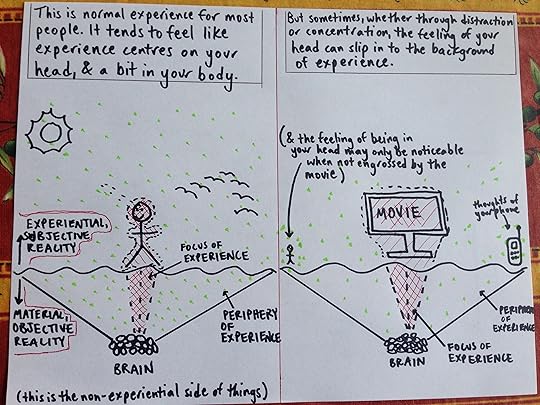
What wise words! Had I read this book years earlier, I would have been saved many awkward encounters in which I tried to convince friends, relatives, and even one or two strangers of the profound fact that you are not inside your head - rather, your head (and all of your experience) is inside you! Harding captures the point I was trying to make, but with much more wit, wisdom, and clarity than I ever could.

(In a last-ditch effort to convince people that I had not lost my mind, I attempted to get my point across with the following picture):

description

For anyone who has ever thought it odd that you never see your own face, questioned whether your dreams and memories are in the first or third person, or wondered why a first person movie is so jarring, this is the book for you.
83 reviews139 followers
April 1, 2019
A book that takes its place next to Alan Watts's 'The Book'- a little pamphlet of sorts that contains a set of words that have the potential to shift your perception of everything, including perception itself. Harding has literally zero guru blood in him. He writes not as a teacher, but as a friendly man who has discovered something that he just can't keep to himself. It's a lovely thing he's done here, a unique yet ubiquitous path of self-inquiry that is worth checking out. I had to take my time reading, it, and I suggest you do too- this one to keep coming back to, to slowly digest, to reference back to, to check in with for fine-tuning.
Profile Image for Selar Majak.
91 reviews7 followers
May 23, 2021
I think I'm too old for spiritual books....
this is the first time that I see a spiritual book go too literal that I'm almost convinced this is satire..

It doesn't delve into any of the zen teachings, but rather goes on about 90 pages to try to convince you that the author has no head without taking the time to explain the spirituality or what it actually means to have no head. to go into such a state of mind that you let go of everything.

And boy the pretentiousness! I felt like I just wanted to shut him up as I read on
7 reviews2 followers
July 1, 2020
Sam Harris and Richard Lang recommended reading On Having No Head as an introduction to headlessness. Reading it didn't provide any insight for me; the book reads like it's Harding's stream of consciousness on the subject. It would have been much more useful for him to state his argument clearly and concisely, and to include some thought experiments to illustrate his point. In my opinion, Richard Lang's interview on the Waking Up app was a much better introduction than this book.
Profile Image for James Q. Golden.
21 reviews124 followers
May 31, 2020
Poetically Majestic in the most literal sense of the "word" book on Zen,

but one of the Dullest and Droniest audiobooks I've ever listened to.

So here the question comes:

(hm, yes, my little padawan)

how do you rate this?

And now a koan arises:

svaha!

Can you find it?

PS. Where are you Peter Coyote, and why the hell did you stop narrating books?
Profile Image for Lani.
52 reviews40 followers
February 2, 2016
A bit "out there" for me. I get the concept but I'm too much of a scientist and rational thinker to buy into this, or any religious thought for that matter. Interesting read, however.
29 reviews
November 30, 2022
This book starts off really strong, emphasising forgetting all the clutter and focusing on your direct experience (where is my head? I dont see a head), but in the second half it turns into an extremely vague spiritual guru self help guide that was basically just word soup.

Alan watts' "the way of zen" was orders of magnitude more clear and insightful on the particular experience this book is espousing.
Displaying 1 - 30 of 245 reviews

Can't find what you're looking for?

Get help and learn more about the design.