Na In de trein, het eerste boek van Uitgeverij Vleugels, en Mijn grote appartement, is er nu een derde titel van Christian Oster: Drie mannen en een stoel. De droge, onderkoelde stijl waarin de wederwaardigheden van de innemende antihelden door Oster worden beschreven levert steevast hilarische scènes op.
Marie had me uitgenodigd om een paar dagen naar Corsica te komen. Ik mocht meenemen wie ik wilde. Ik legde het dus voor aan Marc, met wie ik sinds drie maanden tenniste in de buurt van Porte de Clignancourt. Hij legde het weer voor aan een figuur die ik niet kende. Op de achterbank propte ik de stoel die Marie bij mij had achtergelaten toen ze twee jaar eerder bij me weg was gegaan en die ze me had gevraagd mee te nemen. We bedachten alle drie dat we elkaar onderweg wel zouden leren kennen, en we vertrokken.
Christian Oster was born in 1949. He is the author of over 15 novels, as well as numerous books for children. Among his titles, My Big Apartment (1999) won the prestigious Prix Médicis, and A Cleaning Woman (2001) was made into a feature film by Claude Berri. He lives in Paris.
Three men not in a boat with a dog but in a car with a chair, from the title (which possibly nods to Jerome K. Jerome’s Three Men in a Boat) on Christian Oster put a smile of anticipation on my face which quite a few times turned into a possibly audible laugh.
As soon as I recognised her voice on the phone, I immediately felt the need to sit down, and when she mentioned the chair not much later, it took me a few seconds to understand which chair she was talking about, and that it was the one she was sitting on at that very moment. It was a wooden chair that I hardly ever used and that was right next to me when I answered the phone, a very low, heavy chair with a stiff, if neatly angled, backrest that she had not brought with her and that her father had given her.
Serge Ganz receives a phone call from his ex-girlfriend Marie, from whom he haven’t heard much news for two years. Marie wants him to bring her a chair she left with him in Paris after they separated, while she is now living in Barretone, Corsica. She suggests he can take some friends with him and so he proposes his tennis partner Marc to join him, though he barely knows Marc. Marc in his turn would like to take his friend Cyril Kontcharski, a former tightrope walker who is now a banker but still clings so much to his rope that he wants to take it with him to Corsica (and sleeps next to it – the inability to let go and associated obsessive thoughts (Marie, the rope, thoughts about an anonymous woman in the metro) might be one of the themes in the story).
The three men, who hardly know each other, leave Paris in a car (with the chair) and head for Corsica. Their conversations are comically awkward and forthcoming, the wish of Serge to come closer to Marc and Cyril gently mocking some platitudes on the superficiality of a certain type of male friendships. The three men stumble clumsily and seemingly aimlessly through life, all three they seem funambulists in their own way. Such results in some slapstick scenes on their journey, for instance when they take the chair with them on the boat to Bastia.
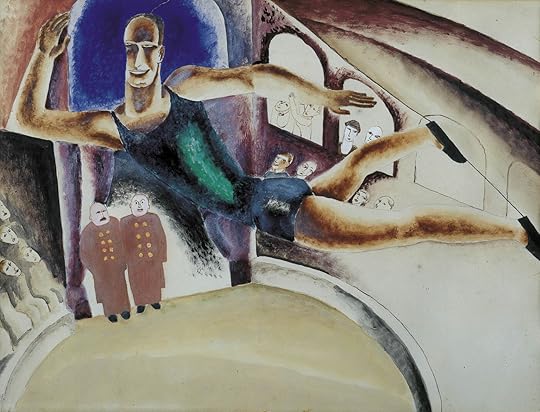
(Frits van den berghe, 1925-1926)
The journey is very much the destination in this short novel, two women come on the path of the three men and open possibilities for more journeys. Christian Oster –apparently a patented road novelist - takes the reader on a journey that spans almost the entire book: from car to boat to car again - one of the characters eventually leaves the story in a non-environmentally friendly way by aeroplane.
Then, for two or three long hours, our crossing went on, giving the impression that we had practically finished it, because of our modest trials, during which the idea that I was going to see Marie again, like time that has stood still, disappeared completely for a moment, dissolved, as it were, into waiting for it to pass, and then the island, which had first been visible in the distance as a simple strip of land, revealed itself to us in the form of coves and mountains, until Bastia suddenly appeared, with its beautiful grey buildings, as if solidified in a past from which the city, despite the late hour, was only unearthed by the perfectly clear and warm weather on which we landed.
Oster’s prose is delightfully fresh, he cossets the reader with unexpected twists and adheres to an eccentric narrative logic which seems to make sense in its own absurdness. Rhythmically he dances from digression to minute detail over sharp and crispy observations, touching on loneliness, love, the difficulty of communication, the longing to connect and to belong with feather-light irony and a keen eye for the bizarre in every day modern life.
A charming and playful intermezzo in which melancholy and light-heartedness blend together in a delectable concoction of which the frothiness and humour reminded me a little of L' écume des jours by Boris Vian (be it with a more happy ending).
Etonnante lecture, déroutante au début par ses enchaînements de phrases longues, mais qui nous prépare au voyage que vont vivre ces 3 hommes. Finalement, le style d'écriture va très bien avec l'histoire. C'est la curiosité qui m'a tenue pour continuer la lecture et découvrir comment allait se dérouler / finir le voyage. La fin du livre, abrupte et rapide, conclut la lecture. Je reste surprise, un peu sur ma faim aussi. Bonne découverte littéraire.
Ik-figuur Serge wordt door zijn ex-vriendin Marie gevraagd om een stoel die nog bij hem staat van Parijs naar Corsica te brengen. Het roadtripgedeelte van deze korte roman is het beste stuk, "On the road" met saaie mensen; na aankomst kon het me allemaal wat minder boeien. Geschreven in een droge stijl die wel werkt bij dit soort antihelden. 3.5/5
"Daar komt het idee vandaan, dat me interesseerde, dat me eigenlijk al heel lang interesseert, om gevangen te zitten in een droom van groene overleving op een steenworp van een gemotoriseerde hel."
L'histoire est très mince, le personnage principal n'a pas beaucoup d'épaisseur non plus, mais c'est surtout le style qui me dérange : ces longues phrases, pleines de digression, ne me font pas du tout l'effet de la prose de Proust !
Oster krijgt veel te weinig aandacht in Nederland. Heeft verdorie niet eens een Nederlandse Wikipedia-pagina! Terwijl er de afgelopen tien jaar nu al vier romans in heel fraaie vertalingen zijn verschenen. Zonder uitzondering heerlijke, fijn geschreven romans. Luchtige, wrang-komische literaire parodieën op de Hollywood romcom (dat is één manier om ze te lezen -- zeker deze roman).
Ze verkopen blijkbaar wel zo goed dat deze titel inmiddels is uitverkocht. Maar de vraag zou natuurlijk zo groot moeten worden dat de uitgever zich ook aangespoord voelt om de uitverkochte titels te gaan herdrukken!
Moeizame start, werd er rusteloos van. Wel bijzonder hoe schrijfstijl veranderde en daarmee ook ander gemoedstoestand van hoofdpersoon aangaf. Maar niet ‘mijn type boek