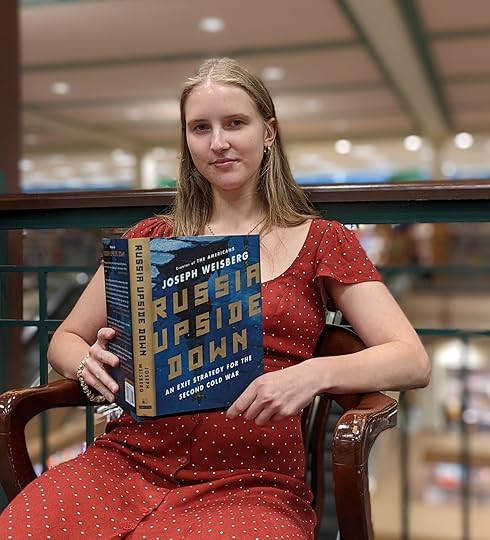
A former CIA officer and the creator of the hit TV series The Americans makes the case that America's policy towards Russia is failing--and we'll never fix it until we rethink our relationship. Coming of age in America in the 1970s and 80s, Joe Weisberg was a Cold Warrior. After briefly studying Russian in Leningrad, he joined the CIA in 1990--just in time to watch the Soviet Union collapse. But less than a decade after the first Cold War ended, a new one broke out. Russia changed in many of the ways that America hoped it might--more capitalist, more religious, more open to Western ideas. But US sanctions have crippled Russia's economy; and Russia's interventions have exacerbated political problems in America. The old paradigm--America, the free capitalist good guys, fighting Russia, the repressive communist bad guys--simply doesn't apply anymore. But we've continued to act as if it does. In this bold and controversial book, Joe Weisberg interrogates these assumptions, asking hard questions about American policy and attempting to understand what Russia truly wants. Russia Upside Down makes the case against the new Cold War. It suggests that we are fighting an enemy with whom we have few if any serious conflicts of interest. It argues that we are fighting with ineffective and dangerous tools. And most of all, it aims to demonstrate that our approach is not working. With our own political system in peril and continually buffeted by Russian attacks, we need a new framework, urgently. Russia Upside Down shows the stakes and begins to lay out that new plan, at a time when it is badly needed.
In Russia Upside Down, Joe Weisberg attempts to re-evaluate the US-Russia relationship (and US-Soviet relationship that preceded it), with mixed results. Weisberg is in his 50s, i.e. old enough to have come of age in the later years of the Cold War, and the first half of the book is dedicated to knocking down a lot of the misconceptions that he, personally, had about the Soviet Union growing up. These misconceptions were no doubt common among his peers, and this section is, I imagine, more useful for those who lived through the Cold War. But for those of us young enough not to remember the Soviet Union (or who were not even born before it fell) it's kind of hit-or-miss, since many people don't think or learn enough about the Soviet Union to develop those misconceptions in the first place. So, it makes some points (an exhaustive examination of the role of the KGB in Soviet society, or the history of anti-Semitism in the USSR) quite interesting, as it's information we don't often hear these days, but others (like the fact that not everybody in the USSR wanted it to collapse, or people who have a more or less positive opinion of Stalin weren't all brainwashed) kind of a waste of time. Of course not everybody wanted the union to collapse -- stability and national strength are important to people, and there was little reason to think the fall of the USSR would be smooth and productive; of course people can have a nuanced opinion of their significant historical leaders -- Weisberg makes the comparison to American opinions of George Washington, although owning slaves (while heinous) pales in comparison to Stalin's purges and pure death toll, so a better comparison probably falls closer to Andrew Jackson. The upshot is generally that the Soviet Union was not the evil empire it was often portrayed as being, and that black-and-white worldview was not productive at the time.
Weisberg then attempts to give the same treatment to the current US-Russia dynamic, which often boils down to "Russia isn't the literal devil, and Russians are people, too, and patriots, and think how America would react if another country was doing to it what America does to Russia." Which, yeah, is often valid, and the advice to tone things down a notch is never too bad an idea. But he does sometimes stray uncomfortably into moral equivalencing -- like, saying we can't really judge Russia for having repressive anti-LGBT laws when America also had discriminatory policies against gays decades ago, or we can't judge Russia's oligarchs and kleptocrats because too much money in politics is also a problem in the US, or we can't judge Russia's wars in Ukraine or Georgia because of Afghanistan and Iraq. The comparisons are good to point out, since it helps put things in perspective -- you can imagine a Russian patriot viewing American criticism as hypocritical or self-righteous -- but that doesn't mean they're entirely valid. Likewise, Weisberg's attempts to contextualize Putin as a smart, capable leader who actually cares about his country, not just a dictator out for his own power, are valid but stray uncomfortably close to whitewashing. Weisberg acknowledges that is a difficult tightrope to walk, and your mileage may vary on how well he manages that.
The final section of the book is Weisberg's advice for how to smooth out the US-Russia relationship, which tends to be a little kumbaya for my tastes. Some points are good -- adopt a less self-righteous and smug tone when conducting diplomacy with Russia, and focus on areas such as fighting terrorism, protecting the environment, and drawing down nuclear arsenals where we can plausibly find common ground with Russia -- but some just seem impractical, like his pat suggestion that both countries agree to stop spying on each other. Much is made of Weisberg's past as a CIA agent in the press for this book (despite him only ever being a trainee), but he has a particular bugbear about espionage being useless and seems to think that a) agreeing to stop spying is a simple thing to do and b) it's going to improve diplomatic relations a ton. I don't know if I buy any of those premises.
Thanks to NetGalley and Perseus Books/PublicAffairs for the ARC.
In this book, "Americans" show creator Joe Weisberg re-evaluates the US-Russia relationship and provides recommendations as to how it can be repaired. I found this book to be somewhat of a mixed bag. In the first half of the book, he spends time unpacking the misconceptions that he (and presumably many other Americans) developed during the Cold War. I would assume that this section would have been more enlightening for someone who lived through the Cold War and has done little reexamination of their biases since then, but as someone not old enough to experience the Cold War, I thought all of his conclusions were fairly obvious. Perhaps the most obvious points in this section were that not all Soviet citizens wanted the USSR to collapse and that Soviet citizens still managed to live complex, relatively full lives despite political oppression. In my opinion, none of this was as revelatory as the author thought it was.
Throughout the book, Weisberg also attempts to compare the US to the USSR/Russia to demonstrate that we are more alike than different. Some of these comparisons work somewhat well.Many others are a stretch. He gets uncomfortably close to excusing anti-Semitism in the Soviet Union by arguing that the US was also anti-Semitic at the time. He also makes the point that we can't necessarily judge Russia for having anti-LGBT policies because America used to have anti-LGBT laws, that we can't judge the KGB for its repression and torture because the CIA has done similar things (shouldn't this mean we should judge the CIA as well?), and that we can't really judge Russia's annexation of Ukraine because of our long list of foreign interventions abroad. Perhaps less examples would have served his point better.
The final part of the book is Weisberg's suggestions for repairing the US-Russia relationship. I agree with the crux of his argument here and thought he argued it well: that the US should be less self-righteous in its dealings with Russia and that there are significant areas of common ground between the two countries that should be focused on. I did feel that some of his specific solutions were unrealistic, but Weisberg himself acknowledges this.
Overall, I thought this book was kind of frustrating. Too much of a focus on finding specific equivalences for US and Soviet/Russian behavior damaged his argument and caused the book to drag.
Thanks to NetGalley and Perseus Books/PublicAffairs for the ARC.
I found this to be a very frustrating book. Mr. Weisberg is the creator of The Americans TV Program. In this book Mr. Weisberg who once worked for the CIA has re-examined his thinking about the USA and Soviet/Russia and how we should manage this relationship. Clearly the US/Russian relationship is not working to benefit either country. He begins by suggesting the old paradigm that the US is everything good and Russia is evil is the problem. Yes, I can agree with this point. But in making his arguments he poses vary false equivalency between our two countries. An early example; Stalin killed many Soviet people but the US also killed many Native Americans. More recent are his arguments that Putin is not a bad guy. He poses the question “Is Putin a killer? He then breaks this down to four groups: • Domestic Terror meaning blowing up Soviet apartment buildings and blaming the Chechens. His response Putting not involved • Putin order to kill journalists. 28 have been killed inside Russia. He doubts Putin was involved • Putin ordered to kill spies and traitors – probably • Putin ordered to murder political opponents – unclear I think holding these opinions does nothing to find a better way to deal with Russia. Lastly when it comes to Kleptocracy and Oligarchy in Russia maybe there is a little but even in America politicians make lots of money when they leave the government. Again, false equivalency. Should we find ways to work with Russia where we can? Of course. But one has to base it on who we are dealing with.
Years before writing this book, the author ‘stumbled into therapy’ (p. 30 of the 338-page e-book edition) to cope with the loss of his father. The theme of his soul-searching and healing process recurs throughout the narrative. It is apparent that the book itself is part of this process and was written to share with the reader the intimate corners of the author’s emotional world. The means of this sharing is unconventional to say the least: by reviewing the social and political history of the Soviet Union and the current affairs in its successor state Russia. The book’s genre thus is a blend of socio-political commentary with a soliloquy of a patient in counseling.
Mr. Weisberg has a deep, almost sensual attachment to Russia. … His affection goes beyond politics as he admits towards the book’s end. … He sees Putin in his dreams (p.286), how they are having a refreshing walk, engaged in a congenial conversation, and he persuades Putin to change his ways. … Now he fantasizes being imprisoned by Putin (p.286). Perhaps (this is now my extrapolation), being flogged by Putin, or in front of Putin, or flogging Putin, or flogging himself. … He is all ‘empathy and understanding’ (p.286), Mr. Weisberg is. We learn from his book that the Soviet regime was good … brutal and good … millions died in civil wars, famines, political purges … those in power could be nicer, but that’s just their way … we must be tolerant and sympathetic … empathy and understanding … KGB was good … have kept a gun to the nation’s head for a century, used it at will, and sent hit men around the world … many honest people worked for KGB … it was just a chubby bureaucracy that created many jobs for the economy, … their execution methods were humane … empathy and understanding … Collectivization was horrible and good …. Seven millions died of starvation, hundreds of thousands were dispossessed, executed or exiled … Factory workers were fed, the nation was industrialized, not everybody was arrested and sent to Gulag … not all is black out there, just different … empathy and understanding … Stalin was a tyrant and a nice fellow … ruthless dictator … won the war … saved the world … could have killed every fellow countryman but chose not to … empathy and understanding … Putin is an autocrat and a soulful man … decimated civil society, jails and kills his political opponents, dreams of restoring the empire, blames everything on America … Russians like it that way, support Putin … he is a patriot, defends his country … what else is he expected to do? - we shouldn’t have antagonized him… It is all nuanced and complex out there … empathy and understanding…
Thus continues the author’s somnambular blabber - for ¾ of the book until his writing lapses into a quixotic mixture of Jungian analysis, author’s unbosoming of his ‘soft spot for dictators’ (287), his grief over the collapse of the Soviet Union, and his call for a withdrawal into Buddhism-style self-discovery through contemplation. The latter is offered as an antidote to the fallacies of black-and-white thinking and proactive foreign policy (p.299).
In its more coherent part, the book represents an egregious case of ambiguity. The author recognizes both good and bad and makes no distinction between the two: there is a flip side to everything, you see, and no room for conclusive judgment. Don’t get me wrong, he implores the reader, I hear you all. I appreciate and accept all the opinions, they all have merit. I don’t want to be criticized, so I want to preempt your criticism. I know how those on the left will attack me and how those on the right will be disgusted, and those in heavens will brood, and those in hell will be enraged. You all are right. I am not trying to make any point out of all the contradictory facts in my book. But could you, he begs, just think it over for me without rushing to conclusions? Can’t we all live in peace without judging each other?
The author’s empathy is everywhere, his judgment, indeed, is nowhere. This kind of moral relativism proves utterly immoral when it comes to the political and social matters that are affecting dozens of millions of people and have lately escalated to regional and international crises. Mr. Weisberg confesses to his deep-seated opposition to ‘groupthink’ (p.284). He sees himself as a contrarian, an iconoclast. Paradoxically, his writing projects an image of an unprincipled opportunist.
Russia is in the grips of an authoritarian, kleptocratic clique, and this book serves its propagandistic agenda. How? - By confusing the readership enough to plant a reasonable doubt in their minds as to the true nature of the regime. Any autocrat would covet and welcome this kind of propaganda for export. For domestic purposes they use less subtle methods in Russia: browbeating independent analysts on talk shows, xenophobic brainwashing on prime time news, and inciting the mob against the leaders of the opposition. For the western audience, Mr. Weisberg’s book is just what the doctor ordered. An average reader would read this book only to conclude: Gosh, it really is complicated, God knows what’s going on in Russia, no way to tell false from true, the best thing for us is probably to continue to do nothing about it. The book serves the time-honored tradition of appeasing the Dictator. – It hardly worked in the past as Mr. Weisberg’s late parents or the collective memory of the Jewish people could remind him.
How did this book happen at all? One possible explanation is that it has been written by a wide-eyed dilettante with a soulful streak in him. The author writes that he had picked an anti-Soviet bias from his liberally-minded parents, then became enrolled in a Soviet studies program at a University, spent some time in Russia to learn the language; apparently never learned it (used translators and Russians with inside experience in his research for this book), applied for a CIA job, quit while still in training, then, along the way, went into counseling, then, as we know, created a relatively acclaimed TV suspense “Americans”. Finally wrote this book, admitting to not having read to the end most of the titles on his source list. – A haphazard outpour from a ‘useful idiot’? Perhaps.
Alternatively, a less benign explanation comes to mind. His protagonists in ‘Americans’ are KGB agents, serial killers of innocent Americans, high-tech thieves and all together very likable people. Also very likable is the FBI agent who chases them for many years (seasons) on end. When this ‘likable’ catches the other two ‘likables’ in the series finale he sets them free, committing a professional and civic act of treason. I now understand why: bad people simply do not exist for Mr. Weisberg, therefore no moral judgment or ethical action is possible or desirable. The immorality in words in ‘Russia Upside Down’ becomes (in the reverse chronological order) immorality in action in ‘Americans’. An FBI agent in stupor instead of action with a blunted sense of whose side he is on – this is Mr. Weisberg’s hero, a paragon of moral agnosticism. So, what is his love affair with KGB and it’s heirs about? The author timidly suggests he may have an affinity for dictators (p.287). Is this love unrequited, I wonder.
An important role in Mr. Weisberg’s review is assigned to comparisons between the USSR/Russia and the United States. ‘Whataboutism’ is the Kremlin’s patented method of rebutting the West. This book follows suit arguing that we are no better than the Russian leadership in many ways and therefore have no moral authority to judge them. To this I would like to remind that two wrongs don’t make a right. The U.S. and Russia must be held to a moral account separately and independently, according to each one’s deeds and misdeeds. There may be no wash between the two. In the book’s context, Russian authorities should be judged on their own ‘merit’, based on their stifling grip over the nation, mendacity, and expansionist threats. Other books will be written in addition to those many already written to bring out the skeletons out of the Washington’s cupboard.
The author and the readers of this book should be reminded that Kremlin’s foreign policy including their relations with the U.S. are secondary to their domestic agenda. The latter is pivoted by the imperative of preserving themselves in power, that is keeping the populace in obedience. Rallying the people against a threatening enemy to the drumbeat of an impending war is a proven tactic, and the U.S. is assigned the role of Russia’s existential nemesis. The ritualistic incantations of the good will that permeate the book are naïve and misleading because they appeal to the regime to act in self-negation by changing its nature. At the institutional level, Russia’s leadership will remain anti-American. At the personal level they rely on the U.S. and the West: they keep bank accounts and buy property, send their children to study, and their families to live in the West.
A reprehensible feature of the book is the lack of clear distinction between the nation and its leaders. There is no Russia as a unified concept. There are the Russian people, creative and hardworking, with survival skills honed over the centuries of oppression at the hand of their own government, and there are authorities who can give or take at will, and who regard people’s needs as a distant second to the priority goal of enriching themselves. I do not believe the author when he says and reiterates that the Russians have the leadership of their choice. In reality, they want the bureaucracy off their backs, they do not want their children to die in Putin’s wars, they want to be represented by legislators and judges held accountable through a normal electoral process.
To remark on the book’s composition, it is eclectic and amorphous, certain sections (e.g., the Epilogue) are intended, apparently, to recycle the scraps of draft writing rather than to advance or wrap up the story. The author has several ways to articulate the same material and is unable to give up on any. Hence, a tiresome repetitiveness. And his soul-searching monologues of a reflection-prone patient that continue for many pages are out of place and off-putting.
In conclusion, the author succeeded in raising his self-awareness to an impressive height of inwardness and self-examination. Unfortunately, his introversion did not help him with self-identification. He is aware of himself all right but does not know who he really is, and what he stands for. In fact, he haughtily stands for nothing. Is his experience with personal self-awareness then worth extending to this country’s political culture? – I am afraid, he did not argue well his case for self-awareness in politics with this book; perhaps even discredited the idea.
Interesting rethink of the Soviet Union that many Americans think of being a monolith. Does not really use concrete examples and vacillated between his personal experience and opinions and uncited facts for there to be a cohesive argument
The author debunks some massive Cold War ideology here. It's very useful for those who were raised in a similar mindset to his:
"I was a product of a common type of political upbringing in America, influenced both inside and outside of the home to believe we were the undisputed greatest country in the world—in fact, in all of history. We had flaws, but they were minor compared to those of other countries. Combined with certain aspects of my own psychology and family environment, this turned me into a hard-boiled cold warrior, a black-and-white thinker who saw the Soviet Union as the dangerous, tyrannical enemy of freedom, and the United States as the virtuous guardian of democracy and goodness. They were the bad guys, we were the good guys."
Now, personally, I am not a Boomer. My parents were, and had some of these ideas too, but I meandered into an AOL chatroom in the mid-90s, made some friends from Australia and the Netherlands, and began learning about the world not according to the US. I then majored in Russian studies in college, so I am really not the audience for this book. But I appreciate that the author is doing the heavy lifting that I get tired of doing, challenging the Cold War rhetoric that justified funding the US military-industrial complex. Now, in the context of the Russian war in Ukraine, some of this book is already out of date, e.g.:
"I will challenge the notion of Putin as a ruthless dictator, and the idea that modern-day Russia is best seen as a highly repressive, deeply corrupt state. "
Erm, I guess you could still apologize for Putin and his regime in 2021. Anyway. if you're a US Boomer who doesn't own a passport because your annual vacation is Disneyland, read the first seven chapters of this book. Everyone else, maybe just follow some Ukrainian journalists on Twitter.
Thank you to the publishers and NetGalley for the opportunity to review a temporary digital ARC in exchange for an unbiased review.
Joe Weisberg je kreirao kapitalnu televizijsku seriju THE AMERICANS u koju je uneo svoj relativno minorni staž kao CIAša i sudeći po knjizi RUSSIA UPSIDE DOWN veliki interes da se životno pa i ideološki preispita.
RUSSIA UPSIDE DOWN je Weisbergov obračun sa samim sobom i svojom mladošću koju je proveo kao reganovac i "hladni ratnik", da bi potom više upoznao SSSR a potom i Rusiju, shvativši da stvari nisu crno-bele čak i onda kada mnogo toga jeste nesporno crno.
U ovoj knjizi, Weisberg iz pozicije čoveka koji ima u suštini mejnstrim političke pozicije za američke standard preispituje percepciju SSSRa i Rusije i pokušava da dokaže kako, uz sve idiosinkrazije, to nije bila Imperija Zla, kako to nije bila jedna isključivo monstruozna, represivna država bazirana na zločinu već jedna zajednica u kojoj je većina ljudi zapravo imala dobre namere a kanalisala ih je kroz ideologiju čije provođenje ponekad podrazumeva određene oblike terora.
Weisberg nije apologeta ni Staljina ni Putina, ali veoma razumno postavlja razne stvari u kontekst i pokazuje ne samo složenost raznih procesa u SSSRu i Rusiji, već i složenost ličnosti koje su vodile tu državu, sa zanimljivim tumačenjima biografija inače dosta jednodimenzionalno precipiranih figura kao što su Andropov i Černjenko.
U Srbiji, ništa od ovih stvari nije nepoznato na nivou ideje. Međutim, Weisberg kao Amerikanac prosto ne može se bi pravno da dozvoli da piše gluposti i da se vodi osećajem, tako da on ovde sve to dosta argumentuje. Otud, čitaocu u Srbiji ova knjiga principijelno ne nudi ništa novo, ali ono što znamo argumentuje i slaže na jedan stabilan način.
Otud, mislim da bi ova knjiga - iako primarno namenjena Amerikancima - veoma prijala srpskim čitaocima. Upravo zbog toga što bez potrebe za bilo kakvom urođenom simpatijom, dobro objašnjava ono što osećamo o međunarodnim odnosima, i razbija mnoge stereotipe koji se koriste u denuncijaciji Rusije (kao da ona sama nije u stanju da produkuje dovoljno nespornih argumenata protiv sebe bez posezanja za klišeima o Staljinu i njegovim uveocima).
Ova knjiga prožima Weisbergovu ličnu sa ideološkom transformacijom što je zanimljivo kao referenca na njegovu seriju jer i u njoj imamo tu Peak TV postavku gde junaci koliko god da je uzbudljivo i zanimljivo to što rade - na kraju dana moraju da rešavaju lične probleme.
I picked up this book after my son and I saw it in a book store. He is very interested in foreign policy, especially related to Russia and Ukraine. It was displayed with a bunch of other truly outstanding books on the same topic, such as Gates of Europe, with some favorable blurbs from apparently knowledgeable folks. I also have enjoyed the Americans and recognized the author from that context. In addition, from the book jacket, I learned that the author also had worked briefly for the CIA, which seemed to lend the book more credibility. I debated giving this book a 3. I might have given it a four for readability, especially relative to other books that I have been reading on similar topics, notwithstanding the fact that it is repetitive and navel-gazing. But I have to give it a 2 overall because the arguments in the book are so weak, infuriating, and poorly reasoned. The book is basically one giant apology for the Soviet Union, Russia, and Putin. (I guess it was lucky (?) for the author that it came out right before the invasion of Ukraine.) Essentially every argument in the book devolves into what-aboutism. Yes, Stalin killed millions, but the US had slavery and killed Native Americans. Yes, Russia invaded Ukraine, but the US invaded Iraq. Yes, Russia interferes in our elections, but we promote democracy in Russia. Yes, the Soviet and Russian governments have been oppressive, but they deal with inequality better than we do. Or the author tries to frame truly atrocious behavior in an unnecessarily favorable light. Yes, Putin kills his opponents, but only real traitors. On top of that the whole thing is packaged in a bunch of psycho-babble related to how going through therapy made the author's political views more nuanced. And generally the author's voice is too present and too personal. I can't believe that I paid money for this book and actually read the whole thing.
"I'm from Ukraine. I moved to the US in 2007 when I was 8 years old. I'm Ukrainian but have a lot of family from Russia because of the Soviet Union, you know, it was very tricky and everyone kind of migrated around. With some family still in Russia, and with the escalating conflict right now, I feel like I should be more informed about some of the stuff happening. People in Russia and Ukraine are giving me their own outputs. America has their own as well. So I'm like, okay, I just want to read everyone's opinion. Most of my family in Ukraine had to flee towards Moldova. Some went to Germany, like my friends. My grandma lives in Crimea with her husband and right now they're very affected by things. We can't really send them money anymore and with all the other countries denying refugee status to Russian citizens, it's kind of like entrapment there in other countries. This is not the first time. When the whole Crimea situation happened in 2014, my grandparents lost their papers, so it was double difficult for them. They said nothing really changed, but also everything changed in like a second. They're not wealthy either, so it's even harder for them. My step-grandpa had 3 strokes already. He's a medical miracle."
I talk to humans reading around us. Check out some of my links if these posts peek your interest! Linktree
Despite my 3 star review you should to read this book. if that is you are an American who wants to understand Russia from an understandable American point of view. It's so rare to get anything even approaching an attempt to explain Russia from an American who is not pro- or anti- Russia. He does cover a lot of ground to address misconceptions, perhaps, about the Soviet Union and current Russia, or Russia as it was in 2020.
Obviously as the creator of The Americans, he knows a thing or two about the country. Still, in some ways, this is SWING and a MISS. To the points he makes about the Soviet Union and what it was like, he's right to say it wasn't like say Moscow on the Hudson dark. But he goes a little far stretching to defend it at times. And there are other Soviet writers who do contrast with his American post-Soviet fall view. It's a little disorganized, sometimes I feel it's his published notepad or something rather than an organized book. He makes some weak points and poor comparisons that made me cringe.
He wrote the book before Ukraine, and he says in the book under bad things Putin did "and all the things he will do after I publish this book" so I don't think you need to read this book with
The author bends over backwards to put a positive spin on everything done by the Soviet Union/Russia clear back to the Russian Revolution. This includes Stalin's gulags clear through Putin. To back up his opinions, he makes comparisons to U.S. actions that he paints as "just as bad." I read this with an open mind but, in the end, I'm just not buying it.
Non-fiction by former CIA agent who proposes looking at Russia, former USSR & Putin from non-Western viewpoints and shows how that can improve analysis of the actions & beliefs of same. It is worth reading. Some of his ideas are controversial, and he acknowledges throughout that is has doubts about some/much of what he thinks.
I was not a fan of this book. His arguments were weak and poorly organized- it felt like he was desperately trying to demonstrate how the USA was just like Russia and “they did bad things but so did we”. This conveniently was published prior to Russia invading Ukraine, so I’d be curious to know if the author changed his tune.
I had such high hopes for this book, but it was nonsensically organized, badly written, and tried to cover all sides, resulting in a weird mish-mash of "Russia is bad, but not that bad, but yeah it's bad, but we're also bad...." loop-de-loops. Big disappointment
Long winded, scattered, poorly organized. Paper thin arguments when he claims things like “Putin and Stalin were great guys.” This feels like pro soviet propaganda and was a DNF which I almost never do.