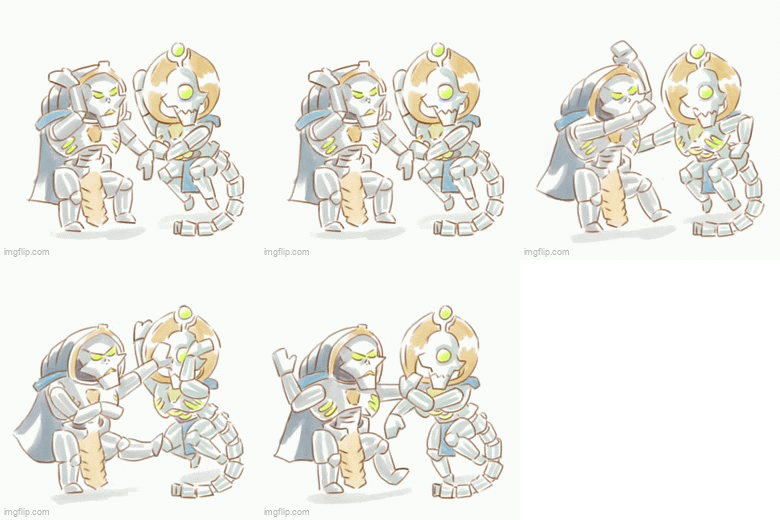
Well, at least this one is a tie-in to a game I've actually played, though not recently, and the Necrons were an element introduced after my first bout with 40K. A brilliant idea, though: a race from millennia in the past, who transcended the flesh and now have distinctly mixed feelings about that, in so far as they have feelings, because the fidelity of their transfer to immortal metal bodies varied massively in line with their social class. Legions of warriors retaining only the barest fragments of self, answerable to overlords who were transferred almost intact, but never quite, their eccentricities and rivalries then only deepening over the long centuries. Nate Crowley's Severed played this mostly for gruesome laughs, a Jeeves and Wooster riff with zombie robots, but while there's plenty of comedy here too, from Spy vs Spy battles between two immeasurably ancient and devious rivals to the fish-out-of-water appeal of seeing them interact with younger and livelier races, the dominant mood is somewhere between cosmic horror and space opera. We open with a recapitulation of deep time, a potted history of life as a whole, from its inception up through fish and lizards to the sort of races who get their own army list, but always, from the earliest days, "Layer upon layer, each generation withering and ossifying, so the living stood unthinking upon a vast necropolis of their predecessors."
This will become a recurring theme: how cultures change, and build on what came before them; how they retain things from the past without even realising it, in ways only noticeable if you happen to be, say, an immortal historian visiting the same planet at intervals across a span greater than that of whole civilisations, never mind individuals. Set against that, the way the Necrons have removed themselves from the whole process, what they've gained from that and what they've lost. They have all the time in the world(s), time to think and plot and study – but also time for their plays to get longer and longer to no great end, and to ponder on how much is forever out of their grasp. I found the comparison of memories from the flesh times to childhood especially poignant – "one knows the colour blue, but cannot recall the first time one knew its name". Almost every page is like that; there's always some little extra detail, some twist of prose or craft it could easily have got away without when there are robot skeletons fighting dinosaurs with ray-guns. Yes, it was probably inevitable that across a book of this size and scale the two rivals, after escalating to deadly enemies, would end up forced to work together, but the Macguffin over which they're struggling is realised in much more satisfying depth than many of its kind, starting out as something like the Voynich Manuscript except with six different plausible solutions, before going on to become even more ingenious. Nor is it merely a trophy, but a focus for two incompatible philosophies, one seeking to preserve it as an artefact of the treasured past and the other to use it as a gateway to the future.
Being a little out of the loop, I'm not sure how much of the lore here is freshly created, how much already established*. Certainly it's the most I've ever seen of the oft-hinted-at Hrud, who for the first third of the book get more stage time than our own kind, who barely crop up beyond appropriately dismissive mention of "the humans' recent civil war". This makes for a wonderful corrective to the tendency of 40K, and indeed science fiction generally, to spend so much time with humans, despite the fact that I can get plenty of them in every other genre. And even when that changes, it works, because we see it through the (mechanical) eyes of one of the leads, Trazyn, who begins as unimpressed with humans as I am: "He collected them, of course, he collected everything. But he considered them on the same level as orks, or various kinds of carnivorous algae." Then, though, the Horus Heresy adds drama, and being as much of a messy bitch as a scrupulously organised, non-organic entity can be, suddenly humans are a bigger deal for him. Especially given some of the possible specimens for his planet-sized collection: "the Emperor was just sitting there on Terra. Seemed a waste, such a historic figure left to rot like that." And through little details like that, not to mention the way in which Trazyn and his rival, the mystic Orikan, eventually develop a grudging and intermittent respect for each other, we get little hints that maybe there are ways in which even the ossified Necrons can change. The psychological intimacy of that constantly balanced with planet-smashing battles, nifty ultratech, and guest appearances for pretty much every 40K faction except the Tau, because fuck those guys. It has the full-spectrum satisfaction only really available from art which knows that minimalism is for cowards – obviously more is more, this isn't difficult – but also knows that if you can't manage nuanced character moments against that background, you're basically just shouting.
*Although one bit I do know isn't Rath's fault is the two superfluous vowels which irritate me every time the 'Aeldari' are mentioned.