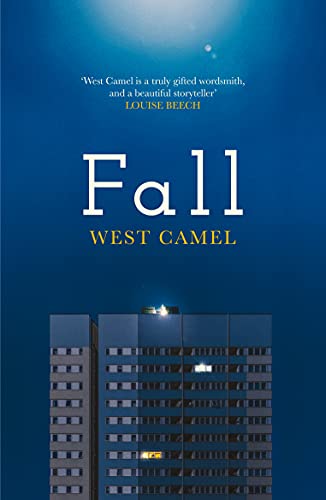
Estranged brothers are reunited over plans to develop the tower block where they grew up, but the desolate estate becomes a stage for reliving the events of one life-changing summer.
Twins Aaron and Clive have been estranged for forty years. Aaron still lives in the empty, crumbling tower block on the riverside in Deptford where they grew up. Clive is a successful property developer, determined to turn the tower into luxury flats.
But Aaron is blocking the plan and their petty squabble becomes something much greater when two ghosts from the past – twins Annette and Christine – appear in the tower. At once, the desolate estate becomes a stage on which the events of one scorching summer are relived – a summer that shattered their lives, and changed everything forever…
Grim, evocative and exquisitely rendered, Fall is a story of friendship and family – of perception, fear and prejudice, the events that punctuate our journeys into adulthood, and the indelible scars they leave – a triumph of a novel that will affect you long after the final page has been turned.
Author West Camel’s debut novel ‘Attend’ was a spell binding and beautiful story with a hint of magic realism, so I was excited to be reading his latest book “Fall” knowing for sure it would be another rewarding and engaging story.
- Estranged brothers are reunited over plans to develop the tower block where they grew up, but the desolate estate becomes a stage for reliving the events of one life-changing summer, forty years earlier. -
Set in the sweltering summer of 1976 which I remember quite well, this slow burner of a tale tells the story of two twin brothers, Aaron and Clive Goldsworthy and their single mother Zoe. As they move into a recently built London tower block designed by architect Zoe, they become friends with black twin girls of a similar age and form a unique friendship, before a single night in 1976 changes all of their lives forever. Switching between then and the present day, I enjoyed reading how the events of 1976 still affected Aaron’s and Clive’s life today, learning that they are estranged and at opposite ends of the spectrum. West Camel has told a story of multi layered prejudice, love, grief and the struggle of a woman in a very male dominant world, where women did not overtake men in their career. Zoe was not a main character per se but it was her feelings and emotions that struck me the most and as a mother myself, I obviously related to her concerns and parenting issues. “Fall” is very much a thought provoking journey of life through a time when racism was the norm, rather than just a novel about family life and it’s divide. This story is one of those books that come along that you’ll never forget and grips you from the first page. It moves along gradually without hurry and is a story I would recommend if literary family drama is your interest.
An absolutely excellent novel - descriptively beautiful, a tense and compelling family drama set over decades with two sets of twins central to the plot.
Not going to give anything away but this is not only a page turner but a literary delight, a book you devour, one that leaves you melancholy.
I couldn’t help but fall for Fall. There is so much to unravel in this multi-layered novel that I could write several critical analysis articles.
Aaron and Clive Goldsworthy are 62-year-old twins who have been estranged for over 40 years. Aaron is the sole occupant of Marlowe Tower, part of a 1970s housing development designed by their mother Zöe on the banks of the Thames in southeast London. Clive is a successful property developer who wants to turn the tower into luxury flats, but Aaron refuses to move. When Annette and Christine Mayfield, a pair of black twins who lived in the tower in the 1970s, move back in, both Aaron and Clive must confront what happened the summer of 1976 and its aftermath.
From the beginning, there are many unanswered questions: Why are the twins estranged? Flashbacks to 1976, when the two were 18, show them being so close that they have a psychic connection. Now they live across the river from each other but haven’t communicated for four decades. What happened? Why do both of them fear the return of the two black women? When Aaron and Clive first met this slightly older pair of twins, they were immediately drawn to them and spent a great deal of time in their company.
Characterization is amazing. All characters are complex and flawed; in other words, they are realistic. At times I would feel compassion for someone and at another time, frustration with them. What especially impressed me is the characterization of the twins. Both direct and indirect characterization techniques are used. We are told that “Clive dislikes – intensely dislikes – having his plans thwarted” and that Aaron is so “infuriatingly obdurate” that he “can never be persuaded of anything.” Then we are shown these traits in their actions and thoughts. I had no difficulty distinguishing Aaron and Clive. Clive is the leader in that he is more forthright, whereas Aaron is rather diffident. The same is true of the women: Annette is more like Clive, while Christine is more similar to Aaron.
I found Zöe such a fascinating character that I’ve added her to my list of fictional characters I’d love to meet in real life. She is a strong, forceful person with a take-charge attitude. As an architect, she is able to help dictate how people move around, and she tries to do this with her family as well. It becomes obvious, however, that her sons do not know her as well as they think. Aaron’s comment that Zöe is complicated is really an understatement. As an architect, she struggled in a male-dominated field and had to make difficult choices between motherhood and professional advancement. Though she tried to build a space where people from different walks of life would live together and even moved her family there, she continued to send her sons to schools outside the area. Though supposedly concerned with egalitarianism, her including secret corridors and hidden doors in the building just for herself and her sons suggests a sense of ownership and superiority. I found myself aghast at some of her choices and in awe of others, but always she behaves in keeping with her personality and priorities.
Though it is Zöe who is described as having a God complex, the narrator also behaves like a divine entity. The omniscient point of view is carried to an extreme. In the novel’s opening, for example, the reader is given a bird’s eye view of London before being invited to swoop down: “We can drop even lower” and “And you might, if you trusted your wings enough to take you down even further, notice . . .”. The narrator has unlimited access to all his characters and reveals their thoughts and gestures in minute detail, thereby developing character - though he also withholds information to create suspense. It is the point of view that makes for such a satisfying closing in the last chapter.
The book examines a number of issues; one of the major ones is racism. Annette and Christine experience prejudice on a regular basis once they move into the housing complex. As events unfold, it becomes clear that racism determines the fates of virtually everyone, not just those of the black characters. Zöe’s options, for instance, are restricted not just because of gender discrimination but also because of society’s attitudes towards blacks.
The title is perfect because it works on so many levels. There are physical falls, fallings-out, and lives falling apart. The housing estate is falling apart. Reading the novel is a process of slowly watching everything fall into place. And how perfect is it that the last word in the book is fall!?
There is so much more I could discuss because there are so many admirable qualities: the elegant prose, the symbolic use of architecture, and the subtly foreshadowed plot twists. There is a great deal of tragedy because so much is lost by so many, but that does not mean there is no hope. I could criticize the slow pace at the beginning and some coincidental meetings, but that would be caviling. This is an extraordinary novel, both immersive and impactful.
This is the third book in recent weeks that I have read, where a tower block is pretty central to the narrative (referencing True Crime Story by Joseph Knox and The Unheard by Nicci French). In this novel Marlowe Tower is at the heart, part of a 1970’s Deptford development and the brainchild of Zoe Goldsworthy, a woman in the distinctly male dominated world of architects. She was so convinced of the merits of the concept that she took her twin sons Aaron and Clive to live there, convinced that communal living was the future. They left behind her architect designed house, which had been the family’s home until that point.
However, now, Aaron and Clive haven’t spoken in 40 odd years. Clive is a property developer and speculator, and is closing in on the estate. A huge thorn in his side is Aaron, who, it seems is the sole inhabitant of the tower, a significant stumbling block to the redevelopment whilst he remains in situ.
The appearance of Annette and Christine, ghosts from the past, is a surprise, and seemingly they are also residing in the tower. For them, the tower signifies a blighted period in their lives. They are black and in 1976 racism was even more rife. The reality of this social experiment evolved in a very different way than anticipated, as the characters all find out to their cost.
This is a dual timeline story which is beautifully brought to life by the author. He has a refined and sensitive writing style that enables the reader to pore over the lives of his characters, set against a bleak, crumbling and unforgiving architectural backdrop. The story in 1976 is filtered through an aged lens of grainy film which is a stark relief to the contemporary story. Pivotal events pull the reader out of the reading reverie the author creates, leaving the reader to reflect on what has occured in the novel, once the final page is turned.
Having read lots of 5* reviews on this book, I feel a bit like I’ve read a different story to everyone else and I am wondering why I did not feel the same way about it as others said they did in their reviews. I found the first part of the book slow and I almost gave up on it at one point as I felt no connection to any of the main characters. I did start to get more interested as the story progressed, and I am glad I finished it, but the revelations at the end did not come as a surprise to me at all. I was, however, filled with melancholy at the joyless and for some characters, grim lives recounted in this book. I know first hand how people can be affected throughout their lives by the actions of others, so I do appreciate that some people lead very sad and difficult lives. Perhaps that’s why I couldn’t feel connected to this book. Perhaps I am trying to justify to myself why I can’t give this book 5* like all the other reviewers.
Fall is a multi-layered, complex and intriguing novel about family ties, and societal structure. Even the title has many levels of relevance. Set in a 1970s, architect-designed community on the banks of the Thames, the concrete blocks, walkways and communal spaces seem like a perfect place for egalitarian neighbourliness, until two black girls move into one of the flats, bringing their friends, their music and their culture with them. Aaron and Clive, twin boys and sons of the architect, are drawn to the girls, also twins, challenging their mother's vision for the estate and her claim not to be a racist. The estate becomes a metaphor for society, riddled with secret stairways and hidden access points; it is far more complex and deeply-layered than it seems. The hot summer of 1976 swelters on the pages, baking the estate and pushing tensions to boiling point. Clever. Very clever. Forty years later the two boys, estranged for many years, are forced to face the consequences of their actions one sultry night. It did not surprise me to learn, at the end of the book, that the writer is an editor by profession. He, via his narrative voice, controls every move, hones every word and directs every thought of his characters. They are utterly his creations-and about as animate-as the cardboard maquettes the architect uses to model her urban village. He tweaks and poses them so that the light shines just so on their faces, pressing them together when they need each others support, arranging their facial expressions, their posture and their thought processes with infinite precision. I did not feel they had any personal volition; they were his puppets, helpless in his over-arching scheme. As an example of what I mean, it is inconceivable to me that two teenaged boys befriended by two older girls would not have sex on their minds. But, for the writer's purposes this cannot be, so they are sexless and, to me, unconvincing creatures. There is no doubt that this book is well-written, the prose spare but effective. It certainly has literary heft. I personally dislike books that play with punctuation. Here, dialogue was prefaced with an endash rather than the traditional speech marks. Why? But then again, the lack of he-said, she-saids was a clever device to show that, with the twins, it didn't really matter who said what. Until it did. And then it got confusing. I found the ending of this book rushed - gabbled out in dialogue - and completely unconvincing. It served the author's theme, not the characters or the story. Now I'm wondering why I gave it four stars rather than three. I think it is just that, for all its faults, there is beauty in it: beauty of prose, of metaphor, of relevance.
I honestly didn't know what to expect when I started reading this book. I knew from reading Attend that West Camel is capable of creating beautifully evocative prose, of taking readers on an unforgettable journey and had no doubt that would be the case again. And it was, but in a way that both contrasted with and complimented his previous novel, presenting readers with a story not steeped in magical realism as Attend had been, but a tale of past transgressions and grave mistakes, the kind of regrets that can tear a family apart. A tale of irreparable divisions, something that I am sure many readers would be able to identify with.
This is the story of twin brothers, Aaron and Clive, once as close as peas in a pod, as only twins can be, now estranged for reasons that will take some time to be revealed. It is clear that whatever happened in their past, it has far reaching consequences, one twin destined to stay in the flat that they once both called home, the other determined to tear it down. From the beginning I had to wonder how their fortunes, and their memories and attachment to the place Aaron calls home, could differ so greatly, but the more I read, the more I came to understand. This is a story that is awash with tragedy, the extent of which will not be clear for some time, and it is well hidden by moments of almost joyous celebration and freedom that comes in the shape of twin sisters, Annette and Christine.
It felt natural that Aaron and Clive should be so immediately drawn to Annette and Christine. Although older than them, the girls have a vibrancy about them, a love of life which adds a new dimension to the boys otherwise limited world. They are also Black, which in 1970s Deptford was a very big deal, and that conflict, that division between race and cultures is portrayed carefully but effectively on the page. There is the overt racism of the girl's neighbours, and them casual undermining of their position in Aaron and Clive's lives that we witness from the boy's mother, Zoe. all of which rang so perfectly true, and whilst not dominating the story to the degree that is becomes merely a story of class and racial divisions, it certainly informs it and shapes the fates of all of the characters in perhaps unexpected ways.
West Camel has created some very complex and multi-faceted characters in this novel. In spite of all of their similarities, both in looks and personalities, you still pick up on the subtle differences between Clive and Aaron from the very start. Clive is much more forthright and confident than his brother, his actions driving some of the most startling and pivotal moments of the story. Similarly, Annette and Christine are two very different personalities, but so very full of life that they bring a touch of magic and an entirely new outlook to Clive and Aaron's very limited scoail spheres. But it is Zoe who really fascinated me. She is a complicated character, very much lost in the wonder of her creative pursuits, obsessed with the apartment complex in which they live and that she was responsible for designing.
There is something almost aloof about Zoe, something that made me feel there were many things about her past that have yet to be revealed. She is lost in the world of her own making, perhaps trapped there to a degree too, immersing herself too deeply in the ideal of this wonderful new life in Deptford in a way that could never quite come to be. She was a woman ahead of her time, creating and designing great works of architecture in a time that still failed to properly acknowledge the skills and capabilities of a woman, to understand that they could be every bit as strong as that of a male counterpart. She is a point of fascination for Christine and Annette, her achievements a thing of almost legend in their eyes, although this in itself creates a point of tension that takes some time to be fully revealed and resolved.
This is a dual timeline story and West Camel has woven the two threads together perfectly, taking readers from the present day conflict between Clive, who wants to rip down and regenerate the old apartment complex, and Aaron, who doesn't, to the events back in the fateful summer of 1976 when everything changed. There is certainly more of a melancholic tone to the present day scenes, and the more we read, the more we understand of the past, the easier it is to understand the way in which the present has been shaped and perhaps darkened a touch. There is a vibrancy to the scenes form the past, in part due to Annette and Christine, but also because, back then, both Clive and Aaron, perhaps even Zoe, has a sense of hope and the possibilities for the future seemed unlimited.
The writing is beautifully descriptive as I would expect from this author, and the imagery strong, bringing each scene and setting to life on the page. There is a quirk in the styling, a slight twist on the typical punctuation and use of speech marks that some may find off putting, and I will admit it took me a time to settle into the flow of the book, but it really does work and suits the overall tone and style of the narrative. Above all, much like with Attend, this is a book that will elicit a whole array of emotions, allow readers to identify with so many aspects of the story and the lives of Clive and Aaron.
What may appear at first pass to be a simple tale of family tragedy and division, is actually an understated but complex tragedy, an undulating story of family, prejudice, power plays and injustice set against a backdrop of endless concrete, once inspiring a sense of hope and unity but ultimately driving loss and division. A hauntingly lyrical novel, full of memorable characters and littered with moments and revelations that can both surprise and yet seem almost inevitable all at once. Recommended.
Aaron and Clive are twin brothers who have been estranged for forty years. Both were brought up in Marlowe Tower, on the now almost uninhabited Deptford Strand Estate, by their architect mother Zoe who designed the estate bank in the 70s. Now Clive is a successful property developer, whilst Aaron’s life has scarcely changed; he is the last remaining resident in the crumbling Marlowe Tower block, his refusal to move a striking blow against his brother who plans to redevelop the tower into luxury flats.
When Aaron realises there are in fact other residents in the tower; two people he never imagined he’d see again, he is forced to confront the past in order to move forward. To revisit a summer from long ago, when one set of twins met another set of twins and planets collided.
What a rich and evocative novel this is. Seeped in imagery and detail, I felt like I was on that estate, I was in that tower. The book is definitely a slow burn, the feeling of decay and abandonment creeps into the story, wonderfully and very cleverly described alongside the gradual disintegration of the brothers’ relationship. The characters were mesmerising, every one playing a crucial role and the setting of this once inspirational, now desolate, crumbling tower block really sent shivers down my spine at times.
The only thing I wasn’t keen on was the lack of speech marks throughout. I know this is getting to be quite common practice but I’m not keen, I much prefer a speech mark to a dash. Long live the speech mark! Aside from that tiny little niggle I found this to be a clever and compelling story, which twists and turns and slips and slides - just like the secret passages hidden away in Marlowe Tower.
West Camel is such a brilliant writer. I loved his debut novel and his latest book, Fall, is another stunning, beautifully written piece of fiction. The prose is stunning and the characters are so well drawn. There is real magic in West Camel’s writing; it draws you into the worlds he creates and holds your attention.
We meet twin brothers, Aaron and Clive who both lived in the same apartment building in Deptford. It is their childhood home but both have different ideas for the future. The building is filled with ghosts from their path and this haunts them both. The brothers different ideas create a strain in their relationship. It also becomes apparent that there is a dark secret hidden in their past. I wanted to know more about this from very early on and I wanted to know what really went on between them. As the story unfolds West Camel begins to make clear why both brothers have a very different view of their home. And this is where the darker picture in the story begins to come clear. The novel is told over a forty year period. In 1976 something horrific happened at the tower which has affected the lives of everyone who was there that night ever since.
All the characters came to life well. We also meet another set of twins Annette and Christine who lived in the tower block in the 70s. They were the towers first black residents and you can clearly see how many people in the building feel about this. They strike up a friendship with Aaron and Clive and I really enjoyed reading the scenes when they were together. The dialogue between them was really well done.
Zoë Goldsworthy is another interesting character. She designed the tower block and I loved that we got added bonus material in the book, drawings showing the building how Zoë imagined it. Zoë is a character who fascinated me from the moment we were introduced to her. I wanted to learn more about her background and what role she had in the story.
There are some shocking final reveals as the full scope of the family tragedy becomes clear and West Camel reveals what really happened that fateful night that haunts Aaron and Clive’s memories. Fall is such a brilliant book and the title is perfect for it in so many ways. It is a multi-layered book that is so well written and thought out. West Camel is fast becoming a favourite writer of mine and I can’t wait to read what he writes next.
Brilliantly constructed and engaging story probing issues of family relationships, racism and the damage that can be caused by silence and secrets. The setting is a 1970s housing development in Deptford where the architect of the project, Zoe Goldsworthy, has moved with her twin sons. The timeline shifts between 1976 and present day, when the twins are estranged from each other and the estate has fallen derelict.
The author gradually unwraps the layers of secrets and misunderstandings that have led the characters to a tragic separation and their current isolation. The writing is haunting and sensitive, and completely pulled me in. The Deptford Strand Estate becomes a character in its own right - one that mirrors the life of the twins, full of hidden passageways and secret doors, gradually revealing itself to its occupants.
I really enjoyed this compelling story with its great sense of time and place and its engaging characters, and it was a great read - for me, the right book at the right time.
I read ‘Fall’ as a proof paperback, courtesy of Karen Sullivan & Orenda Books.
On the face of it, ‘Fall’ is a simple enough tale. Estranged twin brothers, Aaron & Clive, are reluctantly reunited when plans to develop the desolate, crumbling tower block they grew up in emerge. Clive is the property developer, Aaron the stubborn, lonely, last man standing, resisting all attempts to remove him. What follows is a story of greed, love, misplaced loyalty, morality, revenge & retribution, exposing the frailties of a family dynamic which includes the twins’ talented, mercurial & complex mother, Zöe, the architect of the building. Told in two perfectly paced & fluid time frames, it unfolds like a spell.
If the author isn’t a twin, then he is spookily au fait with the nuances that mark twin sensibilities; male & female. For he adds a second set of twins to this mesmerising story. Something I adored about ‘Attend’ - West Camel’s debut novel – was his almost instinctive understanding of his women characters. And he does it again with ‘Fall’. Annette & Christine, for all they are reliable & straightforward, are almost pure creations; their honesty makes them radiant & impossible not to admire.
West Camel’s empathy with the human condition – male & female – shines from the pages. In much the same way as he did with ‘Attend’, he embraces a myriad story elements with a lucidity that marks him as a writer to be cherished.
There was a moment in the book where I literally gasped out loud & said, ‘No way.’ No exclamation – it was a low, cool, wow moment & it took my breath away. 'Fall' is surreptitiously powerful stuff; it sneaks up on you, makes you love it & marvel at it. Makes you want West Camel to write another book. Highly recommended.
Like West Camel's debut novel, Attend, Fall is set in Deptford and although the two are completely separate stories, they share some similarities which will surely become hallmarks of this immensely talented author's books as his body of works continues to grow. The sense of time and place here is immaculate - the storyline switches effortlessly between 1976 and the present day and the lyrical flow of the prose invites readers to immerse themselves into a deceptively simple tale of two estranged brothers who are both equally determined not to give in to the other. Aaron still lives in the flat they grew up in. Marlowe Tower is a now crumbling building in a Deptford estate already undergoing the sort of renovation and regentrification that has seen so many Londoners cajoled and persuaded to leave the homes they had lived in for years. However, Aaron refuses to move and to complicate matters further, it's his twin brother, Clive who is the wealthy property developer behind the scheme to turn the flats into luxury apartments. As the book progresses, it gradually becomes clear why Aaron stayed - this flat, this tower, this estate was designed by their mother, Zoë Goldsworthy, a visionary architect who fought the system to become successful in her field at a time when women were expected to stay at home and leave the profession to the men. Her ground-breaking achievement, the Deptford Strand Estate might be a neglected, shabby shadow of the dreams it once promised to those who chose communal living in high-rise towers but in 1976, it is still filled with people living next to and on top of one another. The reasons behind Clive's plans are revealed eventually too, of course - this is far more than a tale of the good and bad brother at odds with one another 1976 is forever synonymous with the long, hot summer of that year but the chapters simmer with a different type of heat too. Many of the residents of Marlowe Tower object to two young black women moving in. The accusations aren't always overtly racist but the meaning is clear and the tension it brings is a reminder of a period when the National Front were perpetrating acts of violence against black people while much of society claimed "they weren't racist but didn't think that sort fitted in round here." It's an uncomfortable but necessary read, made perhaps all the more so because it is the insidious form of fearful prejudice examined here rather than the more obviously aggressive actions that most people rightly condemned. This 'reasonable' racism, however, was heard in homes across Britain, on our televisions, in our streets and quite possibly from the mouths of some of our relatives. Annette and Christine are also twins and as they refuse to be restricted or cowed by their neighbours, their parties attract scores of young people from the estate and beyond. It's always clear that at some point there has to be some form of confrontation and that the consequences will mean Aaron and Clive don't speak to one another for forty years. As the two older men grapple with the memories of the past and the chapters set in 1976 lead us towards the moment where everything changes, it's fascinating to see how West Camel links the big issues to the more intimate, personal tribulations that challenge and tear apart the lives of these characters. There's a poetry to West Camel's writing which means the power of his words are almost deceptive; this beautiful, descriptive novel explores truths about society and community, families and friends with such penetrating insight. The intricate storyline as it weaves through past and present, truth and lies, memories and regrets is remarkable and at times we're given a birds-eye view of what is happening, connecting us to events on an almost personal level. The secrets uncovered here are mirrored by the extraordinary Marlowe Tower itself, a building which has its own puzzles and mysteries and which becomes almost a character in its own right. It is the twins, Aaron and Clive who are the true heart of the book however, and the bond between the pair, so seemingly unbreakable at first - the unspoken communication and comfort-seeking touches between the pair, so often underline just how close they were as young men - means their isolated existence in their later years, in sight of one another and yet far out of reach is heartbreakingly poignant. The truth behind the shattering tragedy and all that followed is eventually revealed and though the losses and mistakes remain, the conclusion is desperately moving. This bittersweet, thoughtful book and the characters within will linger long in my mind.
West Camel’s Fall is a beautifully written story of family, divided loyalties and what happens when ghosts come back to haunt you. Reading it is like watching a tight flower bud unfurl one petal at a time. Fascinating, rather beautiful in its natural process; leaving you wanting to see the whole flower but not wanting to rush it because the process is itself a thing of beauty and so immersive.
Fall centres on an estate in Deptford. Designed by architect Zoë Goldsworthy to be the ultimate in communal living, she believed in it so much she moved her family there after it was built. David Ross’ architectural drawings give a sense of what Zoe wanted to achieve – planned building of different heights where everyone could live, shop and socialise along the banks of the Thames. It was a democratic vision from an architect of single minded resolve; Zoe was the first woman to design such an ambitious estate and it cost her dearly.
Fall has a dual timeline narrative. It takes place in 1976 just after the estate was built and in the present day, when the estate lies derelict and developers are eyeing it up with a view to creating luxury flats on a demolished site.
Central to the tale are Clive and Aaron. They are twins but have not spoken to each other for 40 years; the events of one summer’s night stand between them. Now Aaron and Clive are on opposite sides of this argument. Clive has become a developer; Aaron is the last resident, holding out against demolition.
At least he was the last resident. Now two others have moved back in. Not seen for years, Christine and Annette have returned to the estate which eschewed them all those years ago. In Fall, West Camel tackles big themes with a story of tragedy, betrayal and a lifetime of regrets.
There’s stillness and poetry to his writing that has a resonating impact. Picturing the boys looking down at their mother from their tower block, they see ‘her white linen trousers a sail crossing a grey concrete sea’.
Zoë is a woman in a man’s world. The choices she has made to achieve her success is something we discover as the book progresses. What is clear almost from the beginning though, is how the residents of this estate view their first black neighbours, and it isn’t pretty. Camel provides beautifully observed portraits of Aaron and Clive – showing their affinity; the way they finish each other’s sentences and how their thought processes seem interlinked, with one twin dominant, but the other never far behind.
Annette and Christine are also twins. We know them less well because they are outsiders and destined to remain so for as long as they live on the estate. They are joyful though. It is they who bring life and song to Deptford Strand and that makes the betrayal they face so much harder to bear.
Fall is a story of families; of being a woman in a man’s world and of the choices we make and the regrets that we have to live with as a result. There is sacrifice, and prejudice; bad decisions and subsequent regrets in this beautiful, immersive story set against the grey concrete blocks of Deptford Strand. Idealism vies with reality as we see how Zoe’s brutalist architectural vision becomes a trap for those who live there; watching as it slowly crumbles into decay.
Immersive, beautiful, and haunting, Fall is a novel that will bear re-reading over the years. Each phrase is so well-judged; each character has their own place in a story that transcends its plot and the clarity and distinction of the writing is a joy to savour. I adored it.
Last year, I read Attend by West Camel and was totally and utterly transfixed by the beauty of the story and the writing.
I really did wonder how this author would follow Attend, how could he write anything quite so special? Well, I don't really know how he does it, but he has. Fall is another beautifully written story that at times took my breath away. It's an exquisite piece of literature, populated with characters who will totally take over your day, in a setting that often feels quite magical, despite the grey concrete and often dismal surroundings of the housing estate that is central to the plot.
Once more, as with his first book Attend, West Camel takes his readers to the heart of Deptford in London. This is not a well-known literary setting, but this author gives the place a heart and a soul, and it becomes the central character within the story.
The story spans four decades, as we met eighteen-year-old twins Aaron and Clive. They live with their mother Zoe in a tower block on a Deptford estate. These are not your ordinary council tenants though, Zoe Goldsworthy is the architect of the the estate and has chosen to live there with her family, to prove that this is real community housing, suitable for all. As much as Zoe would like to feel that the family are just the same as the other residents, they do stand out. Everyone knows that Zoe designed the estate.
When the boys meet Annette and Christine it is inevitable that they will be drawn to them. Another set of identical twins, albeit a few years older than them and also black. There are very few black people in the area and it's 1976. Racism is rife and whilst the local residents do engage with the girls, their throwaway comments and behaviours are judgemental and ignorant. Zoe herself, surprisingly, advises her sons not to hang around with the women either.
Meanwhile, forty five years later, the estate is set for demolition. Aaron and Clive have not spoken for decades. Aaron continues to live in the crumbling tower block that the family called home, whilst Clive looks over from his high rise office, his plans to demolish and redevelop the area thwarted by Aaron's refusal to move. Aaron always thought that he was the only resident left in the tower, and then he hears voices and footsteps, he realises that there are other residents, and when he finds out that Annette and Christine are back, he is perplexed. As is Clive.
There's an almost dreamlike quality to the 1970s story, as the two boys experience parties and community living properly for the first time and gradually and slowly realise that Zoe has not been entirely truthful about their family, for many years.
It's almost impossible to write more about this unusual but extremely compelling story without giving too much away. It's safe to say that it's an utter delight to read and that the author takes many social injustices and brings them to the forefront. It is not just about the wider community though, it is a wonderfully executed study into family relationships; those of siblings and of parents and of controlling behaviours.
There are reveals that are heartbreaking at times and the slow and steady destruction of a family is skilfully handled, with an empathy and understanding that is so brilliantly structured. Such an accomplished novel, so rich and intricate. West Camel is an author who uses words like an instrument, creating a symphony that will thrill any reader.
Fall by West Camel was published in paperback original December 9th with Orenda Books (ebook Oct 9th) and is described as ‘thought-provoking, gritty and evocative literary fiction, triumphantly recalling a time and a place.’
Set over two timelines, Fall is the story of a family torn apart by a singular and tragic event in 1976. Twins, Aaron and Clive Goldsworthy, moved into Marlowe Tower in the 1970s, part of a new development designed by their mother, architect Zoe Goldsworthy. They had previously lived in a home with more land and space, but their mother believed that, as she designed this new complex promoting a new way of living, she and her family should be seen to also embrace this new life. Their parents were estranged so the boys grew up never knowing much about their father.
When designing the complex Zoe included some hidden corridors and stairways, so the boys spent their formative years exploring and generally using the entire complex as their own personal playground. They never really mixed properly with the other residents as it was clear from the outset that Aaron and Clive had a much more privileged beginning than many of the local community. But they never felt too lonely because, as twins, their bond was very strong.
In the sweltering summer of 1976, Aaron and Clive were considering their futures. Clive was university bound but Aaron was unsure of his path. They were now eighteen and hungry for some excitement. On a sunny evening they crossed paths with the energetic and fiery sisters, Christine and Annette, also twins, who had just recently moved into Marlowe Towers. Where Annette and Christine went, people followed. They had a magnetism that drew people in. They were spirited, exciting, challenging, which Aaron and Clive were immediately attracted to. But the local community became incensed as Christine and Annette were inviting a different crowd into the area, and tempers were frayed.
Today Clive and Aaron’s relationship is severed, having not made contact with each other for forty years. Aaron still lives in Marlowe Towers and Clive’s property development company now wishes to level the whole complex and redevelop the area. Offers were made to any remaining residents, with alternative living arrangements, which most accepted but Aaron refuses to move. He remains steadfast in his view that he will not be forced out of Marlowe Towers and, as the story unfolds, we get an insight into his thoughts. Meanwhile Clive is undeterred, frustrated with his brother’s obstinate stand but Clive is very unprepared for what happens next.
West Camel weaves a poignant tale, dipping in and out of the 1970s and today, as the story of Aaron and Clive Goldsworthy unfurls. Fall is an exploration of fractured family dynamics, racial tension, jealousy, prejudice and so much more all beautifully and sensitively handled by West Camel. It is a study of humanity and the tension that can arise in communities where different opinions abound and the impact of same. Fall is a book packed with regret, grief and sadness, a book that is almost mesmerising in its descriptions of people and place.
Fall is an eloquently written tale, a wistful and nostalgic story of two brothers who wasted time, too much time, as they got lost in their own remorse and anguish, fearful of discovering the truth behind that fateful summer of 1976.
I’ve had an absolutely horrible couple of weeks for various reasons and, as a result, have been subsisting on a literary diet of only Christmas books in an effort to cheer myself up and force a festive mood. Stepping outside of this groove and into the world of Fall was a jolt to the system, one which has left me profoundly moved, unsettled and with a lingering questioning about the story I have just read. I’ve left part of my soul in the world of Fall, and replaced it with a piece of the book.
There are so many ideas and issues explored in this book, that it’s hard to take in all in in the first reading, I know it is a book that needs to be returned to to squeeze all of the nuance out of it. However, the overriding theme that drew my focus and attention on the first reading was family. Familial relationships, how those bonds are forged, what makes them strong and what can break them. How much can you ever really know and understand another person, even one with whom you shared a womb, and how much do you trust them, when the bonds of trust are stretched to their limits?
The main characters in this book, twins Aaron and Clive, and their forceful mother, Zoe, are some of the most perfectly drawn characters I have read in a very long time, and it is the beauty and strength and believability of these characters that carried this book and makes it so compelling. The relationships just feel so truthful and honest. As the step-mother of a pair of twins who are currently of the age that Aaron and Clive are in 1976, when the catalytic event of the book takes place, I can see how honest the portrayal of the relationship between them is. Two people, whose lives have been completely entwined since birth, beginning to pull away and forge different paths, and then a dramatic turn of events forces a fracture. I totally bought in to the story and it slightly cracked my heart, because I can see how harmful the situation is. The actions of their mother were astounding to me, it was so obvious how damaging they could prove, and she immediately became a different, and more complex and interesting character in my eyes. The whole story left me with an aching heart and, what more can you ask from a novel, than it really makes you feel something?
West’s writing is beautiful and lyrical and illuminating. He brought not only the people but also the setting to vivid life. I have such a clear picture of the housing estate, the people that live there and the dynamic between all of the characters. This is a book that is living and breathing and vital, and reading it is an immersive and active activity, not a passive experience. I practically inhaled the novel in one sitting, not wanting to break the spell that the author wove around me, not wanting to extricate myself from the world into which he had drawn me so completely.
This is a dark, gritty and painful story of mistrust and abandonment, of broken relationships and painful experiences but, at the same time, I completely loved it. Because it was such an emotive reading experience, because it has left me with a lingering disquiet but a perverse desire to go back and draw more from the story. Because it profoundly affected me in so many different ways. A masterclass in how to write a novel. I can’t recommend it highly enough.
Fall is exactly my kind of book. I loved it because it is exquisitely written, elegantly constructed and completely mesmerising. West Camel’s writing is beautiful. The variety of his sentences means that depth of feeling and meanings are conveyed with almost a visceral intensity. West Camel’s use of the senses, his direct appeal to the reader and his atmospheric prose are truly captivating.
There’s a tension, an air of expectation, bordering menace from the very first moment in Fall that ensnares the reader. The oppressive heat adds to the atmosphere and the switch between past and present tenses for the two time lines adds weight and immediacy, linking both eras perfectly. Whether the nod to Cain and Abel suggested by the fact the twins have names beginning with A add C was intentional I don’t know, but it added a sense of danger lurking in the back of my mind as I read.
In many ways the plot is relatively simple, as Clive wants Aaron out of the tower block he wants to develop, but that belies the intricacies of West Camel’s narrative that only finally fit together as the story reaches its last sentence. In the same way that Zoe’s tower block has secret passages, so reading Fall is the literary equivalent of viewing an Escher painting. Perspectives and truths shift and change so that I thought it was absolutely wonderful. Indeed, Fall is perfectly entitled. Here we have fallings out, physical falls, falls from grace and favour, and so on, that build layers of interest in the story. As soon as I’d finished reading Fall I wanted to read it again as I’m sure there is even more for me to discover. I’m convinced it’s no coincidence that the tower is called Marlowe Tower, because of the connotations of intrigue and links to themes of ambition, power and manipulation in Christopher Marlowe’s life and works that thread through Fall. It’s hard to explain further without spoiling the plot but Fall is such convincing storytelling.
Part of the delicious intensity in reading Fall comes thought the fabulous characterisation. The almost psychic link between Aaron and Clive and between Annette and Christine feels so convincing. Although Aaron seems more prominent in the story because he is still living in Marlowe Tower, Fall feels balanced and nuanced. I found Zoe both abhorrent and fascinating and at no pint could I decide whether she had been entirely honest or entirely duplicitous so that she’s a really flawed, but compelling, individual.
Add in simmering racism, secrets and lies, community and design, relationships and identity and Fall is a book that feels simultaneously modern and timeless. It’s one of my favourite reads of 2021. I thought it was excellent.
It’s going to be incredibly hard to write a logical review about this book because of all the thoughts, feelings and just general things that this book has brought up. It was, firstly, such a surprise. I deliberately chose it (thank you Orenda Books for sending me a stack of publications to work through!) because I knew it wouldn’t have been something I would ordinarily choose. So many people that have read it after ordering from us, have got in touch to say the same. I’m so glad that I stepped away from the norm. If you’re looking for something to prompt you to do the same, then look no further than this book…
This book is set in Deptford in the 1970s – a period of time I never experienced but have read plenty about. West Camel absolutely nails it with the descriptions and sense of time. From almost every page comes that claustrophobic, breathless hot Summer heatwave feeling, made even more so due to the proximity of the residents in the tower block. The smell of the stairwells, the sound of the river, the clang of a heavy door… the breeze on the rooftop… it’s all there. You will feel this book immensely.
This book so topical of the 70s but even now of some of the prejudice and inequality that many people face for a number of reasons. The themes explored within this book will resonate with many, and are very significant. Race, gender, sexuality, class, family, work, discrimination, poverty and so much more. How are all these things artfully and respectfully covered in one book? I don’t know. They just are. West Camel is incredibly talented.
The characters are flawed, honest, but flawed. Two sets of twins and the secrets and lies that bind them also tear them apart. But the most surprising character of them all? The tower… the block of flats… the building at the heart of everything that happens within this book. The secrets within its depths are just as surprising as those within the people described in every chapter. There is so much symbolism in the inclusion of this building – it wasn’t needed, the story could have flowed without it, but it wouldn’t have been the same and not nearly as good.
This is a book with so many meanings, not least that title… Fall. Yet the book itself moves along without hurry. It’s a gentle read. The pace was beautiful. My reading, however, was not. I stole chapters whenever I could because I couldn’t tear myself away. So much falls, so much unravels, but everything about this book has been so well constructed and put together. Title, cover, artwork inside… to the very last word on the final page. Fall.
Fall is set mainly on the fictitious Deptford Strand Estate in London. Designed by idealistic architect Zoë Goldsworthy in the 60s to permit - or require - a 'new way of living', by 2021 it's fallen on hard times and is being reworked, the Marlowe Tower in particular into premium, exclusive apartments.
The redevelopment has split the Goldsworthy family. Zoë's twin sons twins Clive and Aaron are intimately connected with the project, Clive as head of the development company, Aaron, a resident (the only resident) of Marlowe Tower, bitterly opposed to change and - when the book opens - holding up the project. Whether this is out of respect for his mother, spite at Clive or simply because he doesn't want to move out isn't clear.
The antipathy between the two men goes back more than forty years, to the scorching summer of 1976, when the estate sizzled and anger rose among the (white) residents because of the arrival of two young Black women, also twins. Not that anybody on the Deptford Strand was 'racialist', oh no - they just didn't like outsiders...
In the quartet of Annette, Christine, Aaron and Clive, West creates a complex, simmering group among whom stresses arising from racial discrimination, coming-of-age, and the intricacies of twindom arc like lightning at the end of an overheated day. The double timeline particularly brings this out as Camel is able to examine the attitudes of the 70s from the point of view of the present day, casting additional light both where behaviour was unthinking (the language of the police, the prejudices of the estate residents) or where it was analysed and judged at the time.
Race isn't the only prejudice visible here. Once the estate was complete, Zoë moved her two boys from leafy Blackheath into a flat in the 24th floor of Marlowe Tower (where, four decades on, Aaron still lives). Outwardly an egalitarian gesture - Zoë argues that she should be willing to live anywhere that she designed - there does also seem an element of patronage and even control as, over subsequent years, she seems to see herself as the leading figure on the estate. And despite living alongside the working class residents, Zoë still sends her boys to distant schools rather than the one she designed, and mixes mainly with her own middle-class friends (who make visits akin to anthropological field trips).
One senses that the dislocation of that move, at the age of ten, still rankles with the boys, despite their outward devotion to their mother. As the events of the story unfold, they have just reached eighteen and are beginning to separate from one another, a painful process (though one Camel depicts very subtly) made more so by some shocking discoveries and twists in this story. In some ways the wounds of that summer will never heal, with Aaron and Clive still estranged even before the redevelopment is proposed - and their relationship with Annette and Christine is part of that breach. Delicately exploring issues of intention, (mis)communication and the search for redemption, this is a fascinating study. There are some dark themes and incidents but none of them are gratuitous and West uses the eccentricity of Zoë's architectural practice to lighten the mood when needed. Apparently seeing the place as a playground for her kids as much as a place for people to live, she designed it with a full complement of hidden doors and secret corridors, allowing access (for those who know) via shortcuts to most of the estate. A fun idea - but again one that seems to declare a sense of ownership, a right to dictate who goes where and how.
Fall is, like West Camel's Attend (shortlisted for several major awards) something of a study in secrets, the private routes and spaces of the estate echoing concealed corners and bits of private history in the lives of the four protagonists. As the estate is torn down and reshaped, the hidden will inevitably be brought to light - as, it seems, will the true events of 1976. Will that be a traumatic revealing, with dust and rubble everywhere? Or will letting sunlight into those unlit places clean and heal?
Never less than grabbily readable, Fall is an exploration of the recent past and our relationship with it. It's a book I'd strongly recommend.
Aaron and Clive might be twins, but that's where their similarities start and end. In the four decades since they last spoke, their lives have taken very different directions. Aaron is the lone remaining resident in the broken and derelict tower block they grew up in, the one their own mother designed. While Clive has gone on to be a success - wealthy and prosperous, and now a well-known property developer set on ripping down his childhood home.
The first time they'll see each other again is when Aaron tries to stop the development - but it's not just about the flats. It's about something deeper. Somewhere deep in the past, there was one beautiful summer that ended up being the brightest and darkest time of their lives, one where they first met another set of mysterious twins and one they've tried to forget but has been following them their whole lives …
Fall is an evocative and mesmerising exploration into family and history, into the monuments and the moments that create who we are and where we've come from. Immersive and descriptive, West Camel has clearly mastered the art of atmospheric writing, challenging the reader to take another look at the people and places they walk past every day.
A slow-burner full of tension and raw emotion, I wasn't sure initially about this story as it felt like not a lot was happening, but as the pages kept turning that became the beauty of the book. This story wasn't about what happens, it's about the people. It's about complex, flawed, awful, wonderful people and things that happen to them.
We walk along the characters paths as they learn about racism and privilege, about family, about betrayal and revenge, and about what it is to be human. And it has to be said, West Camel has managed to write about women and explore female independence and liberation in a respectful and thoughtful way that definitely has me intrigued about the rest of his writing.
Fall is a strikingly beautiful piece of literary fiction.
West Camel has such a gloriously poetic way with words. They make music across the pages, and his unique way of making his reader part of the story blew me away. One minute we’re getting a bird’s-eye view of the things going on in the Deptford Estate, and the next we drop right down into the thick of the action, sometimes to eavesdrop on conversations, but at others unable to hear what’s going on. His writing envelops one, drawing the reader in to become an intimate part of what’s going on. And what can be more appealing than a story featuring not one, but two pairs of twins? Twins Aaron and Clive Goldsworthy have lived in the estate since they were small, their architect mother having designed it, complete with a number of hidden passageways and stairways known only to them. Twins Annette and Christine move in as tenants when the boys are teenagers, and they immediately become friends. This is the story of their lives, and to tell it, Camel has us move between 1976, when they were innocent teenagers partying up a storm, and the present day, when things are very different. The estate itself is a major character in the story. Now slated for redevelopment, it’s half torn down and practically deserted. Fall is about lies, and miscommunication, about inherent racism and misunderstandings, about roots and insight. And about the wind running through old buildings with their secrets. The dialogue is brilliant, and the way West makes us almost co-conspirators with him as we watch what’s going on is clever, fascinating and even uncomfortable at times. I was caught up not only in the story, but even more so by the elegant writing which had me catching my breath in parts. Those who love a good story as well as sophisticated mastery of the English language, will really enjoy Fall.
Twins Aaron and Clive have not spoken for forty years, torn apart by events in the past and now they are at odds over their childhood home, Marlow Towers, a place that was designed by their mother and the place that Aaron still calls home. Clive wants to redevelop the flats, but he is unable to get his brother to agree to move out despite everything around him being abandoned. When two other former residents move back into the towers, it brings back memories for both Aaron and Clive and makes them face a past they have both been trying to forget. Whilst this book may feel slow to start with as we get to know Aaron and Clive and their relationship with each other, their mother and fellow twins in Marlow Towers Annette and Christine, it is these insights that really draw you in, giving them the complexity and depth that make them seem so real and have you wondering how they got to where they are now. As you are taken along the dual timeline, and more is revealed I found that I could see the similarities and the differences in both sets of twins and I could see how they were drawn to each other despite the attitudes of the time that were both brilliantly and sensitively handled. What was also evident was the influence Aaron and Clive’s mother tried to have over her children and the estate she had created. Unwilling to give up control of either it was this that had the most impact on the events and the ripples they created. There is just something about West Camel’s writing style that automatically makes his books stand out. His ability to shine a light on the past and its highs and lows with descriptions that will transport you right into the heart of the story is truly amazing. You find yourself wanting to get to know the characters and become invested in their lives, knowing from the start that the story will have many layers and will not be as straightforward as it may appear. Having loved his first book Attend, I can say without a shadow of a doubt West Camel is fast becoming an Author I just can’t wait to read
Aaron is, as far as he is aware, the last man standing in a building complex set for refurbishment and demolishment. He is determined to fight to preserve the family legacy, and equally determined to fight his brother Clive. The only thing they can agree on is what a blast from the past could mean for both o them when old friends start to stir up long forgotten trouble and trauma.
I think this author in particular has told a story - the actual core of the premise - that tends to be dismissed, perhaps because systemic racism is part of our colonial roots and the fabric of societal structures. It has been a part of the way we act and interact for so long that it is the norm.
Camel notes the nuances of racism in a variety of ways. From the stereotypical assumptions about the presence in a predominantly white neighbourhood, to the questioning of ownership as opposed to being renters. Most importantly how easy it is and was to point the finger, and in doing so use the systemic abuse and stereotypes to create a story no one questions. Why don't they question? Yeh the answer is part of a bigger problem in a society that lives to the tune of the ghost of a colonial mother ship. Elitism, privilege and whiteness reign supreme, which leaves an abundance of racially profiled victims in its wake.
Although this is a completely different direction from Attend, which is also worth reading by the way, the author always cements his stories in the depths of human interactions and emotions. I think it's a fascinating social commentary with vivid parallels being drawn throughout with the architecture and surroundings to the characters themselves. *I received a courtesy copy*
The past always traps you, for good or bad, it’s always waiting around the corner for the unexpected moment to appear. I think this is a quite unique story; mixing family secrets and mysteries on an intriguing complex in Deptford. The story is told between two different lines, and with two perspectives of the twins that had been estranged from a long time, Aaron and Clive. The one that is trying to demolish the building they grew up in and the one that can’t leave the past without trying to solve it, staying at the building. As you can imagine, things will not be simple, there will be some female twins involved in the story too that will make this book more profound than you can expect. I have to admit that this story has surprised me, in some ways it is too close to home; two twin brothers that don’t know much about their father because their mother has always been secretive about him. I really don’t want to talk much about the plot, I don’t want to reveal too much, any simple detail could make the story lose the spark. Just one little thing, it’s amazing the detail the author has put on describing the building, with all the secret passages and mysterious places hidden in plain sight that only the architect knows, Clive and Aaron’s mother. This story covers secrets, lies and racism; but also love, friendship and hope. A story to make us remember that everything has too many sides and you always have to remember to check both sides before making a decision. I really recommend you to read this book slowly, absorbing all the details of the story and be delighted with the plot, it will leave you breathless. Ready for the “Fall”?
The flagship estate which Aaron and Clive's mother designed has gone the way of so many seventies tower blocks and is now more than ready to be updated. Now fifty years since its creation Clive is the architect who has the dream of redesigning the estate into luxury apartments, but he faces determined opposition from Aaron, the one person who knows just how much this estate is ingrained into the marrow of their bones. Dreams and disillusions linger in the shadows, bringing back memories of 1976 when the twins, Aaron and Clive, called the Deptford estate home and of the time when they met another set of twins, Annette and Christine, and unleashed a set of circumstances which changed all their lives forever.
There's something quietly introspective about reading Fall and as we slowly get to know Aaron and Clive so we begin to feel the pull of why they are now estranged and about what happened in that fateful summer so long ago. With an intriguing sparsity to the narrative, the author seems particularly adept at creating atmosphere and mood. Anyone who is old enough to remember that long hot summer of '76 will remember that unreal sense of being suspended in a time when the heat haze shimmered forever and tempers were frayed to breaking point.
Fall is an accomplished multi-layered family drama which looks at the bonds of sibling loyalty and division, of racial tensions both internally, and externally, and of the ghosts of the past which threaten the peace of an uneasy future.
Aaron believes he is the only resident of an estate, until he hears a noise. On the other side of the river his estranged brother is watching him. Literary fiction that takes us back to the 1970s and gives mystery and intrigue. Twins, Aaron and Clive were brought up by their mother on an estate in Deptford, but have now been estranged for over 40 year. Will current events bring them back together or reveal too many secrets for that bond to ever re-form? The timeline is split between a wonderful hot summer in the 1970s and “now” when they are both in their 60s. Beautifully written this is the story of Aaron and Clive, their relationships and friends, and a life changing event. It is also the story of social norms in the 1970s and the vision behind the high-rise blocks of the 1960s. It is about change, not only for the residents of these flats, but also for Aaron and Clive as they look back and wonder. There is so much within these pages to enjoy. Beautiful written it reaches into the depth of the complex characters, with plenty of mystery as to what happened that summer. Evocative of the 1970s I found myself drawn into the story, the fascinating characters and the superb writing. With plenty of surprises, and a few shocks, this is a book to share and discuss. Plenty for book clubs to get their teeth into: indeed, I can see this becoming a piece of literature that will soon be on academic study curriculums. Just wonderful!
West Camel’s beautiful prose and fascinating characters drew me in and I didn't want to leave the world he has created in this exquisite book. Family dynamics and racial tensions underpin a story of regrets, pride, love and choices bad and good. I was desperate to see how the story would unfold but also lingered over the beautiful turns of phrase, savouring the writing.
Fall centres on two sets of twins and the writing itself reflects the very nature of what it is to be a twin – to be both an individual and a part of a pair. West Camel has a gift for shifting between the perspectives of his protagonists, conveying an almost telepathic relationship between the story’s twin brothers and between the less central twin sisters.
The boys’ mother, renowned architect Zoë Goldsworthy, is a brilliant character, who struggles to balance the pull of her work, and the love and duty she feels towards her family. She hovers over the story and when we are given closer glimpses of this godlike mother figure, it is immensely satisfying.
The setting, both in time and place, is so very real. Fall switches effortlessly between the present day and the events of a blistering summer on a Deptford estate in 1976. The scenes are so vivid, that I could feel the heat, the characters’ fears and the growing unease on the estate as generations clashed.
Fall’s characters will haunt me, its story will stay with me and I will return again and again to the many wonderful lines in this beautifully written book.
Fall, by West Camel, alternates between two timelines. In 1976, we follow 18-year-old twins Aaron and Clive Goldsworthy as they become friends with another set of twins, Annette and Christine, who live a few floors above them in Marlowe Tower, part of a 1960s housing project in Deptford wholly designed by the boys’ mother, Zoe.
In the present day, Aaron is the only person left living in the tower, resisting all the council’s efforts to buy him out so his estranged brother Clive can gentrify it. Then Annette and Christine reappear in the flat they occupied more than 40 years previously, giving the two men cause to reflect on the events that tore them apart.
Fall is a gorgeously written book. The level of care and detail the author puts in to describing the characters and location makes them totally imaginable and ‘real’. You get to know Zoe, Aaron and Clive in all their complexity, and can’t help but get emotionally involved with them as you learn more about their history - not just from 1976, but prior to that too.
As someone with more than a passing interest in social history, including the history of housing, I found that Fall brought historical realities to vivid life. It really captures how architects like Zoe envisioned high-rise estates to be a kind of utopia that would promote health, culture and community among their residents, but found that they couldn’t just make working-class people use the spaces as they intended them to, or do what they decreed was ‘good for them’. Nor could they control how well councils maintained the estates once they were built, or who they housed there.
Above all, this is a story of messy human relationships, not only within the family at the centre of the book, but also those that arise when a lot of different households live closer to each other than is comfortable or desirable. While Zoe makes a point of moving her family from suburban Blackheath to Marlowe Tower to prove they’re not ‘too good’ for it, they’re nonetheless set apart from their neighbours by a variety of ‘tells’, Zoe’s status as the creator of the estate, and the fact that they own their home. Annette and Christine are also seen as interlopers by many people on the estate because they’re Black; the racism they face is sadly representative of the time and further undermines the utopian vision of high-density housing.
Something I really loved about this book was the way Zoe built so many ‘Easter eggs’ into the estate. Marlowe Tower alone contains a multitude of hidden spaces known only to the main characters that have various uses in the story. I often have dreams about finding extra rooms in everyday places, so these details offset Fall’s gritty historical realism with a slightly surreal quality that I adored. The haziness of the hot summer of 1976 and the occasionally trippy, fourth wall breaking narration adds to this effect.
Both vivid and dream-like, Fall brings a slice of social history to life through realistic, complex characters and relationships.
This tells the story of two brothers, twins, who have become estranged. The emotional distance between them is symbolised by the two tower blocks which they live in. In sight of each other, but standing far apart, with battlelines drawn. This story of a family rift spans forty years and slowly reveals the reason for the breakdown in their relationship. One brother, Aaron, is the last inhabitant of the once ground breaking estate which his mother designed. Clive, a successful businessman, sits in his modern tower block and plots the demolition and development of the site. Their mother's vision for the estate is fascinating. She seemed to control all the lives of the inhabitants by seeking to make it self-sufficient. Beneath the surface is a warren of hidden passageways and secret rooms, some of which lead underground elsewhere. There are several layers to the story, with several mysteries to uncover and hidden relationships. Unconscious prejudice is highlighted and a bending of the truth and hiding from reality. It makes for a mesmerising story with tension, fear, regret and avoidance at its heart. I was also struck by the distinctive voice of the author with some interesting stylistic devices and use of tense. This is novel with complex characters and memorable moments which bring you up short and stay in your mind after you have closed the book. In short: beautifully written Thanks to the publisher for a copy of the book