

What do you think?

Breuk
Meneer Yoshie Watanabe, een overlevende van de atoombom, is altijd een voortvluchtige geweest van zijn eigen herinneringen. Jarenlang is hij de wereld rondgereisd en bouwde hij een bestaan op in verschillende talen. Wanneer hij op zijn oude dag, terug in Japan, wordt opgeschrikt door een aardbeving en de daaropvolgende kernramp van Fukushima wordt hij opnieuw geconfronteerd met het collectieve geheugen van een gebroken land. Terwijl het verleden zich lijkt te herhalen maakt Watanabe zich op voor een confronterende zoektocht naar de betekenis van overleving en trauma.
Ondertussen vertellen vier vrouwen – uit Parijs, New York, Buenos Aires en Madrid – ieder hun eigen verhaal over hun intieme relatie met meneer Watanabe aan een raadselachtige Argentijnse journalist. Hun diep doorvoelde herinneringen vormen samen een levensverhaal dat talen, culturen en grenzen overschrijdt en dat is getekend door de breuklijnen van het verleden. Tegen een achtergrond van de huidige klimaatproblemen vertelt Andrés Neuman in Breuk een onvergetelijk verhaal over de veerkracht van de mens en de schoonheid die kan ontstaan uit gebroken dingen
Ondertussen vertellen vier vrouwen – uit Parijs, New York, Buenos Aires en Madrid – ieder hun eigen verhaal over hun intieme relatie met meneer Watanabe aan een raadselachtige Argentijnse journalist. Hun diep doorvoelde herinneringen vormen samen een levensverhaal dat talen, culturen en grenzen overschrijdt en dat is getekend door de breuklijnen van het verleden. Tegen een achtergrond van de huidige klimaatproblemen vertelt Andrés Neuman in Breuk een onvergetelijk verhaal over de veerkracht van de mens en de schoonheid die kan ontstaan uit gebroken dingen
379 pages, Hardcover
First published February 10, 2018
About the author
Andrés Neuman
91 books538 followersHijo de músicos argentinos exiliados (de madre violinista, de origen ítalo-español, y padre oboísta, de origen judío alemán), tiene la ciudadanía argentina y española. La historia novelada de su familia, infancia argentina y ancestros europeos puede leerse en su libro Una vez Argentina. A los catorce años se trasladó a Granada, donde realizó sus estudios secundarios, obtuvo la licenciatura en Filología Hispánica por su Universidad, cursó el doctorado e impartió clases de literatura hispanoamericana.
Neuman debutó en la literatura como poeta y narrador breve. Su primera publicación fue un cuaderno de poemas titulado Simulacros, aparecido a principios de 1998 en una pequeña editorial de Granada. A finales de 1999 se publicó su primera novela, Bariloche, que resultó finalista del Premio Herralde y fue recibida como una de las óperas primas del año. Sus siguientes novelas, que también obtuvieron distinciones, lo confirmarían como uno de los más destacados escritores contemporáneos en lengua castellana. El propio Roberto Bolaño, en su libro de ensayos Entre paréntesis, declaró sobre el joven autor:
"Tocado por la gracia. Ningún buen lector dejará de percibir en sus páginas algo que sólo es dable encontrar en la alta literatura, aquella que escriben los poetas verdaderos. La literatura del siglo XXI pertenecerá a Neuman y a unos pocos de sus hermanos de sangre".
La consagración definitiva como novelista le llegó con El viajero del siglo (2009), obra que obtuvo entre otros el Premio Alfaguara y el Premio de la Crítica; además de resultar elegida entre las 5 mejores novelas del año en lengua española en sendas votaciones convocadas por el diario El País entre 50 críticos y periodistas, y por el suplemento El Cultural del diario El Mundo.
Neuman ha desarrollado una intensa labor de divulgación del relato breve. Además de sus libros de cuentos, que incorporan apéndices teóricos sobre el género, ejerció como coordinador del proyecto Pequeñas resistencias, serie de antologías sobre el relato actual escrito en castellano en todo el mundo, publicada entre 2002 y 2010 por la editorial Páginas de Espuma. Cabe en este sentido destacar su prólogo al libro de Horacio Quiroga Cuentos de amor de locura y de muerte, para la editorial Menoscuarto.
Ha trabajado asimismo como columnista en numerosos medios de España y Latinoamérica. Fue guionista de tiras cómicas en el diario Ideal de Granada, colaborando con el dibujante Kicus en una serie de tiras semanales titulada Los quietos. Escribe regularmente en el suplemento cultural del diario español ABC, en la Revista Ñ del diario argentino Clarín y en su blog personal, Microrréplicas.
En 2007, mediante una nueva votación convocada por el Hay Festival y Bogotá Capital mundial del libro, Neuman fue incluido en la selección Bogotá-39. Más tarde, en 2010, fue seleccionado por la revista británica Granta entre Los 22 mejores narradores jóvenes en español.
Neuman debutó en la literatura como poeta y narrador breve. Su primera publicación fue un cuaderno de poemas titulado Simulacros, aparecido a principios de 1998 en una pequeña editorial de Granada. A finales de 1999 se publicó su primera novela, Bariloche, que resultó finalista del Premio Herralde y fue recibida como una de las óperas primas del año. Sus siguientes novelas, que también obtuvieron distinciones, lo confirmarían como uno de los más destacados escritores contemporáneos en lengua castellana. El propio Roberto Bolaño, en su libro de ensayos Entre paréntesis, declaró sobre el joven autor:
"Tocado por la gracia. Ningún buen lector dejará de percibir en sus páginas algo que sólo es dable encontrar en la alta literatura, aquella que escriben los poetas verdaderos. La literatura del siglo XXI pertenecerá a Neuman y a unos pocos de sus hermanos de sangre".
La consagración definitiva como novelista le llegó con El viajero del siglo (2009), obra que obtuvo entre otros el Premio Alfaguara y el Premio de la Crítica; además de resultar elegida entre las 5 mejores novelas del año en lengua española en sendas votaciones convocadas por el diario El País entre 50 críticos y periodistas, y por el suplemento El Cultural del diario El Mundo.
Neuman ha desarrollado una intensa labor de divulgación del relato breve. Además de sus libros de cuentos, que incorporan apéndices teóricos sobre el género, ejerció como coordinador del proyecto Pequeñas resistencias, serie de antologías sobre el relato actual escrito en castellano en todo el mundo, publicada entre 2002 y 2010 por la editorial Páginas de Espuma. Cabe en este sentido destacar su prólogo al libro de Horacio Quiroga Cuentos de amor de locura y de muerte, para la editorial Menoscuarto.
Ha trabajado asimismo como columnista en numerosos medios de España y Latinoamérica. Fue guionista de tiras cómicas en el diario Ideal de Granada, colaborando con el dibujante Kicus en una serie de tiras semanales titulada Los quietos. Escribe regularmente en el suplemento cultural del diario español ABC, en la Revista Ñ del diario argentino Clarín y en su blog personal, Microrréplicas.
En 2007, mediante una nueva votación convocada por el Hay Festival y Bogotá Capital mundial del libro, Neuman fue incluido en la selección Bogotá-39. Más tarde, en 2010, fue seleccionado por la revista británica Granta entre Los 22 mejores narradores jóvenes en español.
Ratings & Reviews
Friends & Following
Create a free account to discover what your friends think of this book!
Community Reviews
Displaying 1 - 30 of 188 reviews

June 23, 2020
La sublime narrativa de Neuman nos descubre el alma de Yoshie Watanabe, humano. Yoshie nació en Japón y es un sobreviviente de la atroz bomba de Hiroshima. Durante su larga vida, Yoshie ha sido amado intensamente, rechazado sin miramientos, ha aprendido y desaprendido, ha ignorado el frío y el calor, ha huído, regresado, ha dejado huellas en otros y lo han marcado para siempre. Hoy, anciano, deja adivinar la belleza de sus cicatrices, como en el kintsugi.
Desde el "Viajero del Siglo" que no leía nada de Neuman. Y, verdaderamente, fue un gusto.
"...Y me mostró sus cicatrices. Un fino entramado en sus antebrazos y su espalda. Como un ramaje interno. Parecía transportar un árbol. Luego él vio las mías. Las tocó. Las besó. Las bendijo. Nos sentimos livianos, un poco feos y muy bellos. Dos supervivientes".
Desde el "Viajero del Siglo" que no leía nada de Neuman. Y, verdaderamente, fue un gusto.
"...Y me mostró sus cicatrices. Un fino entramado en sus antebrazos y su espalda. Como un ramaje interno. Parecía transportar un árbol. Luego él vio las mías. Las tocó. Las besó. Las bendijo. Nos sentimos livianos, un poco feos y muy bellos. Dos supervivientes".

April 24, 2020
what the authorities fail to see, says the teacher, is that catastrophes spark revolutions that no one would otherwise attempt. we all want to return to normal, but i wonder if we can or if we should.since first encountering traveler of the century over eight years ago i've exuberantly proclaimed to all who would listen (and even many who wouldn't) the brilliance of andrés neuman's writing. the resplendent beauty of his prose, the thoughtful, reflective nature of his ideas, and the depth and vulnerability of his characters are but a few of the things that make neuman's work (both fiction and non) so remarkable. with each passing year, the resounding prognostication of late chilean author roberto bolaño rings ever more indelibly true: "the literature of the twenty-first century will belong to neuman and a few of his blood brothers."
in comparing these histories he has become obsessed with the collective memory of disasters; the way that countries forget the pain they have suffered or caused, the way that all genocides end up resembling one another, plagiarizing one another, both here and in their antipode. he is amazed that what's ours can be found so far away.fracture (fractura), neuman's fifth book translated into english (and first novel since 2014's talking to ourselves), spans both decades and continents. the tale of yoshie watanabe, fracture has at its core 2011's devastating earthquake and subsequent fukushima nuclear disaster. neuman's protagonist, survivor of both the nagasaki and hiroshima bombings, is stranger to neither loss nor love.
it's not that i miss him all of a sudden. i don't miss my youth either. if anything, i miss the circumstances of my life back then, or rather the lack of them. all that i could have been when i was still nobody. if i could travel back to those days, i would just stay perfectly still, filled with wonder, contemplating the brutal vastness of the future. that's the closest thing to happiness i can imagine.told almost entirely from the first-person perspectives of lovers past, fracture takes us from tokyo to paris to new york city to buenos aries to madrid and back to japan. through the memories and recollections of his previous partners, watanabe is slowly revealed, offering a quadrumvirate view of a singular and interconnected life. throughout the novel, neuman also explores the nature of disaster (in addition to nagasaki and hiroshima, also chernobyl and three mile island) and the legacy they leave on individual and shared consciousnesses.
nobody had done anything wrong. or if they had, it was for the common good. no one was actually guilty. or rather, they were both the guilty party and the victim. justice was less important than forgiveness. so you went to your shrink, who told you to go easy on yourself. in other words, if you dug too deep, everyone might end up being implicated, starting with you. it was in your interest to cooperate a little.impressive in scope and touching in its telling, fracture is neuman's most mature outing to date. with each new release, the argentina-born, spain-based author showcases the breadth of his myriad literary talents (three novels, a short story collection, and a book of travel writing are now available in english). against the backdrop of catastrophe and a tumultuous half-century, neuman reckons with fragility and breakage, deftly employing the japanese art of kintsugi as metaphor for the ways in which we strive to put back together that which, at least at the onset, appears irreparably damaged. tenderly told, fracture is a masterful tale— one perhaps all the more important in our own current shared moment of uncertainty, change, and loss.
one should also remember the way in which one remembers.
*translated from the spanish by nick caistor (arlt, benedetti, cortázar, marsé, onetti, saramago, et al.) and lorenza garcia (lelord, redondo, pérez-reverte, japp, et al.)

May 12, 2020
Gorgeous prose but I was a little distracted by the artifice of the language. Which is contradictory,I know, but what I mean to say is that at times the beauty of the words overshadowed their meaning. An overpolished feeling kept me at arm's length, especially in the sections where first-person narrators recount past experiences with the central character. These first-person observations seemed excessively formal sometimes, and a little shallow at other times.
So I'm coming out of this read both disappointed and intrigued. I feel the need to keep looking for a fictional transformation of the Fukushima disaster that goes deeper. And I want to keep reading this author. What I liked: The reflection on the two nuclear disasters that have shaped Japanese self-identity, and how these events might affect a sensitive man who had live through both.
So I'm coming out of this read both disappointed and intrigued. I feel the need to keep looking for a fictional transformation of the Fukushima disaster that goes deeper. And I want to keep reading this author. What I liked: The reflection on the two nuclear disasters that have shaped Japanese self-identity, and how these events might affect a sensitive man who had live through both.

August 4, 2020
Rating: 2.5🍌
UPDATE: After reading other, far more successful books covering some of these same themes by authors actually from Japan, I'm docking another star. To start I recommend Horses, Horses, in the End the Light Remains Pure: A Tale That Begins with Fukushima by Hideo Furukawa (for a much more genuine and interesting treatment of Fukushima) and Inheritors by Asako Serizawa (for a much more complex and nuanced treatment of war trauma, memory, and identity).
ORIGINAL REVIEW: FRACTURE, the third novel from Spanish-Argentine literary sensation Andres Neuman, was probably my Most Anticipated Read of 2020. Besides the universally rapturous reviews, the novel's style and concerns -- an ambitious, fragmentary, prose-heavy novel of big ideas focused on language, history, and collective/individual trauma -- checked all my literary boxes. Unfortunately, it turned out to be my Most Disappointing Read of 2020. This disappointment may have been because of my high expectations. Or it may have been because it’s just not very successful.
The title of the novel refers to literal and figurative events in the book, first and foremost the 2011 Tohoku earthquake and tsunami that killed more than 20,000 people in and around Fukushima and led to one of the greatest nuclear crises in history. Twinning the idea of fracture is the concept of kintsugi, the Japanese art of repairing broken objects that (to oversimplify) operates under the principle that the broken thing can take on a new beauty and meaning when the seams of the repair are visible. These themes -- fracture, mending, and the story in the seams -- drive the narrative.
The novel tells the story of Yoshie Watanabe, a recently retired Japanese businessman who has returned to Tokyo after a long career abroad. Watanabe is also a hibakusha -- a survivor of the US-dropped atomic bombs in WWII -- who was in Hiroshima with his father when the first bomb was dropped; two days later, a second bomb incinerated Nagasaki and the rest of his family with it. (Virtually every review on GR and in newspapers incorrectly states Watanabe was a double hibakusha who survived both bombs. In fact he was still in Hiroshima when the second bomb hit Nagasaki.) The 2011 Tohoku earthquake, the precipitating event in the excellent opening section, provides the impetus for Watanabe to revisit this fundamental trauma that left his life fractured.
Mirroring Watanabe’s fractured life and identity, the novel’s structure itself is fractured, neither linear nor straightforward. Instead, Watanabe's life story is primarily told through a series of intermediaries: four women he had romantic relationships with during his long international business career. Through these women's first-person narratives, we learn about Watanabe's time as a young student in France, his ascent through the corporate ranks of a Japanese technology company in New York and then Buenos Aires, and finally his final working years in Madrid and decision to return to Tokyo upon retirement. Interspersed with sections of Watanabe’s current life in Japan, the women’s stories act as a narrative kintsugi that pieces together Watanabe’s own fractured identity. Along the way, Neuman explores concepts such as collective trauma, war responsibility, and especially humanity's relationship to nuclear energy. There are moments of truly inspired writing, particularly in the sections following the present-day Watanabe as he recalls his life experiences and then becomes obsessed with visiting Fukushima.
Unfortunately, the novel is uneven and the execution fails to fulfill its ambitious conceptual promise. Narratively, Neuman's choice to tell Watanabe's story primarily through the four intermediaries is intriguing and makes sense conceptually but doesn't quite work on the page. Instead of a multidimensional collage of ideas and character, we get a flat, often cliched depiction of both Watanabe and his lovers. The women's voices are far too similar, and the author's reliance on these voices to not only fill in Watanabe's character but also pontificate on the important ideas and/or social movements of the time feels forced.
The novel feels oddly constructed in other ways, as well. While the artistry of kintsugi lies in the visible seams of repair, these seams are less interesting when they show the scars of the author's research. Neuman, who is neither Japanese nor seems to speak Japanese, has drawn from familiar sources for much of his Japan-related material. For example, the description of the atomic bomb hitting Hiroshima will feel extremely familiar -- even cliched -- to anybody who has read any of the massively popular nonfiction accounts of the topic over the decades (among many other stale details, Watanabe finds in the rubble of Hiroshima a pocket watch that stopped at the moment of impact). Neuman's interest in inserting his research is apparent elsewhere, including an episode in which a Japanese guest house operator explains in detail to Watanabe, a Japanese man himself, what a “Western-style room” is (this would never happen; it is common knowledge there).
Third, and perhaps most problematic, is the stereotypical view of Japan and the Japanese. Throughout, Watanabe behaves not as a living, unique character but an accretion of stereotypes about the "Japanese character": an overly polite, enigmatic workaholic who bows to the telephone, practices aikido, quotes Zen haiku poems on a whim, and makes frequent reference to origami. It's not that Japanese people don't do any of these things, it's that one character doing all of them is at best uninteresting and at worst essentialist.
This fault is magnified in the other ambitious project Neuman sets out for himself: explaining Watanabe (and "the Japanese mind") through the syntactical and conceptual laws of the Japanese language. In theory this is deeply compelling, and not even very controversial, but Neuman -- who is a trained philologist and linguist -- attempts to tie Watanabe's character traits to characteristics of the Japanese language that seem to me either overly simplified or potentially wrong altogether. For example, Neuman attributes Watanabe's understanding of the past to an incorrect statement about the Japanese language having "only one past tense," and on multiple occasions conclusions are drawn from what appear to be dictionary translations of Japanese words rather than from a place of understanding the nuances of the language.
Ultimately, only shards of FRACTURE worked for me. The most interesting parts -- Watanabe’s and Japan’s collective trauma as related to both the atomic bomb and the Fukushima disaster -- are buried by a tsunami of cliches, uninteresting details, and examples of ham-fisted dialogue in which the characters act as mouthpieces for Neuman’s philosophical and political interests. Thus 5🍌 for concept, 2🍌 for execution, -1 🍌 for stereotypes, and 2.5 fractured 🍌 overall.
UPDATE: After reading other, far more successful books covering some of these same themes by authors actually from Japan, I'm docking another star. To start I recommend Horses, Horses, in the End the Light Remains Pure: A Tale That Begins with Fukushima by Hideo Furukawa (for a much more genuine and interesting treatment of Fukushima) and Inheritors by Asako Serizawa (for a much more complex and nuanced treatment of war trauma, memory, and identity).
ORIGINAL REVIEW: FRACTURE, the third novel from Spanish-Argentine literary sensation Andres Neuman, was probably my Most Anticipated Read of 2020. Besides the universally rapturous reviews, the novel's style and concerns -- an ambitious, fragmentary, prose-heavy novel of big ideas focused on language, history, and collective/individual trauma -- checked all my literary boxes. Unfortunately, it turned out to be my Most Disappointing Read of 2020. This disappointment may have been because of my high expectations. Or it may have been because it’s just not very successful.
The title of the novel refers to literal and figurative events in the book, first and foremost the 2011 Tohoku earthquake and tsunami that killed more than 20,000 people in and around Fukushima and led to one of the greatest nuclear crises in history. Twinning the idea of fracture is the concept of kintsugi, the Japanese art of repairing broken objects that (to oversimplify) operates under the principle that the broken thing can take on a new beauty and meaning when the seams of the repair are visible. These themes -- fracture, mending, and the story in the seams -- drive the narrative.
The novel tells the story of Yoshie Watanabe, a recently retired Japanese businessman who has returned to Tokyo after a long career abroad. Watanabe is also a hibakusha -- a survivor of the US-dropped atomic bombs in WWII -- who was in Hiroshima with his father when the first bomb was dropped; two days later, a second bomb incinerated Nagasaki and the rest of his family with it. (Virtually every review on GR and in newspapers incorrectly states Watanabe was a double hibakusha who survived both bombs. In fact he was still in Hiroshima when the second bomb hit Nagasaki.) The 2011 Tohoku earthquake, the precipitating event in the excellent opening section, provides the impetus for Watanabe to revisit this fundamental trauma that left his life fractured.
Mirroring Watanabe’s fractured life and identity, the novel’s structure itself is fractured, neither linear nor straightforward. Instead, Watanabe's life story is primarily told through a series of intermediaries: four women he had romantic relationships with during his long international business career. Through these women's first-person narratives, we learn about Watanabe's time as a young student in France, his ascent through the corporate ranks of a Japanese technology company in New York and then Buenos Aires, and finally his final working years in Madrid and decision to return to Tokyo upon retirement. Interspersed with sections of Watanabe’s current life in Japan, the women’s stories act as a narrative kintsugi that pieces together Watanabe’s own fractured identity. Along the way, Neuman explores concepts such as collective trauma, war responsibility, and especially humanity's relationship to nuclear energy. There are moments of truly inspired writing, particularly in the sections following the present-day Watanabe as he recalls his life experiences and then becomes obsessed with visiting Fukushima.
Unfortunately, the novel is uneven and the execution fails to fulfill its ambitious conceptual promise. Narratively, Neuman's choice to tell Watanabe's story primarily through the four intermediaries is intriguing and makes sense conceptually but doesn't quite work on the page. Instead of a multidimensional collage of ideas and character, we get a flat, often cliched depiction of both Watanabe and his lovers. The women's voices are far too similar, and the author's reliance on these voices to not only fill in Watanabe's character but also pontificate on the important ideas and/or social movements of the time feels forced.
The novel feels oddly constructed in other ways, as well. While the artistry of kintsugi lies in the visible seams of repair, these seams are less interesting when they show the scars of the author's research. Neuman, who is neither Japanese nor seems to speak Japanese, has drawn from familiar sources for much of his Japan-related material. For example, the description of the atomic bomb hitting Hiroshima will feel extremely familiar -- even cliched -- to anybody who has read any of the massively popular nonfiction accounts of the topic over the decades (among many other stale details, Watanabe finds in the rubble of Hiroshima a pocket watch that stopped at the moment of impact). Neuman's interest in inserting his research is apparent elsewhere, including an episode in which a Japanese guest house operator explains in detail to Watanabe, a Japanese man himself, what a “Western-style room” is (this would never happen; it is common knowledge there).
Third, and perhaps most problematic, is the stereotypical view of Japan and the Japanese. Throughout, Watanabe behaves not as a living, unique character but an accretion of stereotypes about the "Japanese character": an overly polite, enigmatic workaholic who bows to the telephone, practices aikido, quotes Zen haiku poems on a whim, and makes frequent reference to origami. It's not that Japanese people don't do any of these things, it's that one character doing all of them is at best uninteresting and at worst essentialist.
This fault is magnified in the other ambitious project Neuman sets out for himself: explaining Watanabe (and "the Japanese mind") through the syntactical and conceptual laws of the Japanese language. In theory this is deeply compelling, and not even very controversial, but Neuman -- who is a trained philologist and linguist -- attempts to tie Watanabe's character traits to characteristics of the Japanese language that seem to me either overly simplified or potentially wrong altogether. For example, Neuman attributes Watanabe's understanding of the past to an incorrect statement about the Japanese language having "only one past tense," and on multiple occasions conclusions are drawn from what appear to be dictionary translations of Japanese words rather than from a place of understanding the nuances of the language.
Ultimately, only shards of FRACTURE worked for me. The most interesting parts -- Watanabe’s and Japan’s collective trauma as related to both the atomic bomb and the Fukushima disaster -- are buried by a tsunami of cliches, uninteresting details, and examples of ham-fisted dialogue in which the characters act as mouthpieces for Neuman’s philosophical and political interests. Thus 5🍌 for concept, 2🍌 for execution, -1 🍌 for stereotypes, and 2.5 fractured 🍌 overall.
February 18, 2018
¿Qué deja el horror? Las cosas rotas, las personas. Fragmentos. Belleza ahí.

August 11, 2020
An earthquake fractures the present, shatters perspective, shifts memory plates.
Un terremoto fractura el presente, quiebra la perspectiva, remueve las placas de la memoria.
Fracture is the translation by Nick Caistor and Lorenza Garcia of Andrés Neuman's Fractura.
Originally published in 2018, the book begins, in Tokyo, with reports, and the first effects being felt, of a natural disaster, which leads to a run on toilet paper in the shops. But this isn’t Covid-19 but rather than Tōhoku earthquake, the associated tsunami, and (more man-made, and not immediately known to the protagonists in the opening pages) the resulting Fukushima nuclear incident.
The novel revolves around the figure of Yoshie Watanabe, a retired international business executive for the consumer electronic brand Me (眼 in Japanese which means 'eye').
Mr. Watanabe is a hibakusha, a survivor of the Hiroshima blast. Further, he was actually on a trip from Nagasaki to the city with his father (who was killed in the explosion), and the subsequent bomb in Nagasaki wiped out the rest of his family (Yoshie himself only narrowly missed an evacuation train that would have taken him back to Nagasaki in time for the 2nd attack). And the Watanabe family originated from Kokura, the original target for the 2nd raid before cloud cover forced the diversion to Nagasaki. Neuman has acknowledged the inspiration of the only acknowledged double hibakusha Tsutomu Yamaguchi (https://elcultural.com/Andres-Neuman-...).
As the present-day story progresses, an Argentinian (the other side of the world to Japan) journalist (perhaps an authorial stand-in) is trying to arrange an interview with Mr Watanabe, to discuss his views on the Fukushima incident seen in the light of Hiroshima/Nagasaki (an interview he strongly resists), and Yoshie himself decides to make a visit to the Fukishima area.
But much of the novel looks back to his past. Parts of his story are told my an omniscient third-person narrator, in an journalistic type of style (is what we're reading the eventual results of the journalist's probing?) but this is interspersed with four first-person accounts of their relationship with Yoshie by his lovers in different cities where he studied and then worked
Violet, in 1960s Paris, dealing with the independence war in Algeria, as well as the legacy of the Vichy regime
Lorrie, in 1970s New York, at the time of Vietnam and Watergate
Mariela, in 1980s Buenos Aires, beginning with the Malvinas war and the fall of the military dictatorship
Carmen, in 1990s and early 2000s Madrid as the country's economic boom builds, and then Madrid is struck by the Atocha station bomb
(The latter two locations felt they were evoked in more depth, perhaps reflecting the author's own background)
Each story presents their own perspective of Yoshie and how he does or should deal with his own trauma. But each of the settings has a historical fracture of its own, and each of their relationships with Yoshie also eventually fractures, typically when he is rotated to another country, and they explain how this impacted their own lives. It is a fascinating device, particularly when Yoshie himself is largely silent on his own views. As the author explained (https://www.lazonasucia.com/andres-ne...
The Japanese art of 'kintsugi' is also a key reference, this quote coming early on as Yoshie clears up his collection of banjos some of which have been damaged in the quake:
He is convinced that things which have been on the verge of breaking for whatever reason—slipping, falling, smashing, colliding with one another—enter a second life. An amphibious state that makes them meaningful, impossible to touch in the same way as before. This explains perhaps his growing admiration for the ancient art of kintsugi. When a piece of pottery breaks, the kintsugi craftspeople place powdered gold into each crack to emphasize the spot where the break occurred. Exposed rather than concealed, these fractures and their repair occupy a central place in the history of the object. By accentuating this memory, it is ennobled. Something that has survived damage can be considered more valuable, more beautiful.
But this isn't a philosophy he applies to himself. Another key reference for both the novel and Watanabe himself is Kenzaburō Ōe's Hiroshima Notes (title of the English translation):
Watanabe had been born in the same year as Ōe, in a neighbouring region, just one prefecture away. They were both from towns close to Hiroshima, brought up under a militaristic nationalism, but had opposite approaches to dealing with the past.
His near neighbour wrote about the lessons the world could learn from the nuclear tragedy. About respect for the victims. The dignity of the survivors. Or promoted these ideas with the best of intentions. The problem was that Yoshie himself felt very far from embodying those supposed lessons. He had no sense of being ennobled by everything he’d experienced or lost. All he retained, with brutal clarity, was the fear, the harm, the anger, the shame.
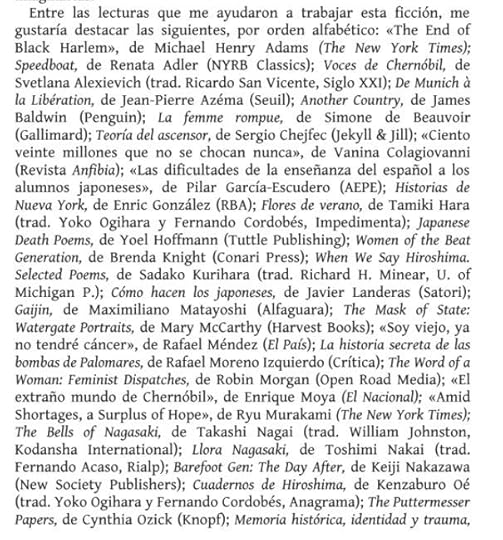
The novel is at times a little exposition heavy, and it felt some of the Hiroshima/Nagasaki/Fukishima facts could have been omitted as they are relatively well rehearsed, albeit stylistically this could reflect the journalistic shadow-narrator and Yoshie's own training as an economist. The original Spanish version included an author’s note listing the various references consulted (and hence possibilities for further reading), including Ōe's book, which was disappointingly omitted from the English version (it can be found from google books - part of it shown below).
The other obvious question mark over the novel is that of appropriating voices - the main characters, in this novel written by a Spanish-Argentinian male author, are a Japanese man and four women from very different backgrounds, and there is a lot of commentary on Japanese culture (at times a little cliched) and language (Neuman's degree was in philology). However here this is an explicit intent in the novel, to tell a story through a different gaze. As Watanabe comments:
I didn’t realise I was Japanese, he would joke, until I left Japan. He maintained that what we call culture is invisible to us from within our own environment, that we only see it when somebody else observes is from outside.
And from an English-language interview with the author (https://observer.com/2020/04/andres-n...)
and this is certainly no The Pine Islands, although one might debate if Solnit's quote extends to writing of novels as well as the reading of them. (NB a link to Solnit's essay that, although it didn't invent the term mansplaining, certainly captured the concept very well https://www.guernicamag.com/rebecca-s...)
At one point when discussing kintsugi the novel comments that it can be artificial where objects are deliberately broken to be restored in this way - and that seemed somewhat resonant with this novel which at times felt rather artificial in its construction.
Overall, an ambitious but flawed novel. 3.5 stars - rounded to 3 as I think ultimately it didn't quite live up to my (high given the author) expectations.
Un terremoto fractura el presente, quiebra la perspectiva, remueve las placas de la memoria.
Fracture is the translation by Nick Caistor and Lorenza Garcia of Andrés Neuman's Fractura.
Originally published in 2018, the book begins, in Tokyo, with reports, and the first effects being felt, of a natural disaster, which leads to a run on toilet paper in the shops. But this isn’t Covid-19 but rather than Tōhoku earthquake, the associated tsunami, and (more man-made, and not immediately known to the protagonists in the opening pages) the resulting Fukushima nuclear incident.
The novel revolves around the figure of Yoshie Watanabe, a retired international business executive for the consumer electronic brand Me (眼 in Japanese which means 'eye').
Mr. Watanabe is a hibakusha, a survivor of the Hiroshima blast. Further, he was actually on a trip from Nagasaki to the city with his father (who was killed in the explosion), and the subsequent bomb in Nagasaki wiped out the rest of his family (Yoshie himself only narrowly missed an evacuation train that would have taken him back to Nagasaki in time for the 2nd attack). And the Watanabe family originated from Kokura, the original target for the 2nd raid before cloud cover forced the diversion to Nagasaki. Neuman has acknowledged the inspiration of the only acknowledged double hibakusha Tsutomu Yamaguchi (https://elcultural.com/Andres-Neuman-...).
As the present-day story progresses, an Argentinian (the other side of the world to Japan) journalist (perhaps an authorial stand-in) is trying to arrange an interview with Mr Watanabe, to discuss his views on the Fukushima incident seen in the light of Hiroshima/Nagasaki (an interview he strongly resists), and Yoshie himself decides to make a visit to the Fukishima area.
But much of the novel looks back to his past. Parts of his story are told my an omniscient third-person narrator, in an journalistic type of style (is what we're reading the eventual results of the journalist's probing?) but this is interspersed with four first-person accounts of their relationship with Yoshie by his lovers in different cities where he studied and then worked
Violet, in 1960s Paris, dealing with the independence war in Algeria, as well as the legacy of the Vichy regime
Lorrie, in 1970s New York, at the time of Vietnam and Watergate
Mariela, in 1980s Buenos Aires, beginning with the Malvinas war and the fall of the military dictatorship
Carmen, in 1990s and early 2000s Madrid as the country's economic boom builds, and then Madrid is struck by the Atocha station bomb
(The latter two locations felt they were evoked in more depth, perhaps reflecting the author's own background)
Each story presents their own perspective of Yoshie and how he does or should deal with his own trauma. But each of the settings has a historical fracture of its own, and each of their relationships with Yoshie also eventually fractures, typically when he is rotated to another country, and they explain how this impacted their own lives. It is a fascinating device, particularly when Yoshie himself is largely silent on his own views. As the author explained (https://www.lazonasucia.com/andres-ne...
La historia está compuesta de fantasmas que recurren, pero lo que más me interesa en realidad como narrador, porque no soy sociólogo ni politólogo, es contar una historia de amor que sucedía en diferentes lugares, lenguas y edades. Hay cuatro mujeres que lo narran, tienen otra cicatriz y otra fractura, de cómo llevamos nuestras fracturas a las relaciones que iniciamos, como llevamos nuestros sismos literales y metafísicos, qué papel juegan nuestras cicatrices en cada presente que iniciamos con alguien nuevo.
History is made up of recurring ghosts, but what really interests me most as a storyteller, because I'm not a sociologist or political scientist, is telling a love story that happened in different places, languages and ages. There are four women who narrate it, they have another scar and another fracture, of how we carry our fractures to the relationships that we start,how we carry our literal and metaphysical earthquakes, what role do our scars play in each present that we start with someone new. (Google translation)
The Japanese art of 'kintsugi' is also a key reference, this quote coming early on as Yoshie clears up his collection of banjos some of which have been damaged in the quake:
He is convinced that things which have been on the verge of breaking for whatever reason—slipping, falling, smashing, colliding with one another—enter a second life. An amphibious state that makes them meaningful, impossible to touch in the same way as before. This explains perhaps his growing admiration for the ancient art of kintsugi. When a piece of pottery breaks, the kintsugi craftspeople place powdered gold into each crack to emphasize the spot where the break occurred. Exposed rather than concealed, these fractures and their repair occupy a central place in the history of the object. By accentuating this memory, it is ennobled. Something that has survived damage can be considered more valuable, more beautiful.
But this isn't a philosophy he applies to himself. Another key reference for both the novel and Watanabe himself is Kenzaburō Ōe's Hiroshima Notes (title of the English translation):
Watanabe had been born in the same year as Ōe, in a neighbouring region, just one prefecture away. They were both from towns close to Hiroshima, brought up under a militaristic nationalism, but had opposite approaches to dealing with the past.
His near neighbour wrote about the lessons the world could learn from the nuclear tragedy. About respect for the victims. The dignity of the survivors. Or promoted these ideas with the best of intentions. The problem was that Yoshie himself felt very far from embodying those supposed lessons. He had no sense of being ennobled by everything he’d experienced or lost. All he retained, with brutal clarity, was the fear, the harm, the anger, the shame.
The novel is at times a little exposition heavy, and it felt some of the Hiroshima/Nagasaki/Fukishima facts could have been omitted as they are relatively well rehearsed, albeit stylistically this could reflect the journalistic shadow-narrator and Yoshie's own training as an economist. The original Spanish version included an author’s note listing the various references consulted (and hence possibilities for further reading), including Ōe's book, which was disappointingly omitted from the English version (it can be found from google books - part of it shown below).
The other obvious question mark over the novel is that of appropriating voices - the main characters, in this novel written by a Spanish-Argentinian male author, are a Japanese man and four women from very different backgrounds, and there is a lot of commentary on Japanese culture (at times a little cliched) and language (Neuman's degree was in philology). However here this is an explicit intent in the novel, to tell a story through a different gaze. As Watanabe comments:
I didn’t realise I was Japanese, he would joke, until I left Japan. He maintained that what we call culture is invisible to us from within our own environment, that we only see it when somebody else observes is from outside.
And from an English-language interview with the author (https://observer.com/2020/04/andres-n...)
"This approach cannot be naïve or merely spontaneous. In this case, it certainly took very long, careful and respectful research, before I felt I could start writing,” he said. He invoked Rebecca Solnit, whose essay, “The Mother of All Questions,” suggests that the point of reading might be to transcend your own experience and explore what it’s like to be other.
and this is certainly no The Pine Islands, although one might debate if Solnit's quote extends to writing of novels as well as the reading of them. (NB a link to Solnit's essay that, although it didn't invent the term mansplaining, certainly captured the concept very well https://www.guernicamag.com/rebecca-s...)
At one point when discussing kintsugi the novel comments that it can be artificial where objects are deliberately broken to be restored in this way - and that seemed somewhat resonant with this novel which at times felt rather artificial in its construction.
Overall, an ambitious but flawed novel. 3.5 stars - rounded to 3 as I think ultimately it didn't quite live up to my (high given the author) expectations.

April 5, 2018
La idea es buena, definir un personaje a través de las mujeres que han pasado por sus vida, pero cuando estos personajes no parecen tener una voz propia (todas hablan igual) y cuando no agregan mucha información a lo que se expone desde un inicio, entonces las 500 páginas se hacen interminables.
March 29, 2023
Kırılma, atom bombası yüzünden tüm ailesini kaybetmiş bir adamın hayatının romanı. Adamımızı hem bir anlatıcı üzerinden hem de hayatına giren dört farklı kadın üzerinden tanıyoruz. Bir yandan da bu hayata paralel olarak dünyada yaşanan nükleer felaketlere, savaşlara, katliamlara bakış atıyoruz. Yazar anlatımının gücüyle bu iddialı teşebbüsün altından başarıyla kalkıyor ve kişisel/toplumsal felaketleri “kırılma” olarak nitelendirerek her şeye rağmen insanın/insanlığın bunlar sayesinde daha da anlam kazandığını söylemeye çalışıyor. Bu yaklaşım bana Leonard Cohen’in “Kusursuzluğu unutun. Her şeyde bir çatlak vardır, ışık içeri böyle girer.” sözünü anlattı. Özetle, hikayesi çok aman aman olmasa da iddiasının altını dolduran iyi bir roman.

April 9, 2018
"Fui descubriendo que es posible iniciarse en una lengua gracias a los errores que sus hablantes cometen en la nuestra. Igual que en el amor, los errores hablan de nosotros más que los aciertos."

April 6, 2019
Sólo quiero dar las gracias a Andrés Neuman por hacerme sentir feliz cuando se lee una buena historia, cosa que hace un tiempito no pasaba. Gracias.

July 4, 2018
En una palabra, genial. Breathtaking brilliant.
A child survives the atomic bomb in Hiroshima but loses his family. He has a fear of war; a fear of nuclear anything. He works hard but peace eludes him.
Four women. Four continents. A search for love.
Then an earthquake rattles Fukushima.
A child survives the atomic bomb in Hiroshima but loses his family. He has a fear of war; a fear of nuclear anything. He works hard but peace eludes him.
Four women. Four continents. A search for love.
Then an earthquake rattles Fukushima.

July 5, 2018
El mejor libro que leí en lo que va del año y quizá del anterior. Tiene encima un laburo increíble.
Mi reseña para mundoconlibros.com.ar: https://mundoconlibros.com.ar/2018/10...
Fractura, el último libro de Andrés Neuman, es un relato escrito con paciencia y, sobre todo, con un enorme trabajo de investigación. El libro es un prisma de ideas y lugares, al igual que su autor, hijo de padres argentinos nacido en 1977 y radicado en Granada a los 14 años, donde se convirtió en licenciado en filología y profesor de literatura hispanoamericana. Luego de publicar su primera novela, “Bariloche”, a los 22 años, no tardó en transformarse en uno de los escritores más apreciados de habla hispana. Roberto Bolaño se refirió a su obra como “algo que sólo es dable encontrar en la alta literatura, aquella que escriben los poetas verdaderos”.
Es el 11 de marzo de 2011, y el anciano señor Yoshie Watanabe (guiño no muy disimulado al poeta peruano José Watanabe) vuelve en subte a su casa de Tokio cuando ocurre el terremoto que se conocerá más tarde como la catástrofe de Fukushima. El desastre reactiva un evento constitutivo no solo de su identidad, sino toda la sociedad global posterior a 1945: El cuerpo de Yoshie, nacido en Nagasaki, está marcado por las cicatrices que le imprimió la bomba de Hiroshima.
“Fractura” tiene encima toneladas de trabajo, y se nota. El anexo de tres páginas es una recomendación personal implícita de fuentes sobre el tema. Neuman deja al descubierto los guiños y mecanismos que utiliza, y esto es parte de su encanto. Escribió el libro entre marzo de 2011 y octubre de 2017, apuntalado en personas y lecturas que lista al final de la obra en orden alfabético, donde no exime ni libros, ni canales de youtube, ni “viajes hipotéticos por google maps” ni (era hora) la wikipedia.
Neuman asegura que los personajes no se describen, sino que actúan. Así que nos lleva de la mano por la vida del señor Watanabe, a quien seguimos de cerca sin adentrarnos jamás en sus emociones. “Fractura” es un ovillo que se desmadeja en bloques. Cada capítulo es una mixtura de reflexiones, declaraciones y soliloquios que entretejen la narrativa y la naturaleza de sus personajes. Los recuerdos de Watanabe se complementan con los de las exparejas que tuvo en Francia, Estados Unidos, España y Argentina.
Pero los grandes acontecimientos, aquellos que ocurren con tal violencia que no pueden ser ignorados, dejan marcas que toda sociedad debe procesar. El trauma de las bombas nucleares, replicado mil veces en diarios y pantallas se iconiza para siempre. La imagen deja resabios incluso en quienes no la vivieron. Permanece en el aire. El señor Watanabe se reconstruye dejando las marcas a la vista. Como en la técnica-filosofía del Kintsugi, que utiliza oro en polvo para rellenar las fracturas de las vasijas japonesas. Haciendo de las marcas un valor agregado, un lugar de admiración, un daño que se cuenta desde el mismo proceso que lo repara.
Es que Yoshie es un catalizador que nos habla de un mundo donde la mixtura cultural profundiza las contradicciones sobre las que se erigió el siglo XX. Las identidades internacionales no solo se mezclan a través de los viajes, el sexo y la amistad. También son depositarias del mismo peligro. La fragilidad frente al desastre nuclear. Los mitos e historias de cada nación, sus recelos y cariños, las diferencias idiomáticas hablan de formas diferentes de procesar el mundo.
Fractura – Andrés Neuman – Alfaguara – Buenos Aires – 2018
Mi reseña para mundoconlibros.com.ar: https://mundoconlibros.com.ar/2018/10...
Fractura, el último libro de Andrés Neuman, es un relato escrito con paciencia y, sobre todo, con un enorme trabajo de investigación. El libro es un prisma de ideas y lugares, al igual que su autor, hijo de padres argentinos nacido en 1977 y radicado en Granada a los 14 años, donde se convirtió en licenciado en filología y profesor de literatura hispanoamericana. Luego de publicar su primera novela, “Bariloche”, a los 22 años, no tardó en transformarse en uno de los escritores más apreciados de habla hispana. Roberto Bolaño se refirió a su obra como “algo que sólo es dable encontrar en la alta literatura, aquella que escriben los poetas verdaderos”.
Es el 11 de marzo de 2011, y el anciano señor Yoshie Watanabe (guiño no muy disimulado al poeta peruano José Watanabe) vuelve en subte a su casa de Tokio cuando ocurre el terremoto que se conocerá más tarde como la catástrofe de Fukushima. El desastre reactiva un evento constitutivo no solo de su identidad, sino toda la sociedad global posterior a 1945: El cuerpo de Yoshie, nacido en Nagasaki, está marcado por las cicatrices que le imprimió la bomba de Hiroshima.
“Fractura” tiene encima toneladas de trabajo, y se nota. El anexo de tres páginas es una recomendación personal implícita de fuentes sobre el tema. Neuman deja al descubierto los guiños y mecanismos que utiliza, y esto es parte de su encanto. Escribió el libro entre marzo de 2011 y octubre de 2017, apuntalado en personas y lecturas que lista al final de la obra en orden alfabético, donde no exime ni libros, ni canales de youtube, ni “viajes hipotéticos por google maps” ni (era hora) la wikipedia.
Neuman asegura que los personajes no se describen, sino que actúan. Así que nos lleva de la mano por la vida del señor Watanabe, a quien seguimos de cerca sin adentrarnos jamás en sus emociones. “Fractura” es un ovillo que se desmadeja en bloques. Cada capítulo es una mixtura de reflexiones, declaraciones y soliloquios que entretejen la narrativa y la naturaleza de sus personajes. Los recuerdos de Watanabe se complementan con los de las exparejas que tuvo en Francia, Estados Unidos, España y Argentina.
Pero los grandes acontecimientos, aquellos que ocurren con tal violencia que no pueden ser ignorados, dejan marcas que toda sociedad debe procesar. El trauma de las bombas nucleares, replicado mil veces en diarios y pantallas se iconiza para siempre. La imagen deja resabios incluso en quienes no la vivieron. Permanece en el aire. El señor Watanabe se reconstruye dejando las marcas a la vista. Como en la técnica-filosofía del Kintsugi, que utiliza oro en polvo para rellenar las fracturas de las vasijas japonesas. Haciendo de las marcas un valor agregado, un lugar de admiración, un daño que se cuenta desde el mismo proceso que lo repara.
Es que Yoshie es un catalizador que nos habla de un mundo donde la mixtura cultural profundiza las contradicciones sobre las que se erigió el siglo XX. Las identidades internacionales no solo se mezclan a través de los viajes, el sexo y la amistad. También son depositarias del mismo peligro. La fragilidad frente al desastre nuclear. Los mitos e historias de cada nación, sus recelos y cariños, las diferencias idiomáticas hablan de formas diferentes de procesar el mundo.
Fractura – Andrés Neuman – Alfaguara – Buenos Aires – 2018

August 24, 2019
El señor Watanabe vuelve a acordarse del kintsugi. Del arte de unir grietas sin secretos. De reparar mostrando el lugar de la fractura.
Allora lo dico subito, così poi passiamo ad altro: non lo dico perché a me piace Neuman in generale, ma credo che questo sia finora uno dei punti più alti della sua produzione. Bellissimo. Aggiungete voi superlativi diversi. Quindi sì, leggetelo.
Il signor Watanabe è un vecchietto giapponese che sta in metropolitana, a Tokyo, mentre un terremoto a Tohoku provoca lo tsunami che dà luogo all’incidente nucleare di Fukushima. Il signor Watanabe, però, è anche un testimone: nascondendosi dietro a un muro per togliersi una scarpa che gli faceva male al piede quando era un bambino, scampa miracolosamente agli effetti del lancio della bomba atomica su Hiroshima. Lo si potrebbe anzi definire un doppio superstite: il padre, che lui stava accompagnando al lavoro in quel di Hiroshima è morto, quindi Watanabe viene accolto in una scuola per la notte, in attesa di essere rimandato con altri superstiti alla città d’origine, nel suo caso Nagasaki. Perderà clamorosamente il treno, rimandando altri giorni ad Hiroshima, ma di fatto salvandosi dalla seconda bomba che distruggerà la casa dove ancora vivevano la madre e le sorelle.
Cresciuto con le stigmate del sopravvissuto a Tokyo, con degli zii, per sfuggire a una sorta di pregiudizio sociale che in Giappone colpì chi si salvò dalle atomiche, Watanabe per tutta la vita ha in qualche modo cercato di fuggire: a Parigi, New York, Buenos Aires, Madrid. Studente prima, alto dirigente di una società di elettrodomestici poi, girerà il mondo vivendo i maggiori avvenimenti della storia a diverse latitudini. A raccontarci chi sia Watanabe sono anche le voci delle donne da lui amate, una per ogni città, personalità diverse, storie diverse che in comune hanno la coscienza, più o meno nascosta, che la loro relazione con quest’uomo giapponese tanto misterioso, prima o poi arriverà al capolinea.
Cuando Aznar ganó las elecciones, me quedé sorprendida. En serio. Le había votado, pero no para que ganara. Era más bien un toque de atención, ¿no?
Madrid potrebbe essere l’ultima tappa, l’arrivo definitivo di Watanabe. L’attentato terroristico di Atocha e la pensione, lo portano però a dover fare i conti con quello che si è lasciato alle spalle: il Giappone e la sua storia.
Conti che verranno esauriti in modo traumatico con il ripetersi di un problema nucleare, appunto quello della centrale di Fukushima, che porterà Watanabe, mentre tutto il Giappone scappa dall’epicentro del disastro, a noleggiare una Toyota Verso per arrivare giusto al cuore del disastro.
Mi fermo. Ma se volete leggere una recensione migliore della mia, c’è questa di Gianni Montieri, che con le parole è molto più bravo di me, uscita su Doppiozero. Lascio qui il link:
my link text
Ya que el horror parecía perseguirlo, quizá fuera mejor ir a buscar el suyo.
Allora lo dico subito, così poi passiamo ad altro: non lo dico perché a me piace Neuman in generale, ma credo che questo sia finora uno dei punti più alti della sua produzione. Bellissimo. Aggiungete voi superlativi diversi. Quindi sì, leggetelo.
Il signor Watanabe è un vecchietto giapponese che sta in metropolitana, a Tokyo, mentre un terremoto a Tohoku provoca lo tsunami che dà luogo all’incidente nucleare di Fukushima. Il signor Watanabe, però, è anche un testimone: nascondendosi dietro a un muro per togliersi una scarpa che gli faceva male al piede quando era un bambino, scampa miracolosamente agli effetti del lancio della bomba atomica su Hiroshima. Lo si potrebbe anzi definire un doppio superstite: il padre, che lui stava accompagnando al lavoro in quel di Hiroshima è morto, quindi Watanabe viene accolto in una scuola per la notte, in attesa di essere rimandato con altri superstiti alla città d’origine, nel suo caso Nagasaki. Perderà clamorosamente il treno, rimandando altri giorni ad Hiroshima, ma di fatto salvandosi dalla seconda bomba che distruggerà la casa dove ancora vivevano la madre e le sorelle.
Cresciuto con le stigmate del sopravvissuto a Tokyo, con degli zii, per sfuggire a una sorta di pregiudizio sociale che in Giappone colpì chi si salvò dalle atomiche, Watanabe per tutta la vita ha in qualche modo cercato di fuggire: a Parigi, New York, Buenos Aires, Madrid. Studente prima, alto dirigente di una società di elettrodomestici poi, girerà il mondo vivendo i maggiori avvenimenti della storia a diverse latitudini. A raccontarci chi sia Watanabe sono anche le voci delle donne da lui amate, una per ogni città, personalità diverse, storie diverse che in comune hanno la coscienza, più o meno nascosta, che la loro relazione con quest’uomo giapponese tanto misterioso, prima o poi arriverà al capolinea.
Cuando Aznar ganó las elecciones, me quedé sorprendida. En serio. Le había votado, pero no para que ganara. Era más bien un toque de atención, ¿no?
Madrid potrebbe essere l’ultima tappa, l’arrivo definitivo di Watanabe. L’attentato terroristico di Atocha e la pensione, lo portano però a dover fare i conti con quello che si è lasciato alle spalle: il Giappone e la sua storia.
Conti che verranno esauriti in modo traumatico con il ripetersi di un problema nucleare, appunto quello della centrale di Fukushima, che porterà Watanabe, mentre tutto il Giappone scappa dall’epicentro del disastro, a noleggiare una Toyota Verso per arrivare giusto al cuore del disastro.
Mi fermo. Ma se volete leggere una recensione migliore della mia, c’è questa di Gianni Montieri, che con le parole è molto più bravo di me, uscita su Doppiozero. Lascio qui il link:
my link text
Ya que el horror parecía perseguirlo, quizá fuera mejor ir a buscar el suyo.

December 26, 2022
‘Akşamüzeri sakin görünüyor ama zaman tetikte.’
Bu cümleyle açılıyor Kırılma. Ve inanın bana bu cümleden sonra bir hayatın içine fırlatılmış buluyorsunuz kendinizi. Bay Watanabe’nin hayatına. Kırılmış bir hayat onunkisi, dağılan parçaları fırlatıp atmadan- bir araya getirmesi, hatta kırılmadan önceki halinden daha güzele ulaşabilmesi mümkün mü? Neden olmasın? Kintsugiyi bilirsiniz, tam da bunu yapar. Bir enkazdan, tecrübelerden doğan bir hayatı çıkarır ortaya. Onu güzeller, yüceltir ve sahiplenir. Çünkü biliriz; yara izlerimizle de tam olmak, parıldamak mümkündür.
.
Peki kolektif hafıza ya da kolektif bilinçaltı kolektif acıyı da doğuramaz mı? Toplulukların sanki aynı bedende sinir hücreleriymişçesine birbirlerini ufak kıvılcımlarla tetikleyeceği türden bir birliktelik. Japonya’ya atılan atom bombalarının sadece Japonya’yı etkileyeceğini kim düşünebilir? Veya susturulan çığlıklar hangi toprakta dile gelir kim bilebilir? Andres Neuman, Kırılma’da şunu yapıyor : kendine hayran bırakarak okuyucunun karnına ağır bir taş koyuyor. O taşı görmezden gelmek mümkün değil, Kırılma’nın üzerine düşünmemek-büyük büyük acılarımızı deşmemek-gelecek günler hakkında endişelenmemek ama buna rağmen hala umudunu kaybetmemek elde değil.
.
Çok sevdiğim, dönüp dolaşıp yine rafından çekip okuyacağım bir eser Kırılma..
.
Lütfen okuyunuz.
.
Şükrü Karakoç kapak tasarımı ve Gökhan Aksay’ın çok beğendiğim çevirisiyle ~
Bu cümleyle açılıyor Kırılma. Ve inanın bana bu cümleden sonra bir hayatın içine fırlatılmış buluyorsunuz kendinizi. Bay Watanabe’nin hayatına. Kırılmış bir hayat onunkisi, dağılan parçaları fırlatıp atmadan- bir araya getirmesi, hatta kırılmadan önceki halinden daha güzele ulaşabilmesi mümkün mü? Neden olmasın? Kintsugiyi bilirsiniz, tam da bunu yapar. Bir enkazdan, tecrübelerden doğan bir hayatı çıkarır ortaya. Onu güzeller, yüceltir ve sahiplenir. Çünkü biliriz; yara izlerimizle de tam olmak, parıldamak mümkündür.
.
Peki kolektif hafıza ya da kolektif bilinçaltı kolektif acıyı da doğuramaz mı? Toplulukların sanki aynı bedende sinir hücreleriymişçesine birbirlerini ufak kıvılcımlarla tetikleyeceği türden bir birliktelik. Japonya’ya atılan atom bombalarının sadece Japonya’yı etkileyeceğini kim düşünebilir? Veya susturulan çığlıklar hangi toprakta dile gelir kim bilebilir? Andres Neuman, Kırılma’da şunu yapıyor : kendine hayran bırakarak okuyucunun karnına ağır bir taş koyuyor. O taşı görmezden gelmek mümkün değil, Kırılma’nın üzerine düşünmemek-büyük büyük acılarımızı deşmemek-gelecek günler hakkında endişelenmemek ama buna rağmen hala umudunu kaybetmemek elde değil.
.
Çok sevdiğim, dönüp dolaşıp yine rafından çekip okuyacağım bir eser Kırılma..
.
Lütfen okuyunuz.
.
Şükrü Karakoç kapak tasarımı ve Gökhan Aksay’ın çok beğendiğim çevirisiyle ~

April 29, 2020
A remarkable story that examines a Japanese salaryman's life through the lens of the four great loves of his life and two catastrophic disasters, Fracture has to be one of the best and most ambitious international novels of the year. The book covers a lot of ground both thematically and geographically, exploring memory, desire, love, language, and loss while bouncing from Tokyo to New York, Paris, Buenos Aires, and Madrid. It's a lot to bite off but Andrés Neuman masterfully weaves together this unforgettable cast of characters and events to a stunning conclusion. I was completely spellbound from start to finish, and now look forward to reading anything and everything I can find by Neuman with an English translation.
April 1, 2018
Y cinco es poco para mí...
En cuanto llega a la terminal, se detiene a revisar su teléfono. La acumulación de notificaciones telefónicas lo irrita cada vez más. ¿De qué demonios le sirve la comodidad de tenerlo todo ahí, disponible al instante, si todos los compromisos y obligaciones se han vuelto igual de instantáneos? Esta proliferación de alertas y actualizaciones no solamente lo fuerza a vivir a un ritmo que no deseaba. También violenta su orden mental de prioridades, concediéndole a lo más reciente una urgencia que en realidad no tiene
No te preocupan miles de muertos, conocés a un solo superviviente y empiezan a importarte
De verdad que a veces pienso que hay libros escritos solo para uno; libros que tarde o temprano te encuentran, como si ese fuera su único destino.
Que lectura más preciosa he tenido con este libro; todo fue perfecto de principio a fin; desde la primera página supe que ya no lo iba a poder soltar. Una narrativa bella y hermosa que todo el tiempo me sostuvo como en una especie de nostalgia serena.
Es como si todas esas preguntas hubieran encontrado sus respuestas; quizá es demasiado utópico decirlo, pero la idea de pensar que es así me hace sonreír. De repente hay solo claridad.
Un superviviente de la bomba atómica. Cuatro mujeres con las que se topa en el transcurso de su vida narrando sus vidas y recuerdos de lo vivido con él.
La manera en la que habla del tiempo, del dolor, de los anhelos, de la guerra, de las relaciones humanas, del propio ser, del olvido y de la memoria es para mí sencillamente perfecta.
No hubo página que no me hiciera querer leer más, ni página que no me asombrara en detalles y en belleza.
Llegó hasta donde muy pocos libros llegan, como si el autor se hubiera tomado la molestia de ubicar cada palabra justo en el lugar donde yo esperaba encontrarla.
Que si los libros pueden cambiar vidas?.... Quizás sí.
En cuanto llega a la terminal, se detiene a revisar su teléfono. La acumulación de notificaciones telefónicas lo irrita cada vez más. ¿De qué demonios le sirve la comodidad de tenerlo todo ahí, disponible al instante, si todos los compromisos y obligaciones se han vuelto igual de instantáneos? Esta proliferación de alertas y actualizaciones no solamente lo fuerza a vivir a un ritmo que no deseaba. También violenta su orden mental de prioridades, concediéndole a lo más reciente una urgencia que en realidad no tiene
No te preocupan miles de muertos, conocés a un solo superviviente y empiezan a importarte
De verdad que a veces pienso que hay libros escritos solo para uno; libros que tarde o temprano te encuentran, como si ese fuera su único destino.
Que lectura más preciosa he tenido con este libro; todo fue perfecto de principio a fin; desde la primera página supe que ya no lo iba a poder soltar. Una narrativa bella y hermosa que todo el tiempo me sostuvo como en una especie de nostalgia serena.
Es como si todas esas preguntas hubieran encontrado sus respuestas; quizá es demasiado utópico decirlo, pero la idea de pensar que es así me hace sonreír. De repente hay solo claridad.
Un superviviente de la bomba atómica. Cuatro mujeres con las que se topa en el transcurso de su vida narrando sus vidas y recuerdos de lo vivido con él.
La manera en la que habla del tiempo, del dolor, de los anhelos, de la guerra, de las relaciones humanas, del propio ser, del olvido y de la memoria es para mí sencillamente perfecta.
No hubo página que no me hiciera querer leer más, ni página que no me asombrara en detalles y en belleza.
Llegó hasta donde muy pocos libros llegan, como si el autor se hubiera tomado la molestia de ubicar cada palabra justo en el lugar donde yo esperaba encontrarla.
Que si los libros pueden cambiar vidas?.... Quizás sí.

August 14, 2020
The prose is the standout feature of Neuman's latest work. The translator deserves a lot of credit here as well. 'Fracture' is a reflective novel; one in which our protagonist slowly comes to terms with the trauma he experienced over sixty years previously in Nagasaki and Hiroshima.
The driving theme here, as suggested by the title, is focused on the scars and fractures that people and things carry with them from past experiences. Neuman concentrates not only on the stories those scars tell about us, but also the unique beauty that each of us carries as a result of those scars. As one character in the novel puts it, "Look, what lovely cracks."
I thought Neuman did an admirable job of developing his character through the narratives of past girlfriends. That can be tricky ground for a writer, but he pulls it off. The lower rating is a result of the pure enjoyment factor. I liked the book, but I never felt a calling to make time to get back to it. I appreciated its qualities more than I enjoyed them. Neuman is an impressive writer, however, so I look forward to reading more of his work. High three stars.
The driving theme here, as suggested by the title, is focused on the scars and fractures that people and things carry with them from past experiences. Neuman concentrates not only on the stories those scars tell about us, but also the unique beauty that each of us carries as a result of those scars. As one character in the novel puts it, "Look, what lovely cracks."
I thought Neuman did an admirable job of developing his character through the narratives of past girlfriends. That can be tricky ground for a writer, but he pulls it off. The lower rating is a result of the pure enjoyment factor. I liked the book, but I never felt a calling to make time to get back to it. I appreciated its qualities more than I enjoyed them. Neuman is an impressive writer, however, so I look forward to reading more of his work. High three stars.

March 7, 2018
Neuman con esta gran novela te deja pensando en tantas cosas como el desarraigo, las heridas del pasado, el aprendizaje de una nueva lengua, el amor transitorio, los viajes, los efectos de la bomba atómica y la industria nuclear, entre otras cosas. Watanabe, un japonés que se quedó sin tierra intenta trazar una nueva vida en lugares como Paris, Nueva York, Buenos Aires y Madrid donde vive diferentes etapas de su vida. Estas ciudades son reflejadas por los cuatro amores que tuvo en estas ciudades que a la vez afectan su vida como superviviente de la bomba atómica. Watanabe, sin darse cuenta, intenta regresar a un pasado que quiso borrar emocionalmente y que finalmente tiene que admitir va a ser siempre parte de él.
September 12, 2018
«Mire, dice el dueño, mire qué grietas más bonitas»
He tenido un año de elecciones poco acertadas en mis lecturas, o puede que no estén mal sino que no sea mi tiempo (por haber pasado ya o aún no llegar), el año pasado fue duro, golpes y caídas, éste ha sido notablemente mejor pero habían cicatrices que me sentía y hacían que sintiera pena e incluso que las odiara un poco, que me odiara un poco a mí misma pero Andrés ha puesto en Fractura la forma que se elige vivir, la huella que otros dejan al pasar por nuestra vida y la que nosotros mismos dejamos en ellos, además del kintsugi que habla acerca de embellecer algo a raíz de enfatizar sus grietas, lo que nosotros podemos llamar fealdad o falla para otros es belleza, arte. Y es con eso que me quedo.
He tenido un año de elecciones poco acertadas en mis lecturas, o puede que no estén mal sino que no sea mi tiempo (por haber pasado ya o aún no llegar), el año pasado fue duro, golpes y caídas, éste ha sido notablemente mejor pero habían cicatrices que me sentía y hacían que sintiera pena e incluso que las odiara un poco, que me odiara un poco a mí misma pero Andrés ha puesto en Fractura la forma que se elige vivir, la huella que otros dejan al pasar por nuestra vida y la que nosotros mismos dejamos en ellos, además del kintsugi que habla acerca de embellecer algo a raíz de enfatizar sus grietas, lo que nosotros podemos llamar fealdad o falla para otros es belleza, arte. Y es con eso que me quedo.

February 10, 2021
From page 321: "As his eyes open and close, he feels he is taking on the other person's point of view, absorbing it into his own consciousness, and that he can see inside as well as he can see outside." Andrés Neuman is a master of seeing and expressing the inside and the outside. His poetic masterpiece absorbs us in a journey around and through the multiple points of view of fractured people. His assemblage of jumbled experiences is an example of literary Kintsugi; the broken pieces are joined together by gold seams, to produce a work more beautiful and beguiling than the original, unbroken item.

May 23, 2020
I've been making a deliberate push for a while to read more translated fiction, a reaction, I suppose, to the world we find ourselves within at the moment and the way that even the bottom of the road seems a little unknowable and a little distant. I want to connect, I think, I want to read about the cultures and the worlds that I can't go to just yet, I want the barriers to fade away into nothing, I want to live.
And living comes through literature, specifically translated literature, the sort that takes language and gives it something new and fresh, each word paying tribute to the story it translates but also the story it wants to tell, this delicate narrative formed somewhere in between two worlds and giving me a snapshot of the world within its pages. Translation is hard, and I admire those who do it. I also want more of it, more of these books that challenge me to read outside of my experience and my worlds, and I am so grateful for those books that make me pause and realise something new, something acute and sharp and deliciously big about life.
My first such moment came in the opening chapters of Fracture, a novel I picked through nothing more than some determined searching on Netgalley, and it was a sentence that made me pause and think: so you are to be this sort of book, are you? A line, so simple, but one that shot through all of the mugginess I've been having whilst reading lately, a line that made me sit up and really see Fracture for what it was. For what it was going to be.
And it is good this book, it is good and big and full of being. It is about those things that connect being, those lines that form between us all and connect and pull and tease and fracture, those moments that echo for years and worlds to come.
Mr Yoshie Watanabe is a survivor of Hiroshima and Nagasaki. And when an earthquake strikes Tokyo in 2011, triggering the Fukushima nuclear disaster, his memories of those prior disasters bring him to make a decision that will change his life. During all of this, four different women share their memories of their time with Yoshie, reflecting on a life lived and loved across the globe. And through it all, the memories of conflict, of disaster - of moments that reverberate for so long, too long, not long enough.
I liked this a lot. Neumann's writing is lyrical, artistic, and though at some points I felt it got away from him, they were few and far between. The overall impression is of a writer who knows what he wants to say about the world and how he wants to say it; these are big, moving questions and to be able to articulate them is a gift. Fracture is a big, big book that pushes the world open and lets you see it for what it is. Highly recommended.
My thanks to the publisher for approving me on Netgalley.
And living comes through literature, specifically translated literature, the sort that takes language and gives it something new and fresh, each word paying tribute to the story it translates but also the story it wants to tell, this delicate narrative formed somewhere in between two worlds and giving me a snapshot of the world within its pages. Translation is hard, and I admire those who do it. I also want more of it, more of these books that challenge me to read outside of my experience and my worlds, and I am so grateful for those books that make me pause and realise something new, something acute and sharp and deliciously big about life.
My first such moment came in the opening chapters of Fracture, a novel I picked through nothing more than some determined searching on Netgalley, and it was a sentence that made me pause and think: so you are to be this sort of book, are you? A line, so simple, but one that shot through all of the mugginess I've been having whilst reading lately, a line that made me sit up and really see Fracture for what it was. For what it was going to be.
And it is good this book, it is good and big and full of being. It is about those things that connect being, those lines that form between us all and connect and pull and tease and fracture, those moments that echo for years and worlds to come.
Mr Yoshie Watanabe is a survivor of Hiroshima and Nagasaki. And when an earthquake strikes Tokyo in 2011, triggering the Fukushima nuclear disaster, his memories of those prior disasters bring him to make a decision that will change his life. During all of this, four different women share their memories of their time with Yoshie, reflecting on a life lived and loved across the globe. And through it all, the memories of conflict, of disaster - of moments that reverberate for so long, too long, not long enough.
I liked this a lot. Neumann's writing is lyrical, artistic, and though at some points I felt it got away from him, they were few and far between. The overall impression is of a writer who knows what he wants to say about the world and how he wants to say it; these are big, moving questions and to be able to articulate them is a gift. Fracture is a big, big book that pushes the world open and lets you see it for what it is. Highly recommended.
My thanks to the publisher for approving me on Netgalley.

November 17, 2019
Yoshie Watanabe è sopravvissuto alla bomba atomica di Hiroshima, ne porta per sempre le cicatrici. È come un vaso rotto... però poi abilmente ricomposto secondo l'antica pratica giapponese del kintsugi, con l'oro a saldare le fratture, a impreziosirle: meglio aggiustare per bene che lasciar perdere e tentare, perlopiù inutilmente, di dimenticare.
Il romanzo è buono, questo Andrés Neuman, argentino naturalizzato spagnolo – per me una scoperta casuale – ha grandi capacità. Solo... la sua scrittura, senz'altro apprezzabile nel breve, è molto densa, non dà mai tregua: se potessi, chiederei gentilmente all'autore qualche momento di respiro in più.
Il romanzo è buono, questo Andrés Neuman, argentino naturalizzato spagnolo – per me una scoperta casuale – ha grandi capacità. Solo... la sua scrittura, senz'altro apprezzabile nel breve, è molto densa, non dà mai tregua: se potessi, chiederei gentilmente all'autore qualche momento di respiro in più.

April 25, 2021
First Neuman I completed, a Hiroshima survivor visits Fukushima after the accident, his past is remembered by 4 women from 4 different places cutting across language barriers - its an interesting technique to tell a deeply political story, but it doesn't always work. I didn't feel like there is an information overload like many other readers of the book, though.

June 12, 2020
The subject of ”Fracture” is Mr Yoshie Watanabe, now retired and a hibakusha, a double survivor of the atomic bombs in Hiroshima and Nagasaki. He lives in downtown Tokyo in a spacious apartment with his collection of banjos. It’s 2011, on the day of the Fukushima nuclear disaster. The earthquake on that day “fractures the present, shatters perspective, shifts memory plates” and Mr Watanabe decides to visit Fukushima. The part of the story which is set in 2011 is told by a conventional narrator while the other parts of Mr Watanabe’s past are narrated by four different women which formed part of his life at different times in Paris, New York, Buenos Aires and Madrid.
The Fukushima disaster unleashes an avalanche of memories and forces Mr Watanabe to face the traumatic beginning of his life and his status as a ‘survivor’. Added to that, Mr Watanabe has a whole life of memories filled with people and places and languages. Mr Watanabe tells one of his partners that “we visualize our personal memories in three speeds...There are memories that come to mind over and over again, obsessively, in slow motion. Then those that seem to skip constantly, as though missing some important scenes. And those that always go by too fast, that we’d like to slow down but don’t know how.” She remarks that “if there’s any truth in this, it occurs to me that the first and second speeds would be the speeds of trauma. The third would be more like pleasure.”
My only criticism, and hence the 4 stars rather than 5, would be that at times I felt that the poignancy was a bit forced and therefore a little artificial. For example, when Mr Watanabe enters his home after the earthquake he “discovers that a few volumes on the uppermost shelves have been dislodged. Is there a pattern to these literary movements? Might they make up a kind of seismic anthology? Might certain authors be more predisposed to being displaced?”.
‘Fracture’ is a meticulously crafted and introspective novel about the interplay of history, memory, trauma, and disaster. Neuman has written a quietly excellent novel about what it means to survive and to remember as we become older.
With thanks to the publisher for the digital review copy via Netgalley.
The Fukushima disaster unleashes an avalanche of memories and forces Mr Watanabe to face the traumatic beginning of his life and his status as a ‘survivor’. Added to that, Mr Watanabe has a whole life of memories filled with people and places and languages. Mr Watanabe tells one of his partners that “we visualize our personal memories in three speeds...There are memories that come to mind over and over again, obsessively, in slow motion. Then those that seem to skip constantly, as though missing some important scenes. And those that always go by too fast, that we’d like to slow down but don’t know how.” She remarks that “if there’s any truth in this, it occurs to me that the first and second speeds would be the speeds of trauma. The third would be more like pleasure.”
My only criticism, and hence the 4 stars rather than 5, would be that at times I felt that the poignancy was a bit forced and therefore a little artificial. For example, when Mr Watanabe enters his home after the earthquake he “discovers that a few volumes on the uppermost shelves have been dislodged. Is there a pattern to these literary movements? Might they make up a kind of seismic anthology? Might certain authors be more predisposed to being displaced?”.
‘Fracture’ is a meticulously crafted and introspective novel about the interplay of history, memory, trauma, and disaster. Neuman has written a quietly excellent novel about what it means to survive and to remember as we become older.
With thanks to the publisher for the digital review copy via Netgalley.

October 25, 2020
4 and half stars
What a wonderful reading experience!
From the beautifully designed hardcover dust jacket (the gold seams actually sparkle in real life), to the impressive translation that seems to have captured the beauty and thoughtfulness of Neuman's original story, Fracture is a journey to savour.
I knew I was in for a treat from the very first sentence, “The afternoon appears calm, and yet time is waiting to pounce.” This leads us into the startling realisation that we are about to feel the tremors of the 2011 Tohoku earthquake and tsunami in Tokyo, along with our protagonist, Yoshi Watanabe.
The fear and shock of the magnitude 9 earthquake, followed by the images of the horrifying tsunami and the subsequent Fukushima Daiichi nuclear disaster, take Yoshie back in time.
Time and it's passing, memory and what we choose to remember and what we choose to forget become the central themes in Neuman's story about Yoshie, a survivor of the bombing of Hiroshima and Nagasaki by default. Yoshie is a hibakusha, a person affected by exposure to an atomic bomb, in a country unable to talk about it. His life is fractured, broken. He spends the rest of his life trying to piece it back together.
Neuman is a writer not afraid to take a risk with his writing.
He's an Argentinian man writing about a much older Japanese man, from the perspective of numerous women living all around the world (Paris, New York, Argentina, Madrid). We have Yoshie's narration about life in Tokyo now and his remembrances of the war, and we have these women reflecting on their time with Yoshie. What he was like at that period of his life, their views on how the war affected him and why their relationships with him ultimately failed.
Full review here - http://bronasbooks.blogspot.com/2020/...
What a wonderful reading experience!
From the beautifully designed hardcover dust jacket (the gold seams actually sparkle in real life), to the impressive translation that seems to have captured the beauty and thoughtfulness of Neuman's original story, Fracture is a journey to savour.
I knew I was in for a treat from the very first sentence, “The afternoon appears calm, and yet time is waiting to pounce.” This leads us into the startling realisation that we are about to feel the tremors of the 2011 Tohoku earthquake and tsunami in Tokyo, along with our protagonist, Yoshi Watanabe.
The fear and shock of the magnitude 9 earthquake, followed by the images of the horrifying tsunami and the subsequent Fukushima Daiichi nuclear disaster, take Yoshie back in time.
Time and it's passing, memory and what we choose to remember and what we choose to forget become the central themes in Neuman's story about Yoshie, a survivor of the bombing of Hiroshima and Nagasaki by default. Yoshie is a hibakusha, a person affected by exposure to an atomic bomb, in a country unable to talk about it. His life is fractured, broken. He spends the rest of his life trying to piece it back together.
Neuman is a writer not afraid to take a risk with his writing.
He's an Argentinian man writing about a much older Japanese man, from the perspective of numerous women living all around the world (Paris, New York, Argentina, Madrid). We have Yoshie's narration about life in Tokyo now and his remembrances of the war, and we have these women reflecting on their time with Yoshie. What he was like at that period of his life, their views on how the war affected him and why their relationships with him ultimately failed.
Full review here - http://bronasbooks.blogspot.com/2020/...

July 22, 2020
While I was thoroughly engrossed by this new novel from the Argentine literary sensation (in fact I was wrapt in attention for almost three fourths of this novel, and that is no mean achievement!), I felt Neuman laid it on a little too thick over the basic premise of the story i.e. the impact memory has on assessing the fixations and faultlines in our relations to the past and also to the redoubtable present, which in the current story is no less than a tsunami and a nuclear disaster. As in previous books Neuman's prose is gorgeous and rich in description and imagery, and he never fails to fully realise his characters though their inner workings and their interrelationships. The story has in its center the Japanese company executive, Yoshi Watanabe, and his relationship with four woman [viz. Violet (from Paris), Lorrie (from New York), Mariela (from Buenos Aires), and Carmen (from Madrid)] from different phases of his life in his wanderings around the world and his travails with several languages . Besides that there is a short role for the Argentinian reporter Jorge Pinedo investigating the life of the Japanese gentleman. With these cast of characters the novel makes for an engrossing read. But especially the last chapter that describes the episode of the tsunami.

November 11, 2020
Post que realicé el 13 de abril de 2019: Hace un año aproximadamente tuve la oportunidad de cruzar con una grandiosa obra como lo es Fractura de Andrés Neuman. No fue algo que pude devorar de forma inmediata, requería tiempo, espacio y mi atención plena (¡vaya a saber lo que tardó esta última!). Pero hoy, puedo decir que sus palabras te acompañan, te abrazan, te desgarran y te enseñan. Como todas las grandes historias, entreteje el olvido, los silencios, las despedidas, la belleza y la memoria. Te inspira y permite recrear lo ajeno como propio. Como lector lo sientes e imaginas “el olvido” como una realidad efímera y correspondida.
Ha dejado tanto en mí, que no deseo un silencio y un acto de egoísmo. Sino que pueda tocar la vida de quien lo escoja.
“Cuando una cerámica se rompe, los artesanos del kintsugi insertan polvo de oro en cada grieta, subrayando la parte por donde se quebró. Las fracturas y su reparación quedan expuestas en vez de ocultas, y pasan a ocupar un lugar central en la historia del objeto. Poner de manifiesto esa memoria lo ennoblece. Aquello que ha sufrido daños y sobrevivido puede considerarse entonces más valioso. Más bello”. Así empieza esta hermosa historia.
Ha dejado tanto en mí, que no deseo un silencio y un acto de egoísmo. Sino que pueda tocar la vida de quien lo escoja.
“Cuando una cerámica se rompe, los artesanos del kintsugi insertan polvo de oro en cada grieta, subrayando la parte por donde se quebró. Las fracturas y su reparación quedan expuestas en vez de ocultas, y pasan a ocupar un lugar central en la historia del objeto. Poner de manifiesto esa memoria lo ennoblece. Aquello que ha sufrido daños y sobrevivido puede considerarse entonces más valioso. Más bello”. Así empieza esta hermosa historia.

June 18, 2020
The author seems to know everything about everything. I was unconvinced by this Argentinian male’s vast store of knowledge about the Japanese, women, nuclear energy, Paris, New York, World War II, and on and on. I found it all really tedious and made it only to the 35% point. I received a free copy of this book from the publisher.

January 7, 2023
Muhteşem bir roman Kırılma. Ailesini küçük bir çocukken Nagazaki ve Hiroşima atom bombası saldırıları sonucu kaybetmiş, hayatını bir teknoloji şirketinin Fransa’dan Arjantin’e İspanya’dan ABD’ne farklı ülkelerdeki şubelerinde çalışarak geçirmiş, emekliliğinde ülkesinde dönen Japon bir adamın hayatını anlatıyor. Karakterin hayat hikayesinin tümüne iki paralel anlatımla ulaşıyoruz. 2011 yılında Japonya’da yaşanan deprem ve ardından depremin tetiklediği Fukuşima Nükleer Santrali kazasıyla başlayan ilk hikayede üçüncü tekil şahıs anlatımıyla karakterin bugününü okuyorken, paralel hikayeyle de karakterin hayatına giren dört farklı kadının birinci tekil anlatımıyla onun farklı ülkelerdeki geçmişine tanıklık ediyoruz. Karakterin hikayesi üzerinden Neuman, başta nükleer silahlanmanın yol açtıkları olmak üzere, 20. yüzyıldaki katliam ve insanlık suçlarını ele alıyor. Irk, etnisite gibi faktörlerle kışkırtılıp kahramanlık “destan anestezisi” (bayıldım bu tabirine) ile halklara yutturulan savaşların dayandığı ekonomik temellerden, ‘demokratikleştirme’, ‘savaş sonrası yeniden yapılandırma’ kisvesi altında yapılan sözde yardımlara ve bunların kuklası askeri diktatörlere kadar dünyanın farklı köşelerinde insanların hayatlarında yara açan ya da kırılmalar oluşturan düzeni eleştiriyor. Fransa’nın Cezayir’deki nükleer denemelerinden Vietnam Savaşı’na, Arjantin’deki askeri darbelerden İspanya’daki Franco sonrası döneme dünyanın farklı köşelerinden o kadar bütünlüklü bir resim çiziyor ki bu kadar genç yaşta bu kadar mevzuya böylesine hakim olmasına ayrı, bunları tek potada böyle bir edebi metinde eritebilme yeteneğine ayrı hayran oluyorsunuz yazarın. Tüm bu eleştirilerini kırılma metaforuyla ve ışığın çatlaklardan sızması misali insanın da kırıklarıyla daha anlamlı, acı da olsa hatıralarıyla daha mükemmel ve alametiferikası olan kırıklarıyla daha özel olduğu fikri üzerine inşa etmesi de muazzamdı. Her ne kadar romanın ana izleği olmasa da, Neuman’ın farklı kültürlere ve onların insanın karakteri ve yaşamı üzerindeki etkilerine hakimiyetine de ayrıca hayran olduğumu belirtmeden geçemem, Doğu Avrupalı bir babayla İspanyol bir annenin çocuğu olarak Arjantin’de doğmasının da bunda payı vardır sanırım. Anlatımı, ele aldığı meseleler ve bunları kurguda işleme şekli, savundukları ve kurgusuyla, okuduğum en iyi çağdaş edebiyat eserlerinden biriydi.

November 19, 2018
Hay algo en este libro que me ha llegado profundamente encantador y es su narrativa, su manera de escribir de acercarnos a sus letras, hacernos partícipes del momento y creándonos la sensación de necesitar saber que surgirá.
Las tragedias se guardan en la memoria, que resulta siendo el privilegio donde ocultamos el dolor o la alegría. Parece una ruptura con el presente donde acudir a esa memoria toma un sentido casi de supervivencia.
En el relato de las 4 mujeres de su vida, entreteje ciudades y culturas diferentes donde tan solo el Sr. Watanabe como en un silencio trae a su mente los momentos, una memoria que esta al mismo nivel de las diferencias entre oriente y occidente, se suceden como choques de la cultura donde él sabe abrirse paso aprender y sobrellevar su existencia, aun ensimismados sus recuerdos con los que – me digo – el autor quiere mostrarnos ese marco histórico que origino en él cierto escepticismo, y así mismo los personajes femeninos dotados de su propia vida sin estereotipos, sin vivencias heroicas cada una dejando un vacío.
La pasión en cada una de las ciudades de estancia, hacen que la decantación de sus recuerdos nos obligue a ver la realidad, y considerar además que este es un solo punto, nada de los sucesos trágicos han terminado por que los humanos no los dejamos; tan solo agolpamos sobre ellos el olvido físico, y aparente solución, pero impera la necesidad de seguir.
El Sr. Watanabe, abre sus heridas y las cierra, el arte del Kintsugi, como referencia para esta historia, donde podemos claramente sentir que las cicatrices son el espacio por donde entra la luz, “El poeta Rumi decía que “la herida es el lugar por donde entra la luz”, pero para el caso, por donde salen sus ansias de olvido o de recordación para re descubrir quien fue y ha sido. Donde han quedado grabadas las tragedias vividas, las cercanas, las de los suyos..??
Muy, recomendado leerlo. Socialmente su interior trágico por la mano del hombre no termina. .
Displaying 1 - 30 of 188 reviews