What would happen if tigers disappeared? Find out in this fifth book in the award-winning If Animals Disappeared series that imagines the consequences of a world without tigers.
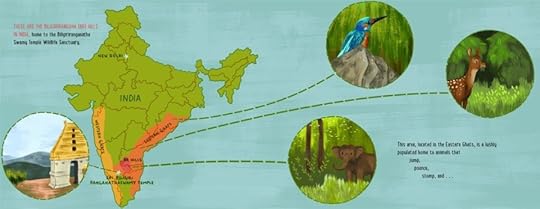
Deep in the Biligirirangana Hills in India, a fierce creature roams.
This landscape is home to animals that are
slithery
smart
hidden
and....LOUD like the roar of a tiger.
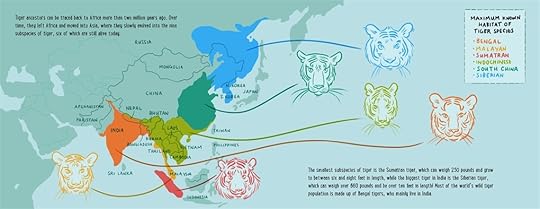
There are nine subspecies of tigers, but three are now extinct. They play a very important role in keeping nature in balance. But, due to expanding human populations, poaching, and more, they’re in danger.
What would happen if tigers disappeared completely? Join Lily Williams as she tracks the devastating reality of what our world might look like without tigers.
Lily Williams is the critically acclaimed author and illustrator of the If Animals Disappeared picture book series and of a middle-grade graphic novel, Exposures. With Karen Schneemann, she is the co-creator of Go with the Flow, which was nominated for an Eisner Award, and Look on the Bright Side. Lily lives in Colorado, where she is an elementary art teacher. Her work can be seen in films and books and on the web at lilywilliamsart.com.
Another installment in a fantastic series of books introducing us to endangered animals that are vital for the food chain and eco-system (worldwide).
In this book, we learn about the impact tigers have on the environment of the areas where they live. This also leads to a nice overview on the different sub-species and the different places they inhabit. Naturally, introducing us to the various habitats is equally important - not least to show what exactly makes tigers disappear.
As with the other installments, this has a page dedicated to what individuals and communities can do in order to help save the species, too. It wasn't taking up too much space but gave some nice ideas.
Most, though, I enjoyed the author laying out what happens when big predators disappear, the impact that has, this impact trickling down and down and down until EVERY other species is affected.
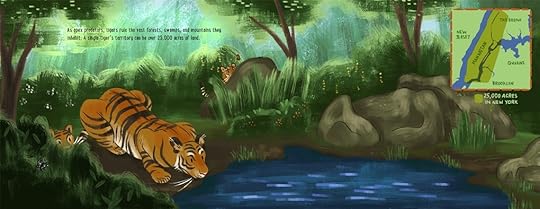
Wonderful full-page illustrations give this the right feel, making it seem as if you, too, were walking through the jungles and observing these majestic animals. It doesn't hurt that the tigers are too cute. ;)
Fantastic addition to the series. Chronologically, this is the last/newest, but for me it's the second-to-last to read. While I hate that so many animals are disappearing, I hope the author will create more of these as they are a great way of teaching young and old readers important lessons about how nature works and everything intersects.
Stand up and roar for Lily Williams’s If Tigers Disappeared, the fifth book in her award-winning series. Tigers follows the familiar pattern: we learn where the animals live, some history about them, and why their populations have declined. Tigers have been around more than two million years, yet in the past 100 years, humans have nearly wiped out their population. When an animal becomes extinct, the ripple effect (also called the trophic cascade) has far-reaching effects on our ecosystem.
Since tigers are apex predators, the animals it eats flourish when no longer hunted by the big cats. These populations booms then cause changes to the forest, waterways, and landscapes. This immense concept is conveyed simply, inviting kids to think about our world’s interconnectedness and demonstrating how indigenous people should continue to be involved in the tiger’s conservation. Though the topic is quite sad, the overall feeling is of hope, emphasizing the importance of knowledge and advocation for these amazing animals.
Williams’s tigers are magnificently drawn in many stages of action, including a couple of curious cubs. Back matter includes a glossary, recap of the tigers’ endangered status, and information on how we can help. This important book educates while charming us with lively images of six remaining subspecies of tigers.
This is the fifth installment of Williams's "If Animals Disappeared" series and it might be my favorite of the bunch! I love the map showing where the Biligirranganatha Swamy Temple Wildlife Sanctuary is in India as well as the map marking the habitats of the six subspecies of Tigers alive today. Williams teaches readers that tiger populations declined by 96 percent from 1900 to 2000! As Williams explains under the "Tigers are in Trouble" section in the back of the book, the indigenous people featured in this book are the Soliga people and "we cannot talk about conservation, biodiversity, and saving endangered species without discussing the indigenous communities who have protected and worked their lands for centuries in sustainable and nature-honoring ways." I love that Williams tells readers that many indigenous communities worship tigers and she touches on the issues associated with "relocating people from their ancestral homes" to establish tiger wildlife sanctuaries on their land. Williams also tells readers, under the "How You Can Help Save Tigers" section in the back of the book, "responsible zoos and wildlife sanctuaries won't let visitors touch their large cats." Perfect!
This was really great. Overall, it took a difficult concept and explained it in kid friendly terms. The only exception to this is the usage of "apex predator" several times without explaining it. I know what an apex predator is but children reading this book may not. I love the illustrations, they really help bring the book to life. I like the mention of indigenous people and how we should be learning from them the best ways to protect the land and animals.
I love all of Lily William's Disappeared books, not only because I am a huge animal/environmental person but also because it is one of the few environmental series that always has African American children as the focus characters. To top it off, I love the illustrations and simple but informative text make this a go-to book for any budding conservation scientist.
This book lives up to the legacy of the other books in this series. Lily has clearly taken great pains to research the work that she's paired with her fantastic signature art style. Like the other books, I'd not hesitate to recommend this to kids and adults alike. I've learned something new from all of her books, and I suspect so will you!
Love everything about this series! The decline of tigers over the last century or so is alarming, information about the very serious problem is simply presented for young readers. Engaging illustrations and complete back matter. Especially enjoyed the attention to the importance of native peoples’ experience in the conservation effort. Sad to hear this is the last of the series.
A great book that shows the importance of protecting animals. the book goes over the dangers tigers face, what is being done to protect them, what could be done better, and gives suggestions for how the reader can help.
Lily Williams triumphs again, with another thoughtful and important look at a keystone species and its crucial role in the ecosystem. Gorgeous art and a message everyone needs to hear.
This short book reminds me of Earth Mother, a book that showed how men, frogs and mosquitoes were intertwined in nature and how none could exist happily without the others. So it is with all species on earth. Tigers are no different.
Starting with the eye-catching cover of a tiger and its whelp surrounded by orange dashes, the author takes us through the different kinds of subspecies (three gone forever, alas), where they originated, where they live now and comparisons between the largest and the smallest. The book springs surprises, such as when an orange-and-black-striped beast seems to leap from the page with a powerful howl. With a jump, we are led into a speculation about a future world where all the tigers disappeared.
It’s a compelling story and an uncomfortable reminder of how fragile our ecosystem is and how mankind must be held to accounts and look to conservation. It’s never too early for children to learn that caretaking may start in the home but it doesn’t end there.