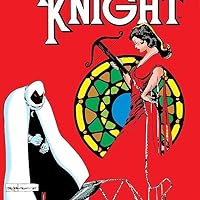
Ghosts, werewolves and things that go crazy in the night! Marvel’s multiple-personality midnight marauder takes the fight to the strangest rogues’ gallery in all of comics — from Arsenal, the one-man army, to the nun with a crossbow known as Stained Glass Scarlet. The Jester is no joke, for either Moon Knight or Daredevil. Then there’s Morpheus, who’s guaranteed to give you sleepless nights. But the old foes are the worst: enemies like Midnight Man and Bushman, who have returned to plague Marc Spector. Or is he Steven Grant? Jake Lockley? As always with Moon Knight, the voices inside his head can be as destructive as the lunatics trying to kill him! Doug Moench and Bill Sienkiewicz hit full stride in a super-hero comic like no other!
Doug Moench, is an American comic book writer notable for his Batman work and as the creator of Black Mask, Moon Knight and Deathlok. Moench has worked for DC Comics, Marvel Comics, Dark Horse Comics and many other smaller companies; he has written hundreds of issues of many different comics, and created dozens of characters, such as Moon Knight. In 1973, Moench became the de facto lead writer for the Marvel black-and-white magazine imprint Curtis Magazines. He contributed to the entire runs of Planet of the Apes, Rampaging Hulk (continuing on the title when it changed its name to The Hulk!) and Doc Savage, while also serving as a regular scribe for virtually every other Curtis title during the course of the imprint's existence. Moench is perhaps best known for his work on Batman, whose title he wrote from 1983–1986 and then again from 1992–1998. (He also wrote the companion title Detective Comics from 1983–1986.)
Moench is a frequent and longtime collaborator with comics artist Paul Gulacy. The pair are probably best known for their work on Shang-Chi: Master of Kung Fu, which they worked on together from 1974–1977. They also co-created Six from Sirius, Slash Maraud, and S.C.I. Spy, and have worked together on comics projects featuring Batman, Conan the Barbarian and James Bond.
Moench has frequently been paired with the artist and inker team of Kelley Jones and John Beatty on several Elseworlds Graphic Novels and a long run of the monthly Batman comic.
A collection of mostly one shot issues, some two part stories, but still really engaging.
A lot of the first half is simple stopping crime and beating up bad guys. The second half gets a little bit more mystical. A little darker again. And also, Moon Knight is funnier? It's a bit jarring but kind of goofy in the best way. I don't know if anything lives up to the stuff in the Hulk Back Magazines in volume 1 but I'm still enjoying my time with this series.
Moon Knight feels like a 70s tv series, featuring a masked vigilante with gadgets who moonlights as a cabbie and millionaire, fighting crime and supernatural foes at night. Some nice stories in this collection, I particularly liked the supernatural-themed ones, as some of the spy/terrorist plotlines fell flat for me and ended up being a bit boring. Marc Spector’s looming schizophrenia should have been more explored here, as he struggles to keep 4 different personalities in check. Overall a decent collection.
Great collection of these early Moon Knight stories. Tis is when he is still a street level hero and Marvel didn't try to blend him into the superhero family of the Avengers. Great read. Very recommended
This is the second of the Moench Epic Collections and picks up where the last one left off. We continue the fun adventures of Moon Knight and have a few arcs with Morpheus that I badly wish the D+ show had used for inspiration as opposed to... whatever it was that it did. The writing, for the most part, is fresh even now. There are some surprisingly insightful bits of social commentary to be found here, and fun twists and turns abound.
The character grows, the art matures, and I'm left wanting more by the end of it. It's not a bad starting point.
Some pretty good Moon Knight tales in this one. Much more of the mercenary detective side of the character instead of the mystical stuff. However the real highlight is Bill Sienkiewicz art throughout the book. Some of the best art I’ve ever seen in this one, especially the issues of the dream villain Morpheus. Can’t imagine what it must have been like reading it when it was coming out. Truly ahead of its time. A must read for not only Moon Knight fans but comic book art fans as well.
I mostly skimmed this, stopping to read a handful of issues that looked particularly interesting. Moon Knight, particularly this run, Iis an interesting blend of Batman and the Shadow. While the writing is still very wooden and displays a lot of tropes of early comics, the artwork is absolutely stunning.
vol 2 of Doug Moench's moon knight is still rather uneven, but the highs are much higher. the final morpheus arc was the best piece of comic writing and artwork in this entire run so far. bar none. sienkiewicz keeps getting better and better, and the creative team has now fully developed an identity for moon knight.
this volume is brought down by the nimrod strange/arsenal arc. it wasn't horribly bad but it was, in my opinion, a noticeable step down. doug seemed very invested in it though, as it is to my memory the only storyline to be dragged out for four entire issues. this arc aside, there are more hits in here than misses.
I've been continually blown away by how upfront this book is about its ideas. it feels very cutting edge in a lot of ways, very sharp and political for its time. i like when moon knight deals with the city; the people in it and how they are treated by the systems which govern them and by the people which act as enforcements of that system. i love gena and crawley, even if we don't see them nearly enough. this to me is a core tenant of what makes moon knight work, which is all absent from that one arc I've been harping on about.
even if it isn't great every single issue, the highs here are monumental, and the lows are still readable. my number one hope going forward is that they permanently drop the bonus stories tacked on to the end. they aren't interesting, they're usually done by a different creative team, and they only act to pad out some extra pages. we can lose them.
Great collection of stories. This Epic Collection collects the bulk of the Moench run, the previous having collected only the first 4 issues, and the third and final Epic Collection collecting the final batch. The stories in this collection are very strong for the most part, having only a few arcs I didn't care much for. Here we get the first appearances of Stained Glass Scarlet and Morpheus, as well as the return of many other Moon Knight villains that would become iconic in time. I must admit that I struggle to get through a lot of 80s comics, but this still reads very well and holds up strongly. Luckily, Moench doesn't rely on repetitive exposition or narrating what we can see is happening in the panel like a lot of books of the time. And Sienkiewicz's art is beautiful, moody, and kinetic. Really such a good run, and I can't wait to read the rest.
Just an incredible collection that sets the foundation for why Moon Knight is so damn cool
This is a book that perfectly illustrates why a strong and collaborative creative team on a book is so important to create something memorable and timeless. Doug Moench's writing slowly growing more and more nuanced and solid as the book goes on and then Bill Sienkiewicz's art slowly morphing from a very Neil Adams inspired style when inked by people like Klaus Janson, to his gritty and utterly badass style once he starts inking his own stuff. Even Christie Scheele's colors slowly favoring negative space and abstraction, it’s all one hell of a thing to witness, you get to see Moon Knight slowly adopt his image of being a ghost/wraith and it looks so cool.
Do be forewarned, if you’re buying this with the expectation of how modern comics are (And honestly even comics back then started being) written with 6-7 issue story arcs, think again, most of the stuff collected in here are self-contained stories that build up the mythos of Moon Knight individually, while also painting a larger picture about him and developing him.
So let me go over each one in excruciating attention to detail because I loved this book so much that I really wanna do that.
Issue #5: A story about a "haunted" old house out in the outskirts of NY, it’s just a bit of a fun ride that showcases how well Moon Knight works with pseudo-supernatural elements. It’s well drawn but definitely quaint when compared to how Sienkiewicz's art will eventually look.
Issue #6: This one actually pays off the ending from Issue #4 in the previous volume in a fun way, basically Marc has to go to a Caribbean island to help a friend of his from his mercenary days with a bit of an abduction problem they’re having over there, it showcases Ricky and Ray (Gena's sons) for the first real time in action as supporting characters for Marc and they’re fun! I love them! Not to mention the small glimpses you get into Marc's past through his friend are also nice bits and nuggets of world and character building. Just a fun issue wrapped around another fun pseudo-supernatural setting that also involves Voodoo and it’s cool.
Issues #7-8: The first of the very few two-parters collected in this book and it’s a fun one. It involves a bunch of terrorists altering the water supply of Chicago to make people hallucinate and spread chaos, it’s mainly focused on the effect Moon Knight has on the people around him, it’s got some great moments with Crawley as well, which makes it fun. And it’s made even better in retrospect because it shows how dealing with Marc's shenanigans can push his friends to a breaking point where they kinda ruin their lives, something that has been kind of important in the recent years of the book with MacKay at the helm.
Issues #9-10: Another two-parter, this one focusing on the return of Midnight Man and Bushman from last Volume and it leads to a super fun confrontation between Marc and Mogart, especially because here is where Sienkiewicz starts experimenting with inking his own stuff and it looks stunning; not as much as it will eventually look like, but still incredible. It’s also the first story to truly put a focus on Marc's mental health and his DID (referred to as Schizophrenia in this book, but it’s a product of its time so I don’t really mind) and the true nature of his character. It’s just some solid character work from Moench.
Issue #11: An Issue focusing on Frenchie's past! And it’s solid enough. It is a little bit rushed, compressed and has a bunch of tropes that I don’t really care much for, but it’s still nice to see Frenchie get fleshed out a bit as it is still some good character writing.
Issue #12: The first appearance of Morpheus! One of my favorite MK villains. It’s another fun Issue, Sienkiewicz inks his own stuff in this one again and he manages to turn Morpheus into this incredibly terrifying presence, I do feel as if the ending is a bit of a rush job cause they made Morpheus to be too powerful in his first appearance so they had to come up with a kind of hacky way to defeat him, but it’s still fun, if only because of that Sienkiewicz art.
Issue #13: A fun little crossover with Daredevil where they fight The Jester. Not much outside of that.
Issue #14: The first appearance of Scarlet Fasinera, aka Stained Glass Scarlet, aka probably one of MK's best villains in his rogues' gallery. This one is so good, it focuses on the tragedy of her life and how in certain ways it reflects parts of Marc's own. It’s just some damn good storytelling.
Issue #15: It’s a story about a racist, xenophobic Neo-Nazi that dresses himself up in a rat costume and calls himself Xenos; it’s just a lot of fun, the message is obviously "racism bad" but it’s a message that was fitting then and it’s still fitting now, especially with the multi panel rant the villain goes on about how immigrants are the root of everything wrong with "modern" America (1981 back then) so if anything it’s a story that has a lot of longevity because the world doesn’t seem to have changed a bit in over 30 years, so it’s nice to see a Nazi wearing his true skin of a rat get beat up by a guy wearing a white hood.
Issue #16: It’s a fill-in Issue not written by Moench or drawn by Sienkiewicz. It’s fine. I like how it’s kind of trying to do what Frank Miller would do a few years later with his Roulette storyline in DD #191, analyzing the impact superhero stories and comic books have on impresionable young minds, and it’s fine. It’s always nice to see ol’ Ben Grimm as a guest star as well, even if it’s brief and he doesn’t mention his team-up with MK in Two-In-One #52.
Issues #17-20: Now this is a big one, I personally like to refer to this massive 4-Issue story arc as "The Arsenal Saga" and it’s a doozy of a story. The first truly multi-part story that is collected in here, it’s so damn good. It focuses on this crazy, megalomaniacal terrorist warlord guy: Nimrod Strange, aka Arsenal; and it’s just a fun spy-thriller lite type of story where Marc is sent on a wild goose chase for this guy. It’s got some great artwork and awesome action moments, even if Issue #18 feels a bit like filler as Marc doesn’t do anything besides fight a couple of Arsenal's "elite" soldiers to waste time until the next part where actual plot development happens. And this is the first arc where Marlene gets showcased as so much more than a damsel in distress, she gets some great moments to show off her stuff (both literally and metaphorically) and it’s another great story mirroring what Marc's life could've been had he not turned a new leaf.
Issue #21: A nice little pace breaker after the insanity that was the Arsenal Saga, it’s a self-contained story where MK teams up with Brother Voodoo to deal with some more supernatural stuff in the heart of Haiti and it’s just a bit of fun, innit?
Issues #22-23: The final story arc collected here and what a way to close out a book. It’s the return of Morpheus and he’s pissed after the events of his first appearance, I love the mystery and dread that comes from him puppeting everything behind the scenes and it all building up to a crescendo at the end of that Issue with his awakening and return and a bunch of awesome reveals, and then the second part is even cooler because of the extended confrontation between Marc and Morpheus, on top of more great character moments for Marlene and Marc. This is also the Issue where Sienkiewicz's art truly shines and has evolved into something truly special and awesome. There’s a reason this is the issue that made Charlie Huston a Moon Knight fan and would eventually lead to his great run a few years later.
So overall? A great showcase of why Moon Knight is such a badass and my favorite character after Spider-Man. Just incredible.
It's fascinating to study the progression of Moon Knight's character over the course of these early comics (this volume collects issues 5-23, 1981-82) and trace how Doug Moench and Bill Sienkiewicz have slowly hashed out aspects of this dark superhero that today's readers take for granted. (Well, I guess it's fascinating for me and other assorted nerds, geeks, and True Believers. It's probably something entirely different for most normal people who won't be reading this collection in the first place anyway.)
Despite Marlene's insistence on calling him "schizo," Moon Knight's three alter-egos began as really nothing more than three separate aliases adopted to help mask his identity, in stark contrast to today's deeply disturbed figure whose struggle with dissociative identity disorder leads to institutionalization and some really grim mental trauma. But here in these early comics, the reader can begin to see the inner conflicts arising in Mark/Steven/Jake's identity. He has yet to slip over into something readily identifiable as mental illness in these pages, but what merely started as a joke on Marlene's part and a series of aliases is starting to transform into something much darker in these stories.
Similarly, over the course of these issues, the reader can see how the role of Khonshu begins to develop more. The early version of Moon Knight was not conceived as an avatar of the god himself, and Marc Spector still does not communicate with Khonshu at this point, but his statue is featured more prominently in these stories as it is first stolen and then destroyed by the Midnight Man (before Marlene reveals that she had actually replaced it with a facsimile), and there are a couple of short "Tales of Khonshu" included at the end of some of these comics in which the figure of Khonshu plays a role. Significantly, these tales do not involve Spector at all, although amusingly he does show up in some of his own short comics featuring life before he becomes Moon Knight when he was a sort of low-budget Indiana Jones/Tomb Raider kind of figure.
Fans of the Disney Plus/MCU series may find this volume instructive. Or they may find it aggravating to discover they don't really know Moon Knight at all. Me, I am enjoying the evolution of his character and am looking forward to getting back to the third volume.
This volume collects the bulk of writer Doug Moench and artist Bill Sienkiewicz acclaimed run on the MOON KNIGHT series from Marvel in the 80s. Sienkiewicz's art is truly a marvel, no pun intended. He starts off looking a lot like his mentor Neal Adams, but by the end of the book, you see the innovative, dynamic and exquisitely chaotic art style that will define his work on NEW MUTANTS and more. Moench does a nice job of giving MK a unique and layered story, pushing back against the preconception that Moon Knight is just Marvel's version of Batman. Though some of the broad strokes are similar - butler, wealthy man masquerading by night as a vigilante to avenge a past trauma - the two characters are very different. Moench creates a diverse and memorable supporting cast and does a nice job trying to build a menacing Rogues Gallery for the hero. Though his main love interest, Marlene, seems a bit one-note and too damsel-in-distressy, she has moments of strength and comes into her own toward the end. If you're a fan of Batman, particularly the work of Dennis O'Neil or Frank Miller's iconic take on Daredevil, this run is a contemporary book that ranks along with them. Great stuff.
This volume contain stories that begin to transform Moon Knight from a traditional vigilante style superhero into an stylized cutting edge artistic phenomenon. The combination of Bill Sienkiewicz’s growing artistic confidence and narratives of dysfunctional dissociative identity disorder from Doug Moench that challenged the traditional conventions of the superhero comic norms are taking seed. The early stories in the volume are still fairly traditional, but the reader approaches the final issues, a clear shift can be witnessed. There is a greater depth of thought in the stories and greater sense of urgency and a kinetic frenzy to the art that is simultaneously exciting, terrifying and unsettling. With this volume, we begin to see and understand exactly why Moon Knight by Moench and Sienkiewicz was considered groundbreaking and a contemporary classic.
I really enjoyed this volume. definitely overall better than volume 1, although I think some issues in volume one such as the Hulk comic appearances surpass stories in this one.
That being said, most of these issues really hit. The Stained Glass Scarlet, Morpheus, Nimrod Strange (which at one point they accidentally call Hugo Strange?), crossovers with Daredevil and Brother Voodoo.
A the volume goes along, the comic start to get darker, and I learned that's because they started selling directly to comic stores and got around the comics code. That being said, the stories leading up to that change were sometimes equally as bleak.
My guy Doug Moench and Bill Sienkiewicz really are a brilliant team.
Also a p.s., the filler stories are also quite good. I like them as a reason to use Marc Specter more. The stories of Konshu are also quite interesting, although I thought Marc discovered the statue of Konshu hidden in Egyptian tomb... but I'll stop asking questions.
P.s.s. I like that Moon Knight had his own little Daredevil Born Again moment with the Statue of Konshu being destroyed, but it felt like it was a crisis conceived of nothing, and it being solved changed nothing. I would rather have had the event change the status quo in a way.
Collecting issues 5 to 23 of the early 1980s Moon Knight run, this is a fascinating collection. After getting the new, official backstory out of the way (and neatly dismissing the original, 1970s' origin) in the first four issues, this collection sees the clear progression of the character, and of writer Moench and artist Sienkiewicz, with all three settling into this run and producing some great work. There's not much in the way of multi-issue story arcs and Moon Knight's enemies are (as usual) a bit on the goofy side at times but these are the issues where Marc Spector's mental state starts becoming a real storyline issue and not just some handy narrative device. It also has the introduction of Morpheus, a genuinely top tier MK villain. Yes, some of looks dated, cheesy and a little simplistic now but these stories were written and drawn four decades ago. The artform has moved on. And Moench and Sienkiewicz are two of the people who made that happen.
If you're not a fan of Bill Sienkiewicz – I've been one for decades – this volume may be a bit painful to read.
It's long, verbose in the style of the time, often clumsy or far-fetched, if not completely out of place – some episodes take place in broad daylight and/or are very James Bond-esque – compared to the MK we know today. I found it laborious to read.
Sienkiewicz illustrates most of the episodes and his style evolves to become similar to that of the New Mutants a little later on. Inking is important for artists of this style: ultimately, the best results are achieved when he inks his own work. Janson does a very good job, as always. The others – McDonnell, Giacoia, etc. – do not do the artist justice.
In short, this is a book for true fans of either MK or Sienkiewicz. Or both.
I started reading Moon Knight because of the infamous Moon Knight-core meme page. A page who seems to be really big about letting people know not to read the Bendis run--and talking about "A Feast Unknown" (kind of defeating the point by making it very well known)
Moon Knight is a great "hero" in that he is just a really weird guy. Just... the weirdest little guy out there. Just doing things--that are things he is doing
Some parts of this comic have aged less terribly than others. Keep in mind the time this stuff was written in when reading it... but it is a pretty decent time
Moon Knight is... a hot mess--and entertaining to watch on that basis
I think Xenos is my favourite. There are elements of 'anti-Moon Knight' about him which juxtaposes nicely with our hero's alternate identities. Also a fan of Jester, Stained Glass Scarlett, Morpheus, Nimrod Strange and of course Bushman. I like Blacksmith and Master Sniper as well despite their incredibly boring names.
Sienkiewicz's art gets better and better as the series goes on. The last story with Morpheus as the villain is his finest work. Moench writes most of the stories, the ones he doesn't are the weakest.
Reading older material like this has to be a longer task than most things I read, and I have to get in the headspace. It does amuse me to see what insane plot lines writers had to come up with every single issue back in the day, stuff like being doused with drugs, almost being drowned in the sewers, fighting international warlords, and chaising down murderers. I only wish I could get more invested, it's just the style of stories at the time. Fun seeing the coloring and Sienkiewicz's artwork, but beyond that, I doubt I return to this material.
This is the height of Moon Knight, where Moench and Sienkiewicz really hit their stride on the character and bring depth and complexity to what could easily have been just a basic Batman/Daredevil pastiche. It's been years since I read these stories but they really reminded me why I love Moon Knight and this run in particular. This is also when Sienkiewicz really starts pushing his art out of a Neal Adams style and into something truly different and amazing.
These are all non-connecting issues from the early 80s in the Doug Moench run of Moon Knight. They are extremely hit-or-miss and the highs are not worth the time it takes to read all of them.
Issues with Midnight Man, Stained-Glass Scarlet, Bushman, and Morpheus are all worth reading, but skipping everything else is in your best interest. Also, the lack of Crawley makes me sad because he's the greatest part of Moon Knight.
Moon Knight has multiple personalities, a history as a mercenary that brought him tremendous wealth, Jewish roots, and a superhero origin story that is rooted in ancient Egyptian mysticism. And that costume! I love his look and I like his character traits. But it took until the mid 00's when authors like Warren Ellis and Jeff Lemire were able to (and allowed to) explore MK's full creative potential. Nevertheless, the Moench/Sienkiewicz run is a character-defining classic, but it took some effort on my part to get through this volume. The stories are pretty good overall, some are great. They're just a bit dated. Bill Sienkiewicz' art, who pencils and inks the majority of the issues, is definitely a standout feature of this collection. I am looking forward to reading the third volume in MK's Epic collection series.
While the art takes a noticeable dip whenver a fill-in artist comes in for an issue, the team of Moench and Sienkiewicz really keeps you going. While I haven't hated this classic version of Moon Knight, I will say that I'll be happy to finish this era so I can get to the modern stuff that the character is more well-known for.
The stories are solid. The Earth 616 is consistent. Marlene comes across more as a tough, straight-shooting, but less-intelligent character than she was at first. Strong homages to Will Eisner, "Maxwell Grant," "Kenneth Robeson," and the Batman writing line-up!
Probably the high point of this original run. Goes back and forth from being great to bad. The Morpheus stuff is awesome, I like Xenos as a villain for him quite a bit, Midnight Man is fun. It's just still inconsistent and it has a big problem of giving Moon Knight lasting obstacles to overcome. But if you are gonna read the original run, this is probably it's peak.
So I enjoyed learning about the character, but the writing style is so dated lol. They wrote out every idea the had, and every action he made lol. I noticed the evolution of the publication though, and can't wait to read the next volume.