There are many different ways for a home to be lost, and for the world to become defined by that loss.
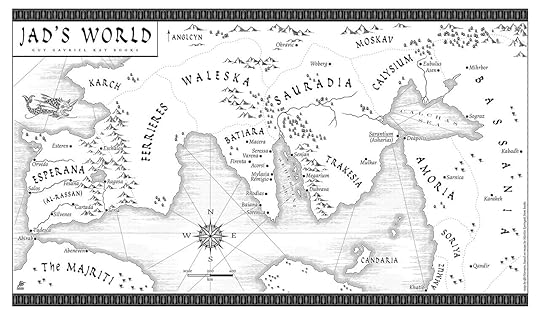
The latest novel from GGK doesn’t actually travel over all the seas in the world, being confined to Renaissance Era Mediterranean shores, called here the Middle Sea. But it does explore in detail this concept of alienation, of exiles from a lost homeland, of people in search of a stable and safe haven. A lot of the characters are moving around in ships, sail-driven or rowed by slaves. Many of them are either pirates or trying to protect their lands from pirates and invaders. They are living in ‘interesting’ times, turbulent enough to catch the artist’s imagination.
It was not what anyone would have called a safe time to be sailing on, or living beside, or anywhere near the reaches of the Middle Sea.
All the books written by Kay are part of an ever expanding tapestry, with each new novel woven into the already established pattern that is based on the known history, yet transformed and given a mythical dimension in the author’s vision. [and with a little magic to spice things up]
The present novel can be considered a direct sequel of A Brightness Long Ago , with many characters carried over and numerous events from that story heavily referenced here. It can be read as a stand-alone adventure, but I believe it works better for readers who are familiar with what went on before.
This observation is valid for practically all the other ‘medieval’ novels written by Kay, who likes to include a lot of Easter eggs and allusions from his own alternate history, stretching here from Al-Rassan and Sarantium up to more recent events in Batiara.
A murder, a diamond, a book.
We start the journey aboard a pirate/commercial/envoy ship on the north coast of Africa, where two adventurers, Rafel and Nadia, are on a secret mission to assassinate the local caliph. There are complications, but also unexpected rewards for the bold and shrewd agent, and Kay wants to show us how from this minor incident the whole Middle Sea is taken by storm.
You navigated your life, he thought, like a ship between rocks, in night and a storm.
Rafel ben Nader and Nadia bint Dhiyan have been brought together by their common plight: they have been both exiled from their homelands, the man for his Jewish religion by the Inquisition, the young woman being abducted by pirates and sold as slave to a harem.
Both are remarkable for trying to take control of their lives in this cruel and merciless setting, as they travel around the Middle Sea to the courts of the most powerful rulers on the shores: tyrants and emperors, merchants and bankers, pontiffs and pirates, outcasts and sellswords.
How do people make choices in life? she wondered. If they lived a life that allowed choices. Did they really make them? Or merely drift into things then look back, years later, and wonder? Or were choices made for them. Or ...?
The story can be read as pure adventure: there are enough battles and political machinations, alliances and betrayals, mercenaries and secret spies to satisfy the most exigent thrill seeker, but this is for me first of all a GGK type of story: so familiar that it almost becomes annoying in its peculiar characteristics. Such as the author’s habit of constantly breaking the fourth wall in order to comment on his own prose and characters. The story is about half action, half commentary, but I still love GGK’s sensibility and vision, even as I jot down in the margins words like lachrymose after one too many scenes of tearful reunion or emotional overload.
There is a sameness to the type of character the author likes to focus on that makes me think he often changes settings but he reuses plots and actors. This can be explained by the sort of history that Kay considers important and worth telling, by the qualities he admires in the people he views as shapers of history and art. Most of them are defined by extreme shrewdness, a necessary survival trait in the opinion of the author, which makes them a tad too good to be true in my book. Luckily, Kay is not satisfied with two-dimensional characters, and he weaves into their personalities balancing traits, yearnings, dreams. His histories are also known for trying to find a balance between telling of the lives of the powerful and the lives of the downtrodden.
It is also true that the balancing of people’s lives, however trivial they might be within a grander tapestry, can matter just as much in a certain kind of history. Most lives are trivial, after all, in the reckoning of the world, if not for those living them. These stories can also be told, however. Perhaps they need to also be told.
Rafel and Nadia are examples of what passed for ordinary lives in these dangerous times, made special by circumstances and by their own abilities to navigate the perils of the seas. Through them, we get involved with the most powerful agents of change, as recorded by official histories, but also with the people from the streets and the farms.
To mention all of them here in my review is beyond the scope of my own commentary, but it is part of the attraction I still feel for every new book written by GGK.
Stories are, as much as anything else, an act of love.
If anything, the author can be said to love his characters too much. His sympathies are never in doubt, to the point that some developments become predictable to the reader who is already familiar with his other novels. I was conscious of this sappy trend in his prose right from the start [Tigana], yet I am always in a forgiving frame of mind when I turn the last page, probably for the subtle nudge I received in the direction of looking at the past through the tinted glass of a true artist.
A tale can be spoken, or sung – in a castle hall, a sun-bright marketplace, a tavern filled with singers listening to the oldest one. Or there might be pages to be turned, slowly or quickly, by a fire or a river, or before sleep comes at night.
The magic tapestry will teach us that it is hard to survive in this cruel world, that homes and families can be lost in natural or human made cataclysms, that there are predators and prey out there, storms and black rocks that wait to breach the timbers of your ship, but that, in the end, the journey must be taken.
And that there are compensations along the way for pain and loss.
Sometimes the tale offered is of the lives and deaths of those deemed powerful. And sometimes it is about men and women trying as best they can to live, shape lives, despite the loss of a home, roots, origins, a sense of where they might belong. That loss never goes away but it can, with great good fortune, become one thing among others. Because there are sometimes grace, mercy, kindness, friendship, love ...