How Difficult it is to Escape from Academic Writing
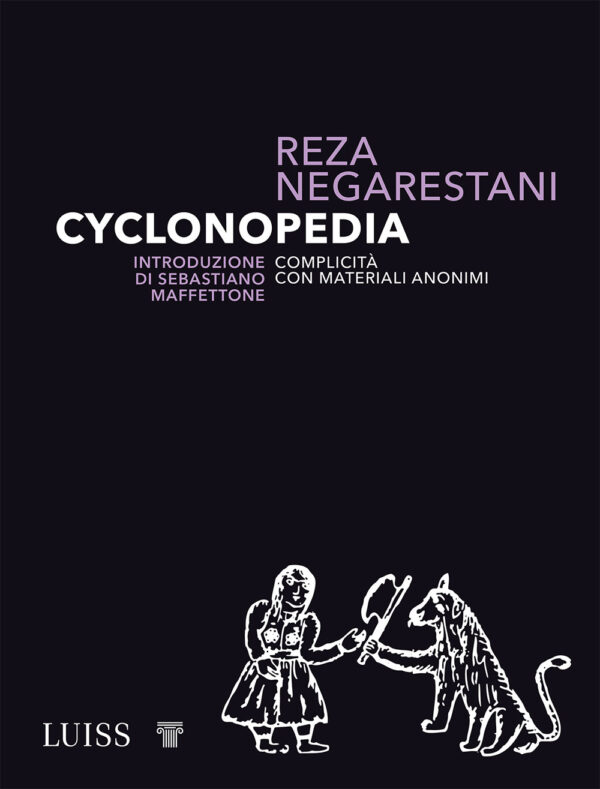
This remains an interesting book over fifteen years after it was published. The back cover copy makes it sound like it's science fiction. One of the endorsements describes it as "an uncategorizable hybrid of philosophical fiction, heretical theology, aberrant demonology and renegade archaeology." That's a bit sloppy, because the book is only philosophical fiction in the sense that it is invented, a la Borges or Lem. And heresy isn't its point. "Cyclonopedia" is a philosophic treatise framed as a fiction, and woven together with devices from literature.
The author, Reza Negarestani, has read a lot of Deleuze and Guattari, and a wide range of political theory (Michael Hardt and Antonio Negri's Empire has a similar rhetoric in places). Many chapters could almost be presented at philosophy conferences; there are analyses of oil, machinery, war, camouflage, and other subjects that are in line with some eccentric Deleuzian readings that have long been acceptable in academic contexts. The fictional part comes partly in the book's claim that "the Middle East [is] a sentient and living entity... in a very literal sense of the word," but more in the many poetic analyses of its leading concepts--analyses that draw on Deleuze but also on popular culture, from H.P. Lovecraft to John Carpenter's "The Thing." (Again, that's commensurate with Deleuzian and cultural studies, and, oddly, with Graham Harman's subsequent interest in Lovecraft in Weird Realism.)
Since this book, Negarestani has become interested in a range of issues in contemporary philosophy of mind, computation, and science, and his writing has become much less experimental and closer to academic norms. (See the publications of Urbanomic, and the journal Collapse.) Cyclonopedia is not the clearest formulation of his interests, but it is by far the best writing.
The best passages of the book are imaginative analyses of particular concepts. There is a spectacular long footnote explaining the concept of the "inorganic demon," ranging from "The Exorcist" to "Doom III." (p. 223 ff) There is a very good page on the survival of pre-Islamic ways of writing "Allah." (p. 173). There is an excellent poetic analysis, reminiscent in its way of Bachelard's ruminations on elements, but also of Lautreamont, on the subject of the Babylonian demons Enkidu and Pazuzu (the latter familiar from "The Exorcist"). (p. 113 ff) That analysis includes a description of "rammalie," "an Arabic word for communication with other worlds and aeons through patterns on pebbles and desert sand."
The book has a glossary, with well-developed theoretical concepts. In that regard it resembles Latour's book on nature, or Ranciere's book on politics. Negarestani has invented, and defined, an entire vocabulary for interpreting the socio-political, historical, and psychological state of the Middle East: Double Numbering, hypercamouflage, polytics, heresy-engineering, Druj literature, Tellurian blasphemy, schizostrategy... they could all be used in discussions outside the book.
The book's weaknesses, I think, have to do with Negarestani's work as a fiction writer and as a theoretician. The former becomes apparent when the reader moves from the brief introduction, which tells the story of the discovery of the manuscript, into the manuscript itself: at that point it is clear that the introduction is an incompletely imagined fiction (it consists of brief vignettes, which are intended to be taken as sufficient fictional context). Before the reader makes the transition to the body of the book, it appears that the fragmented descriptions in the introduction are a deliberate strategy; but there are no analogously fictional strategies in the book.
Negarestani is in some ways a wonderfully prolific and inventive theorist, so it may seem odd to suggest that the book's other weakness is theory. I have in mind the fact that in a number of passages the theory is incrementally close to Deleuze and other mainly French poststructuralist theorists, and it risks reading like the sort of parody written by disaffected graduate students. An analysis of the semiotics of the rat (p. 229) is an example: it has a kind of grim humor, but it is a pastiche of any number of such analyses in authors as diverse as Barthes and Serres. In other passages, neologisms proliferate in the way that used to be called "Derridadrivel," for instance in this chapter opening: "In the mid-eighties, before succumbing to his petromantic nympholepsy..." (p. 195). There are also passages that read like versions of popular film and novels, as in this chapter opening: "By the time Colonel West turned into a renegade and deserted Delta Force's Special Tactics and Rescue Squad..." (p. 129). This is knowing, but it's not in control of the fact that as it continues it appears inadvertent or unreflective about its closeness to is sources.
These two issues—regarding fiction and theory—are usually found in different kinds of writing: the first occurs in novels everywhere, the second in academic writing. It's unusual to have them together in one book, written by a person with an understanding of Middle Eastern languages, history, and archaeology. I read the book at first as an attempt at academic fiction (as in Borges), but again as an attempt to seriously theorize the Middle East, and especially the meanings of oil. In that respect, the book is spectacular.
The relative weakness of the overtly fictional moments in the book, as compared with the outlandish strength of the conceptualizations and the pleasure of the unexpected cultural juxtapositions, is the reason this book remains academic, tied to and reliant on academic philosophic knowledge. I also wish that Negarestani had written a book that did not rely so much on Deleuze, Foucault, and its other points of (Western, European, mainly French) reference: since Cyclonopedia Negarestani has developed strong critiques of many such positions, but this book was a chance to tip the balance of explanation from France to Iran and beyond. Instead he joined the Anglophone and Francophone discussions of speculative realism and other subjects that are common in Western academia.
[2009, revised 2017, 2024]