Jump to ratings and reviews
Rate this book

Beeswing

Rate this book
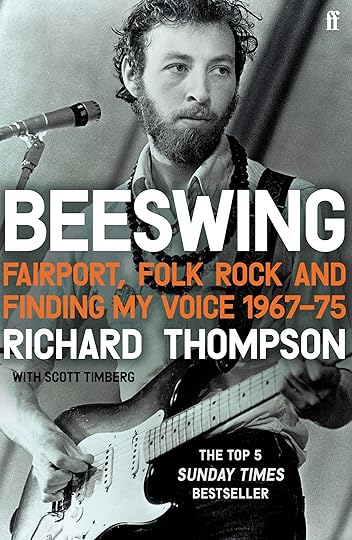
THE TOP FIVE SUNDAY TIMES BESTSELLERA BOOK OF THE YEARROUGH TRADE, THE TIMES , ROLLING STONE , CLASH, MOJO , UNCUTThe memoir of international music icon Richard Thompson, co-founder of the legendary folk rock group Fairport Convention.'I encourage everyone to read this wonderful book.'ELVIS COSTELLO'Thompson could be said to be an English Dylan - only in some ways he's even better than that.'GUARDIANRichard Thompson came of age during an extraordinary moment in 1960s Britain - as music began to reflect a great cultural awakening, the guitarist and songwriter co-founded Fairport Convention, ushering in the era of folk rock. An intimate memoir of personal discovery and creative intensity, Beeswing vividly captures the life of an international music icon in a world on the cusp of change'Gripping . . . A quiet joy of a memoir.'GUARDIAN'Thompson writes exceptionally well . . . If you love music in all its myriad forms, you'll love this book.'NEW YORK JOURNAL OF BOOKS'An intimate, revealing tome, Beeswing is the voice of a figure at the heart of the British counter-culture.'CLASH'Perceptive, lyrical, amiable and seemingly effortless . . . required reading.'CAUGHT BY THE RIVER

227 pages, Paperback

First published January 1, 2021

165 people are currently reading
1764 people want to read

About the author

Librarian note:
There is more than one author in the GoodReads database with this name.
This profile may contain books from multiple authors of this name.

Ratings & Reviews

What do you think?
Rate this book

Friends & Following

Create a free account to discover what your friends think of this book!

Community Reviews

5 stars
366 (25%)
4 stars
699 (49%)
3 stars
321 (22%)
2 stars
32 (2%)
1 star
5 (<1%)
Displaying 1 - 30 of 249 reviews
Profile Image for Dave Schaafsma.
Author 6 books32.1k followers
April 26, 2021
The opening lyrics of Richard Thompson’s song, “Beeswing,” his fictional reflection on the sixties:
I was nineteen when I came to town
They called it the Summer of Love
They were burning babies, burning flags
The hawks against the doves
I took a job in the steamie down on Cauldrum Street
And I fell in love with a laundry girl
Who was working next to me

Oh she was a rare thing, fine as a bee's wing
So fine a breath of wind might blow her away
She was a lost child, oh she was running wild
She said "As long as there's no price on love, I'll stay
And you wouldn't want me any other way"

The song Beeswing, by Richard Thompson:

https://video.search.yahoo.com/yhs/se...

Richard Thompson often makes lists of the twenty best guitarists of all time, and he’s on my list, for sure. I’ve hear him play live and have several of his records (which means some of what I have is vinyl, yep). In addition, he’s a legendary songwriter, with a lot of popular and critical acclaim. Born in 1949, he skipped school as many young people did in the sixties to go on the road, to resist traditional society and to commit to the life of an artist. Basically, what that means is he skipped school because he would rather study guitar rather than traditional school subjects. Beeswing is what would seem to be the first of a series of memoirs, focusing on the early years, 1967 through 1975. In 1967, at the age of 17, he co-founded Fairport Convention, one of the great British bands in the sixties (and still playing today!) fusing traditional British music with pop and rock. At 21 he left the band, married Linda Pettifer, was married for ten years and produced six albums with her, and since then has produced more than eighteen albums, most of them solo.

I listened to Thompson read his own book, which had help in the making by a ghost writer. It’s a three star book, I think, but I am giving it four stars because I am a fan and I love hearing his voice, and because I liked the anecdotes, which he shares as if we were in a pub together. Would it were true! Thompson, almost clinically shy most of his life, honors some of the greats he has known--Sandy Denny, Nick Drake, Fairport generally, and many others--and trashes almost no one, which seems consistent with his gentle demeanor. Yet Thompson admittedly had anger problems and admitss a few times that he was in his younger days arrogant. We don’t get much about who he really was then, except to know he lived music and loved above all the guitar. It's mainly about the music, of course, and the musical life in those days.

We don't know much about Thompson’s home life because he left early, and primarily because he just wants to give you the basics of what you expect from a musician’s memoir--some of the concerts and name dropping of friends--Dylan! Joni!--and some ideas about his focus on retaining the traditions of British folk music in contemporary folk and rock. We don’t go very deep into his relationships with Sandy Denny or his wife Linda. Or anyone, really. We visit the scenes and move on, with some sense of regret. We don’t know how he “lost his way” nor why it is he really found it in his embrace of Sufism. I know from what I heard Linda said recently, that “he’s nicer now,” for which I am grateful, as the telling retains some (though not enough) of his characteristic lyricism, and his humor (mocking sixties hippie fashion, and so on). If you know nothing about Richard Thompson, don’t start with this sort of generic memoir, though he's very charming and likable here; start with his music and you’re welcome.

Oh! There's one criticism of the memoir that he/his team was wrong about. In a kind of appendix Thompson includes a section of dreams he has had about Joni, Dylan, Linda, Sandy, bizarre, lyrical, evocative, hilarious. The memoir as it is is somewhat disappointedly straightforward, but if I were the editor (go ahead, hire me for the second edition!), I would have infused the basic narrative with these dreams, making it more magical and lyrical throughout. More playful. You're a poet, Richard! Make it more poetic! The dreams are great, though.

Richard Thompson’s ‘52 Vincent Black Lightning:

https://video.search.yahoo.com/yhs/se...

Fairport Convention, with Sandy Denny, “Who Knows Where the Time Goes”:

https://video.search.yahoo.com/yhs/se...
Profile Image for Paul Bryant.
2,409 reviews12.6k followers
March 5, 2023
All the reviews get this exactly right – great musician writes cautious memoir. I can’t complain too much, I suppose. It surely would have been excruciating, for example, to explain why his marriage to Linda went wrong (she has been much more forthright in her various public comments, and none of it is complimentary). But if you’re going to brush these emotional dramas aside, your memoir will be a list of guitars I bought, band member changes, albums I recorded, tours I toured, hotels I hated and cool musicians I met. RT is one of my all time favourites and I liked his friendly voice, it was all very interesting, up to page 195 then it fell to bits very badly.

RT became fascinated by Sufism, the mystical branch of Islam, and joined a small Sufi sect, and dragged along his wife :

Linda followed me into Islam a few months later, and I hoped it was because her heart called her to it, and not out of fear of losing me

But Richard, didn’t you ask her, then or later? Don’t you now know the answer to that?

Scrupulously avoiding hindsight is one thing but skating over the surface of difficult situations is another. Joining an ascetic sect is a massive lifestyle change – he says that for a year he gave up music and became a carpet dealer because of Islam – and from interviews Linda has done over the years it seems it was a terribly difficult thing for her. We get no insight into the life of a serious follower of Sufi living in a Sufi commune, and the memoir grinds to a sudden very ramshackle halt in 1976 (not 1975).

Strictly for fans with pretty low expectations.

PLAYLIST

The Old Changing Way

https://www.youtube.com/watch?v=fRCzv...

Withered and Died

https://www.youtube.com/watch?v=Gg-HN...

The Sun Never Shines on the Poor

https://www.youtube.com/watch?v=uN4sa...

The Dimming of the Day

https://www.youtube.com/watch?v=qzqjD...

For Shame of Doing Wrong

https://www.youtube.com/watch?v=J9Sja...

First Light

https://www.youtube.com/watch?v=3B68v...
Profile Image for Loring Wirbel.
374 reviews100 followers
March 11, 2021
My lifelong love of Richard Thompson, combined with general curiosity about the scene surrounding Fairport Convention, Fotheringay, Steeleye Span, and similar neo-traditionalist bands in the U.K., made it a virtual certainty I'd give Thompson's memoir four stars. And his delightful turns of phrases, no surprise given his lyricism, made the rating easy to justify. But there were times when Thompson made it challenging to award his book more than three stars.

In the first place, the parameter of years listed on the cover didn't seem to make a lot of sense - why a hard stop in 1975? In reality, we get a superficial study of Richard and Linda Thompson's move to a Sufi community in Sussex in 1976, some of their tribulations after leaving the order, and a whirlwind look at Thompson's divorce. But he addresses the nearly 40 years as a single and solo musical artist following the divorce as an afterthought. This 300-page book covers only the high-school through mid-1970s years with any depth. Maybe Thompson already has his follow-on book planned, but I'd remind him that Barack Obama has kicked out three 500+-page memoirs that cover only his first term in office. I may be a firm believer that one should only say what needs to be said, but in this case, Thompson is selective about what he says.

I do not think this is because he wants to keep secrets, but because, having become a world-famous guitarist while still 17, he didn't give himself adequate time to develop a fully-examined life. I wouldn't put special emphasis on the utility of Thompson attending university, only that he would have benefited from more time thinking about such things as his relationship to his parents and his possible misgivings about his professional relationship to Sandy Denny. In looking at his turn to Sufism and his decision to make the hajj to Mecca, for example, Thompson talks about a lifelong love of spiritual pursuit and various ways of knowing, but doesn't really say why he found Sufism to be the most rewarding -- at least for a while.

Music fans will find that Thompson is at his best in describing the turmoil of a working band, the difficulty of working in a studio, and how certain musical techniques led to collaborations with artists way outside the hippie-folk community. Reviewers on Goodreads who say the touring passages sometimes feel more like a diary than a memoir have a legitimate point, though. What we don't find a lot about is how the development of a British scene looked from the vantage point of an audience. If we look to Elvis Costello's memoir, for example, he mentions how British audiences in the hippie era almost never stood up or danced during concerts, but instead sat and pondered. Costello also gives his own reasons why the near-cult-status artist Nick Drake never developed a wider audience. Thompson covers the same era and people, but never really talks about how the band might look from the audience vantage point.

We learn something about the songwriting process, and how Thompson describes it as an intuitive effort that is not easy to dissect and analyze. Fair enough. HIs example of "Beeswing" as a song could stand in for "Wall of Death" and other classic Thompson numbers. But once again, I think there are additional points of view he could explicitly state.

In addition to not giving himself enough time in his late teen years to develop a critical examination of the self, it seems Thompson is too hung up in what constitutes authenticity in British traditionalism. The thing I liked about Costello's memoir, and in David Byrne's How Music Works, is that both books take the point of view of "Screw it, it's all music, what we think is authenticity really doesn't matter." Thompson's lamentation about the passing of certain types of folk-rock, and his disinterest in phases of glam, punk, etc., shows that he hasn't really abandoned the quest for authenticity as largely useless.

Because Thompson has continued to be on the forefront of pop and folk composition from 1982 to 2021, we really need to hear some more about these latter years (which are almost four times as long as the period examined). It is not just that Thompson has plenty to be proud of as a solo artist, it's that he needs to point with pride to his children with Linda, as well as to his son by Liz Gordon. While he had a reconciliation with Jesse Gordon recently, giving his coming to terms a flavor of Joni Mitchell's, there's so much more that could be said.

One element that saves this book as a real keeper is its appendix dealing with critical dreams Thompson has had. In them, we get a sense of how his subconscious mind works. If a little bit more had been brought forward into the writing of an autobiography, we might even have ended up with a five-star book. Here's hoping there's more to come.
Profile Image for Karen Witzler.
548 reviews212 followers
June 24, 2021
You probably have to be a fan, and already be familiar with this great poet/guitarist's work.

Listen to the albums with Linda: I Want to See the Bright Lights Tonight, Hokey Pokey, First Light, Sunnyvista, Pour Down Like Silver, Shoot Out the Lights. (This was the courtship music of my marriage - I kept going back for more.) Then go backwards to Fairport Convention and forwards to the years of solo work.

I still remember driving on a dark road in silence and my husband casually putting on the then-new RT CD featuring the song "Beeswing". (He liked to surprise me - see, better than your BOOKS of poetry.) I felt as though I had been slapped - a great (and I do mean great) English story poem suddenly sideswiping me in the dark.

It is interesting to peek a bit into the inner workings.
Profile Image for Cody.
988 reviews300 followers
January 22, 2025
You couldn’t find early Fairport Convention records in Southern California for life or limb in the early 90s; least not the ones with Richard, Simon, Ashley, Martin, et. al. Thus, it took Rykodisc reissuing Unhalfbricking in 199x until I could hear them. “Genesis Hall.” Pre-internet world; going off of books and liner notes: THAT is the first time I ever heard Thompson.

Needless to say, it’s been a 30-year incense/shrine scenario here since. Whether with Fairport, the absolutely inestimable Linda, solo, or whatever amalgam (Morris On; The Bunch; “North Star Grassman and the Ravens…”) the gallows-funny Richard has been worshipped and adored with a piety forsaking my Catholic heredity. Fuck it: he IS the definition of “(Guitar, Vocal).” No shit. Look it up.

This was wonderfully dry and as self-effacing as any fan would expect. Morris On, RT.

(Unrelated-ish: RIP to the maestro, Garth Hudson; the world keeps getting darker. There’s nothing at the end of the rainbow, indeed.)
Profile Image for Dave.
1,286 reviews28 followers
April 11, 2021
Richard Thompson is a genius guitar player, and a songwriter that consistently amazes me. No one writes a better sad song about lost love ("Beeswing"), or happy (sounding) song about lost love ("Tear-Stained Letter"), or a better love song that's really about God--or is it the other way around? ("A Heart Needs a Home," "Dimming of the Day"). Or so many terrific songs about death ("Meet on the Ledge," "Wall of Death," "When I Get to the Border," "Farewell, Farewell"). Or simply unclassifiably great songs--"Hokey Pokey," "I Want to See the Bright Lights Tonight," "The Great Valerio." I haven't even mentioned "Lotteryland" or "Genesis Hall" or "Don't Sit on My Jimmy Shands." And have you heard his cover of "Oops! I Did It Again"?

I say all this, because this book doesn't really approach the depth of his songwriting or the adventurousness of his guitar playing. It's a pleasant story about Thompson's early adult life and the music and musicians that he enjoyed and played and played with up until about the time he converted to Sufism. There's quite a bit about his love of traditional/English music. There's a chapter about his relation to Sufism and his trip to Mecca, and a concluding couple after-chapters that very rapidly deal with the end of his marriage to Linda and the writing of "Beeswing." I very much enjoyed reading about the joys and sorrows of the early Fairport Convention, and getting his pictures of Sandy Denny and Nick Drake, and there's a terrific anecdote about his meeting Buck Owens that almost reads like one of his songs. But really, my favorite parts--the ones that really have the terse, bracing, immediate effect of his songs--are the odd dreams that he relates in the back, and the printed lyrics of some of those songs (like "Sloth") that show what's really going on in his head.

I am glad, as Linda Thompson has said in interviews, that he's much nicer now. But I'm not sure that this book really gets at how he "lost his way and found his voice." I think the inexplicable Muse that he follows tells that story through his songs a lot more clearly.

Still, I'm glad I read it, and if you don't know him, you should, and this is a good place to start. And thanks, Richard, for signing my copy!
Profile Image for Stephen.
2,175 reviews464 followers
November 4, 2022
Interesting bio of the co founder of fairport convention
Profile Image for Melanie.
397 reviews38 followers
February 21, 2021
If you have ever been to one of Richard Thompson's concerts, you'll recognize his voice in this memoir - simultaneously witty, knowledgeable, self-deprecating, and generous. What you'll miss is the music, traced from his earliest experiences through Fairport Convention and the beginnings of his solo career.

If ever a book needed a Spotify list to read by, this is it! Familiar as I am with much of the music, I still longed to hear those early proto-Fairport collaborations, Sandy Denny's wild and sweet soprano, Linda Thompson's simultaneously strong and fragile voice, and the sounds of Richard himself, having a blast as he travelled the world with musical buddies as wild and talented as he is.

Thompson's wit glitters in this memoir. My recommendation is to read it with your musical source of choice at hand, or, at least, a generous pad of paper to note every musical reference you want to follow up on. At least, listen to the loveliest of his songs, "Beeswing," in several of its incarnations. You won't be sorry.

Highly recommended. Thank you, NetGalley, for the ARC to review.
Profile Image for Jeff.
738 reviews27 followers
March 30, 2021
Modest and astutely rhetorical, Richard Thompson's Beeswing: Losing My Way and Finding My Voice adroitly stage-manages the singer-songwriter's dreams to the book's appendix. If you've had the song reaching for your heart at a Richard Thompson show (I've seen at least five over the last 30 years), this might make for a somewhat attenuated literary performance. Thompson's memoir of his early years of joining Fairport Convention, following his co-writer and bandmate Sandy Denny out of the band; doing session work and prepping a solo career, as well as turning away from the business, to Sufism, has an authentic, and quite emblematic arc. As a book I would compare it to Dave Van Ronk and Elijah Wald's Mayor of McDougal Street; Thompson's c0-writer on his memoir, Scott Timberg, may have performed a function for the touring musician not unlike Wald's service to Van Ronk; conceiving how the book could be written; taking initial steps to effect the contract; such that the book could survive the loss of one of the collaborators, in the case of Mayor of McDougal Street's, Van Ronk, in the case of Thompson's memoir, the young writer whose hand in the book's initial chapters is marked by their lack of color.

It's my suspicion, in other words, that Thompson actually wrote the chapters on his marriage to Linda Thompson, as well as on the welcome he found in Sufi, and his subsequent pilgrimage to Mecca in 1975. For fans of the duo, it will be no surprise that while he's kindly disposed to his children's mother, the duo's career-arc takes a downstage position in relation to Thompson's spiritual journey. This has the effect of sparing his family as well as drawing attention to his community, since he discovered the Sufi community among the music-industry professionals with whom he'd played for a year after he left Fairport in 1971; these were the musicians with whom he's playing on Sandy Denny's fine recording, The Northstar Grassman and the Ravens; soon enough, he'd be worshipping with them.

My two cents, both counter-culture currency: while Fairport Convention's early career drama tells of the band's discovery of a British folk rock audience and community in the aftermath of The Band's 1967-68 Woodstock recordings, by a different metric, let's say the discovery of a music attuned to its audience's mass bohemianism, the band's inner drama also signifies the compromises Sandy Denny and Richard Thompson found unendurable: A touring band that had just cut their third (and arguably, their best) record, Unhalfbricking, an auto accident en-route home from a 1969 tour date, in which Thompson was very much a factor, resulted in the perishing of two of the band's number, which didn't deter the band from doing another 1969 recording, Liege and Lief, as well as planning for another tour, one of their first obligations to which Denny could not meet, for very understandable, traumatic reasons the boys in the band weren't hearing. She was fired. Thompson perks up to an implication one wonders whether the rest of the band could manage: "Why would you fire the best singer in the land, who in hindsight is one the greatest singers Britain ever produced?"

There are two answers, really. First, like Aretha Franklin, Sandy Denny had some bother stepping on a plane (Joe Boyd, Fairport's producer-manager, had promised the boys a Stateside trip). Second, Denny was involved in a romance, with an Aussie guitarist, Trevor Lucas, whose band carried the lugubrious name, Eclection. That Ron Burgandy-worthy band name signals that Fairport's best strategy for handling Denny's romance with Lucas, bringing Lucas into the more successful band, invited from the latter merely the anticipate-able tier-reflex. The bother for the band was that, in losing Denny, they lost Thompson, too. In Denny's firing was the seed of Thompson's adventure away from the band's seasoned professionalism. It also, intriguingly, anticipates the birth of alternaland -- the post-punk recrudescence of Sixties peak-experiences.

The question for a book like this is how does the craftsmanship and virtuosity of this singer-songwriter/guitarist translate to book format? Unfortunately the answer here is not so straightforward as the question of precipitant cause in the break-up of the great Fairport lineup. Thompson is a brilliant songwriter, nowhere more brilliant than in "Beeswing's" (the song's) anecdotal analysis of the Sixties. He's a moving and effective singer, whose career as a troubadour commands a 1000-upward fans in 100 American cities, so has demanded that his voice on Richard and Linda Thompson songs supplant their original vocalist's (Gotta love Acoustic Classics). His instrumental virtuosity, however, spells no concomitant as an author -- or not yet. I very much liked the end of this book, once he got onto Sufi. At that point his spiritual discipline began to translate into the career in a very moving way. But as he's right to assay, his growth as a person needed the humanism he's brought to his spiritual practice. And that topic only finds "voice" in the final couple of chapters here.
Profile Image for Julier.
880 reviews28 followers
September 20, 2022
Richard Thompson is one of my favorite songwriter/singer/musicians and live-performance artists. I enjoyed hearing his voice (and dry humor) in the audio version. Thompson shared history of music from those years (1967-1975) and his efforts to create "perfect" music to record.

The title fits the book's focus--an examination of his intellectual, musical, spiritual and personal growth from age 18 to 26 including a lot of talented well-known people and groups he was with. He made a point at naming a wonderful array of artists he admired and was detailed in his praise. He still feels the early deaths of some of these musicians as a loss of their unfulfilled talents to the history and development of music.

I really enjoyed the anecdotes he shared but would have liked more. What he did not include was the personal part of his life, other than leaving his marriage with Linda. For example, near the end he out-of-the-blue alluded to having "five talented children" he got along with, now.

I listened to this book to get to know him better as a person, and to learn more about his life and passion for music. One notable aspect was the scholarly involvement of him and his friends in creating and recording music. (Today it is hard to appreciate how hard they had to work to research and collect historical and contemporary music.) I knew he was cerebral, and now appreciate his depth and breadth even more than I did. (Just take a look/listen at his DVD/CD set: 1000 Years of Popular Music https://a.co/d/gTBOYtd )

I also had not known what a shy introvert he is. I loved his description of his interaction with musician Nick Drake that made Thompson seem gabby!

(Perhaps intuiting this, my partner and I chose not to disturb his peace when we saw him in a quiet hotel breakfast room the morning before his performance in tiny Jacksonville, OR. Hard for an extrovert like me!)

Not a great read from a literary perspective, but I'm glad I read it and will continue to go on exploring and enjoying his music and look forward to a new installment in perhaps a series of memoirs. I regret I cannot express his powerful, passionate music and performances!

A side note: the book in print has a detailed index!

Here is very interesting background article on how the book was conceived and written with Scott Timberg. It was also an emotional read. If you're interested, here's the link to the April 6, 2021, article in Neutral.News: https://netral.news/en/richard-thomps...
Profile Image for Bookreporter.com Biography & Memoir.
712 reviews50 followers
April 18, 2021
My life forever changed on a summer day in 1969. I walked into a record store and heard a song called “Genesis Hall” by Fairport Convention. Everything came together on that recording, but it was the guitar playing that opened up synapses in my brain that I didn’t know I had. The guitar player was Richard Thompson, and in the intervening half-century I have made it a point to acquire and listen to every note he has recorded. Thompson’s memoir, BEESWING: Losing My Way and Finding My Voice 1967-1975, is a welcome revelation for both fanatics and casual fans.

Thompson exists in that musical limbo between obscurity and superstardom. His music is unusual, informed by such seemingly disparate elements as jazz, early English music and American Cajun waltzes, among other genres, and is not necessarily accessible to fans of mainstream pop. BEESWING aims at those familiar with Thompson who likely know a great deal of the book’s contents. The draw here is that his unique voice comes shining through as he discusses his childhood influences that took seed and bloomed in the mid-1960s, when the British music scene exploded.

Though not shy, Thompson is generally not given to self-promotion. His concerts often have the same feel that one would get if an unbelievably talented musician started playing guitar at a party, bringing the proceedings to a startled, hypnotized and enthralled standstill. So it is a unique experience to read his version of how Fairport Convention came together while he was still in his teens, its vision, and how the project almost died when a motor vehicle accident seriously injured several members of the band, killing his girlfriend and drummer Martin Lamble.

They carried on because they didn’t know what else to do. Thompson details his eventual departure from the band, his solo work, his albums with his (now ex-) wife Linda Thompson, and his session appearances. His distinctive sound has graced projects from Nick Drake and Beausoleil to The Golden Palominos (where he appears with Michael Stipe from REM) to his own work. The book’s subtitle is a bit erroneous, as Thompson does stray past the self-imposed 1975 limitation to talk about what has occurred since then, focusing more on the music than his personal history.

Thompson continues to record and perform well into his seventh decade. Some of his best music can be found on his most recent release, 13 Rivers, a heady accomplishment for anyone in the arts. BEESWING is not music, but it sings, telling the story of one of our greatest contemporary guitarists in a voice as unique as his playing and composing. It is worth reading, even if you have never heard a note he has played (though you probably have at some point).

Reviewed by Joe Hartlaub
Profile Image for Glenn.
Author 13 books118 followers
March 29, 2021
Reads like a breeze. Frank, moving, filled with great stories, some shocks, moved me to tears twice. A noble undertaking by a great artist.
Profile Image for Sid Nuncius.
1,127 reviews127 followers
April 24, 2021
I enjoyed Beeswing very much, although I did think there was something missing at its emotional core.

Richard Thompson writes very well, so the book is readable and enjoyable throughout. His account of his early years and of the formation and progress of Fairport Convention is fascinating, especially for those fans like me who spent their pocket money on What We Did On Our Holidays, Liege and Lief and the others as they came out. There is a fine picture of the life of a touring band in those days and Thompson’s friendship with and respect for many of his fellow musicians is plain – including Martin Lamble, whose tragic death in that terrible crash is very touchingly evoked. He also says straight out that the music business is full of...er...a vulgarity meaning the outlet from the digestive tract, although he doesn’t indulge in bitching about individuals. It’s all fascinating stuff to any RT or Fairport fan.

What we don’t get is much in the way of self-revelation. He talks about his personal life in a detached matter-of-fact way (other than about his Sufism, which is extremely interesting, if a little briefly dealt with). The well-documented family and marital upheavals are barely touched on, and although it’s probably unfair to expect too much here, this determined silence does leave something of a hole at the heart of the book, I think.

Nonetheless, this is a very good read which I can warmly recommend.
Profile Image for Chris.
10 reviews3 followers
September 21, 2021
Not quite as good as I had hoped. RT has a remarkable story and is an incredible player but like some other brilliant artists doesn’t seem to have a lot to say about his actual art. His stories of others are priceless: Sandy Denny, his contemporaries both in Fairport Convention and out of it. Perhaps his inner musical journey is too personal? It’s all described in a very matter-of-fact “what I did on my summer holiday” kind of tone. Perhaps he feared boring us with lessons learned by becoming a guitar virtuoso? There’s very little about guitar playing. How the hell did he get so good at the instrument? Practice I’m sure but we’ll never know what kind. There is one fascinating anecdote where he meets Buck Owens and his band and we discover how he has an encyclopedic knowledge of their music. News to Buck and news to us, as Richard seems to think we’re more interested in them judging him for his long hair than listening to his descriptions of how the music grabbed him. There is some of that for sure, and there’s music he points to that I’ve never heard which is now on my list. But for someone who has lived his life avoiding musical clichés, Richard just didn’t give his book enough of his signature guitar tone.
Profile Image for Nigeyb.
1,475 reviews405 followers
November 8, 2024
I am not much of a Richard Thompson fan, however saw this as a deal so snapped up a copy. I listened to the audiobook narrated by the man himself. For a Richard Thompson fan this is doubtless fascinating. From my more neutral perspective, I found plenty to enjoy and appreciate but was never enthralled.

There’s little personal disclosure. His personal life is related in a detached manner aside from his Sufism, which is more interesting, if only briefly covered. His family and marital upheavals are barely touched on which is symptomatic of the book's pervading dispassionate tone.

3/5


The memoir of international music icon Richard Thompson, co-founder of the legendary folk rock group Fairport Convention.

Guitarist and songwriter Richard Thompson came of age during an extraordinary moment in British culture: it was 1967 and popular music was reflecting a great cultural awakening. In the midst of this, eighteen-year-old Thompson co-founded Fairport Convention and helped invent a new genre of music.

Thompson packed more than a lifetime of experiences into his late teens and twenties. From the pivotal years of 1967 to 1975, he matured into a major musician, survived a devasting car crash and departed Fairport Convention for a duo act with his wife, Linda, at the height of the band's popularity. His discovery and ultimate embrace of Sufism profoundly reshaped his approach to everything in his life and, of course, the music he wrote thereafter.

In Beeswing, Thompson goes back to his childhood, recreates the spirit of the sixties and takes us inside life on the road in the UK and the US, crossing paths - and occasionally sharing the stage - with the likes of Led Zeppelin, Pink Floyd, Nick Drake, Jimi Hendrix and more.

An intimate memoir of musical discovery, personal history and social revelation, Beeswing - like Patti Smith's Just Kids or Marianne Faithfull's Faithfull - vividly captures the life of one of Britain's most significant artists during a heady period of creative intensity, in a world on the cusp of change.
Profile Image for Mathew Coombs.
12 reviews
July 4, 2023
I am guessing if you are curious about reading this book you are already a fan or at least interested in Richard Thompson and/or Fairport Convention, or both!

Thompson to me, along with Kate Bush and Roy Harper is one of the greatest singer songwriters this country has ever produced. Along with being an electric guitar player of extraordinary talent and originality. How much talent can one man possess? Does this translate to being an able writer of prose? Well, I feel a bit mixed about the book to be honest.

First what I like about it. You get Thompson's great modesty, wit and eye for a telling detail which you would know from his songwriting. I really liked the sense he gave of growing up in middle class post war North London, wanting to kick against the comfortable but boring lives his parent generation wanted (quite understandably after the horrors of the war). He does evoke this world of discovering Buddy Holly and Gene Vincent and bunking off Double French because you stayed up late the previous night, watching The Who at the Marquee. The yearning for a more expressive and meaningful existence than that mapped out by School and Parents. It was a world Thompson drew on for his wonderful "Mock Tudor" album.

Thompson is also great at explaining the creative process in writing his great songs. What inspired him, the subjects, the dreams, the encounters he drew on to craft the work. The great influence the English Folk Tradition gave him and his obvious respect for it and the modern practitioners like Martin Carthy and Dave Swarbrick. It sent me off to listen to work I had not heard of in English folk, always a good sign of a music book.

The downsides, I would agree with other reviewers that the latter part of the book, after he marries his girlfriend and eventual musical partner Linda Thompson (ne, Peters) seems rushed. Perhaps because my favorite work of Richard's was made with Linda (those wonderful Albums in the mid-1970s such as "Pour Down Like Silver"), I felt a bit cheated that he didn't go into the making of them in as much detail as the classic albums he made with Fairport Convention.
I understand he may not have been comfortable talking about this period of his life since his subsequent divorce from Linda but it leaves gaps in the story.

So one for the fans I think, glad I read it, good in the main but trails off at the end. So it loses a star.
Profile Image for Matthew Budman.
Author 3 books83 followers
June 14, 2021
On the page, RT's voice is a bit less droll than in his between-song patter, but his recollections and insights are both valuable and welcome; it's a pleasure to accompany him as he revisits his co-founding of Fairport Convention as a teenager, the band's mission to create a new genre reclaiming classic U.K. ballads, and his first years with his wife and musical partner Linda. There's wide-eyed excitement, success, disillusionment, haunting drama. Thompson jammed with, and was friendly with, an incredible host of superstars—from the Beatles to Hendrix to Led Zeppelin—and drops just enough names to satisfy while never seeming self-aggrandizing (not an easy balance to strike).

Any fan will inevitably experience flickers of disappointment that Thompson skips over even mentioning some major tracks—one gets the sense that he could talk at length, entertainingly, about pretty much anything on which he's worked. And he barely mentions his unique and unparalleled guitar technique, or any of the chords and melodies he's composed (how does he cite "Dimming of the Day" only in passing?), or the fact that he's 72 and somehow still sounds exactly as he did at 20. But the somewhat-arbitrary cutoff of 1975 (though Thompson does mention some future projects, including 1982's harrowing Shoot Out the Lights, which raised his profile in the States) means that we can hope for another volume of memories.
Profile Image for Jim.
839 reviews3 followers
May 1, 2021
Richard Thompson is one of my favorite musicians. (I got tickets yesterday to see him as my first post-pandemic concert!) I enjoyed learning about his background and hearing some of his memories and stories from the early part of his career. It was interesting to learn the background behind a few of his songs as well.
But to be very honest, this book leaves me wanting more. More depth to some of the stories. More insight into the songs and where they came from. And may we a little more personal insight, for example how was he affected by Sandy’s death or his divorce from Linda?
I can only hope there is a volume two in the works that may shed some light on these things and talk about his solo career. There’s a lot of great songs whose backstories are probably pretty fascinating!
Profile Image for Ro.
274 reviews
July 4, 2021
Upfront confession. I am a fan. I love Mr. Thompson's music. I have fond memories of a wedding mixtape that included selections from Fairport Convention and the title track of Sunnyvista. I have even fonder memories of live shows at the Palms, the Crest, and another venue in my hometown where I sat mesmerized in the 3rd row marveling at guitar work so happy to be there. It was my first outing after a major medical event and I was happy to be hale and whole and on a date with my beloved.

I opted to listen to this as an audiobook, but own both the audio and ebook versions. I have always found RT's speaking voice soothing, persuasive, intimate, and hearing him read his thoughts was like an extended concert patter or like having tea on a rainy day or driving on a road trip.

He writes with intimacy, sincerity, humor, and honesty -- a little polite snark and some edge. It was a pleasure to read and I cannot wait to see RT again on tour.
Profile Image for Jan.
1,327 reviews29 followers
May 10, 2021
An enjoyable, low-drama memoir from the legendary guitarist, songwriter and singer. I didn’t catch on to RT until 2002, when T Bone Burnett used Dimming of the Day in the soundtrack of The Divine Secrets of the Ya-Ya Sisterhood, so I especially enjoyed the chapters dealing with Fairport Convention’s songs and history. Thompson reads the audiobook well, and sent me down several YouTube rabbit holes to explore the songs he discusses.
Profile Image for Raymond Parish.
Author 3 books17 followers
July 2, 2023
An excellent chronicle of Richard Thompson's musical highs, lows, and in-betweens. His reflections on his mates are heartfelt and humorous. He stays above the fray when writing about his lost relationships, especially Sandy Dennis and wife, Linda, his writing appearing almost as an afterthought. Perhaps this tells me, as the reader, about the depth of his grief. One concert highlight of my life was seeing the author solo, telling stories from the book between songs. Brilliant.
Profile Image for tortoise dreams.
1,235 reviews59 followers
December 31, 2021
I think of RT as a contemporary artist. He regularly puts out new music and tours constantly, even coming near my little backwater (pre-Covid) every year or so. He's actually been around for a long time as this memoir makes clear, which focuses on Fairport Convention, the group in which he got his start in the Sixties. The account is uneven, sometimes poetic seeming to spring from his songwriter soul and other times very prosaic and distant with the British reserve reflecting his efforts to create a British music untainted by American influences. Includes much on the nuts and bolts of songwriting and the music industry, but little on his philosophy of or learning the guitar. He periodically discusses his development as a person, including his exploration of and commitment to Sufism. Excellent moments, but left this reader (and fan) wanting more. [3½★]
Profile Image for LAPL Reads.
615 reviews210 followers
October 15, 2021
Richard Thompson has spent his entire adult life on the fringes of stardom. Beginning in his late teens, he has been an influential songwriter and guitarist. Thompson was a founding member of British folk rock pioneers, Fairport Convention. He has also been an in-demand session musician and performed as a duo with his ex-wife Linda. While he has appeared on few hit records, he is acclaimed for bringing a jazz texture to rock guitar and converting traditional British folk tunes to supple rock ballads. Realizing in the late sixties that he couldn’t compete with the guitar solos of Jimi Hendrix and Eric Clapton, which were based in the American blues tradition, he went in the other direction and incorporated Celtic, Indian, and Middle Eastern sounds into his guitar repertoire.

In Beeswing, Thompson’s engaging memoir of his early career, written with the late, Los Angeles-based writer, Scott Timberg, Thompson revisits the inspirations behind his early songs and the difficulties of making it as a working musician. At age twenty, he survived a motorway accident that took the lives of both his new girlfriend and Fairport’s drummer. The band recorded its seminal album, Liege & Lief, in a state of grief. The early years of Fairport were marked by excessive drinking, experiments with communal living, and struggles to make waves in the American market. At times, Fairport played to hostile or indifferent crowds outside their native country. Thompson left the band in the early seventies due to creative differences, but continued to regularly play with old bandmates in London’s small folk rock scene.

Thompson was a spiritual seeker in his early twenties and a few years after he left Fairport, he and Linda fell in with a Sufi community in London. The mystical branch of Islam briefly took Thompson away from the music business before he tentatively started writing songs again to perform with Linda.

He gave up alcohol and lived a more ascetic lifestyle. One of the more entertaining passages in Beeswing involves his hajj to Mecca with four other pilgrims, including a young boy. Thompson was able to reestablish his career in the early eighties when his album with Linda, Shoot Out The Lights, was released to critical acclaim. The couple subsequently divorced, but he remained a devout Muslim. Thompson has worked steadily in the music business since their breakup and has dual solo careers in rock and folk music. Beeswing illuminates both sides of his musical legacy.

David B., Librarian, InfoNow
284 reviews
April 21, 2021
Thompson is a gifted writer with strong opinions and a thoughtful observer. There is a certain Scottish hardness to him that he tries to suppress, but isn’t always able to do so. He has said he ended this book in 1975 because he had lost interest in others’ music memoirs as they prattled on into their middle age. Fair enough — I’ve had the same experience. (Growing up and settling down might lead to a more satisfying life, but it doesn’t necessarily produce as many interesting stories!)

His creative peak lasted several decades longer — certainly through the 1990s at least. And in 1975 he was all of 26 years old. I suspect, therefore, that he ends where he does — becoming Sufi and starting a family with Linda — because this is where the stories might hurt others. One senses he may have chosen to protect his relationships with his children over an in-depth retelling of these years, which actually sound like a fascinating period. But who can blame him?

So we get an abbreviated overview of 1976-1982 — leaving music to move to East Anglia with a Sufi community, which causes all sorts of strains in his marriage and ultimately is abandoned when leadership in the community is contested. Then working as an antiques dealer [!] for about a year, before returning to music with two attempted “commercial” records, and an ill-advised third under the aegis of Gerry Rafferty that was finished but nixed by Thompson himself. Ultimately the songs were recut as the masterpiece “Shoot Out the Lights,” representing an artistic triumph that coincided with the dissolution of his marital and then musical partnership with Linda.

Maybe someday we’ll get a more detailed account of RT post-1975. Until then, we can enjoy the inside story of his adventures with Fairport Convention and his days with Linda, when he was consciously trying to create a new musical idiom and producing many timeless records with many of the giants of British folk.
348 reviews11 followers
May 17, 2021
My favourite moment form Nick Hornby's High Fidelity is when the rather most junior employee in the record shop, who is constantly bullied by the other members of staff, is discovered going out for a date. When pressed he says that he is taking a girl to see Richard Thompson explaining 'he's Britain's finest ever guitarist, isn't he?' To which the shop owner Rob replies 'yes he is'. The response is as natural and spontaneous as saying the weather in the UK this May has been terrible. For Thompson an almost supernaturally talented musician, with exquisite touch and sensitivity, as well as being an intermittently brilliant songwriter. Anyone seeing him live is in for one hell of a treat, with the jokey, rather eccentric persona shining almost as brightly as the playing.
And this memoir is everything his fans would expect. Its discerning, modest and full of understated humour. Thompson is an introvert, and he doesn't speak readily about his personal life, but this was never going to be a kiss and tell book. Its focus is on music and the cameraderie that exists between musicians. The focus is on Thompson's early years, and on the quest to add a distinctively British flavour to then contemporary popular music. For anyone interested in British music of the period this is essential reading, up there with Joe Boyd's White Bicycles.
Profile Image for Jay Gabler.
Author 13 books144 followers
April 1, 2021
Comedian Charlie Fleischer famously said that "if you remember the '60s, you really weren't there." Singer-songwriter Richard Thompson was definitely there, and in his new memoir he supports his case by lack of pretense to remember it all. Some books feel like sitting next to the author on an airplane for 12 hours; Beeswing is more like sitting next to the author at dinner.

The unassuming tone of the book — subtitled Losing My Way and Finding My Voice 1967-1975 — is fitting for an artist who's long had a reputation as a musician's musician. Now 71, Thompson remains active as a touring and recording artist, often described to American audiences as "the best guitarist you've never heard of."

I reviewed Beeswing for The Current.
2,044 reviews14 followers
May 26, 2021
(2). Richard Thompson has been (and is) an important player in a niche of the music business. Mostly us old timers are aware of him, Fairport Convention, Sandy Denny, Steeleye Span and others of this genre. This memoir of his beginnings has a few highs and lots of boring lulls. As always, his childhood story is intriguing. His early start trying to break into the music business is equally fun, but then we get into the interminable listing of every musician he ever played with on every record, every session and audition. It wears you down, and many of the music memoirs do this. His recollection of names and places is fairly remarkable, but it is just lists. When we get stories, real stories, about goings on, the book is solid, but there is just too much detail of who, when and where that makes you want to just skim the pages. Medium stuff.
Profile Image for Chris.
393 reviews11 followers
February 22, 2021
It is difficult to say what one expects from a memoir by a musician. As a casual fan of Thompson, I got a basic timeline of musical events in his life, and a little addition context to the world in which some of these recordings were created. But beyond that I found little in regard to contemplation on a life lived or reflection on choices, musical and otherwise. And the detail that was there becomes sparser and sparser as the chronology continues on. I don't know if this book would be of any interest beyond readers who are already familiar with Thompson's music, and deep fans will not get much new out of it. Thanks to NetGalley and the publisher for a free copy of this ebook in exchange for an unbiased review.
Profile Image for Paul Frandano.
477 reviews15 followers
June 22, 2023
As a person who has been completely in the tank for RT since a c.1981 Kurt Loder comment in Rolling Stone on the "little-known" Richard Thompson sent me running to the library for a Richard and Linda recording (it just happened to be Shoot Out the Lights) that absolutely blew my mind...I've very mixed feeling about this book, for which I think 3.5 stars is generous.

The good: When I started collecting RT's work, I bought all the Fairport Convention studio albums and played them through. I didn't know their importance or the significance of the band; I was listening for the RT parts and didn't linger over the Fairport years. I returned to those CDs, putting them in heavy rotation, decades later, reading RT's book. When I read a musician's biography, I generally have on in the background the music under discussion, and thus did I listen carefully to all the Fairport material, essentially dialing in on the stages by which RT grew into a virtuoso guitarist and songwriter (not singing all that much except as a harmony baritone, until the departure of Sandy Denny in 1970 after the recording of Liege & Lief). I read about RT's role in founding the folk-rock group, the band's indebtedness to The Byrds, The Band, a measure of country music, that helped open the door to an English/Scottish/Irish folk idiom powered by electric (or electrified) instruments. (And, FWIW, I was surprised at how little Fairport Convention earned during the 3 years RT was in the pioneering band.) After Denny's departure (actually, according to Richard, a firing) RT sang his own songs of the 5th Fairport album, "Full House," but he also left the group shortly after the 1970 American tour to follow his own musical impulses. He made a modest living in 1971 and 1972, as a first-call studio guitarist for other folk-rock artists, and as a sometime producer, and sideman in Sandy Denny's band, a producer, player, and harmony singer on Denny's first two solo albums. Finally, in 1972, Thompson began to record under his own name, his first LP being "Henry, The Human Fly," which had perhaps the oddest cover photography in pop-rock musical history and fell rather stillborn from the press--although I think it's redeemed by a half-dozen songs that continue to entertain and amuse, despite Richard's bland vocals, on which he worked hard to improve. RT has a finely honed sense of humor and tells a good story. One of my favorites was his encounter with Buck Owens and his Buckaroos, a band he admired, in a Detroit diner.

The bad: The book cover said 1975 was the cutoff date of Richard's recounting of his formative period. His narrative actually moved beyond this, to 1976 and later, recording with Linda, for example, but in other strange, forward-jumping, ways as well. He discusses his marriage to Linda--and thus, very briefly, the Richard and Linda Thompson recordings-- superfluously, and moves very cautiously and superficially, to their breakup, which he had no apparent interested in discussing in these pages. He spends a chapter on his personal transformation (if that's the proper term) in accepting Sufi Islam, in which Linda joined him--"Lind a followed me into Islam...and I hoped it was because her heart called her to it, and not out of fear of losing me...", but with which Thompson seems to have fallen out with his Sufi community over leadership and succession issues, and departed with Linda back to London. (That said, to this day he remains a practicing Muslim.) I puzzled over this, another, stage, unsure what to make of it, although his account of his first Haj was entertaining.

And in the end, I enjoyed reading this book, thinking it captures his voice and phrasing and, with his music in my ears, his early growth as a musician and performer. I don't think, however, that Thompson has another, post-Richard-and-Linda, book in him. It would be about touring, recording, writing, the great Albert Hall show, parting with Nancy Covey in a second divorce, and now with a new partner, Zara Phillips, residing in my home state of New Jersey, and I'm sure would have several amusing anecdotes. I don't think I'd buy that book, though. I have a long shelf of his music. I'll enjoy that in lieu of a potential sequel.
Profile Image for Christopher.
1,440 reviews221 followers
September 3, 2022
Richard Thompson has had a long and richly creative career as a singer-songwriter and virtuoso guitarist, but these memoirs focus solely on the early days, namely his time in Fairport Convention, his activity as a session guitarist in the early 1970s, and the first albums made as part of a celebrated duo with his first wife Linda. Naturally there is a chapter that covers all the necessary preludes: his family, his childhood and how he started playing the guitar in the first place. There is also an epilogue that describes in just a few lines the later albums of Richard & Linda Thompson and the demise of their duo (and marriage).

The book is written in a conversational tone and is entertaining enough. As a longtime Thompson fan who was already familiar with much of this history from other publications, there was not too much information that I didn’t already know. However, I did appreciate the firsthand description of Thompson’s frenetic activity as a session guitarist in 1971, and his heavy drinking and ultimate decision to give that up.

The closing point of this book, 1975, marked a pivotal year in Thompson’s life and career because it marked the start of a sabbatical from the music business in order to work with a Sufi commune in East Anglia. Thompson writes about his personal spiritual quest, but there is no attempt to describe the broader community he was part of. That is a pity, because this Sufi community (of English converts to Islam) was quite controversial, and it has been vilified or praised by other participants, and one would have appreciated hearing more about Thompson’s own experience and views in retrospect.
Displaying 1 - 30 of 249 reviews

Can't find what you're looking for?

Get help and learn more about the design.