

What do you think?

The Latin America Readers
The Costa Rica Reader: History, Culture, Politics
Long characterized as an exceptional country within Latin America, Costa Rica has been hailed as a democratic oasis in a continent scorched by dictatorship and revolution; the ecological mecca of a biosphere laid waste by deforestation and urban blight; and an egalitarian, middle-class society blissfully immune to the violent class and racial conflicts that have haunted the region. Arguing that conceptions of Costa Rica as a happy anomaly downplay its rich heritage and diverse population, The Costa Rica Reader brings together texts and artwork that reveal the complexity of the country’s past and present. It characterizes Costa Rica as a site of alternatives and possibilities that undermine stereotypes about the region’s history and challenge the idea that current dilemmas facing Latin America are inevitable or insoluble. This essential introduction to Costa Rica includes more than fifty texts related to the country’s history, culture, politics, and natural environment. Most of these newspaper accounts, histories, petitions, memoirs, poems, and essays are written by Costa Ricans. Many appear here in English for the first time. The authors are men and women, young and old, scholars, farmers, workers, and activists. The Costa Rica Reader presents a panoply of eloquent working-class raconteurs from San José’s poorest barrios, English-speaking Afro-Antilleans of the Limón province, Nicaraguan immigrants, factory workers, dissident members of the intelligentsia, and indigenous people struggling to preserve their culture. With more than forty images, the collection showcases sculptures, photographs, maps, cartoons, and fliers. From the time before the arrival of the Spanish, through the rise of the coffee plantations and the Civil War of 1948, up to participation in today’s globalized world, Costa Rica’s remarkable history comes alive. The Costa Rica Reader is a necessary resource for scholars, students, and travelers alike.
383 pages, Paperback
First published September 1, 2004
Ratings & Reviews
Friends & Following
Create a free account to discover what your friends think of this book!
Community Reviews
Displaying 1 - 21 of 21 reviews

February 28, 2025
I read this book in preparation for our family trip to Costa Rica. It's easy to dip in and out of it. It gave me a great introduction to the history of the country and I appreciated learning so much from diverse Costa Rican voices.

December 26, 2024
Aight, pretty up and down since it's a collection of other works - some really hit and some DID NOT
Also some of the translations were not great, and that's coming from a gringo like me
Also some of the translations were not great, and that's coming from a gringo like me

Want to Read
February 7, 2008I was poking around on Amazon since I had a gift certificate from my Amazon credit card. My goal was to find books for one cent that I could take with me to Costa Rica. This ended up being much more than a penny, but I was pleasantly surprised to see it since I had taken a class with the author when he was a visiting professor at Iowa.

October 6, 2014
Introduction
Published by Duke University Press, these readers are widely available for a number of countries. Having enjoyed The Cuban Reader, I was enticed to this one in preparation for an upcoming visit to Costa Rica. The great thing about these readers is that they present history by organizing incidental writings from a variety of sources and viewpoints, which has the effect of providing a more realistic and authentic view of the past.
Colonial Costa Rica
Prior to the arrival of Columbus in 1502, the territory of Costa Rica was home to about 400,000 indigenous people. The Spanish conquest drastically reduced the numbers of indigenous peoples. The genocidal enslavement of indigenous American peoples is like a holocaust far beyond any other the world has ever seen. The Spanish descended upon the Americas like wolves. The Spaniards reduced the indigenous population to the point of extinction through disease, war, reprisals, relocation, and brutal exploitation. The Native American population stood at about 120,000 in 1569 and had fallen to about 10,000 by 1611. However, in the coastal plains of Talamanca and near the current border with Nicaragua, some of the wild Indians took refuge and resisted Spanish conquest until the second half of the 19th century.
The Colonialists relied on the exaction of tribute and labor from indigenous groups. There was a constant demand for Indians. Expeditions to hunt and extract Indians occurred even though the monarchy outlawed slavery. The Colonists extracted the Indians for labor under jumbled up religious justification about the necessity to bring these wild infidels under the “yoke of the gospel”. In fact, churches sometimes even served as temporary prisons for the captured Indians until they could be set to work. The Indian leaders were hanged, beheaded, and their heads displayed on pikes. The constant massacre of Indian chiefs dismantled the Indians’ sociopolitical structures. The conquest of the Indians continued until 1709 when the indigenous peoples rebelled and destroyed all the churches built in their territory.
Today’s Indigenous Costa Ricans
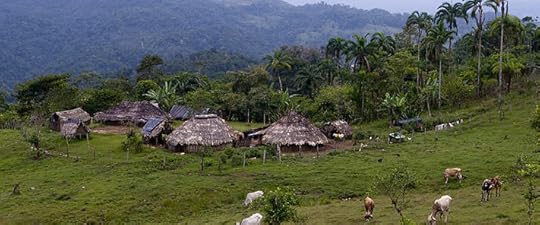
Indigenous community in Talamanca, Costa Rica.
The last 30 years of the 19th century proved disastrous for Costa Rica’s remaining indigenous peoples and the communities that have survived in the dense jungles. The international rubber boom motivated rubber tappers to penetrate the forests and this led to the rape, murder, and enslavement of hundreds of indigenous peoples. The rapid expansion of the United Fruit Company’s banana plantations led to devastating incursions onto the lands of indigenous groups. Sedentary communities in the highlands were overrun. According to the 2,000 census, 1.7% (63,876) of the current population remains indigenous.
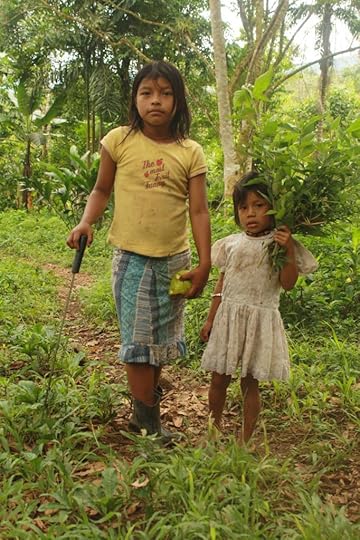
Children of Cabecar peoples, fewer than 200 remain.
The tragic thing is that peaceful communities that desire to live naturally off the land, in accordance with the earth, are not left alone, but are exploited by outsiders on a malicious quest of destruction to accumulate wealth. And it is wealth not for their immediate needs, as the manna-like existence derived by the indigenous peoples, but wealth to be stored for the fearful futures of the exploiters, to be gambled, invested, squandered, and ultimately integrated back into that exploitive machinery of lustful Mammon which is so intent on the destruction of this planet.
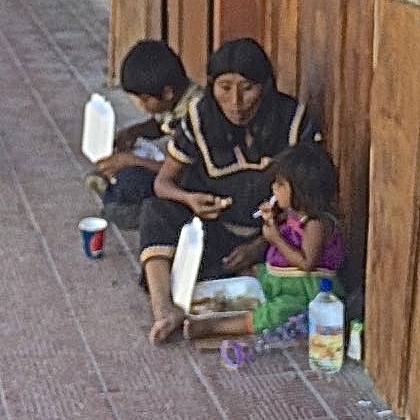
Indigenous People in the streets of Quepos in 2014
Social Composition
Colonial society in Costa Rica was not built upon African slave labor as in much of Latin America, but rather upon the proliferation of cattle estates and peasantry. There was a brief cacao boom in the 1700’s that was based on the labor of imported African slaves, but this slave trade was very limited in Costa Rica. Instead, a free peasant economy developed of small agriculturalists. The race mixture is about 60% mestizo, 18% mulatto, 12% Indian, and 10% Spanish.
There also developed a Colonial elite made up of smaller groups of merchants, owners of large estates, and civil functionaries. These elites garnered wealth from an unequal exchange with the peasantry. They bought the agricultural surplus at low prices and sold imported articles at high prices.
The so-called rural democracy of the 18th century was a society of peasants and merchants in which the exploitation of the former by the latter was not based upon physical coercion, but rather on the different positions each enjoyed in market relations. Social hierarchies in Costa Rica are more dependent upon economic wealth than on ethnic origin.
One entry in this Reader is by Latin philosopher Constantion Lascaris, who describes the origins of social development in Costa Rica aas follows:
“Costa Rica is the result of the unplanned, organic penetration of the frontier. A man throws an axe over his shoulder and with machete in hand burns a piece of forest, plants it, and builds his shack. Little by little others arrive, burn forest and build cabins. They rarely meet one another, although they know of one another. Slowly the footsteps of the folk forge tracks and paths that intersect in a point. One day, a farsighted man installs himself at that point. He builds a slightly bigger shack and uses it as a storehouse. He spends his entire day waiting for someone to come and buy from him. The store shack becomes the nerve-center for the group of houses. The store becomes a social center, a place where the community comprehends itself. To sustain its business, the store must offer credit until crops are harvested. To maintain the line of credit, the customer must pay up from time to time. It becomes more than a store. It is an arrangement of closeness, of mutual survival, as opposed to the sterile profit taking of the modern corporate marketplace.“
–Constantion Lascaris
The Cult of the Virgin of los Angeles (Costa Rica’s black Madonna)
The legend is that in 1635 an Indian woman found an image of the Virgin, crudely sculpted in black granite, near spring waters, just outside the city of Cartago. Although she took the image to her hut, the image kept somehow returning of its own accord to the place where she found it. A hermitage was built upon the site.
Initially only the lower classes practiced devotion to the image, but with time whites also came to be followers of the little black image. In 1675 construction of a church of limestone was initiated on the site. In 1669 the colonial governor donated an entire cacao plantation to the image!
From these lowly origins, a cult developed that ultimately attracted the Cartago elites into dark pagan feasts, replete with bulls, drunkenness, African dances, and fornication. Each year this “Brotherhood of los Angeles” celebrated its patron with religious and profane functions. By the mid 18th century, the sanctuary had become famous and received visits of pilgrims from afar. Great festivities were held that degenerated to the point of taking on scandalous character. Cartago gave itself up to a shocking licentiousness, lewdness, and drunkenness.
In 1782, Bishop Esteban Lorenzo de Tristan sought to put an end to the dances, feasts, and scandals in the shrine by modifying the celebrations to a parade and moving them to Cartago, where the event became known as “La Pasada”. However, at the urging of the authorities and residents of Cartago, the Bishop ultimately declared the Lady of los Angeles the patron saint of the city in 1824!
The image now resides on a gold, jewel-studded platform at the main altar in the Basilica de Nuestra Senora de los Angeles in Cartago. Each August 2, on the anniversary of the statuette’s discovery, pilgrims from every corner of the country walk the 22 km from SanJose to the Basilica. Many of them come the last few hundred meters of the pilgrimage on their knees.
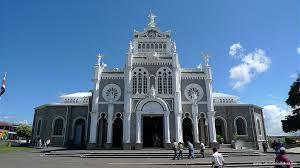
Basilica de Nuestra Senora de los Angeles in Cartago.
Good Men (1750-1850)
Between 1750 and 1850, the State began to disseminate the values of the dominant class. An upper-class family ideal gained appeal: the self–sufficient, male breadwinner and the dependent, homemaking wife. A very interesting method of civil procedure developed, particularly for marital disputes. The judge would name two good men to speak on behalf of the involved parties. These good men worked with the judge as mediators in the judicial process.
The use of “good men” from the community to seek righteousness in the legal process is a unique and intriguing practice that I find very interesting, especially in comparison to our modern system of using biased lawyers as hired guns to conduct open legal warfare. In contrast, our modern courts conduct “dog and pony shows”, designed to sway often uninformed and poorly educated jurors to rule in a matter they vaguely understand. Perhaps the U.S. legal system should seek to deploy a few good men? ☺
William Walker (1850-1860)
In 1856 Costa Ricans went to war against the American mercenary William Walker who had taken over Nicaragua and was threatening a Central American conquest. Walker was born in Nashville in 1824. He received a medical degree from the University of Pennsylvania and practiced medicine for some time. In 1853, Walker began recruiting colonists from amongst American supporters of slavery and believers in the American policy of “Manifest Destiny”. Most of Walker’s colonists came from Kentucky and Tennessee. With 45 men, Walker went into Mexico and captured La Paz, which he declared his capital and made himself President. However, the Mexicans eventually forced Walker to retreat back into California.
In 1854, a civil war erupted in Nicaragua and in 1855 Walker took 60 men and gained control of Nicaragua. Amazingly, U.S. President, Franklin Pierce recognized Walker’s regime as the legitimate government of Nicaragua in 1856. Walker than set his sights on conquering all of Central America and tried to take Costa Rica. Walker invaded Costa Rica but was defeated by a citizen army in a battle in which Juan Santamaria became a national hero for Costa Rica. Honduran troops attacked Walker from the north. In his plight, Walker sought support from the southern U.S. States by promoting his campaign as a fight to spread the institution of slavery.
Eventually, Walker was captured by the U.S. Navy in 1860 and returned to New York where he wrote a book about his exploits. Walker then returned to Honduras, only to be re-captured, this time by the British. Rather than return Walker to the U.S., the British decided to turn him over to Honduran authorities who executed him by firing squad.
Juan Santamaria
Juan Santamaria was a humble day laborer praised for a heroic act at the battle of Rivas that allegedly snatched victory from William Walker’s mercenaries in 1856. According to the traditional account, soldiers were asked to volunteer to advance towards an enemy position and set it on fire. Several soldiers tried and were killed in failure. Finally, Santamaria volunteered on the condition that, in the event of his death, someone would look after his mother. He then advanced, was mortally wounded, but before expiring succeeded in setting the enemy position on fire, which turned the battle decisively for a Costa Rican victory.
Between 1885 and 1895 the elites and intellectuals developed Santamaria into a prototypical patriotic hero that the lower classes were encouraged to emulate. It was, in all respects, the development of a national mythology. A statue of Santamaria was erected in Alajuela and the lower classes were encouraged to identify with Santamaria’s selfless sacrifice for the country. Santamaria was presented as from the very lowest social strata, as an illegitimate child of a poor woman. With Santamaria, the dominant oligarchy harnessed a symbol for promulgating their policies. Today, the international airport in Costa Rica is named after Santamaria.

The graphic above is of an oil painting by Costa Rican artist Enrique Echandi (1866-1859) that created a national scandal because it depicted Santamaria as a mulatto in peasant dress, seemingly mocking the trim solider in uniform portrayed in the official propaganda. Even more stimulating in this art is that Santamaria is accomplishing the heroic task without apotheosis, self-elevation, or nationalistic glorification. This artist was a precursor of a group of young iconoclastic intellectuals who began to subvert the State mythology at the turn of the 20th century.
In many ways, the figure of Jesus has been similarly deployed to pacify the masses, to coax them into acceptance of humility, poverty, and a passive existence in the face of the vulgar excesses exhibited by those who have exploited them.
Coffee Capitalism (1850-1890)
Coffee transformed Costa Rica from a poor and miserable country to a richer and more prosperous one in the space of about 15 years. Between 1850 and 1890, the sale of coffee accounted for around 90% of the country’s export earnings. The clearest winners were the coffee barons who made millions by controlling land, credit, prices, and processing facilities. The clearest losers were the indigenous communities of the highlands who saw their common lands stripped and their traditional rights trampled by encroaching colonists. The coffee barons expanded their land holdings under the cloak of a governmental policy for the privatizing of public lands under the presidency of Juan Rafael Mora (1849-59).
Prior to the takeoff in coffee capitalism, the Costa Ricans constituted a homogeneous group of yeoman farmers who lived in a world with minimal class distinctions and exploitation. These vile things came later with coffee. The nature of capitalism is for the industrious to put the less industrious to work and profit thereby; or for the informed to put the less informed to work; or for those with connections to markets to put those without such connections to work. The whole process becomes a means by which some profit from the labor of others and such laborers lose some portion of the benefits from their labor.
However, the absence of capitalism would leave the industrious entrepreneurs without the necessary profit motivation to work out their industriousness. The only way to ensure industry without capitalism is to somehow find an alternative for the profit motive. Simple love for one another remains an insufficient motive for the species of man that now inhabits this planet.
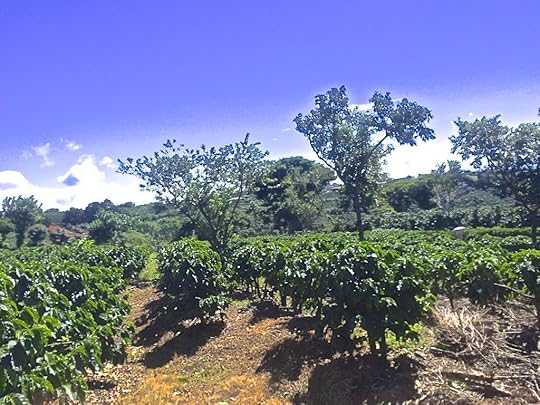
Costa Rican Coffee Plantation Near Poas Volcano
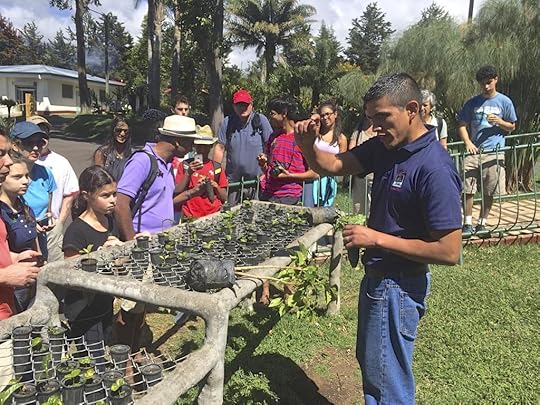
Coffee worker shows us how the coffee seedlings are started.
Environmental Destruction
The booming coffee economy created Costa Rica’s first struggles over environmental contamination. Not only the mass clearing of virgin rain forest, but also contamination of water sources by discharge from coffee processing facilities. Costa Rica has long held the world record in forest clearing. At its peak, about 7% of the forest was cleared every year. The State passed laws allowing citizens to claim public lands. The resulting soil erosion is now visible on the hillsides of Costa Rica. It is a vulgarization that comes with the wholesale destruction of God’s gifts that are irreplaceable and contain many diversified life forms, DNA structures, and medicines not yet discovered.
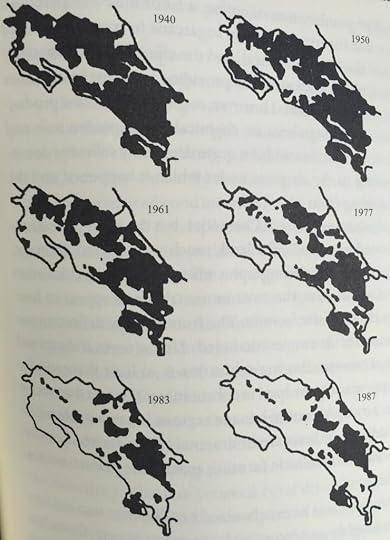
Costa Rican Forests (in black), 1940-1987
To start banana production, it was necessary to prepare future plantations on lands almost entirely covered by virgin jungle and swamps. In 1942, the United Fruit Company began to experience fungus problems with its infusion of huge banana farms into the Costa Rican landscape.
Crews were hired to spray poison to combat banana diseases. The sprayers became impregnated with the blue-green colored spray, which coated their hats, clothing, and even skin. It also penetrated the respiratory passages of the sprayers causing them to become hoarse, emaciated and in many cases to develop tuberculosis. Even though United Fruits fungicide application program lasted 25 years, the wageworkers suffered as much exposure to the toxic chemicals as the organisms they were seeking to control. United Fruit controlled over 1,400,000 hectares in four Central American countries and held a near-absolute monopoly in the North American banana trade. The sprayers developed headaches, night coughs, and blindness. However, these conditions were dismissed as the malicious imaginations of leftist labor agitators.
The irony of men getting sicker as the banana plantations are restored to health reveals the macabre nature of agricultural capitalism’s exchange of the lives of men for the productivity of plants. The eerie symmetry between the robustness of the crop and the emaciation of the men whose labor allowed it to grow became grotesque. The State assisted in suppressing strikes and jailed union organizers. In fact, Costa Rican authorities gave United Fruit free reign to conduct systematic union suppression. However, by the late 1950’s the banana plants began to uproot and United Fruit discovered the toxic spray has so infused the soil as to prevent its continued use for bananas. The company abandoned the land, selling it to smaller farmers who were not informed of the problem. The new growers could not get even rice to grow and found the land to be nearly totally sterilized. The only thing they could find to grow on the land were palm trees and the land was planted with palms for producing palm oil. On our recent trip to Costa Rica we visited these palm forests and observed the harvesting of palm fruit that is today processed into palm oil.
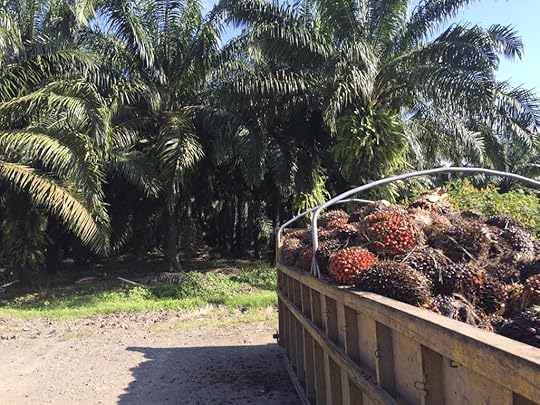
Palm Forest and harvested Fruit
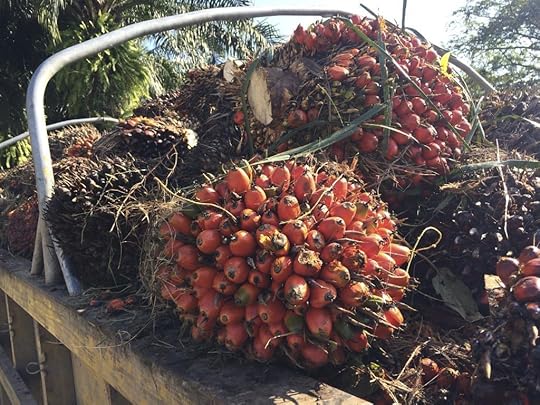
Close up of Palm Fruit, which is steamed and mashed to produce the palm oil that is found in many foods and cosmetics.
CONTINUED IN COMMENT SECTION BELOW
Published by Duke University Press, these readers are widely available for a number of countries. Having enjoyed The Cuban Reader, I was enticed to this one in preparation for an upcoming visit to Costa Rica. The great thing about these readers is that they present history by organizing incidental writings from a variety of sources and viewpoints, which has the effect of providing a more realistic and authentic view of the past.
Colonial Costa Rica
Prior to the arrival of Columbus in 1502, the territory of Costa Rica was home to about 400,000 indigenous people. The Spanish conquest drastically reduced the numbers of indigenous peoples. The genocidal enslavement of indigenous American peoples is like a holocaust far beyond any other the world has ever seen. The Spanish descended upon the Americas like wolves. The Spaniards reduced the indigenous population to the point of extinction through disease, war, reprisals, relocation, and brutal exploitation. The Native American population stood at about 120,000 in 1569 and had fallen to about 10,000 by 1611. However, in the coastal plains of Talamanca and near the current border with Nicaragua, some of the wild Indians took refuge and resisted Spanish conquest until the second half of the 19th century.
The Colonialists relied on the exaction of tribute and labor from indigenous groups. There was a constant demand for Indians. Expeditions to hunt and extract Indians occurred even though the monarchy outlawed slavery. The Colonists extracted the Indians for labor under jumbled up religious justification about the necessity to bring these wild infidels under the “yoke of the gospel”. In fact, churches sometimes even served as temporary prisons for the captured Indians until they could be set to work. The Indian leaders were hanged, beheaded, and their heads displayed on pikes. The constant massacre of Indian chiefs dismantled the Indians’ sociopolitical structures. The conquest of the Indians continued until 1709 when the indigenous peoples rebelled and destroyed all the churches built in their territory.
Today’s Indigenous Costa Ricans
Indigenous community in Talamanca, Costa Rica.
The last 30 years of the 19th century proved disastrous for Costa Rica’s remaining indigenous peoples and the communities that have survived in the dense jungles. The international rubber boom motivated rubber tappers to penetrate the forests and this led to the rape, murder, and enslavement of hundreds of indigenous peoples. The rapid expansion of the United Fruit Company’s banana plantations led to devastating incursions onto the lands of indigenous groups. Sedentary communities in the highlands were overrun. According to the 2,000 census, 1.7% (63,876) of the current population remains indigenous.
Children of Cabecar peoples, fewer than 200 remain.
The tragic thing is that peaceful communities that desire to live naturally off the land, in accordance with the earth, are not left alone, but are exploited by outsiders on a malicious quest of destruction to accumulate wealth. And it is wealth not for their immediate needs, as the manna-like existence derived by the indigenous peoples, but wealth to be stored for the fearful futures of the exploiters, to be gambled, invested, squandered, and ultimately integrated back into that exploitive machinery of lustful Mammon which is so intent on the destruction of this planet.
Indigenous People in the streets of Quepos in 2014
Social Composition
Colonial society in Costa Rica was not built upon African slave labor as in much of Latin America, but rather upon the proliferation of cattle estates and peasantry. There was a brief cacao boom in the 1700’s that was based on the labor of imported African slaves, but this slave trade was very limited in Costa Rica. Instead, a free peasant economy developed of small agriculturalists. The race mixture is about 60% mestizo, 18% mulatto, 12% Indian, and 10% Spanish.
There also developed a Colonial elite made up of smaller groups of merchants, owners of large estates, and civil functionaries. These elites garnered wealth from an unequal exchange with the peasantry. They bought the agricultural surplus at low prices and sold imported articles at high prices.
The so-called rural democracy of the 18th century was a society of peasants and merchants in which the exploitation of the former by the latter was not based upon physical coercion, but rather on the different positions each enjoyed in market relations. Social hierarchies in Costa Rica are more dependent upon economic wealth than on ethnic origin.
One entry in this Reader is by Latin philosopher Constantion Lascaris, who describes the origins of social development in Costa Rica aas follows:
“Costa Rica is the result of the unplanned, organic penetration of the frontier. A man throws an axe over his shoulder and with machete in hand burns a piece of forest, plants it, and builds his shack. Little by little others arrive, burn forest and build cabins. They rarely meet one another, although they know of one another. Slowly the footsteps of the folk forge tracks and paths that intersect in a point. One day, a farsighted man installs himself at that point. He builds a slightly bigger shack and uses it as a storehouse. He spends his entire day waiting for someone to come and buy from him. The store shack becomes the nerve-center for the group of houses. The store becomes a social center, a place where the community comprehends itself. To sustain its business, the store must offer credit until crops are harvested. To maintain the line of credit, the customer must pay up from time to time. It becomes more than a store. It is an arrangement of closeness, of mutual survival, as opposed to the sterile profit taking of the modern corporate marketplace.“
–Constantion Lascaris
The Cult of the Virgin of los Angeles (Costa Rica’s black Madonna)
The legend is that in 1635 an Indian woman found an image of the Virgin, crudely sculpted in black granite, near spring waters, just outside the city of Cartago. Although she took the image to her hut, the image kept somehow returning of its own accord to the place where she found it. A hermitage was built upon the site.
Initially only the lower classes practiced devotion to the image, but with time whites also came to be followers of the little black image. In 1675 construction of a church of limestone was initiated on the site. In 1669 the colonial governor donated an entire cacao plantation to the image!
From these lowly origins, a cult developed that ultimately attracted the Cartago elites into dark pagan feasts, replete with bulls, drunkenness, African dances, and fornication. Each year this “Brotherhood of los Angeles” celebrated its patron with religious and profane functions. By the mid 18th century, the sanctuary had become famous and received visits of pilgrims from afar. Great festivities were held that degenerated to the point of taking on scandalous character. Cartago gave itself up to a shocking licentiousness, lewdness, and drunkenness.
In 1782, Bishop Esteban Lorenzo de Tristan sought to put an end to the dances, feasts, and scandals in the shrine by modifying the celebrations to a parade and moving them to Cartago, where the event became known as “La Pasada”. However, at the urging of the authorities and residents of Cartago, the Bishop ultimately declared the Lady of los Angeles the patron saint of the city in 1824!
The image now resides on a gold, jewel-studded platform at the main altar in the Basilica de Nuestra Senora de los Angeles in Cartago. Each August 2, on the anniversary of the statuette’s discovery, pilgrims from every corner of the country walk the 22 km from SanJose to the Basilica. Many of them come the last few hundred meters of the pilgrimage on their knees.
Basilica de Nuestra Senora de los Angeles in Cartago.
Good Men (1750-1850)
Between 1750 and 1850, the State began to disseminate the values of the dominant class. An upper-class family ideal gained appeal: the self–sufficient, male breadwinner and the dependent, homemaking wife. A very interesting method of civil procedure developed, particularly for marital disputes. The judge would name two good men to speak on behalf of the involved parties. These good men worked with the judge as mediators in the judicial process.
The use of “good men” from the community to seek righteousness in the legal process is a unique and intriguing practice that I find very interesting, especially in comparison to our modern system of using biased lawyers as hired guns to conduct open legal warfare. In contrast, our modern courts conduct “dog and pony shows”, designed to sway often uninformed and poorly educated jurors to rule in a matter they vaguely understand. Perhaps the U.S. legal system should seek to deploy a few good men? ☺
William Walker (1850-1860)
In 1856 Costa Ricans went to war against the American mercenary William Walker who had taken over Nicaragua and was threatening a Central American conquest. Walker was born in Nashville in 1824. He received a medical degree from the University of Pennsylvania and practiced medicine for some time. In 1853, Walker began recruiting colonists from amongst American supporters of slavery and believers in the American policy of “Manifest Destiny”. Most of Walker’s colonists came from Kentucky and Tennessee. With 45 men, Walker went into Mexico and captured La Paz, which he declared his capital and made himself President. However, the Mexicans eventually forced Walker to retreat back into California.
In 1854, a civil war erupted in Nicaragua and in 1855 Walker took 60 men and gained control of Nicaragua. Amazingly, U.S. President, Franklin Pierce recognized Walker’s regime as the legitimate government of Nicaragua in 1856. Walker than set his sights on conquering all of Central America and tried to take Costa Rica. Walker invaded Costa Rica but was defeated by a citizen army in a battle in which Juan Santamaria became a national hero for Costa Rica. Honduran troops attacked Walker from the north. In his plight, Walker sought support from the southern U.S. States by promoting his campaign as a fight to spread the institution of slavery.
Eventually, Walker was captured by the U.S. Navy in 1860 and returned to New York where he wrote a book about his exploits. Walker then returned to Honduras, only to be re-captured, this time by the British. Rather than return Walker to the U.S., the British decided to turn him over to Honduran authorities who executed him by firing squad.
Juan Santamaria
Juan Santamaria was a humble day laborer praised for a heroic act at the battle of Rivas that allegedly snatched victory from William Walker’s mercenaries in 1856. According to the traditional account, soldiers were asked to volunteer to advance towards an enemy position and set it on fire. Several soldiers tried and were killed in failure. Finally, Santamaria volunteered on the condition that, in the event of his death, someone would look after his mother. He then advanced, was mortally wounded, but before expiring succeeded in setting the enemy position on fire, which turned the battle decisively for a Costa Rican victory.
Between 1885 and 1895 the elites and intellectuals developed Santamaria into a prototypical patriotic hero that the lower classes were encouraged to emulate. It was, in all respects, the development of a national mythology. A statue of Santamaria was erected in Alajuela and the lower classes were encouraged to identify with Santamaria’s selfless sacrifice for the country. Santamaria was presented as from the very lowest social strata, as an illegitimate child of a poor woman. With Santamaria, the dominant oligarchy harnessed a symbol for promulgating their policies. Today, the international airport in Costa Rica is named after Santamaria.
The graphic above is of an oil painting by Costa Rican artist Enrique Echandi (1866-1859) that created a national scandal because it depicted Santamaria as a mulatto in peasant dress, seemingly mocking the trim solider in uniform portrayed in the official propaganda. Even more stimulating in this art is that Santamaria is accomplishing the heroic task without apotheosis, self-elevation, or nationalistic glorification. This artist was a precursor of a group of young iconoclastic intellectuals who began to subvert the State mythology at the turn of the 20th century.
In many ways, the figure of Jesus has been similarly deployed to pacify the masses, to coax them into acceptance of humility, poverty, and a passive existence in the face of the vulgar excesses exhibited by those who have exploited them.
Coffee Capitalism (1850-1890)
Coffee transformed Costa Rica from a poor and miserable country to a richer and more prosperous one in the space of about 15 years. Between 1850 and 1890, the sale of coffee accounted for around 90% of the country’s export earnings. The clearest winners were the coffee barons who made millions by controlling land, credit, prices, and processing facilities. The clearest losers were the indigenous communities of the highlands who saw their common lands stripped and their traditional rights trampled by encroaching colonists. The coffee barons expanded their land holdings under the cloak of a governmental policy for the privatizing of public lands under the presidency of Juan Rafael Mora (1849-59).
Prior to the takeoff in coffee capitalism, the Costa Ricans constituted a homogeneous group of yeoman farmers who lived in a world with minimal class distinctions and exploitation. These vile things came later with coffee. The nature of capitalism is for the industrious to put the less industrious to work and profit thereby; or for the informed to put the less informed to work; or for those with connections to markets to put those without such connections to work. The whole process becomes a means by which some profit from the labor of others and such laborers lose some portion of the benefits from their labor.
However, the absence of capitalism would leave the industrious entrepreneurs without the necessary profit motivation to work out their industriousness. The only way to ensure industry without capitalism is to somehow find an alternative for the profit motive. Simple love for one another remains an insufficient motive for the species of man that now inhabits this planet.
Costa Rican Coffee Plantation Near Poas Volcano
Coffee worker shows us how the coffee seedlings are started.
Environmental Destruction
The booming coffee economy created Costa Rica’s first struggles over environmental contamination. Not only the mass clearing of virgin rain forest, but also contamination of water sources by discharge from coffee processing facilities. Costa Rica has long held the world record in forest clearing. At its peak, about 7% of the forest was cleared every year. The State passed laws allowing citizens to claim public lands. The resulting soil erosion is now visible on the hillsides of Costa Rica. It is a vulgarization that comes with the wholesale destruction of God’s gifts that are irreplaceable and contain many diversified life forms, DNA structures, and medicines not yet discovered.
Costa Rican Forests (in black), 1940-1987
To start banana production, it was necessary to prepare future plantations on lands almost entirely covered by virgin jungle and swamps. In 1942, the United Fruit Company began to experience fungus problems with its infusion of huge banana farms into the Costa Rican landscape.
Crews were hired to spray poison to combat banana diseases. The sprayers became impregnated with the blue-green colored spray, which coated their hats, clothing, and even skin. It also penetrated the respiratory passages of the sprayers causing them to become hoarse, emaciated and in many cases to develop tuberculosis. Even though United Fruits fungicide application program lasted 25 years, the wageworkers suffered as much exposure to the toxic chemicals as the organisms they were seeking to control. United Fruit controlled over 1,400,000 hectares in four Central American countries and held a near-absolute monopoly in the North American banana trade. The sprayers developed headaches, night coughs, and blindness. However, these conditions were dismissed as the malicious imaginations of leftist labor agitators.
The irony of men getting sicker as the banana plantations are restored to health reveals the macabre nature of agricultural capitalism’s exchange of the lives of men for the productivity of plants. The eerie symmetry between the robustness of the crop and the emaciation of the men whose labor allowed it to grow became grotesque. The State assisted in suppressing strikes and jailed union organizers. In fact, Costa Rican authorities gave United Fruit free reign to conduct systematic union suppression. However, by the late 1950’s the banana plants began to uproot and United Fruit discovered the toxic spray has so infused the soil as to prevent its continued use for bananas. The company abandoned the land, selling it to smaller farmers who were not informed of the problem. The new growers could not get even rice to grow and found the land to be nearly totally sterilized. The only thing they could find to grow on the land were palm trees and the land was planted with palms for producing palm oil. On our recent trip to Costa Rica we visited these palm forests and observed the harvesting of palm fruit that is today processed into palm oil.
Palm Forest and harvested Fruit
Close up of Palm Fruit, which is steamed and mashed to produce the palm oil that is found in many foods and cosmetics.
CONTINUED IN COMMENT SECTION BELOW
May 8, 2020
The Costa Rica reader is an anthology of different texts and passages collected from different authors by Steven Palmer and Ivan Molina, who also give a brief introduction prior to each new chapter and text. The first chapters of the book follow a broad chronological order, initiating with the Spanish, their conquest and the subsequent life as a colony; The XIX Century after independence and the creation of an agricultural land based on coffee and banana; the post ward period that came with economic growth and finally, for the chronological order;the post crisis period of 82 and the end of the XX century. The final chapters describe different topics to Costa Rican history and society, from the ethnically and racially point of view; from the economy and working conditions through the republic's life and finally of the new political, economical and environmental drivers of the XIX Century (Based on 2002 Costa Rica).
When I began this book I expected it very vague and a bit boring, considering there was not cohesion between all chapters and texts, I could not have been more wrong. Despite the texts were not originally intertwinned or hat any relation whatsoever, Molina and Palmer developed a very good way of linking each according to their different introductions and topics.
Another great point of the book is the incredible and powerful way that day to day descriptions of life of different normal people can have such a valuable historical and analytical value for a society, following the chronological line we are presented by the recounts of a slave during the Spanish colony avowing for his master to give him freedom; the re-evaluation of many myths of the Spanish conquest, for many decades portrayed as "pacific" and slow, is revisited and tackled; the revision of one of Costa Rican "greatest hero" Juan Santamaria, more than another poor victim of war rendered into Costa Rican pride and source of patriotism by the political elites; the insidious affair of the agricultural business by the highland's elites with coffee and US interventionist through the United Fruit Company with the banana industry; the changing point in history of the '48 Civil war and the subsequent taking of power of Figueres, ushering 3 decades of constant growth and prosperity until the crisis of 81-82 and the interesting analysis of it presented on this book.
On the non chronological chapters, we could also understand a little bit more of the racial components of the real Costa Rica, leaving behind any outdated view of a white majority, with the afro culture at the Caribbean cost, the remnants of indigenous cultures on some spots of the country and the cultural implication of the thousand influx of Nicaraguans following the conjuncture of Nicaragua in the 80s; The expansion of the urban civilisation from the central highlands towards every direction in the country and the subsequent deforestation of the country and finally, the boom in tourism that made ambiguous the fight for environmental protection.
The book has many texts that I did not enjoy, nevertheless as a whole is a very recommended read for anybody interested in Costa Rica's history, politics and economy, although I must say that without any previous knowledge of basic costa Rica's history the enjoyment of the book could been heavily lowered.
When I began this book I expected it very vague and a bit boring, considering there was not cohesion between all chapters and texts, I could not have been more wrong. Despite the texts were not originally intertwinned or hat any relation whatsoever, Molina and Palmer developed a very good way of linking each according to their different introductions and topics.
Another great point of the book is the incredible and powerful way that day to day descriptions of life of different normal people can have such a valuable historical and analytical value for a society, following the chronological line we are presented by the recounts of a slave during the Spanish colony avowing for his master to give him freedom; the re-evaluation of many myths of the Spanish conquest, for many decades portrayed as "pacific" and slow, is revisited and tackled; the revision of one of Costa Rican "greatest hero" Juan Santamaria, more than another poor victim of war rendered into Costa Rican pride and source of patriotism by the political elites; the insidious affair of the agricultural business by the highland's elites with coffee and US interventionist through the United Fruit Company with the banana industry; the changing point in history of the '48 Civil war and the subsequent taking of power of Figueres, ushering 3 decades of constant growth and prosperity until the crisis of 81-82 and the interesting analysis of it presented on this book.
On the non chronological chapters, we could also understand a little bit more of the racial components of the real Costa Rica, leaving behind any outdated view of a white majority, with the afro culture at the Caribbean cost, the remnants of indigenous cultures on some spots of the country and the cultural implication of the thousand influx of Nicaraguans following the conjuncture of Nicaragua in the 80s; The expansion of the urban civilisation from the central highlands towards every direction in the country and the subsequent deforestation of the country and finally, the boom in tourism that made ambiguous the fight for environmental protection.
The book has many texts that I did not enjoy, nevertheless as a whole is a very recommended read for anybody interested in Costa Rica's history, politics and economy, although I must say that without any previous knowledge of basic costa Rica's history the enjoyment of the book could been heavily lowered.

November 14, 2024
I liked the concept of this book: an anthology of historical texts as a means of discovering the history of Costa Rica. However, there were two main issues I had with this book. First, the language is of an extremely and unnecessarily high lexile level. It is often quite difficult to stay engaged when the prose is written like this. Considering that much of the original text was likely written in Spanish, I find it a grave flaw that the author chose to translate it in such an obstructive manner. Second, the anthology certainly followed broad themes that connected the various texts, but there was a lack of overarching messaging as a result. For instance, many documents were ultra specific, and the single-paragraph introduction composed by the author was not enough context. In my opinion, the context preceding each text was almost more helpful than the documents themselves.
I am glad that I explored this type of book, but I will not be reading any of Palmer/Molina’s other works.
I am glad that I explored this type of book, but I will not be reading any of Palmer/Molina’s other works.

January 16, 2024
I didn't care for the editing work. A few interesting articles spread here and there throughout, but the editors provided no context for the pieces. Had I known Costa Rican history beforehand, it may have fleshed some things out, but coming in completely naive, I feel I wasted much time. It didn't help that it is 20 years old, but I knew that going in.

November 11, 2024
I was looking to understand the history and culture of Costa Rica and this book offered some valuable insight into that. This collection had a range of views and also went well with local history that I have heard about from people verbally. I enjoyed learning from this book. It takes time to read and understand, but well worth reading to know more about Costa Rica.

October 18, 2019
A collection of source documents with great summary lead-ins. No current perspectives, as there have been no updated articles in the last 20 years. The pieces are enjoyable.

February 25, 2025
Compilation of articles, stories and a poem that span Costa Rica's history and gives a valuable perspective into the people of Costa Rica and their culture.

August 30, 2025
Interesting perspectives on the growth of Costa Rican society and history through the colonial period to present day.

April 15, 2026
Love having primary source material and short chapters/sections but also way too dry of a pure history book. Would have benefitted from more story telling.

Read
April 19, 2026I was going to type out a quote that I thought was interesting from the section that discussed the figure Jose Santamaría, which after I typed, made me realize that without the context of that section, it really made no sense and my brain, at the time of being fascinated by that quote, was desperately tired and needed to sleep.
This book is a lot of things, and while I wish I could offer some kind of critical analysis on the sources used, the way the sections were organized, and the information offered, I feel way out of my depth even attempting to do so. So I shall not. The things I found most interesting about this book were the discussions on the aforementioned Jose Santamaría (and historical folk figures in general), Francisco Cubillo, any discussion this book had regarding the environment and Costa Rican ecosystems, and the inclusion of Eulalia Bernard's poem, 'My Mother and the Seawall'.
I feel like I should not have read this before reading an actual of history of Costa Rica. I am missing so much context, for like whole of everything that this book is discussing. I would now like to track down a comprehensive history of Costa Rica and also more of Eulalia Bernard's poetry.
This book is a lot of things, and while I wish I could offer some kind of critical analysis on the sources used, the way the sections were organized, and the information offered, I feel way out of my depth even attempting to do so. So I shall not. The things I found most interesting about this book were the discussions on the aforementioned Jose Santamaría (and historical folk figures in general), Francisco Cubillo, any discussion this book had regarding the environment and Costa Rican ecosystems, and the inclusion of Eulalia Bernard's poem, 'My Mother and the Seawall'.
I feel like I should not have read this before reading an actual of history of Costa Rica. I am missing so much context, for like whole of everything that this book is discussing. I would now like to track down a comprehensive history of Costa Rica and also more of Eulalia Bernard's poetry.

July 31, 2013
I find these readers to be a really interesting way to learn more about the history of the countries I'm visiting, but also to try and understand better the nuance of the cultures there. This is an excellent example in the series with good factual introductions (neither too long nor too short) and really engaging extracts or republications of different works. It includes not only written sources, but also reproductions of paintings, newspaper cartoons and photographs. I would highly recommend this to anyone planning a trip to this lovely country.

Read
October 2, 2015These are a series of country studies that provide a valuable overview of various Latin American countries. They use both primary and secondary sources by eyewitnesses and important scholars respectively to illuminate key periods of each country’s history. They also include a trove of images, maps, and fine art. Each volume focuses on a single country. Currently, Duke has published readers about the Dominican Republic, Chile, Paraguay, Guatemala, Ecuador, Perú, Costa Rica, Cuba, México, Argentina, and Brazil

August 28, 2011
Parts 1 through 5 are chronological. 6 through 8 focus on contemporary Costa Rica and are divided thematically.
I am really enjoying this. Some pieces are quite long: between 5 and 6 pages. Includes various flyers and brochures, photographs and reproductions of paintings.
Many entries written by the editors themselves.
I am really enjoying this. Some pieces are quite long: between 5 and 6 pages. Includes various flyers and brochures, photographs and reproductions of paintings.
Many entries written by the editors themselves.

May 10, 2009
One of the books I read while researching Costa Rica: the Last Country the Gods Made.

Did Not Finish
January 15, 2016I enjoyed what I read while travelling in Costa Rica, but it was a library book, and I didn't get very far in it before it had to be returned. I would recommend it, along with "Monkeys are Made of Chocolate" for travel reading in Costa Rica.
March 6, 2012
Excellent reader to understand why Costa Rica is different from its neighbors. Useful for courses taught on Central America or Costa Rica.

June 1, 2013
Interesting and informative.

Read
November 20, 2018Too academic / unfun to read, so I skimmed instead.
Displaying 1 - 21 of 21 reviews