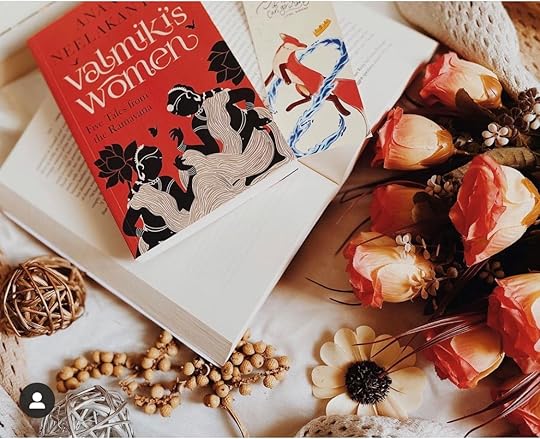
Would King Dasharatha even have his coveted sons were it not for the sacrifice of his daughter Shanta?
Was Manthara an evil, conniving handmaid to the queen, or a loving mother who tried to protect her ward from palace intrigues?
How did Meenakshi of the beautiful eyes transform into the embodiment of ugliness and immoral lust? In an epic that revolves around the life of a righteous prince, what role do the women play?
As bestselling author Anand Neelakantan peels back the layers of Valmiki’s timeless saga, these stories of ambition, love, devotion and courage shine through, inviting readers to look at the women anew. Lovers, sisters, wives and mothers who hold a complex epic together—these are the women of Valmiki’s Ramayana.
Anand Neelakantan is an Indian author, columnist, screenwriter, and public speaker. He is known for writing mythological fictions and has authored ten books in English and one in Malayalam. He follows the style of telling stories based on the perspective of the antagonists or supporting characters of a larger work. His debut work Asura: Tale of the Vanquished (2012) was based on the Indian epic Ramayana, told from the perspective of Ravana—the first book in his Ramayana series. It was followed by series of books based on characters from Mahabharata and Baahubali. His books have been translated to different languages such as Tamil, Hindi, Malayalam, Telugu, Kannada, Marathi, Bengali , Gujarati, Assamese, English and Indonesian Bahasa.
Anand's Asura is one of the 100 books to be read in a life time as per Amazon.[1] The book has sold more than half a million copies across the years. Three of his books have been shortlisted for Crossword Book Award during the respective years. He was listed as one among the "100 top celebrities in India" in 2015 and 2017 by Forbes India. Anand also writes a column for The New Indian Express on current affairs and his fortnightly column is called "Acute Angle".
Should this book really be named 'Valmiki's Women'? It's always interesting to come across newer versions and interpretations of the epics like Ramayana and Mahabharata; to see how one story can be perceived from so many dimensions and understand that in most cases there isn't a clear black or white to the characters. However, I don't think it's entirely fair to come up with an idea or a character version which is miles away from Valmiki's Ramayan and then associate it with the poet. While the tales of Shanta, Manthara, Meenakshi and Taraka are intriguing as told by the author, the stories are sometimes way different from Valmiki's version. A lot of the concepts of rich poor divide, feminism seem very force fitted at times and it feels the author twisted or gave new angles to the story just so these themes could make sense. I didn't at all like the treatment meted out to Lakshmana's character. Shrupnakha or atleast Valmiki's Shrupnakha was no damsel in distress or even a damsel head over heels in 'love' with Lakshmana. She was a rakshasi who gets smitten by Ram, expresses her lust to him, body shames Sita, calls her not good enough for Ram and then offers to eat her up so he can be free. When he denies her advances citing he won't marry again, she goes to Lakshmana. When she's refused again she attempts to kill Sita and that's when her nose is chopped off. She brings her rakshas brothers (Khar/Dushan) to attack Ram. When they fail she goes to Ravana and brainwashes him into kidnapping Sita so that she can see the fun. My perception is to see Lakshman's act as self-defence or defence for Sita. Meenakshi/Shrupnakha was about to kill her! The book brings a very different (to me a shocking) perspective. Laskshmana is shown as an Alpha male. Shrupnakha approaches him with 'love' and because she dared to love someone beyond her reach (her being rakshasi and him being prince) he abuses her by chopping off her nose, ears and breasts (I don't think Valmiki's Ramayan mentions breasts and I had never heard that they were chopped off too). Sita actually apologies to her many years later when she's banished from Ayodhya because she feels that this is the result of their bad karma during the exile (that is abusing Shrupnakha). I appreciate the idea of bringing innovative perspectives to the these epics, but does that mean we have to change the story so much? Had the genders been reversed in Shrupnakha/Meenakshi's story would the author have been equally sympathetic to that man? If there had been a male lusting after a married woman, approaching her to marry her, offering to eat up her husband so she can marry him, going after her younger sister when refused and then eventually attacking the husband because he couldn't take rejection. Let's not unnecessarily demonize Shrupnakha but let's not call her a saint as well. I had differing opinions on many of the tales told in the book, but this one was totally absurd.
Have been a crazy fan of Anand Neelakantan’s works ever since I read Asura. Very few novels take an established perspective and invert the whole viewpoint while keeping the same context. Nothing short of Goosebumps when I read Asura and Ajaya. So Valmiki’s women is an extension on that !
My personal favourite in this set of 5 short stories has to be that of.. well all 5 ! Almost impossible to choose ! Thoroughly enjoyed reading the completely opposite context of the same story and convincing myself that the other viewpoint may have been true too ! While I had read Bhoomija, Shantha, and Meenakshi as separate parts, this novel is unique for the moving stories of Manthara and Tataka ! Never knew how the construct of rakshasa was used in the battle between Good and Evil. Leaves me questioning everything in the world ! And am grateful to the novel and writer for making me think about things that are taken for granted in our Mythological constructs ! 5 stars and more for the sheer ability to become a voice of the marginalized and unspoken !
Plot/Characters: This book contains short stories of five women that portrays the lives of Bhoomija, Meenakshi, Shanta, Manthara and Tataka – characters whose actions have major repercussions in the venerated epic.
Valmiki’s Women, Neelakantan opens with Bhoomija, a heartbreaking tale of two Krauncha birds, their killer.
The second short story featuring Shanta, the little-known sister of the famed royal quartet hailing from Ayodhya.
Tataka and Meenakshi aka Soorpanakha, traditionally portrayed as lusty, demented demonesses with insatiable appetites, stand tall as remarkable women who fought for their beliefs and lived and died as they saw fit.
Story line: • Anand Neelkantan digs into the Ramayana to tell the stories of five women from the Indian epic. While some of them are lesser discussed in the popular versions of the epic, all are without doubt intriguing and interesting characters in their own right. Instead of using a devotional perspective, story was narrated the incidents from a very rational viewpoint. • Story wasn't about good versus evil. It perfectly portrayed that good or bad is always relative and based on perspectives of people. • Story wasn't slow, and kept me intrested till the end, I also liked how all them connected. ꒰⑅ᵕ༚ᵕ꒱˖♡
Story Prospective: Story was told from the point of view of 5 women but it was changed sometimes to different characters to help us get what they felt about things, that really make the stories more immersive and felt more connected with the characters. ෆ╹ .̮ ╹ෆ
Feminism: • It was perfectly feminist even thou it was wriiten from P.O.V of hindu mythology which usually portrays women as submissive and weak. • The women of the Puranas weren’t voiceless, faceless women as they are made out to be. They faced life, questioned gods and chose a fiercely independent path and this book portrayed that perfectly. ( ˘ ³˘)♥
Facts: For facts, these women weren't talked about much in the original epic so it's hard to contemplate what their actual nature was like, and since Anand Neelkantan writes novel from a logical p.o.v rather that supernatural, so that is also something different, other than that most of the basic facts were right in relation to the original epic.
*Make note that the Anand Neelkantan offered his interpretation of the Ramayana based on reading not one or two versions but various versions of the epic say, the Thai Ramayana or jain Ramayana.
Final review: • I really really liked this book ❤️ unlike "Asura- Tale of the Vanquished" this book didn't felt dragged, In asura story went really slow in the middle, but here it was interesting from start to end. • I liked the choice of women for this book, they covered all the grounds, princess, begger, animal, demonesses which gave story a complete feel. • Story was deep and drew out the emotions of the characters. So there is a lot more soul in this book. ( ˘ ³˘)♥
I would recommend this book to everyone who is interested in reading Indian Mythology from a fresh and new prospective.
Anand Neelakantan has sort of become the author who stands for the marginalized voices trying to blur the lines between "hero" and "villain". I was not 100% sure if that is entirely a good thing, but then the alt story sure does give you a new POV.
Valmiki's Women narrates the fate of the forgotten women who hold together Ramayana which is the story of men. The hunchbacked Mantara, the first daughter of Drithirashtra - Shanta, Meenakshi better known as Soorpanaka - the epitome of ugliness and immoral lust, the forest yaksha Taraka - all hold together the narrative between the popular storylines of Ramayana. Like the dying moments of Drithirashtra or Kaikeyi claiming the boons. By presenting a human villified tale - often with other characters who are not known much, the author adds credibility to the alt narrative.
So while, the storyline does not outrightly contradict the popular version, it raises reasonable doubt on the intent and motive of the actions. I loved the Kaikeyi and Mantara storyline the most since it was trying to potray a very human form of Mantara. The other stories, though researched and good, had an element of trying to appeal to the feminist (and honestly i felt was forced).
I do not know how a book like this changes anything, but I am glad the possibility is explored. Also, glad he is back to writing on the researched field than on Maghizhmathi.
PS: I rate this book much higher than any by Amish Tripathi since he is still trying to blend in a narrative of possible within the known framework than make it a point to stand out like a sore thumb.
I really liked that the author has picked women from Ramayana who are often sidelined or less talked about because they're labeled as rakshasis or evil. No body talks about them and it's always Ram, Sita, and Lakshman. This book is a fresh perspective on women sidelined by history/mythology because they thought men's valor and courage needs to highlighted more and women's strength, suffering and loss is worthless. I really enjoyed the storytelling and couldn't put the book down after starting it.
This book tells us what is very hard for our society to accept. The role women play in our lives and how we downplay their roles. Loved the book till the very end.
We feel sad every time we hear Shanta's story (Ram's sister story) and we feel angry every time we hear Manthara's name. Was she really the reason for Ram's exile? What was her story? Such questions always made me curious. When I came across this book, I knew I had to read this one!!!
My day was sorted with this amazing read. Valmiki's Women by @itsanandneel published by @westland_books is the story of five tales from The Rayamana. The tales we were unaware of, Especially the story of Manthara.
Anand Neelakanthan shares the stories of Shanta, Bhoomija, Manthara, Tataka and Meenakshi. We have heard a lot of Shanta, Bhoomija and Meenakshi but reading about Manthara and Tataka was a different experience.
How beautifully the author described the bond of Kaikeyi and Manthara, the bond between Shanta and kaikeyi, the Conversation between Sita and Meenakshi.
As the story proceeds, the author surprises the readers with amazing unheard stories. Shanta's journey, her perspective, Meenakshi's perspective, Manthara's point of view, will make you curious, will make think.
As my tea gets cold, Manthara's story made me feel sad for her, made me feel proud of Shanta. The exciting and intriguing writing style with descriptive narration will amaze the readers.
The unheard story of Manthara is a must-read story from this book. Her bond with Ram and Sita, her influence in Kaikeyi's life and the way her life changed, everything is beautifully expressed by the author.
Even though we all know Shanta's story, but Anand Neelakantan made it too fascinating that I could not stop myself and admire Shanta. Even Meenakshi's story was amazingly written.
Each of them had a strong point of view, their perspective towards the life they were living and the life they choose for themselves.
Once again, Anand Neelakanthan astounds readers with amazing, unheard stories with his magical writing style.
A book that you are going to enjoy especially if you love reading mythology.
For years we have read the epics Ramayana and the Mahabharata with a definitive view of certain characters being idyllic and the rest being immoral or even devilish.The five tales in this book are different from the usual Ramayana tales as they try to humanise the women in Ramayana who have been deemed immoral because of how their stories were put across. For instance, in one of the stories we get to know about the villainous Manthara - who was not only the maid who ignited hate in Kaikeyi's mind. . She was also her mother, who brought her up and kept her daughter's well-being above everything. This fuelled her actions and later resulted in Lord Rama's exile. The other stories similarly give us some clarity by telling the POVs of some other lesser liked characters of the Ramayana owing to their portrayal by the author. So, having said that it's actually a good book if mythology is your preferred genre and you want to read and understand Ramayana from a different light.
“Tell your father you don’t want to be adopted, you are heir to the Ikshavaku Vamsa. The throne belongs to you!” says Kaikeyi.
Would you expect a loathsome detestable woman like Kaikeyi to stand against the patriarchial customs of the Kingdom of Ayodhya? Would you be willing to see heroism in the antagonists of Valmiki's Ramayana?
Valmiki's Women is the first book by Anand Neelakantan that I have read and it would be an understatement to say that I am overjoyed to have stumbled upon this work. Different renditions of Hindu epics like Ramayana and Mahabharata have been written and published since time immemorial; we are more acquainted with the contemporary works of authors like Amish Tripathi.
Anand Neelakantan has centred this book around five women who featured in the epic of Ramayana and either are lesser known, or largely misunderstood. Shanta, Kaikeyi, Manthara, Tadaka and Meenakshi are the protagonists of Valmiki's Women, wherein their backstories, motives and aspirations are described in utmost details. Their stories are written from their perspective and not that of a hero. Victory of good over evil , the main idea behind such epics and relics has been diluted and more grey areas are explored. This exploration of the fine line between good and evil is what makes Anand Neelakantan's work relatable and rememberable.
We have been taught since childhood about Rama's heroism and Raavana's arrogance; about Sita's sacrifice and Surpanakha's deceit. But we have not been taught to ask questions or think more about the covert motives of the characters portrayed in a bad light. If anything, Valmiki's Women makes the story that people of India have been reciting for centuries a little more complex and interesting. Nothing is entirely black or white, there are always multiple perspectives and nothing really can categorise them as truly right or wrong.
Read it only if you are well acquainted with the original story, else it would very difficult for you to appreciate the nuances of this brilliant work.
“In this illusory world every emotion was real. In this world that was real, every truth was illusory. Nothing was right or wrong. The universe had its own rhythm. Like day and night, like the seasons, everything changed and yet remained the same”
This book reminds us that history is written by winners. It reminds us that heroes have flaws and Gods have weaknesses. 4 female characters from the epic we think we know so well are picked here, and their stories are retold from their perspective. Their perspective is so unique that you will want to re-read Ramayana once again to see the whole epic in new light.
My earliest childhood memory does include me and my sister watching Ramayana on the tv. Lord Rama and Hanuman fascinated me the most! I would eagerly wait for the scene when Hanuman remembers his powers and grew taller than the mountains. It was exhilarating to watch the battle and the victory of Lord Rama.
Notice how I didn't get excited about the women in the story. That was 'childhood me' and I'm glad the 'now me' has read this book. Now I know the awe-inspiring stories of the women in the greatest mythological story of India.
Valmiki's Women brings to you the five beautifully narrated stories of the sidelined women from the Ramayana story. The sacrifice of Shanta, the maternal love of Manthara and even the unbreakable spirit of Meenakshi. This collection of short stories is here to give a refreshing clarity to Valmiki's Ramayan.
I've heard a lot about Anand Neelakantan's writing and I am impressed. From the very beginning I was in love with the visual writing style. The author has done a phenomenal job in humanizing the characters. The book doesn't shy off in giving us an honest and complete insight into the epic Ramayana. The emotional flow from one page to another kept me hooked. With its eye-opening stories and raw emotional plot, this enchanting book has surely become one of my favourite mythological reads.
Even though I have read countless books on Indian mythology, I enjoyed this collection since it had a refreshing take on the same stories but through the point of views of the characters which have been mostly unvoiced. 3.75 stars
Anand Neelakantan returns to retelling the lesser known stories of the Ramayana, this time with a focus on the often glossed over female characters who play an important role in the epic's story beats.
Treading the grey line once again, questioning existing norms, Neelakantan takes us through 5 short but racy stories in the Ramayana.
I would have liked a little more reverence to the source material as vilifying lead characters just for the sake of it doesn't sit well with me, but maybe I'm not always the target audience for this books...
This book contains stories from the Ramayana which is told from the perspective of different characters. It contains five short stories - Bhoomija, Shanta, Manthara, Tataka and Meenakshi.
Though the first chapter is named Bhoomija it is not about Sita, it is about Valmiki and how he decides to write about Sita. The other chapters are the stories as per the chapter name. It is good to read the story from the perspective of different characters and this makes the reader wonder who was right and who was wrong. Overall, it's a wonderfully written book and is a must read by all Mythology fans.
I loved the concept of this book, focusing on five women of the Ramayana. Would have sounded better if it was called The Women Of Ramayana than Valmiki's Women though.
All five stories were different and yet interconnected in one way or the other. Loved Manthara and Meenakshi's story the most.
I once read that history is written by the victor and hence narrates only one perspective. Not only are the main protagonists glorified, cast into unidirectional moulds but can often do no wrong. What was possibly ment to be a story of a man's super human effort to do his best, given his personal and societal challanges became a drama of good versus evil.
Valmiki's women is a series of stories about the various characters that appear in the Ramayana - Bhoomija, Shantha, Manthara, Tadaka, Meenakshi. All the tales tell the story from the perspective of the characters, their circumstances, beliefs and emotions. They shatters the labels given to the women in the epic. The label of good and evil depends on the perspective from which the story is told.
These are engaging and thought-provoking stories, beautifully told.
Mythology is a theme that always fascinated me the most. And Indian mythology of course holds my interest to its peak, for I grew up with those tales, the retellings, the myths and all the traditions, all revolving around the two main epics, Ramayana and Mahabharata.
My parents, both being Sanskrit Professors, I have always heard their discussions with research scholars, with regards to the lesser-renowned characters, especially women in these epics. So, when I found this book, I grabbed it with no hesitations.
I wish I could ever express in a few words how gratifying this read was! It touched me on a very personal level and all in incredibly wonderful ways.
Valmiki's Women recounts the tale of five famous and infamous characters from Ramayana. Five unique stories of love, ambition, courage, and devotion.
I have met these characters in multiple ways through books and series and many more; but to stop and think of them as the main character in their own story, what instances lead them to take the step towards their well-known actions. The wonderful collection of short stories with some incredible Whys, Whats and Hows!
The author has paced it brilliantly and I couldn’t put down the book till I finished the whole. I loved all the characters and savored each tale with utmost yearning. For me, each tale was perfect, satisfying and beautifully captivating. Don’t you love it too when you finish a book and just go “Woahhhhhhhhh!!!”
Anand Neelakantan is one of my very favorite authors. If ‘Asura’ made me one of his huge fans, ‘Valmiki's Women’ deep rooted my admiration to its very core.
A book that could make you adore it with five simple unique tales. One that will make you marvel at the author's craftsmanship. A book that will make you think and wonder and admire!
Review: If you love Indian mythology and are familiar with the events of Ramayana, you should read Valmiki's Women. Valmiki is the author of the epic Ramayana and we come to know about the lives of different women in the epic through this book.
This book comprises of five chapters. 1. Bhoomija - This chapter introduces us to Valmiki and the events which inspired him to write Ramayana with Bhoomija (Sita) playing a pivotal role in the epic.
2. Shanta - In this chapter, we get to know Shanta, who is the first-born of King Dasharatha and Queen Kausalya. We come to know about her life and her struggles to win her father's affection who is yearning for a son.
3. Manthara - Anyone who is familiar with Ramayana knows about Manthara, who is held responsible for provoking Queen Kaikeyi to send her elder step son into exile for 14 years. Through this chapter, we hear her side of story and know whether she was really evil or she was a loving mother, who only wanted to protect her foster daughter and secure her future.
4. Tataka - In this chapter we get to know about Tataka's life through her son Maricha. As he is on the verge of dying, he recalls his childhood memories and the circumstances which led him to the current state.
5. Meenakshi - This is the last chapter where we meet Meenakshi aka Shurpanakha, who visits Ayodhya as the Queen is being sent into exile by her husband. As both the women come face to face, they reflect on their past.
I absolutely loved the representation of women in this book. I have been familiar with Ramayana since childhood but in this book we approach it through the eyes of different characters which gives us a fresh perspective. My favorite was Shanta and Manthara's story.
This is my 3rd book by Anand Neelakantan. This book has 5 stories, Bhoomija, Shanta, Manthara, Tataka and Meenakshi.
Bhoomija is another name for Sita and i only learnt it by reading this book. In this story, she is not a person, but a concept, an idea that is born within the mind of Valmiki. Valmiki observes the lives of two birds in love and their death, and realizes that nature can be kind yet cruel, but comes in a full circle. It makes him want to write, to sing the beauty of nature and its promise. He captures the beauty of nature within a woman and she takes birth in his mind first. She is named Bhoomija and will always be that to him, no matter the other names she is blessed with.
The story of Shanta is heartbreaking. A woman yearning for the love of her father, yet she is dismissed and disregarded, only used and sacrificed as a tool for him to beget sons. The king Dasharath never sees the gem he had, only yearned for what he did not have. Shanta deserves a novel of her own.
Many know Manthara, the hunchback who whispered evil to Queen Kaikeyi, but no one knows her past. The author dedicated the longest chapter in this book for her, spanning more than a hundred pages, talking about her life as the caretaker of Princess Kaikeyi in the lands of Kaikeya, till she becomes an old hunchback. Her life was filled with pain, but also miracles. Her entire life was dedicated towards her princess, and it is almost possible to forgive her. Almost
Tataka was the demoness that Rama killed in the forest. Her story was from the point of view of her son, Mareecha, who later becomes a vital player in the kidnapping of Sita. History heroes are often told from the point of the victorious, but what of those who lose? They are painted as ugly and cruel. It has been happening from the beginning of time. Its the same even today. The author's speciality is to write the story from the perspective of the 'villain'
Meenakshi's story was kind of like a redemption. It makes one root for her, & her final friendship with Sita was bittersweet.
The book 'Valmiki's Women' by Anand Neelakantan, is a collection of some wonderful short stories and through these stories the author portrays the lives of some female characters in the great epic Ramayana.
Ramayana is one of my favourite epics and therefore I thoroughly enjoyed reading this book.The book portrays the stories of Princess Shanta, Manthara, Meenakshi, Tataka etc and all the characters portrayed in this book have an integral role in the great epic. It was interesting to know and learn more about the various characters in Ramayana and about their lives. The narration style was pretty amazing. Another interesting thing about this book is that it helps the reader in understanding the epic Ramayana from different perspectives of various characters. This book gave me a clear insight about some strong women characters of Ramayana and their stories.
Overall it was an amazing read. I would recommend this book to those who love Indian mythology and would like to know more about the characters in Ramayana.
"Are we women, any different from the women of those times?"
I kept thinking about this question as I read through the first few pages of this book.
The first chapter Bhoomija is a masterpiece. In this chapter the Author tells us the incident that inspired the Great Valmiki to write Ramayana. I could feel the emotions behind every character through the Author's words. The book also tells the story of Rama's elder sister, Shanta. Well, I did not know about her and I am sure there would be many who wouldn't know either! I found her story quite intriguing. So, I am glad the author wrote about her.
This book also made an attempt to clear few prejudices about Queen Kaikeyi and about Rakshasa, Yaksha and Gandharva.
That only hiccup I had is that the story about Lakshamana snapping Meenakshi's nose. Nevertheless, the book is worth reading. And I loved it.
Learning the backstories of the women who inadvertently played a key role in the shaping of Ramayana as we know it, was amazing. Women in our patriarchal society have always been called the cause of events, never justified though. Hence reading/listening about those stories, lost within the folds of a Marayada Puruahothama's story.. was like finding a lost treasure. makes one appreciate the long fight we have faced, as a society and even to date failed, to give a woman's right of place in society.
Kudos to Anand Neelakantan. This truly is another wonderful book. I enjoyed Asura as my first read after a long break from reading.. followed by the kids book 'Asura Tales'. This sure will be one more on my recommended list!
The author has written some good creative imaginative scenarios trying to bring the popular women's perspectives. While I appreciated the idea behind the book, certain narratives felt very misleading. I personally dislike drawing current generation value parallels with stories from an ancient era. Cultural and social values change, and morality, right or wrong is fluid.
There is always one book on your shelf that you want to take out and hug because of how beautifully it was written and how warm it made you feel. That book for me, Valmiki’s Women – Five Tales from the Ramayana by Anand Neelakantan. The reason is simple, I love books written from a different perspective from existing stories. Hindu Mythological fiction has become my go-to ever since I started reading this genre. Coming back to the book. What has made it so special? We read about Manthara, Tataka, Soorpanakha, but no one has heard about Shanta. Sita is our main character, so no one would not know her.
The book starts off with the story of Sita or, as Valmiki would like to call her, Bhoomija— born from Earth. She is his message, his love, his goddess, his mother, and his beloved daughter. How she comes to birth is the most beautiful thing I have read. The motive behind her birth. And when I say birth, I mean Valmiki’s creation.
The second chapter talks about Shanta—Dasharatha’s only daughter. Have you heard of her before? Because I have not. I have read many books and heard many tales of Ramayana, yet I have never heard the name Shanta mentioned anywhere. For introducing me to her, I have the author to thank for.
The next chapter talks about Manthara. Isn’t it easier when you have someone you can put all your blames on? It is human’s second nature. Well, for most times. Manthara was not a saint, sure. But were others any better? Letting anger get the better of yourself is not the most ideal situation. That is what I felt reading this chapter. I started questioning the ethos of every character, be it in this book or in life. Why are they doing this? What prompts any human to behave the way they do?
The fourth chapter talks about Tataka. The way she was always described to you, me, or anyone who heard and read the Ramayana is that she is a humongous demon and disturbs the great priests’ rituals. But here, she is described as someone completely “normal” who was misunderstood. If you think I am giving you a spoiler, I am not. The emotions you will be going through while reading this chapter are indescribable, and I won’t be able to put them in words.
Now, for the final chapter. A bittersweet ending of the life of Meenakshi. This chapter will intrigue the thought of the aftermath of a war. The Ramayana we were told as kids only informed you of the happy ending when Rama and Sita go back to Ayodhya and Rama rules. Many forget the aftermath of the war. But Anand Neelakantan does not forget to mention this in his book.
A perfect end to the book that describes the lives of five women from the Ramayana—a great epic of India.
Disclaimer: A physical copy was provided by Westland Publications in exchange for an honest review. The Thoughts, opinions & feelings expressed in the review are therefore, my own.
Females have always been represented as extremes not just in literature but also in mythology. For females can only either be evil, like Mantara or Pagan of Virtues like Sita, in Ramayana. • But females, not just humans are quite the complex creatures and putting them forward in black and white is not just wrong, but also quite disrespectful. • Valmiki’s Women is a collection of 5 stories - all women from Ramayana - and all of them similarly put forth in a whole of black and white in Ramayana - but here, the author has put forth a different perspective from what we have been told to treat as gospel! • Valmiki’s Women is my first book by Anand Neelakantan, but it was enough for me to fall for his writing style! And if you are like me, where you find yourself questioning what is generally accepted to be the truth; then anthologies like Valmiki’s Women is definitely up your alley.
As someone who admittedly doesn't know the details of the Ramayana, I thoroughly enjoyed the multi-faceted narratives from women often treated as villians, monsters and instigators. It makes you think of the master piece in a different light, of the complexity of indian philosophy and the various perspectives that a truth or event has. Well written, gripping, heartbreaking but beautiful
I just finished _Valmiki's Women_ and I’m speechless. This book gave voice to the women we were taught to judge without understanding. Seeing Kaikeyi and Manthara in a new light broke my heart and opened my mind. The author didn’t just retell the Ramayana, he made me feel it through Sita, Kaushalya, Urmila, and Mandodari. This book that made me question, cry, and respect these characters more. A must-read for everyone.
There are parts I enjoyed, there are definitely parts that I don't agree to. There are parts that raise doubts, there are parts that don't fit. There are parts that feel thrusted into the fabric of the tales just to make them stand out from the plethora of retellings. A typical Anand Neelakantan's work.