

What do you think?

The Cemeteries of Amalo #1
The Witness for the Dead
Murder, Politics and Intrigue.
When the young half-goblin emperor Maia sought to learn who had set the bombs that killed his father and half-brothers, he turned to an obscure resident of his Court, a Prelate of Ulis and a Witness for the Dead.
Thara Celehar found the truth, though it did him no good to discover it. Now he lives in the City of Amalo, far from the Court though not exactly in exile. He has not escaped from politics, but his position gives him the ability to serve the common people of the city, which is his preference.
He lives modestly, but his decency and fundamental honestly will not permit him to live quietly.
When the young half-goblin emperor Maia sought to learn who had set the bombs that killed his father and half-brothers, he turned to an obscure resident of his Court, a Prelate of Ulis and a Witness for the Dead.
Thara Celehar found the truth, though it did him no good to discover it. Now he lives in the City of Amalo, far from the Court though not exactly in exile. He has not escaped from politics, but his position gives him the ability to serve the common people of the city, which is his preference.
He lives modestly, but his decency and fundamental honestly will not permit him to live quietly.
241 pages, Kindle Edition
First published June 22, 2021
About the author
Katherine Addison
23 books3,883 followersA pseudonym of Sarah Monette. Both Sarah and Katherine are on Twitter as @pennyvixen. Katherine reviews nonfiction. Sarah reviews fiction. Fair warning: I read very little fiction these days.
Sarah/Katherine was born and raised in Oak Ridge, Tennessee, one of the three secret cities of the Manhattan Project.
She got her B.A. from Case Western Reserve University, her M.A. and Ph.D. from the University of Wisconsin-Madison. Despite being summa cum laude, none of her degrees is of the slightest use to her in either her day job or her writing, which she feels is an object lesson for us all.
She currently lives near Madison, Wisconsin.
Sarah/Katherine was born and raised in Oak Ridge, Tennessee, one of the three secret cities of the Manhattan Project.
She got her B.A. from Case Western Reserve University, her M.A. and Ph.D. from the University of Wisconsin-Madison. Despite being summa cum laude, none of her degrees is of the slightest use to her in either her day job or her writing, which she feels is an object lesson for us all.
She currently lives near Madison, Wisconsin.
Ratings & Reviews
Friends & Following
Create a free account to discover what your friends think of this book!
Community Reviews
Displaying 1 - 30 of 2,045 reviews

December 17, 2018
“A terrible result does not always have a terrible cause.”
We would like to befriend Othala Celehar. He is our new favourite everyday hero. A cat-feeding, ghoul banishing kind of hero. What more could one ask for?
Witness of the Dead is not an occupation, it is more of a religious calling that necessitates certain abilities. The tasks involve everything from performing funerals to speaking with the dead (or, more accurately, empathising with them) to murderer hunting with occasional undead banishment in between. Should we were not content in our present occupation, we would most assuredly consider a change of professional career.
Overall, we find this book exquisite. We very much loved The Goblin Emperor, and although The Witness for the Dead appears to be a sequel, it is rather a companion novel than anything else. Thara Celehar had an important but at the same time marginal role in book one and so it is irrelevant whether you read or remember what had happened before especially that it has only an indirect resonance in this novel. Indeed, we did not manage to refresh our memory with a re-read, and in the end, it mattered not a jot.
We have found The Goblin Emperor to be a treasure trove of ingenious world-building ideas, exquisite characterisation and seamless narrative. It was definitely standing apart from the grimdark crowd on the one side and then the clichéd anthropocentric assemblage on the other side of the fantasy gala. We have expected a similar quality here.
And yet, we would be very hard-pressed if you asked us whether this is a character-, a story-, or a world-driven book. There is no doubt that everything evolves around Thara and his calling. Are you bored with jaded moral relativists so coveted by grimdark authors? Othala Celehar comes to your rescue.
We have found him to be an inspiriting personage. Thara pursues his calling despite adversities, despite the costs, despite the social and political conundrum his commission places him in. In fact, he cares neither about the rank nor about the riches although he is so poor that he can barely afford light and heating and wears only second-hand clothes. He is a gentle and delicate person endowed with a harsh and gravelled voice and, by his own admission, has no gift of conversation, and is a bad liar. He is also so lonely that stray cats whom he feeds sardines seem to be his closest companions in the world. No wonder he’s best friends with the dead, eh?
In other words, all these nuances, these fractions, if not outright contradictions render Othala Celehar a perfect protagonist able to carry the main burden of the story on his respectably if a tad shabbily appareled shoulders.
At the same time, Witness vel ama is a sort of a cleric detective bound to the mysteries of the dead entrusted into his care, be it a murder or a problematic inheritance. The main plot has our protagonist witnessing for an opera singer, who died mysteriously. However, there are also other deceased souls who have their last champion in him. In this aspect, the novel veers from a fantasy into a mystery more than anything else. Piecing the puzzle together is done very neatly, without sudden reveals, rather through deduction, attention to detail and a dollop of luck, which is rooted in the dutiful nature of Othala Celehar who never shirks even the most mundane or gruel tasks.
Then there is the allure of the Elflands, definitely incomparable when it comes to the creativity of the world. Court manners and endearing peculiarities of the elven/goblin society notwithstanding, this book takes us as far as possible from the splendid opulence of the Imperial Court as everything takes place in a provincial backwater. This setting has its benefits as, in the first place Othala Celehar is not stifled so much by protocols and, secondly, he meets a fascinating variety of characters and visits all sorts of fun places that would be definitely out of bounds for His Imperial Serenity.
And so, as Thara the person meets Thara the detective in the daily routine where the main crime enigma melds with other two minor cases, it becomes obvious that it is not the city of Amalo but rather Thara’s soul where the dead, the undead and the ghosts also mingle. Throughout the novel, we were wondering why Othala Celehar has all the compassion for the dead and none for himself. We did not understand why he is so empathetic for the deceased and so ruthless for himself. It was as if Thara was punishing himself day after day without a reason at all. Unfortunately, when that reason is finally revealed, en passant, might we add, there is no catharsis that would mean a change or at least a liberation. And in that, we find the only flaw of the novel.
We did like the predecessor better, but it does not mean that accompanying Thara wasn’t delightful. While we lacked the political intrigues and manoeuvres (Thara while trapped into the web of colliding interests and competing powers, is far too straightforward and too inward-looking to care about things so mundane), The Witness for the Dead has its own set of charms. Therefore, even though “delightful” is perhaps not the first adjective that comes to our mind when we think about funerals and murders and undead, The Witness for the Dead is precisely that. A lot is thanks to the beguilingly simple language which in truth must be fiendishly difficult to execute for a writer. But the lightness of the prose, despite the ubiquitous morbidity, allowed us to finish the book within a day. And want for more.
It all started with The Goblin Emperor ★★★★★
Also in the series:
2. Grief of Stones ★★★★☆
3. [come out, I know you're there]
We would like to befriend Othala Celehar. He is our new favourite everyday hero. A cat-feeding, ghoul banishing kind of hero. What more could one ask for?
Witness of the Dead is not an occupation, it is more of a religious calling that necessitates certain abilities. The tasks involve everything from performing funerals to speaking with the dead (or, more accurately, empathising with them) to murderer hunting with occasional undead banishment in between. Should we were not content in our present occupation, we would most assuredly consider a change of professional career.
Overall, we find this book exquisite. We very much loved The Goblin Emperor, and although The Witness for the Dead appears to be a sequel, it is rather a companion novel than anything else. Thara Celehar had an important but at the same time marginal role in book one and so it is irrelevant whether you read or remember what had happened before especially that it has only an indirect resonance in this novel. Indeed, we did not manage to refresh our memory with a re-read, and in the end, it mattered not a jot.
We have found The Goblin Emperor to be a treasure trove of ingenious world-building ideas, exquisite characterisation and seamless narrative. It was definitely standing apart from the grimdark crowd on the one side and then the clichéd anthropocentric assemblage on the other side of the fantasy gala. We have expected a similar quality here.
And yet, we would be very hard-pressed if you asked us whether this is a character-, a story-, or a world-driven book. There is no doubt that everything evolves around Thara and his calling. Are you bored with jaded moral relativists so coveted by grimdark authors? Othala Celehar comes to your rescue.
We have found him to be an inspiriting personage. Thara pursues his calling despite adversities, despite the costs, despite the social and political conundrum his commission places him in. In fact, he cares neither about the rank nor about the riches although he is so poor that he can barely afford light and heating and wears only second-hand clothes. He is a gentle and delicate person endowed with a harsh and gravelled voice and, by his own admission, has no gift of conversation, and is a bad liar. He is also so lonely that stray cats whom he feeds sardines seem to be his closest companions in the world. No wonder he’s best friends with the dead, eh?
In other words, all these nuances, these fractions, if not outright contradictions render Othala Celehar a perfect protagonist able to carry the main burden of the story on his respectably if a tad shabbily appareled shoulders.
At the same time, Witness vel ama is a sort of a cleric detective bound to the mysteries of the dead entrusted into his care, be it a murder or a problematic inheritance. The main plot has our protagonist witnessing for an opera singer, who died mysteriously. However, there are also other deceased souls who have their last champion in him. In this aspect, the novel veers from a fantasy into a mystery more than anything else. Piecing the puzzle together is done very neatly, without sudden reveals, rather through deduction, attention to detail and a dollop of luck, which is rooted in the dutiful nature of Othala Celehar who never shirks even the most mundane or gruel tasks.
Then there is the allure of the Elflands, definitely incomparable when it comes to the creativity of the world. Court manners and endearing peculiarities of the elven/goblin society notwithstanding, this book takes us as far as possible from the splendid opulence of the Imperial Court as everything takes place in a provincial backwater. This setting has its benefits as, in the first place Othala Celehar is not stifled so much by protocols and, secondly, he meets a fascinating variety of characters and visits all sorts of fun places that would be definitely out of bounds for His Imperial Serenity.
And so, as Thara the person meets Thara the detective in the daily routine where the main crime enigma melds with other two minor cases, it becomes obvious that it is not the city of Amalo but rather Thara’s soul where the dead, the undead and the ghosts also mingle. Throughout the novel, we were wondering why Othala Celehar has all the compassion for the dead and none for himself. We did not understand why he is so empathetic for the deceased and so ruthless for himself. It was as if Thara was punishing himself day after day without a reason at all. Unfortunately, when that reason is finally revealed, en passant, might we add, there is no catharsis that would mean a change or at least a liberation. And in that, we find the only flaw of the novel.
We did like the predecessor better, but it does not mean that accompanying Thara wasn’t delightful. While we lacked the political intrigues and manoeuvres (Thara while trapped into the web of colliding interests and competing powers, is far too straightforward and too inward-looking to care about things so mundane), The Witness for the Dead has its own set of charms. Therefore, even though “delightful” is perhaps not the first adjective that comes to our mind when we think about funerals and murders and undead, The Witness for the Dead is precisely that. A lot is thanks to the beguilingly simple language which in truth must be fiendishly difficult to execute for a writer. But the lightness of the prose, despite the ubiquitous morbidity, allowed us to finish the book within a day. And want for more.
It all started with The Goblin Emperor ★★★★★
Also in the series:
2. Grief of Stones ★★★★☆
3. [come out, I know you're there]

July 16, 2021
A society of elves and goblins mixed with a murder mystery/detective story, investigated by a shy, gay, and kind elf.
Final review! First posted on FantasyLiterature.com:
The Witness for the Dead is the long-hoped-for sequel to Katherine Addison’s marvelous and unusual 2014 fantasy, The Goblin Emperor, in which we met Maia, a half-goblin, half-elf young man who unexpectedly inherited the throne of the elf kingdom when his father, the emperor, was killed along with his brothers in an airship explosion. Thara Celehar, an elven prelate and a Witness for the Dead, was a minor character in that novel who investigated the airship accident at Maia’s request and eventually was able to unearth the truth of why it occurred.
The Witness for the Dead is more of a companion novel set in the same world, rather than a direct sequel, so it can be read as a stand-alone book, but it’ll give you a better grounding in this world if you read The Goblin Emperor first. This book picks up with Thara’s life some time after he has left the elven court, leaving behind a slight cloud of scandal — Thara is gay, and his married lover was executed for murdering his own wife. Thara has now moved to the city of Amalo and taken up his calling again as a Witness for the Dead.
A Witness for the Dead wears several hats, including murder investigator, priest and funeral director, but Thara also has the unusual magical ability to touch a dead body and sense memories and impressions from the spirit of the person who died. When a woman’s body is pulled out of the canal in Amalo, Celehar is asked to investigate to find out who she is — which doesn’t take too long — and who killed her and why, which is far more difficult to determine. For one thing, her bones aren’t telling Thara anything really useful, so he has to rely on other, more mundane investigative methods. For another, the woman was an opera singer who had an unfortunate habit of making an enemy of nearly everyone around her. One of her enemies is the in-house composer for the Vermilion Opera, Mer Pel-Thenhior, to whom Celehar is rather reluctantly attracted.
There are a couple of other interesting subplots that help to liven up this murder mystery novel. One involves a missing pregnant woman whose family believes that her husband killed her, eventually leading to a trail of questionable deaths. The other subplot concerns the wealthy Duhalin family whose patriarch has died, leaving behind some greedy heirs who are disputing which of two wills is the real one and which is the forgery. When Celehar announces his finding, based on touching the grandfather’s cremated ashes, it has repercussions for him as well as for the Duhalin family members.
To try to avoid the resulting trouble, Celehar is packed out of town and told to take care of a ghoul problem in a small mining town two days’ journey away. Ghouls start out eating dead meat but sooner or later switch to killing and eating the living. Celehar’s talents include the ability to quiet and rebury ghouls (more permanently the second time around), but the journey turns out far more exciting and dangerous than he expected.
Actually I found both of these subplots more intriguing than the main plotline. The opera singer’s scandalous ways couldn’t quite make up for the plodding nature of Celahar’s investigation. The main beauty of The Witness for the Dead isn’t in the main murder mystery plot, which is serviceable but not particularly memorable, but in Addison’s extraordinarily fine world- and character-building.
Like The Goblin Emperor, The Witness for the Dead is somewhat slow-paced but lovely in its detailed world-building. Addison has created a richly-imagined, steampunk-flavored fantasy world, slightly touched by magic, and brimful with vivid, realistic details, like stray cats that impatiently wait for handouts and teahouses with fragrant, exotic offerings. There’s a wide variety of skin tones and eye colors, especially due to the mixing between goblins and elves, which is far more prevalent here than in Maia’s court.
Addison’s characters are well-rounded and realistic. Thara Celehar is a particularly complex soul: he’s humble and shy, tending toward melancholy and isolation, and on the edge of poverty. At the same time, he’s a decent, kindhearted man who’s resolutely determined to be honest and to do his duty, even in the face of daunting opposition. He’s also rather awkward and ill-at-ease with others, even with the charming part-goblin Pel-Thenhior … who is, unfortunately for Thara, one of the chief suspects in the opera singer’s murder.
The Witness for the Dead isn’t as brilliant or delightful as The Goblin Emperor (few books are), but it’s still well worth reading if you were a fan of that book and have been longing to return to that world. If Addison writes more stories or novels set in this world, I’ll definitely be there for them.
Thanks to the publisher for the ARC!
Final review! First posted on FantasyLiterature.com:
The Witness for the Dead is the long-hoped-for sequel to Katherine Addison’s marvelous and unusual 2014 fantasy, The Goblin Emperor, in which we met Maia, a half-goblin, half-elf young man who unexpectedly inherited the throne of the elf kingdom when his father, the emperor, was killed along with his brothers in an airship explosion. Thara Celehar, an elven prelate and a Witness for the Dead, was a minor character in that novel who investigated the airship accident at Maia’s request and eventually was able to unearth the truth of why it occurred.
The Witness for the Dead is more of a companion novel set in the same world, rather than a direct sequel, so it can be read as a stand-alone book, but it’ll give you a better grounding in this world if you read The Goblin Emperor first. This book picks up with Thara’s life some time after he has left the elven court, leaving behind a slight cloud of scandal — Thara is gay, and his married lover was executed for murdering his own wife. Thara has now moved to the city of Amalo and taken up his calling again as a Witness for the Dead.
A Witness for the Dead wears several hats, including murder investigator, priest and funeral director, but Thara also has the unusual magical ability to touch a dead body and sense memories and impressions from the spirit of the person who died. When a woman’s body is pulled out of the canal in Amalo, Celehar is asked to investigate to find out who she is — which doesn’t take too long — and who killed her and why, which is far more difficult to determine. For one thing, her bones aren’t telling Thara anything really useful, so he has to rely on other, more mundane investigative methods. For another, the woman was an opera singer who had an unfortunate habit of making an enemy of nearly everyone around her. One of her enemies is the in-house composer for the Vermilion Opera, Mer Pel-Thenhior, to whom Celehar is rather reluctantly attracted.
There are a couple of other interesting subplots that help to liven up this murder mystery novel. One involves a missing pregnant woman whose family believes that her husband killed her, eventually leading to a trail of questionable deaths. The other subplot concerns the wealthy Duhalin family whose patriarch has died, leaving behind some greedy heirs who are disputing which of two wills is the real one and which is the forgery. When Celehar announces his finding, based on touching the grandfather’s cremated ashes, it has repercussions for him as well as for the Duhalin family members.
To try to avoid the resulting trouble, Celehar is packed out of town and told to take care of a ghoul problem in a small mining town two days’ journey away. Ghouls start out eating dead meat but sooner or later switch to killing and eating the living. Celehar’s talents include the ability to quiet and rebury ghouls (more permanently the second time around), but the journey turns out far more exciting and dangerous than he expected.
Actually I found both of these subplots more intriguing than the main plotline. The opera singer’s scandalous ways couldn’t quite make up for the plodding nature of Celahar’s investigation. The main beauty of The Witness for the Dead isn’t in the main murder mystery plot, which is serviceable but not particularly memorable, but in Addison’s extraordinarily fine world- and character-building.
Like The Goblin Emperor, The Witness for the Dead is somewhat slow-paced but lovely in its detailed world-building. Addison has created a richly-imagined, steampunk-flavored fantasy world, slightly touched by magic, and brimful with vivid, realistic details, like stray cats that impatiently wait for handouts and teahouses with fragrant, exotic offerings. There’s a wide variety of skin tones and eye colors, especially due to the mixing between goblins and elves, which is far more prevalent here than in Maia’s court.
Addison’s characters are well-rounded and realistic. Thara Celehar is a particularly complex soul: he’s humble and shy, tending toward melancholy and isolation, and on the edge of poverty. At the same time, he’s a decent, kindhearted man who’s resolutely determined to be honest and to do his duty, even in the face of daunting opposition. He’s also rather awkward and ill-at-ease with others, even with the charming part-goblin Pel-Thenhior … who is, unfortunately for Thara, one of the chief suspects in the opera singer’s murder.
The Witness for the Dead isn’t as brilliant or delightful as The Goblin Emperor (few books are), but it’s still well worth reading if you were a fan of that book and have been longing to return to that world. If Addison writes more stories or novels set in this world, I’ll definitely be there for them.
Thanks to the publisher for the ARC!

February 18, 2021
Loved this. All my thanks to my agent and the wonderful people at Tor for the opportunity to read it early. At first I wasn't sure I would enjoy it as much as The Goblin Emperor, but it fully grabbed me by about 1/3 of the way through and left me with the same feelings of warmth and hope for humanity. Reading Goblin Emperor first isn't necessary, though I do recommend it. I've preordered and am already looking forward to re-reading.

July 1, 2021
Delightful. I may have loved this one more than its predecessor, as this was much more in the vein of a pure detective novel and the other was political intrigue with a dash of mystery. Once again, these books always seem to come to me when I'm stressed out and I need someone good to cheer for. This book had some nice worldbuilding and a story with medium to low stakes but still a handful of murders. Add to that a dash of opera, a plethora of teahouses, a few truly creepy nights with ghouls and ghosts, enough backstabbers to make any proper upright citizen righteously angry, and a fun mystery or three to solve. It's like an elves and goblins Fantasy cozy! Now I know there are probably legit complaints about too much this or not enough that, but honestly, when I come away just feeling like I've spent some time in my happy book place, I don't care about the nitpicking. Well done, and Ulis bless Thara Celehar, that delightful man...err...elf. I would read a whole series of him being kind and solving murders.

July 10, 2021
ARC received from the publisher (Tor) in exchange for an honest review.
It’s always difficult when one of your most anticipated releases of the year turns out to be a complete disappointment. I had a little warning, fellow fans of The Goblin Emperor disappointed, my experience with The Angel of the Crows tempering my expectations, I knew it was not a true sequel and different…but I did expect a certain degree of craft that just wasn’t there in the end.
The story follows Thara Celehar, a witness for the dead and a minor character from The Goblin Emperor as he goes around his job, investigating the causes of death of various inhabitants of Amalo and helping resolve their disputes. In particular, the cases he focuses on here are the murder of an opera singer (mostly this), an inheritance dispute, and a woman who died in mysterious circumstances shortly after her marriage.
The biggest issue with the book is the characterisation. Not only do the characters lack the charm that The Goblin Emperor had, Celehar has no personality at all. He’s dutiful and restrained – and that’s it. And he undergoes no growth, no change whatsoever. The side characters are entirely forgettable. The only semi-interesting one is Arveneän, the murdered and quite unsympathetic opera singer, but well…she’s dead. We only ever see her through other characters’ eyes.
The writing, this time in first person, is also dull and lifeless. I went there, I talked to that person, then I went to that place, I had some tea, and so on. The plot is also very meandering, with a lot of random subplots and a weak main thread (which might have better worked as a novella?), which would be entirely fine if everything else was in order. But combined with the character issues, it made the book awfully tedious to read. It didn’t take long until I started skimming.
I continued for one reason and one reason only: I’m a complete slut for mysteries. No matter how bad, I need to know the answer. So I skimmed on. And yes, unsurprisingly, the resolution to the main mystery was largely unsatisfying and lackluster. I doubt that “well okay then” was the intended reaction.
To use a metaphor, this book the equivalent of ordering a luxurious comforting latte and discovering you got served cold espresso instead. It’s not that the order got changed and doesn’t match my expectations per se. If I got a nice mocha or a capuccino I would still happily take it and not complain at all. But while cold espresso is coffee and drinkable and does the trick of waking you up, it just doesn’t compare.
Enjoyment: 2/5
Execution: 2/5
Recommended to: …honestly, this one is hard to recommend
Not recommended to: character-focused readers
More reviews on my blog, To Other Worlds.
It’s always difficult when one of your most anticipated releases of the year turns out to be a complete disappointment. I had a little warning, fellow fans of The Goblin Emperor disappointed, my experience with The Angel of the Crows tempering my expectations, I knew it was not a true sequel and different…but I did expect a certain degree of craft that just wasn’t there in the end.
The story follows Thara Celehar, a witness for the dead and a minor character from The Goblin Emperor as he goes around his job, investigating the causes of death of various inhabitants of Amalo and helping resolve their disputes. In particular, the cases he focuses on here are the murder of an opera singer (mostly this), an inheritance dispute, and a woman who died in mysterious circumstances shortly after her marriage.
The biggest issue with the book is the characterisation. Not only do the characters lack the charm that The Goblin Emperor had, Celehar has no personality at all. He’s dutiful and restrained – and that’s it. And he undergoes no growth, no change whatsoever. The side characters are entirely forgettable. The only semi-interesting one is Arveneän, the murdered and quite unsympathetic opera singer, but well…she’s dead. We only ever see her through other characters’ eyes.
The writing, this time in first person, is also dull and lifeless. I went there, I talked to that person, then I went to that place, I had some tea, and so on. The plot is also very meandering, with a lot of random subplots and a weak main thread (which might have better worked as a novella?), which would be entirely fine if everything else was in order. But combined with the character issues, it made the book awfully tedious to read. It didn’t take long until I started skimming.
I continued for one reason and one reason only: I’m a complete slut for mysteries. No matter how bad, I need to know the answer. So I skimmed on. And yes, unsurprisingly, the resolution to the main mystery was largely unsatisfying and lackluster. I doubt that “well okay then” was the intended reaction.
To use a metaphor, this book the equivalent of ordering a luxurious comforting latte and discovering you got served cold espresso instead. It’s not that the order got changed and doesn’t match my expectations per se. If I got a nice mocha or a capuccino I would still happily take it and not complain at all. But while cold espresso is coffee and drinkable and does the trick of waking you up, it just doesn’t compare.
Enjoyment: 2/5
Execution: 2/5
Recommended to: …honestly, this one is hard to recommend
Not recommended to: character-focused readers
More reviews on my blog, To Other Worlds.

April 25, 2021
I got the ARC! So of course I had to re-read Goblin Emperor to get myself prepared for the sequel.
BUT. It's not really necessary to have read the first book in the series to enjoy this one. I mean, sure, we get to know the cleric Witness for the Dead in the first book, but only in the capacity for solving the overall mystery.
This sequel does not have the same cohesive worldbuilding and plot as the first, but that's all right, too. What we should expect is a continuation of the humanist feel, an exploration of the world, its peoples, and plenty of side mysteries plagued with politics both big and small.
It's comforting. It's even something of a gentle ramble.
I admit I like the first book better and I'm afraid I expected more out of this one because of it, but it was still quite interesting. The most important part is the feel -- and it felt comforting. It is, after all, a journey.
BUT. It's not really necessary to have read the first book in the series to enjoy this one. I mean, sure, we get to know the cleric Witness for the Dead in the first book, but only in the capacity for solving the overall mystery.
This sequel does not have the same cohesive worldbuilding and plot as the first, but that's all right, too. What we should expect is a continuation of the humanist feel, an exploration of the world, its peoples, and plenty of side mysteries plagued with politics both big and small.
It's comforting. It's even something of a gentle ramble.
I admit I like the first book better and I'm afraid I expected more out of this one because of it, but it was still quite interesting. The most important part is the feel -- and it felt comforting. It is, after all, a journey.

August 30, 2018
I finally decided to read this, and I am so glad I did!
After The Angel of the Crows, I was afraid this sequel to The Goblin Emperor would be disappointing, but I was wrong. It was nearly as good. Thara Celehar is a much better character here than in the first book.
The mystery part of the book is less interesting to me, but still good. All in all, I am really looking forward to The Grief of Stones.
If you enjoyed The Goblin Emperor, definitely pick this one up. It has the same style and some of the same characters, and is thoroughly enjoyable.
**************************
Guys we have a title and holy crap I didn't think I could get more excited but I SO AM.
**************************
OH MY GOD I NEED THIS SO BAD
That is all.
After The Angel of the Crows, I was afraid this sequel to The Goblin Emperor would be disappointing, but I was wrong. It was nearly as good. Thara Celehar is a much better character here than in the first book.
The mystery part of the book is less interesting to me, but still good. All in all, I am really looking forward to The Grief of Stones.
If you enjoyed The Goblin Emperor, definitely pick this one up. It has the same style and some of the same characters, and is thoroughly enjoyable.
**************************
Guys we have a title and holy crap I didn't think I could get more excited but I SO AM.
**************************
OH MY GOD I NEED THIS SO BAD
That is all.

April 13, 2021
I enjoyed Witness for the Dead, and found it quite soothing, but I didn't love it like I thought I would. Addison's world is wonderfully intricate but also excessively complicated, and whilst I liked the gentle hero, the plot (when there was one) meandered to excess.
My biggest question before starting was whether I should reread The Goblin Emperor. I read it two years ago, and loved it, but remember little to none of the details. Having finished this, I'd say that rereading that isn't necessary, and you could probably get away without reading that at all (though if you had to read this or that, I'd pick that any day).
The story follows Thara Celehar, Witness for the Dead, as he investigates the death of a woman found washed up in the canal. Some might call it a cozy mystery–no running or fighting in sight–but I think it might be better described as a slice of life, because there’s little to no tension or urgency surrounding the death, and part of the charm of the book is watching Celehar go about his every day life, drinking tea and feeding stray cats.
I loved the intricacy of Addison’s steam-punk world. It’s not particularly large, but it’s easily imagined, with its tram systems and opera, tea houses and air ships. There’s even pre-payment gas meters which, as someone who works in the domestic energy industry, was a wonderful surprise.
Celehar is a kind soul who walks through life swathed in a cloak of gentle melancholy. He’s dutiful to a fault and conscientious in all he does; not proud but far from a pushover either. He has few friends and is surprised by every kindness shown to him. I liked him, and could have loved him, but I felt there was a distance between us that was never really closed.
For all of these good points, the book only just scraped three stars. The book has next to no plot, and what plot there is meanders to extremes, with random sub-plots coming to the fore at various times, making you question whether there was a point to any of them or if any would even see a resolution. In fact, what resolution we did see of the main plot was entirely underwhelming.
Unfortunately, none of this was helped by the over-whelming complexity of Addison’s religious set up, her hierarchy of honorifics or her unusual and ever-changing nomenclature. Even now, I’m unsure of the difference between the Archprelate and the Amal-othala, nor do I know if there’s any connection between Ulineise(i) and Ulistheileian, or if they have anything to do with the Untheileneise. The names were nearly impossible to remember (let alone pronounce), and seem to have infinite possible varieties depending on situation.
Witness for the Dead is a book to read if you’re looking for a relaxed vibe and a fantastical slice of life. It is not a book to rush through, and it certainly won’t keep you glued to the page. I’m unlikely to recommend it, but do not regret having read it. I would recommend The Goblin Emperor, so if you’re looking for something to read, look there. If you’re looking for something like it, try Penric’s Demon instead.
"What happened?" "She was murdered," I said. "Do you know who did it?" "No," I said, "but to witness for her, I must find out."
My biggest question before starting was whether I should reread The Goblin Emperor. I read it two years ago, and loved it, but remember little to none of the details. Having finished this, I'd say that rereading that isn't necessary, and you could probably get away without reading that at all (though if you had to read this or that, I'd pick that any day).
The story follows Thara Celehar, Witness for the Dead, as he investigates the death of a woman found washed up in the canal. Some might call it a cozy mystery–no running or fighting in sight–but I think it might be better described as a slice of life, because there’s little to no tension or urgency surrounding the death, and part of the charm of the book is watching Celehar go about his every day life, drinking tea and feeding stray cats.
I loved the intricacy of Addison’s steam-punk world. It’s not particularly large, but it’s easily imagined, with its tram systems and opera, tea houses and air ships. There’s even pre-payment gas meters which, as someone who works in the domestic energy industry, was a wonderful surprise.
Celehar is a kind soul who walks through life swathed in a cloak of gentle melancholy. He’s dutiful to a fault and conscientious in all he does; not proud but far from a pushover either. He has few friends and is surprised by every kindness shown to him. I liked him, and could have loved him, but I felt there was a distance between us that was never really closed.
For all of these good points, the book only just scraped three stars. The book has next to no plot, and what plot there is meanders to extremes, with random sub-plots coming to the fore at various times, making you question whether there was a point to any of them or if any would even see a resolution. In fact, what resolution we did see of the main plot was entirely underwhelming.
Unfortunately, none of this was helped by the over-whelming complexity of Addison’s religious set up, her hierarchy of honorifics or her unusual and ever-changing nomenclature. Even now, I’m unsure of the difference between the Archprelate and the Amal-othala, nor do I know if there’s any connection between Ulineise(i) and Ulistheileian, or if they have anything to do with the Untheileneise. The names were nearly impossible to remember (let alone pronounce), and seem to have infinite possible varieties depending on situation.
Witness for the Dead is a book to read if you’re looking for a relaxed vibe and a fantastical slice of life. It is not a book to rush through, and it certainly won’t keep you glued to the page. I’m unlikely to recommend it, but do not regret having read it. I would recommend The Goblin Emperor, so if you’re looking for something to read, look there. If you’re looking for something like it, try Penric’s Demon instead.

June 27, 2021
4.5 of 5 stars at The BiblioSanctum https://bibliosanctum.com/2021/06/29/...
The Witness for the Dead is marketed as a standalone sequel to Katherine Addison’s The Goblin Emperor, but to tell the truth, it’s more of a separate story rather than a direct continuation. The story follows protagonist Thara Celehar, who holds the titular role of Witness for the Dead, or someone who has the ability to speak to the recently deceased. Sometimes, he may even glean the final moments of their life—what they saw, what they thought, what they felt. You might remember him from the first book as the court Prelate of Ulis who helped Maia find out the truth about the deaths of his father and brothers, but even if haven’t read it, it won’t matter. This novel works perfectly fine as a self-contained story, and it’s something of a murder mystery, which held the greatest appeal for me.
As the book begins, we discover that Celehar is now residing in the city of Amalo, far removed from the royal palace setting we were introduced to in The Goblin Emperor. His new post allows him to serve the common people, which he finds rewarding, though as we’ll soon find out, he has not been able to completely escape the world of politics. His latest assignment takes him to the glamorous Vermilion Opera where he must investigate the death of Arveneӓn Shelsin, one of their star performers whose body was pulled from the canal in one of the seedier parts of town. As the elven singer was something of an arrogant and petulant prima donna when she was alive, there is no shortage of people who disliked her, but did any of them despise her enough to kill her? If Celehar is to do his job properly, which means burying Shelsin with the respect she is due, then he needs to know the truth. Unfortunately though, this means he must interrogate everyone close to the victim, and before long Celehar is faced with the unpleasant possibility of having to confront some powerful and dangerous people.
My impression is that Katherine Addison has a fondness for writing mysteries, given that her last novel The Angel of the Crows was pretty much Sherlock Holmes fanfic with angels. But for several reasons, I felt The Witness for the Dead is a much better book and a lot more effective. One, the world of The Goblin Emperor is entirely her own and so is the character of Thara Celehar, who is one of the best protagonists I have had the pleasure to come across in ages. Two, I loved being back in the Elflands, despite—or perhaps because of—the fact that the setting is so different from the first book. Don’t get me wrong, I had fun exploring the glitz and glamor of the royal court with Maia, but personally I found the bustling city of Amalo to be much more interesting. Certainly, we got to meet a greater diversity of characters and experience a more varied slice of life in this world than we got from the palace.
But ultimately—and I feel it’s worth reiterating again and again—it was really Celehar who stole the show. I liked that he was a unique character, with endless layers to his personality and thought process, making him a rather unconventional detective. The religious piety and respect for rituals that he showed in the first book are emphasized here, as on the whole the common people of Amalo are more devout than the nobility at Court, and so our protagonist finds himself in his element. Still, he is painfully formal in all his interactions, but also likes to speak frankly. While on the surface, this combination of traits might not make him seem very appealing, I have to say it had the effect of endearing him to me even more. It’s also important to note that he’s not just being overly polite for the sake of etiquette, but because he relies on some of that formality as a shield in uncomfortable social situations. This somehow made him come across as more authentic to me, a narrator I could easily sympathize with, and I liked how Addison was able to subtly convey all that about his personality through just his conversations and actions.
And obviously, I can never resist a fantasy mystery. I thought the storyline was well done here, with the author utilizing a number of plot devices and genre elements to great effect. As Celehar conducts his investigation, clues are dropped aplenty, with seemingly unrelated side arcs ending up playing a role later on. Sure, the novel didn’t have the same glowing softness and aura of opulence that The Goblin Emperor had, but to me, that’s a good thing. To be honest, I much preferred the murder mystery feel to the courtly drama and political intrigue, and admittedly my mood at the time was probably better suited for the more down-to-earth vibes of The Witness for the Dead.
As such, this book gets my recommendation for readers with a penchant for mystery fantasy fiction, especially if you enjoy character-focused stories. Thara Celehar is an unforgettable protagonist whose incredible characterization and unique voice will stay with me for a long time. I also wouldn’t be too concerned with reading the series books in order. Since The Witness for the Dead reads more like a spin-off than a true sequel, not having the first book under your belt isn’t going to disadvantage you at all, not to mention that as much as I enjoyed The Goblin Emperor, I actually think this book was better.
The Witness for the Dead is marketed as a standalone sequel to Katherine Addison’s The Goblin Emperor, but to tell the truth, it’s more of a separate story rather than a direct continuation. The story follows protagonist Thara Celehar, who holds the titular role of Witness for the Dead, or someone who has the ability to speak to the recently deceased. Sometimes, he may even glean the final moments of their life—what they saw, what they thought, what they felt. You might remember him from the first book as the court Prelate of Ulis who helped Maia find out the truth about the deaths of his father and brothers, but even if haven’t read it, it won’t matter. This novel works perfectly fine as a self-contained story, and it’s something of a murder mystery, which held the greatest appeal for me.
As the book begins, we discover that Celehar is now residing in the city of Amalo, far removed from the royal palace setting we were introduced to in The Goblin Emperor. His new post allows him to serve the common people, which he finds rewarding, though as we’ll soon find out, he has not been able to completely escape the world of politics. His latest assignment takes him to the glamorous Vermilion Opera where he must investigate the death of Arveneӓn Shelsin, one of their star performers whose body was pulled from the canal in one of the seedier parts of town. As the elven singer was something of an arrogant and petulant prima donna when she was alive, there is no shortage of people who disliked her, but did any of them despise her enough to kill her? If Celehar is to do his job properly, which means burying Shelsin with the respect she is due, then he needs to know the truth. Unfortunately though, this means he must interrogate everyone close to the victim, and before long Celehar is faced with the unpleasant possibility of having to confront some powerful and dangerous people.
My impression is that Katherine Addison has a fondness for writing mysteries, given that her last novel The Angel of the Crows was pretty much Sherlock Holmes fanfic with angels. But for several reasons, I felt The Witness for the Dead is a much better book and a lot more effective. One, the world of The Goblin Emperor is entirely her own and so is the character of Thara Celehar, who is one of the best protagonists I have had the pleasure to come across in ages. Two, I loved being back in the Elflands, despite—or perhaps because of—the fact that the setting is so different from the first book. Don’t get me wrong, I had fun exploring the glitz and glamor of the royal court with Maia, but personally I found the bustling city of Amalo to be much more interesting. Certainly, we got to meet a greater diversity of characters and experience a more varied slice of life in this world than we got from the palace.
But ultimately—and I feel it’s worth reiterating again and again—it was really Celehar who stole the show. I liked that he was a unique character, with endless layers to his personality and thought process, making him a rather unconventional detective. The religious piety and respect for rituals that he showed in the first book are emphasized here, as on the whole the common people of Amalo are more devout than the nobility at Court, and so our protagonist finds himself in his element. Still, he is painfully formal in all his interactions, but also likes to speak frankly. While on the surface, this combination of traits might not make him seem very appealing, I have to say it had the effect of endearing him to me even more. It’s also important to note that he’s not just being overly polite for the sake of etiquette, but because he relies on some of that formality as a shield in uncomfortable social situations. This somehow made him come across as more authentic to me, a narrator I could easily sympathize with, and I liked how Addison was able to subtly convey all that about his personality through just his conversations and actions.
And obviously, I can never resist a fantasy mystery. I thought the storyline was well done here, with the author utilizing a number of plot devices and genre elements to great effect. As Celehar conducts his investigation, clues are dropped aplenty, with seemingly unrelated side arcs ending up playing a role later on. Sure, the novel didn’t have the same glowing softness and aura of opulence that The Goblin Emperor had, but to me, that’s a good thing. To be honest, I much preferred the murder mystery feel to the courtly drama and political intrigue, and admittedly my mood at the time was probably better suited for the more down-to-earth vibes of The Witness for the Dead.
As such, this book gets my recommendation for readers with a penchant for mystery fantasy fiction, especially if you enjoy character-focused stories. Thara Celehar is an unforgettable protagonist whose incredible characterization and unique voice will stay with me for a long time. I also wouldn’t be too concerned with reading the series books in order. Since The Witness for the Dead reads more like a spin-off than a true sequel, not having the first book under your belt isn’t going to disadvantage you at all, not to mention that as much as I enjoyed The Goblin Emperor, I actually think this book was better.

July 7, 2021
The Witness for the Dead is to The Goblin Emperor what Cranford is to Great Expectations. Addison's first book in this world was a coming-of-age with big players and big stakes. Her second is scaled down considerably: it's set in a smaller city far away from the capital; the events, even the murders and scandals and politicking, are local in scale and somewhat picaresque in structure. The protagonist is middle-aged, melancholic prelate Thara Celehar, whose title and duty are the same: witness for the dead.
And the dead are no quieter in the town of Amalo than they were in the capital. A beautiful young woman turns up dead in the canal; her last memories are of being pushed in the water and getting hit in the head. Another young woman, whose brother claims she was killed by her husband, lies somewhere in a pauper's graveyard. There are contentious (and perhaps faked) wills, ghouls risen from bodies buried without a headstone, and treacherous local politics. Thara is determined to do his duty by them all.
The Witness for the Dead is probably more mystery than it is fantasy, but its humble, duty-bound protagonist couldn't be further from Sherlock Holmes or Hercule Poirot. Thara is driven by his tremendous sense of responsibility for the dead (and, as it turns out later, his own ghosts), regardless of their status or conduct in life. He runs counter to every morally ambiguous grim-dark fantasy hero, and I like him all the better for his kindness toward stray cats, his pained resignation when presented with a fashionable yellow coat after ruining his black one (fighting ghouls is messy work), and his bone-deep compassion and sense of fairness. However, whereas the development of Maia's character fueled a lot of the tension in The Goblin Emperor, Thara's character is essentially set, so there's that much less suspense.
My favorite thing about The Witness for the Dead is probably just being in Katherine Addison's world again, daunting names and politics and all. Amalo is a lovingly and immersively described city, and Thara travels all over it in his (somewhat leisurely) pursuit of answers for his dead, stopping by tea houses and pawn shops, cemeteries and opera houses, and acquainting himself with its different neighborhoods and subcultures. Addison's world feels cohesive and enveloping, and there's more diversity in both class and culture here than there was in The Goblin Emperor.
I didn't adore this one the way I did its predecessor; I felt a much milder enjoyment that was compounded by a lack of emotional payoff at the end. But even less-than-awesome Katherine Addison is pretty good, and well worth the time and money spent upon it.
Thanks to Allie - see her review here - for the buddy read and discussion!
And the dead are no quieter in the town of Amalo than they were in the capital. A beautiful young woman turns up dead in the canal; her last memories are of being pushed in the water and getting hit in the head. Another young woman, whose brother claims she was killed by her husband, lies somewhere in a pauper's graveyard. There are contentious (and perhaps faked) wills, ghouls risen from bodies buried without a headstone, and treacherous local politics. Thara is determined to do his duty by them all.
The Witness for the Dead is probably more mystery than it is fantasy, but its humble, duty-bound protagonist couldn't be further from Sherlock Holmes or Hercule Poirot. Thara is driven by his tremendous sense of responsibility for the dead (and, as it turns out later, his own ghosts), regardless of their status or conduct in life. He runs counter to every morally ambiguous grim-dark fantasy hero, and I like him all the better for his kindness toward stray cats, his pained resignation when presented with a fashionable yellow coat after ruining his black one (fighting ghouls is messy work), and his bone-deep compassion and sense of fairness. However, whereas the development of Maia's character fueled a lot of the tension in The Goblin Emperor, Thara's character is essentially set, so there's that much less suspense.
My favorite thing about The Witness for the Dead is probably just being in Katherine Addison's world again, daunting names and politics and all. Amalo is a lovingly and immersively described city, and Thara travels all over it in his (somewhat leisurely) pursuit of answers for his dead, stopping by tea houses and pawn shops, cemeteries and opera houses, and acquainting himself with its different neighborhoods and subcultures. Addison's world feels cohesive and enveloping, and there's more diversity in both class and culture here than there was in The Goblin Emperor.
I didn't adore this one the way I did its predecessor; I felt a much milder enjoyment that was compounded by a lack of emotional payoff at the end. But even less-than-awesome Katherine Addison is pretty good, and well worth the time and money spent upon it.
Thanks to Allie - see her review here - for the buddy read and discussion!

February 7, 2022
Loved the first book, The Goblin Emperor, in this series so much that I read it twice, the second time in audio. Can't wait for this one to be released.
* * * * *
This is a quiet, thoughtful, sobering read that's in stark contrast to the noise and unrest all around right now. The writing is calming and deeply moving in a way that's hard to define. It doesn't make me want to dig into it to figure out what makes it work or why it is the way it is, and I'm fine with that for now. I don't want to ruin the magic or the tranquility.
Notes and spoilers to be added soon
* * * * *
This is a quiet, thoughtful, sobering read that's in stark contrast to the noise and unrest all around right now. The writing is calming and deeply moving in a way that's hard to define. It doesn't make me want to dig into it to figure out what makes it work or why it is the way it is, and I'm fine with that for now. I don't want to ruin the magic or the tranquility.
Notes and spoilers to be added soon

June 22, 2021
2025 reread
Ahoy there! I reread the original book and the trilogy set in the same world. I don’t really know how many times I have read or listened to each book. These are comfort reads when I am in need of soothing. I adore them so much. The only really new thoughts concerned Celehar and his “love interest” in the trilogy. I was originally annoyed because they don’t get together. However, in listening to it this time, it was obvious that the relationship was never actually suggested for real. I put it there. Celehar sort of could wonder about it and eventually asks outright. But the fact is that the author puts tons of hints in there that make it clear what the “love interest’s” true gender preferences are. I am no longer annoyed by how this turned out. I still need to track down the two short stories I haven’t read called “Lora Selezh” and “Min Zemerin’s Plan.” Arrr!
*********
This series is another comfort read for me. I just love the world building in this. But mostly I love Thara Celeha. He does not believe he deserves love or forgiveness, always tries to do the right thing, and is a lovely character to follow. The dignity of how he deals with the dead is so heart warming and also heart wrenching at times. Another favorite in this book is the Pel-Thenior, the manager of the Vermillion Opera. Their interactions sweet. I continue to love how real the world feels. I love how tea is used in the culture. The first book of this series can be read as a standalone. The second cannot. I do not know when book three comes out but I wants it! There seem to be a couple of short stories set in the world that I will have to track down. Arrr!
********************
Ahoy there me mateys! I received this fantasy eARC from NetGalley in exchange for an honest review. So here be me honest musings . . .
The first book of this series the goblin emperor is one of me favourite comfort reads. This be a standalone book set in the same world so ye don't have to read them in order but I do recommend it.
This novel does not have the same feel of scope or political intrigue as its predecessor. What is does still have is a character ye love to root for and find comfort in. Celehar is not a ruler but a dutiful man whose position, a witness for the dead, leaves him on the fringes of society. That fact that he can speak to the dead, unlike the rest of his calling, leaves him even more isolated.
I loved Celehar. Ye follow him in his daily tasks and watch him find answers about the dead. How he solves mysteries is not glamourous or even thrilling. But it his care for those families he helps and his reverence for the dead that makes him so loveable.
The plot is leisurely, the worldbuilding continues to be excellent, and I loved every minute. I certainly would read more books set in this world, however i will continue to reread these books and enjoy them. Arrr!
So lastly . . .
Thank you Macmillian/Tor-Forge!
Ahoy there! I reread the original book and the trilogy set in the same world. I don’t really know how many times I have read or listened to each book. These are comfort reads when I am in need of soothing. I adore them so much. The only really new thoughts concerned Celehar and his “love interest” in the trilogy. I was originally annoyed because they don’t get together. However, in listening to it this time, it was obvious that the relationship was never actually suggested for real. I put it there. Celehar sort of could wonder about it and eventually asks outright. But the fact is that the author puts tons of hints in there that make it clear what the “love interest’s” true gender preferences are. I am no longer annoyed by how this turned out. I still need to track down the two short stories I haven’t read called “Lora Selezh” and “Min Zemerin’s Plan.” Arrr!
*********
This series is another comfort read for me. I just love the world building in this. But mostly I love Thara Celeha. He does not believe he deserves love or forgiveness, always tries to do the right thing, and is a lovely character to follow. The dignity of how he deals with the dead is so heart warming and also heart wrenching at times. Another favorite in this book is the Pel-Thenior, the manager of the Vermillion Opera. Their interactions sweet. I continue to love how real the world feels. I love how tea is used in the culture. The first book of this series can be read as a standalone. The second cannot. I do not know when book three comes out but I wants it! There seem to be a couple of short stories set in the world that I will have to track down. Arrr!
********************
Ahoy there me mateys! I received this fantasy eARC from NetGalley in exchange for an honest review. So here be me honest musings . . .
The first book of this series the goblin emperor is one of me favourite comfort reads. This be a standalone book set in the same world so ye don't have to read them in order but I do recommend it.
This novel does not have the same feel of scope or political intrigue as its predecessor. What is does still have is a character ye love to root for and find comfort in. Celehar is not a ruler but a dutiful man whose position, a witness for the dead, leaves him on the fringes of society. That fact that he can speak to the dead, unlike the rest of his calling, leaves him even more isolated.
I loved Celehar. Ye follow him in his daily tasks and watch him find answers about the dead. How he solves mysteries is not glamourous or even thrilling. But it his care for those families he helps and his reverence for the dead that makes him so loveable.
The plot is leisurely, the worldbuilding continues to be excellent, and I loved every minute. I certainly would read more books set in this world, however i will continue to reread these books and enjoy them. Arrr!
So lastly . . .
Thank you Macmillian/Tor-Forge!

October 14, 2024
Actual rating: 4.499999999 stars.
So I started listening to this book and...
Shock #1: Maia, where art thou?! The Goblin Emperor MC is nowhere to be found! Horror! Dismay! Discombobulation!
Shock #2: Kyle McCarley, where art thou?! The most excellent Goblin Emperor narrator is nowhere to be found! Horror! Dismay! Discombobulation!
Shock #3: what the stinking fish is going on here?! There is no Maia and there is no Kyle McCarley but there is Thara Celehar and there is Liam Gerrard and this is so bloody shrimping good I might die any second now! Joy! Jubilance! Utter delectation!

This is me being utterlydelectated delighted (in case you were wondering).
Yes, it is true, I kind of wanted to unleash my murderous children on Katherine Addison when I started listening to this book. I mean, The Goblin Emperor might or might not be one of my favorite books of the year so imagine my surprise when I jumped into this installment and realized the bloody goblin emperor wasn't even in it! The audacity, Katherine Addison! The audacity!
Needless to say, I wasn't in the best of dispositions at first. Of course, it didn't help that my Anemic Barnacle Brain of the Golfball-Size Holes couldn't remember who the bloody shrimp Thara Celehar was (in my defense, there are multiple characters—all of them withridiculous challenging names—in the first book, which didn't help either). But I got increasingly intrigued. And I got used to Liam Gerrard's narration. And I ended up kinda sorta falling in lurve with Thara Celehar. (Not a grumpy, socially awkward cleric again, goddammit! What the bloody shrimp is wrong with me?! 🤦♀️🤦♀️)
Long story short (and also, spoiler alert): I loved the book. And what's not to love, I ask you? Addison's writing is simply 😍😍, the world is just as amazing as it was in book #1, the cast of characters is downright scrumptious, the dialogues are fantastic...and then there is my boyfriend, Thara Celehar 😬. A ghoul-banishing cleric detective-type of guy who would rather be speaking to the dead than to the living? And who has feline companions? You bet I'm locking him up in my High Security Harem!
Oh, and this was such a despicably cozy read, too. I'm not sure how Katherine Addison managed it, given that the story is all about murders and deaths and funerals and not particularly fun stuff, but a delightful tale this most certainly is.Or maybe I'm just weird.
Anyhoo and stuff, I think I already said this about the previous book in the series but rehashing never hurt anyone so here goes:

P.S. Sardines are underrated. And so are mustard-yellow coats.
P.P.S. It's official, I'm addicted to earlobe communication.
The Chronicles of Osreth universe :
· Book 1: The Goblin Emperor ★★★★★
· Book 1.1: The Orb of Cairado ★★★★
· Book 2: The Witness for the Dead ★★★★
· Book 3: The Grief of Stones ★★★★
· Book 4: The Tomb of Dragons ★★★★★

[Pre-review nonsense]
Oh damn, I'm in love with a grumpy, socially awkward cleric again. And a gay one at that.
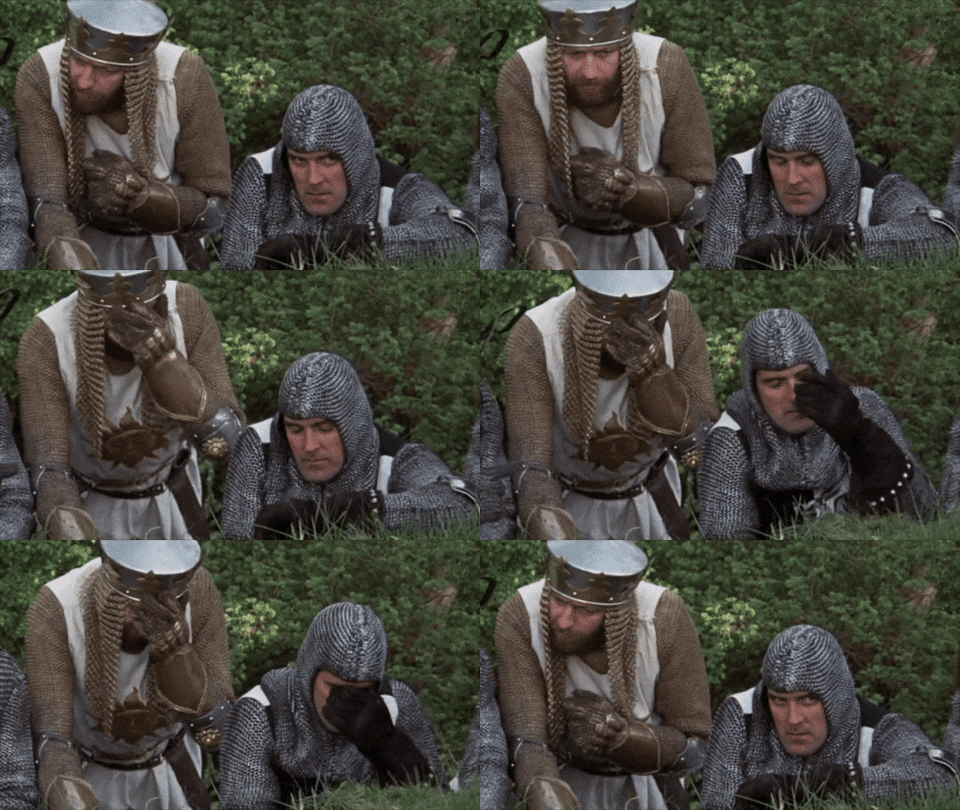
➽ Review to come and stuff.
So I started listening to this book and...
Shock #1: Maia, where art thou?! The Goblin Emperor MC is nowhere to be found! Horror! Dismay! Discombobulation!
Shock #2: Kyle McCarley, where art thou?! The most excellent Goblin Emperor narrator is nowhere to be found! Horror! Dismay! Discombobulation!
Shock #3: what the stinking fish is going on here?! There is no Maia and there is no Kyle McCarley but there is Thara Celehar and there is Liam Gerrard and this is so bloody shrimping good I might die any second now! Joy! Jubilance! Utter delectation!
This is me being utterly
Yes, it is true, I kind of wanted to unleash my murderous children on Katherine Addison when I started listening to this book. I mean, The Goblin Emperor might or might not be one of my favorite books of the year so imagine my surprise when I jumped into this installment and realized the bloody goblin emperor wasn't even in it! The audacity, Katherine Addison! The audacity!
Needless to say, I wasn't in the best of dispositions at first. Of course, it didn't help that my Anemic Barnacle Brain of the Golfball-Size Holes couldn't remember who the bloody shrimp Thara Celehar was (in my defense, there are multiple characters—all of them with
Long story short (and also, spoiler alert): I loved the book. And what's not to love, I ask you? Addison's writing is simply 😍😍, the world is just as amazing as it was in book #1, the cast of characters is downright scrumptious, the dialogues are fantastic...and then there is my boyfriend, Thara Celehar 😬. A ghoul-banishing cleric detective-type of guy who would rather be speaking to the dead than to the living? And who has feline companions? You bet I'm locking him up in my High Security Harem!
Oh, and this was such a despicably cozy read, too. I'm not sure how Katherine Addison managed it, given that the story is all about murders and deaths and funerals and not particularly fun stuff, but a delightful tale this most certainly is.
Anyhoo and stuff, I think I already said this about the previous book in the series but rehashing never hurt anyone so here goes:
P.S. Sardines are underrated. And so are mustard-yellow coats.
P.P.S. It's official, I'm addicted to earlobe communication.
The Chronicles of Osreth universe :
· Book 1: The Goblin Emperor ★★★★★
· Book 1.1: The Orb of Cairado ★★★★
· Book 2: The Witness for the Dead ★★★★
· Book 3: The Grief of Stones ★★★★
· Book 4: The Tomb of Dragons ★★★★★
[Pre-review nonsense]
Oh damn, I'm in love with a grumpy, socially awkward cleric again. And a gay one at that.
➽ Review to come and stuff.

June 22, 2021
6.5/10 stars
My full review can be found on my blog.
[...]
I’ve read The Goblin Emperor ages ago and while I enjoyed it, I also had a few choice words to say about the things that I felt didn’t work so well. Ah, those were the days when my tongue was very sharp indeed and my tolerance much lower than it is today 😉
Having read Addison’s The Angel of the Crows more recently (and finding that book so bad that I only wrote a short GR review for it) I approached The Witness for the Dead with certain trepidation. I needn’t have worried, however. If jumping straight into the highly regulated and intricate world of elves’ and goblins’ steam-powered fin de siecle is what you were waiting for, The Witness for the Dead delivers it in spades.
Let’s start with the matter of sequels. The Witness for the Dead can be called a “sort of” sequel to The Goblin Emperor, in that it follows a minor character from the first book and that it takes place after the events of The Goblin Emperor (which have some, albeit slight, pertinence to the events of The Witness for the Dead). It could be read as a standalone, though I suspect the pleasure of discovering the small references to the book #1 is an important aspect of the book #2’s draw. All in all, I’d recommend reading The Goblin Emperor first, bearing in mind that the links between the two books are rather weak. Maia comes up only in dialogue, twice or thrice, and that’s it; other characters from the first book are either mentioned only in passing or not at all. Other, except for Thara Celehar, the eponymous Witness for the Dead and the Prelate of Ulis, who is the main protagonist of the new novel.
Celehar is a skillfully created, complex character: wounded and insecure, plagued by low self-esteem and a heavy burden of responsibility, honest and full of integrity and compassion, vulnerable yet persevering. He can also be stubborn to a fault, unable to understand social cues, unbending and brusque in his social interactions, and quite obsessive in his adherence to social rules and norms, be they related to the forms of speech, maps, or even proper clothing. In all, he constitutes a rare, accurate and valuable portrayal of an ASD (autism spectrum disorder) personality, for which Addison deserves all the praise she can get: she made Celehar relatable and comprehensible, deserving of our empathy and friendship and support, and she did it without glossing over any of Celehar’s interpersonal, relational difficulties or problems of social maladjustment, noticeable especially within such highly regulated society as the one from The Goblin Emperor’s world.
Celehar is the brightest star of the book, no doubt. As a character study, and a worldbuilding study, The Witness for the Dead works really well. Here, the glittering world of the court is eschewed for the provincial and, in consequence, more down-to-earth world of Amalo – with all its petty conflicts and dreams, dirty factories, communal cemeteries, boarding houses, city anonymity, and local but no less vicious bids for power. The problems might be low-key, not related to the well-being of emperors and countries, but they are no less important for being small: we have a serial killer on the loose; last will fraud and scandals; slander; ghouls roaming freely and eating people in rather ghastly ways; a bloody factory accident; and a murder mystery involving opera singers. The tone of this book is more somber than The Goblin Emperor, which is also an improvement, at least for me – the overflowing, cloying sweetness of the first novel is drastically limited here, both by the idiosyncrasies of the different narrator and by the vastly different topics.
It’s evident that The Angel of the Crows, a Sherlock Holmes fantasy fanfic Addison published last year, influenced the plot of The Witness for the Dead: it has a similar, fragmented structure, built around mystery cases which may or may not be related, lending the book an episodic, rambling feel. The plot is far from tight; it reads more like a newspaper serial than a novel, and this unfortunately results in lowering the stakes of the whole arc quite a lot. The ending seems rushed and unfinished, and while I expect the intent was to create a feeling of opening possibilities, what I actually experienced was a very sudden THE END where a whole lot of stuff still remained unresolved.
That said, I enjoyed this book quite a lot, mostly due to Thara Celehar’s unique personality. His adventures are not all equally credible, and Addison still can’t write decent action scenes in a non-yawn-inducing way, but I found Celehar realistic, believable, and very likeable in all his vulnerability, his inability to fit in, his need for a meaningful human (well, not really, but writing elven/goblin/sentient being would take too much space, as you can see ;)) contact, his integrity, and his unwavering devotion to his duties.
All in all, The Witness for the Dead is an enjoyable return to the world of The Goblin Emperor. Less sweet and sentimental than its predecessor, it firmly retains the feel-good vibes of the previous book, making them more realistic when viewed through the lens of the struggles of the wonderfully imperfect protagonist, Thara Celehar.
I have received a copy of this book from the publisher through NetGalley in exchange for an honest review. My thanks.
My full review can be found on my blog.
[...]
I’ve read The Goblin Emperor ages ago and while I enjoyed it, I also had a few choice words to say about the things that I felt didn’t work so well. Ah, those were the days when my tongue was very sharp indeed and my tolerance much lower than it is today 😉
Having read Addison’s The Angel of the Crows more recently (and finding that book so bad that I only wrote a short GR review for it) I approached The Witness for the Dead with certain trepidation. I needn’t have worried, however. If jumping straight into the highly regulated and intricate world of elves’ and goblins’ steam-powered fin de siecle is what you were waiting for, The Witness for the Dead delivers it in spades.
Let’s start with the matter of sequels. The Witness for the Dead can be called a “sort of” sequel to The Goblin Emperor, in that it follows a minor character from the first book and that it takes place after the events of The Goblin Emperor (which have some, albeit slight, pertinence to the events of The Witness for the Dead). It could be read as a standalone, though I suspect the pleasure of discovering the small references to the book #1 is an important aspect of the book #2’s draw. All in all, I’d recommend reading The Goblin Emperor first, bearing in mind that the links between the two books are rather weak. Maia comes up only in dialogue, twice or thrice, and that’s it; other characters from the first book are either mentioned only in passing or not at all. Other, except for Thara Celehar, the eponymous Witness for the Dead and the Prelate of Ulis, who is the main protagonist of the new novel.
Celehar is a skillfully created, complex character: wounded and insecure, plagued by low self-esteem and a heavy burden of responsibility, honest and full of integrity and compassion, vulnerable yet persevering. He can also be stubborn to a fault, unable to understand social cues, unbending and brusque in his social interactions, and quite obsessive in his adherence to social rules and norms, be they related to the forms of speech, maps, or even proper clothing. In all, he constitutes a rare, accurate and valuable portrayal of an ASD (autism spectrum disorder) personality, for which Addison deserves all the praise she can get: she made Celehar relatable and comprehensible, deserving of our empathy and friendship and support, and she did it without glossing over any of Celehar’s interpersonal, relational difficulties or problems of social maladjustment, noticeable especially within such highly regulated society as the one from The Goblin Emperor’s world.
Celehar is the brightest star of the book, no doubt. As a character study, and a worldbuilding study, The Witness for the Dead works really well. Here, the glittering world of the court is eschewed for the provincial and, in consequence, more down-to-earth world of Amalo – with all its petty conflicts and dreams, dirty factories, communal cemeteries, boarding houses, city anonymity, and local but no less vicious bids for power. The problems might be low-key, not related to the well-being of emperors and countries, but they are no less important for being small: we have a serial killer on the loose; last will fraud and scandals; slander; ghouls roaming freely and eating people in rather ghastly ways; a bloody factory accident; and a murder mystery involving opera singers. The tone of this book is more somber than The Goblin Emperor, which is also an improvement, at least for me – the overflowing, cloying sweetness of the first novel is drastically limited here, both by the idiosyncrasies of the different narrator and by the vastly different topics.
It’s evident that The Angel of the Crows, a Sherlock Holmes fantasy fanfic Addison published last year, influenced the plot of The Witness for the Dead: it has a similar, fragmented structure, built around mystery cases which may or may not be related, lending the book an episodic, rambling feel. The plot is far from tight; it reads more like a newspaper serial than a novel, and this unfortunately results in lowering the stakes of the whole arc quite a lot. The ending seems rushed and unfinished, and while I expect the intent was to create a feeling of opening possibilities, what I actually experienced was a very sudden THE END where a whole lot of stuff still remained unresolved.
That said, I enjoyed this book quite a lot, mostly due to Thara Celehar’s unique personality. His adventures are not all equally credible, and Addison still can’t write decent action scenes in a non-yawn-inducing way, but I found Celehar realistic, believable, and very likeable in all his vulnerability, his inability to fit in, his need for a meaningful human (well, not really, but writing elven/goblin/sentient being would take too much space, as you can see ;)) contact, his integrity, and his unwavering devotion to his duties.
All in all, The Witness for the Dead is an enjoyable return to the world of The Goblin Emperor. Less sweet and sentimental than its predecessor, it firmly retains the feel-good vibes of the previous book, making them more realistic when viewed through the lens of the struggles of the wonderfully imperfect protagonist, Thara Celehar.
I have received a copy of this book from the publisher through NetGalley in exchange for an honest review. My thanks.

July 24, 2022
never thought i'd be this comforted while reading about an exhausted, overworked, sad, lonely gay elven clergyman dealing with gruesome deaths but here we are. there's just something very soft and optimistic about katherine addison's writing and i'm absolutely eating it up.

July 11, 2021
I truly loved the meandering little tale of the Goblin Emperor. This was strange because it was not at all what I expected but also follows the spirit fairly well. I don't think it will wear the same spot into my heart, but I'm glad to have read it.
CONTENT WARNING:
Things to love:
-Earnestness. Once again the main character and his confidants are just...good people. You just want them to have good lives and someone who loves them.
-Low/high stakes. Like with the first book, this one has the same commingled sense of dire tragedy and gentle coziness.
-Elven culture. So much worldbuilding in the details. This is a real strength in this series.
Things I didn't love:
-Murder mystery. I didn't expect this long awaited sequel to be an Elven urban fantasy? But it did have A LOT of mysteries, so at least it was a bit more convoluted than your average mystery novel.
-Handwavium. I don't remember this much magic being in the first book? And for someone who is so good at creating complex histories for fictional worlds, the magic seemed surprisingly flat.
-He is Othala Celehar, Witness for the Dead. Do a shot for every time this is said, but NOT REALLY because you will die.
-A bit abrupt. It was sort of odd, because the way this ends makes it feel slice-of-life-y which I like, but it also makes it feel incomplete, which I don't like. I am ambivalent, as was this ending.
In sum, I think it was a delightful, low-stress way to spend a day, and I'm glad to have read it, but I had to just be okay with this NOT being Goblin Emperor.
CONTENT WARNING:
Things to love:
-Earnestness. Once again the main character and his confidants are just...good people. You just want them to have good lives and someone who loves them.
-Low/high stakes. Like with the first book, this one has the same commingled sense of dire tragedy and gentle coziness.
-Elven culture. So much worldbuilding in the details. This is a real strength in this series.
Things I didn't love:
-Murder mystery. I didn't expect this long awaited sequel to be an Elven urban fantasy? But it did have A LOT of mysteries, so at least it was a bit more convoluted than your average mystery novel.
-Handwavium. I don't remember this much magic being in the first book? And for someone who is so good at creating complex histories for fictional worlds, the magic seemed surprisingly flat.
-He is Othala Celehar, Witness for the Dead. Do a shot for every time this is said, but NOT REALLY because you will die.
-A bit abrupt. It was sort of odd, because the way this ends makes it feel slice-of-life-y which I like, but it also makes it feel incomplete, which I don't like. I am ambivalent, as was this ending.
In sum, I think it was a delightful, low-stress way to spend a day, and I'm glad to have read it, but I had to just be okay with this NOT being Goblin Emperor.

November 8, 2021
(review to follow)

July 10, 2022
Addison still got it! Great murder mystery with a unique setting and an endearing and loveable main character.

March 30, 2022
I had never been to the Vermilion Opera before - the ticket prices, even for the cheapest seats, were far beyond my meager budget. I was unprepared for the rich vermilion walls of the lobby and could only be grateful there was no one to see me standing there as stunned as a fish. The lobby was vast and its color, combined with its cavernous vault, intensified my impression of being caught in the jaws of some monstrous beast. I started toward the ticket office at one end of the lobby, uneasily aware of the clacking sound of my shoe heels, and a young half-goblin man, pale eyes in a dark face, appeared suddenly in the ticket window and said, "Can I help you, othala?"
"My name is Thara Celehar," I said, "and I am a Witness for the Dead. I need to speak to someone about a death for which I am witnessing."
Katherine Addison surprised me with The Goblin Emperor, and cemented her first impression with The Witness for the Dead - I love this world she's built, and getting more of it, however tangential, was fantastic.
It's not really a sequel, but a novel placed in the same world as the Goblin Emperor, so go into it aware that this won't continue Maia's story, but instead focuses on Thara Celehar, Witness for the Dead and new arrival in Amalo (And I've just noticed it's now getting its own sequel in June, which, YES).
I feel odd about finding this novel as comforting as I did, because despite the cosiness of frequent tea house visits, the genteel nature of the language, and Celahar's general demeanour of kindness, The Witness for the Dead does deal with death, blackmail, even murderous ghouls. It's the presentation, I think, because Celehar operates with such compassion that it's hard not to feel comforted by a book told from his viewpoint, through that lens of caring. It's uncommon for me to find a book so intriguing and yet want to avoid reaching the end.
Which, speaking of, would be my only ding, because it's quite abrupt - everything was flowing along unhurriedly (the book does meander - that's something I enjoyed, but keep it in mind if that's not your bag), then suddenly - we're done, and wrapping up, and bang, acknowledgements. Knowing a sequel is coming has taken some of the sting away though, and I couldn't knock off a star anyway - I absolutely enjoyed the journey of this book, and I know I'll be coming back to it plenty.
"My name is Thara Celehar," I said, "and I am a Witness for the Dead. I need to speak to someone about a death for which I am witnessing."
Katherine Addison surprised me with The Goblin Emperor, and cemented her first impression with The Witness for the Dead - I love this world she's built, and getting more of it, however tangential, was fantastic.
It's not really a sequel, but a novel placed in the same world as the Goblin Emperor, so go into it aware that this won't continue Maia's story, but instead focuses on Thara Celehar, Witness for the Dead and new arrival in Amalo (And I've just noticed it's now getting its own sequel in June, which, YES).
I feel odd about finding this novel as comforting as I did, because despite the cosiness of frequent tea house visits, the genteel nature of the language, and Celahar's general demeanour of kindness, The Witness for the Dead does deal with death, blackmail, even murderous ghouls. It's the presentation, I think, because Celehar operates with such compassion that it's hard not to feel comforted by a book told from his viewpoint, through that lens of caring. It's uncommon for me to find a book so intriguing and yet want to avoid reaching the end.
Which, speaking of, would be my only ding, because it's quite abrupt - everything was flowing along unhurriedly (the book does meander - that's something I enjoyed, but keep it in mind if that's not your bag), then suddenly - we're done, and wrapping up, and bang, acknowledgements. Knowing a sequel is coming has taken some of the sting away though, and I couldn't knock off a star anyway - I absolutely enjoyed the journey of this book, and I know I'll be coming back to it plenty.

October 4, 2021
This book is in some way very similar and in others utterly different than its predecessor The Goblin Emperor. And both are very, very good.
The similarities come from seeing this universe through the point of view of someone who has responsibilities they don't particularly want, but fulfill them excellently anyway out of a sense of duty to their fellow sentients. Maia (the titular Emperor) and Thara Celehar (the titular Witness) are also both fundamentally kind yet severely traumatized people who deal with a crap ton of crap in a short time and despite their struggles succeed professionally (if not necessarily personally). In this book alone there is And Thara Celehar handles it all with quiet, relentless, emotionally repressed confidence.
The main difference is that we are not with the Emperor, but instead a poverty-stricken prelate. And this gives us a much more ground level view of the Empire. Addison has done a great job of world building and how she weaves together history, religion, technology, race, geography, and little telling details is incredibly well done.
I can't help but want more in this series! A great entry in the recent trend of SF/Fantasy about good (but often damaged) people trying to do the right thing.
**Thanks to the author, publisher, and NetGalley for a free copy in exchange for an honest review.
The similarities come from seeing this universe through the point of view of someone who has responsibilities they don't particularly want, but fulfill them excellently anyway out of a sense of duty to their fellow sentients. Maia (the titular Emperor) and Thara Celehar (the titular Witness) are also both fundamentally kind yet severely traumatized people who deal with a crap ton of crap in a short time and despite their struggles succeed professionally (if not necessarily personally). In this book alone there is And Thara Celehar handles it all with quiet, relentless, emotionally repressed confidence.
The main difference is that we are not with the Emperor, but instead a poverty-stricken prelate. And this gives us a much more ground level view of the Empire. Addison has done a great job of world building and how she weaves together history, religion, technology, race, geography, and little telling details is incredibly well done.
I can't help but want more in this series! A great entry in the recent trend of SF/Fantasy about good (but often damaged) people trying to do the right thing.
**Thanks to the author, publisher, and NetGalley for a free copy in exchange for an honest review.
March 30, 2026
2.5 stars, and I will not rate it higher even for the love of Maia.
Considering that The Goblin Emperor has been one of my all-time favorite books ever since I first read it almost ten years ago (and one I can and will happily reread any number of times), The Witness for the Dead turned out to be a huge disappointment for me.
I knew going in that this wasn’t a direct sequel and only loosely connected to the original plot, but I was still surprised by how detached I felt throughout.
Even though Thara Celehar was only a side character in TGE, Addison gave him real depth through his actions and his interactions with Maia. Here, despite the first-person narration (which, in my view, doesn’t do the book OR the MC any favors), Celehar feels like an empty shell which his author forgot to fill with any memorable personality traits.
The plot doesn't help matters much either. It is a sequence of vague, loosely connected events that totally lack the political or any kind of intrigue that was so deftly built-up and presented in TGE.
And then there are the names. For reasons I can’t quite explain, I had no trouble with them in The Goblin Emperor, but here the sheer number of unfamiliar names and new titles felt overwhelming and unnecessary.
I was seriously tempted to abandon the book around the halfway mark, but I was reading it for a challenge, so I pushed through.
Not a terrible book by any means, but an utterly forgettable one. While it made me appreciate The Goblin Emperor even more, I still feel it was time/energy wasted.
Considering that The Goblin Emperor has been one of my all-time favorite books ever since I first read it almost ten years ago (and one I can and will happily reread any number of times), The Witness for the Dead turned out to be a huge disappointment for me.
I knew going in that this wasn’t a direct sequel and only loosely connected to the original plot, but I was still surprised by how detached I felt throughout.
Even though Thara Celehar was only a side character in TGE, Addison gave him real depth through his actions and his interactions with Maia. Here, despite the first-person narration (which, in my view, doesn’t do the book OR the MC any favors), Celehar feels like an empty shell which his author forgot to fill with any memorable personality traits.
The plot doesn't help matters much either. It is a sequence of vague, loosely connected events that totally lack the political or any kind of intrigue that was so deftly built-up and presented in TGE.
And then there are the names. For reasons I can’t quite explain, I had no trouble with them in The Goblin Emperor, but here the sheer number of unfamiliar names and new titles felt overwhelming and unnecessary.
I was seriously tempted to abandon the book around the halfway mark, but I was reading it for a challenge, so I pushed through.
Not a terrible book by any means, but an utterly forgettable one. While it made me appreciate The Goblin Emperor even more, I still feel it was time/energy wasted.

Read
November 12, 20232.5 stars…maybe

December 25, 2021
The Witness for the Dead is Addison’s follow-up to her enormously popular Goblin Emperor. Here, she takes a bit character from her epic fantasy novel and whisks him to a faraway town where Prelate Thara Celahar talks to the Dead, getting to the bottom of what happened to them, particularly when it’s an angry opera singer found floating in a canal. Although most other readers have found much to rejoice in with this new novel, perhaps reading Goblin Emperor first helps to lay a foundation and background for this book. Without the prior novel, one is left with a rather obscure religion, unpronounceable names and titles, and a general lack of action and excitement. Once again, Addison has interesting ideas, but they do not seem to result in much. A minority opinion, but an honest one.

September 28, 2022
What a wonderful book!! Last year, I read The Goblin Emperor, and it was one of my favourite books of the year.
In my review, I called The Goblin Emperor:
“A fantastic read for anyone who wants a break from the grim darks, sprawling epics, and thrilling adventures. It’s a quieter story but no less impactful.
Really, really good book. Fabulous ending, pacing, characters, and it made me extremely happy to read.”
It’s much the same with the sequel. It’s a short book at just over 300 pages, but I tried to take my time with it and savour it as much as possible. I can’t put into words how much I enjoyed this - probably a little more than The Goblin Emperor, if I think about it.
Yes, the same formal/informal language is back (yay!) as well as the naming conventions (which are a little confusing if you aren’t paying attention), but it’s written so NICELY that I don’t care about any parts that I stumbled over.
It’s hard to explain, but reading this made me realise what my real reading jam is. Books that I’ve really, really loved and enjoy so much tend to be small scale, intimate stories within bigger epics. I love lots of magic and dragons, but it absolutely isn’t necessary as long as there is a sense of wonder and awe. I enjoy a focus on a couple of characters being affected by their world, and dealing with it in the best way they can (even if its hard or they make mistakes or struggle with self-doubt) rather than “chosen ones” who go on to change the world and are super confident and sarcastic and witty.
I connect so much more with the underdogs doing what they can, and that is so much of what The Witness of the Dead delivers.
We follow Thara Celehar, a Witness For The Dead, who now lives in the city of Amalo. We met Celehar in The Goblin Emperor, so it was wonderful to follow a story with an already established character.
Returning to this world was absolutely wonderful. I thought I’d miss all the courtly intrigues and politics, but I actually found the lack of that very refreshing. There is still plenty of intrigue and politics, just of a different flavour, and less intense.
It’s almost like a slice of life story, we follow him day in day out, see his struggles and nightmares, how he shares sardines with local cats, what his favourite tea is (and oh my gosh there are so many wonderful sounding teahouses!), how he gets from different parts of the city. I can see the tram lines in my mind’s eye, the bridges, the boarding houses, the opera!
His power allows him to see the dead’s last thoughts and final wishes - helpful when it comes to wills, finding items, or discovering the manner in which someone has died. He becomes embroiled in two mysteries - the death of a singer at the Vermillion Opera (arguably the “main” story) as well as the death of a young woman in a cemetery she shouldn’t be in.
Unravelling the mystery along with Celehar was a delight, and so was meeting the other people he encounters. It’s a deeply religious society, with various sects and rituals and I absolutely devoured it all. There was one part that was legitimately terrifying and I needed to put the book down for a moment to steel myself, but overall I would call it a light read.
Celehar is so wonderful to follow. He is humble and modest, plagued by guilt and insecurity, and yet always tries to do the best he can. He tries to do what is right. He shows kindness. He is determined and stubborn (but NOT in an irritating way), and I would happily read book after book about his work and teahouse visits.
I love a story about smaller stakes and the impact they have on “normal” people rather than “heroes” - despite being a world inhabited by elves and goblins, I am able to connect with these characters very clearly.
There’s a discussion in the final few pages about monstrous people and monstrous acts which I found very poignant. There are so many beautiful lines in this book and they definitely made me think.
Highly recommend!
In my review, I called The Goblin Emperor:
“A fantastic read for anyone who wants a break from the grim darks, sprawling epics, and thrilling adventures. It’s a quieter story but no less impactful.
Really, really good book. Fabulous ending, pacing, characters, and it made me extremely happy to read.”
It’s much the same with the sequel. It’s a short book at just over 300 pages, but I tried to take my time with it and savour it as much as possible. I can’t put into words how much I enjoyed this - probably a little more than The Goblin Emperor, if I think about it.
Yes, the same formal/informal language is back (yay!) as well as the naming conventions (which are a little confusing if you aren’t paying attention), but it’s written so NICELY that I don’t care about any parts that I stumbled over.
It’s hard to explain, but reading this made me realise what my real reading jam is. Books that I’ve really, really loved and enjoy so much tend to be small scale, intimate stories within bigger epics. I love lots of magic and dragons, but it absolutely isn’t necessary as long as there is a sense of wonder and awe. I enjoy a focus on a couple of characters being affected by their world, and dealing with it in the best way they can (even if its hard or they make mistakes or struggle with self-doubt) rather than “chosen ones” who go on to change the world and are super confident and sarcastic and witty.
I connect so much more with the underdogs doing what they can, and that is so much of what The Witness of the Dead delivers.
We follow Thara Celehar, a Witness For The Dead, who now lives in the city of Amalo. We met Celehar in The Goblin Emperor, so it was wonderful to follow a story with an already established character.
Returning to this world was absolutely wonderful. I thought I’d miss all the courtly intrigues and politics, but I actually found the lack of that very refreshing. There is still plenty of intrigue and politics, just of a different flavour, and less intense.
It’s almost like a slice of life story, we follow him day in day out, see his struggles and nightmares, how he shares sardines with local cats, what his favourite tea is (and oh my gosh there are so many wonderful sounding teahouses!), how he gets from different parts of the city. I can see the tram lines in my mind’s eye, the bridges, the boarding houses, the opera!
His power allows him to see the dead’s last thoughts and final wishes - helpful when it comes to wills, finding items, or discovering the manner in which someone has died. He becomes embroiled in two mysteries - the death of a singer at the Vermillion Opera (arguably the “main” story) as well as the death of a young woman in a cemetery she shouldn’t be in.
Unravelling the mystery along with Celehar was a delight, and so was meeting the other people he encounters. It’s a deeply religious society, with various sects and rituals and I absolutely devoured it all. There was one part that was legitimately terrifying and I needed to put the book down for a moment to steel myself, but overall I would call it a light read.
Celehar is so wonderful to follow. He is humble and modest, plagued by guilt and insecurity, and yet always tries to do the best he can. He tries to do what is right. He shows kindness. He is determined and stubborn (but NOT in an irritating way), and I would happily read book after book about his work and teahouse visits.
I love a story about smaller stakes and the impact they have on “normal” people rather than “heroes” - despite being a world inhabited by elves and goblins, I am able to connect with these characters very clearly.
There’s a discussion in the final few pages about monstrous people and monstrous acts which I found very poignant. There are so many beautiful lines in this book and they definitely made me think.
Highly recommend!

August 14, 2021
I adored everything about The Goblin Emperor: the coming-of-age story of the young Emperor seeking to find his place in the world, the Machiavellian court politics, and the intricate worldbuilding. Although Witness for the Dead was set in the same world and features a minor character from the first book, I didn’t find it nearly as compelling. Whereas I would characterize The Goblin Emperor as a YA fantasy novel, Addison’s new story is a cozy mystery about a melancholy middle-aged prelate. The Witness for the Dead is a standalone novel, so while the other characters from The Goblin Emperor are referenced, they do not appear in this book.
Plot: Thara Celehar is a Witness for the Dead, with the ability to enter the minds of the recently deceased and experience their final memories. (I kept getting flashbacks to the little boy in the Sixth Sense.) Thara’s gift enables him to help settle the affairs of the dead, whether sorting out inheritance disputes or working with police to identify murders. Over the course of the book, he attempts to solve several mysteries: the murder of a beautiful young opera singer, the questionable death of a pregnant woman, and a family battle over a will. At the same time, Thara is struggling with a past trauma and trying to return to a life of faith after the death of his lover.
Characters: Thara is a highly sympathetic protagonist; he is a kind, genuine, and humble person who dedicated his life to helping others. He was the best part of the story. Addison’s emphasis on fundamentally decent protagonists is a refreshing change from the current predilection for anti-heroes. There were no major female characters, unless you count the dead women whose murders are being investigated, which felt strange to me. The villains were largely one-dimensional, but the (male) friendships were written with warmth and attention to detail.
Writing: excellent.
Pacing: slow. So very, very slow. Apart from two action scenes, most of the story follows Thara on his rambles through Amalo questioning people and drinking tea. So, so much tea.
Worldbuilding: exhaustively detailed, with a Tolkien-like emphasis on language. You will need a glossary to follow all the naming conventions.
Magic: surprisingly, almost none. Thara’s ability is a religious gift, not part of a magic system. The author seems more interested in steampunk technology.
Romance: there is a slow burn potential romance between Thara and the man who manages the opera house, who is a potential suspect in one of the crimes, but it isn't a major focus.
Oddities: Despite communing with the dead on a regular basis, Thara is afraid of ghosts.
Wow factor: alas, none. The author throws out a few red herrings and side stories to keep the reader guessing over the final resolution of the cases. I guessed correctly on one of the murders, but not how the cases were connected, so the twist was successful. But the focus was on the mundane daily lives and deaths of the citizens of Amalo; this is not a save-the-world type story.
Overall, it was a decent book and I enjoyed my buddy read with Jennifer, whose wonderful (and far more enthusiastic) review can be found here: https://www.goodreads.com/review/show...
Plot: Thara Celehar is a Witness for the Dead, with the ability to enter the minds of the recently deceased and experience their final memories. (I kept getting flashbacks to the little boy in the Sixth Sense.) Thara’s gift enables him to help settle the affairs of the dead, whether sorting out inheritance disputes or working with police to identify murders. Over the course of the book, he attempts to solve several mysteries: the murder of a beautiful young opera singer, the questionable death of a pregnant woman, and a family battle over a will. At the same time, Thara is struggling with a past trauma and trying to return to a life of faith after the death of his lover.
Characters: Thara is a highly sympathetic protagonist; he is a kind, genuine, and humble person who dedicated his life to helping others. He was the best part of the story. Addison’s emphasis on fundamentally decent protagonists is a refreshing change from the current predilection for anti-heroes. There were no major female characters, unless you count the dead women whose murders are being investigated, which felt strange to me. The villains were largely one-dimensional, but the (male) friendships were written with warmth and attention to detail.
Writing: excellent.
Pacing: slow. So very, very slow. Apart from two action scenes, most of the story follows Thara on his rambles through Amalo questioning people and drinking tea. So, so much tea.
Worldbuilding: exhaustively detailed, with a Tolkien-like emphasis on language. You will need a glossary to follow all the naming conventions.
Magic: surprisingly, almost none. Thara’s ability is a religious gift, not part of a magic system. The author seems more interested in steampunk technology.
Romance: there is a slow burn potential romance between Thara and the man who manages the opera house, who is a potential suspect in one of the crimes, but it isn't a major focus.
Oddities: Despite communing with the dead on a regular basis, Thara is afraid of ghosts.
Wow factor: alas, none. The author throws out a few red herrings and side stories to keep the reader guessing over the final resolution of the cases. I guessed correctly on one of the murders, but not how the cases were connected, so the twist was successful. But the focus was on the mundane daily lives and deaths of the citizens of Amalo; this is not a save-the-world type story.
Overall, it was a decent book and I enjoyed my buddy read with Jennifer, whose wonderful (and far more enthusiastic) review can be found here: https://www.goodreads.com/review/show...

January 6, 2022
Katherine Addison is a master of storytelling and I'm in awe of her characterization skills.
The book as a whole isn't perfect, but the flaws - a structure somewhat disjointed at times, mostly - grow dim in the face of its undeniable strengths. I cannot wait to read the sequel.
The book as a whole isn't perfect, but the flaws - a structure somewhat disjointed at times, mostly - grow dim in the face of its undeniable strengths. I cannot wait to read the sequel.

Want to Read
October 20, 2018OMG, PRAISE THE LORD, THERE'S A SEQUEL.
I don't know whether to scream my lungs out or roll on the floor out of happiness, I think I'm going to cry...
I don't know whether to scream my lungs out or roll on the floor out of happiness, I think I'm going to cry...

June 2, 2022
Those looking for a return trip to the Machiavellian intrigue of Addison's The Goblin Emperor may find themselves disappointed here. The world's the same, but the genre has completely changed. This is a detective story involving one Thara Celehar, a figure who held a small role in the original tale and is consulted for his ability to sense the final thoughts and intents of those who have recently expired. He will clear up the matter of a Will, for example, by touching a corpse to receive its news, or detect flashes of dying moments that may be used to solve a murder.
Readers of my reviews will recognize, perhaps, the similarity of this posthumous-communication concept to that employed by the melancholy detective I've been crowing about in the series of Neapolitan novels written by Maurizio de Giovanni. My Commissario Ricciardi has a comparable gift, yet his is a much more tragic soul whose thoughts tend to travel bittersweet roads in a far greater poetic journey. Had I not encountered this evocative Italian first, who knows? I might be touting Celehar as a daring feat of literary skill.
Alas, I did. And so...
Readers of my reviews will recognize, perhaps, the similarity of this posthumous-communication concept to that employed by the melancholy detective I've been crowing about in the series of Neapolitan novels written by Maurizio de Giovanni. My Commissario Ricciardi has a comparable gift, yet his is a much more tragic soul whose thoughts tend to travel bittersweet roads in a far greater poetic journey. Had I not encountered this evocative Italian first, who knows? I might be touting Celehar as a daring feat of literary skill.
Alas, I did. And so...

September 27, 2021
3.5 stars rounded up
The Witness for the Dead is a short novel following Celehar, a side character from The Goblin Emperor, as he investigates murders and takes down ghouls as part of his job as a Witness for the Dead. It's a very different sort of book from The Goblin Emperor, but not in a bad way.
Celehar is a quiet, tea-drinking gay man who wants to fly under the radar but instead becomes drawn into complicated situations. I enjoyed this and found the mysteries interesting, although I do think there was a bit too much going on for how long the book is. There are two primary mysteries we're trying to solve, which involve the mysterious deaths of two different women. But there are so many little side plots that the book tends to lose momentum. I love a character driven narrative, but I wish this had been a bit more focused. Still interesting and enjoyable, but a book this short shouldn't take me so long to get through. I received a copy of this book for review from the publisher. All opinons are my own.
The Witness for the Dead is a short novel following Celehar, a side character from The Goblin Emperor, as he investigates murders and takes down ghouls as part of his job as a Witness for the Dead. It's a very different sort of book from The Goblin Emperor, but not in a bad way.
Celehar is a quiet, tea-drinking gay man who wants to fly under the radar but instead becomes drawn into complicated situations. I enjoyed this and found the mysteries interesting, although I do think there was a bit too much going on for how long the book is. There are two primary mysteries we're trying to solve, which involve the mysterious deaths of two different women. But there are so many little side plots that the book tends to lose momentum. I love a character driven narrative, but I wish this had been a bit more focused. Still interesting and enjoyable, but a book this short shouldn't take me so long to get through. I received a copy of this book for review from the publisher. All opinons are my own.

July 1, 2021
Thara Celehar is the Witness for the Dead of this book’s title. He’s gifted with the ability to find out the truth of a death by making contact with the deceased’s body. He says a prayer of compassion, then asks the dead to answer questions. Sometimes, it’s too late, and there’s no one left in the body to answer the query. But sometimes, he’s able to get answers or at least an impression of the person’s last moments. He then bears witness for the dead person, testifying to what he’s learned in order to solve a mystery or resolve a dispute. His basic goodness allows him to carry out his duties with dignity.
However, despite being located in a smaller city far from the capitol, Thara is not completely shielded from the backbiting and political striving that characterizes the prelacy of Amalo. There are some who are jealous of Thara’s connection to the emperor; others fear that he might gain power and seek to tear him down. No matter how he tries to stay outside the fray, he’s drawn in repeatedly.
As the book opens, Thara becomes involved in several unsolved cases. In one, a family needs him to discover who their patriarch’s intended heir is, as the will is in dispute. In another, sadder case, a brother seeks his sister’s body, believing that the man she eloped with may have done her harm. And in the story that becomes the overarching plotline of the book, a beautiful young woman’s body is pulled from the canal — was her death an accident, or was she killed? And if it was murder, who did it?
As he investigates, he becomes drawn into the worlds of the opera, the rich patrons, the seedier bars and teahouses, the gambling establishments, and the law enforcement of Amalo. He persists in pursuing the truth, even when his own life and reputation are at stake. Despite his fears and doubts, Thara is always true to his calling, and his intelligence and bravery enable him to see his inquiries through until he can find the truth on behalf of the dead.
The world of The Witness for the Dead is the world of The Goblin Emperor… and I can’t even begin to describe or explain how much I love this world. Author Katherine Addison has meticulously crafted a world with a finely developed culture, religious underpinnings, class stratifications, nobility and commoners, courtiers and princes. There’s a strange beauty to the descriptions of the people and the society, and I am particularly head over heels in love with the language of The Goblin Emperor‘s world.
In her books, the author creates a vocabulary and grammar that is dizzyingly strange and difficult, making the books seem almost impenetrable at first — but if we stick with it (as I encourage everyone to do), the names of the people and places and institutions, as well as the forms of address and the contrasting formal and informal speech patterns, all create a sort of linguistic magic. As I re-read The Goblin Emperor via audiobook, I was enthralled all over again, not just by the story, but by the very sound of it all. Truly an incredible experience.
Back to The Witness for the Dead: I loved this story. It was fascinating seeing Thara Celehar about his work. We see him in action in The Goblin Emperor through his interactions with the Emperor, but here, we’re privy to more of his inner life and learn more about what sort of person he is and what drives him. It’s an engrossing character study, enhanced by clever mysteries for Thara to solve.
I suppose my only complaint about The Witness for the Dead isn’t really about this book at all: I just missed Maia (Emperor Edrehasivar VII) so, so much. I would gladly read a multiple-volume history covering the reign of the emperor… but I’d also happily settle for just one more novel!
I can’t imagine reading The Witness for the Dead without having read The Goblin Emperor. I do know at least one person who’s planning to do just that, and I’ll be interested to hear her thoughts. I don’t think this book would work as a stand-alone, since I can’t see how someone could truly make sense of the world (not to mention all those names!!) without having read the previous novel. But, I’d be happy to be proven wrong!
I highly recommend The Witness for the Dead, but please do yourself a favor and read The Goblin Emperor first. I hope you’ll love it as much as I do!
Review copy courtesy of the publisher via NetGalley. Full review at Bookshelf Fantasies.
However, despite being located in a smaller city far from the capitol, Thara is not completely shielded from the backbiting and political striving that characterizes the prelacy of Amalo. There are some who are jealous of Thara’s connection to the emperor; others fear that he might gain power and seek to tear him down. No matter how he tries to stay outside the fray, he’s drawn in repeatedly.
As the book opens, Thara becomes involved in several unsolved cases. In one, a family needs him to discover who their patriarch’s intended heir is, as the will is in dispute. In another, sadder case, a brother seeks his sister’s body, believing that the man she eloped with may have done her harm. And in the story that becomes the overarching plotline of the book, a beautiful young woman’s body is pulled from the canal — was her death an accident, or was she killed? And if it was murder, who did it?
As he investigates, he becomes drawn into the worlds of the opera, the rich patrons, the seedier bars and teahouses, the gambling establishments, and the law enforcement of Amalo. He persists in pursuing the truth, even when his own life and reputation are at stake. Despite his fears and doubts, Thara is always true to his calling, and his intelligence and bravery enable him to see his inquiries through until he can find the truth on behalf of the dead.
The world of The Witness for the Dead is the world of The Goblin Emperor… and I can’t even begin to describe or explain how much I love this world. Author Katherine Addison has meticulously crafted a world with a finely developed culture, religious underpinnings, class stratifications, nobility and commoners, courtiers and princes. There’s a strange beauty to the descriptions of the people and the society, and I am particularly head over heels in love with the language of The Goblin Emperor‘s world.
In her books, the author creates a vocabulary and grammar that is dizzyingly strange and difficult, making the books seem almost impenetrable at first — but if we stick with it (as I encourage everyone to do), the names of the people and places and institutions, as well as the forms of address and the contrasting formal and informal speech patterns, all create a sort of linguistic magic. As I re-read The Goblin Emperor via audiobook, I was enthralled all over again, not just by the story, but by the very sound of it all. Truly an incredible experience.
Back to The Witness for the Dead: I loved this story. It was fascinating seeing Thara Celehar about his work. We see him in action in The Goblin Emperor through his interactions with the Emperor, but here, we’re privy to more of his inner life and learn more about what sort of person he is and what drives him. It’s an engrossing character study, enhanced by clever mysteries for Thara to solve.
I suppose my only complaint about The Witness for the Dead isn’t really about this book at all: I just missed Maia (Emperor Edrehasivar VII) so, so much. I would gladly read a multiple-volume history covering the reign of the emperor… but I’d also happily settle for just one more novel!
I can’t imagine reading The Witness for the Dead without having read The Goblin Emperor. I do know at least one person who’s planning to do just that, and I’ll be interested to hear her thoughts. I don’t think this book would work as a stand-alone, since I can’t see how someone could truly make sense of the world (not to mention all those names!!) without having read the previous novel. But, I’d be happy to be proven wrong!
I highly recommend The Witness for the Dead, but please do yourself a favor and read The Goblin Emperor first. I hope you’ll love it as much as I do!
Review copy courtesy of the publisher via NetGalley. Full review at Bookshelf Fantasies.
Displaying 1 - 30 of 2,045 reviews