Evelyn Waugh's first a portrait of one of the greatest artists of the nienteenth century, from one of the greatest writers of the twentieth
'Biography, as books about the dead are capriciously catalogued, is still very much in the mode'
This is a sparkling account of Dante Gabriel Rossetti's tragic and mysterious life, telling the story behind some of the greatest poetry and painting of the nineteenth century. Shot through with charm and dry wit, and illuminated by his sense of kinship with the Pre-Raphaelite artist, Rossetti is at once a brilliant reevaluation of Rosetti's work and legacy, as well as a blast of defiance against the art establishment of Waugh's day.
'The youthful high spirits of the writing make this a true cultural delight' New Statesman
'To be celebrated with fireworks, bunting and marching bands' Country Life
Evelyn Waugh's father Arthur was a noted editor and publisher. His only sibling Alec also became a writer of note. In fact, his book “The Loom of Youth” (1917) a novel about his old boarding school Sherborne caused Evelyn to be expelled from there and placed at Lancing College. He said of his time there, “…the whole of English education when I was brought up was to produce prose writers; it was all we were taught, really.” He went on to Hertford College, Oxford, where he read History. When asked if he took up any sports there he quipped, “I drank for Hertford.”
In 1924 Waugh left Oxford without taking his degree. After inglorious stints as a school teacher (he was dismissed for trying to seduce a school matron and/or inebriation), an apprentice cabinet maker and journalist, he wrote and had published his first novel, “Decline and Fall” in 1928.
In 1928 he married Evelyn Gardiner. She proved unfaithful, and the marriage ended in divorce in 1930. Waugh would derive parts of “A Handful of Dust” from this unhappy time. His second marriage to Audrey Herbert lasted the rest of his life and begat seven children. It was during this time that he converted to Catholicism.
During the thirties Waugh produced one gem after another. From this decade come: “Vile Bodies” (1930), “Black Mischief” (1932), the incomparable “A Handful of Dust” (1934) and “Scoop” (1938). After the Second World War he published what is for many his masterpiece, “Brideshead Revisited,” in which his Catholicism took centre stage. “The Loved One” a scathing satire of the American death industry followed in 1947. After publishing his “Sword of Honour Trilogy” about his experiences in World War II - “Men at Arms” (1952), “Officers and Gentlemen” (1955), “Unconditional Surrender" (1961) - his career was seen to be on the wane. In fact, “Basil Seal Rides Again” (1963) - his last published novel - received little critical or commercial attention.
Evelyn Waugh, considered by many to be the greatest satirical novelist of his day, died on 10 April 1966 at the age of 62.
It seems Rossetti and Lizzie Siddal are not leaving my mind! I’m utterly enthralled and fascinated by their lives and the artwork of The Pre Raphaelite Brotherhood and whilst I’m definitely no expert on the subject, I enjoy reading up on anything related to their life and times. Having recently read Hall Caine’s memoir on Dante Gabriel Rossetti, Reflections of Rossetti, I thought I’d read Evelyn Waugh’s Rossetti: His Life and Works. I’m just going to affirm that what I’m musing upon is just purely my initial, instinctive reaction to Evelyn Waugh’s seemingly harsh criticisms on his pondering subject. Let me begin by quoting Evelyn Waugh in regards to Rossetti and his reasoning for writing the book: ‘so Rossetti’s art, at fitful moments, flames into the exquisite moments of Beata Beatrix. It is the sort of problem that modern aesthetics does not seem capable of coping with. It has been the object of this book to state, though, alas! not to solve, this problem.’ If you know of Dante Gabriel Rossetti’s aforementioned Beata Beatrix. Circa 1864 – 1870. Now, I’m choosing to insert the name of the painting here which was so closely inspired by Dante Gabriel Rossetti’s own turmoil and grief of losing his beloved wife Lizzie Siddal, who’s death often accompanied the Poet and Painter to varying degrees of haunting, pivoting him into despair and sadness throughout the remainder of his own life. The artist, might I mention, had no model pose for this portrait but recalled the details of his late wife, choosing to not represent her in death but ‘a sudden, spiritual transfiguration.’ I’m absolutely moved and fascinated by the piece and think it’s a wonderfully archaic, raw and powerful swan song for Rossetti’s beloved Lizzie! I was completely bemused when I read in Rossetti: His Life and Works, that: A) Evelyn Waugh dubs the life of Lizzie Siddal as pathetic. Naturally, I had many thoughts about that, all of which completely protested this abomination of a label, so I thought I’d take to my bookstagram and post a mini ramble about how much I disagreed here: https://www.instagram.com/p/CEdu1FBgE... – do check it out if you’d like to know more. For the record though, yes, she was sickly (a poor immune system), coupled with two stillbirths, so of course she’s not going to be glowing with health! But oh, she was a celebrated beauty in her own right and I’ve no doubt she and Rossetti loved one another as only two souls of their kind could! And B) So in Waugh’s little summarising, closing sentence he suggests that he’s wanting to state that modern aesthetics of his time would find it hard to take on board Rossetti and the Pre Raphaelite Brotherhood’s artwork Aesthetics (he actually quotes the PRB in their forming days as “not knowing how to paint”), which I think is quite laughable in itself, given the seamless flair that these gentleman and their female counterparts and Muses possessed! Although I’m not hugely familiar with Evelyn Waugh, though I do know he’s celebrated in his own literary right and I understand he often equipped himself with a sarcastic, dry tone. As I found myself reading more of Rossetti: His Life and Works, I found myself speculating if Waugh felt like his objective was just to be low-key crass about his chosen subject, throwing shade and criticisms towards Dante Gabriel Rossetti and the part he played in the formation of The Pre Raphaelite Brotherhood. Also, for a biography that’s centred and indeed titled Rossetti: His Life and Works, I personally found about 75% of this book to not even be Dante Gabriel Rossetti specific! I thought that this would prove insightful as Rossetti’s beloved friend Hall Caine detailed, but I definitely (and unfortunately so) didn’t find it here! Through Waugh’s borderline scathing notations against Rossetti’s life, blatantly talking about how ineffective his artwork was (and again veering back to the finishing point, where I feel like Evelyn Waugh openly suggests that he wanted to get a (non existent, in my opinion) point across that Rossetti’s art doesn’t fit with the modern aesthetic of Waugh’s day, perhaps. Yet, wasn’t it The Pre Raphaelite Brotherhood that formed together in 1848, because they wanted to challenge the unimaginative and artificial historical paintings of The Royal Academy, believing art should mirror the real world as much as possible?! So that concludes my second installment of babbling about Rossetti and The Pre Raphaelite Brotherhood, this time as communicated rather vague through Evelyn Waugh’s Rossetti: His Life and Works. I look forward to reading more material on the subject and I hope you enjoyed reading my musings. :)
Evelyn Waugh és un prodigi de les turres. Si te saps submergir en la turra, val la pena aguantar-la. Si no, te pots preparar per a la xapa més abominable de ta vida.
Waugh and piece: an appreciation of Rossetti, written when Waugh was 24 and before he had become scratchy and conservative about art, is far from a sophomore work. He writes with critical love and judgement about a flawed character producing works of genius and a certain amount of dross - and this applies as much to the poetry as it does to the paintings. Of course it’s erudite: early on, we have words like bituminous, machicolations, infrangible - for which in each case the gibbons that program autocorrect can find no substitutes. There’s waspish wit aplenty, such as this comment on the PRB: “The movement began, as it ended, with people talking in Bloomsbury” - a daring assertion since it might also reflect on the author’s literary career - and a phrase which sums up He-Evelyn in one go: “anyone who, confronted with its [Beata Beatrix] sublime and pervasive sanctity, can speak of it coldly in terms of saturation and planes and plastic values (as many people, hatless and dishevelled, may be heard declaiming daily in the Tate Gallery) has constricted his artistic perceptions to an ant like narrowness,” though for the most part he restrains both didactic instincts and snobbery, and instead simply lets the reader know what he thinks whilst allowing him room to make up his own mind. You won’t find biography or art criticism like this (and it’s very much a hybrid) nowadays, with authors and publishers fearful of demographics, opinion and authoritative comment. Those responsible for the content of Radio 4 - increasingly indistinguishable from any other broadcasting, would be required to read this, and understand that it’s perfectly possible to sound like you know what you’re talking about without putting people off or being - perish the thought - ‘inaccessible’.
Waugh and Rossetti! what a congenial marriage of birds and stones. The joy of course is that biography will always be threaded with the biographer, and Evelyn Waugh’s thread is composed of the finest golden fleece. Evelyn is gifted with far more whimsy, charm, and agility than the modern biographer (although he is perhaps less thorough). His innate and expansive aesthetic understanding expressed here explains the picturesque compulsion of his prose in Brideshead. True to form, he is at his most delighted, and triumphant, when ruminating upon religion. Of course— and I cannot believe it took me so long to realise— Waugh’s aesthetic and spiritual sagacity is one and the same, and it is this potent power of his that has finally explained to me how I have always felt about Rosetti’s paintings. Waugh’s language of ruins and candles is one that is always instinctively, and irrevocably understood.
I found this book very hard to read mostly because I found it boring. The author seemed to go on about things which weren't directly related to Rosetti and his life story, which is what I was looking for, maybe just to fill the pages
This is an interesting journey by the author of many well-known books, including Brideshead Revisited and Decline and Fall.
Written in 1927, when he was only 24, this was Waugh's first publication. Blasted for their non-traditional form of art, at the time, there was little interest in the Pre-Raphaelite artists. For exaggeration, critics who savagely were opposed to the Pre-Ralphaelite movement, chose the provocative, avant garde, mysterious and self destructive Rossetti as their framework for derision.
Waugh's later writings depict the hypocrisy of the British aristocracy and, while he pointed a wicked finger at the rich, and was known for his witty satire, throughout his life he was also deeply attracted to the lifestyle. Knowing this helped me when reading his look at Rossetti and the Pre-Raphaelites.
Waugh did an excellent job at depicting the formation of the Pre-Raphaelite brotherhood, attentively researching each member and their contribution. However, his portrayal of Rossetti appears to be in keeping with the jealous and ignorant. His picky nastiness is what I would deem pinkies in the air, tea cup in hand, little old gossipy lady like.
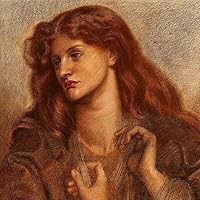
Using Fanny Cornforth as a model, Rossetti's masterpiece Monna, Vanna, is currently prominently displayed in the Tate Gallery in London
Of this incredible painting, Wauch noted it was the "most sumptuous vision of barbaric glory and on the whole more than a little absurd."
Waugh deemed Rossetti a "meloncholy old fraud."
History and the Pre-Raphaelite paintings stand the test of time. Certainly Waugh was entitled to his opinion and art is very subjective. I simply wish Waugh's pettiness was not so prominent throughout the book because it greatly detracted from his young accomplishment.
Great writers exploring small, not altogether interesting topics yielded another gem.
This time, a troubled author explores why artists are troubled and posits, for perhaps the first time, the idea that being troubled is a necessary condition for artistic genius. This idea is now accepted. Yet I imagine Waugh's hesitant and hedged conclusion from the life of a bohemian (slur) in a Victorian Age was provocative and disquieting to all but the early post-moderns.