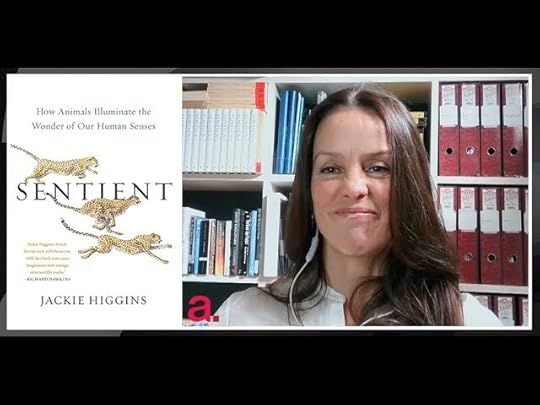
“Sentient” here refers to our ability to sense the world around us—but by “our” I mean the entire animal kingdom. And as for the idea that we use just five senses to do that (sight, hearing, smell, taste and touch), well that’s an idea which has been out of date for a very long time now. There are at least a couple of dozen senses, and probably more.
So we have the mantis shrimp, which looks a lot like a small lobster and has an incredible twelve types of cone cell in its retinas for seeing colours, compared to our three. There’s the spookfish of the deep ocean, the only species in five hundred million years of vertebrate history to have an extra pair of eyes which form an image using, not lenses, but curved mirrors (and which possibly makes them reflecting telescopes, I’m still not sure). Then there’s a mole with a nose which looks like a tiny hand but acts as an extra eye, seeing underground. The Goliath catfish tastes the world with its whole body, nose to tail. Trained avalanche dogs can smell skiers buried under twenty-four feet of snow. And so on (if I told you all the rest, this review would be as long as the book itself).
But Sentient isn’t only about going “wow” at their extraordinary abilities; its point is very much about better appreciating our own too, our more familiar human senses. For example, the human eye can register a single photon of light—even a physicist would struggle to convey just how tiny that is; a photon is one of the fundamental quantum particles of the universe. That’s astounding, I had no idea. In an utterly silent room, like Beranek’s Box constructed in a lab at Harvard, the human ear can hear its owner’s nervous system functioning. If our ears were just a smidgeon more sensitive than that we’d be hearing (and being distracted by) the very atoms of the air around us vibrating. Our hearing, in other words, is as acute as it could be without becoming a liability. Like dolphins and bats, we too have echolocation, we locate silent and immobile objects from the sounds they reflect—even their shapes and compositions. A very limited echolocating ability it’s true, but we do have it and some biologists suspect we unconsciously use it all the time. And even that’s not the half of it…
To sum up the theme of this wonderful book: the animal kingdom is endlessly astonishing—and as fully paid-up members ourselves, so are we.