

What do you think?

Past Imperfect
Joan Collins is the internationally famous actress whose career has brought her to a new peak of stardom as Alexis Carrington Colby in "Dynasty" - a role which might have been created for the tempestuous, strong-willed and passionate woman that she is herself.
As might be expected, she tells the truth - from her romantic adventures, sometimes desirable, sometimes disastrous, with some of the most famous and interesting men in the world, to the inside story of her fascinating and erratic acting career - candidly divulging her "past imperfect" in a book that is, like herself, outspoken, witty, daring and full of life.
“…This book, a sensation when it was published in England, is sheer heaven…”--NY Times
As might be expected, she tells the truth - from her romantic adventures, sometimes desirable, sometimes disastrous, with some of the most famous and interesting men in the world, to the inside story of her fascinating and erratic acting career - candidly divulging her "past imperfect" in a book that is, like herself, outspoken, witty, daring and full of life.
“…This book, a sensation when it was published in England, is sheer heaven…”--NY Times
333 pages, Paperback
First published January 1, 1978
About the author
Joan Collins
92 books100 followersJoan Henrietta Collins, OBE is a Golden Globe Award-winning English actress and bestselling author.
Ratings & Reviews
Friends & Following
Create a free account to discover what your friends think of this book!
Community Reviews
Displaying 1 - 30 of 38 reviews

October 29, 2014
Joan Collins has been a soft target in the press for many years. Her five husbands, unwise film choices and sheer flamboyance has often overshadowed her tenacity, innate intelligence and enduring wit. A British contemporary of Brigitte Bardot, Elizabeth Taylor and Marilyn Monroe, Collins is one of the last great Hollywood dames. She has written other books but in this early book (first published in 1978) she is disarmingly honest about swinging Hollywood in the sixties and seventies.
Whilst still a student at the Royal Academy of Dramatic Art in London, Collins was raped by her first lover (aging movie star Maxwell Reed) after he slipped her a drugged whiskey and coke. Ignoring her parents’ advice she married him at nineteen and endured a sadistic and abusive relationship for seven months. She left him after he tried to pimp her to an old roué for ten thousand pounds. Collins had the guts to ignore his threats of – ‘Some of the boys will carve up your pretty little face if you ever leave me.’
Collins descriptions of her career move to America and life at Twentieth Century Fox and MGM are a great read and she has the ability to laugh at herself. Her portraits of Hollywood moguls are particularly fascinating in that she documents their avariciousness and belief that they could get away with anything. And usually did. At 26 she was told by a fifty year old producer she’d sexually rejected, that she was too old for a part in his film. Fortunately this simply fuelled her ambition and her film career lasted for decades.
As Collins wrote, ‘My past was not perfect – whose is? – but it certainly wasn’t dull.’
Whilst still a student at the Royal Academy of Dramatic Art in London, Collins was raped by her first lover (aging movie star Maxwell Reed) after he slipped her a drugged whiskey and coke. Ignoring her parents’ advice she married him at nineteen and endured a sadistic and abusive relationship for seven months. She left him after he tried to pimp her to an old roué for ten thousand pounds. Collins had the guts to ignore his threats of – ‘Some of the boys will carve up your pretty little face if you ever leave me.’
Collins descriptions of her career move to America and life at Twentieth Century Fox and MGM are a great read and she has the ability to laugh at herself. Her portraits of Hollywood moguls are particularly fascinating in that she documents their avariciousness and belief that they could get away with anything. And usually did. At 26 she was told by a fifty year old producer she’d sexually rejected, that she was too old for a part in his film. Fortunately this simply fuelled her ambition and her film career lasted for decades.
As Collins wrote, ‘My past was not perfect – whose is? – but it certainly wasn’t dull.’

March 11, 2013
One of the best "celebrity" memoirs I've ever read. Collins is witty and reading this book made me realize how intelligent she is. Well, I've watched her in interviews and she's always poised and erudite, so it came as no surprise that her autobiography was well written. So many actors' memoirs are banal and boring, but Collins certainly is never banal or boring. Don't let the book jacket fool you, this book is anything but kitsch.

April 29, 2014
So when my friend's 80 year old mother offers me a book to read, saying, "This is what we considered trashy back in the day," I couldn't resist. According to her, she bought it on a trip to London because it was just not available in the US due to some sort of scandal, I'm not really sure what that's all about. I enjoyed this one! I didn't really know who Joan Collins was before reading it, but if she wrote this herself, she's definitely someone I'd like to know. The stories of what Hollywood was like in the 1950s and 1960s are really interesting, and of course all of Joan's romances are fun to read about. She appears to be really honest in this book, though, which makes me wonder if she did that regarding some aspects of her life in order to make it appear she was being honest throughout. All in all, this is a great light read!

June 23, 2010
La Collin's own life all manages almost to transcend even the most preposterous episodes of Dynasty - and I loved it :-D

March 10, 2013
So I am on a Joan Collins kick. I love her-the look, the attuide and the lifesytle and so when I discovered her autobiography I had to get it.
And it was a great read when it comes to finding out her long and drama filled backstory. Starting from her days growing up in London with her small family, the early days at the Royal Dramatic Academy, to her early career in film I found this to be a page turner. It was interesting to learn about the last days of the studio system, her friendships with various Hollywood elite and her career comeback with the one and only "Dynasty".
She pulls no punches and almost nothing is sacred--except her relationship with sister Jackie--and she goes in great detail about her marriages, romances, and career highs and lows. I learned a lot of surprising facts from her early engagement with Warren Beaty, the infamous french hotel fire she was trapped in in real life to the near life derailing accident that befell one of her children.
What I took from her story is how to be a survivor, how the backend of your life can change into sucess and how personal courage and charisma can be the biggest assest anyone has. Well worth the read
And it was a great read when it comes to finding out her long and drama filled backstory. Starting from her days growing up in London with her small family, the early days at the Royal Dramatic Academy, to her early career in film I found this to be a page turner. It was interesting to learn about the last days of the studio system, her friendships with various Hollywood elite and her career comeback with the one and only "Dynasty".
She pulls no punches and almost nothing is sacred--except her relationship with sister Jackie--and she goes in great detail about her marriages, romances, and career highs and lows. I learned a lot of surprising facts from her early engagement with Warren Beaty, the infamous french hotel fire she was trapped in in real life to the near life derailing accident that befell one of her children.
What I took from her story is how to be a survivor, how the backend of your life can change into sucess and how personal courage and charisma can be the biggest assest anyone has. Well worth the read
This entire review has been hidden because of spoilers.

January 27, 2012
I read this entertaining little book in the meantime while I was waiting for my laptop to repair itself. Thank to Windows; and the need to reinstall everythingl; I had many hours to review this writing; that tells us about the life and miracles of this beautiful and aged actress.
I think that I didn't loose my time. In the preface; she says that she wrote this book alone; without the help of any journalist or professional writer. If that is true; I have to take off my hat: I liked her style; direct; sincere and honest. Obviously she will not speak bad about herself; but she also doesn't try to look like a saint or a martir; and that is a fact of admiration.
I liked this book because it entertained me; and it was relaxing. I hope that this actress is having a good time in her life.
I think that I didn't loose my time. In the preface; she says that she wrote this book alone; without the help of any journalist or professional writer. If that is true; I have to take off my hat: I liked her style; direct; sincere and honest. Obviously she will not speak bad about herself; but she also doesn't try to look like a saint or a martir; and that is a fact of admiration.
I liked this book because it entertained me; and it was relaxing. I hope that this actress is having a good time in her life.
July 30, 2014
I had this book in paperback form years ago when it came out but this Kindle edition has no pics and that sucks. Also, I know there were stories cut from the Kindle edition that I clearly remember from the paperback. If this is the only copy you can get, fine. If you can get a copy of the old paperback, you will be happier.
January 2, 2017
Amusing and nicely written. She's a hollywood star so she's no saint, but she doesn't dwell on her sexual practices. She has a strong sense of self and she goes for her dreams. She's ahead of her time in many ways.

February 23, 2025
The beautiful and talented actress recounts her professional and personal life, from her childhood in England, through her three broken marriages and love affairs, to her daughter's accident and recovery.
December 31, 2007
A very readable book. Joan Collins is from the old school of actresses, so she knew people and had experiences that are probably typical of her generation. Honest, crazy.

May 21, 2026
what a resilient and inspiring woman! This was a great insight into the struggles and challenges of being an old Hollywood starlet and the lessons Joan took away from her experiences was also very helpful for me!

February 17, 2023
Joan Collins tells a good story. She is honest about her "past imperfect", but also a reflection of her upbringing that included thoughts like "men only want one thing." She tells of losing her virginity while she was unconscious from a drug that had been slipped into her drink by a person that was then a star. It was one of a few introductions to the corruption within that system where she was working. But she doesn't write to blame.
Her relationship with Warren Beatty included being engaged when he first began to be known. Not surprisingly, he was not able to stay faithful when they were apart working on different projects.
While there are many famous names in her life, and while she became a star before her 20's in England and then "across the pond", she was still a young girl in a profession where people took advantage of people.
One especially riveting story was that when Elizabeth Taylor became hospitalized and assumed to be dying while making Cleopatra, the studio which had tested her for the role asked her to get on a plane and come take over the role, despite many scenes having been shot. She refused because it would not be fair to Elizabeth, who she considered a friend, and because she was not about to take action while she was hovering between life and death.
The stories of times with great attention and income are followed by times near her 40s where work became scarce, and she needed to be the breadwinner because her husband had lost his job. She always went back to work taking roles that might not be great scripts, but kept her name out there. She managed to get a film funded for her sister Jackie Collins' bestseller The Stud, where she would star in it, after taking it to many producers who turned it down. When it was finally done, the press once again had to grudgingly admit she could act.
There were seasons of mostly TV guest roles. One of those, of course, led to an episode of Star Trek known as City on the Edge of Forever, which was certainly one of the reasons I wanted to know more about her life. It is generally agreed to be the best of all the Original Series. She doesn't talk about it long, but does acknowledge the attention the role got, and enjoying working with Bill Shatner (which most of his friends call him).
This is not a book where you feel she always made good choices. But she did manage a career that has spanned six decades and a half, when most actresses knew that they would be very fortunate to work past their early 30's. Finally, when roles were still scarce and there was a definite need, she took the role of Alexis Carrington because Aaron Spelling fought for her to get the part, having worked with her when she was younger. When she came on Dynasty it was #45 in the ratings. The addition of Alexis helped the show take off, and it was #1 by the next year. She doesn't dwell on it, but certainly acknowledges the privileges it gave her to return to and surpass her previous fame, and to always have work after it. She was the J.R. Ewing (Dallas had been the show that revitalized the nighttime soaps) of Dynasty, and certainly the show took off when people saw her play this ex-wife of the patriarch on the show, as a very adversarial character.
Joan was often labeled "bad girl" from her earliest roles, even when she was a very conservative young woman just trying to find her feet. That image was created largely by studios that decided she could help them best in those roles. Perhaps as time went by, she took on some of those characteristics. But she seems to have been an honorable member of each production she was part of, and took notice of not just stars but of crews that worked on these projects.
An interesting book and life.
Her relationship with Warren Beatty included being engaged when he first began to be known. Not surprisingly, he was not able to stay faithful when they were apart working on different projects.
While there are many famous names in her life, and while she became a star before her 20's in England and then "across the pond", she was still a young girl in a profession where people took advantage of people.
One especially riveting story was that when Elizabeth Taylor became hospitalized and assumed to be dying while making Cleopatra, the studio which had tested her for the role asked her to get on a plane and come take over the role, despite many scenes having been shot. She refused because it would not be fair to Elizabeth, who she considered a friend, and because she was not about to take action while she was hovering between life and death.
The stories of times with great attention and income are followed by times near her 40s where work became scarce, and she needed to be the breadwinner because her husband had lost his job. She always went back to work taking roles that might not be great scripts, but kept her name out there. She managed to get a film funded for her sister Jackie Collins' bestseller The Stud, where she would star in it, after taking it to many producers who turned it down. When it was finally done, the press once again had to grudgingly admit she could act.
There were seasons of mostly TV guest roles. One of those, of course, led to an episode of Star Trek known as City on the Edge of Forever, which was certainly one of the reasons I wanted to know more about her life. It is generally agreed to be the best of all the Original Series. She doesn't talk about it long, but does acknowledge the attention the role got, and enjoying working with Bill Shatner (which most of his friends call him).
This is not a book where you feel she always made good choices. But she did manage a career that has spanned six decades and a half, when most actresses knew that they would be very fortunate to work past their early 30's. Finally, when roles were still scarce and there was a definite need, she took the role of Alexis Carrington because Aaron Spelling fought for her to get the part, having worked with her when she was younger. When she came on Dynasty it was #45 in the ratings. The addition of Alexis helped the show take off, and it was #1 by the next year. She doesn't dwell on it, but certainly acknowledges the privileges it gave her to return to and surpass her previous fame, and to always have work after it. She was the J.R. Ewing (Dallas had been the show that revitalized the nighttime soaps) of Dynasty, and certainly the show took off when people saw her play this ex-wife of the patriarch on the show, as a very adversarial character.
Joan was often labeled "bad girl" from her earliest roles, even when she was a very conservative young woman just trying to find her feet. That image was created largely by studios that decided she could help them best in those roles. Perhaps as time went by, she took on some of those characteristics. But she seems to have been an honorable member of each production she was part of, and took notice of not just stars but of crews that worked on these projects.
An interesting book and life.

April 28, 2020
If you know me, you knew I was going to have to read this one, although I actually purchased it about a year before I started watching Dynasty. It was 50 cents at a thrift store and there was simply no way that I could leave it on the shelf. I wasn’t going to read it until I finished watching Dynasty, because I was worried about possible spoilers, but this quarantine has me plowing through the Hollywood Memoir section of my bookcase so quickly that I was running out of options and this one was really calling to me. Luckily, a quick check of the copyright let me know that I could safely enjoy this one, as I am already past the point on the show of the time this book was written.
I’ll be honest, I knew very little about this Joan before she started on Dynasty. In fact, I remember the network boasting about the big stars they had lined up and the only one I knew was the guy who did the voice on Charlie’s Angels. In fact the only thing I knew of Joan Collins was her turn as the villainess the Siren on a forgettable episode of the 60’s Batman (Joan says she did the role in the 70’s, but that is neither here nor there) and her B movie classic- The Empire of the Ants. A must see for any lover of Bad Movies. So I was surprised to learn of Joan’s lengthy Hollywood career. The gay me exploded with delight as this Joan borrowed a quote from Joan Crawford, of whom she was a fan, to summarize the conditions of women in Hollywood. I also learned that this Joan had a co-starring role in a movie with Bette Davis, who she claims was rude and dismissive to her.
This Joan does walk us through the making of most all of her movies but they are not movies that I am familiar with. Yet these lesser-known pictures usually have co-stars like Robert Wagner, Paul Newman or Bob Hope as leading men so the stories she tells are still captivating to me. She has a scathing story to tell about being in a filmed play with Orson Wells and has few kind words for Bing Crosby.
What this Joan seems most interested in doing is writing her life as if it were a romance novel, perhaps the way her sister Jackie might have written it, so at the forefront of every chapter and in fact almost every story is in some way related to the current man in her life. And again, since this list includes Sydney Chaplin (Charlie’s son), Warren Beatty, Ryan O’Neal and a Middle Eastern prince (she has a thing for thick, black hair…) and Cloris Leachman's husband the stories are always fascinating.
I was disappointed that this book was published in Dynasty’s third season so Joan had not been on the show long and therefore has only a few stories from the set. She does admit that her on screen rival Krystal Carrington, played by Linda Evans and her get on fabulously off set and have been friends for years. I always find it fun when on screen enemies are actually friends in real life.
I’ll be honest, I knew very little about this Joan before she started on Dynasty. In fact, I remember the network boasting about the big stars they had lined up and the only one I knew was the guy who did the voice on Charlie’s Angels. In fact the only thing I knew of Joan Collins was her turn as the villainess the Siren on a forgettable episode of the 60’s Batman (Joan says she did the role in the 70’s, but that is neither here nor there) and her B movie classic- The Empire of the Ants. A must see for any lover of Bad Movies. So I was surprised to learn of Joan’s lengthy Hollywood career. The gay me exploded with delight as this Joan borrowed a quote from Joan Crawford, of whom she was a fan, to summarize the conditions of women in Hollywood. I also learned that this Joan had a co-starring role in a movie with Bette Davis, who she claims was rude and dismissive to her.
This Joan does walk us through the making of most all of her movies but they are not movies that I am familiar with. Yet these lesser-known pictures usually have co-stars like Robert Wagner, Paul Newman or Bob Hope as leading men so the stories she tells are still captivating to me. She has a scathing story to tell about being in a filmed play with Orson Wells and has few kind words for Bing Crosby.
What this Joan seems most interested in doing is writing her life as if it were a romance novel, perhaps the way her sister Jackie might have written it, so at the forefront of every chapter and in fact almost every story is in some way related to the current man in her life. And again, since this list includes Sydney Chaplin (Charlie’s son), Warren Beatty, Ryan O’Neal and a Middle Eastern prince (she has a thing for thick, black hair…) and Cloris Leachman's husband the stories are always fascinating.
I was disappointed that this book was published in Dynasty’s third season so Joan had not been on the show long and therefore has only a few stories from the set. She does admit that her on screen rival Krystal Carrington, played by Linda Evans and her get on fabulously off set and have been friends for years. I always find it fun when on screen enemies are actually friends in real life.

February 9, 2020
Bought this at a charity book sale inside a church in Dusseldorf. Maybe it is the first (auto)biography I've ever read, I should check. It wasn't bad. As might have been expected, Mrs Collins doesn't write a single negative word about herself. Still, it's interesting to get a behind-the-scenes view of television and the movie business. Decades before the revelations in the wake of the #metoo movement, Collins casually shows that it was common practice to demand sexual favours from actresses in exchange for a casting (which she declines to have given). The rest of the book is mostly name dropping of famous collaborators and love interests. Mrs Collins uses hindsight to emphasize her role in the lives of peopls who would reach the highest peaks of stardom later. That way she can tell for instance how James Dean took her for a reckless ride in his porche, and how she told him whie getting out that he ought to drive more carefully in the future or it would be bound to get him killed. Predicting the future is an easy game when you're already in it!

September 25, 2017
This felt like an honest read, especially with some of the juicy bits, even if she has had to gloss over some facts and details as there is a lot to her life and what she remembers. I felt I knew her better and in a fairer way than how she is portrayed in the media. The bio was an old 1978 version whereby she was subsequently criticised for her portrayal of her first husband, but when I read that chapter, I thought it felt authentic and even a bit daring, as much less was said in the 1970s about marriage abuse, so she was ahead of her time in bringing some unpleasant facts out into the open. For a woman born in the 1930's, she has achieved much in the filmstar world and she's definitely a grande dame and has some great personal values that we could all learn from.
January 7, 2017
What an amazing life! I pray that Joan realizes that salvation is a gift not of works lest any should boast ; no there is none good but God that's why Jesus laid down His life for US!
All the heartbreak, yet truly better to have loved than to never have dared.
If I could suggest two or three self-help books for the lovely Ms. Collins to enjoy that would be:
What Women wish their husbands knew by Dr James Dobson, also by Dr JD Love Must be Tough, and lastly The Five Love Languages by Dr Gary Chapman.
This is with the caveat of consuming the chicken and leaving out the bones.
All the heartbreak, yet truly better to have loved than to never have dared.
If I could suggest two or three self-help books for the lovely Ms. Collins to enjoy that would be:
What Women wish their husbands knew by Dr James Dobson, also by Dr JD Love Must be Tough, and lastly The Five Love Languages by Dr Gary Chapman.
This is with the caveat of consuming the chicken and leaving out the bones.

August 16, 2016
I really like reading biographies and picked this up around the time that the TV Dynasty was a hit show with Joan Collins.
It was an interesting life story and there were a few surprises and revelations.
It was an interesting life story and there were a few surprises and revelations.

April 16, 2009
Alexis Carrington Colby from Dynasty / Edith Keeler from Star Trek / Badass!

August 9, 2014
A Juicy Read!

February 7, 2026
I adore Joan. I would only recommend this book to those who feel the same way about her. Here she’s hilarious and brutally honest. A few details may be too much for some. I love how open she is.
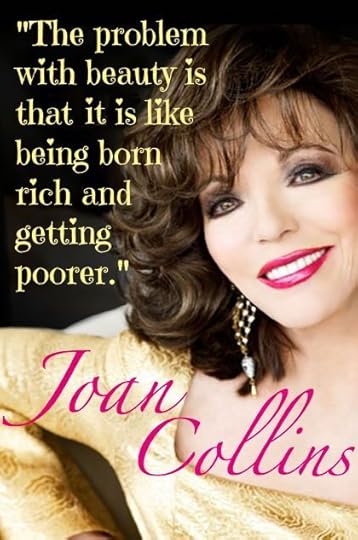
Here are some of my favorite quotes.
Positive Outlook
“I have always been able to do two or three times the amount of activities the average person can do. I have enormous energy and wake up practically every day excited about just being alive.”
“The truth is, there's no secret. You get the face that you deserve, eventually. I believe in enjoying the life you have as much as possible, in living without envy, frustration and bitterness toward others-and in trying to be happy and worry-free. (Not an easy goal in my life.)”
This One Cracks Me Up!
“Arthur and I had come to a final parting of the ways on New Year's Eve. We were dancing at the Charles Lederers' New Year's Eve party. The music was soft and romantic, but we were not. We were having another peevish row, quietly, so that the imposing array of distinguished guests could not overhear our heated discussion. They could not have failed to hear the following dazzling dialogue: Arthur: ‘You are a f*cking bore.’ Me: ‘And you are a boring f*ck.’ And that was the end of that.”
Priorities
“Success is not enough. Money and material possessions are not enough. Nor beauty-nor men-nor love nor lust or whatever it's called these days. The truly important things in my life now are the health and love of my children-particularly Katy, with whom I have an irrevocable bond-and the love and loyalty of my close friends who have remained by me throughout the years.”
Here are some of my favorite quotes.
Positive Outlook
“I have always been able to do two or three times the amount of activities the average person can do. I have enormous energy and wake up practically every day excited about just being alive.”
“The truth is, there's no secret. You get the face that you deserve, eventually. I believe in enjoying the life you have as much as possible, in living without envy, frustration and bitterness toward others-and in trying to be happy and worry-free. (Not an easy goal in my life.)”
This One Cracks Me Up!
“Arthur and I had come to a final parting of the ways on New Year's Eve. We were dancing at the Charles Lederers' New Year's Eve party. The music was soft and romantic, but we were not. We were having another peevish row, quietly, so that the imposing array of distinguished guests could not overhear our heated discussion. They could not have failed to hear the following dazzling dialogue: Arthur: ‘You are a f*cking bore.’ Me: ‘And you are a boring f*ck.’ And that was the end of that.”
Priorities
“Success is not enough. Money and material possessions are not enough. Nor beauty-nor men-nor love nor lust or whatever it's called these days. The truly important things in my life now are the health and love of my children-particularly Katy, with whom I have an irrevocable bond-and the love and loyalty of my close friends who have remained by me throughout the years.”
September 13, 2023
🖋️I enjoyed reading this fascinating memoir, since it has the humor and frankness which I like. I also like the stories Joan Collins tells of people she knew – or still knows. The writing style is smooth and intelligent (although I can do without the peppering of vulgarities).
🏮 Kindle Unlimited.
🔲 Excerpts of note:
🔷●▬●🔶●🔶●▬●🔷
🏮 Kindle Unlimited.
🔲 Excerpts of note:
🔹It has usually been my positive attitude, stamina, optimism and sense of humor that have not only made me survive, but have brought me success . . . "Any woman who would reveal her age would reveal anything." Thus spoke Oscar Wilde. And I agree with him.
🔸There had been an absence of laughter and gaiety in the latter months of my life with Maxwell Reed. Sydney [Chaplin] was like ice water in the desert. He filled a tremendous need in my life to have fun; to enjoy my flaming youth and to be nonconformist as far as the "establishment" went. I didn't deliberately set out to shock people, but Syd gave not a single damn about what the world thought of him. Since I was a chameleon where men were concerned, I too adopted his "screw you" attitude toward his fellow man.
🔹. . . I sat in my hideous orange-and-yellow hotel room in Beverly Hills for the seventh consecutive night, alone, gazing at an unusual personality on television called Liberace.
🔷●▬●🔶●🔶●▬●🔷
October 16, 2024
love dynasty and love joan so i wanted to read this book so bad! it’s out of print now but i found an old copy on ebay and i’m so glad i got it. she’s had such a long, successful career that seems amazing on the outside, but she faced many setbacks and heartbreaks that made me feel much more sympathetic for her and i understand her character more. she has so many experiences and memories with huge hollywood stars like marilyn monroe, james dean, jane fonda, and more and it was so fun to hear these stories. love it!

November 29, 2022
I love Joan Collins and listened to this via Audible, which she narrates. Listening to this autobiography narrated by Collins made it even more fabulous.
Her life is fascinating. Some of it is also shocking and horrific. Is all of it true? Who knows - but it's thoroughly enjoyable. The only downside, I guess, is that it was published shortly after she started Dynasty - but she has later books that discuss that time.
Her life is fascinating. Some of it is also shocking and horrific. Is all of it true? Who knows - but it's thoroughly enjoyable. The only downside, I guess, is that it was published shortly after she started Dynasty - but she has later books that discuss that time.

December 30, 2022
Tantalizing Read
I really enjoyed this book. I would have liked to read more about her upbringing but, the salacious details of her many romances made this book extremely hard to put down. If you are at all interested in the Golden era and its many stars, do yourself a favor and don't pass this up.
I really enjoyed this book. I would have liked to read more about her upbringing but, the salacious details of her many romances made this book extremely hard to put down. If you are at all interested in the Golden era and its many stars, do yourself a favor and don't pass this up.

November 5, 2023
This started out very good! About halfway through, I started to get a little bored. Too much detail that wasn’t interesting or needed. She did not spend nearly enough time talking about her role on Dynasty, which is what she is widely known for and that was disappointing. Overall, interesting! Love me some Joan Collins so it was great to learn a bit more about her life.

November 13, 2019
I read this because I recently tried watching Dynasty and found everything about it to be tedious--except for Joan Collins. Her book is dishy, full of name dropping, and details the behind-the-scenes of old Hollywood.

August 12, 2021
I absolutely adore Joan Collins! She is the best! I loved this autobiography, which was strikingly candid and entertaining. Joan Collins does not take herself too seriously, and she is a beautiful person, inside and out. Bravo!
April 28, 2022
Entertaining and often hilarious, especially the first half. Not as good as her later autobiography but still a good read. One major drawback is some shocking editing and spelling. At times like run thru a foreign translation to English app. Very poor.

October 23, 2018
Very entertaining book! It seems suspiciously one-sided but Joan spills the beans and gives up all the juicy gossip. I couldn't help liking her!
September 15, 2021
Candid and frank, at times salty — it’s the life of an assured woman not afraid to go after what she wants. A history of a strong feminist and good human.
Displaying 1 - 30 of 38 reviews