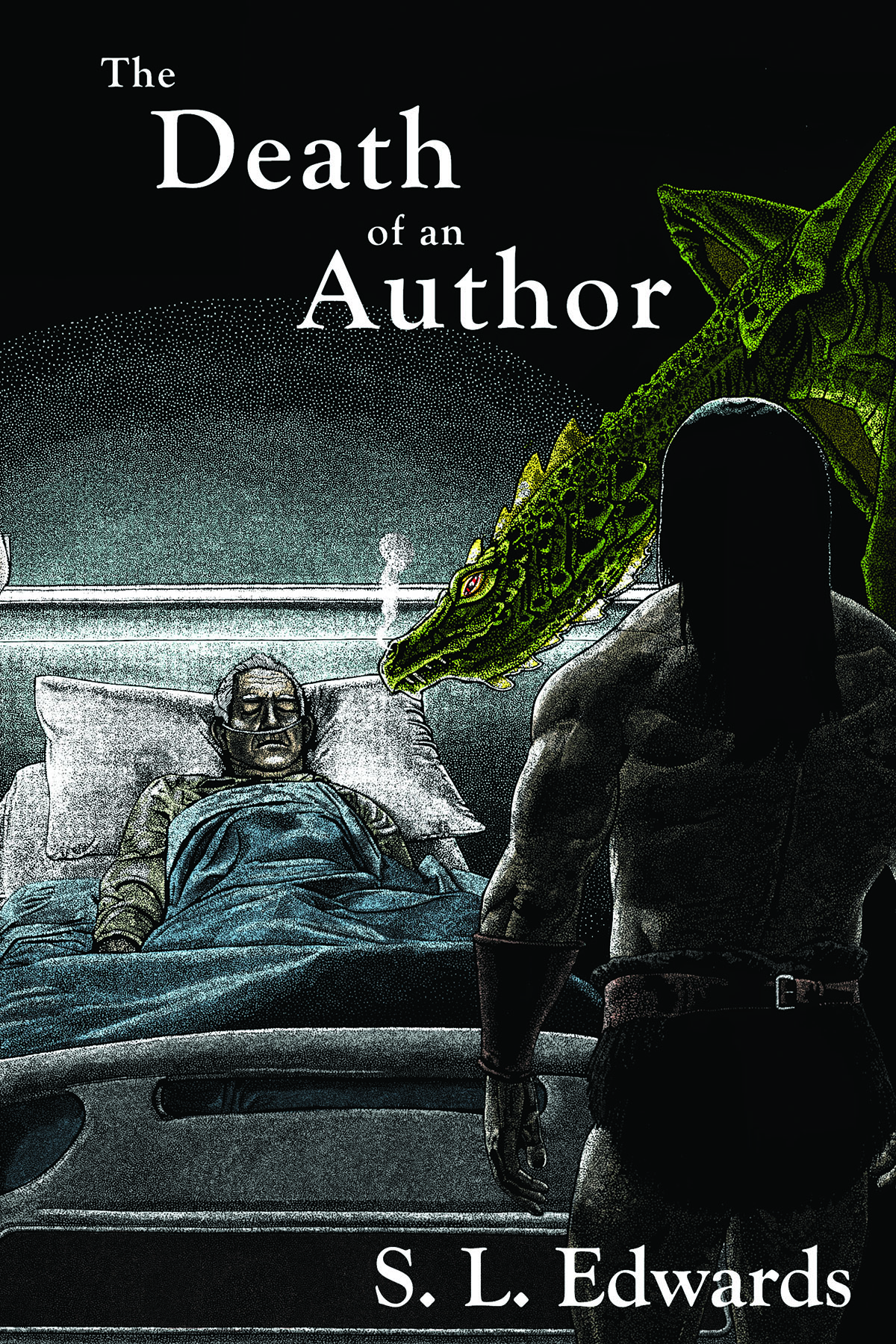
In his second short story collection, S. L. Edwards offers tales of fantasy and horror, all-too human and all-too terrifying. In this volume, you’ll find stories of vampires lording over the zombie apocalypse, gunslingers fighting their way through haunted mining towns, dragons at the end of the world, and the death of an author.
At the intersection of pulp horror, weird fiction, and a general love for fantasy, The Death of an Author is a kinetic collection, with offerings both for those who enjoyed Whiskey and Other Unusual Ghosts and for new readers as well.
Well! The book is finished. But I am still asking myself, in which genre does it belong? Horror? Fantasy? No. I think these were something different. Exquisitely written personal tales, clothed in the attire of pulpy characters— that's what we have got here. Following the 'Introduction' by John Linwood Grant we have fifteen stories and one vignette. Out of these fifteen stories, the first set of ten contained pulpy characters, but the stories were more about loss and pain, than of heroic retribution or redemption. But "The Death of an Author" was undoubtedly the best of the lot. Infact, it is a truly memorable short story, that would appeal to every wordsmith who has ever tried to create his own worlds. Next came five stories based on Mythos. These were short, sharp, sickening, and yet strangely alluring. The mythos-tainted landscape depicted in these stories appears to be very-very familiar. Underneath the trappings of mystery and horror, they reveal truths. But most importantly, it’s all presented in such lyrical and haunting prose that they don't come across as political musings. Instead, we have tales to read and re-read. Personally I would have preferred more of such mytho-politico tales in comparison to the depressing lot of pseudo-pulp accumulated in the first section. Hence one star is dropped. But otherwise the book is a treat for connoisseurs who can appreciate penmanship. Recommended.
In a follow up to his horror-heavy Whiskey and Other Unusual Ghosts, S.L. Edwards offers seventeen stories of monster, dystopian, spectral, and political weird fiction tinged with cerebral fantasy and Lovecraftian allegory in The Death of an Author. Seven of the tales are original to the collection, and whether you fancy creature creepfests or contemporary satire, you’re certain to find a dark ditty to enjoy... Read the rest of my review on Ginger Nuts of Horror
If I were to really get down to it, what I need from a book is to know its author. From start to finish, I see a book as a way to meet someone new. Between the lines, behind the tropes—I need a person, looming large, their unmistakable stamp on every choice. Through these choices, I find connection, resonance.
S.L. Edwards was on every page of his first collection, Whiskey and Other Unusual Ghosts, so it was fitting that I’d want to check out his follow-up, The Death of an Author. In the former, he wrote political horror, oftentimes focused on Latin America, with a sort of grinning love of genre silliness lurking behind the heavy, human content in his stories. I saw someone who was empathetic and funny, with a heart beating on their sleeve. I liked what I saw.
The Death of an Author finds Edwards in top form, maybe even better form, when compared to his first collection. The stories herein are very much still reactions to current events (which give them a sort of exuberant immediacy—as if we’re reading the author’s real-time thoughts; an oh, c’mon! shouted at the television transubstantiated into fiction), but this time around Edwards seems more comfortable playing in the sandbox of genre. Here we have vampires, zombies, and Cthulhu—all depicted with the adoration of a kid and a box of crayons. The Death of an Author is an ode to what made us love the genre in the first place, all grown up.
Divided in three parts, there’s a visionary cohesion to each section. The first, Fantasies and True Secrets, deals up a serving of stories that range from the Weird to the Gothic. Reading these stories, you can’t help but feel a tangible love for monsters, even when they’re being used as a means to comment on world events or personal tragedy. It’s no mistake that the collection’s first story, “Christmas at Castle Dracula,” features one of horror’s most famous villains. This is the equivalent of an author playing. This is action figures slamming together while pursed lips create onomatopoeia. It’s easy to get lost in this play, to remember back when everything was just so, so cool.
But to define this collection as an experiment in genre escapism wouldn’t really be right, because again, Edwards is on every page of The Death of an Author. “A Slower Way of Starving,” which has a deliciously (ha!) out-there premise—features commentary on consumption, trauma, and why we tell stories. It does this with well-realized characters and an apocalyptic vision of a world where the 1% watch and wait while the rest of us endlessly consume.
The title story, too, is one where we get to see the eye for human frailty that has made Edwards one of the foremost talents in the genre. “The Death of an Author” is the story in this collection that affected me most, as it will for most authors who like to believe their stories will have a life beyond them. It’s a tale of an old man on his deathbed, waiting for the end, surrounded by family who are both amused and curious about his life as a pulp writer. When his old characters start showing up to say their farewells, we’re left with something sad, bittersweet, but ultimately optimistic. It’s a story about legacies, an examination of what we leave behind.
The second part of this collection, Miskatonic and Madness, features a side of Edwards we didn’t see much of in Whiskey and Other Unusual Ghosts—that of the Lovecraftian pulpist. Surprisingly, this is also where Edwards gets the most timely, using Lovecraft’s pantheon of weirdo gods and cultists as a vehicle for social and political commentary. “The Cthulhu Candidate” introduces this section, but also serves as an introduction to Congressman Marsh—a political candidate from Innsmouth, who reappears through several stories in this collection, and eventually becomes president. “The Cthulhu Candidate” is a refreshing riff on those bumper stickers you inevitably see come election season—the ones that feature the tentacled high priest and a caption that says something like, “Why vote for the lesser evil?” Edwards takes this as a literal jumping off point, where a slumming reporter interviews the election’s most dark horse candidate—to inevitably maddening results.
There’s also an absurdity to this section that I find refreshing, a sense of humor in how Edwards uses these tropes. Dagon cults and Cthulhu are talked about with the same bland comfort as Protestants and Catholics. In these Mythos stories, which take place in the modern day, Lovecraft’s world is reimagined as an alternate history—where everyone knows the people in Innsmouth look like funky fish, where everyone knows someone who worships an Old One. In Edwards’ hands, Lovecraft’s mythos is a perversely askew mirror of our own world, with many of the same problems dealt from many of the same hands.
The third and final section features acknowledgements and one final story, “The Last Mayflies Out of Bogota,” which serves as a sort of melancholy goodbye amidst a world in turmoil. I like to think it’s hopeful, despite everything—a feeling I get from a lot of Edwards’ works, that somehow, something will go right. Peace will be achieved, despite its bloody cost; an end to suffering will occur, eventually, after a near eternity of it. I think this hopefulness that runs in the heart of Edwards’ stories makes them all the more sad, all the more scrappy. “The Last Mayflies Out of Bogota,” like all the stories in The Death of an Author, are fighting for something.
S.L. Edwards is becoming a powerful voice in horror. He calls upon a range of the fantastic to tell his tales of people, real humans, grappling with the world around them. It’s tough, beautiful, fun stuff—the likes of which makes for a read that captures a broad spectrum of emotion. In The Death of an Author, there were moments where I smiled to myself, impressed with Edwards play; other times I nodded sagely at his incisive indictments; and then, as with the title story, I cleared the lump from my throat and tried to do my own play-acting, pretending that I had not just read something that touched me deeper than I could tell. The Death of an Author is a work of openness, it’s Edwards sharing himself, his own frustrations and sorrow—horror is just a tool, a bridge, a means of reaching out and saying: Yes, me too.