When life gets hard, what will you do to the Other to protect yourself?
Boats are sinking in the Mediterranean, and Siobhan begins work at a night shelter for asylum seekers. At the same time she is coping with the fallout of her relationships with an identical twin sister, an ex-girlfriend, and a boyfriend with whom she can no longer have sex. As political conflicts escalate she begins to recognise the destructive, zero-sum dynamic she learned in childhood and is forced to acknowledge her own violent logic of self-preservation.
Drawing on cinematic montage, the narrative renders fragments of memory, experience and observation in a pattern of shifting analogies that work to illuminate the possibility of a less binary world.
‘In its intimate and dazzling constellation of anecdote and memory, Seesaw’s form seems to be exquisitely composed by the very alliances of correspondence, analogy and sympathetic magic that its narrator dare not believe in. Siobhan’s struggles speak to an existential and political urgency: how does anyone keep balance while seesawing between the personal and the collective, past and present, brutality and hope, the authentic and the algorithm? Seesaw’s brilliance is its refusal to settle easily on either side, all the while reminding us that the middle ground should be more than just an idea – it should be capable of sustaining life.
Seesaw is a brilliant puzzle of a novel whose ideas must be pieced together along with the rest of the story. Doohan’s narrative structure is indebted to cinematic montage, resulting in fragmented storytelling that cuts through time. One of the central projects of the work is a deconstruction of mimetic desire that sees relationships as zero-sum - or, like a seesaw, up or down. There are frequent references to the European refugee crisis and the rise of fascism in America, which expand the scope of the work beyond a story about sibling rivalry. This was one of the highlights of my 2021 reading year.
That Christmas, when we were eighteen, she gave me a stranger than usual present. We were in the front room, wrapping paper on the carpet, the tree in the corner by the TV. The present was a wooden seesaw on a string. There was a small wooden doll at each end and, if you pulled it along, they moved up and down. 'Zero-sum,' she said as I opened it. 'I saw it in a charity shop and I thought, that's perfect.'
Seesaw is the latest book from the Republic of Consciousness Book Club (sign up here) and from the incredible small press CB Editions, run by author Charles Boyle.
The novel is set, at least in its present-day narrative, in 2015-7, a time spanning Brexit, the Trump presidency, a refugee crisis, starting in September 2015, David Cameron’s visit to Jamaica, when he ducked the topic of reparations but did kindly fund the building of a prison so the UK could repatriate Jamaican prisoners (a misheard reference to ”reparations” is pivotal to one key scene in the novel) and ending in August 2017 and the Charlottesville rally (which triggers the novel’s key revelation).
This socio-political scene provides a backdrop to a more personal tale, narrated by Siobhan, her and her identical twin Sinead born in May 1982, on the day the Belgrano was sunk: the Sun heralded our birth with the headline GOTCHA.
One of the many recurrent images in the novel is that of puzzles and jigsaws and the reader has to piece together Siobhan’s story, which is both non-linear and fractured, as well as accompanied by her musings on various topics (e.g. the invention of Gore Tex). Although in practice everything comes back to the twins mimetic relationship:
I stare out of the window at the passing fields. The role of props. That's what I do. I collect fact after fact, story after story, but no matter what they are, they all sink into the same swamp: I ask everything the same question what are you telling me about me? In every piece of news, in every horrible event in the plethora of horrible events, all I see is her, and me, and us —
After verbal images of a mischief of baby rats fighting over their mother’s teats, the titular Seesaw, and a Facebook video of factory works making globes, Siobhan’s narrative opens with her being driven by Tom, her partner, to see her parents. Her relatively casual comment that she doesn’t drive as it just wasn’t my thing is one that turns out, towards the novel's end, to disguise something far more disturbing.
But the most glaring indication that something is seriously amiss comes some pages later when Siobhan snaps at Tom when he calls her ‘love’, later explaining the source of her anger:
Calling me love, I explain again, is like when they used to call me twin. Twin was all they'd ever call us at school. Like it made no difference at all which one we were.
Now, full disclosure, I am an identical twin. And Siobhan’s reaction couldn’t be further from my own at that age - the best way to offend us, was actually for teachers or fellow pupils to claim they could tell the difference and refer to us by our names.
Later Siobhan and Sinead have a confrontation when they go to view Diane Arbus’s highly offensive Twins photo, one that both, for me, demonises twins and yet tries, unsuccessfully, to undermine their shared identity.
At a later stage, perhaps the most memorable in the novel, pinpoints the exact moment when Siobhan betrays her identity, their ‘we’ shattering into two 'I's.
Laughing Cow cheese triangles, with sliced tomatoes, in a baguette. The whole cling-filmed sandwich hot from the sun. Sharp crumbs finding their way inside our spotted swimming costumes. Our teeth are wobbly, and under the pine trees, behind the beach, we play with the ones that are nearly ready to fall out, foreign objects swinging over dark cavities, hanging on only by tight red threads. All our wobbly teeth, four of them so far, have fallen out within two days of each other and have been in the exact same places. Now we are working on a back middle tooth on the right. A big one. I can get the tip of my finger underneath one side of it, making a delicious blunt pain on the other. Can you do — Yeah. And then — Oh yeah. And if you — Ow! Yeah. The pale dusty ground is covered in long pine needles. We can feel them beneath our feet, knees and bottom. The smell is sweet and the light is sharply dappled; cold and dark in some spots, hot in others. I can get my finger under it, in the hole! How? Sinead hand moves toward my mouth. Her fingers touch my lip. No. What? No. What? Her face is confused. I am shaking my head, my mouth closed. I can taste the iron taste that comes after we play with our teeth. She reaches again, touches my closed lips, drops her hand. It has gone quiet. A quiet we have never heard before. We are looking at each other. 'Well, I'll do it on my own tooth, then. I'll do it to myself.' It's a different voice, coming from outside.
In her delusion, Siobhan comes to believe that she is a skeuomorph of Sinead (or vice versa):
The first usage of the word skeuomorph was by Dr Henry Colley March in 1889: the transfer of thong-work from the flint axe, where it was functional, to the bronze celt, where it was skeuomorphic. His point was this: to make a pre-historic axe you had to use a strip of animal hide to tie a wooden handle to a sharpened piece of flint. Later, when such a tool could be fashioned out of bronze, and even though they had no function at all, markings imitating the thong wrapping were still added. … Skeuo as container or tool; morph as form or shape. I'm trying to work out if a skeuomorph is the opposite of an isomorph. An isomorph is an arrangement in which the relations and proportions between elements are preserved, a structure that doesn't alter its fundamental form as it grows. I decide they are not opposites; they are more like different kinds of sameness, fake sameness and real sameness. Isomorphs can look different but be the same deep down, but with a skeuomorph the sameness is only ever superficial — a copy caught up in a past it no longer even remembers.
Powerful but very distressing. 5 stars from a re-read and I very much enjoyed discussing the novel with the author at the Book Club monthly call, where she revealed that she is also an identical twin and that the novel started as, although morphed away from being, autofictional.
A short book that can easily be read in a day, but not an easy one to assess or review. If somebody had told me that this was autofiction, I could easily have believed it, but I don't know enough about the author to know whether it is a fair label. It also has echoes of Jenny Offill and Patricia Lockwood in the way a vague narrative arc is constantly interrupted by digressions on thoughts and feelings. Definitely a book that deserves a wider readership.
I received this book as part of my Republic of Consciousness Book Club subscription. That said, it comes from CB Editions and there are some publishers who give you confidence about a book before you have opened it or even know what it is about. CB Editions in one of those publishers for me: I haven’t by any means read all the books published by them, but the ones I have read include what I think must go down as my favourite book ever (Will Eaves’ Murmur) and the books written by CB himself under his Jack Robinson pseudonym.
But my confidence in the publisher isn’t the reason I have given this book 5 stars. One of the main things that boosted my rating here is that, very unusually for me, I completed the book and immediately turned back to page 1 and read it again. There has to be something about a book for me to want to do that.
So, why did I want to re-read this immediately? Part of the reason is the structure of the book. The blurb on the back says ”Drawing on cinematic montage, the narrative renders fragments of memory, experience and observation in a pattern of shifting analogies that work to illuminate the possibility of a less binary world.” What this means in practice is that the reader has to keep lots of plates spinning at the same time. It’s not unusual for me to read a book structured like this, but here I found that the fragmented nature felt more consistent and more unified than a lot of the similarly structured books I have read. But there was still enough of a puzzle here for me to want to re-read.
And I mention this because this book seems to operate at all these levels, especially the puzzle and the game, although the word “game” implies a lot more fun than our protagonist has.
Siobhan is one of identical twins. Sinead is her sister. Siobhan is our narrator and her relationship with Sinead is core to the book and functions a lot of the time at the “competition + conflict” level. I’m not a twin and the world of twins is something I can never experience, although many of my GR friends who move in the same groups there as I do know identical twins who sometimes give us an insight. Siobhan is also dealing with a failed relationship with another woman and a current relationship with a man. In both cases, sex has been a struggle for her. What happens as Siobhan works through these relationships forms the core of the “plot” of this book, if plot is the right word, which I doubt.
But then there’s the puzzles that run in parallel. There are multiple references in the book to parallel worlds and one of the things I really liked as I read this was the way the author used the puzzle aspect of the book to support the storyline. I guess you could say that this means the structure is slightly artificial, but it doesn’t feel like that, especially given the fragmented nature of the storytelling. Siobhan being a twin spawns thoughts about copies and copying which leads to thoughts about mimics and then to mimesis and mimetic desire (we want something because others want it). Thoughts about copies spread out to thoughts about “mise en abyme” (recursion) and about how much things have to change before they stop being themselves. Then there’s the seesaw of the book’s title and related thoughts about “zero sum” (someone wins and someone loses an equal amount). It is for the reader to piece together all these ideas which come at you in scatter gun fashion and build on one another as the book progresses. We end up at “quantum entanglement”, what Einstein referred to as “spooky action at a distance”: two particles created in the same place at the same time which continue to act upon each other no matter how far apart they are. As the book says. ”You can’t even describe them independently of one another: the only way to do it is by giving a quantum state of the pair as a unit.”
And then there’s the fact that the book is set in 2016 and is filled (in a way that might remind a reader of No One Is Talking About This) with references out to 2016’s main events and to other things the narrator remembers seeing on social media. For a while I wondered whether 2016 doesn’t feel rather a long time ago now in the sense that a lot of water has flowed under the bridge since then and the world feels a very different place. However, one of the things the book explores (a bit) is the way truth can sometimes be stranger than fiction and 2016 seems like the perfect year to set a book like that.
And there’s a lot more like this - I’m only scratching the surface. I haven’t mentioned all the stuff about the way the brain works by comparing events with a model it has built based on the past. Our narrator is very concerned that she is never actually reacting to what is happening, but only to how her brain can map that into its model of the past.
In fact, anyone thinking of reviewing this book should probably be a little bit scared. There’s a passage that talks about Rorshach’s ink blot tests and which records Rorschach as having said:
”It’s not so much about what they imagine they see, but rather how much of the ink blot they use to come to a decision: do they use the whole image or just part of it? I am interested in observing how hard the viewer will work to make sense of the whole scene, I am interested in observing how he deals with conflictual information.”
It’s a brave reviewer who takes on this book after reading that. I’m fairly sure I’ve failed any test that measures whether I take in the whole picture, although, in my defence, I’d point out that my notes from the book are a lot, lot longer than this review.
Maybe now you can start to understand why I read it twice.
Disturbing, But Compulsively Readable Review of the CB Editions paperback edition (September 2021)
The title Seesaw evokes images of childhood playground games. A dark underbelly is gradually revealed though as the lead character Siobhan's disturbing relationships to her sibling Sinead, ex-girlfriend Chloe and current partner Tom come to light in the book's cutup style of flashbacks and flashforwards. This is also paralleled in her observing her friend Alice's two children Wren and Rose where the older child is resentful of her younger sister.
We want to like Siobhan despite her psychological problems and violent acting out. She is sympathetic to the world immigration crisis and works as a volunteer at a UK asylum facility and even travels to a refugee camp in Calais, France to work part-time, although she disassociates from that experience as well. The end finds her on the brink of what looks like a perilous end-of-life choice, but we are still left with a feeling of hope for recovery and repair at the close.
Although the somewhat experimental montage style of the book may sound like a cause for obscurity and disorientation, I found Seesaw to be compulsively readable and read it in only a few days (not typical for me, I usually space books out over a week or more).
The book also has an interesting learning subplot, with Siobhan regularly dictionary browsing, googling or viewing online videos and passing on information about Skeuomorphs, Mimesis, Allelopathy and such. At the same time, there is the downside of the author perpetuating the fine people hoax.
I read Seesaw as the September 2021 selection from the Republic of Consciousness Book of the Month (BotM) club. Subscriptions to the BotM support the annual Republic of Consciousness Prize for small independent publishers.
Trivia and Links Publisher CB Editions' official page for Seesaw has a link that opens a pdf file where you can read the opening 11 pages of the book.
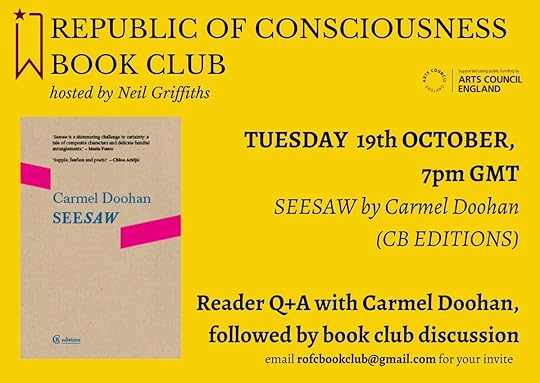
If you are reading this before October 19, 2021 you can still join in the Republic of Consciousness Book Club Author's Q&A and discussion on that date. Details available on Twitter here.
If I were to summarise Carmel Doohan’s novel using one picture, it would have to be this:
Picture
For those who do not know this is Diane Arbus’ Identical Twins, Roselle, New Jersey, 1967. A photograph about identity between identical twins. As one can see one is smiling, while the other is frowning. The point being that although the twins look the same, there is an attempt to project their individualism.
This sort of tension is a running theme during the book.
Another touchstone is Dziga Vertov’s 1929 film, Man with a Movie Camera, a film which consists of a number of images (including twins). The book’s style is not dissimilar. Both the picture and the film are mentioned in Seesaw
The book’s narrator is Siobhan, who has a partner called Tom. We readers discover that Siobhan freezes whenever Tom wants to have sex with her and was previously in a relationship with a girl, Chloe. Both relationships are important in getting an insight into Siobhan’s character. Due to the book’s structure: a series of loosely connected paragraphs, all this information is revealed to the reader in bits and pieces.
However, the focal point of Seesaw is Siobhan’s relationship with her twin sister, Sinéad. As the book progresses a lot of Siobhan’s problems are linked to her. At first Siobhan speaks about the novelty of being a twin: switching classes, fooling people, wearing the same clothes but also she notices that despite the similarities both twins have different characters as one is more outgoing while the other is reserved. This leads to Siobhan’s dissociation with her twin and there are times when both meet and argue.
One of Seesaw’s highlights is when Sinéad takes Siobhan to an art gallery and they come across the picture of Diane Arbus’ Twins and there they discuss a traumatic incident which affected both sisters in different ways, which may mean that although Siobhan is trying her hardest to forge an identity, identical twins still have a strong connection between themselves.
Seesaw is not only a novel about identity and sibling relations. It is one of gender and mental health. Through the use of metaphors, trivia about pop culture and symbolic encounters, Carmel Doohan has created a complex character who is trying to find their way in the world, and complicated one at that. The mixed up jigsaw puzzle feel of the book also helps understand the many things that are going on in Siobhan’s mind. To continue on the jigsaw analogy, the more we read the more we understand about Siobhan’s life. Not to mention that the prose is crisp and highly readable.
Without mincing any words, Seesaw is excellent. It is captivating and interesting. I will guarantee that the reader will learn a lot of things in the process and, as someone who has never been a twin. I got a lot of interesting insight into them as well. The novel’s publisher, CB Editions has released many interesting and mind bending books in the past but Seesaw might be their best one too date.
Many thanks to CB Editions for providing a copy of Seesaw
Not quite sure what I thought of this one. There are some brilliant bits & the fragmentation works well for the topic. Until it just felt... fragmented, being inside a cracking mind. Depressing & stressful too.
This was an intriguing book. Its core is a story about being an identical twin but the book is set in the real world happenings of 2016. The twin telling the story does a lot of volunteer work with refugees and there are continuous comments on then-current events such as Brexit and US race for President.
The twin tells the story of the alienation between her twin and herself, how it started, and how it escalated. She hates being called "Twin", which is how she and her sister were referred to throughout school. She seems incapable of developing her own identity and this is causing her severe difficulties in relationships. Her description of her sister is one of a person seeking vengeance against her for trying to break the twin-bond.
There is much more depth to this novel than I've managed to convey. For an excellent review of the book and its complexity (it is not a difficult read but brings up fascinating topics for rumination), read Neil's at https://www.goodreads.com/review/show.... For a review from an identical twin whose position is on twinness is the opposite but who enjoyed the book, read Paul Fulcher's at https://www.goodreads.com/review/show....
I think I need to add a new bookshelf for books deserving to be reread!
I really appreciate what this novel tries to do, even though it doesn't always succeed - to represent the disjunctures of trauma and emotional pain, and what they do to narrative, and also to present 'the political' in the life of characters. Sometimes the writing of what is happening 'in the world' feels too on-the-nose but it's always sincere and never trite. I found the narrative of twins' together/apartness very compelling and I think it's in this narrative that Doohan's aliveness to flesh, words and silence is really apparent. Looking forward to more.
I am sorry but this book is poor. I'm tired of the "refugee crisis" being narrated in this tone. A trigger/inconvenience for aid workers/"kind people". It's a mere plot device. If you want to write about siblings - do so. It may be "abstract/experimental" but the same old gaze is in there.
Don't use refugees' experiences to center/tilt/trigger an aid worker, it's crass.
Some of us who were refugees can read.
I never saw the point of sensitivity readers until i wasted an afternoon reading this off my flatmates shelf.
It's trying to be Zadie Smith and David Lynch but falls flat.
damn. what a neat little book this is. its told in vignettes which felt like the point - the book primarily centered around the connectedness of every random moment. it was poetic and weird (almost creepy) at times, very sad, very intimate and yet so universal in the themes surrounding trauma, pain, love, sex, war. the twin element was really fascinating to me too, esp when it tied back to the connectedness of everything and the unique bond between two people who share exact DNA.
it took me a min to get into it but once i did it was v hard to put it down. def intrigued by doohans writing and would def read more.
fav quote (though there are many !!):
'a torn chicken giblet lying across a wishbone on a plate, the alignment of Venus in the night sky, the shape as a dancer raises her arm then lifts her chin. there are hidden resemblances between things that do not, at first, seem connected - a web or pattern holding the microcosm and the macrocosm together, each detail whispering it’s connection to the whole.'