

What do you think?

Unnatural Ends
Sir Lawrence Linwood is dead. More accurately, he was murdered—savagely beaten to death in his own study with a mediaeval mace. The murder calls home his three adopted children: Alan, an archeologist; Roger, an engineer; and Caroline, a journalist. But his heirs soon find that his last testament contains a strange proviso—that his estate shall go to the heir who solves his murder.
To secure their future, each Linwood heir must now dig into the past. As their suspicion mounts—of each other and of peculiar strangers in the churchless town of Linwood Hollow—they come to suspect that the perpetrator lurks in the mysterious origins of their own birth.
To secure their future, each Linwood heir must now dig into the past. As their suspicion mounts—of each other and of peculiar strangers in the churchless town of Linwood Hollow—they come to suspect that the perpetrator lurks in the mysterious origins of their own birth.
402 pages, Paperback
First published June 20, 2023
About the author
Christopher Huang
3 books228 followersChristopher Huang was born in Singapore. He migrated to Canada at the age of seventeen, but returned the following year to complete his two years of military service in the Singapore Army. He studied Architecture at McGill University, and lived for many years in Montreal, Quebec, before moving to Calgary, Alberta.
Ratings & Reviews
Friends & Following
Create a free account to discover what your friends think of this book!
Community Reviews
Displaying 1 - 30 of 414 reviews

June 2, 2022
4.5⭐
In April 1921, Alan, an archeologist, Roger, an engineer, and Caroline, a journalist – the three Linwood siblings return to their family estate in Yorkshire for their adoptive father’s funeral. Their father, the late Sir Lawrence Linwood, had been bludgeoned to death in his study with a medieval flanged mace by an unknown assailant.
Upon the reading of Sir Lawrence’s will, they are made aware of a “find my killer” clause wherein in the case of an unnatural death, the one who can solve his murder inherits his estate. Their father's manipulation from beyond the grave does not come as a surprise as the three of them have spent their whole lives under the autocratic control of Sir Lawrence whose idea of nurturing competitive spirit involved pitting them against one another throughout their childhood. As adults, they still crave his approval at every juncture and strive to maintain the standards set by him and fulfill his expectations. Though none of them are particularly motivated to deprive the other two of their share of the inheritance, the siblings do venture out following different clues in search of who may be responsible for their father’s murder. As the narrative progresses, we see how their endeavors lead to the unearthing of long-buried family secrets and the siblings come to realize just how deep-rooted their father’s control and manipulation of those around him have been throughout their lives. The larger part of the third-person narrative switches between the perspectives of Alan, Roger and Caroline- their present lives and struggles and how their lives have been shaped by their childhood experiences and the authoritarian, often tyrannical behavior of Sir Lawrence towards them. Harsh discipline paired with strict academic schedules meant to fuel ambition and competitiveness among the siblings, with little to no intervention from Lady Linwood on their behalf made for a less than idyllic childhood. Their only respite was in the hours they spent with one another in their playroom in one of the towers of the old mansion- a room they dubbed 'Camelot'.
Unnatural Ends by Christopher Huang is a smartly crafted murder mystery set in 1920s England with an interesting and diverse cast of characters. Each of the main characters is well fleshed out, even the most unlikable ones. There are many supporting characters we meet throughout the narrative which can be confusing at times. The novel with its multiple threads does require a bit of patience on the part of the reader, but it is well –worth the effort. The author does a brilliant job in bringing all the characters and their stories together. Huang’s writing is elegant and the author's note at the end of the book indicates the research that went into framing the post-World War I period setting. This is a lengthy novel, written with meticulous attention to detail, in terms of the historical and physical setting of the story as well as descriptions of the dysfunctional dynamics within the Linwood family. The twists and turns as well as the character studies kept me hooked till the end. Though I could partially predict where the story was going I loved how the author got us there. Fans of Agatha Christie and Daphne Du Maurier might find this one quite intriguing!
I eagerly look forward to reading more from Christopher Huang.
Many thanks to Inkshares and NetGalley for providing the digital review copy in exchange for an honest review.
In April 1921, Alan, an archeologist, Roger, an engineer, and Caroline, a journalist – the three Linwood siblings return to their family estate in Yorkshire for their adoptive father’s funeral. Their father, the late Sir Lawrence Linwood, had been bludgeoned to death in his study with a medieval flanged mace by an unknown assailant.
Upon the reading of Sir Lawrence’s will, they are made aware of a “find my killer” clause wherein in the case of an unnatural death, the one who can solve his murder inherits his estate. Their father's manipulation from beyond the grave does not come as a surprise as the three of them have spent their whole lives under the autocratic control of Sir Lawrence whose idea of nurturing competitive spirit involved pitting them against one another throughout their childhood. As adults, they still crave his approval at every juncture and strive to maintain the standards set by him and fulfill his expectations. Though none of them are particularly motivated to deprive the other two of their share of the inheritance, the siblings do venture out following different clues in search of who may be responsible for their father’s murder. As the narrative progresses, we see how their endeavors lead to the unearthing of long-buried family secrets and the siblings come to realize just how deep-rooted their father’s control and manipulation of those around him have been throughout their lives. The larger part of the third-person narrative switches between the perspectives of Alan, Roger and Caroline- their present lives and struggles and how their lives have been shaped by their childhood experiences and the authoritarian, often tyrannical behavior of Sir Lawrence towards them. Harsh discipline paired with strict academic schedules meant to fuel ambition and competitiveness among the siblings, with little to no intervention from Lady Linwood on their behalf made for a less than idyllic childhood. Their only respite was in the hours they spent with one another in their playroom in one of the towers of the old mansion- a room they dubbed 'Camelot'.
Unnatural Ends by Christopher Huang is a smartly crafted murder mystery set in 1920s England with an interesting and diverse cast of characters. Each of the main characters is well fleshed out, even the most unlikable ones. There are many supporting characters we meet throughout the narrative which can be confusing at times. The novel with its multiple threads does require a bit of patience on the part of the reader, but it is well –worth the effort. The author does a brilliant job in bringing all the characters and their stories together. Huang’s writing is elegant and the author's note at the end of the book indicates the research that went into framing the post-World War I period setting. This is a lengthy novel, written with meticulous attention to detail, in terms of the historical and physical setting of the story as well as descriptions of the dysfunctional dynamics within the Linwood family. The twists and turns as well as the character studies kept me hooked till the end. Though I could partially predict where the story was going I loved how the author got us there. Fans of Agatha Christie and Daphne Du Maurier might find this one quite intriguing!
I eagerly look forward to reading more from Christopher Huang.
Many thanks to Inkshares and NetGalley for providing the digital review copy in exchange for an honest review.

November 20, 2021
Linwood Hall, in the year 1906, was "a jumble of grey stone walls pockmarked with tall, narrow windows. French doors had been punched into the ground floor in the last century opening on the broad terrace cantilevering over the cliff...All around them, the windswept North Yorkshire moors...". A tall tower room rose from the middle of the estate, a playroom nicknamed "Camelot" by the three adopted children of Sir Lawrence Linwood. "Camelot" was accessible through passages behind the walls.
In 1921, Alan an archeologist, Roger an engineer, and Caroline, a journalist were called home upon the death of their father. "In the event that my death should be due to unnatural causes, I charge my children with the task of identifying the killer. If one of them finds the killer, to the satisfaction of the police and the courts of law-I rescind previous statements and leave the entirety of this residuary estate to that child." It was determined that Sir Lawrence was murdered in his study, the instrument of death, a medieval flanged mace. "Wasn't one of the suits of armor in the great hall holding a mace?"
There had been no way to escape Father's shadow. A portrait of him hung over the marble fireplace. Alan, the eldest child, channeled Father's voice. "Find my killer. Only do this for me, and all of this shall be yours." Three adopted children, raised with an iron fist by a tyrant of a father, began to peal away layers of the past in an attempt to look to the future. The twists, turns and ever widening array of potential murder suspects will keep the reader guessing and reassessing! Even as adults, Sir Lawrence's presence loomed over his children's lives. They soldiered on, looking for clues, finding an old inscribed watch...a rosary. Were these relics of the past connected to the present day search for answers?
"Unnatural Ends" by Christopher Huang is a gothic mystery, a who-dun-it thriller, and a family drama created by dysfunction. Alan, Roger, and Caroline each share their perspective of being raised by Sir Lawrence as well as their theories on his demise. Plan to be surprised! Highly recommended.
Thank you Inkshares and Net Galley for the ARC in exchange for an honest review.
In 1921, Alan an archeologist, Roger an engineer, and Caroline, a journalist were called home upon the death of their father. "In the event that my death should be due to unnatural causes, I charge my children with the task of identifying the killer. If one of them finds the killer, to the satisfaction of the police and the courts of law-I rescind previous statements and leave the entirety of this residuary estate to that child." It was determined that Sir Lawrence was murdered in his study, the instrument of death, a medieval flanged mace. "Wasn't one of the suits of armor in the great hall holding a mace?"
There had been no way to escape Father's shadow. A portrait of him hung over the marble fireplace. Alan, the eldest child, channeled Father's voice. "Find my killer. Only do this for me, and all of this shall be yours." Three adopted children, raised with an iron fist by a tyrant of a father, began to peal away layers of the past in an attempt to look to the future. The twists, turns and ever widening array of potential murder suspects will keep the reader guessing and reassessing! Even as adults, Sir Lawrence's presence loomed over his children's lives. They soldiered on, looking for clues, finding an old inscribed watch...a rosary. Were these relics of the past connected to the present day search for answers?
"Unnatural Ends" by Christopher Huang is a gothic mystery, a who-dun-it thriller, and a family drama created by dysfunction. Alan, Roger, and Caroline each share their perspective of being raised by Sir Lawrence as well as their theories on his demise. Plan to be surprised! Highly recommended.
Thank you Inkshares and Net Galley for the ARC in exchange for an honest review.

July 12, 2022
If it is a debut, it is a truly promising one. Apart from the mystery which is rather complicated, the book offers gradual unravelling of the three main characters, the victim's adopted children which is always what I like. Their stories and what they learn about themselves and each other in the due course is like adding another piece of a big puzzle which, when completed, surprises the reader. The ambiance of the place and the feel of the period is perfect.
*Many thanks to Christopher Huang, Inkshares, and NetGalley for arc in exchange for my honest review.*
*Many thanks to Christopher Huang, Inkshares, and NetGalley for arc in exchange for my honest review.*

October 7, 2022
In the beginning was Linwood Hall, and Linwood Hall was the world.It saddens me that I didn't enjoy this book, at all. I feel like I'm letting down my friends because Fran and Sujoya really enjoyed it.
Unnatural Ends is about Sir Lawrence Linwood, a eugenics enthusiast and eccentric who feels like something out of a bad Batman episode. When the details were revealed about his past, it just felt way too out there.
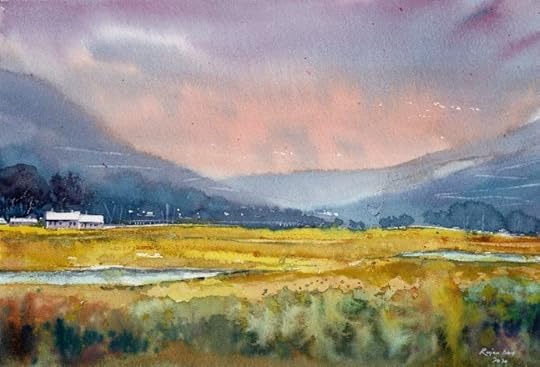
North Yorkshire Moores in the Evening (where the author said Linwood Hollow is set)
Originally, I found him fascinating. Linwood was killed in his study. It was locked and the killer could only have come in through the window. He had three adopted children, two of whom were people of colour. And the author will NEVER. LET. YOU. FORGET.
...Sir Lawrence Linwood's children were all adopted, so no one expected much family resemblance; but Roger, darker even than Caroline and with a hard-to-place exoticism about his featuresA few pages later
...Roger Linwood with that queer, exotic something about him that was not quite Chinese, not quite Indian, and certainly not entirely EnglishBut wait, there's more
Amberley was talking about that odd, exotic something about his features, he realised, which no one else had ever been able to placeThis may be the first book I've ever read where a character's ethnicity was part of the mystery.
But perhaps what left me most disappointed was how poorly the sleuthing was done. See, after the death of Linwood, the three siblings are told by their solicitor's son that the estate is to be left to their adoptive mother, Rebecca. However, whoever solves the murder of Lawrence Linwood, gets to inherit the bulk of the estate.
And so I thought would begin a race to be the first to solve Father's murder. But the siblings soon get more caught up in uncovering secrets of their past. It's some of the worst amateur sleuthing in that there was barely any sleuthing. At one point Alan discovers the murder weapon because vibes.
As though drawn by the hand of God—Father would have had a fit at the idea—Alan turned to the hidden panel that opened into the servants' passage. It slid with barely a whisper, and he stepped through into the cool, dark space beyond... He blinked as his eyes adjusted, and then he saw it: ...Another thing that got on my nerves was the eschewing of proper plot progression for a bit of Shakespearean juxtaposition. Father is like King Lear. Mother is like Katharina from The Taming of the Shew. The cat is Pawtia, Portia from Merchant of Venice (don't worry you'll get a full detailed explanation of the pun). It got repetitive and boring. If you read this book, make it a drinking game. I certainly wish I had.
I also didn't like the superhuman powers of observation. It's possible to read people's demeanours and infer how they are feeling. It's also easy to make assumptions. Agitation could be anxiety or impatience. Impassivity could be a resting bitch face or boredom. Blushing could be embarrassment or joy. But not for these characters.
"How positively delightful." But behind the sarcasm, Caroline thought she heard a note of warmth and sympathy.Then why not solve the murder by looking into the eyes of these characters then finding the intent to kill?
He saw fear in every movement, under that fear, a certain relief. Grief was only the third emotion to register after that.
There was also a lot of repetitiveness. One of the reasons I absolutely loathe multi person POV. When one character has visited a location, I don't then need a rehash of the location from a different perspective. So what if Caroline was right that the church was gothic, Alan? What purpose does it serve? There was also a lot of redundant description. And it wasn't even entertaining to read. The characters are indistinguishable, which begs the question why they needed POVs.
But perhaps the straw that broke this camel's back was the line, God created tea to inspire wakefulness in men. This is of course, in response to officers on the watch falling asleep after taking tea. Somehow that line struck me as the stupidest thing I've heard out of a fictional Englishman's mouth.
This book disappointed me. Even the finale was dull. And not even carried out by the three main siblings whose actions we've been following through the whole book. The grand mystery is solved through a conspiracy of coincidences and sheer dumb luck. The prose was lacking and I was borderline bored. It's unfortunate but I'm afraid our association has come to a natural end.
This book will be available for purchase March 2023.
Thank you to Netgalley for providing me with a copy in exchange for an honest review.

September 5, 2022
Linwood Hall is perched on a cliff, overlooking the Yorkshire moors on one side, and towering over the villagers of Linwood Hollow on the other. Today it is spring of 1921, and the house is preparing the austere burial of its master. The three adult children, all adopted, are coming back for the funeral of their Father. Together with Mother, they are instructed about the will: Linwood Hall is to be sold and the proceedings are to be divided into three equals part, meaning the estate will no longer be in the family after countless generations. That is unless Father died of unnatural causes, in which case the whole estate will go to the child who solves the murder. As father has in fact been brutally murdered, this is the start of an investigation that will delve into the deeply buried secrets of the Linwood family.
Of course, there is the mystery to be solved, but first and foremost, this book is filleting the psychological repercussions of a dysfunctional family: what does it mean to be adopted, how can a child bounce back from a cruel upbringing without any love or tenderness, how strong are the ties that keep siblings together, how can a husband break his intelligent and independent wife? After reading some contemporary quick and dirty "domestic thrillers", I vowed to avoid the genre entirely for a few years, but here we have a clever and interesting take on the genre. The settings are perfect for a fall read, going back and forth between the dark estate in the moors and the bustling city center of London in the pouring rain, while delving into humans darkest motivations and actions. If I were to point out any flaw, it would be the length of the book, because even when reading very nice prose at a perfect pace, sometimes it is just too long.
I would highly recommend this book to anyone who wants a different approach to a genre that I thought was largely over its peak.
A sincere thanks to NetGalley, Inkshares and the author for an ARC in exchange for an honest review.
Of course, there is the mystery to be solved, but first and foremost, this book is filleting the psychological repercussions of a dysfunctional family: what does it mean to be adopted, how can a child bounce back from a cruel upbringing without any love or tenderness, how strong are the ties that keep siblings together, how can a husband break his intelligent and independent wife? After reading some contemporary quick and dirty "domestic thrillers", I vowed to avoid the genre entirely for a few years, but here we have a clever and interesting take on the genre. The settings are perfect for a fall read, going back and forth between the dark estate in the moors and the bustling city center of London in the pouring rain, while delving into humans darkest motivations and actions. If I were to point out any flaw, it would be the length of the book, because even when reading very nice prose at a perfect pace, sometimes it is just too long.
I would highly recommend this book to anyone who wants a different approach to a genre that I thought was largely over its peak.
A sincere thanks to NetGalley, Inkshares and the author for an ARC in exchange for an honest review.

March 12, 2022
It is important to note that the majority of the themes explored in this book deal with sensitive subject matters. My review, therefore, touches on these topics as well. Many people might find the subject matters of the book as well as those detailed in my review overwhelming. I would suggest you steer clear of both if this is the case. Please note that from this point forward I will be writing about matters which contain reflections on child abuse, psychological abuse, physical abuse, the death of an animal, & others.
After the death of Lawrence Linwood in what proves to be a devastating series of blows; his three (3) children find themselves sequestered with the responsibility of solving his murder. However, what is to ensue is something straight out of a series of closed-door murder mysteries which might leave you patiently waiting for the conclusion to confirm your suspicions. Huang waltzes the reader throughout 1921; memories of the Great War, the scientific upheaval to be felt around the world, & the social changes breaching the surface of the previously lavishly lived lives of the wealthy.
I have very conflicting feelings about this book. Therefore, let me state first & foremost that Huang is a brilliant writer. The language which is employed throughout the story was both appropriate for its time as well as meticulously crafted to fit the character who was utilizing it. The book is separated into four (4) parts & within each of these, we see many characters take the main stage as we pass through events from their first-person point of view. This never left me feeling confused or muddled. Everyone is a clearly defined individual & their dialogue matched their personalities. That is to say that Huang presents the reader with fantastic characters.
My reason for feeling conflicted is that I have read this story before in a number of other books, mainly “The Body in the Library” by Agatha Christie. I will take ownership of my feeling of not being very pleased with the mystery as a whole as this will be a book filled to the brim with subject matters that many people might not be aware of. However, many seasoned readers will have guessed the plot layout from the initial chapters & will subsequently spend 400 pages waiting for their conclusions to be confirmed—such is the case with my reading experience.
The character of Lawrence Linwood is one of a child abuser. Reading so many instances wherein the children are being put under psychological duress was very distressing. That is not to say that things of this nature should not be written, on the contrary, I think it is of value to share the reality that many experiences. However, being as this book was so long, the number of times all of the children reflect both individually & collectively about scenarios in which their father induced fear & violence to reinforce the moulding he sought to achieve, was very draining. When it is revealed that Linwood was in fact impregnating the biological mothers of his children, none of whom were his wife, I had to ask myself if this was meant to be a shock. This was, after all, a character who was abusing children for the entirety of their lives to the point in which they were psychologically impaired in their adulthood.
I cannot say that presenting Linwood as a child abuser was done in vain nor could I say that it was meant to leave subtle hints at the extent he would go to to achieve what he desired. Therefore, perhaps the reveal of the children being biologically related to him simply intended to extend the reader’s horror when we learn that he bludgeoned a man to death in a quest to find the right air for his estate.
As I said before, I have read “The Body in the Library” & the instant that we learn that Linwood’s body was beyond recognition as a result of the violence of his murder, I thought back to Agatha Christie. I cannot imagine trying to write murder mysteries knowing that the titan herself has covered essentially any plausible roadways an author might take. Regardless, there will be people who have not read this book & shall not think to question whether or not the psychopath would indeed fake his death to continue pursuing his torment behind the curtain.
What I found to be frustrating while reading this book was having to wait for the characters to remember the obvious. The entire estate had servants' halls, old tunnels, nooks & crannies, yet no one thinks to check any of those at any time. It is only after the death of the actor that everyone clues into the impossibility of the murder being performed by someone outside the house. Everything up until that point was truly always hinting at the same person, Linwood, as being the perpetrator. I appreciate the ludicrous notion that is him faking his own death but, it truly felt as though the bulk of the novel focused on the children finding their other biological parents—two of which were also murdered by Linwood & Rebecca. This is an interesting plot point but, again, I had guessed at this early on & so their quests, back & forth across town, felt interminably long.
There is a lot to say in terms of how the subject matter & the characters were presented in this book. Rebecca Linwood has been brutally abused by her husband for over 30 years & by the end of the story, she is institutionalized. The three Linwood children are abused throughout their nearly 30 years of life & are then expected to simply pull up their socks & trudge onward. We are presented with two very different conclusions to similar situations. Caroline has to drown a cat so that her father might mould her to be less emotionally inclined & more willing to murder human beings for reasons that, in my opinion, are not very clear.
The premise behind Linwood faking his own death was to put into practice throughout the years of abusive, moulding, he had inflicted on his children. He wanted them to fight until their deaths for the right to rule the estate. Should they have complied, Linwood would have done what? Simply moved away & remained hidden until the event of his actual death? What if none of his children had returned at the news of his passing? What if they had sat at the house & realized how crummy their childhood was & sold the estate? Lest we forget that Rebecca was put into Broadmoor Hospital—convincing any one person of her inability to maintain the estate would not have been complicated.
Subsequently, why did the police not question the clause in the Will? To indicate that, in the event of murder, the child who solves the crime will be the ruler of all, seems very bizarre. How many people are inserting such a clause into their final Will & Testaments? Understandably, one is meant to suspend their disbelief to appreciate the decision that the police took to allow the children to play detective & search for their father’s killer. Leading into that, had Linwood thought about the fact that his children would discover his past crimes? What if they had found him out only to abandon the estate altogether? After all, their father murdered their biological mothers & sent another into isolation for fear of violence. Is it not plausible that they would feel some inkling of understanding the magnitude of such actions?
Much of this story resides on the children acting in turn to the abuse they suffered yet, Linwood knew them to be independent beings who had well-established lives. Might he not have worried for an instant that his plan would fall, as we say, à l’eau? Perhaps, I am seeking to understand too much of a man who had nothing but hatred in his heart. All while understanding that abuse manifests itself in various ways for everyone who has found themselves at its mercy.
When all is said & done the reason I did not dislike this book was due to the quality of the writing. I found myself; annoyed at Caroline’s ignorance & absurd obsession with quoting plays; a bit bored at the redundancy of the full names of characters being repeated; longing for more of Alan’s point of view; sad for the lawyer who went home to an empty house; distressed at the amplitude of horrors experienced by Rebecca; weighed down by the reality of a post-war era; saddened for the children who manoeuvred their way in a darkened life; last, but not least, appreciative of a story which was harrowing from start to finish regardless of the transparency of the crimes, the themes presented held their own.
Thank you to NetGalley, Inkshares, & Christopher Huang for the free copy of this book in exchange for an honest review!
After the death of Lawrence Linwood in what proves to be a devastating series of blows; his three (3) children find themselves sequestered with the responsibility of solving his murder. However, what is to ensue is something straight out of a series of closed-door murder mysteries which might leave you patiently waiting for the conclusion to confirm your suspicions. Huang waltzes the reader throughout 1921; memories of the Great War, the scientific upheaval to be felt around the world, & the social changes breaching the surface of the previously lavishly lived lives of the wealthy.
I have very conflicting feelings about this book. Therefore, let me state first & foremost that Huang is a brilliant writer. The language which is employed throughout the story was both appropriate for its time as well as meticulously crafted to fit the character who was utilizing it. The book is separated into four (4) parts & within each of these, we see many characters take the main stage as we pass through events from their first-person point of view. This never left me feeling confused or muddled. Everyone is a clearly defined individual & their dialogue matched their personalities. That is to say that Huang presents the reader with fantastic characters.
My reason for feeling conflicted is that I have read this story before in a number of other books, mainly “The Body in the Library” by Agatha Christie. I will take ownership of my feeling of not being very pleased with the mystery as a whole as this will be a book filled to the brim with subject matters that many people might not be aware of. However, many seasoned readers will have guessed the plot layout from the initial chapters & will subsequently spend 400 pages waiting for their conclusions to be confirmed—such is the case with my reading experience.
The character of Lawrence Linwood is one of a child abuser. Reading so many instances wherein the children are being put under psychological duress was very distressing. That is not to say that things of this nature should not be written, on the contrary, I think it is of value to share the reality that many experiences. However, being as this book was so long, the number of times all of the children reflect both individually & collectively about scenarios in which their father induced fear & violence to reinforce the moulding he sought to achieve, was very draining. When it is revealed that Linwood was in fact impregnating the biological mothers of his children, none of whom were his wife, I had to ask myself if this was meant to be a shock. This was, after all, a character who was abusing children for the entirety of their lives to the point in which they were psychologically impaired in their adulthood.
I cannot say that presenting Linwood as a child abuser was done in vain nor could I say that it was meant to leave subtle hints at the extent he would go to to achieve what he desired. Therefore, perhaps the reveal of the children being biologically related to him simply intended to extend the reader’s horror when we learn that he bludgeoned a man to death in a quest to find the right air for his estate.
As I said before, I have read “The Body in the Library” & the instant that we learn that Linwood’s body was beyond recognition as a result of the violence of his murder, I thought back to Agatha Christie. I cannot imagine trying to write murder mysteries knowing that the titan herself has covered essentially any plausible roadways an author might take. Regardless, there will be people who have not read this book & shall not think to question whether or not the psychopath would indeed fake his death to continue pursuing his torment behind the curtain.
What I found to be frustrating while reading this book was having to wait for the characters to remember the obvious. The entire estate had servants' halls, old tunnels, nooks & crannies, yet no one thinks to check any of those at any time. It is only after the death of the actor that everyone clues into the impossibility of the murder being performed by someone outside the house. Everything up until that point was truly always hinting at the same person, Linwood, as being the perpetrator. I appreciate the ludicrous notion that is him faking his own death but, it truly felt as though the bulk of the novel focused on the children finding their other biological parents—two of which were also murdered by Linwood & Rebecca. This is an interesting plot point but, again, I had guessed at this early on & so their quests, back & forth across town, felt interminably long.
There is a lot to say in terms of how the subject matter & the characters were presented in this book. Rebecca Linwood has been brutally abused by her husband for over 30 years & by the end of the story, she is institutionalized. The three Linwood children are abused throughout their nearly 30 years of life & are then expected to simply pull up their socks & trudge onward. We are presented with two very different conclusions to similar situations. Caroline has to drown a cat so that her father might mould her to be less emotionally inclined & more willing to murder human beings for reasons that, in my opinion, are not very clear.
The premise behind Linwood faking his own death was to put into practice throughout the years of abusive, moulding, he had inflicted on his children. He wanted them to fight until their deaths for the right to rule the estate. Should they have complied, Linwood would have done what? Simply moved away & remained hidden until the event of his actual death? What if none of his children had returned at the news of his passing? What if they had sat at the house & realized how crummy their childhood was & sold the estate? Lest we forget that Rebecca was put into Broadmoor Hospital—convincing any one person of her inability to maintain the estate would not have been complicated.
Subsequently, why did the police not question the clause in the Will? To indicate that, in the event of murder, the child who solves the crime will be the ruler of all, seems very bizarre. How many people are inserting such a clause into their final Will & Testaments? Understandably, one is meant to suspend their disbelief to appreciate the decision that the police took to allow the children to play detective & search for their father’s killer. Leading into that, had Linwood thought about the fact that his children would discover his past crimes? What if they had found him out only to abandon the estate altogether? After all, their father murdered their biological mothers & sent another into isolation for fear of violence. Is it not plausible that they would feel some inkling of understanding the magnitude of such actions?
Much of this story resides on the children acting in turn to the abuse they suffered yet, Linwood knew them to be independent beings who had well-established lives. Might he not have worried for an instant that his plan would fall, as we say, à l’eau? Perhaps, I am seeking to understand too much of a man who had nothing but hatred in his heart. All while understanding that abuse manifests itself in various ways for everyone who has found themselves at its mercy.
When all is said & done the reason I did not dislike this book was due to the quality of the writing. I found myself; annoyed at Caroline’s ignorance & absurd obsession with quoting plays; a bit bored at the redundancy of the full names of characters being repeated; longing for more of Alan’s point of view; sad for the lawyer who went home to an empty house; distressed at the amplitude of horrors experienced by Rebecca; weighed down by the reality of a post-war era; saddened for the children who manoeuvred their way in a darkened life; last, but not least, appreciative of a story which was harrowing from start to finish regardless of the transparency of the crimes, the themes presented held their own.
Thank you to NetGalley, Inkshares, & Christopher Huang for the free copy of this book in exchange for an honest review!
This entire review has been hidden because of spoilers.

February 19, 2023
Unnatural Ends is a mystery set in the North Yorkshire moors in 1921 after the death of Sir Lawrence Linwood. It is only after his three adopted children, now adults, arrive home for the funeral that they learn the truth: Sir Lawrence was brutally murdered. I enjoyed the ambiance of this book which, for me, read like a Golden Age mystery novel with all of the attention to details of the people, their homes and their stations in life. In fact, initially I thought this might be a reissue of an older book but no, it definitely isn’t.
With the use of flashbacks to the childhood memories of Alan, Roger and Caroline, as well as some of their memories during and after the recent war, the author fills in the history of this family and reasons why someone might have wanted Sir Lawrence dead. There’s a mass of confusing leads and possibilities. I enjoyed the chase, following the various suspects and clues to a satisfying conclusion.
Huang provides historical notes at the end of the book, placing the fictional Linwood Hall and the village of Linwood Hollow in the real countryside mentioned within the novel in discussing train travel, etc. Many of the bones of the story are historical, if not the Linwoods themselves.
Recommended for those who enjoy historical mysteries and historical fiction.
A copy of this book was provided by Inkshares through NetGalley in return for an honest review.
With the use of flashbacks to the childhood memories of Alan, Roger and Caroline, as well as some of their memories during and after the recent war, the author fills in the history of this family and reasons why someone might have wanted Sir Lawrence dead. There’s a mass of confusing leads and possibilities. I enjoyed the chase, following the various suspects and clues to a satisfying conclusion.
Huang provides historical notes at the end of the book, placing the fictional Linwood Hall and the village of Linwood Hollow in the real countryside mentioned within the novel in discussing train travel, etc. Many of the bones of the story are historical, if not the Linwoods themselves.
Recommended for those who enjoy historical mysteries and historical fiction.
A copy of this book was provided by Inkshares through NetGalley in return for an honest review.

February 17, 2022
My thanks to Inkshares and Edelweiss for a review copy of the book.
Unnatural Ends is a murder mystery set in a small village in the Yorkshire moors in the 1920s involving family dynamics, secrets and centred around a rather unsettling theme.
As the book opens, we meet three siblings, Alan, Roger and Caroline Linwood arriving at their home Linwood Hall, as their father, Sir Lawrence Linwood has died. The three are shocked to learn that their father’s death was not a natural one, and he was rather brutally murdered in his own study. Not only that, according to the terms of his will, whichever of the three solves the murder stands to inherit Linwood Hall.
We soon learn that the three siblings were all adopted by Sir Lawrence and two of them are of mixed race. Sir Lawrence was harsh and strict but brought up the three children to achieve laurels in their own ways; always trying to make them ‘strong', with no room for emotion, even towards each other. Sir Lawrence was much admired in his village for his scientific work had helped improve agriculture and bring prosperity to most. So who could have killed him and why? As the siblings start to look into this, on their own and together, they start to not only understand the kind of person Sir Lawrence really was but also discover secrets from their own pasts.
Told in third person, the narrative shifts between different perspectives; essentially the three siblings but also a couple of times, Inspector Mowbray who is in charge of the case, Lady Linwood, their mother, and Iris Morgan, Robert's girlfriend/fiancée who has accompanied him home. We also get some glimpses of the past when the three were children.
I enjoyed these shifts in perspective, particularly between Alan, Roger and Caroline as with these, the lines of enquiry they undertake shift and we also get to see things from each of their viewpoints—Alan is an archaeologist so his views always take into account the past; Roger works with planes and cars, engineering his own improvements while Caroline who works as a journalist and was destined by their father for parliament, is also interested in the theatre and that comes through in her view of things. The dynamics between the three have changed somewhat ever since the war and the three having followed their separate paths, but while they pursue their own investigations they also share the information eventually forming a more complete picture.
The atmosphere in the book was quite well done too; Linwood Hall is an imposing old house looking over the village and the moors but more than its age and past, it is Sir Lawrence who looms large through it all. Whether it is when the three were children or now when they’ve grown and set off on their own paths, they continue to be under his shadow and control, always trying to live up to his expectations and doing what he'd want them to. While it isn’t that they haven’t got their interests and personalities but one can see them being stifled almost by their father's shadow.
The mystery itself was pretty interesting as well, though I managed to guess whodunit pretty early on. The book did get me to doubt what I thought with some of its twists and turns, but then I found more clues. The why on the other hand was something I did not guess (and pieced together with the siblings), nor some of the other details. The explanation when it emerged while realistic and possible was all the same very unsettling and that and other details did send some chills down my spine.
Overall though this made for an interesting and engrossing read both for its plot and characters.
4.25 stars (I lowered my rating a tiny bit because the who was guessable.)
Unnatural Ends is a murder mystery set in a small village in the Yorkshire moors in the 1920s involving family dynamics, secrets and centred around a rather unsettling theme.
As the book opens, we meet three siblings, Alan, Roger and Caroline Linwood arriving at their home Linwood Hall, as their father, Sir Lawrence Linwood has died. The three are shocked to learn that their father’s death was not a natural one, and he was rather brutally murdered in his own study. Not only that, according to the terms of his will, whichever of the three solves the murder stands to inherit Linwood Hall.
We soon learn that the three siblings were all adopted by Sir Lawrence and two of them are of mixed race. Sir Lawrence was harsh and strict but brought up the three children to achieve laurels in their own ways; always trying to make them ‘strong', with no room for emotion, even towards each other. Sir Lawrence was much admired in his village for his scientific work had helped improve agriculture and bring prosperity to most. So who could have killed him and why? As the siblings start to look into this, on their own and together, they start to not only understand the kind of person Sir Lawrence really was but also discover secrets from their own pasts.
Told in third person, the narrative shifts between different perspectives; essentially the three siblings but also a couple of times, Inspector Mowbray who is in charge of the case, Lady Linwood, their mother, and Iris Morgan, Robert's girlfriend/fiancée who has accompanied him home. We also get some glimpses of the past when the three were children.
I enjoyed these shifts in perspective, particularly between Alan, Roger and Caroline as with these, the lines of enquiry they undertake shift and we also get to see things from each of their viewpoints—Alan is an archaeologist so his views always take into account the past; Roger works with planes and cars, engineering his own improvements while Caroline who works as a journalist and was destined by their father for parliament, is also interested in the theatre and that comes through in her view of things. The dynamics between the three have changed somewhat ever since the war and the three having followed their separate paths, but while they pursue their own investigations they also share the information eventually forming a more complete picture.
The atmosphere in the book was quite well done too; Linwood Hall is an imposing old house looking over the village and the moors but more than its age and past, it is Sir Lawrence who looms large through it all. Whether it is when the three were children or now when they’ve grown and set off on their own paths, they continue to be under his shadow and control, always trying to live up to his expectations and doing what he'd want them to. While it isn’t that they haven’t got their interests and personalities but one can see them being stifled almost by their father's shadow.
The mystery itself was pretty interesting as well, though I managed to guess whodunit pretty early on. The book did get me to doubt what I thought with some of its twists and turns, but then I found more clues. The why on the other hand was something I did not guess (and pieced together with the siblings), nor some of the other details. The explanation when it emerged while realistic and possible was all the same very unsettling and that and other details did send some chills down my spine.
Overall though this made for an interesting and engrossing read both for its plot and characters.
4.25 stars (I lowered my rating a tiny bit because the who was guessable.)

May 23, 2022
NOT READY FOR PRIME TIME
This had the bones of a really good murder mystery.
But it’s not there yet. It needs to be tightened up. The book would need lots of editing,
cuts, and rewriting to be a good read.
I was not engaged at all until about the 25% mark, which is when the story gets more interesting.
So a lot of the first quarter of the book could be cut.
Afterwards, the pacing and my level of engagement was erratic.
The characters were ok, but not compelling. We learn little about them beyond what’s relevant to
their roles in the story. Alan Linwood, in particular, seemed a complete cipher. Roger and Caroline Linwood could at least be differentiated: Roger by his engineering and mechanical expertise and Caroline by her love of theater. But Alan was never more than a paper cutout for me.
Thanks to NetGalley and Inkshares for providing an an ARC (Advance Review Copy) of this novel in exchange for an honest review.
#UnnaturalEnds #NetGalley
This had the bones of a really good murder mystery.
But it’s not there yet. It needs to be tightened up. The book would need lots of editing,
cuts, and rewriting to be a good read.
I was not engaged at all until about the 25% mark, which is when the story gets more interesting.
So a lot of the first quarter of the book could be cut.
Afterwards, the pacing and my level of engagement was erratic.
The characters were ok, but not compelling. We learn little about them beyond what’s relevant to
their roles in the story. Alan Linwood, in particular, seemed a complete cipher. Roger and Caroline Linwood could at least be differentiated: Roger by his engineering and mechanical expertise and Caroline by her love of theater. But Alan was never more than a paper cutout for me.
Thanks to NetGalley and Inkshares for providing an an ARC (Advance Review Copy) of this novel in exchange for an honest review.
#UnnaturalEnds #NetGalley

January 16, 2023
This book wasn't at all what I expected, and I think perhaps I made a wrong assumption based on the cover (red with mace) and the authors surname. I will never learn my lesson!! Never assume and my apologies for applying a stereotype.
This was such an intriguing book! Set in the early 1920's Alan, Roger and Caroline Linwood are the adopted adult children of Sir Lawrence Linwood. They return home on learning that their father has passed away and are shocked to learn that he has been murdered. Then due to the reading of their father's will they could be pitted against each other to ensure that they inherit, or they could choose to be allies and share the reward.
Inspector Mowbray, who is investigating the murder is not sure what to make of these three very different people who appear to have a strange reaction to their father's death.
There were a lot of elements to this story which builds and builds to a shocking revelation that exposes a truly monstrous being.
Thank you Inkshares and Netgalley for the opportunity to review this digital ARC.
This was such an intriguing book! Set in the early 1920's Alan, Roger and Caroline Linwood are the adopted adult children of Sir Lawrence Linwood. They return home on learning that their father has passed away and are shocked to learn that he has been murdered. Then due to the reading of their father's will they could be pitted against each other to ensure that they inherit, or they could choose to be allies and share the reward.
Inspector Mowbray, who is investigating the murder is not sure what to make of these three very different people who appear to have a strange reaction to their father's death.
There were a lot of elements to this story which builds and builds to a shocking revelation that exposes a truly monstrous being.
Thank you Inkshares and Netgalley for the opportunity to review this digital ARC.
April 1, 2022
When I read the blurb of this book I immediately thought it had Poirot vibes, who can beat a good murder mystery. However, although a murder mystery it was, the storyline felt very unique and not the least bit as expected. Recently, I have found a lot of thrillers/murder mystery books follow a very similar format but I can say this novel is different in a really good way.
The story focuses around the Linwood family, Sir Linwood who was murdered, Lady Linwood down beaten wife, and their adopted children Alan, Roger, and Caroline. The three heirs to the Linwood estate are tasked in Sir Linwood’s will to discover who killed him and whoever completes the task first will become the sole heir. As is the case in most thrillers, things are not all they seem and secrets are slowly revealed throughout the Linwood children’s investigations.
The first thing to say is that I was thoroughly hooked to this book, it managed to get me out of a reading slump and deeply engrossed in the 1920s. I was inside Linwood Hall watching the action as it happened.
The main things I enjoyed about this novel were that this novel uses dual narration with each chapter coming from a different person’s viewpoint. This helps you to understand each character better and see how they all fit together and why events lead to where they are in the present. I loved all the characters in the novel, I felt they were very well developed and all had a part to play in the narrative- you don’t always get this with thrillers!
The ending is very clever and it took me a long time to get myself to the point where I had an inkling of what was to come. When the big reveal did happen, I still thought that maybe there were more surprises to come, so I was still guessing what was going to happen all the way to the end.
If you are looking for a good old-fashioned murder mystery, this is it with sprinkles on top!
The story focuses around the Linwood family, Sir Linwood who was murdered, Lady Linwood down beaten wife, and their adopted children Alan, Roger, and Caroline. The three heirs to the Linwood estate are tasked in Sir Linwood’s will to discover who killed him and whoever completes the task first will become the sole heir. As is the case in most thrillers, things are not all they seem and secrets are slowly revealed throughout the Linwood children’s investigations.
The first thing to say is that I was thoroughly hooked to this book, it managed to get me out of a reading slump and deeply engrossed in the 1920s. I was inside Linwood Hall watching the action as it happened.
The main things I enjoyed about this novel were that this novel uses dual narration with each chapter coming from a different person’s viewpoint. This helps you to understand each character better and see how they all fit together and why events lead to where they are in the present. I loved all the characters in the novel, I felt they were very well developed and all had a part to play in the narrative- you don’t always get this with thrillers!
The ending is very clever and it took me a long time to get myself to the point where I had an inkling of what was to come. When the big reveal did happen, I still thought that maybe there were more surprises to come, so I was still guessing what was going to happen all the way to the end.
If you are looking for a good old-fashioned murder mystery, this is it with sprinkles on top!

August 25, 2022
a brilliant psychological mystery
a man is killed and in his will is mentioned that he'll leave his legacy to either of his children who will catch his killer but as they try to untangle the truth they are left wondering whether their father deserved it..
this is a story of a dysfunctional family primarily focused on the children of the family, all of them adults now. since their childhood they have craved and fought for their father's approval. their father is a larger-than-life persona who has dictated their whole life and career and is still present to them from beyond the grave.
despite all this they firmly believe in their father and think highly of him. but trying to solve his murder which was his way of disposing off his legacy, they uncover some uncomfortable truths shining a whole new light on their father making them wonder whether he was a benefactor or a tyrant?
the plot twist wasn't exactly shocking but i loved the other twists and turns the story took.
thank you to netgalley and publisher for the eARC
a man is killed and in his will is mentioned that he'll leave his legacy to either of his children who will catch his killer but as they try to untangle the truth they are left wondering whether their father deserved it..
this is a story of a dysfunctional family primarily focused on the children of the family, all of them adults now. since their childhood they have craved and fought for their father's approval. their father is a larger-than-life persona who has dictated their whole life and career and is still present to them from beyond the grave.
despite all this they firmly believe in their father and think highly of him. but trying to solve his murder which was his way of disposing off his legacy, they uncover some uncomfortable truths shining a whole new light on their father making them wonder whether he was a benefactor or a tyrant?
the plot twist wasn't exactly shocking but i loved the other twists and turns the story took.
thank you to netgalley and publisher for the eARC

May 19, 2022
*Thanks to Netgalley and the publishers for a free copy in exchange for an honest review.
I have mixed feelings with this one! The story and the plot were okayish, good at times, but dragged too at times.
About the plot - Sir Linwood is brutally murdered and it is upto his adopted children - Alan, Roger and Caroline to find the suspect as it was their father's last demand, he made a strange will to leave all of his estate to the heir who solved his murder.
The premise is exciting but that's about it. I could guess how things were going to unfold and that doesn't makes it a good mystery, right! But kudos to the author, his writing if not brilliant but is still very very remarkable. It had all the 'Agatha Christie' vibes and that is a big achievement.
The first half dragged but it regained it's pace back in the second half. I personally enjoyed the perspectives from all the characters, it gave a complete picture.
This book touches some common and recycled tropes and hence I won't say it as a standout but the writing is good enough to enjoy and I'm willing to read more of the author's work in the future.
I have mixed feelings with this one! The story and the plot were okayish, good at times, but dragged too at times.
About the plot - Sir Linwood is brutally murdered and it is upto his adopted children - Alan, Roger and Caroline to find the suspect as it was their father's last demand, he made a strange will to leave all of his estate to the heir who solved his murder.
The premise is exciting but that's about it. I could guess how things were going to unfold and that doesn't makes it a good mystery, right! But kudos to the author, his writing if not brilliant but is still very very remarkable. It had all the 'Agatha Christie' vibes and that is a big achievement.
The first half dragged but it regained it's pace back in the second half. I personally enjoyed the perspectives from all the characters, it gave a complete picture.
This book touches some common and recycled tropes and hence I won't say it as a standout but the writing is good enough to enjoy and I'm willing to read more of the author's work in the future.

September 23, 2023
I love a dark, atmospheric, early 20th Century mystery, and this is one of the best! Great plot, characters and scene setting. I really enjoyed it!

March 17, 2023
Alan, Roger and Caroline, the children of Sir Lawrence Linwood, meet again at their father's funeral. His will states that the one child who solves his murder will inherit the estate.
But how did he know he would be murdered?
Unnatural Ends is a well crafted mystery set in the 1920's. With flashbacks to each child's earlier years, we experience one crooked man's version of life as a stage and the power of deception.
A fast paced read in easy accessible language full of interesting twists and turns. Well rounded colorful characters make the grey scenery come alive.
Thank you Netgalley and Inkshares for the ARC.
But how did he know he would be murdered?
Unnatural Ends is a well crafted mystery set in the 1920's. With flashbacks to each child's earlier years, we experience one crooked man's version of life as a stage and the power of deception.
A fast paced read in easy accessible language full of interesting twists and turns. Well rounded colorful characters make the grey scenery come alive.
Thank you Netgalley and Inkshares for the ARC.

June 25, 2023
4.5* A twisty character-based mystery with an historical setting.
December 26, 2022
I was hooked from the first chapter till the end! The setting was one of the most interesting ones I have encountered in a while with the descriptions sucking me in. The main characters- the quite dysfunctional Linwood family- were also memorable and each with a unique voice.
It could be one of the best books I have read.
This was an ARC copy provided by NetGalley in exchange for an honest review.
It could be one of the best books I have read.
This was an ARC copy provided by NetGalley in exchange for an honest review.
August 13, 2022
Wow! This book is in contention for being one of my favorite murder mysteries of all time. It feels equally driven by the characters and the plot, which is hard to come by these days; the glorious complexity of the mystery doesn’t overshadow the complexity of each Linwood sibling. The prose is dazzling, the descriptions full, the setting haunting. You can really tell how much thought went into crafting every little detail, and I give Huang so much credit for putting this all together.
This book prompted me to reread it upon finishing, which is one of the highest levels of praise I can give to a mystery. Its conclusion was foreshadowed so cleverly that I felt compelled to revisit the little clues I missed the first time around. In contrast to mystery/thrillers that seem to just pick the most shock-worthy ending possible, this one seems to have been carefully developed to convey Huang’s overarching message. The “red herrings” are not fake outs that lead to nowhere, but rather serve as important pieces of the puzzle. The cast of characters is large enough to yield a wide array of theories, but not too large that it causes confusion or information overload. As an aspiring writer, this is a piece I’ll be revisiting as an example of so many things done right.
Below, I’ve tried to break down some of the many factors that came together to create what I’d consider to be a masterful piece of work. Thank you so much to NetGalley and Inkshares for this ARC in exchange for my review! I’m so thrilled to be able to share my thoughts about it and can’t wait to see if other readers felt the same.
The Linwood siblings
One of the main strengths of the book is the characterization of Alan, Roger, and Caroline Linwood. First of all, it was such a great choice to have most “chapters” focus on the perspective of one while keeping a third-person omniscient narration throughout. I feel like I got to know each of their inner workings deeply but enjoyed that a consistent voice was maintained. This also allowed for a “show, don’t tell” technique that Huang does incredibly well; a lot of what we know about the characters is inferred through their various thoughts, behaviors, and decisions rather than laid out for us outright.
For example, we learn so much about each of them from the prologue alone. In this short description of them playing in their Camelot tower room, young Alan is introduced to us reading a book on the window ledge – looking out at the land and studying the words of someone long ago. Roger is greasing the squeaky door handle as the practical, inventive problem-solver. Caroline has turned her long pigtails into a flour-dusted beard, insistent on playing whichever damn role she pleases. Rereading it after finishing the novel, I was struck by how perfect these introductions were! Similarly, the opening chapters of each arriving home for Sir Linwood’s funeral show what is on each of their minds as they lay eyes on Linwood Hall. It’s clear that all three share a certain dread and anxiety about the place, but their specific thoughts reveal the differences between them: Alan looks upon the hall with a historian’s eyes, contemplating its evolution. Roger drives up in the motorcar he built himself, recalling how Father told them to look forwards and never back. Caroline can’t even bring herself to go straight home, and stops in the village first to reflect on her father’s expectations of her.
The differences between them highlight important aspects of their characters, which are useful to keep in mind throughout the story. Alan and Roger, for example, are directly juxtaposed in their past vs. future orientation. Alan’s whiteness is contrasted with Roger and Caroline’s ethnic ambiguity. Roger’s apparent openness is contrasted with Alan and Caroline’s more aloof demeanors. And as the only girl, the pressures Caroline felt from their father’s expectations were vastly different from those of her brothers. When the characters act in ways that go against their little labels – for example, when Roger realizes that perhaps he’s more concerned with the past than he thought, or Alan’s unique resemblance to their father becomes less relevant – it makes things all the more interesting.
I was also so fascinated by their relationships with each other. The obvious sentiment they felt towards one another, combined with their father’s firm opposition of all things sentimental, created such an interesting tension in all their interactions. Speaking of “show don’t tell,” this was perfectly illustrated in the scene they first reunite; Alan wants to run down the stairs and greet his siblings with a hug but deliberately holds himself back. We also learn that they each have a copy of a photograph of the three of them taken after the war, which ends up symbolizing their secret affection and familial bond. When the photos are brought up from each of their perspectives, they all say something along the lines of: My siblings probably threw their copies away, but I’ve kept mine in a special place and it’s extremely important to me. Much of their dialogue is thus layered with unsaid words, suppressed by their restraint. What a joy to dig into!
Linwood Hall
I’m a sucker for books set in mysterious old castles (which is why I requested this title!), and it usually doesn’t take more than a brief description of one for me to imagine the setting and feel properly immersed in it. But Huang breathed so much life into Linwood Hall – made it such an anchor to the story, as it was to the Linwoods’ lives – that I think my expectations for story settings have effectively changed. First of all, the servants’ passages behind the walls were such a nice touch and allowed for some great imagery of the children scurrying through them (I loved the image in the prologue of Caroline “imagining herself as the ghost of some historic Linwood, gliding soundlessly through the walls of the house”). I also liked the notion of the house swallowing them whole when a character disappeared into a panel; it was a clever representation of the hold it had over its inhabitants. And the presence of activity behind the walls helped with the personification of the house:
Similarly, the great hall was said to be its “heart” with the other rooms radiating out from it.
Another thing that was heavily stressed was its altitude – its unique position perched up on a ridge and overlooking the valley. This helped symbolize the feudal-like relationship the Linwoods had with the village they resided over. Interestingly, though, the altitude of the house seemed to be more than just a metaphorical reflection of the Linwoods’ power; it was as if the physical height of Linwood Hall actually fed into the perceived amount of control they had. This idea is also brought up during the flashback to Alan in Machu Picchu, as his assistant says, “It’s the altitude … It does something to your perspective of the world.” And of course, the Chesterton quote from “The Hammer of God” at the start of the novel primes us to think about this before the book begins.
Storm imagery
I’m someone who (I think) is particularly aware of the relationships between outside conditions and my internal state. I’ve always thought that the weather has a bigger effect on my mood than that of most people, and I remember reading a passage in Frankenstein years ago that elicited an actual epiphany in me: The weather just reflects what I am feeling back on me! It was inside me all along! So nature reflecting the inner states of characters/the story is hardly an innovative thing in literature, but I tend to notice and appreciate when it’s used. Huang’s lyrical writing and masterful use of imagery made it especially noticeable to me here. He often describes the sky as full of clouds that get heavier and heavier, building up a very real sense of forthcoming dread and effectively establishing an ominous tone. But I think that he also goes a step further with his storm descriptions, which is why I wanted to highlight it specifically.
I clocked two major storms throughout the course of this book: one at the top of the rising action when the siblings start uncovering secrets, and one near the end when the full picture starts coming together. The differences between how each storm is described – and where the siblings are in relation to them – mirror a change within the siblings themselves. The first storm takes place in London as Roger and Alan investigate their respective leads. Both are safely out of its reach as it occurs. With Alan, “the first, fat raindrop spat down on him as he put his hand to the door,” and he makes it into the Oriental Studies building just as it breaks. Professor Matsudaria’s tidy office is then contrasted with the roaring storm taking place outside of it: “Outside, lightening flashed against the rain-splattered window, though none of the thunder could be heard in the well-insulated womb that was this office.” Alan speaks with the professor and learns puzzling information about his family, but then exits the building into a clear night: “In spite of the evidence of the wet pavement, it felt as though the rainstorm he’d witnessed through Professor Matsudaria’s office window had never happened.”
At the same time, Roger meets with a contact named Captain Amberley in his London club to try to get some information about another lead. Like Alan, he gets out of his car just as the storm starts and “got the top up only just in time” (impeccable timing, these two!), dashing inside as the rain “[beat] down like machine gun fire.” Like the professor’s office, the inside of the club is juxtaposed with the storm outside: “The storm showed no sign of abating, but that was outside. Within the club, a warm stillness left Roger feeling comfortably secure, proof against the elemental rage without.” And, mirroring Alan’s experience exactly, he realizes that the rain had stopped as he steps outside. These two don’t have to face the storm head-on just yet.
During this meeting with Roger, we also see Amberley remark that the rain outside takes him back to the monsoons in Nepal. Despite the violent language Huang uses to describe the London rain (i.e. “machine gun fire”), we are told that this storm is virtually nothing in comparison:
These words come back to Roger during the second storm – particularly the phrase “Mother Nature mocking the follies of men.” This is a fascinating quote on many levels, but what stands out to me in this context is the overt distinction between a higher power (Mother Nature) and ordinary men. They are in the Camelot tower room during this scene, where the young Linwoods once felt like Gods themselves. Rain and wind are pouring in (“screaming”!) through the giant open windows, which happens to be one of my favorite visuals in the book. Huang mentions a few times throughout the novel that because it was so open, the children only played in that room when the weather was nice – not in the cold, and never in the rain – which makes me think he intended the storm in this scene to be a stark realization for them all. Oh, this room was your Camelot? Oh, you guys thought you ruled all the eye could see? That’s cause you’ve never been here in a storm, fools! Look at you now, struggling to keep out of reach of the rain!
Whether or not the siblings really are being mocked here, the contrast between this storm and the first one adds a unique layer to the storytelling. They are technically inside here as well, interestingly, but Linwood Hall doesn’t provide the same refuge from the elements that the professor’s office and club did. Before the tower room scene, Roger, Caroline and Iris race through the rain to get inside. As Roger makes it in, “the shadowy cool of Linwood caught at his rain-soaked clothes, chilling him to the bone.” Hey may be out of the rain, but Linwood won’t protect him from the storm. And the siblings subsequently face a truth they haven’t faced before.
As another nice touch, further supporting Huang’s use of storms to represent Linwood Hall’s true nature, we get our first Iris-centered chapter where he writes the following:
The writing really is something else. And then Alan sitting at the window leaning into the rain, and Roger making sense of the parallel storm inside his mind, and Caroline looking around at all of it as if it were a stage in a play; I think I’ll have to cut myself off here. What a gift to be able to read something that inspires me to unpack so much. I am so looking forward to reading Huang’s other novel, and all his novels yet to come!
This book prompted me to reread it upon finishing, which is one of the highest levels of praise I can give to a mystery. Its conclusion was foreshadowed so cleverly that I felt compelled to revisit the little clues I missed the first time around. In contrast to mystery/thrillers that seem to just pick the most shock-worthy ending possible, this one seems to have been carefully developed to convey Huang’s overarching message. The “red herrings” are not fake outs that lead to nowhere, but rather serve as important pieces of the puzzle. The cast of characters is large enough to yield a wide array of theories, but not too large that it causes confusion or information overload. As an aspiring writer, this is a piece I’ll be revisiting as an example of so many things done right.
Below, I’ve tried to break down some of the many factors that came together to create what I’d consider to be a masterful piece of work. Thank you so much to NetGalley and Inkshares for this ARC in exchange for my review! I’m so thrilled to be able to share my thoughts about it and can’t wait to see if other readers felt the same.
The Linwood siblings
One of the main strengths of the book is the characterization of Alan, Roger, and Caroline Linwood. First of all, it was such a great choice to have most “chapters” focus on the perspective of one while keeping a third-person omniscient narration throughout. I feel like I got to know each of their inner workings deeply but enjoyed that a consistent voice was maintained. This also allowed for a “show, don’t tell” technique that Huang does incredibly well; a lot of what we know about the characters is inferred through their various thoughts, behaviors, and decisions rather than laid out for us outright.
For example, we learn so much about each of them from the prologue alone. In this short description of them playing in their Camelot tower room, young Alan is introduced to us reading a book on the window ledge – looking out at the land and studying the words of someone long ago. Roger is greasing the squeaky door handle as the practical, inventive problem-solver. Caroline has turned her long pigtails into a flour-dusted beard, insistent on playing whichever damn role she pleases. Rereading it after finishing the novel, I was struck by how perfect these introductions were! Similarly, the opening chapters of each arriving home for Sir Linwood’s funeral show what is on each of their minds as they lay eyes on Linwood Hall. It’s clear that all three share a certain dread and anxiety about the place, but their specific thoughts reveal the differences between them: Alan looks upon the hall with a historian’s eyes, contemplating its evolution. Roger drives up in the motorcar he built himself, recalling how Father told them to look forwards and never back. Caroline can’t even bring herself to go straight home, and stops in the village first to reflect on her father’s expectations of her.
The differences between them highlight important aspects of their characters, which are useful to keep in mind throughout the story. Alan and Roger, for example, are directly juxtaposed in their past vs. future orientation. Alan’s whiteness is contrasted with Roger and Caroline’s ethnic ambiguity. Roger’s apparent openness is contrasted with Alan and Caroline’s more aloof demeanors. And as the only girl, the pressures Caroline felt from their father’s expectations were vastly different from those of her brothers. When the characters act in ways that go against their little labels – for example, when Roger realizes that perhaps he’s more concerned with the past than he thought, or Alan’s unique resemblance to their father becomes less relevant – it makes things all the more interesting.
I was also so fascinated by their relationships with each other. The obvious sentiment they felt towards one another, combined with their father’s firm opposition of all things sentimental, created such an interesting tension in all their interactions. Speaking of “show don’t tell,” this was perfectly illustrated in the scene they first reunite; Alan wants to run down the stairs and greet his siblings with a hug but deliberately holds himself back. We also learn that they each have a copy of a photograph of the three of them taken after the war, which ends up symbolizing their secret affection and familial bond. When the photos are brought up from each of their perspectives, they all say something along the lines of: My siblings probably threw their copies away, but I’ve kept mine in a special place and it’s extremely important to me. Much of their dialogue is thus layered with unsaid words, suppressed by their restraint. What a joy to dig into!
Linwood Hall
I’m a sucker for books set in mysterious old castles (which is why I requested this title!), and it usually doesn’t take more than a brief description of one for me to imagine the setting and feel properly immersed in it. But Huang breathed so much life into Linwood Hall – made it such an anchor to the story, as it was to the Linwoods’ lives – that I think my expectations for story settings have effectively changed. First of all, the servants’ passages behind the walls were such a nice touch and allowed for some great imagery of the children scurrying through them (I loved the image in the prologue of Caroline “imagining herself as the ghost of some historic Linwood, gliding soundlessly through the walls of the house”). I also liked the notion of the house swallowing them whole when a character disappeared into a panel; it was a clever representation of the hold it had over its inhabitants. And the presence of activity behind the walls helped with the personification of the house:
“The servants’ passage ran through the whole house like blood vessels through a human body. To be in the passage was to be in the lifeblood of the house and therefore part of it.”
Similarly, the great hall was said to be its “heart” with the other rooms radiating out from it.
Another thing that was heavily stressed was its altitude – its unique position perched up on a ridge and overlooking the valley. This helped symbolize the feudal-like relationship the Linwoods had with the village they resided over. Interestingly, though, the altitude of the house seemed to be more than just a metaphorical reflection of the Linwoods’ power; it was as if the physical height of Linwood Hall actually fed into the perceived amount of control they had. This idea is also brought up during the flashback to Alan in Machu Picchu, as his assistant says, “It’s the altitude … It does something to your perspective of the world.” And of course, the Chesterton quote from “The Hammer of God” at the start of the novel primes us to think about this before the book begins.
Storm imagery
“Alan had the sense, as his train hurtled south into that darkness, that he was rushing headlong into a storm, and yet, the promised storm did not break. God and Nature were holding back.”
I’m someone who (I think) is particularly aware of the relationships between outside conditions and my internal state. I’ve always thought that the weather has a bigger effect on my mood than that of most people, and I remember reading a passage in Frankenstein years ago that elicited an actual epiphany in me: The weather just reflects what I am feeling back on me! It was inside me all along! So nature reflecting the inner states of characters/the story is hardly an innovative thing in literature, but I tend to notice and appreciate when it’s used. Huang’s lyrical writing and masterful use of imagery made it especially noticeable to me here. He often describes the sky as full of clouds that get heavier and heavier, building up a very real sense of forthcoming dread and effectively establishing an ominous tone. But I think that he also goes a step further with his storm descriptions, which is why I wanted to highlight it specifically.
I clocked two major storms throughout the course of this book: one at the top of the rising action when the siblings start uncovering secrets, and one near the end when the full picture starts coming together. The differences between how each storm is described – and where the siblings are in relation to them – mirror a change within the siblings themselves. The first storm takes place in London as Roger and Alan investigate their respective leads. Both are safely out of its reach as it occurs. With Alan, “the first, fat raindrop spat down on him as he put his hand to the door,” and he makes it into the Oriental Studies building just as it breaks. Professor Matsudaria’s tidy office is then contrasted with the roaring storm taking place outside of it: “Outside, lightening flashed against the rain-splattered window, though none of the thunder could be heard in the well-insulated womb that was this office.” Alan speaks with the professor and learns puzzling information about his family, but then exits the building into a clear night: “In spite of the evidence of the wet pavement, it felt as though the rainstorm he’d witnessed through Professor Matsudaria’s office window had never happened.”
At the same time, Roger meets with a contact named Captain Amberley in his London club to try to get some information about another lead. Like Alan, he gets out of his car just as the storm starts and “got the top up only just in time” (impeccable timing, these two!), dashing inside as the rain “[beat] down like machine gun fire.” Like the professor’s office, the inside of the club is juxtaposed with the storm outside: “The storm showed no sign of abating, but that was outside. Within the club, a warm stillness left Roger feeling comfortably secure, proof against the elemental rage without.” And, mirroring Alan’s experience exactly, he realizes that the rain had stopped as he steps outside. These two don’t have to face the storm head-on just yet.
During this meeting with Roger, we also see Amberley remark that the rain outside takes him back to the monsoons in Nepal. Despite the violent language Huang uses to describe the London rain (i.e. “machine gun fire”), we are told that this storm is virtually nothing in comparison:
“Days like this take me back – I want to open up the window and feel the wind blowing in. This isn’t really much of a storm compared to the monsoons. That’s power, Linwood: the raw, red power of Mother Nature mocking the follies of men. We don’t get anything close too it here in safe, stodgy old England.”
These words come back to Roger during the second storm – particularly the phrase “Mother Nature mocking the follies of men.” This is a fascinating quote on many levels, but what stands out to me in this context is the overt distinction between a higher power (Mother Nature) and ordinary men. They are in the Camelot tower room during this scene, where the young Linwoods once felt like Gods themselves. Rain and wind are pouring in (“screaming”!) through the giant open windows, which happens to be one of my favorite visuals in the book. Huang mentions a few times throughout the novel that because it was so open, the children only played in that room when the weather was nice – not in the cold, and never in the rain – which makes me think he intended the storm in this scene to be a stark realization for them all. Oh, this room was your Camelot? Oh, you guys thought you ruled all the eye could see? That’s cause you’ve never been here in a storm, fools! Look at you now, struggling to keep out of reach of the rain!
Whether or not the siblings really are being mocked here, the contrast between this storm and the first one adds a unique layer to the storytelling. They are technically inside here as well, interestingly, but Linwood Hall doesn’t provide the same refuge from the elements that the professor’s office and club did. Before the tower room scene, Roger, Caroline and Iris race through the rain to get inside. As Roger makes it in, “the shadowy cool of Linwood caught at his rain-soaked clothes, chilling him to the bone.” Hey may be out of the rain, but Linwood won’t protect him from the storm. And the siblings subsequently face a truth they haven’t faced before.
As another nice touch, further supporting Huang’s use of storms to represent Linwood Hall’s true nature, we get our first Iris-centered chapter where he writes the following:
“It was a far cry from that sunny day when she and Roger had stopped here on their way to the house and she had her first glimpse of it. She’d thought then that there was something romantic about its haphazard, asymmetrical geometry – and Roger had talked about it being the Camelot of his childhood – but now, under the shadow of the coming storm… this was Linwood Hall in its element.”
The writing really is something else. And then Alan sitting at the window leaning into the rain, and Roger making sense of the parallel storm inside his mind, and Caroline looking around at all of it as if it were a stage in a play; I think I’ll have to cut myself off here. What a gift to be able to read something that inspires me to unpack so much. I am so looking forward to reading Huang’s other novel, and all his novels yet to come!

July 23, 2023
A new author to me, Christopher Huang is described as a fan of ‘Golden Age’ detective fiction and that’s easy to see because Unnatural Ends has many of the features you’d expect in a classic crime novel – a murder victim found in a locked room, a will, a series of suspicious deaths – plus a touch of the Gothic in the ancient and forbidding Linwood Hall with its stone walls and towers, and servants’ passageways.
To say the contents of their father’s will comes as a surprise to Lord Linwood’s three grown-up children – Alan, Roger and Caroline – is an understatement. They had not expected to be pitted against one another in a contest whose prize is inheritance of the entire Linwood estate. Having said that, perhaps it shouldn’t have come as that much of a surprise given their upbringing was more a series of tests by their stern, exacting father than a conventional childhood.
The story alternates between the points of view of the three children so we see how they approach – both separately and together – the search for clues to the identity of the murderer, the means by which the murder was carried out and its motivation. But we also get occasional glimpses of recent events in their lives and recollections of growing up at Linwood Hall, a place dominated by their father. ‘Father himself was like the prelude to a storm, a gathering darkness.’ As the story unfolds and they discover more, these recollections take on a very different complexion. And what they discover is distinctly unsettling and quite unexpectedly dark.
Unnatural Ends is a really cleverly constructed crime mystery with the customary helping of red herrings, sleights of hands and unexpected reveals. But what particularly stood out for me is how the author incorporates into the motivation for the dastardly deeds a philosophy – a quite distasteful one, actually – that was surprising prevalent at the time. Plus a bit of Nietzsche for good measure. And at one point, Caroline read my mind by commenting, “This is King Lear, isn’t it?”. (I do love a bit of intertextuality.)
I really enjoyed Unnatural Ends for its ingenious plot and clever evocation of ‘Golden Age’ detective fiction.
To say the contents of their father’s will comes as a surprise to Lord Linwood’s three grown-up children – Alan, Roger and Caroline – is an understatement. They had not expected to be pitted against one another in a contest whose prize is inheritance of the entire Linwood estate. Having said that, perhaps it shouldn’t have come as that much of a surprise given their upbringing was more a series of tests by their stern, exacting father than a conventional childhood.
The story alternates between the points of view of the three children so we see how they approach – both separately and together – the search for clues to the identity of the murderer, the means by which the murder was carried out and its motivation. But we also get occasional glimpses of recent events in their lives and recollections of growing up at Linwood Hall, a place dominated by their father. ‘Father himself was like the prelude to a storm, a gathering darkness.’ As the story unfolds and they discover more, these recollections take on a very different complexion. And what they discover is distinctly unsettling and quite unexpectedly dark.
Unnatural Ends is a really cleverly constructed crime mystery with the customary helping of red herrings, sleights of hands and unexpected reveals. But what particularly stood out for me is how the author incorporates into the motivation for the dastardly deeds a philosophy – a quite distasteful one, actually – that was surprising prevalent at the time. Plus a bit of Nietzsche for good measure. And at one point, Caroline read my mind by commenting, “This is King Lear, isn’t it?”. (I do love a bit of intertextuality.)
I really enjoyed Unnatural Ends for its ingenious plot and clever evocation of ‘Golden Age’ detective fiction.

March 18, 2024
I listened to Unnatural Ends on audio and was absolutely engrossed in it! It tells the story of Lord Linwood, who is murdered, and his three adopted children are called to his estate for the reading of the will. Unbeknown to them, there is a clause in Lord Linwood's will that states that should his death be caused by an unnatural end, the person to inherit his estate will be the person who solves the murder.
In their search, Roger, Alan and Caroline unearth a whole heap of history that they had not bargained for. Growing up, their father had been a tyrant, and it was in his nature to be mean and cruel - but quite to what extent they hadn't realised until they go digging.
This book is dark, there's all sorts going on, and for that I really, really liked it! I try to listen to a couple of audiobooks a month and I do often find my mind wanders, but this one kept me really interested! If you're a fan of historical crime fiction, I can very much recommend.
In their search, Roger, Alan and Caroline unearth a whole heap of history that they had not bargained for. Growing up, their father had been a tyrant, and it was in his nature to be mean and cruel - but quite to what extent they hadn't realised until they go digging.
This book is dark, there's all sorts going on, and for that I really, really liked it! I try to listen to a couple of audiobooks a month and I do often find my mind wanders, but this one kept me really interested! If you're a fan of historical crime fiction, I can very much recommend.

April 18, 2022
|E-ARC provided by NetGalley and Inkshares. Thank you.|
Unnatural Ends is an ambitious story about a father, his three adoptive children, and a murder mystery to solve. The most intriguing aspect of this book, in my opinion, was the characters. It is definitely a character-driven plot. Alan, Roger, and Caroline, with their nuances of a perspective on the way that they view the world and their surroundings; Alan, with his archaeological knowledge and his love for history. Roger, with the mechanical way that his mind functions. And Caroline, with her character-analysis of the people in her life and the people she newly meets.
Now, I have to say that I didn't feel anything towards Lawrence Linwood, nor did I particularly care for his character. He was set up to be a fearsome man, with his own "idealistic" mentality, and his interest in eugenics. While the latter topic (and the way it hints at the atrocities committed in the Jewish Holocaust) is surely a horrific thing to discuss, it wasn't galling enough in the way that it intended to be, and his motivations and actions were unfathomably unbelievable to a degree.
I had several issues with the way that Rebecca Linwood was written, and that also applies for the detective, both of which we did not get enough character development or background for.
As for the plot, it was sadly not engaging at all. I also don't see the need to have the story set at such a date (the 1900s) just because it could serve as a surprise element for the twist, which was hardly surprising, since I've come to the conclusion that the characters came to at the end, halfway through the book. I feel like we spent a lot of time studying the past actions of Lawrence Linwood instead of the history of Linwood Hollow itself.
In a sense, the story was a Christie-esque mystery, with semi-developed characters, a semi-well-written plot, and a rushed ending.
If you're a fan of historical settings (which I myself am, but wasn't a fan of this one), and beautiful sceneries, this one definitely sets the atmosphere for it.
Unnatural Ends is an ambitious story about a father, his three adoptive children, and a murder mystery to solve. The most intriguing aspect of this book, in my opinion, was the characters. It is definitely a character-driven plot. Alan, Roger, and Caroline, with their nuances of a perspective on the way that they view the world and their surroundings; Alan, with his archaeological knowledge and his love for history. Roger, with the mechanical way that his mind functions. And Caroline, with her character-analysis of the people in her life and the people she newly meets.
Now, I have to say that I didn't feel anything towards Lawrence Linwood, nor did I particularly care for his character. He was set up to be a fearsome man, with his own "idealistic" mentality, and his interest in eugenics. While the latter topic (and the way it hints at the atrocities committed in the Jewish Holocaust) is surely a horrific thing to discuss, it wasn't galling enough in the way that it intended to be, and his motivations and actions were unfathomably unbelievable to a degree.
I had several issues with the way that Rebecca Linwood was written, and that also applies for the detective, both of which we did not get enough character development or background for.
As for the plot, it was sadly not engaging at all. I also don't see the need to have the story set at such a date (the 1900s) just because it could serve as a surprise element for the twist, which was hardly surprising, since I've come to the conclusion that the characters came to at the end, halfway through the book. I feel like we spent a lot of time studying the past actions of Lawrence Linwood instead of the history of Linwood Hollow itself.
In a sense, the story was a Christie-esque mystery, with semi-developed characters, a semi-well-written plot, and a rushed ending.
If you're a fan of historical settings (which I myself am, but wasn't a fan of this one), and beautiful sceneries, this one definitely sets the atmosphere for it.

February 28, 2023
Star review in an upcoming issue of Booklist and on the blog: https://raforall.blogspot.com/2023/04...
Three Words That Describe This Book: intricate plotting, great characters, immersive
This book is a perfect example of why we need diverse voices writing traditional golden age type mysteries. It showcases what is missing when only white people are allowed to tell these stories.
Great characters, fleshed out expertly, and each adds to the story and each other.
From my draft review:
An immersive read with satisfyingly intricate plotting, but where this mystery excels is in how Huang seamlessly incorporates issues from its time and makes them integral to the resolution– race, class, gender, eugenics, and PTSD– issues that will resonate with 21st Century readers. A great choice for fans of family drama fueled mysteries, featuring strong, likable characters such as Bradley’ Flavia de Luce mysteries or Chang’s The Family Chao.
Three Words That Describe This Book: intricate plotting, great characters, immersive
This book is a perfect example of why we need diverse voices writing traditional golden age type mysteries. It showcases what is missing when only white people are allowed to tell these stories.
Great characters, fleshed out expertly, and each adds to the story and each other.
From my draft review:
An immersive read with satisfyingly intricate plotting, but where this mystery excels is in how Huang seamlessly incorporates issues from its time and makes them integral to the resolution– race, class, gender, eugenics, and PTSD– issues that will resonate with 21st Century readers. A great choice for fans of family drama fueled mysteries, featuring strong, likable characters such as Bradley’ Flavia de Luce mysteries or Chang’s The Family Chao.

January 9, 2023
This turned out to be a DNF for me. It was so boring that I couldn’t finish it. I don’t do murder mysteries anymore because they are so boring. I thought it was it was going to be different than what it was but it wasn’t

September 5, 2024
piacevole
TRAMA:
Sir Lawrence, violento manipolatore e folle genetista agricolo, viene trucidato nel suo studio.
Ai 3 figli adottivi il compito di scovare il colpevole
TRAMA:
Sir Lawrence, violento manipolatore e folle genetista agricolo, viene trucidato nel suo studio.
Ai 3 figli adottivi il compito di scovare il colpevole

February 15, 2022
2.25 Stars
ARC provided by NetGalley in exchange for an honest review
Unnatural Ends is a historical murder mystery that had plenty of murder but, unfortunately, not enough mystery.
The synopsis sounded promising enough: it's 1921, and Sir Lawrence Linwood, a renowned figure in the English village of Linwood Hollow, has been murdered in his study - and it's up to his three adopted children to solve the case. Thanks to a clause in Sir Linwood's will, whichever child successfully figures out who killed their father inherits his estate.
The actual story was not quite as intriguing though.
In my experience, murder mysteries don't tend to be too fast-paced...but if it were in a running race, this book would come last. This book was so slow-paced that I found it difficult to muster up the motivation to actually read it. This is probably because the search for the murderer deviated into a search for answers about the origins of our adopted siblings, which took up a significant portion of the book and wasn't particularly engaging or suspenseful to me. Almost every single time some important piece of information was uncovered, I had already predicted it. In fact, I had solved our murder case when I was about a quarter of the way through the book. Although I eventually became distracted by exploring alternative explanations, when it was revealed that I had been right, I couldn't help but feel disappointed, especially because it seemed like this book was a million pages long. At about the 90% mark, I admit that things did start to get interesting, but the actual ending felt a little rushed and anti-climactic.
I didn't hate reading this though. Despite the fact that this book proved to me that my vocabulary is not as extensive as I previously thought - if I had a dollar for the number of new plant names I learnt just from reading this, I would probably have about $50 - and sometimes I was just so confused about what people were talking about, how they figured things out or how they jumped from one topic of conversation to another (maybe it's because I lack reading comprehension skills), I enjoyed the writing style. I can't exactly pinpoint why, but I just think it suited the story well.
I also thought the characters were great. If I had to choose, Iris would probably be my favourite (or maybe Caroline), but even the minor ones were well-developed and interesting. The relationships between our main characters were also done well in my opinion. As someone who enjoys reading about different family dynamics, I love that the siblings genuinely cared about each other, even though they were raised to have contempt for "maudlin sentimentality" (no, I did not know what maudlin meant before I read this, but it, and other words, have now been added to my repertoire). Although there really was not much romance in this (which I'm not mad about), I did like Iris and Roger based on what we did see of them.
Overall, this wasn't awful, and it definitely improved my vocabulary, but it's just not what I'm looking for in a murder mystery.
ARC provided by NetGalley in exchange for an honest review
Unnatural Ends is a historical murder mystery that had plenty of murder but, unfortunately, not enough mystery.
The synopsis sounded promising enough: it's 1921, and Sir Lawrence Linwood, a renowned figure in the English village of Linwood Hollow, has been murdered in his study - and it's up to his three adopted children to solve the case. Thanks to a clause in Sir Linwood's will, whichever child successfully figures out who killed their father inherits his estate.
The actual story was not quite as intriguing though.
In my experience, murder mysteries don't tend to be too fast-paced...but if it were in a running race, this book would come last. This book was so slow-paced that I found it difficult to muster up the motivation to actually read it. This is probably because the search for the murderer deviated into a search for answers about the origins of our adopted siblings, which took up a significant portion of the book and wasn't particularly engaging or suspenseful to me. Almost every single time some important piece of information was uncovered, I had already predicted it. In fact, I had solved our murder case when I was about a quarter of the way through the book. Although I eventually became distracted by exploring alternative explanations, when it was revealed that I had been right, I couldn't help but feel disappointed, especially because it seemed like this book was a million pages long. At about the 90% mark, I admit that things did start to get interesting, but the actual ending felt a little rushed and anti-climactic.
I didn't hate reading this though. Despite the fact that this book proved to me that my vocabulary is not as extensive as I previously thought - if I had a dollar for the number of new plant names I learnt just from reading this, I would probably have about $50 - and sometimes I was just so confused about what people were talking about, how they figured things out or how they jumped from one topic of conversation to another (maybe it's because I lack reading comprehension skills), I enjoyed the writing style. I can't exactly pinpoint why, but I just think it suited the story well.
I also thought the characters were great. If I had to choose, Iris would probably be my favourite (or maybe Caroline), but even the minor ones were well-developed and interesting. The relationships between our main characters were also done well in my opinion. As someone who enjoys reading about different family dynamics, I love that the siblings genuinely cared about each other, even though they were raised to have contempt for "maudlin sentimentality" (no, I did not know what maudlin meant before I read this, but it, and other words, have now been added to my repertoire). Although there really was not much romance in this (which I'm not mad about), I did like Iris and Roger based on what we did see of them.
Overall, this wasn't awful, and it definitely improved my vocabulary, but it's just not what I'm looking for in a murder mystery.

August 8, 2022
Thank you to the author, the publisher, and NetGalley for allowing me to preview this book.
This book is the definition of nonchalant murder writing. You might be thinking, J what does that even mean? To me it means boring, predictable, and disinteresting mystery fiction.
First, though the tag is not there, I finished this within 3 hours or less. This means the prose carried little depth, and I'd call it young adult. I've tried and tried on Goodreads to get what "young adult" even is, but this prose does not live up to anything someone over 16 couldn't EASILY read. The content doesn't either.
While "adult content" or lack of doesn't bother me at all, I deeply appreciate novels that are actually functional and challenging. YA is not a great representation of the broader world, and I think young people should be shown prose that is more difficult. Remember, content to me is different... there are some "easy to read" books with heinous content that (if I were a parent) I wouldn't want a kid reading. This isn't that, though. It just lacks on every front.
If you asked me in a sentence to describe this novel I'd say: "evil Downton Abbey but way more predictable than that". Actually Downton Abbey might be more sinister!!
We have a woefully limited cast of characters- to the book's credit some are intriguing.
We also have two major twists. The first was enjoyable; the second was stupid and ruined the whole novel for me. There's also the doctrine presented of "blood is thicker than water" which I am goddamned sick and tired of in modern prose.
As I mentioned this read like a kids' book and there was no atmosphere. I'm not sure whether or not I'm happy I nearly DNF'd this. I did see it through but it was so just... lame that I've got very little to say about it. Even with our small cast of characters, deeper surprises could've been cast.
The wife character could have been fleshed-out a lot more. Can you imagine letting your husband father biological children via mistresses just because you're infertile? I bet she was pissed-off. What was that arrangement?
I do not recommend this book. I've written many better reviews but this book doesn't deserve it, quite simply.
Cheers!
~J
This book is the definition of nonchalant murder writing. You might be thinking, J what does that even mean? To me it means boring, predictable, and disinteresting mystery fiction.
First, though the tag is not there, I finished this within 3 hours or less. This means the prose carried little depth, and I'd call it young adult. I've tried and tried on Goodreads to get what "young adult" even is, but this prose does not live up to anything someone over 16 couldn't EASILY read. The content doesn't either.
While "adult content" or lack of doesn't bother me at all, I deeply appreciate novels that are actually functional and challenging. YA is not a great representation of the broader world, and I think young people should be shown prose that is more difficult. Remember, content to me is different... there are some "easy to read" books with heinous content that (if I were a parent) I wouldn't want a kid reading. This isn't that, though. It just lacks on every front.
If you asked me in a sentence to describe this novel I'd say: "evil Downton Abbey but way more predictable than that". Actually Downton Abbey might be more sinister!!
We have a woefully limited cast of characters- to the book's credit some are intriguing.
We also have two major twists. The first was enjoyable; the second was stupid and ruined the whole novel for me. There's also the doctrine presented of "blood is thicker than water" which I am goddamned sick and tired of in modern prose.
As I mentioned this read like a kids' book and there was no atmosphere. I'm not sure whether or not I'm happy I nearly DNF'd this. I did see it through but it was so just... lame that I've got very little to say about it. Even with our small cast of characters, deeper surprises could've been cast.
The wife character could have been fleshed-out a lot more. Can you imagine letting your husband father biological children via mistresses just because you're infertile? I bet she was pissed-off. What was that arrangement?
I do not recommend this book. I've written many better reviews but this book doesn't deserve it, quite simply.
Cheers!
~J

October 11, 2022
As I read this book, the golden-age mystery writers—John Dickson Carr, Agatha Christie, and Josephine Tey—came to mind. These writers set the standard for whodunits; stories that make us want to catch the murderous villain on our first (second, third) guess. So, what does Unnatural Ends have in common with these writers? Everything, including witty, concise, and natural prose.
We have a locked room with a dead body, ala John Dickson Carr: the master of the locked room mystery. Just like his novel The Hollow Man, we have a man found murdered in his study. The door and window are locked from the inside. There is also a character who might not be whom he/she says they are.
Like an Agatha Christie novel, there are many suspects, and no solid motive. Could it be his wife, Lady Linwood: a once strong and independent woman (one of the first female medical doctors in England) now silenced and cowed due to years of brutal abuse by her husband? Or should we be suspicious of his three adopted children? Sir Lawrence was an exacting and negligent parent; one who liked to test his children on their reactions to stimuli. He saw sentimentality, affection, and contrition as signs of weakness (never say you are sorry; it makes one appear weak). If he saw any of these qualities in any of his children, he would make sure to hold back any type of positive reward.
Finally, there are similarities to the crime/mystery stories of Josephine Tey; specifically, the police are secondary to the amateur sleuths. The grown children separately follow divergent leads towards uncovering his murder. Along the way, they learn more about the circumstances of their births, and the disappearances of their mothers. They are joined by Iris, the girlfriend of Roger who is the youngest and favorite of Sir Lawrences children. She adds an outsiders view to the family and the villagers.
This is a true homage vintage mystery and crime novels. I found no flaws in logic, and was engaged right from the start. It was refreshing to read something this well written by a modern writer.
I would like to thank Netgalley and Inkshares publishers for the opportunity to read and enjoy this whodunnit.
We have a locked room with a dead body, ala John Dickson Carr: the master of the locked room mystery. Just like his novel The Hollow Man, we have a man found murdered in his study. The door and window are locked from the inside. There is also a character who might not be whom he/she says they are.
Like an Agatha Christie novel, there are many suspects, and no solid motive. Could it be his wife, Lady Linwood: a once strong and independent woman (one of the first female medical doctors in England) now silenced and cowed due to years of brutal abuse by her husband? Or should we be suspicious of his three adopted children? Sir Lawrence was an exacting and negligent parent; one who liked to test his children on their reactions to stimuli. He saw sentimentality, affection, and contrition as signs of weakness (never say you are sorry; it makes one appear weak). If he saw any of these qualities in any of his children, he would make sure to hold back any type of positive reward.
Finally, there are similarities to the crime/mystery stories of Josephine Tey; specifically, the police are secondary to the amateur sleuths. The grown children separately follow divergent leads towards uncovering his murder. Along the way, they learn more about the circumstances of their births, and the disappearances of their mothers. They are joined by Iris, the girlfriend of Roger who is the youngest and favorite of Sir Lawrences children. She adds an outsiders view to the family and the villagers.
This is a true homage vintage mystery and crime novels. I found no flaws in logic, and was engaged right from the start. It was refreshing to read something this well written by a modern writer.
I would like to thank Netgalley and Inkshares publishers for the opportunity to read and enjoy this whodunnit.
August 24, 2022
Thanks to Inkshares, via NetGalley, for this advance reader's copy in exchange for an honest review.
I almost DNF'd this book when I started it. The first third, till about the funeral of the despicable Sir Lawrence, was slow. I'm not sure if was the overall pacing or the storycrafting that seemed to drag and to be dull.
Once the 3 adult children, survivors of abuse and cruelty (TW/CW), started their own investigations did the book become relatively more interesting. (Also, TW/CW for spousal abuse, drugging people, imprisoning people, racism.) The plotting is intriguing and led the reader down false paths and faux suspects.
I requested this title due to its premise and that interest held, keeping me curious enough to want to know who the killer was.
My biggest complaints are about the over-use of explaining and the aforementioned pacing. I found this "schooling" and need to describe and rationalize to be distracting and juvenile. I skimmed mightily whenever explanations came up, usually/especially in the clunky and obvious flashbacks. Oh and please ready yourself for lots of references to the weather and the layout of buildings.
I almost DNF'd this book when I started it. The first third, till about the funeral of the despicable Sir Lawrence, was slow. I'm not sure if was the overall pacing or the storycrafting that seemed to drag and to be dull.
Once the 3 adult children, survivors of abuse and cruelty (TW/CW), started their own investigations did the book become relatively more interesting. (Also, TW/CW for spousal abuse, drugging people, imprisoning people, racism.) The plotting is intriguing and led the reader down false paths and faux suspects.
I requested this title due to its premise and that interest held, keeping me curious enough to want to know who the killer was.
My biggest complaints are about the over-use of explaining and the aforementioned pacing. I found this "schooling" and need to describe and rationalize to be distracting and juvenile. I skimmed mightily whenever explanations came up, usually/especially in the clunky and obvious flashbacks. Oh and please ready yourself for lots of references to the weather and the layout of buildings.

August 10, 2022
Thank you Netgalley for this ARC!
This was brilliant!! Let met say it again: This. Book. Is. Brilliant.
At first it seemed like I was going to need some time getting into the story and the writing style, but this was not the case at all. The concept of this story was so good and I could not wait to get into it. It did not disappoint. I really liked the flashbacks and different povs, they really helped to progress the story.
I loved the characters and how different, yet similar they were. They all have their own lives and stories. For a long time everyone was a suspect and their were many plottwists that I did not expect at all. I genuinly gasped out loud several times. So many important events were seen from several point of views.
It was a complicated mystery, but a very surprising one.
This was brilliant!! Let met say it again: This. Book. Is. Brilliant.
At first it seemed like I was going to need some time getting into the story and the writing style, but this was not the case at all. The concept of this story was so good and I could not wait to get into it. It did not disappoint. I really liked the flashbacks and different povs, they really helped to progress the story.
I loved the characters and how different, yet similar they were. They all have their own lives and stories. For a long time everyone was a suspect and their were many plottwists that I did not expect at all. I genuinly gasped out loud several times. So many important events were seen from several point of views.
It was a complicated mystery, but a very surprising one.

November 11, 2021
I received a copy of this novel from the publisher via NetGalley.
I'm giving this four stars, even though it was a bit too gothic for my tastes, because I think it would be worth that to the right reader. I found the three main characters, the adopted siblings Alan, Roger, and Caroline, difficult to warm to and oddly characterized, but as it became clear how damaging their upbringing had been that was perhaps intentional. I worked out what was going on just before the author revealed it, so that was well-plotted.
There were secret passages galore and plot twists and turns which were at the same time bit cerebral and also too melodramatic for me. Still, after a very slow beginning, it held my interest throughout.
I'm giving this four stars, even though it was a bit too gothic for my tastes, because I think it would be worth that to the right reader. I found the three main characters, the adopted siblings Alan, Roger, and Caroline, difficult to warm to and oddly characterized, but as it became clear how damaging their upbringing had been that was perhaps intentional. I worked out what was going on just before the author revealed it, so that was well-plotted.
There were secret passages galore and plot twists and turns which were at the same time bit cerebral and also too melodramatic for me. Still, after a very slow beginning, it held my interest throughout.
Displaying 1 - 30 of 414 reviews