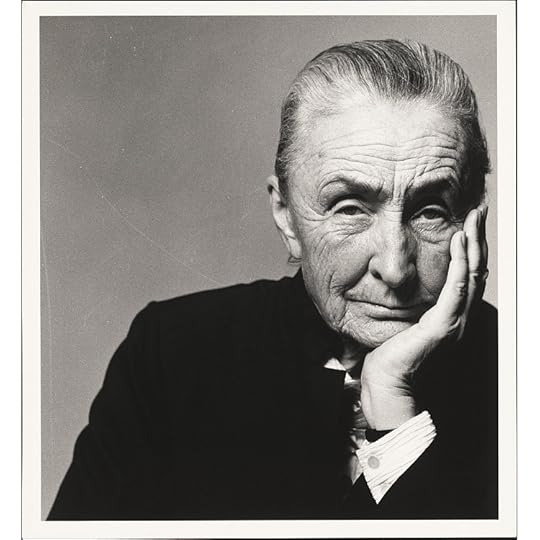
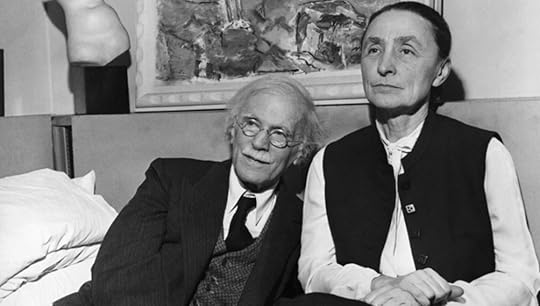
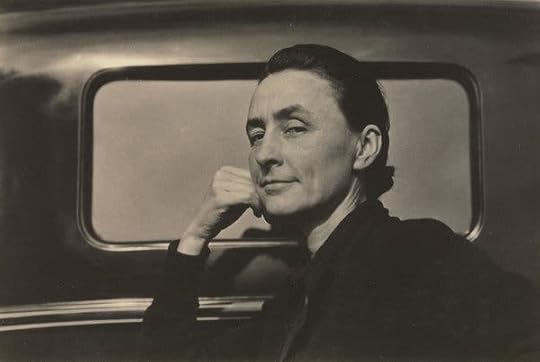
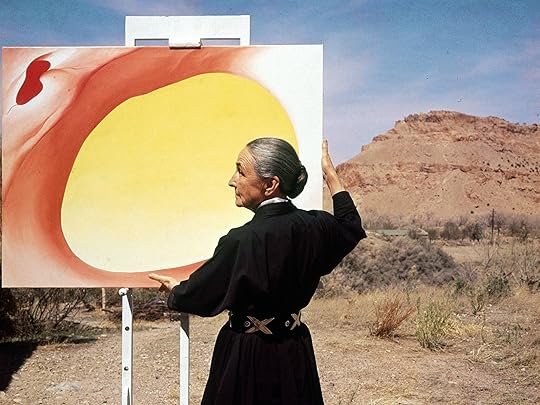
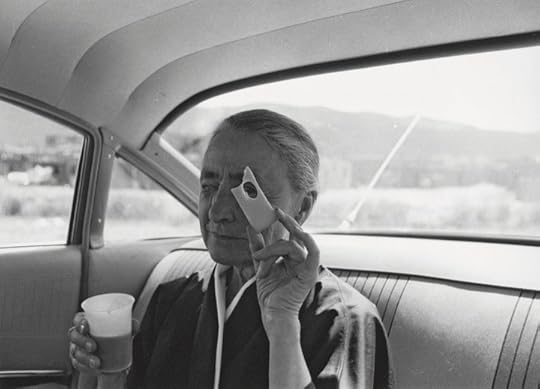
Georgia O’Keeffe (1887–1986) was a major figure in modern American art for some seven decades. Importantly, her fame was not associated with shifting art styles and trends, but rather with her own unique vision, based on finding essential and abstract forms in nature. O’Keeffe’s primary subjects were landscapes, flowers, and bones, each explored in successive series over several years. Certain works went on for decades, producing 12 or more variations of an original image. Among these, O’Keeffe’s magnified pictures of calla lilies and irises are her most famous. Enlarging the tiniest petals to fill an entire canvas, O’Keeffe created a proto-abstract vocabulary of shapes and lines, earning her the moniker “mother of American modernism.” In 1946, O’Keeffe became the first female artist to be given a solo show at the MoMA in New York. This introductory book from TASCHEN Basic Art 2.0 traces O’Keeffe’s long and luminous career through key paintings, contemporary photographs, and portraits taken by Alfred Stieglitz, to whom O’Keeffe was married. We follow the artist through her pioneering innovations, major breakthroughs, and her travels and inspirations in Southeast Asia, India, the Middle East, and, above all, New Mexico, where she was particularly inspired by the majestic landscapes, vivid colors and exotic vegetation. About the series Born back in 1985, the Basic Art Series has evolved into the best-selling art book collection ever published. Each book in TASCHEN’s Basic Art series a detailed chronological summary of the life and oeuvre of the artist, covering his or her cultural and historical importance a concise biography approximately 100 illustrations with explanatory captions
Britta Benke, born in 1960, studied art history, classical archaeology and romance languages and literature in Göttingen, Münster and Bonn. Georgia O'Keeffe is the main focus of her research and also the subject of her dissertation.
I came to this book in an unexpected way. I found it in a bookshop that concentrates on Medieval history and art, but they had a few of these Taschen books. I got a couple. They look like flimsy coffee-table books, but they are not. Or rather, they are not just that. I have now learnt that for these series the Taschen editors have chosen magnificent authors, and that their presentations are complete and engaging. Excellent introductions then to any given artist.
As Walter Benjamin pointed out reproductions of art vulgarize it to the point of banality. And all those posters of O’Keeffe’s flowers in pastel colors that one finds in shops or dentist’s waiting rooms had saturated my interest in this artist’s work. Not even when I visited New Mexico a few years ago, was I particularly interested in pursuing her trail. Now I kick myself for this.
Georgia O’Keeffe had a long life, an interesting life, a productive life and she left an exemplary path to inspire many women after her. Born in 1887 she almost reached ninety-nine years of life dying in 1986. With such a long life, and her energy and determination and acumen, she not only witnessed but participated in the formation of the American avant-garde, always in her own way.
Originally from Wisconsin, but partly raised in Virginia, she moved soon to New York. By chance her drawings came to the attention of photographer and gallerist Alfred Stieglitz (1846-1946) who soon promoted her. He was over twenty years her senior, but they soon became lovers and married. Even if their relationship was stormy and intense, they remained married for twenty years until his death in 1946 and she took charge of executing his will, for which she had to abandon painting for a few years.
In Stieglitz’s circle, which included all the concentration of European avant-garde (he had organized the 1913 Armory Show, introducing to the Americans the likes of Cézanne, Picasso etc), Georgia first saw art that offered a different paradigm to those in the Art schools she had attended. It also introduced her to art theory such as Kandinsky’s Concerning the Spirituality in Art and the writings of Henri Bergson that underlined the idea that emotions could detain the perception of the passage of time. And for this no other medium was better than photography. Expectedly around Stieglitz’s camera other photographers such as Paul Strand, Chares Sheeler, Ansel Adams etc.
Reading this has awakened my perception of her work so that even with her over reproduced flowers, I have been paying attention to her choice of colors, the way she combines, diffuses their tonalities, enhances some hues and delineates borders. She had a particular way of applying tight brushstrokes that would create different textures, endowing her petals with a velvety finish. And her distorting enlargement, cropping and decontextualizing are really what gave her botanical observations her signature.
But all was not femininity and flowers. For one she rejected strongly the interpretations that associated her flowers to the female sexual organs – idea that possibly originated in Stieglitz himself. She vocally denounced that critics were appropriating her art by giving meanings which had not been part in her creative process. And then she also responded, defiantly, when her first approaches to painting architecture met with male rejection – and again Stieglitz was part of this opposition. She had no qualms entering what was considered a territory for men only.
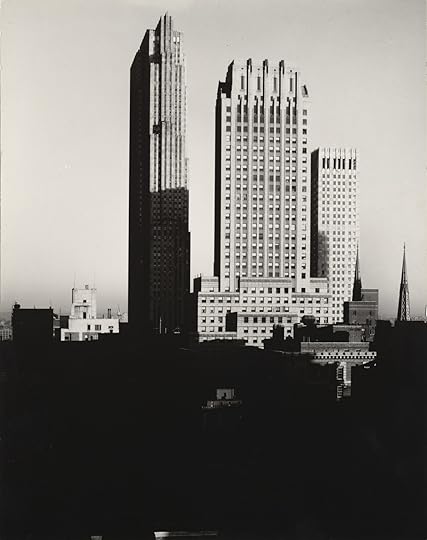
We have to remember that this happened during the 1920s, when skyscrapers were beginning to make an affirmative presence in Manhattan, something they did back then only in the southern part of the island, around Wall street. And these were office buildings. When some taller buildings began to be erected in midtown, they were partly residential or hotels. One of these was "The Shelton" and that is where O’Keeffe and Stieglitz moved. This provided them with additional vistas onto the street and cityscapes from those captured from the sidewalk. Out of their windows on the 30th floor, both artists produced fascinating photographs and paintings. Both would have seen the extraordinary film produced by Paul Strand and Charles Sheeler in 1921 . Here were the extreme viewpoints and the sharp effects of light and the play between volume and void that we then see in Georgia’s fantastic paintings. SPOILER I found this fascinating blog with an entry on "The Sheldon" http://daytoninmanhattan.blogspot.com... on the Shelton SPOILER.
When in the late 20s she and Rebecca Strand (wife of Paul) accepted the invitation from the wealthy art patron Mabel Dodge Luhan to come to New Mexico, that was another revelation. The sandscapes, the blinding sun and the open spaces became another endless source of inspiration. A separation from the difficult Stieglitz was also appealing and Georgia moved there. She nonetheless continued to have a presence in NY through her growing fame. The Brooklyn museum organized a solo exhibition, the Met got one of her works, and much later MoMA put on their first exhibition dedicated to a female artist.
During this period she tried different palettes, simplified her forms, explored the underlying geometry of her chosen objects, and advanced in her investigation of the relationship between voids and frames --that she had started with her NY buildings-- as the bones of dead animals become frames to the pervading intense blue of her skies. Atmospheric qualities melting elements of nature and cosmic depths.
It was not until Stieglitz died that O’Keeffe ventured to travel abroad. Based in the South West she was first attracted to visiting Mexico, where she met Kahlo and Rivera in 1951. Two years later she went to Europe, again choosing the Southern countries such as Spain (where she admired the Goyas) and France. And in 1959 she traveled the world spending three months going through an expanded catalogue of the Asian countries. Her last trip, at the age of 96 was to the Costa Rican Pacific coast.
During her long flights she discovered other subjects, other views. Simplification continued and views of rivers from above, and beds of cushiony clouds, were at the source of her near abstract paintings. These she labeled according to tonalities: “Blue, Black and Gray” or “It Was Red and Pink”
It was after finishing this wonderful book and after watching a film and a couple of lectures that I realized that the Thyssen museum is organizing an exhibition on Georgia O’Keeffe for 2021. I am delighted.
Como é costume com a Taschen, este livro é uma ótima revisão da vida e obra de Georgia O'Keeffe - e a forma perfeita de alguém que não conheça muito sobre ela se adentrar na sua essência. Foi o meu caso; e que gosto que foi descobrir esta autora que, como Sophia de Mello Breyner na sua poesia, descobre esse espantoso esplendor do mundo que aparece aqueles que tomam consciência da própria presença do real. Como com muita da poesia de Sophia, a pintura de Georgia O'Keeffe é sobretudo um olhar atento sobre o mundo, colorido por uma alma invulgar.
Until I picked up this book (as a cheap used book at my local bookstore) I had never gone out of my way to learn about Georgia O'Keeffe. I was aware of her work. I teach her
...
... will rewrite when I am no longer frustrated with Goodreads and Safari for being dicks and eating my review because they, in their infinite wisdom, decided to log me out.
I've always loved O'keeffe's work but never deeply understood what made her such a significant artist. Throughout this book, I came to love her, not only as an artist but also as a woman. The quotes cited alongside her paintings and the references to the artists she surrounded herself with gave me deeper insight into her world. I absolutely see the natural world in detail, just as O'keeffe did. Her goal to make everyone stop for a moment and examine the world through her eyes has a beautiful sentiment. This book does a wonderful job at recounting her work and lifetime 🏵🏵🏵
“I have things in my head that are not like what anyone has taught me—shapes and ideas so near to me—so natural to my own way of being and thinking that it hasn’t occurred to me to put them down.”
Sad her husband’s philandering caused her not to paint a mural in Grand Central Station, NYC. Some of her work is very appealing to me and some not. A trailblazer in the 20s.
While preparing for a trip to Santa Fe that included visiting the O’Keefe museum and without any prior knowledge of the artist, I wanted a book that would give a general understanding of Georgia O’Keefe for better art appreciation. This book delivered well with a short, but thoughtful and nuanced biographical sketch and a selection of her major works. It also took only about an hour to read so it was a great time investment.