Jump to ratings and reviews
Rate this book

The Tablet of Destinies

Rate this book
'The Flood didn't come suddenly as a big surprise. It came at the end of a long, tormented story. Men just went on multiplying and the noise they made was ever more irksome . . . I remember days of desperation.'

A long time ago, the gods grew tired of humans and decided to send a flood to destroy them. But Ea, the god of fresh underground water, didn't agree. He advised one of his devotees, Utnapishtim, to build a quadrangular boat to house humans and animals, and saved these living creatures from the Flood.

Rather than punish Utnapishtim for his disobedience, Enlil, King of the gods, granted the mortal eternal life and banished him to the island of Dilmun. Thousands of years later, when Sinbad the Sailor is shipwrecked and arrives on that very same island, the two begin a conversation about courage, loss, salvation and sacrifice.

Following Calasso's masterful retelling of ancient Greek myths in The Marriage of Cadmus and Harmony and Indic myths in Ka, this richly imaginative work delves into the crucible of our collective consciousness to reimagine the origin stories of one of the earliest human civilizations.

128 pages, Hardcover

First published October 8, 2020

17 people are currently reading
290 people want to read

About the author

Roberto Calasso

66 books679 followers
Roberto Calasso (1941 – 2021) was an Italian writer and publisher.

Calasso was born in Florence in 1941, into a family of the Tuscan upper class, well connected with some of the great Italian intellectuals of their time.

Calasso worked for the publishing firm of Adelphi Edizioni since its founding by Roberto Bazlen in 1962 and became its Chairman in 1999. In 2015, he bought out the company to prevent it from being acquired by a larger publishing firm. His books have been translated into more than 20 languages.

He was the author of an unnamed ongoing work reflecting on the culture of modernity, which began with The Ruin of Kasch in 1983, a book admired by Italo Calvino. Dedicated to the French statesman Charles Maurice de Talleyrand-Périgord or, Talleyrand, it was followed in 1988 by The Marriage of Cadmus and Harmony, in which the tale of Cadmus and his wife Harmonia becomes a pretext for re-telling the great tales of Greek mythology and reflecting on the reception of Greek culture for a contemporary readership. Another world civilization is surveyed in Ka (1996, where the subject of the re-telling is Hindu mythology). K restricts the focus to a single author, Franz Kafka; this trend continues with Il rosa Tiepolo (Tiepolo Pink), inspired by an adjective used by Marcel Proust to describe a shade of pink used by Venetian artist Giambattista Tiepolo in his paintings. With La folie Baudelaire, Calasso once more broadens his scope from fresco to a whole civilisation, that of Paris in the latter half of the 19th century, reconsidering the lives and works of the post-romantic generation of writers and artists from Baudelaire to Valéry. In one of his more recent works, Ardore (2010), the author returns to India for an exhaustive analysis of the theory and practice of Vedic sacrifice and its significance for post-modern epistemology.

Along with his status as a major analyst specifically of the works of Kafka, Calasso was, more broadly, active in many essays in retrieving and re-invigorating the notion of a Central European literary culture. He also served as the president of the International Alexander Lernet-Holenia Society, which promotes the publication, translation and study of this multi-genre Austrian writer and his focus on the identity crisis of his characters at odds with postimperial Austria and Central Europe.

Ratings & Reviews

What do you think?
Rate this book

Friends & Following

Create a free account to discover what your friends think of this book!

Community Reviews

5 stars
38 (23%)
4 stars
72 (45%)
3 stars
43 (27%)
2 stars
5 (3%)
1 star
1 (<1%)
Displaying 1 - 30 of 30 reviews
Profile Image for fantine.
250 reviews755 followers
July 29, 2025
"All the gods you have encountered, or will encounter, any-where, at the farthest edge of whatever sea, are made of the same substance. There is a great gleaming tangle rolling over and over and constantly shedding bits of itself. And those bits are other gleaming tangles that go on rolling over and shedding other smaller bits, which again are gleaming tangles. This is the life of the gods," said Utnapishtim.
Profile Image for Matthew Ted.
1,007 reviews1,037 followers
June 5, 2022
59th book of 2022.

Calasso is an Italian writer I've managed to avoid for some time despite owning his two major works, The Marriage of Cadmus and Harmony and Ka. Instead of reading those first, as I planned, I have NetGalley to thank for sending me an advance copy of a 'new'* Calasso book, which is going to be published in late July. This one is under 150 pages long but deals with myth as his other major works do. The whole book is a dialogue between Sinbad the Sailor and Utnapishtim on the island of Dilmun. The latter disobeyed the gods and was banished to the island, and his punishment, rather than death, was eternal life. That was several thousand years before Sinbad arrives, and Utnapishtim finally has someone to talk to. And talk he does.

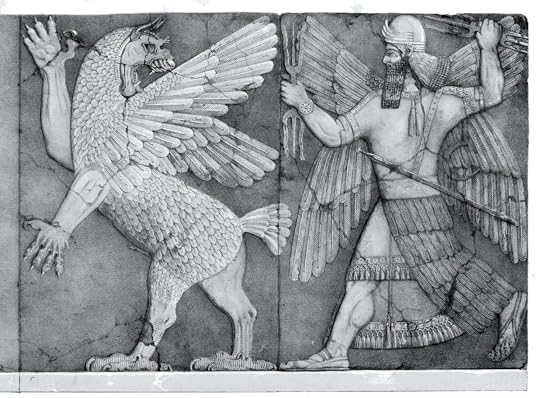
The mythology in the book was almost entirely unknown to me, mostly around Ea, the Sumerian god of water, creation and knowledge. His son features. As does the construction of Babylon, the Anunnaki in general, and Gilgamesh. Utnapishtim's monologue tells a number of old myths in a very simple style over the course of ten small chapters. Sinbad occasionally interrupts or has something to say himself, but a majority of the text is Utnapishtim's own monologue. Below are some examples of the prose and some of the highlights/interesting ideas from the book. Starting with the description of the Underworld from Utnapishtim.
"More than Babylon or Eridu, it was the Underworld that was the Great City. Walking through it, one came across one palace after another. Some said: 'This is Nergal's palace, this is Ereshkigal's.' But there were others, too, palaces of minor gods, Hushbisha, Dimpimeku, Ninazimue. There were temples, too, and towers. Darkness was constant, except when Utu, the Sun, made a brief visit to pass judgement. The inhabitants wandered in the dust, dressed in feathers down to their feet, like birds that cannot fly. They ate clay."
description
One interesting idea was Utnapishtim describing how once all humans spoke the same language, but 'understood one another too much. There were endless fallings out. Even more dangerous though, where the moments when they reached a sudden agreement.' So, Ea 'multiplied the tongues of men',
"At first bewilderment and confusion ran riot. Then people began to split up and withdraw into different regions, well protected from one another. A dim veil came down on each of these places. But the veil could be torn open by curiosity and study."

But the gods were not sure if they were '"more or less happy than before"', "'They kept their eyes mainly on whatever was close to them, wanting to possess it forever."'
The price tag seems a little steep for such a short book but I recommend it to anyone who enjoys reading about myths, these are not the sorts of stories you read often. I had certainly never read about Utnapishtim and Ea and all the Anunnaki.
_____________________

*Calasso died just last year. So far I haven't found any information about when he wrote this book. Update: looks like it was originally published in 2020, though I'm not sure if it was written as late as that, or dug up from Calasso's older work.
Profile Image for Alessia.
35 reviews4 followers
January 8, 2021
"Forse pensano che il mondo non è fatto per dare risposte."
Profile Image for Tamara Agha-Jaffar.
Author 6 books282 followers
July 31, 2022
The Tablet of Destinies by Roberto Calasso, translated from the Italian by Tim Parks, is a slim volume that delves into myths from Mesopotamia.

The narrative unfolds in the form of a conversation between Utnapishtim and Sindbad the Sailor. A shipwrecked Sindbad turns up on the island of Dilmun where Utnapishtim and his wife have lived for thousands of years ever since they were granted eternal life by the gods. Hungry for company and eager to tell his stories, Utnapishtim takes advantage of Sindbad as his captive audience.

Utnapishtim weaves together episodes of different myths from Mesopotamia. Included is the story of warring gods, the defeat of Tiamat, and the ascendance of Marduk in the Enuma Elish, also known as The Babylonian Creation; the friendship between Gilgamesh and Enkidu, the flood story, and Utnapishtim’s immortality in the Epic of Gilgamesh; and Ishtar/Inanna’s possession of the mes, her marriage, and her descent into the underworld in The Hymn to Inanna: Queen of Heaven and Earth. Episodes from these and other myths appear intermittently, looping in and out of each other’s stories. Eventually, each myth is told in its entirety, but its episodes are scattered throughout and have to be pieced together at the end of the narrative. This mingling of myths suggest they should not be viewed as separate entities but as different iterations of a continuous, cohesive whole.

Most of the conversation is conducted by Utnapishtim, eager to tell his story. Sindbad occasionally interrupts with a short tale of his own or a question. More often than not, Utnapishtim is unable to provide an adequate response, claiming to be simply repeating what was revealed to him by the god Ea. He frequently sounds baffled by his predicament, unsure if the gods have forgotten about him. He waits. And he tells his stories.

Utnapishtim has accepted his fate, but this acceptance is tinged with notes of melancholy. He emerges as a compelling character, embroiled in a circumstance not of his own making, unsure of what the gods want from him, and desperate to transmit his stories. His blurring together of the different myths suggests he sees them as one long, uninterrupted narrative of our beginnings. Although he narrates weighty, mythological events that presumably go back to the beginning of time and the creation of humans, he adopts a matter-of-fact tone throughout. His goal is to transmit the stories to someone who will carry them off the island since he is unable to do so, himself.

Calasso has provided a vigorous rendition of these myths. The looping in and out of different myths makes for fascinating reading, especially if one can recognize which episode came which myth and how they blend together to make a cohesive whole. But this technique is rewarding for those already familiar with the mythology of ancient Mesopotamia. For others, it may prove to be too much of a challenge.

Recommended.

My book reviews can also be found at www.tamaraaghajaffar.com
Profile Image for Tiziana.
223 reviews36 followers
February 14, 2022
Instagram

«Tutte le storie sono accadute prima del Diluvio. Dopo non c’è altro che storie di naufragi. I naufragi sono sempre un certo numero. Sette. O trecento. E finiscono sempre allo stesso modo. Mentre le storie di prima del Diluvio sono concatenate. Ancora non ne ho visto la fine. Per questo ho continuato a parlare con te. Talvolta avevo la sensazione di parlare da solo. Ma ora so che quelle storie, almeno per frantumi, e sempre con larghi squarci fra l’una e l’altra, abitano anche in te. Sono come me, sfuggite alla morte.»

Se siete appassionat* di epica e di mito, questo libro potrebbe fare per voi.
Sinbad il Marinaio dopo un naufragio si ritrova al fianco di Utnapishtim, “il più vecchio dei vecchi e il più vivo dei vivi”, che inizia a narrare una lunga storia, iniziando dalla nascita degli dei per poi virare sulla creazione degli uomini, nati grazie ad argilla impastata e al sacrificio di una divinità e all’uso del suo sangue.
C’è poi il racconto del Diluvio, da cui Utnapishtim e l’umanità sono stati salvati solo grazie alla costruzione di un battello grazie all’avviso del dio Ea.
C’è Ishtar e i suoi “me”, i doni di potere che ha strappato a suo padre. La discesa di Ishtar nel regno dei morti da cui nessuno ha il potere di ritornare, perché una discesa richiede sempre una vita...
ci sono molte altre storie, stipate in queste quasi 150 pagine, in cui Sinbad non è solo un ascoltatore, ma è anche testimone di avvenimenti fuori dall’ordinario.
121 reviews5 followers
August 17, 2021
I miti della creazione del Vicino Oriente Antico narrati da Utnapishtim a Sindbad il Marina­io, naufrago sull'isola di Dilmun. Al di là della raffinatezza del contenuto, un saggio sulla potenza del racconto nella trasmissione dell'universo culturale di un popolo, che va al di là della differenza di lingua, tradizioni, orizzonti intellettuali: «un giorno mi svegliai e vidi un altro uomo che dormiva nella mia tenda. [...] cominciammo a parlare. [...] a un tratto mi accorsi che ero io a insistere con i racconti. Un giorno mi attraversò il pensiero che forse erano gli Anunnaki [gli dei, n.d.r.] a volere tutto questo, a governarlo. Volevano che una voce raccontasse le storie che erano accadute prima del Diluvio. E soltanto io ero rimasto tra i vivi. Quelle storie le avevo vissute o mi erano state raccontate. [...] ora so che quelle storie, almeno per frantumi, e sempre con larghi squarci fra l'una e l'altra, abitano anche in te. Sono come me, sfuggite alla morte (81)».
Profile Image for Mass.
104 reviews2 followers
January 31, 2021
Che cosa c’era scritto sulla Tavoletta dei destini? L’ordine.
Un ordine inenarrabile, che tutto governa. Quello che si può raccontare invece, Galasso lo affida alla voce di Utnapishtim, sopravvissuto al Diluvio, immortale, solo nei millenni, abitante di un vuoto senza confini. Il suo destino è rimanere vivo.
Profile Image for Paolo Bizzarri.
97 reviews81 followers
October 21, 2023
Libro piuttosto strano - i miti sulla creazione del mondo delle popolazioni assiro babilonesi trasposti in forma di racconto. Interessante da leggere, ma molto erudito.
Profile Image for Davide Orsato.
122 reviews5 followers
August 8, 2021
Zum Raum wird hier die Zeit… “Qui lo spazio diventa tempo”, dice Gurnemanz nel Parsifal wagneriano, e lo stesso accade a Dilmun, dove continua a vivere Utnapishtim, il superstite del Diluvio. Piccolo scrigno metafisico che chiude il filone mitico dell’opera calassiana con un commiato di classe: “So che stai per partire. È quello che hai fatto sempre. Anch’io continuerò a fare quello che ho fatto sempre: rimanere vivo”.

Grazie Roberto per quello che hai fatto: resterai vivo.
241 reviews18 followers
March 21, 2025
I’m fascinated by this confusion, this mixing of names and languages, something always about
to happen and never finally accomplished
Tablet of Destinies, pg 39


I have long admired Roberto Calasso. Like his fellow critic (and novelist) Umberto Eco, Calasso is a member of a generation, perhaps the last, to have so many dead and living Indo-European languages to draw on that any work of his reflects the variegated collision of his myriad thoughts that unravel ways of seeing myth and the world in ways we never imagined.
For example, running Sinbad the Sailor aground on the reefs of Sumerian Mythology. It’s an intriguing way to combine vastly different mythologies; Sinbad is of the high seas of the common era, while the Sumerians and their gods are of the entwined Tigris and Euphrates, bickering and fighting for superiority over one city state or another.
The Sumerian pantheon of assorted gods called the Annunaki inhabit an Olympus not so different than their Classical Greek in that there are seven primary gods. But beyond this Olympian leadership, masses of Summerian gods abound. I found myself wading around in muddy water in the dark.
For good reason. According to my handy AI handle, as many as 3,600 deities roamed the Sumerian world. This is not totally unexpected as I’m still recovering from discovering Apollo Smintheus, who has a close relationship to mice and rats, one presumes so as to act as a godly foil against their predations. Though the major Greek gods were thirteen or so in number, not counting titans, nymphs, river gods, sea gods, Hades and a variety of demi-gods like Heracles, they still would lose a fair fight (if they were mortal) agains the Summerians.
And this is the problem with The Tablet of Destinies: One book and so many destinies. A rather thin book at 105 pages, there is a swirling, swarming confusion I didn’t fee when I read Calasso’s Marriage of Cadmus and Harmony and K about Kafka.
I’m not one to go around begging for am easy read unless I’m on a beach vacation, but I feel Calasso fell short here. It’s a shame because I love his scholarship and writing. I believe if one were to put in another read or two, the scheme might fall off the bone ripe for digestion. Alas, I’ve other things to do though my love for Calasso’s work remains.
Profile Image for Montse.
173 reviews3 followers
Read
April 21, 2025
Encara em trenca esquemes que s'escrigui al s.XXI una epopeia grega. Tant èpica ienrevesada que era difícil de seguir quin déu feia què.
L'hauria de llegir quatre cops, malgrat el glossari, no es pot seguir els canvis de nom dels personatge ja que no són d'aquest món. L'acabo amb aquell regust d'haver llegit una santa escritura d'heroicitats impossibles per a humans, però que formen la configuració del nostre destí. Que mencionés Guilgameix i Babilònia em fa pensar que em falta vagatge clàssic per gaudir mentre l'immortal Utnapixtim comparteix històries amb un Sindbad curiós que se les empesca per fugir del Vell Mar. Tota una aventura, m'ha agradat llegir però no sé pas si la recomanaria. Una genialitat de traducció.

A tall d'exemple:
pg76. Marduk donava a entendre que, encara que Erra hagués devastat la terra sencera, no hauria canviat res essencial. De totes maneres, no hauria afectat en res la "carn dels déus" (l'arbre mesu). Pel que fa als homes, sempre quedaria una resta, preparada per continuar els mateixos gestos, per acomplir les mateixes cerimònies.
p77—Algunes d'aquestes històries em van arribar en forma d'enigmes. I de vegades aquells enigmes es mostraven en certes ceremonies. [...] He pensat molt en aquestes històries i no he arribat a reconstruir-ne tots els passatges. Només en un punt: després de Marduk ja no van aparèixer més déus, com si s'haguessin extingit o s'haguessin eliminat entre ells. I viure sense déus va ser considerat no només admissible, sinó fàcil.
p87. Els Anunnaki no eren autosuficients, encara que molts s'ho pensessin. Els calia un objecte on es concentrés tot allò que era i esdevenia el món: la Tauleta dels Destins, que ara custodien, però tot recordant que en el seu origen la Tauleta s'havia precipitat a l'Apsu i a Tiamat, la seva potència enemiga més esfereïdora.
p94.—L'ordre que prové d'Ea pot ser amagat, elusiu. Però és omnipresent. Qualsevol ordre establert pels homes, sigui bo o dolent, no aconsegueix d'aguantar gaire temps.
This entire review has been hidden because of spoilers.
Profile Image for riley.
92 reviews8 followers
February 8, 2025
Hate to say that I didn’t like this as much as I thought I would. As usual, full of information, myth stories, and thoughtful commentary, only a bit muddled in the execution. The book is basically just a conversation between Utnapishtim (of Mesopotamia’s flood myth) and Sindbad the Sailor. They discuss ancient stories, their meaning, and the experiences of being caught up in (you guessed it) their respective destinies.

In theory, this set up is picture perfect and an amazing setting for what is going to be discussed. A perfect backdrop for these characters and their stories and their discussions. Only that’s all it really is—a backdrop.

This book would have benefitted a lot if Calasso had decided to really lean into the fictional narrative he created OR if he had written it as another one of his nonfiction books. He teeters on the brink of both and so struggles to settle into the depth of either.

Despite this, it was still a worthy, enjoyable, and informational read. The scene where Sindbad describes the dunes of time that he finds on the island is a stand out from the fictional narrative; the discussion of how myth and memory persists even after the gods have “died” was a standout on the theoretical side.

Anyways, I’ve yet to regret reading any of Calasso’s books. Despite some of my negative takeaways, this was still a worthwhile, informational, and enjoyably artistic read. It’s a shame to do three stars, it’s really closer to 3.5.
Profile Image for Greg.
764 reviews3 followers
September 3, 2022
* I would like to thank Netgalley and the publisher for the opportunity to review this book. *

This is a retelling of Mesopotamian myths, as told by the eternal Utnapishtim to Sindbad the Sailor. Utnapishtim's story of a flood was an earlier version of that of Noah's Ark. After surviving the flood, Utnapishtim was granted eternal life and sent by the gods to Dilmun to live out his endless days.

A key part of the stories that Utnapishtim tells is the struggle for possession of the Tablet of Destinies. This is a nondescript tablet that actually contains the record of all destinies, good and bad. The one thing that the gods cannot abide is that they may become subject to the whims of chance, so possession of this tablet is vital for their future. Many of the stories concern the theft and return of the Tablet.

I enjoy mythological tales, and this made a nice change from the more common Greek, Roman and Norse myths.
Profile Image for Massimo Monteverdi.
703 reviews19 followers
January 28, 2021
È una mitologia laica quella di Calasso. Questi dèi così terreni e così privi di religiosità sono lontanissimi dalle divinità piene di dogmi che imperversano oggi. C’è (c’era) dunque molta più spiritualità sulle rive del Tigri e in Mesopotamia che in tutta la vicenda, ad esempio, del cristianesimo o dell’islamismo. Sotto traccia appaiono, luminose, le tracce di culture spazzate via secoli fa dal furore della Storia che oggi possono ancora impartire lunghe lezioni sul rapporto tra uomini e potere, tra sacro e profano, tra mistero e verità. Anche la tavoletta del titolo rappresenta l’efficace metafora di come solo regole condivise dal consesso sociale possano garantirne la convivenza pacifica e di quanto sia pernicioso affidarne la manutenzione a pochi eletti.
169 reviews1 follower
July 3, 2022
Roberto Calasso works his usual magic with mythology, this time with the Mesopotamian pantheon. First off, Calasso treats his subjects seriously, as Beings of great power and creation - not as curiosities or metaphors or objects of humor. Second, he does a wonderful job of weaving random myths and tales into a coherent narrative, anchored in a rough timeline.

In this book, he adds an extra layer to his account by having an intermediary - Utnapishtim of the Sumerian account of the Great Flood - act as the storyteller, in a series of conversations (really monologues) with a stranded Sindbad the Sailor. This adds a filter of a (near) human voice trying to make sense of his Gods' actions.

Everything by Calasso is worth reading, and this is no exception.
Profile Image for Davis.
148 reviews8 followers
February 9, 2023
It is wonderful to see Calasso return, late in his life, to the same literary mode as that of The Marriage of Cadmus and Harmony and Ka: namely, his unique brand of mythography. It is a mode of writing that seems to make those books infinite, inexhaustible sources of divinity.

This book is no less infinite, no less worthy of a lifetime of study and appreciation - the only difference, I suppose, is that while those other books take days to read, this book can be read in a single morning.

I like to think that somewhere beyond the flow of time, perhaps on the island of Dilmun, Calasso continues to tell stories of the gods to uncomprehending ears. It is pure fantasy, but nevertheless it soothes my soul.
Profile Image for Greta Martin.
3 reviews
September 9, 2023
Questo è il primo libro che leggo di Calasso, sebbene lo conosca da tempo e ne abbia sempre letto degli articoli. La sua scrittura è molto scorrevole ma la cui comprensione può risultare ostica. Come in altri suoi libri - e in generale nella sua poetica - si occupa di epica e di miti, sviscerandoli ma soprattutto li rendere attuali. Ciò gli consente di sviluppare delle riflessioni profonde che aiutano il lettore ad attualizzare punti di vista sempre differenti. Questo stile ricercato di Calasso ne dimostra la profondità spirituale e intellettuale, che senza troppi ghirigori, riesce a colpire a pieno chi legge.
Lo consiglio veramente a tutti, sebbene la scrittura possa risultare a tratti poco facilmente assimilabile.
Profile Image for Maggie Rotter.
164 reviews17 followers
June 17, 2022
Roberto Calasso died almost a year ago at the age of 80. His 1988 book length essay, The Marriage of Cadmus and Harmony, was described as a "complex and intellectually dazzling novel using ancient Greek mythology to explore the origins of Western thought'. Various of his other works explore the mythology and storytelling of and older cultures of the world. The Tablet of Destinies is narrative in style, that introduces Enlil, king of the gods, and boat builder/animal rescuer Utnapishtim in a story that parallels Noah and the flood but arrives at a very different outcome. Anyone drawn to the charm of myth will enjoy this short volume and may want to delve into Calasso's other works.
Profile Image for Nosemonkey.
629 reviews17 followers
June 12, 2024
A short, confusing, dreamlike yet engaging overview / retelling not so much of the myth of the great flood (as the cover blurb promises), but of Mesopotamian mythology, including the story of Gilgamesh. I liked it, but didn't fully follow it - too many unfamiliar names of unfamiliar gods, some of whom also make an appearance in Calasso's The Book of All Books.

Will need to be re-read to be taken in fully - and I suspect even then I'll need more commentary and analysis to get it. A shame Calasso decided not to provide that this time - but he does like to make you work for his insights, so I guess I should have suspected as much...
Profile Image for Josh.
110 reviews1 follower
December 24, 2023
The Tablet of Destinies is a sequel of sorts to the Epic of Gilgamesh. Picking up the thread with Utnapishtim, the undying man, the book is a dialogue between him and Sinbad the Sailor from Arabic folklore. Their topic? The age of order (human prehistory) vs. the age of chance (our own). A vein of mystery has always run through Calasso’s writings, so that it seems the author himself speaks through Utnapishtim, relating stories of gods and heroes, while admitting even he doesn’t know their full meaning. This might be Calasso’s most elliptical work. A gift to long-time readers, yet I suspect bewildering to new ones.
Profile Image for Stefano Franke.
54 reviews1 follower
February 23, 2024
A magnificent book by the master of ancient stories.

A hundred tales about the first civilization, their Gods and their servants all connected together with the conversation between Sindbad the sailorman and a Semi-God, that live is eternal because the infinite favor he make to humanity.

A Book about the endless relationships between Gods and humans, a constant motive’s in the majority’s of Roberto Calasso books.

Recommended to any readers who have been interested in Ancients culture and mythology.

Like good wines Calasso prose would be getting better through the years.
Profile Image for Carlos.
2,702 reviews77 followers
July 24, 2025
Calasso presents the Mesopotamian myths through a conversation between Sinbad (the Sailor) and Utnapishtim (the Mesopotamian Noah). For any reader familiar with other mythologies, the resonances between cultures cannot go unobserved. From Greek to Norse to Egyptian, Calasso presents myths that highlight the commonalities of humans’ understanding of the cosmos and the forces that rule, or claim to. An interesting presentation of a less well-known mythology that makes wonderful connections with other cultures.
Profile Image for Asaria.
958 reviews72 followers
December 27, 2023
It's rare to find retellings of Mesopotamian mythology so I appreciate Calasso's attempt. I'd live without Sindbad's framing story but in later "tablet" it nicely converges with Utnapishtim's tale.

The tales themselves do not bring anything fresh. If you read any myth collection before, you will find them almost unchanged. Some reflection here and there and some add-ons for the sake of continuity.
11.4k reviews192 followers
July 13, 2022
A short- novella length- dialogue between Sinbad the Sailor and Utnapishtim on the island of Dilmun where Utnapishtim has been banished. This was unfamiliar territory for me and it didn't help that the writing is dense, very dense. Thanks to Netgalley for the ARC. I might not have finished but fans of mythology will no doubt relish it.
Profile Image for Jeff Mccurry.
33 reviews9 followers
August 16, 2022
Calasso is rewarding as ever. Here he considers the origins of the world in divine violence, the reality and force of necessity and order, the way that necessity can become meaningful, although not necessarily benevolent, as destiny, the ceremonies gods and humans use to sustain order, and the impossibility of immortality and the way stories might be the only immortality we can get.
Profile Image for Bronwen Griffiths.
Author 4 books24 followers
May 14, 2025
I'm not quite sure what I think of this book. I thought it was going to be about Noah but really it is a re-telling of the story of Innana and Gilgamesh. It isn't like anything else I have read and for that reason I found compelling, although a little hard going at times. It reads like a myth, as though it was written thousands of years ago.
Profile Image for Elena Ighanian.
42 reviews
December 4, 2025
Kan ikke nok om mesopotamisk mytologi for å 100% forstå boken men veldig spennende og fikk lyst til å lære mer. Elsker forfatteren
Profile Image for Ilya.
68 reviews17 followers
November 2, 2022
I still count myself a newcomer to Calasso: despite having "The Marriage of Cupid and Psyche" on my list for quite some time, I started only with "The Book of All Books" earlier this year, based largely on Stephen Greenblatt's review in the New York Times. It was a sonorous work that told biblical tales—some more familiar than others—with a striking lack of condescension. At times, it appeared to sow difficulty on purpose, perhaps because difficulty tends commands respect, which in turn is the only way to approach the actual Book of all Books. Its familiarity, Calasso seemed to say, occludes our vision; to recover it one has to commit to an act of creative forgetting. Perhaps for that reason, his observations, or summations, felt so starkly original, so remarkably fresh.

“The Tablet of Destinies,” which succeeds “The Book of All Books,” is a much slimmer volume. Its subject is a synthesis of ancient Mesopotamian myth—again, some of it more familIar than the rest—except , this time, Calasso does his retelling through two characters, Utnapishtim and Sindbad. I cannot say how much of this retelling is Calasso’s invention, and it does not matter. What does is that Calasso, again, elevates the strangeness of myth, its resistance to mindless domestication. In doing so, and much as he did with the Bible, he recovers the otherworldly poetry of these stories, their grain, taste and smell—none of which we know anything about. It is much more of an accomplishment than it may seem: so much of popular fiction expends itself on barren, insipid retellings of myth, from this perspective or that. Nine times out of ten, it succeeds only in trivializing and sedating its sources. Calasso’s book—which only takes a few hours to read—is a far cry from this cycle of adopting and adapting, his voice, posthumous though it now is, that of a truly original thinker and story(re)teller.

— Many thanks to Farrar, Straus & Giroux for an ARC via NetGalley
Profile Image for YJ.
13 reviews
September 19, 2024
Confusing to start to finish--names of Mesopotamian gods and places are mentioned without much explanation. However, Calasso does such an amazing job at bringing ancient gods to life!

Definitely one needs background knowledge on the Ancient Near East to be able to enjoy.
Displaying 1 - 30 of 30 reviews

Can't find what you're looking for?

Get help and learn more about the design.