The Adelaar: a Dutch East-Indiaman Wrecked in 1728 off Barra, Outer Hebrides, Scotland Colin J. M. Martin, School of History, University of St Andrews, Fife KY16 9AL, Scotland, UK Article appeared in The International Journal of Nautical Archaeology (2005) 34.2: 179-210 Doi: 10.1111/j.1095-9270.2005.00054.x
What follows is not a review but more of a summary of a document containing a detailed account of a little-known shipwreck and a modern archaeological investigation of it. The vessel was an early “Iolaire”, (Gaelic for “The Eagle”), sailing almost two centuries before the well-known twentieth-century vessel of the same name. The steamship Iolaire was bearing home to the Isle of Lewis on 31st December 1918 two hundred and eighty souls, most of them soldiers returning from serving in the First World War. Their ship was wrecked, due to error on the part of the captain, on rocks about three hundred yards from their native shore, rocks which they knew well, but about which, due to naval protocol, they could not presume to advise their captain. New Year’s Day found two hundred and one of these boys and men laid out on the beach, or lost in the waters. The island was devastated. For many years afterwards, girls born to their families were given names for their lost male relatives, with the feminine suffix “-ina”. The story is still commemorated. To end this summary of the more famous story, I point to the books below as likely sources of interest – I haven’t read them yet, although I have bought the first one and it’s sitting waiting!
Just a note now on the geographical context of all this. There have been plenty of shipwrecks here, perhaps the best-known being the Politican, made famous by Compton MacKenzie in his purloined story, “Whisky Galore” (written up from a draft by a local schoolteacher, entrusted to him before the days of copyright). I have recently come across an account of the Norge, carrying refugees from Europe to the New World, which was wrecked off Rockall, and locals here are very familiar with the tale of the Annie Jane, also carrying emigrants, wrecked off Vatersay. There are also some Italian men buried in a local graveyard, victims of a Second World War sinking. These were Italians who had settled in the UK, in Wales, and who had crewed a British ship, the Arandora Star, in 1940.
So, in a locality that has seen wrecks as recently as the mid-twentieth century, we return to our sailing vessel, named in Dutch the Adelaar, or Eagle. The information that follows is all taken from the article by Dr Colin Martin, referenced above. I’d never heard of this story, and I’ve lived over forty years in this small island.
The author gives lots of nautical and archaeological detail, but I was more interested in the general story. The Adelaar was built in Middelburg in Zeeland, a trade centre for the “VOC”, or Dutch East India Company. She was bound for Batavia (modern Jakarta) on the north coast of Java, carrying merchandise, bricks and ingots for ballast, and “specie” (coins) with which to purchase spices, tea and porcelain for the return trip.
What was she doing off Barra? The article says that the north-about route round the British Isles was “frequently taken instead of the more direct Channel passage because of the prevailing winds or, on occasion, political instability”. (I suppose this refers to the Spanish Wars and their later effects). I had already learned that there was a sailing port in Stornoway in the Isle of Lewis used extensively by Dutch trading vessels, so I imagine that was also a factor to be considered in the choice of route.
Like the later Iolaire, the Adelaar was seen “dangerously close to the shore”, this time off the more southerly island of North Uist, in a light NNW wind. The wind backed to WSW, keeping the ship too close in again, and then veered NNW, giving the captain a chance to clear the reefs of Barra. However the wind became a gale, and the ship struck a reef off Greian Head, where there are steep cliffs facing the Atlantic. There were no survivors. I found the following description striking:
“It is an extremely exposed location: westward the open water fetch is 3500 km (Newfoundland), north-westward 2000 km (Greenland), and northward 2250 km (Spitzbergen and the polar ice cap).”
The story really brought home to me how vulnerable these sailing ships were, and how frail, how fatally at the mercy of a change in wind direction and strength, and the beat of the sea. I wonder at the rashness (or courage) of those who entrusted their lives to them. I don’t mean the crew, who could have been ‘pressed’ or just poor and without choice in life – or even adventurous – but the passengers, such as the woman whose body was found, with the bodies of her two children, whom she had tied to her when the ship went down. Perhaps she was joining her husband in Batavia. There was also “a young gentlewoman, who had in her Breast between her Shift and her Skin, a Letter of Recommendation from her Mother to a Gentlewoman in the East Indies”. What were the stories of all these people? A novelist could do wonders with this tale. And aren’t you entranced by those Germanic-based capital letters for nouns, even as late as the eighteenth century?
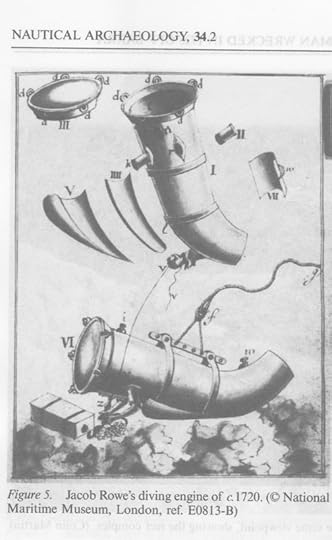
The quest for the ship’s treasure began. The “specie” had been stored in seventeen chests, silver and gold bars, silver ducatons and copper coins. One Alexander MacKenzie, “an Edinburgh lawyer who held the sinecure of “Admiral Depute for the Western Isles” was hot on the trail of the bounty. There’s a fascinating paragraph in the article about how he organises his operation (with local collaboration), but I’ll restrict myself here to a scanned picture of Captain Jacob Rowe’s ‘diving engine’, “in effect . . . an armoured diving dress”.
It’s like something out of “Cyrano de Bergerac”, isn’t it? But MacKenzie’s operation “brought up virtually all of the treasure”. Dr Martin goes into fascinating detail about how this ‘diving engine’ actually worked. There’s also historical detail about the complex litigation over ownership of the treasure, in which George II personally intervened, and which became known as “The Scottish Case”. At this point in this summary I was so worried about infringing copyright that I tried, without success, to contact Dr Martin (who seems to be a remarkable person) and also the official holders of the copyright, The National Archaeology Society, who gave kind permission, as did The National Maritime Museum for the use of the illustration above.
It seems that the story, which went on for years, was remembered in Barra up to modern times, and a version was recorded by John MacPherson, a local storyteller, known as “The Coddy”. My GR friend John was one of the divers on the modern archaeological excavation from 1972-74. This article is accompanied by a further article on the use of explosives during this operation, as well as the hand excavation. Among the many and various artefacts recovered were iron guns from the wreck, cast at Finspong in Sweden. Dr Martin has long experience of nautical archaeology. He ends his article with the explanation that “exposed historic shipwrecks . . . can retain levels of archaeological integrity from which significant and reliable conclusions may be drawn”. The detail in his article would certainly substantiate that, and his efforts to examine and record pay honour to this ship and to those who sailed in her.
Editing the above to reflect Ian's comment below. The Italians on the "Arandora Star" were internees, not crew. Thanks to Ian for the correction.