In another unrelenting look at the iniquities of the American justice system, Lawrence Goldstone, acclaimed author of Unpunished Murder , Stolen Justice , and Separate No More , examines the history of racism against Japanese Americans, exploring the territory of citizenship and touching on fears of non-white immigration to the US -- with hauntingly contemporary echoes. On December 7, 1941 -- "a date which will live in infamy" -- the Japanese navy launched an attack on the American military bases at Pearl Harbor, Hawaii. The next day, President Franklin Roosevelt declared war on Japan, and the US Army officially entered the Second World War. Three years later, on December 18, 1944, President Roosevelt signed Executive Order 9066, which enabled the Secretary of War to enforce a mass deportation of more than 100,000 Americans to what government officials themselves called "concentration camps." None of these citizens had been accused of a real crime. All of them were torn from their homes, jobs, schools, and communities, and deposited in tawdry, makeshift housing behind barbed wire, solely for the crime of being of Japanese descent. President Roosevelt declared this community "alien," -- whether they were citizens or not, native-born or not -- accusing them of being potential spies and saboteurs for Japan who deserved to have their Constitutional rights stripped away. In doing so, the president set in motion another date which would live in infamy, the day when the US joined the ranks of those Fascist nations that had forcibly deported innocents solely on the basis of the circumstance of their birth. In 1944 the US Supreme Court ruled, in Korematsu v. United States , that the forcible deportation and detention of Japanese Americans on the basis of race was a "military necessity." Today it is widely considered one of the worst Supreme Court decisions of all time. But Korematsu was not an isolated event. In fact, the Court's racist ruling was the result of a deep-seated anti-Japanese, anti-Asian sentiment running all the way back to the California Gold Rush of the mid-1800s. Starting from this pivotal moment, Constitutional law scholar Lawrence Goldstone will take young readers through the key events of the 19th and 20th centuries leading up to the fundamental injustice of Japanese American internment. Tracing the history of Japanese immigration to America and the growing fear whites had of losing power, Goldstone will raise deeply resonant questions of what makes an American an American, and what it means for the Supreme Court to stand as the "people's" branch of government.
Lawrence Goldstone is the author of fourteen books of both fiction and non-fiction. Six of those books were co-authored with his wife, Nancy, but they now write separately to save what is left of their dishes. Goldstone's articles, reviews, and opinion pieces have appeared in, among other publications, the Boston Globe, Los Angeles Times, Chicago Tribune, Miami Herald, Hartford Courant, and Berkshire Eagle. He has also written for a number of magazines that have gone bust, although he denies any cause and effect. His first novel, Rights, won a New American Writing Award but he now cringes at its awkward prose. (Anatomy of Deception and The Astronomer are much better.) Despite a seemingly incurable tendency to say what's on his mind (thus mortifying Nancy), Goldstone has been widely interviewed on both radio and television, with appearances on, among others, "Fresh Air" (NPR), "To the Best of Our Knowledge" (NPR), "The Faith Middleton Show" (NPR), "Tavis Smiley" (PBS), and Leonard Lopate (WNYC). His work has also been profiled in The New York Times, The Toronto Star, numerous regional newspapers, Salon, and Slate. Goldstone holds a PhD in American Constitutional Studies from the New School. His friends thus call him DrG, although he can barely touch the rim. (Sigh. Can't make a layup anymore either.) He and his beloved bride founded and ran an innovative series of parent-child book groups, which they documented in Deconstructing Penguins. He has also been a teacher, lecturer, senior member of a Wall Street trading firm, taxi driver, actor, quiz show contestant, and policy analyst at the Hudson Institute. He is a unerring stock picker. Everything he buys instantly goes down.
Look, it's my own fault. Just read the title more carefully. I expected this to be more about the actual internment camps, not so much about the Century of Bigotry Leading to Japanese American Internment. I can't blame the author, he put it right there emblazoned on the cover, but the picture is also clearly, well, interned people. I didn't enjoy 23 chapters of nothing, 1 short chapter of very glossed-over discussion of actual internment, and then 1 hyper-summarized short chapter of the legal cases brought against the US government over said internment. Those two chapters were the parts I was most interested in and they were an extremely disappointing 23 pages long COMBINED -- 10 of which were full-page pictures padding the count.
I think I could have enjoyed this a lot more if the ratio was reversed. Give me two or three background chapters on the context of why Americans were racist jerks in the early 1900s, and then 20 chapters on how internment came about as a policy decision and how it was enacted, etc.
Oh well, when you grab a book on the spur of the moment on your way out of the library, sometimes you come up with a dud.
Fascinating and horrifying at the same time. I'm beginning to understand how accepted and expected the idea of white supremacy was in the United States throughout our history. Well, accepted and expected by white people, of course, and mostly men, at least they're the ones that created the laws and made the court rulings. This book explores just what it's subtitle says--how a century of bigotry led to Japanese American Internment. So many people have put up with so much abuse for such a long time. Ugh. Great book.
First sentence: On December 8, 1941, one day after the Japanese navy launched on American air and naval bases at Pearl Harbor in Oahu, Hawaii, President Franklin Roosevelt addressed a joint session of Congress. He told American lawmakers that December 7, 1941 was a "date which will live in infamy," and asked that a state of war be declared between the United States and Japan. While his denunciation of an unprovoked attack as the two nations were actively negotiating to resolve their differences was certainly justified, three years later, December 18, 1944, became another date that has lived in infamy, one about which President Roosevelt was silent. The reason for his lack of outrage on this occasion was perhaps because he was directly responsible for what would later be widely seen as an indelible stain on America's honor. On that day, with the defeat of fascism glimmering into sight, the United States Supreme Court, by a 6-3 vote, ruled that the forced relocation of more than 100,000 Americans, two-thirds of whom were United States citizens, to what government officials themselves called "concentration camps," was fully justified under the United States Constitution. Not one of these Americans had been accused of a crime. They had been torn from their homes, jobs, schools, and communities to be deposited in tawdry, makeshift housing behind barbed wire solely because of their race.
Premise/plot: Two things this book is not: 1) It is not a graphic novel.* 2) It is not a nonfiction book focusing on Japanese-American internment (concentration) camps during the Second World War.**
Who can be a citizen of the United States of America? How has citizenship been legislated from the very beginning? What rights do citizens have? Do non-citizens have any rights? How has race been defined, regulated, legislated? Does "white" mean EVERY person who is not "black"? This begins to be an issue with Chinese (and subsequently Japanese) immigration in the nineteenth century. The east coast and the west coast have VASTLY different (equally strong) opinions on how big a problem or issue this immigration is. Politicians run campaigns (and sometimes win elections) based on the subject of IMMIGRATION. The book covers over a hundred years of policy. [What could rightly be called systematic racism.] The book examines the subject of race--sometimes Chinese, sometimes Japanese, sometimes all Asians--through the decades. This is done primarily through laws being legislated. (Sometimes these laws/bills are successful; sometimes legislation fails) And the book also looks at judicial cases. The book is definitely a LAW NERD book. Readers get a close look at case after case after case through the decades. It all leads up to HOW COULD INTERNMENT HAVE HAPPENED???? And the answer, of course, was it was inevitable. For over seventy-five years, there's essentially been one narrative being pushed. And that one narrative is undeniably bigoted.
My thoughts: I have read a handful of books (at least) about Japanese-American concentration (internment) camps. Some nonfiction. A few fiction. All of them thought-provoking. I hadn't ever read about the history leading up to this however. It was fascinating yet incredibly sad. All the legal cases were something unique. I've not read many books from this legal viewpoint one that uses the law as a way to bridge the story together into a wonderful whole.
*My local library actually has this filed as a "teen graphic novel" and assigned it a call number accordingly. It does future readers little good to come into the book expecting it to be a graphic novel. **Yes, the book mentions this, of course it does, but it is the end-destination.
Picked this up after listening to Sharon Says So's podcast about the incarceration during WWII. This gives another good examination about why it happened and then why the Supreme Court refused to rule it as unconstitutional (which FLABBERGASTS me).
This book does not go into the experience of the camps, but rather looks at the experiences Japanese Americans had been enduring for a century. It goes through the legal history of how citizenship was contested for non-white, non-Black residents (a fight still going on today, sadly) and continues through the legal fight of Japanese Americans who resisted incarceration. Very well done and interesting.
Rating for the content, definitely not for the writing, which I found to be a grade below of the target audience of the book.
In other words, the book is meant for high schoolers, but I feel a high school could have written this much better. If I handed this into my high school English teacher, they would have cried.
But for real, this is a VERY important topic and I do think people should read this. The research is there and it is immensely important to know the past to understand how the racist ideas that plague us today came to be.
Not a history of the Japanese internment but of the racism and policies that led up to that. Goldstone shows how deeply anti-Asian racism ran in America, especially in the west. The strong links between economic concern holds true -- opportunism leads to racism, just as shown in Stamped from the Beginning: The Definitive History of Racist Ideas in America.
It's a bit dry for me though, and I wish there was more original art -- the photos and reproductions are great, but also all black and white.
This felt a lot like reading a textbook; that is to say, it was full of facts and names and dates, but it was dry. If you really just enjoy nonfiction, you'll probably enjoy this. I prefer more narrative to my nonfiction. Also, there were many points when I thought to myself, "Was this written for young readers or adults?"
3.75 stars. This book gave a lot of history about the years and awful bigotry leading up to the WW II interment camps. I was expecting more about the actual camps. There is so much of American history we are never taught in schools.
Asian-American history is not something that is often discussed in North American schools so this book offers a lot of great background to bridge that information gap. Although it is a relatively short book, it covers a great deal of information from the history of the earliest Asian migrants to the USA, to the issues of citizenship (in a society where people are categorized as being either "white" or "black", what category do Asians fall under, and what rights are they entitled to?), to the internment of Japanese-Americans.
As the title suggests, this book focuses primarily on the history of Japanese-American citizens but it also covered Asian-American history in general as well, since the deep-rooted racism towards Chinese, Mongols, Indians, etc. also impacted the Japanese-American community and further exacerbated the anti-Asian sentiment that ultimately led to the internment of over a hundred thousand Americans (and Canadians - let's not forget that Canada also played a part in this) of Japanese origins.
I learned a lot from this book as it included a lot of interesting (and racist) case laws and rulings that really make readers realize the entrenchment of white supremacy throughout North American history.
Audiobook Comments: I listened to the audiobook (at x1.1 speed), which was well-narrated and captured and maintained my attention.
***#12 of my 2023 Book Riot Read Harder Challenge - Read a nonfiction book about BIPOC and/or queer history.*** _________________________________ If you liked this book, then the following books may also be of interest to you (and vice versa):
A bit text-heavy for me, but goodness how eye-opening this is. The photographs are an awesome touch and this will make readers want to continue to speak up to prevent anything like this from happening again. There is so much bravery shown in the story of this time period which is incredibly powerful, too.
6 stars This needs to be in every library in the US and Assigned to every student to at least once in their time as a student.
this has been sitting next to my computer for three weeks waiting for a review and i still can't come up w/the right words. So is this just emotion pouring out...
a bookstore loaned me the advanced reader and i've been raving about it to friends, to people at the history society i volunteer at, on facebook pages, to people at church and even to people at the bar i go to on pub quiz night. Days of Infamy will make you angry at small minded politicians, arrogant judges and the current state of our country. This is the story of racism directed at the Chinese which was redirected at Japanese because they didn't have as good lawyers. Why were Chinese immigrants okay to discriminate against? Because they didn't try to assimilate. Why were Japanese immigrants okay to discriminate against? Because they tried to assimilate. They were both easy targets cause they don't look like us. Then San Fransisco politicians got involved (perhaps the most screwed up politicos in the US live in and run The City That Knows How.) Japan almost declared war against the US in 1908(09?) because the floundering mayor of SF and the political boss of SF needed a scapegoat and had overplayed their hand against the Chinese after the 06 earthquake. Schmitz, Ruef, Phelan, all of them and their cronies kept screaming about the Japanese taking over the West Coast and the President had to keep stepping in to calm the Japanese govt. and prevent war. Eventually this hatred and small mindedness ends up in the Supreme Court where an recently immigrated judge ruled that immigrants aren't good 'Mericans unless they are white, but that ain't racism. Eventually the nation of Japan bombs a US territory that we gained through backstabbing and deceit and other territories that we gained through an act of war and used as slave states. So Americans of Japanese ancestry or birth are taken to concentration camps (newly rechristened as Relocation Camps, cause they were relocated from the horse stalls they were forced to live in after being forced to vacate their homes they'd lived in for decades). One irony, of many, that Goldstone points out is that Japan considered Japanese-Americans traitors because they supported America.
Goldstone gives example after example of the treatment people who just wanted to work, live and go to school legally in the US were instead shafted (he doesn't even mention the anti-Japanese parade in walnut creek in the 1880s). And he does the worst thing possible in the book, he doesn't let us off the hook by saying it happened a long time ago and we are so much better now. Goldstone points out, sometimes subtlety and sometimes w/a baseball bat, that we are the same now - making scapegoats, following racist politicians that have nothing to say but hate, we either discriminate against Others or allow it to happen (is there a difference?). Many times in Days of Infamy (and in the dozens of California history magazines i've read while thinking of what to write in this review) it is pointed out We (on the West Coast , in the Bay Area, San Franciscans) are no different than people of the Old South following the Confederate flag and its ugliness, our racism isn't as deep because our American history doesn't go back as far but it has been as strong and we need to be vigilant about its return.
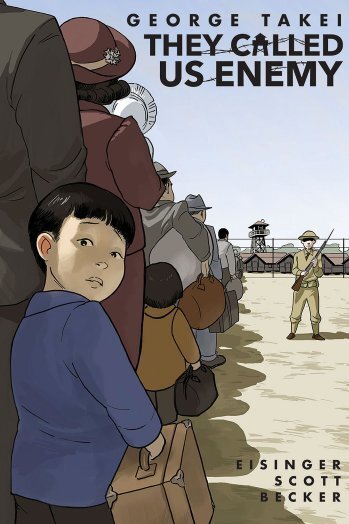
There have been a number of books about the internment of Japanese Americans during World War II. Fictional titles include Denenberg's The Journal of Ben Uchida: Citizen 13559 Mirror Lake Internment Camp (1999), Garrigue's The Eternal Spring of Mr. Ito (1985), Houston's Farewell to Manazar (1974), Kadohata's Weedflower (2006), and Otsuka's When the Emperor Was Divine (2002). For nonfiction titles, there are Sandler's Imprisoned, Sakurai's Japanese American Internment Camps, and Takei's graphic novel style memoir, They Called Us Enemy. Although this cover looks like one on a graphic novel, this book is a deep dive into the systemic racism that Asian immigrants faced from the middle of the 1800s until World War II, and how that racism allowed the Japanese internment to occur.
While Goldstone is not of Asian descent, he is an expert in constitutional law and has done a great deal of research, Days of Infamy is a well constructed and sympathetic look at the history of Asian immigrants and Asian Americans. Starting with the Gold Rush of 1948, he looks at the various people who came to the US from Asian countries, and how they were treated, especially by the laws. My biggest takeaway is that for many, many years, the constitution was interpreted as pertaining only to white males. Not only that, but even after people pointed out that the term "white" has no clear meaning, people in power chose to define the term in whatever way suited their purposes.
Historic event after historic event shows how Asian immigrants were mistreated, even while popular opinion embraced aspects of the culture, shown by events such as the Panama–Pacific International Exposition in 1915. Immigration policies were in place that made it difficult for people, especially women, to come into the country, and other policies made it nearly impossible for people to own land, even if they were born in the US. It was even debated whether or not people who were born in the US to parents who were not citizens were citizens themselves, even when the language was fairly clear. It seems that it is always possible for people to interpret laws in ways that suit their own purposes!
Accompanied by vintage photographs, newspaper articles, and other documents, Days of Infamy paints a clear picture of how the government spent years interpreting laws in ways that made it very easy for President Roosevelt to authorize Executive Order 9066 with little or no opposition. It is an important cautionary tale for a time when it is all to easy to forget the past, during a time when it would be all to easy to repeat it.
"Days of Infamy" by Lawrence Goldstone represents a very strong and deeply disturbing investigation into events leading up to the internet of Japanese Americans during World War II. Goldstone carefully presents all the historical conditions pointing to intense harm and driven injustices. The key events and political decisions which would lead to Executive Order 9066 are summarized well in this book. The book demonstrates various roles of different individuals and institutions in such a civil rights violation, pointing out that the internet was not clearly a spontaneous pearl harbor reaction but instead the sum of decades of racial policy and attitude. My personal reading was greatly affected by the exposure that I received by reading this story that has suffering and flexibility in the Japanese American community, Goldstone smoothly writes an informative yet emotionally persuasive text, while the reason for such a great and informative story is just to be confronted with the human consequences of disadvantage and discrimination, And as such, Goldstones work is a sharp reminder of how fragile civil liberties. This is a powerful and necessary read for any person seeking insight into this terrable period in American injustice in whatever form it may come.
Certainly the cover led me to believe it was going to more approachable for younger readers. I've spent time with my children at the Topaz museum dedicated to those interred there during WWII and I probably have an above-average fascination with the topic. I have several family friends and neighbors who were interred there; friends my grandfather clung to fiercely for years.
Days of Infamy, however, was, as the title says, really not about their internment, but focused mostly on the century of laws leading up to their internment that allowed for such an action to occur. It was non-fiction writing that focused mostly on facts and history and quite a bit less on people or their experiences. The author focuses on a few more personal stories, but mostly only as they relate to the court cases files about their circumstances. The piece felt more pointed and angry than most, which is justified in a topic of this nature, but I felt spent a lot of time with an overly-narrow, modern view of historical events.
Read as a nomination in the non-fiction book award category as a panelist for Children's and Young Adult Bloggers' Literary Awards (Cybils Awards).
great history of the racism of America and it's immigration laws leading up to WWII. the reading level seems to be at least middle school. I feel like I learned so much about the conflicts between Russia, China, and Japan that Ive been missing.
" Had the decisions been different, in time, whites may have come to see the Japanese as valued members of their communities instead of as outsiders to be feared and loathed. by contriving their decisions to conform to race prejudice, the supreme Court did a grave disservice to White society as well as to the Japanese." p180
" True democracy requires a constant commitment to not only safeguard the rights of those who cannot safeguard themselves, but also not to tolerate those who to press the weak, either through ignorance or for personal gain. those who stand by and allow evil to be perpetrated when they are capable of doing something to stop. it are as culpable as those who perpetrated themselves." p228
the book ends with a commentary on a couple current decisions (through 2019) that are doing the same thing as the supreme Court in 1942.
This is a nonfiction book showing not only the Day of Infamy but the Days. Over one hundred years Japanese Americans have had to fight for their freedom.
It goes through history and shows how we have gotten to modern day. This is a graphic depiction and tells the story of many families who were hurt by decisions that were made in America. The book tells many stories that will open teens eyes to how bigotry leads to many Japanese Americans either returning to Japan or living a dramatic life here in the United States.
Some details that may not be appropriate for younger readers. This is definitely a YA non-fiction book. I believe that children in eighth grade and up will be able to understand the content that is in the book. I felt the story was well written with a lot of emotions.
I would recommend this book in areas where you are lacking information on the subject matter.
Days of Infamy: How a Century of Bigotry Led to Japanese American Internment by Lawrence Goldstone is a must read YA history book. The author has done a massive amount of research to put together this history covering nearly 100 years of the history Asian immigrants and Asian Americans, more specifically Japanese immigrants and Japanese Americans. I was expecting quite a bit more time to be dedicated directly to the WWII era internment. Out of approximately 230 pages, only about 30 of those were about that part of history. Obviously, the rest of it covers the history that leads up to Executive Order 9066. I really appreciated that we get to see photos of the people affected by this order. If you're looking for a fascinating, yet absolutely horrific, work of non-fiction, Days of Infamy is a must-read.
i came into this expecting for this book to be a young adult non fiction - relatively objective. i was disappointed. this felt like a high school research paper but drag it out for 200 pages. as other reviewers have mentioned, i expected it to be strictly about the internment but i was disappointed in that too. the last 30 pages were about the internment but the rest at the start was a slow drag of court case after court case. the author also was not objective at all. i agree with his opinion but calling someone “an ignorant, narrow-minded bigot” took it too far. he continuously cycled out different people in the narrative with little explanation. the 2 stars is because the content is very important to learn about. if you’re considering reading this, pick another one that’s better written.
Reading about the dark times in American history can be difficult. We see racism today and yet it seems that our leaders have not learned how much hate and ignorance have impacted our nation. We have lost out on the intelligence and gifts that so many can offer due to prejudice and racism.
I found this book informative yet disturbing as I learned so much about a group of people that were marginalized simply because of their skin tone and where they came from.
The text is certainly higher level, which is why I gave this book 3 stars. I was envisioning this as an option for middle school students to read, but the vocabulary would be difficult to manage for an average middle school reader.
My librarian recommended this book to me. It is a clear and powerful book that explains how decades of racism and anti-Asian laws in the United States led to the internment of Japanese Americans during World War II. Instead of focusing only on life inside the camps, the book shows the long history of prejudice that made the injustice possible. This makes it an eye-opening and important read for students and adults.
The writing is straightforward but sometimes dense because it covers court cases, laws, politics, as well as people's personal stories.
Grades: 6-12, but ideal for older grades due to vocabulary.
This would be a great book for students to read during a WW11 unit, or a classroom discussion about how laws can harm minority groups.
I started reading this book because my class recently covered WWII and the reasons why certain decisions were made and I figured this could give me a deeper view into the history of internment. Our textbook had three sentences that covered the subject matter of this entire book and I've never before been so disappointed by how our current schooling system works. The laws and court rulings discussed in this book that were so important to civil rights and violations thereof weren't even named in my textbook and I'm in an honors course. This book really opened my eyes to a lot of things and I am so thankful it was on the "new arrivals" table at my library.
This engaging narrative nonfiction book describes the many laws and policies used in U.S. history to discriminate against Asian immigrants, resulting in the Japanese American Internment Camps of WWII. From Chinese Exclusion laws, to preventing Asian immigrants from becoming citizens or owning property, to other legal maneuvers, this disgraceful history is clearly told. Quotations from court cases and newspapers lend authentic voices and demonstrate the use of primary sources. B&W photos throughout the book, and extensive source notes and other back matter, make this a great choice for both research as well as recreational reading.
I think the book could've benefited from a "hook" to help you travel throughout. At times it was /super/ academic, especially with the expected audience being high schoolers. I wish the author had touched more on what Japanese internment looked like and the legal battles through that. I understand that the main focus of the book was how the US got to Japanese internment, but it felt odd for it to suddenly go from court case/injustice/legal battle/politics to "then internment happened, we need to carefully watch the government in the present, bye now." The ending was just very sudden in my opinion.
“Bigotry cannot be turned on and off like a water faucet. True democracy requires a constant commitment to not only safeguard the rights of those who cannot safeguard themselves but also not to tolerate those who would oppress the weak either through ignorance or for personal gain. Those who stand by and allow evil to be perpetrated when they are capable of doing something to stop it are as culpable as those who perpetrate it themselves.”
“ and so, it would be sad enough if Japanese internment could be dismissed as an aberration of the American past, but the feelings and reasonings that resulted in that injustice are all too present in a nation today.” Page 228
Fantastic read, really had a lot of information (hopefully I actually learned some of it). This is one of those things we don't talk about in history class, so reading the run-up to Japanese internment was really interesting. I got slightly bored at the end, but for most of it I couldn't put it down. I could see this contending for the Sibert. I think most importantly is that I now want to read all of the author's books.
I wanted this book to include more about Japanese interment camps (a time in US history not spoken of enough). Instead this book was a 200 page history lesson on racism and bigotry in the United States, specifically Chinese and Japanese Americans. It was just not what I was expecting it to be. The message about history repeating itself and tying it to our recent president is vital in its connection to what could happen if/when racists have political power.
While this was a little clinical and definitely not an enjoyable book to read because it’s very dry, this is a lot of very important information for what led to the Japanese internment. Even as a history teacher, there was a lot of stuff in here I did not know. I feel like this is a great resource if you’re studying the internment camps, because it explains why there was such distrust of the Japanese. I also feel like this is a great primer for why we can never let this happen again.
Excellent. The author covers not only the internment of the Japanese following the attack on Pearl Harbor, but what led up to it. The systematic white-supremacist racism that denied citizenship to Asians only because they were not white. The fearmongers pursuing their own agendas. This book should be required reading. Highly recommended.