

What do you think?

Discipline
During the Civil War, many Quakers were caught between their fervent support of abolition, a desire to preserve the Union, and their long-standing commitment to pacifism. When Charles Cox, a young Quaker from Indiana, slips out early one morning to enlist in the Union Army, he scandalizes his family and his community.
Leaving behind the strict ways of Quaker life, Cox is soon confronted with the savagery of battle, the cruelty of the enemy (as well as of his fellow soldiers), and the overwhelming strangeness of the world beyond his home. He clings to his faith and family through letters with his sister, Fanny, who faces her own trials at home: betrayal, death, and a church that seems ready to fracture under the stress of the war.
Discipline is told largely through the letters exchanged between the Cox siblings—incorporating material from actual Quaker and soldier journals of the era—and drawn in a style that combines modern graphic storytelling with the Civil War–era battlefield illustrations of the likes of Thomas Nast and Winslow Homer. The result is a powerful consideration of faith, justice, and violence, and an American comics masterpiece.
Leaving behind the strict ways of Quaker life, Cox is soon confronted with the savagery of battle, the cruelty of the enemy (as well as of his fellow soldiers), and the overwhelming strangeness of the world beyond his home. He clings to his faith and family through letters with his sister, Fanny, who faces her own trials at home: betrayal, death, and a church that seems ready to fracture under the stress of the war.
Discipline is told largely through the letters exchanged between the Cox siblings—incorporating material from actual Quaker and soldier journals of the era—and drawn in a style that combines modern graphic storytelling with the Civil War–era battlefield illustrations of the likes of Thomas Nast and Winslow Homer. The result is a powerful consideration of faith, justice, and violence, and an American comics masterpiece.
312 pages, Paperback
First published October 5, 2021
About the author
Dash Shaw
70 books197 followersDash Shaw is an American cartoonist and animator, currently living in Richmond, Virginia.
Shaw studied Illustration at the School of Visual Arts in Manhattan. He has been publishing short comics and illustrations in a number of anthologies, magazines and zines since his college years. In 2008 Fantagraphics Books published Shaw's first long format graphic novel, the family comedy-drama Bottomless Belly Button. Among his other notable works: BodyWorld (2010, Pantheon Books), New Jobs (2013, Uncivilized Books), New School (2013, Fantagraphics), Blurry (2024, New York Review Comics).
Shaw's animated works include the Sigur Ros video and Sundance selection 'Seraph', the series 'The Unclothed Man in the 35th Century AD' and the movies My Entire High School Sinking into the Sea (2016) and Cryptozoo (2021).
Shaw studied Illustration at the School of Visual Arts in Manhattan. He has been publishing short comics and illustrations in a number of anthologies, magazines and zines since his college years. In 2008 Fantagraphics Books published Shaw's first long format graphic novel, the family comedy-drama Bottomless Belly Button. Among his other notable works: BodyWorld (2010, Pantheon Books), New Jobs (2013, Uncivilized Books), New School (2013, Fantagraphics), Blurry (2024, New York Review Comics).
Shaw's animated works include the Sigur Ros video and Sundance selection 'Seraph', the series 'The Unclothed Man in the 35th Century AD' and the movies My Entire High School Sinking into the Sea (2016) and Cryptozoo (2021).
Ratings & Reviews
Friends & Following
Create a free account to discover what your friends think of this book!
Community Reviews
Displaying 1 - 30 of 66 reviews

December 28, 2021
One thing you can expect from Dash Shaw as you encounter a new work from him: Surprise, and Discipline is no exception. Shaw is an experimental animator and cartoonist, who has done a lot of sort of strange comics. I like narrative, I really do, but I also feel like I learn about the nature of narrative from folks like Shaw who challenge the very nature of narrative. Some of them work for me, and some of them don’t, but if he has a new work out, I want to see it. Shaw has done playful things like books about Cosplay, and Clue (the board game), and I think he is mainly playing around with form, trying new ways to say things. I’m reading a lot more mysteries as I get older, and that’s of course a genre, where you expect certain conventions. You fill the form with a story.
Shaw tries to undermine these forms. But in the last decade he has been working on a project that looks nothing like anything else he has done, an historical project that I understand he intended to be something like Chester Brown’s Louis Riel, a work capturing in fairly conventional ways an historical moment. But if you have read any two random pages of Shaw you know he could never end up with anything looking like conventional narrative.
Oh, sorry, Discipline is about the Quakers during the Civil War, wherein Shaw did a lot of library research, historical studies. It’s about the struggle for Quakers in that period between its commitment to pacifism, on the one hand, and its abolitionism, on the other hand. How do you reconcile those things in the love of country? One key source was an 1866 book called The Fighting Quakers by Augustine Duganne, that features a series of letter exchanges between a mother and two Quaker soldier sons. Shaw used for his text these and other letters to tell the story of Charles Cox, a young Quaker from Indiana who slips out of his house early one morning to enlist in the Union Army, scandalizing his family and his community.
Shaw also looked into nineteenth-century American drawing and painting from artists he admires such as Thomas Nast and Winslow Homer, though his work really looks very little like those artists's work. The initial look of it is a sketchbook, capturing the faces of Quakers and soldiers. Moments in Quaker life, moments in war. It feels a bit like a journalist's sketchbook. Shaw says he was aware that art was generally scorned by Quakers as unnecessary adornment, though they did allow quilt-making and some forms of portraiture, so these arts are reflected here.
Here’s Shaw in a New York Review of Comics interview, where you can see some of it, and you can hear Shaw talk through his intentions in the book:
https://www.nyrb.com/products/discipl...
So if it began as a conventional historical project, where the expectation in the reader is realism, what we end up with is Shaw focuses on capturing emotion and feeling mainly through images and scraps of text. I’ll call it an antiwar project that explores Quakerism respectfully. So it’s more a series of images than a coherent story, a patchwork quilt of images. I like it.
Shaw tries to undermine these forms. But in the last decade he has been working on a project that looks nothing like anything else he has done, an historical project that I understand he intended to be something like Chester Brown’s Louis Riel, a work capturing in fairly conventional ways an historical moment. But if you have read any two random pages of Shaw you know he could never end up with anything looking like conventional narrative.
Oh, sorry, Discipline is about the Quakers during the Civil War, wherein Shaw did a lot of library research, historical studies. It’s about the struggle for Quakers in that period between its commitment to pacifism, on the one hand, and its abolitionism, on the other hand. How do you reconcile those things in the love of country? One key source was an 1866 book called The Fighting Quakers by Augustine Duganne, that features a series of letter exchanges between a mother and two Quaker soldier sons. Shaw used for his text these and other letters to tell the story of Charles Cox, a young Quaker from Indiana who slips out of his house early one morning to enlist in the Union Army, scandalizing his family and his community.
Shaw also looked into nineteenth-century American drawing and painting from artists he admires such as Thomas Nast and Winslow Homer, though his work really looks very little like those artists's work. The initial look of it is a sketchbook, capturing the faces of Quakers and soldiers. Moments in Quaker life, moments in war. It feels a bit like a journalist's sketchbook. Shaw says he was aware that art was generally scorned by Quakers as unnecessary adornment, though they did allow quilt-making and some forms of portraiture, so these arts are reflected here.
Here’s Shaw in a New York Review of Comics interview, where you can see some of it, and you can hear Shaw talk through his intentions in the book:
https://www.nyrb.com/products/discipl...
So if it began as a conventional historical project, where the expectation in the reader is realism, what we end up with is Shaw focuses on capturing emotion and feeling mainly through images and scraps of text. I’ll call it an antiwar project that explores Quakerism respectfully. So it’s more a series of images than a coherent story, a patchwork quilt of images. I like it.

November 18, 2021
A 17-year-old Quaker boy from Indiana forsakes the pacifism of his religion to enlist in the Union Army and take up arms against the South as part of Sherman's March. In this historical fiction, he and his sister exchange boring letters full of angst and religious claptrap with an excess of -eths, thees, dosts, and thous lifted from actual letters from real people written during the war. Much of the story is told in pantomime around the blobs of cursive text, often contrasting or unrelated to the words, but sometimes supplementing.
And I found all of it quite boring, having seen much the same stuff in Glory and other Civil War dramas. The manner of presentation and opaqueness of the characters do little to make the Quaker angle significant or interesting.
The art consists of minimalist sketches that the back cover dares compare to Thomas Nast and Winslow Homer. Copywriters apparently do not look at art very much.
And I found all of it quite boring, having seen much the same stuff in Glory and other Civil War dramas. The manner of presentation and opaqueness of the characters do little to make the Quaker angle significant or interesting.
The art consists of minimalist sketches that the back cover dares compare to Thomas Nast and Winslow Homer. Copywriters apparently do not look at art very much.

November 10, 2021
4.5
Another masterpiece from comics genius Dash Shaw, based on factual accounts of Quaker soldiers fighting in the Civil War.
Shaw delivers this haunting and beautiful graphic novel with simple black and white drawings, and no panels, dialogue balloons or sound effects, relying solely on actual letters from soldiers to tell the story.
Highly recommended for fans of John Porcellino and Frank Santoro, Terrance Malick’s film The Thin Red Line, and stunning, experimental comics in general.
Another masterpiece from comics genius Dash Shaw, based on factual accounts of Quaker soldiers fighting in the Civil War.
Shaw delivers this haunting and beautiful graphic novel with simple black and white drawings, and no panels, dialogue balloons or sound effects, relying solely on actual letters from soldiers to tell the story.
Highly recommended for fans of John Porcellino and Frank Santoro, Terrance Malick’s film The Thin Red Line, and stunning, experimental comics in general.

October 8, 2021
My wife didn’t like this at all but she never read it. And she loves everything Quaker. She just couldn’t get past the art and layout. I thought it was great, especially the art and layout. Divorce papers have been served.

January 11, 2022
I *appreciated* what this was. I did not enjoy reading it.
May 20, 2026
Maybe a level too experimental? We don't get much of the normal speech bubbles or text boxes of the average comic, so the art has to do most of the heavy lifting, but the art is also pretty experimental and unlike your usual comics. So there's times where it's very hard to follow what's going on. Like when did Charles go to Confederate prison? Was it off panel, or did I just miss it in confusion?
This book has good questions to ask, but I'm not certain if it explored them as well as it could. I certainly respect it, but I'm not really sure if it works or not.
This book has good questions to ask, but I'm not certain if it explored them as well as it could. I certainly respect it, but I'm not really sure if it works or not.
December 21, 2021
This graphic novel. based upon true accounts, is the story of a young Quaker man who, despite his religion's pacifist teachings, runs away to fight for the Union during the Civil War. His early fervor and naivety are tested as he experiences firsthand the horrors of war, including being jailed in a Confederate prison camp.
The story and history are gripping, but I did have to squint to read much of the cursive, handwritten text, and the sketchbook-like line drawings didn't always make clear what was going on.
The story and history are gripping, but I did have to squint to read much of the cursive, handwritten text, and the sketchbook-like line drawings didn't always make clear what was going on.
April 6, 2023
cool to read something centered around / written by someone quaker

October 6, 2021
Brilliant and deeply moving. A young Indiana Quaker joins the Union Army during the Civil War. Only the second graphic novel I've read (other is Fun Home). Powerful graphics and a compelling story that raises important questions about pacifism and disaffection. Highly recommend.

July 29, 2024
This is an incredible graphic novel about Quakers during the Civil War. It explores pacifism versus the desire to support the end of slavery. The author used archival materials and quoted from primary documents— particularly letters and diaries. The illustrations are incredible and are in a collage style rather than a traditional comic grid. The visuals focus on facial expressions and the natural world, and there are several clever transitions between the two main characters: a brother fighting in the war and a sister writing to him at home. This book encapsulates the moral crises of the time and its portrayal of violence is adept and provocative.

December 16, 2021
Shaw never disappoints, this may be his oddest book to date. It's a fictionalized retelling of a young Quaker who joins the Civil War against the wishes of his family and peers. All the words (or most of them?) are taken directly from letters and diaries from the time period.
Read
March 13, 2026legitimately couldn’t say how i feel about this book.

January 3, 2022
Dash Shaw's absurd but deeply touching vision is turned towards more explicitly human and humane subjects and themes then I think I've read from the author previously. I think Dash's maturity as an artist and writer shines through, and comes together in a work that radiates the best that the comic medium has to offer as a unique and incomparable visual storytelling form. Our characters move through time, space, emotion, and thought in transitory and often collaged images that communicate more then words or video ever could.

August 4, 2025
With minimal text and simplistic art, Dash Shaw tells the tale of a young Quaker man who enlists in the Army during the Civil War. The story follows his time at war, as well as his family back home, and how they all struggle with their own interpretations of their faith in relation to the inherent violence of the conflict. Shaw is a unique talent that is able to convey so much through so little.

December 27, 2023
Thought provoking on a number of levels, especially in the current historical moment.

November 10, 2021
DISCIPLINE is about a Quaker man who goes off to fight for the Union in the Civil War, against the wishes of his pacifist family and Quaker community. The loose, sketchy style and lack of regular comic book panels and page layouts briefly seemed unfinished to me, but didn't take long to make a certain narrative & emotional & historical sense. There's not much text here, and what little there is appears in letters between the man and his sister, or as monologues from Quaker congregants speaking up at their weekly meetings. These often surprising and thought-provoking thoughts on war, morality, and religion were taken from real letters and diaries written by Civil-war era Quakers and Quaker soldiers:
"We are pitted against a demonic spirit which has been known in all ages as Oppression. ... Peace is not the answer now. We must do wrong rather than suffer wrong. There is no folly in expecting Satan to cast out Satan."
"There is a holy mind that is above fear."
"When thou dost look at a church, thou canst tell what kind of God is worshiped in it. It is the outer body of the inner idea of God."
I'm usually not particularly interested in war stories, but I've always been fond of Quakers' activism and idealism, and this was an interesting angle on the U.S. civil war that I'd never thought about before.
"We are pitted against a demonic spirit which has been known in all ages as Oppression. ... Peace is not the answer now. We must do wrong rather than suffer wrong. There is no folly in expecting Satan to cast out Satan."
"There is a holy mind that is above fear."
"When thou dost look at a church, thou canst tell what kind of God is worshiped in it. It is the outer body of the inner idea of God."
I'm usually not particularly interested in war stories, but I've always been fond of Quakers' activism and idealism, and this was an interesting angle on the U.S. civil war that I'd never thought about before.

April 2, 2022
Read this for my MFA, but the annotation makes a pretty good review as is, so I'm just posting a gently edited version.
Discipline by Dash Shaw is a 2021 graphic novel following a young Quaker, Charles, who leaves home to fight in the Civil War despite the peace testimony, the ideal that Friends hold to that they should work towards peace and against war.
This is something that is particularly interesting to me. Even though I find a lot of Civil War history unnerving and discomfiting, it’s something I dig into with a morbid sense of fascination every few years. The mechanics of war are a large part of it, I think, as I often find myself focused on the time leading up to the conflict and the political and social situations that precipitated it. For instance, there’s a delightful book that I come back to with some frequency, Pharmako/Poeia: Plant Powers, Poisons, and Herbcraft, which discusses the interactions of plants (particularly ‘plants of power’, which often boils down to intoxicants) and humans more from the plants perspective, personifying the mindless way that they want to continue existing and thus shape human history to ensure that this is the case. Following the chapter for alcohol focuses some on this, thanks to the rum trade.
It’s also interesting to me from an advocacy standpoint, and there’s a quip I saw a while back (in a Quaker setting, no less), something like, “The opposite of war is not simply the lack of fighting.” There’s a lot of quotes within the book that deal with this:
I am told that to many in the South the idea of Liberty itself is strangely associated with that of African Servitude. We are pitted against a demonic spirit which has been known in all ages as Oppression: that spirit which is so brutalizing in its influence that it can change a woman into a fiend, and a child into an imp of cruelty. Peace is not the answer now. We must do wrong rather than suffer wrong. There is no folly in expecting Satan to cast out Satan. (p. 73)
This quote crops up when Charles is in training, and, although it’s hinted that he joined the Union army as a way to prove his courage (“It is all nonsense to borrow trouble from the future […] Who expects to go through life, gathering roses, from which the thorns have already been plucked?” (p. 43)), this transmutes to a true belief in fighting for abolition. The conflicted thoughts surrounding the peace testimony and fighting for what is right play out in a lot of thoughts on outer and inner lives, on faith and actions:
Outward forms represent inward life. All of man’s action is a representation of himself. He lives out his inner life.
A body grows around a man as a tree around the life it represents. If he be a fruitful tree, he is known by his fruit — if not fruitful, his barrenness reveals him as much as his fruit would be fruitful.
When thou dost look at a tree, thou canst tell the kind of life that is in it, what its fruit will be, and what its use to man. (p. 62)
It occasionally veers quite gnostic:
There are two understandings to man: the inward and the outward, the outward knoweth not the inward for it is too dense to penetrate within. The inward searcheth eternal things, the outward external things. The word is the Glory of God revealed. The Spirit of man liveth in this glory when it comprehendeth the word. The Glory of God is that living goodness which surrounds him eternally, even as the presence of a good man surrounds him externally.
Thou dost learn to labor in eternal fields. (p. 124)
This winds up reflected in the character’s view of his church:
When thou dost look at a church, thou canst tell what kind of God is worshipped in it. It is the outer body of the inner idea of God. (p. 63)
and:
The world has a false scale in which actions are weighed. A man is frequently considered good simply because he attends some house of worship regularly. Many attend such places for this consideration. I would rather do one good act tan go to church a lifetime without doing it, and would rather take the chance of the one act than all the professions in the world. Goodness is an active principle. It is simply acting up to thy own highest idea of right. Goodness is the fruit of the action. (p. 166)
The critical nature of these thoughts towards Charles’s faith from birth are echoed by his sister and some other Friends back at home, where they discuss just what action means in the context of a war that many view as in just cause. What is a ‘just war’ aside, this is a conversation that continues within Quakerism today (I have ✨stories✨). Actions and deeds versus profession of faith come into conflict:
All we do to others is done in realty unto ourselves. For every violation of his own inward light of truth man must suffer, and he will soon cease to kindle fires which burn only himself.
Each man is his own scale weighed, and the lean of the scale is his own ray of light. (p. 166)
If the language of these quotes feels stilted or formal, it’s because the narrative is built up from actual letters sent by Friends who joined to fight in the Union army (and those they left behind). There was no Charles, here; he is a construct built out of many men and many families writing back and forth, the author deftly working passages from letters together like tatted lace strung around simple pen drawings. There are no panels, no color or shading, and this combined with the cursive hand of letters in the Quakers’ formal speech patterns makes for a dreamlike experience that adds a layer of surreality and separation that I imagine must be the case for those experiencing the horrors of war, being prisoners of war, being separated not only from one’s family but from one’s core beliefs.
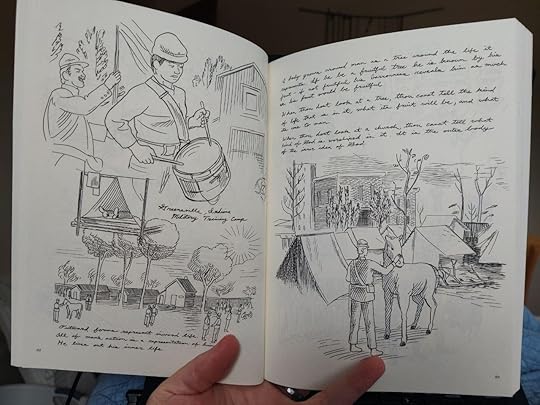
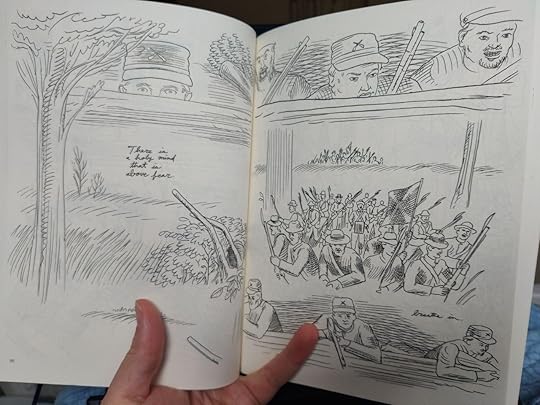
Out of all of this, though, my favorite page is probably one of the simplest. There is a page where the only text is “There is a holy mind that is above fear.” (p. 90) The page contains three simple pen drawings:
Above the quote, a man in a union cap peering above a log. The man’s view of the log and a tree, a field beyond that. The field zoomed in, showing the vague shapes of human forms, armed, but only just barely discernible.The man’s expression, though! It’s…there’s this spot that’s somewhere between terror and excitement where ‘happy’ and ‘sad’ and ‘angry’ and ‘understanding’ drop away and there’s just an ineffable sense of one’s own mortality. Duty is too abstract a concept to hold in the mind. And beneath that, “There is a holy mind that is above fear.”
Quakers, as…well, we’ll say ‘gently lapsed charismatics’, are no strangers to gnostic concepts of the worldly in contrast to the spiritual. It’s not uncommon in Great Awakening thought. It’s just that, in that moment, that spiritual side of you gets kicked back a half a pace. There is a holy mind that is above fear, but the weird part is that the disconnect remains.
I’m terrified for those in my life and the lingering grief I mooshed awkwardly into my previous projects. That part of me that engages with expectant silence is inaccessible. But it’s still there.
There is a holy mind that is above fear.
Anyway, all that to say that I really liked the book. I picked it in particular as I wanted something that explored that disconnect between faith and reality.
July 7, 2025
I came upon this by accident at the library and was attracted by the quilt pattern on the cover. The story is of a 17 year old drawn to volunteering for the Union army during the American Civil War. He comes from the heart of a Society of Friends community and is completely naive about what war means in real experience. He in Sherman's army and his community at home go through the war trying desperately to examine life and community's demands while measuring their actions against the teachings of the New Testament and those of Quaker thinkers. This is a painful and difficult process for them all especially for Charlie and his sister Fanny who needs comfort and support after her mother dies and finds it with Cyrus, by whom she finds herself pregnant.
It is interesting to follow Charlie as he prepares to confront Cyrus because you can literally see his hands form fists which relax as he decides to leave Cyrus' punishment up to God. That part of the story is left hanging a bit as this reader wonders what happened finally to Fanny and her child. I don't recall Quaker feeling being particularly tolerant of sexual misbehaviour.
The black line drawing in this book is unbelievably vivid and carries the noise, suffering, and violence of war straight into your eyes. There are time lapse sequences that have you experiencing the emotions of particular moments in a vivid way. When Charlie and his fellows break into a house looking for food we follow every moment as the one man sees and starts to steal a necklace but is stopped by the woman of the house who holds a gun on them. The upshot of the incident is that the woman shoots them from behind and is shot herself. The company returns later, arrests the daughter and burns the house. It is a perfect example of a moment becoming a whole example of how war starts.
How do we hold to the aims of peace creation in a violence infused world? What do we do about evil people with great power? There is a passage where it is suggested that slavery would have been ended in God's time without the need of war. Should we rely on that? What about those innocents who suffer in the meantime?
It is interesting to follow Charlie as he prepares to confront Cyrus because you can literally see his hands form fists which relax as he decides to leave Cyrus' punishment up to God. That part of the story is left hanging a bit as this reader wonders what happened finally to Fanny and her child. I don't recall Quaker feeling being particularly tolerant of sexual misbehaviour.
The black line drawing in this book is unbelievably vivid and carries the noise, suffering, and violence of war straight into your eyes. There are time lapse sequences that have you experiencing the emotions of particular moments in a vivid way. When Charlie and his fellows break into a house looking for food we follow every moment as the one man sees and starts to steal a necklace but is stopped by the woman of the house who holds a gun on them. The upshot of the incident is that the woman shoots them from behind and is shot herself. The company returns later, arrests the daughter and burns the house. It is a perfect example of a moment becoming a whole example of how war starts.
How do we hold to the aims of peace creation in a violence infused world? What do we do about evil people with great power? There is a passage where it is suggested that slavery would have been ended in God's time without the need of war. Should we rely on that? What about those innocents who suffer in the meantime?

November 14, 2021
I struggled with this. The Thee and Thou stuff I started to skim. I could guess what they were trying to say.
As for the artwork... nah. Just not appealing to me.
As for the artwork... nah. Just not appealing to me.

February 12, 2022
Another great success for Shaw!

February 13, 2022
Hard to read due to the font used for
The letters
The letters
May 21, 2022
Well, it's official; I've read my first graphic novel. This is a *novel* experience for me to read a comic book from cover to cover as my only experience with them beforehand was reading pages of 'BONE' or 'Naruto' over the shoulder of kids on the school bus. I don't know whatever dissuaded me from pursuing one of the highly sought after GNs that would be the most elusive targets come library day; if I had to bet on it, I'd say it had something to do with my mum ushering me into the world of Dickens at the same time.
Anyway, enough with that. Discipline! Good work! I came to know of this novel after reading Cinemascope's piece of Shaw after his release of 'We brought a cryptozoo'. Although I always wanted to read a GN at some point (said with no conviction), it was 'Discipline' 's hand-drawn aesthetic and time era that finally compelled me to do so. And well, it's good.
The story is exactly what you'd expect. A quaker goes to the civil war. There's an external conflict between the Quakers of his actions. That's it really. The drawings are quite good and have some artistic direction behind them when it comes to placement and action but I felt the material lacking. Our main protagonist writes beautifully but isn't particularly developed and the backdrop for the most engaging material is not explored at the end of the piece.
I was surprised at just how fast this book reads. It looks like it was going to be an undertaking of the likes of 'Anna Karenina' but due to the minimal text, it reads in about an hour and a half, maybe less. So plenty of time to take in those wondrous drawings!
Will be on the lookout for more like this!
Anyway, enough with that. Discipline! Good work! I came to know of this novel after reading Cinemascope's piece of Shaw after his release of 'We brought a cryptozoo'. Although I always wanted to read a GN at some point (said with no conviction), it was 'Discipline' 's hand-drawn aesthetic and time era that finally compelled me to do so. And well, it's good.
The story is exactly what you'd expect. A quaker goes to the civil war. There's an external conflict between the Quakers of his actions. That's it really. The drawings are quite good and have some artistic direction behind them when it comes to placement and action but I felt the material lacking. Our main protagonist writes beautifully but isn't particularly developed and the backdrop for the most engaging material is not explored at the end of the piece.
I was surprised at just how fast this book reads. It looks like it was going to be an undertaking of the likes of 'Anna Karenina' but due to the minimal text, it reads in about an hour and a half, maybe less. So plenty of time to take in those wondrous drawings!
Will be on the lookout for more like this!
November 30, 2021
3.5 stars. It was an interesting glimpse into the difficulty that the Civil War brought into Quaker meeting houses and homes. Staunch abolitionists and staunch pacifists, their closely held values collided with one another. Each Friend found themselves challenged by the choices they faced. Some, like the main character, went to war for the Union, leaving behind fractured communities and families.
The book embraces Quaker simplicity and silence. The story is bare and quiet. The reader must draw their own conclusions and truths from pages of simple drawings, punctuated with refrained letters between family and soldier. This approach presents a challenge for me. I can see and appreciate the intent, but I don’t have a Quaker heart. I actively dislike the silence of Quaker worship. The quiet simplicity of the book grates on me, leaving me agitated and wanting the author to do more and me to do less. For the introspective reader, this may be a deeply satisfying read. As a restless and somewhat lazy reader, I walked away intrigued but ultimately unfulfilled.
The book embraces Quaker simplicity and silence. The story is bare and quiet. The reader must draw their own conclusions and truths from pages of simple drawings, punctuated with refrained letters between family and soldier. This approach presents a challenge for me. I can see and appreciate the intent, but I don’t have a Quaker heart. I actively dislike the silence of Quaker worship. The quiet simplicity of the book grates on me, leaving me agitated and wanting the author to do more and me to do less. For the introspective reader, this may be a deeply satisfying read. As a restless and somewhat lazy reader, I walked away intrigued but ultimately unfulfilled.

April 10, 2022
During the Civil War, many Quakers were caught between their fervent support of abolition, a desire to preserve the Union, and their long-standing commitment to pacifism. When Charles Cox, a young Quaker from Indiana, slips out early one morning to enlist in the Union Army, he scandalizes his family and his community.
Discipline is told largely through the letters exchanged between the Cox siblings—incorporating material from actual Quaker and soldier journals of the era—and drawn in a style that combines modern graphic storytelling with the Civil War–era battlefield illustrations of the likes of Thomas Nast and Winslow Homer. The result is a powerful consideration of faith, justice, and violence, and an American comics masterpiece.
The graphic storytelling is also sparse, simple, and "silent" illustrating the ideals of Quaker spirituality quite literally.
A marvelous feat of storytelling.
Discipline is told largely through the letters exchanged between the Cox siblings—incorporating material from actual Quaker and soldier journals of the era—and drawn in a style that combines modern graphic storytelling with the Civil War–era battlefield illustrations of the likes of Thomas Nast and Winslow Homer. The result is a powerful consideration of faith, justice, and violence, and an American comics masterpiece.
The graphic storytelling is also sparse, simple, and "silent" illustrating the ideals of Quaker spirituality quite literally.
A marvelous feat of storytelling.

December 31, 2022
We follow fallen Friend Charles, who deviates from his Quaker path in order to serve with the Union army during America's Civil War, as he faces the brutality of war and grapples with what being a Christian actually means.
I liked the incorporation of real historical documents and letters into this work...I just don't think it was executed well. The imagery, on occasion, didn't match up or serve a gripping parallel with the letter excerpts.
I also think more time should've been spent on the Quaker meetings to show real conflict with their ideology and the changing times. The stakes- despite being in the middle of a war- don't feel very severe, and we're not shown any sort of consequences for the Quakers' action (or lack thereof). It might be a story specifically about Charles but considering how much of his life is dedicated to his Quaker community, one would think there would be some sort of full-circle moment/plot/etc.
Discipline, for me, just lacked depth.
I liked the incorporation of real historical documents and letters into this work...I just don't think it was executed well. The imagery, on occasion, didn't match up or serve a gripping parallel with the letter excerpts.
I also think more time should've been spent on the Quaker meetings to show real conflict with their ideology and the changing times. The stakes- despite being in the middle of a war- don't feel very severe, and we're not shown any sort of consequences for the Quakers' action (or lack thereof). It might be a story specifically about Charles but considering how much of his life is dedicated to his Quaker community, one would think there would be some sort of full-circle moment/plot/etc.
Discipline, for me, just lacked depth.

April 7, 2022
At first, I was comfortable with the format of the novel, but by the 2nd chapter I was able to let go of my uneasiness. The simple sketches, the cursive text, and the thee and thou language of letters between Quaker siblings, Fanny and Charles Cox, drive the narrative. Shaw drew inspiration from a text called Fighting Quakers by Duganne (1866) and other Quaker writings. He explores the conflict between pacifism, a Quaker testimony, and abolitionism. Charles leaves home to fight in the union army and Shaw unflinchingly illustrates the horrors of war by both Union and Confederate troops. At the same time, individuals in Fanny's Quaker meeting hold Charles in the light and pray for his safe return, despite some disapproval of Charles' enlistment. The letters between Fanny to Charles connect the stories together.

December 21, 2021
I think I would've understood what was going on better if I were better at reading cursive. But cursive is just a way to torture left-handed children, so I purged it from my brain. Unfortunately, it meant it took me a long time to interpret the text. Besides the cursive, which is a scourge on humanity and left-handed people such as myself and is rightfully stricken from general use, the imagery in this book is spectacular. However, if you don't know a whole lot about Quakers, you might be confused. Still, a beautiful graphic novel, I just wish it didn't use cursive. Left-handers unite! Don't let them torture us with endless ink stains!

January 29, 2023
A Hoosier Quaker goes against his family's wishes and enlists in the Union Army. The entire narrative is depicted in the form of letters exchanged by the boy and his sister. Dash Shaw foregos the standard sequential formalism of panels, and insteads renders pages of loose sketches to deliver the story. It's actually quite effective and I found the deviation from traditional form refreshing. But this is kind of a dry read, and the cursive hand-lettering for the letters makes for an excruciating read (this might just be a me thing). It's hard not to admire the inventiveness by Shaw, hence my overall positive review of Discipline, but it's far from my favorite of his works.

July 25, 2024
I read this graphic novel because it came highly recommended. It's the story of a Quaker man who chooses to participate in the Civil War because he believes it is against his religion to enslave people. Unfortunately, it's also against his religion to kill, so he is excommunicated from his church, though he will be forgiven and reinstated if he chooses to return to the community. All of the text for this book is taken directly from Quaker letters from this era. It was an interesting look at the Quaker way of life and the wrestling of ideals concerning the Civil War. There were just some confusing things in the story that I didn't feel were resolved.

November 10, 2024
Discipline, Dash Shaw
(The title does not match the content). This is a unique and special book. I picked it up and initially did not think it worthwhile reading. But I'm glad that I did read it. One of the best insights into what was going on in the hearts of some people in the American Civil War, through the letters to and from Fanny and her brother Charles regarding their Quaker ideals.
"Who expects to go through life, gathering roses, from which the thorns have already been plucked?" (p.43)
"The future loses sight of our professions [of love and mercy] and judges us as we are." (p.195)
(The title does not match the content). This is a unique and special book. I picked it up and initially did not think it worthwhile reading. But I'm glad that I did read it. One of the best insights into what was going on in the hearts of some people in the American Civil War, through the letters to and from Fanny and her brother Charles regarding their Quaker ideals.
"Who expects to go through life, gathering roses, from which the thorns have already been plucked?" (p.43)
"The future loses sight of our professions [of love and mercy] and judges us as we are." (p.195)
Displaying 1 - 30 of 66 reviews