Reverend Merrily Watkins finds herself replacing a retiring exorcist who is determined to make the transition as unpleasant as possible
Diocesan Exorcist: a job viewed by the Church of England with such extreme suspicion that they changed the name. It's Deliverance Consultant now. Still, it seems, no job for a woman. But when the Bishop offers it to Merrily Watkins, parish priest and single mother, she's in no position to refuse.
It starts badly for Merrily and gets no easier. As an early winter slices through the old city of Hereford, a body is found in the River Wye, an ancient church is desecrated, and signs of evil appear in the cathedral itself, where the tomb of a medieval saint lies in pieces.
short review for busy readers: 2nd book in the spiritual/paranormal detective series starring Merrily Watkins, female exorcist in the Church of England. Engaging, with a conspiratorial plot and lots of ghostly happenings.
in detail: I greatly enjoy the Merrily Watkins series and this volume was no different.
What's interesting is that the C of E's "Deliverance Ministry" (what used to be called "exorcism") is just now starting to expand and include psychology and trauma work. Traditional exorcisms of demons are now a complete rarity.
But that doesn't mean people still don't have run-ins with the indescribable. (Cue the Ghostbuster's theme! 🎵)
The old male priests who have been doing this work up to now don't think Merrily is up to the task because women "have no tradition" they can fall back on.
This is very true. Women -- as other characters show -- have often been seen as "working for the other team". All their "tradition" is in the witch/seeress department, as they were shut out from roles in the Church.
It also might be the case that women in spiritually responsible roles today attract a higher rate of male scorn and violence -- as it mentions in the novel that female vicars are often targets of hate crimes by virtue of them being female and therefore seen as weaker and easy pickings.
Both arguments I found extremely interesting, especially when seen in contrast to the occultist Athena White, who clearly is very much in control of the ectoplasm and not vice-versa.
Does that mean it's Christianity and the patriarchal worldview that makes women in the church more vulnerable to spiritual attack than men? If you don't buy into that -- as Athena White doesn't -- then it doesn't apply? After all, "belief is everything" as one of the exorcists in the novel says.
Interesting question.
There's a bit of a dramatic close to this novel that I thought was somewhat overdone, but all-in-all a highly enjoyable novel that raises some very interesting questions about women, faith and the supernatural.
I've read erratically wrt the series order, but the Merrily Watkins novels have definitely grown on me 😉
I enjoyed catching up with the second Merrily Watkins novel. I found this second instalment abit of a lull after the dramatic storm of the first novel in the series - in a positive way (tho not quite as much of a lull as Lulham). it provided a nice bit of time and space to step back from the dramatic introduction to the village, characters, the overall themes and subjects, and the series. tho it did pick up a little pace around a fifth/quarter/third of the way in, but not too much. some drama, and various plot lines establishing, I think later to tangle, but plenty time for reflection still 🙂
🌟🎚🌟
I very much enjoyed the introduction to 'deliverance'* 🙂 the novel spends quite alot of time introducing deliverance ministry within the Church of England, and some of it's history and politics, some of its more famous figures and written works too. I liked the exploration and sketching and establishment of all the aspects of deliverance in this novel, and found it interesting in itself 🙂
the novel also focussed on some of the politics of appointing a young female vicar as deliverance minister. there was pretty obviously highlighted sexism and gender role assumptions wrt skills perceived needed as a deliverance minister, and those wanted for the rebranding of exorcism as deliverance. and there was some exploration of the politics around women being ordained, and how a man who supported that might still have reservations and biases about women's roles and opportunities within the church. men having so many opinions, and control, over the direction that women's ministry takes... 😕🙄
🌟
the in passing mention of 'spiritual warfare' had me thinking about a herbalist I once interviewed as part of a dissertation, and her self identified role as a spiritual warrior within her Christian faith, and how that featured within her role as a healer. one thing led to another and I ended up internet searching abit to find out what someone I knew who had been an early ordained woman vicar was currently up to 😉
and it got me thinking about what a Christian friend in Norfolk told me about Spiritual Mapping, and about identifying historic awa current disruptions to peace in a place, and working with community to try to heal them, including the work they were part of doing locally... and had me thinking about that being a potential part of deliverance... 🤔
🌟
Merrily's consideration of accepting the role of deliverance minister, including within a context of both support of and antagonism towards her doing so - both perspectives presented being slightly extreme/polarised and ill-informed/unbalanced, had me thinking quite alot about the processes of reflection and prayer within decision making 🙂
🌟🎚🌟
⛰🌳⛰
the setting for these novels is a village on the English-Welsh borders, and there's generally quite alot of focus on longstanding families and residents, awa the experiences and positions of relative newcomers. this novel focussed on one family, whose presence in the area possibly went back millennia. I really liked the thoughts around the linking of people and place - generations settled and working the same piece of land.. until something breaks it - and how to heal that. the lines stretching back thru history and prehistory. and the linking/paralleling of this to some extent with Ley lines, connecting spiritual places and points in the landscape. (Alfred Watkins, author of The Old Straight Track and who was from Herefordshire, gets quite abit of reference in this novel 🙂)
⛰🌳⛰
we meet Catherine Moon, a rather ethereal archaeologist. her role initially seems in part to bring in an exploration of aspects of mental health, within individuals and families, and Lol's psychiatric history and current psychotherapy training. and to raise the possibility of a relationship between her and Lol, tho more to highlight/look at the attraction (and challenges/barriers to it) between Merrily and Lol...
tho she also provides a link to some of the local pagan practices and practitioners, both in her familial and archaeological links to land, and her exploitation, manipulation, and ultimate victimisation by others' agendas.
I think a big thing in this novel was exploring the 'good' and 'bad' people and practices within both the Christian and Pagan traditions, and within psychology too.
🌟
I quite liked the 80s references... including the in passing references to Merrily's punk past 😉🎵🎶
(music and musicians often feature in the series 🙂)
🌟
there was also a strong focus on teenagers, and some explorations of family dynamics, relationships, friendships, peer pressure, manipulation... and parenthood and single parenthood. I think the latter, and some more diverse/less traditional family structures, is a strong line through the series 🙂
🌟
o, yeah, I should make a brief mention of the climax and central core of the novel!! 😆 a demon in the cathedral! set loose by some work on a tomb... was it deliberate or accidental? 😉 I liked the researching of the history of the place, it's priests, and the discussion of evil residing contained over time, tho always ready to be disturbed.
🌟
the sexualisation (including of language) at times, and threat towards women, still bothers me quite abit... it's there to some degree in most of the novels I've read so far. I don't much like it, and it's probably the thing I like least about the authors choices. tho I also understand why it's there, particularly in the context of the structural and institutional shit of this kind still very present in UK, and Euro-Anglo, society. but it continues to make me uncomfortable, I think because I'm aware some people kinda get off on it 😕
🌟
not the last Merrily Watkins novel I'll be reading 😉
🌟
accessed as a library audiobook, nicely read by Emma Powell 🙂
🎚🪦🌳
*I got curious if the Church of England does have a named deliverance minister role like this, or if Phil Rickman made it up? it does!
The Witness is abit clearer, tho also comes off as slightly sensational. thinking about some of the language, maybe Phil Rickman drew on it 😉 : https://thewitness.org/what-is-delive...
This is the second in the Merrily Watkins series, which sees her training for the post of Diocesan Exorcist in the Church of England, or ‘Deliverance Consultant,” as the Bishop (‘Call me Mick’) prefers to name it. The previous holder of the post, Cannon Dobbs, seems to resent the post of a female Exorcist and Merrily also has to battle her own concerns and problems. Especially after she is called to the bedside of a dying man, after the nurses claim they are afraid of him…
Like all the Phil Rickman books I have read, this is a novel with several inter-weaving threads running alongside each other. We have Merrily’s daughter, Jane, and her older, new friend, Rowena. There is Lol Robinson and a vulnerable young woman, Catherine Moon. A haunted care home, Satanism, anonymous letters and struggles within the Church.
I listened to the audio version of this, read brilliantly by Emma Powell, who brought all of the characters to life. I look forward to reading on in this series, as well as exploring more of Phil Rickman’s stand alone novels. Absolutely brilliant – chilling, creepy, intelligent and a wonderful cast of characters.
A creepy yet cozy paranormal British mystery that takes place in a sleepy English village. The writing is excellent, and I love all of the main characters. Plus, I'm loving some of the quirky minor characters. This one, the second in the series, lost a star due to the Moon storyline, which never really captivated me, although being crucial to the plot, it was necessary. The audio version, read by Emma Powell, is also very well done. I couldn't ask for anything more from this series so far.
One other note about the audio: Not sure why the audio performance does not include the one-page "Closing Credits", which is much more than just a list of people the author wants to acknowledge. It explains that the novel is set in a real location and loosely based on real people. I found it really increased my "creepy factor" to learn that there actually is a Deliverance minister in Hereford. And there really was a Denzil Joy. I decided to add that information to my review in case anyone is listening only, rather than listening in conjunction with a paper book, which is how I read audiobooks.
I will definitely continue with this series. They come from the UK and aren't easy to find, but I've been getting secondhand copies in excellent condition on Amazon Marketplace (for only about $4 including shipping, a real bargain for these books).
Description: This series follows country vicar Merrily Watkins, who is one of the few women priests working as an exorcist in the UK. When a grisly murder takes place in her local area, the police come calling for her assistance.
Another enjoyable, outre, 3.5 star read from Phil Rickman rounded down to 3 stars. Oh, Merrily, I had much higher hopes for your development in the role of Deliverence Minister!
Midwinter of the Spirit is the second book in the Merrily Watkins series.
Reverend Merrily Watkins is a mum of one who joined the clergy after her husband died. The book starts with Merrily on a course to become a deliverance minister. The diocese already has a deliverance minister called Cannon Dobbs who is due to retire shortly. A new bishop has joined the diocese who no longer wants to use the word exorcism and prefers the sexed up phrase deliverance minister.
When the local hospital asks the bishop for a deliverance minister he gives Merrily's telephone number. The patient is dying but is so malevolent the nurses want spiritual guidance from the church to protect themselves. His final death scene was so shocking it left Merrily shaken.
Merrily's daughter Jane does not agree with the church and is interested in spiritualism. She disapproves of her appointment to deliverance minister and calls Merrily the soul police. Jane makes a friend at school called Rowenna who is also into spiritualism, they join a club called the hub which attracts Satanists.
I enjoyed this book but at 560 pages the author could have trimmed the book without affecting the storyline. I understand that Moon was an important character to the plot but I think her part could of been cut. This book was not scary but the plot did leave me with a tingle going down my spine. I have another book in this series and I hope Merrily becomes more settled.
Whereas the first book about the new female parish priest of Ledwardine eased its way slowly into paranormal territory, this second book jumps in with both feet. It opens with Merrily taking classes on how to be a "Deliverance minister", which is the hip new way to say "exorcist". This seems to be a real Church of England thing.
I am surprised at how much I liked this, since ghosts and demonic possession and satanism are not the kind of fantasy I usually prefer. Rickman’s writing and his pacing are really excellent: this is absorbing and suspenseful.
And while "subtle" is not the word I would use for the paranormal stuff, I am impressed that nothing actually happens in the book that couldn’t be explained away rationally. All the supernatural evil elements are a matter of perception, although they certainly feel real to Merrily, and to other characters, and they are treated seriously. I appreciate the absence of people floating above their beds, or heads spinning around, or portals to Hell being opened - although if the author continues to escalate he may get there before this series is done.
This is the second book in the Merrily Watkins series by Phil Rickman and I enjoyed is a great deal. I had previously written a review of the book but it seems to have disappeared from my goodreads shelf and I could not leave one of my favourite reads without a review. Merrily Watkins is the new vicar of Ledwardine in Herefordshire; she is also the Diocesan Exorcist or Deliverance Minister! Merrily is a single mother (widowed) with a teenage daughter. There is some sexism in the Church of England regarding her appointment and Merrily has to be a strong character in order to hold her own and do her job in the best way that she can. The book is really scary and the character of Denzil Joy made my flesh crawl! When I discovered that there is a Deliverance Minister and that the person Denzil Joy really existed I was astounded and even more affected by the story. Things in Ledwardine and at the Cathedral become very frightening and also very dangerous for Merrily and her daughter is also at risk. Merrily has to make some very difficult decisions, both professional and personal and what she decides will impact not just upon herself but also on other innocent (and evil) people. All of Phil Rickman’s books are a wonderful read and he gives such life to all of his characters, not just the main ones but the 'bit part' ones also, this makes the reader feel that they know the village and its occupants and makes a great difference to the believability of the story.
Wow I loved this book especially as it was based in Herefordshire where I have made my home. Such a beautiful county.
I have read several books by Phil Rickman previously but not this one, I came to this book when I saw that it was going to be turned into a TV program. Unfortunately work has been manic and I missed the first installment on TV so I cracked on with the book. It drew me in from the first pages. Merrily is unlike any vicar I could have imagined, she drinks, smokes and swears. Then again she is only human.
After several chapters I sought out the 1st TV installment and I must say I was a bit disappointed it differed vastly from the book. So I set the programs to record and got on with reading. Much more rewarding. I would recommend the book over the program any day.
Its all the more interesting reading a book based in a location you have knowledge of and I found myself driving around and then even doing extra research about the Hereford Cathedral and St Thomas Cantilupe. I even checked out about the Boy Bishop Ceremony which is totally real. AWESOME!
I really tried with this book as the reviews were so good and the synopsis sounded original. I have rarely read a book of this genre either so curiosity played a hand in my choice initially. As already mentioned I really tried but struggled with it. It was quite slow at first and I didn't like the the slowness of pace. I found that every time I began to get faintly interested the story jumped to another characters such as Lol and Moon or a different topic. I found this confusing and it prevented me from interacting with all the characters. When Merrily was called out during the night to a dying man suspected of being truly evil and dangerous, I thought I had got into things at last, but sadly that was it. My interest flagged more and more. I also thought there was far too much tedious dialogue between Merrily and her daughter. In the end I decided to give this book a miss and try another of Phil Rickman's novels.
Ghastly stuff... got as far as this Merrily priestess woman trying out her spiritual attempts with a dying man who manifested all that is "evil" before expiring at hospital. No more, thanks. I don't know and cannot determine if this is meant to be entertaining or funny. I am not going further with this series. I could list two dozen other events or interactions that led up to this attempt at exorcism but don't have the stomach to recall the offensive stuff I read. Will read no further.
I'm really alone here with my rating but I'm sticking with it. One of two things is going on with this author and his character Merrily. Either he hates her or he doesn't know how to write female characters. One of the themes of this book is the problem women clergy have as they minister in their churches. They are raped, dismissed, not taken seriously, told to their faces that a man is needed for the particular job, etc. Merrily encounters quite a bit of this, except for the raping part so far. Although she's been sexually assaulted, particularly in the first book. But Merrily takes as one of her confidants a man, Huw, who tells her early in the book she shouldn't take a job as an exorcist because there aren't centuries of tradition behind her to combat the crazies that will come out of the woodwork when they realize she's a FEMALE exorcist. Not only does Merrily continue to seek his counsel, she says he's a right good person and talks him up every chance she gets. Wha? Being a woman myself, I would consider his remarks to be condescending twaddle. The centuries of tradition behind her is the Anglican church and a person fills a job with what they have within them. If a man was a weak, wailing, yellow-bellied idiot then guess what kind of exorcist HE would be. And in the end of the book, Huw, tells her , well no duh you jerk. And Merrily herself thinks . Holy cow woman, what is your problem? I think very few women authors would have had Merrily skipping down the road of good intentions with Huw. It doesn't sit right.
So really this book was ruined for me by one conversation early on. I kept trying to forget it and then I tried rewriting the conversation but my bubble was burst and I couldn't help seeing all the other crackpot things that Rickman did to Merrily. For the second book in a row, Merrily is unable to sleep. All ALL the other characters keep commenting on how tired and worn down she looks. For the second book in a row she's susceptible to malign spirits who make her ill. For the second book in a row, her only allies are her temperamental teenage daughter and a dodgy ex-rockstar who used to have severe mental problems but is now just completely lacking in confidence. For the second book in a row, men come on to her in disgusting and inappropriate ways. For the second book in a row, Merrily doesn't have much confidence in herself and makes stands at stupid times and gives in to others at stupid times and makes her life so much messier than it needs to be. Even, for the second book in a row, her house attacks her.
I don't think Phil Rickman dislikes women. Other women characters seem to have their acts together whether they are on the side of evil, good or only out for themselves. They have experience and confidence and know what they want. Apparently Rickman doesn't want this for Merrily. He wants her sick, cold, sleep-deprived and attacked on all sides. Maybe the third book finally allows Merrily some balance in her life. I hope so, but I'm not sure I'll be reading it. This series has such potential and obviously lots of others love it. I expected to love it after having read the first book.
While I really enjoyed this book, I would rate it a low 4 stars due to the fact that it felt quite disjointed. I would have preferred a better flow. The chapters were short, and within the chapters were POV shifts. Perhaps the book was written this way to create that feeling of confusion. But, it will in no way prevent me from reading more books in the series. I'm quite invested with the main characters - Merrily, Jane, & Lol.
This book dove much more into the realm of the supernatural that the first book as Merrily became the diocese's new "Deliverance" minister, also known as an exorcist.
A bit of a slog, I had to force myself to get to the end. Merrily was not quite so annoying as in the first book, but her daughter was. However, the main problem is with the plot which just get more and more absurd. If you can accept that there is a satanist plot to infiltrate the Church of England by planting long term moles then ok, but I didn't manage that leap of imagination.
first 3/4 of the book annoying, last 1/4 awesome - so many characters, you keep getting dropped in the middle of a scene or conversation, until FINALLY everything ties togethers, all the pieces fall into place, and you're glad you stuck to reading it although I've wanted to stop several times during the first half.
Again really liked it. Lots of different story lines made it seem a bit confusing (mirroring Merrily and Jane's experience of it I suppose)but it all came together beautifully. I didn't see the ending coming. These books seem especially good now the nights are closing in...
I enjoyed this more than I liked "The Wine of Angels." I appreciated Merrily's vacillating state of mind as she struggled to resolve her calling with the reality of life in the modern era.
This was another compelling read for me from this author. The start tells of Merrily Watkins on a training session to be a candidate for the position of a new Deliverance Consultant (the new name for Diocesan Exorcist). She does have doubts at first, but then when it is decided that she is successful, she hope it isn't just that she is a female priest, which are relatively new. She is then thrown into the deep end by being called to a man who is dying in hospital, who the nurses there are afraid of. This then turns out to be quite a frightening situation. This a just part of the story, which has several incidents running along side it, together with Jane, her daughter, making a new friend who causes Merrily some concern, and Lol a friend who also seems to be caught up in sinister occurrences. I am very interested and eager to carry on with this series.
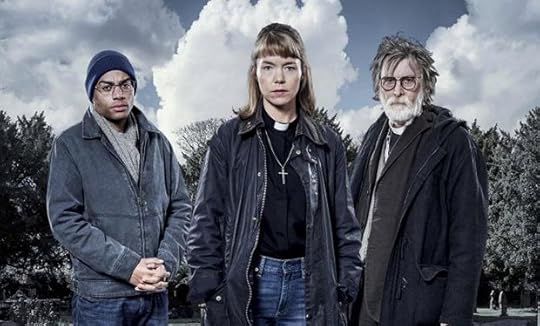
Parish priest, single mum, chain smoker, exorcist.... Satanists are planning something really evil in Hereford and, with the help of her daughter Jane, shy folk singer Lol and grumpy Yorkshireman and head exorcist Huw, its up to newly appointed deliverance (exorcist) minister Merrily Watkins to stop them. Slow placed and complex with some brilliant characters. Don't be put off by the very average tv adaptation, they only used about a 3rd of the book and although Anna Maxwell Martin was a really good pick for Merrily, for me Merrily will always be Nicola Walker.
As Winter draws in here the lure of the supernatural lingers. And so, as a result, I picked up the second book in the Merrily Watkins series by Phil Rickman. (The first book, The Wine of Angels, was reviewed by me way back in 2011.)
The second book continues to build on the premise of the first novel. Merrily is still debating on whether she actually wants to be a Deliverance Consultant (aka an ‘exorcist’ by the non-secular) as well as the vicar of Ledwardine.
This time around it’s a story of possession and spiritual entrapment, set partly in historical Hereford Cathedral as well as in Ledwardine village. In Hereford Merrily is being persuaded by the trendy bishop Michael (“Call me Mike”) Hunter to take on the role of Deliverance Minister for reasons that are not always entirely clear. It seems that the choice of Merrily may be political, partly to annoy Canon Dobbs, the imminently retiring Diosesan Exorcist, who seems dead against a woman being the next. Unsurprisingly Merrily does not like that idea.
With a title Midwinter of the Spirit, it should be clear that there are times when things seem rather bleak here. Merrily and others do a lot of soul-searching, and it is difficult, life-changing stuff. Merrily begins the book going on a Deliverance training course, where she meets the gruff Welshman Huw Owen, who bluntly suggests that the job may not be for her. Events early on in the novel even make Merrily question the choice herself, and she is mentally and physically affected by one visit she makes to a hospital patient.
Seeing the physical and mental toll such matters have on her mother, Jane is also unsure whether her mother is doing the right thing. She also has some heart-searching to do, for as much as she wants her Mum to follow her belief she also thinks that by taking on extra duties her Mum is being lured even closer into organised religion, which in her mind is a bad thing. Jane herself is also uncertain about the purpose and meaning of religion in a modern society. With her friend Rowenna, a new arrival to the village, they visit a spiritual fair, which further confuses Jane on matters spiritual.
Others also questioning their purpose and self-meaning are characters first met in The Wine of Angels. After leaving Ledwardine and moving to Hereford, Merrily’s friend, retired musician Lol Robinson, is asked by a friend to look after his sister, fragile young woman Katherine ‘Moon’. Moon is trying to rebuild her life after a number of events, and to do so has returned to the place where she was born – and also the place where her father committed suicide when she was a child. Lol is torn between his friendship of Moon and his unrequited feelings for Merrily and becomes connected to events as the book progresses.
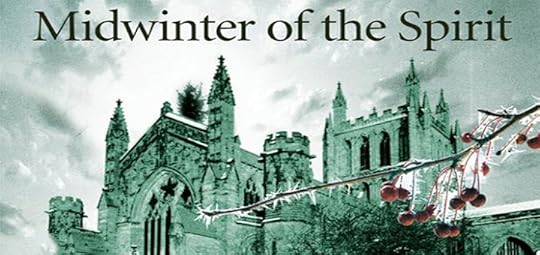
Of these events, there’s a range of odd to choose from. A body is found in the River Wye near the Cathedral, a nearby ancient church is desecrated, which Merrily has to investigate, and, perhaps scariest of all, signs of evil appear in the cathedral itself, where the tomb of medieval saint Thomas Cantilupe is being renovated.
It’s a potent mixture of contemporary values and ancient history, with current events linked to the past and the folklore of the area. What Phil manages to do so well is combine his fictional characters with real places and history, which grounds them in some sort of normality. Whilst there are supernatural events here, they’re slight enough to be readable by those who just like a good suspense story. The characters show progression and they’re engaging enough to keep the pages turning.
Midwinter of the Spirit takes a little while to get going. It’s a slow build of a book, but by the end all makes sense. Whilst there’s a slight feeling that things tie up a little too neatly, there’s also some intriguing plot points and characters that are set for no doubt further revelation later in the series (which is now up to fourteen novels, with a fifteenth due next year.)
For those hankering after a wallow in British rurality, combined with a certain creepy thrill, this series delivers.
Do you believe in the Devil? Reverend Merrily Watkins, Hereford’s, and possibly the country’s, first female Deliverance Minister is told that a healthy amount of scepticism is needed as well as a low profile and plenty of fuse wire. However Deliverance is basically a softer way of saying exorcism and the more Merrily sees of the supernatural forces, the mores she is drawn into a web of Satanic influences that could include her own daughter. Like all Rickman’s books, Midwinter of the Spirit effortlessly combines the real world with the mystic and a hefty dose of Folklore.
Merrily is an endearing heroine. She is courageous, fallible and sympathetic. Throughout the book I wanted her to succeed. Jane, the errant daughter was perhaps more feisty and amusing. I liked the way she would refer to Merrily as ‘Reverend Mum,’ and how she struck out to follow her own path even though it was not always with the best of intentions. It is not made clear at the end of the book but I hope that Jane continues to find a balance in her own spirituality as I would be disappointed is she reverts back to her mum’s Christianity and becomes one of the ‘soul police.’ The relationship between these two women was one of the things that made this book so engrossing to read. The tension of their love for each other set against different views of the world made it a complex and changing thread throughout the book.
The other characters in the book are also well drawn and engrossing. I especially liked the paranoid and lovable Lol Robinson. The crusty and intimidating last exorcist, Dobbs, is, for the most part, an ominous shadow, but it is a long one that stretches through the book and haunts many of Merrily’s footsteps. The up and coming Bishop of Hereford is a smooth and smarmy git, but his purple tracksuit deserves a mention.
Despite having a reverend for a main character and a daughter with a curiosity in the pagan this is not really a book about spirituality as such, at least not beyond the confines of the characters. It does raise interesting questions about how religion works. Like magic, which is a prevalent theme in most of Rickman’s work, it seems that the power of religion only works if you believe in it. When those who are responsible for holding the church together don’t believe then the gateway is open for the satanic nastiness to creep through. It is a very pragmatic approach and yet it the belief of the characters works. The Satanists belief in their power have devastating effects on Hereford Cathedral and it is only the belief of a few priests who can stop it.
This book is part mystery and part horror. There are not many ‘boo’ moments, but if you like horror that gets into your head and messes with your mind this is a book you should try. I also loved the way that so many disparate plots are drawn together by the end of the book. Real life would never be that neat, but in fiction it is satisfying to see it all come together. The Devil doesn’t quite make an appearance by the end of the book. But something unexplainable and evil is definitely loose in Hereford.
What a strong sequel!! Rickman offers one of those rare sequels in Midwinter of the Spirit - one that surpasses the series opener! The entire novel is creepier and spookier, providing genuine spine-tingling chills as the story progresses. Though lengthwise it is no shorter than the first book, the pacing does not suffer the same sort of inconsistencies (although the ending still came a bit too quickly for me!).
The characters that Rickman so carefully constructed continue to develop, and their relationships become more complex and layered. I am particularly drawn to Lol, and I really like the dialogue interchanges between him, Merrily and Jane. I hope to see these relationships continue to flourish as the series moves onward. Some of the new characters that appear in this second book, I genuinely hope will be series regulars - particularly Athena - she is so charming! This is a very enjoyable read - I even found myself liking Rickman’s villains!
The overall style of the novel has begun to remind me a bit of the writing of Sarah Rayne - another British mystery writer that does not seem to have caught on much in the U.S. Both Rayne and Rickman create “meaty” sort of mysteries - the characters are richly detailed and the plot’s intricacies all eventually interconnect.
The supernatural element that one would expect in a series about an exorcist is stronger in this book. Rickman handles this well, and it makes me even more curious and excited to see where the series will go from here. I adore the characters, so I am quite excited that I have started reading this series when there are quite a few books already published and waiting to be read!
There's a nebulous quality to this author's writing that makes me frustrated. I just don't believe the voices of the characters. Jane is irritating in her willingness to be friends with any old person who can manipulate her. She speaks like no teenager I've ever met (and I teach her age group). Merrily too is annoying with her constant patronizing of her daughter with "flower" even when they are arguing and her desire for a smoke all the time alienates me. Has this author never argued with a teenager? You just can't speak to them like that without raising the stakes considerably. Conversations are often insubstantial, so I am left thinking " what did I just read?" And need to re read to get the gist. I think I'm just too much of a sceptic for this series. I don't believe in either a god or a devil, so I'm left in limbo. Mind you - I'd happily check out a video of the text.
I loved this book intensely the first time round. Now, as with other things I’ve read, I see its shortcomings a little better upon a second read. I still feel Jane is poorly-drawn in some ways, a little condescending. And how odd that she doesn’t seem to have just come through the harrowing experience of narrowly avoiding being assaulted then murdered by serial rapists and murderers? Sorry, she should be suffering from some intense PTSD rather than coyly trying to get her mother laid. Somewhat beggars belief. But I think the plot is otherwise fairly clever. Rickman applies a deft hand to the supernatural, leaving a battle between the forces of good and evil in a technologically-advanced, spiritually banal age somewhat plausible here. I’m still impressed and pleased with these books and there will always be a place in my heart for Merrily Watkins and Huw Owen.
A brilliant mix of mystery, magic, crime, evil goings on, human relatiomships and complex characters. Add in some good descriptions, a compelling pace and a real sense of place and you get an excellent book. An absolute pleasure to read.
The central character, Merrily, is embarking on a career as an exorcist, which brings her into contact with all kinds of strange people and activities. A very nasty plot links some of her strange encounters, and the story builds very effectively to a dramatic climax. A real page turner towards the end.
Midwinter of the Spirit by Phil Rickman. Book 2 in the Merrily Watkins series. Really enjoying these mashups of crime and supernatural blended with the Church and English folklore. Atmospheric and creepy as hell, with a brilliantly complex protagonist in Merrily, who questions her faith and sanity while juggling her calling and her responsibilities as a parent against increasing evidence of satanic practices and possession. It's a bit like Midsomer Murders meets The Exorcist.



 Re-visit via miniseries.
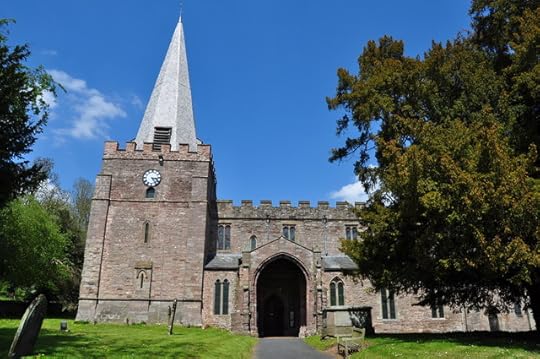 Ledwardine