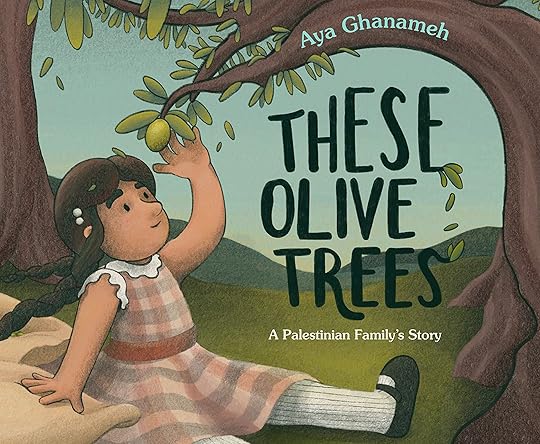
The story of a Palestinian family’s ties to the land, and how one young girl finds a way to care for her home, even as she says goodbye.
It’s 1967 in Nablus, Palestine.
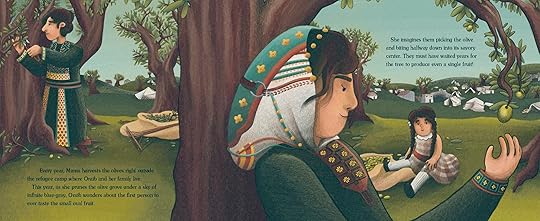
Oraib loves the olive trees that grow outside the refugee camp where she lives. Each harvest, she and her mama pick the small fruits and she eagerly stomp stomp stomps on them to release their golden oil. Olives have always tied her family to the land, as Oraib learns from the stories Mama tells of a home before war.
But war has come to their door once more, forcing them to flee. Even as her family is uprooted, Oraib makes a solemn promise to her beloved olive trees. She will see to it that their legacy lives on for generations to come.
Debut author-illustrator Aya Ghanameh boldly paints a tale of bitterness, hope, and the power of believing in a free and thriving future.
Aya Ghanameh is a Palestinian illustrator, writer, and designer from Amman, Jordan currently based in New York City. Her work moves away from state-centric ways of thinking to center the voices of ordinary people in historical and political narratives. Her debut children's picture book, THESE OLIVE TREES (Viking Books, 2023), is inspired by the experiences of her family who cultivated her love of the earth throughout her upbringing in exile. Aya graduated from the Rhode Island School of Design with a BFA in Illustration and a minor in Literary Arts & Studies. Previously a Children's Books & Gifts Design Fellow at Chronicle Books, she is now a Designer at Penguin Workshop at Penguin Random House.
This is such a beautiful picture book, I knew Aya from Twitter when she was a graduate student and this book was her graduation project. Such beautiful illustrations and ideas, the olive tree runs deep into the soul of everything Palestinian, my grandparents actually took many seeds and sand from Palestine to plant it in their new home back in the day. Food and gardening are the essence of Palestinian families.
This book isn’t even out yet and I already love it! A Palestinian Queen of an author who accurately depicts the struggles of Palestinians under illegal occupation and apartheid everyday. Definitely will read this and definitely will recommend to everyone (especially nasty Zionists) to read it too. #FreePalestine
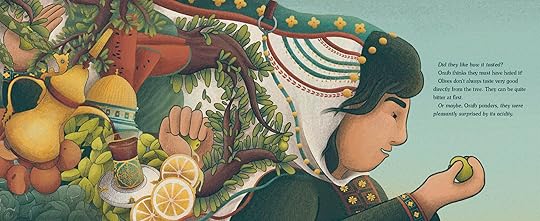
This stunningly illustrated OWN voice Palestinian book for early elementary kids is an important story and I love that it is coming out to the world, but I do have some issues with the literary aspects and target demographic. The story bounces around from being factual about the brining and curing process of turning the bitter olives into numerous things, to Oraib's present life in the refugee camp, to memories of the family's life in Al Tira. When war once again drives the family from their home in the Balata refugee camp, Oraib, plants seeds and vows to return one day to harvest the fruit. The language at times is very mature and complicated for ages 5-8, I felt uncomfortable with the family moving being attributed to war and not occupation, and at one point it clearly articulates there are many olive trees located outside the camp and that they are leaving the seeds that would be later planted, so why is the climax her asking the earth permission to plant one more and for the sky to water and care for it until she can return? The backmatter allows the book to be used to spread awareness about Palestine and the process of harvesting olives, but the illustrations will appeal to younger readers, and the concepts contained seem more geared for slightly older ones. There is nothing religious in the book, there is depiction of the Dome of the Rock in an illustration and I believe the author/illustrator identify as Muslim.
The writing style of the book is fairly surface level with concepts not fleshed out to allow difficult concepts to reach younger readers. When describing the taste of the fresh olives, Oraib wonders if long ago people were, "pleasantly surprised by its acidity." No insight into what that acidity tastes like, or bitterness, or what curing and brining means. Often the paragraphs seem long winded and repetitive, adding very little to advance the story.
There is little lyricism in the text, and the first time some tries to peek out, the metaphor is quickly abandoned, and it is notable that it doesn't return. The occasional enjoying of the bitter fresh olives is juxtaposed with the surprising joy occasionally found in the camp, it seems that with the uprooting of the family once again at the end, this thread would have been a natural inclusion to reinforce the patience for something better to occur.
The dramatization of asking the earth and sky when planting a seed upon their departure, didn't make much sense to me. It is noted there are olive trees already there, the illustrations show the ground littered with seeds that were to be planted had they stayed, so why not have the little girl pocket some of the seeds to take with her wherever they go. That is after all what the mother is doing at the beginning. Why not have the little girl invest in the cause herself and share in that ownership that they will always endure and prosper. The personification of the earth, sky and rain also doesn't seem to fit the flow of the story, so much is internal observation and reflection of the main character, that this seems like an attempt to bring it back to a child's level that instead just reads disjointed.
I might have missed something as I am not Palestinian, but the book to look at is incredibly beautiful, I just don't think it will be read and remembered by young children. One of my first thoughts when reading it was that it was an early draft, but it is to be published soon and this review is based on the most recent version sent to me. I also wondered in the back of my mind if the book was allowed to be used to check a box, and wasn't given the editing and polishing that it deserved on purpose. It depresses me to even think that, and I guess I'll never know, but I would love to hear your thoughts, and I do hope you will request your local libraires to shelve the book as a show of support to authentic Palestinian voices.
A beautiful book based on the author’s own memories and family experiences of being a Palestinian.
Genre: Adv. Picture Book Ages: 5-8 Author and Illustrator: Aya Ghanameh Publisher: Viking/Penguin Kids
This gorgeous book shows Oraib, a young Palestinian girl, who lives in a refugee camp. Each year her and her family harvest olives from the trees around them. Olives are so important to her family and Oraib thinks about how there is joy even in the bitter taste- and how useful they are for life in the camp. But after displacement and war comes to the camp, the young girl and her family are forced to leave the only home they’ve ever known. Oraib plants an olives in the ground as a way to have hope- she promises the land that she will be back to see the tree grow, even if it takes a long time.
The book’s illustrations are absolutely stunning and show memories and even sadness in emotionally soft ways that are kid friendly.
Reading this book was an emotional process - honestly I read it multiple times to fully feel all the emotions as well as uncover the layers of symbolism. I appreciated the authors note in the back that shows the truth of Palestinian displacement, and also how the text compliments the story by showing how rough it can be to grow up as Palestinian.
The olive trees symbolize Palestinians in the book - showing how even though the trees take a long time to grow, and even if they are torn down and displaced, their seeds are in the land, and will grow once again. This symbol of hope- of returning home -is something that is present in each Palestinian’s heart, present in the keys they hold dear, and the memories they hang on to.
Definitely an important story and one that brings a fresh perspective and gorgeous art to gently teach children and adults about the reality (the bitter taste but the powerful roots) of being Palestinian.
A beautiful picture book exploring the displacement of Palestinians from their land through a conversation on their connection to that land. I loved it. The illustrations and story were both beautiful, and I'm so glad to have read it.
I had heard about this book for a while now, and I didn't know if I was prepared enough to answer all the questions my little ones ( 4 year olds ) might have. So, I had not picked it up for bedtime reading until now. I don't agree with the reviews that say it is pushing propaganda. It is an Own Voices book and it does just that. It talks about a child named Oraib from Palestine and her family's story.
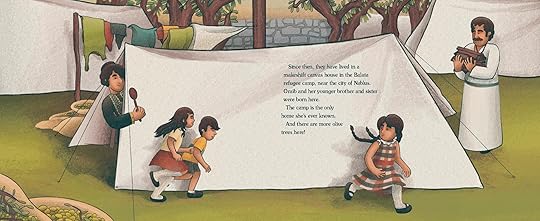
As expected, they wanted to know a lot - words like refugee camp, war, living in tents, having to leave their beloved olive trees behind as they haven't more again - all of these brought out so many questions in them. Is there any war happening around us? Will we have to pack up and move too? Do you know someone who had to live like that? I answered them to the best of my abilities, assuring them about now and telling them not to dwell on tomorrow. As Oraib's mother assures her in the story that where they have to go, they will be together, I try to work on the same assurances. It is up to us as a parent to decide how much in detail we would want to go.
I have realised one thing though - not reading such books to them isn't going to keep them isolated from these realities of life for ever. A few weeks ago, the word war did enter their vocabulary, thanks to the news and media. So, I do plan to keep reading these books to them, letting them ask questions, asking them for some time to think if I don't have an answer for a question right away. Every reading, every story about wars and refugees is going one more opportunity to talk, to adjust my previous answer, add age appropriate details and nuance, and so on. I am trying to keep my answers free from bias ( and I know, I have quite a few my own ). In the end, these books are not a means for me ( or any parent ) to convince them that my opinions and convictions are the right ones. They are going to have opinions and beliefs of their own as they grow and become adults. For me, these are opportunities - to talk, to discuss, to ask questions, to exchange opinions. These are not debates, not yet. Maybe, they will become so in the future, but I do hope to find the strength to keep it unbiased and non judgemental to the best of my abilities.
It's so heartbreaking to read this one and see how Palestinians are being banished from their land because of the "war". The line "The camp is the only home she's ever known" is proof that so many people don't even have a place to live permanently, like Oraib. But I admire how Oraib stays together with her family, and they always have each other.
I really hope and pray from the bottom of my heart that Palestine receives a permanent ceasefire and can build comfortable households, friendships, and a beautiful environment in their land. So many lives in Palestine deserve to thrive and have a future in their country. From the river to the sea, always and forever Free Palestine 🇵🇸🤍
“if the olive trees knew of the hands that planted them, their oil would become tears.” the words from Mahmoud Darwish carry the grief of the Palestinians to this day. may we live to see a Free Palestine where Oraib will return for her harvest.
“Wait for me, one day when we’re older, I’ll return to you for harvest.”
This book left me with an ache in my chest, a mix of sadness and hope. 🙁 It's a story about a Palestinian family—Oraib and her mama live in a refugee camp, constantly moving, losing their home, and yearning for their land. That’s… not something you can truly get unless you’ve been through it. 😢 There was a scene that stuck with me—seeing Oraib plant an olive pit, even though she might not see it grow. That act might seem small, but it speaks volumes about strength and resilience. It made me think about all the news I see about Palestine and realize there are real people behind those stories, and you should know that the story is inspired by the author's own family history. Oraib’s story, while fictional, reflects a reality many Palestinians face; they’re just like Oraib, holding onto hope and their heritage even when everything feels uncertain, and their voices deserve to be heard—their struggles, their hope, their strength.
aya ghanameh is not a writer but an illustrator. she made this book for oraib, her grandmother who died two years ago. she wrote this book about her.
little oraib at that time, considered olive trees to be a source of life for the people in the refugee camps. the wood can be burned or made into tools, and the fruit oil can be used as food.
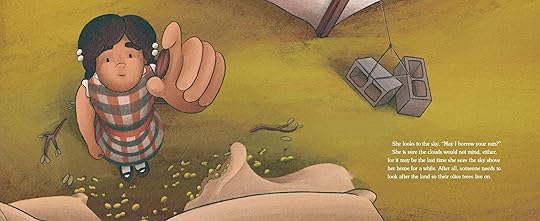
unfortunately, the ongoing war made oraib had to part with the olive tree. but, she said, "We can. I'll borrow an olive and plant its seed."
she is sure the earth wouldn't mind, and the rain could borrow its water. although olive trees take a long, long time to grow, she will be patient.
--
honestly, i cried after reading this book. as you know, until now the land of palestine is still not free. but oraib, aya, the palestinian people, and us, have always faithfully waited for palestinian freedom.
you can finish this novel in one sitting. even though it is short, the message conveyed is very profound. oraib's love for the olive tree shows that she is the true owner of "the land".
and aya, she's so great! the illustrations are very pleasing to the eyes. she succeeds in being an extraordinary story teller in conveying oraib's dream to the reader.
so please, don't stop talking about palestine! from the river to the sea, palestine will be free! 🫒🍉
It hurts me to see them need to move here and there whenever Israel came. 🥲 and the way the book used word “war” instead of “genocide”, it’s hurting me even more. I hope the ceasefire will be permanently happened sooner. Aamiin.
This book is tell us about Oraib, a little kid who love olive tree and want to grow it. For her, olive tree is a source for everyone's life. The wood can be burned or made into tools and the fruit oil can be used as food. When she want to grow it, she needs to leave the land. She and her family needs to go to other city to safe their life.
If you know, it's getting more sad after you see Oraib leave her olive trees.
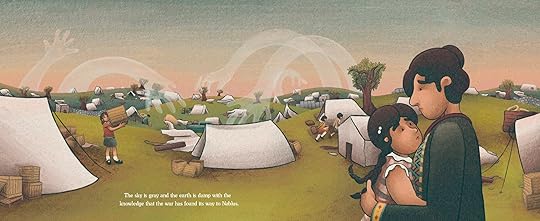
Oraib is a young girl from 1967 living with her family in a refugee camp in Nablus, Palestine. She and her mom pick olives from trees outside of camp, utilizing their many purposes to their advantage. One day, Oraib is surprised to learn that they’re packing up the olives to leave. Oraib is frightened about the olive trees, recalling her family fleeing their hometown and leaving their olive trees behind. War has closed in once more, causing the refugees to flee from the camp that Oraib calls home. She decides that she will not abandon her olive trees and takes an olive pit to plant at their new home. This way, Oraib is always connected to her home. Ghanameh’s story approaches heavy topics in sensitive ways that help kids understand the severity of the situation without frightening them. For example, the clever illustrations depict war as a ghostly hand plucking people from their lives. Educators can use this book for a lesson in empathy, especially towards immigrants and refugees, or for teaching historical events. This story can be used to introduce conversations about current world affairs and Palestine, such as the war in Gaza.
I usually don't rate and review children's books, but this five-minute read is a necessity. Reading this book is a fantastic way to start introducing our children about Palestinian family history. A lovely tale of resilience and hope in the face of displacement, ideally suited for young readers to read.
This story is based on the author's grandmother's memories of the nakba in 1967. A thoughtful and poignant story told through the eyes of a little girl. Set in a refugee camp, this beautifully illustrated book explores the significance of olive trees in Palestinian culture. It can serve as a starting point for many conversations with young children, touching on topics like planting seeds, how things grow, how one plant can provide so many necessities, the idea of home, and patience.
a look into the history of the authors grandmother growing up in multiple refugee camps during war. beautiful art and a heartbreaking look at the reality Palestinians go through. done in a way that's easy for younger readers to read & understand. highly recommend to older readers as well, parents or otherwise.
from the authors note: "It is the story of every Palestinian refugee who is condemned to a life in the refugee camps, and the story of every olive tree still standing. Like these olive trees, we are still here." 🍉
This story is based on and influenced by the author’s grandmother and her experience through the Nakba back in 1948. The story takes place in 1967, and unfortunately it’s still extremely topical today in 2024. The artwork is stunning in this children’s book and the story is beautifully written, though heavily underlined with sadness. I highly recommend this book for all ages; 5 out of 5 stars for sure.
based on true story and masked with a good and amazing illustration. i remember when the zionist trying to banned this book and attacked the author in real life and on X, clearly they don't want people to know and learn about this part of the history. they try to burn the olive trees but little things they didn't know that the seeds are everywhere and will always resist.
This is such a beautifully written and illustrated book! I’m saving this for the day I have children to pass it down too and definitely purchasing copies for my loved ones’ children!