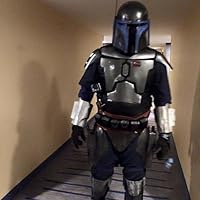
This official behind-the-scenes companion to season two of the hit Disney+ series The Mandalorian features exclusive concept art by the Lucasfilm art department and original interviews with the artists, writers, and filmmakers
The Art of Star Wars: The Mandalorian (Season Two) takes fans behind the scenes of the second season of the Emmy Award–winning Disney+ live-action Star Wars television series. Filled with concept art, character, vehicle, weapon, and creature designs, and interviews with key crew and creatives, including executive producer/showrunner/ writer Jon Favreau (Iron Man, The Lion King) and executive producer/ director Dave Filoni (Star Wars: The Clone Wars, Star Wars: Rebels), The Art of Star Wars: The Mandalorian (Season Two) will provide readers with an exclusive look at the stunning art and design work that helped bring new and returning characters and locations to life.
Season two of The Mandalorian tracks the continuing adventures of Din Djarin (Pedro Pascal) and the Child as they explore the far reaches of the Star Wars galaxy in an effort to return Grogu to his people and stay one step ahead of Moff Gideon’s (Giancarlo Esposito) Imperial remnant and squad of dark troopers. Alongside comrades from the first season, the duo encounters a cadre of new allies and forms tenuous alliances with former Jedi Padawan Ahsoka Tano (Rosario Dawson), frontier marshal Cobb Vanth (Timothy Olyphant), fellow Mandalorians Bo-Katan (Katee Sackhoff) and Koska Reeves (Mercedes Varnado aka Sasha Banks), and fan-favorite bounty hunter Boba Fett (Temuera Morrison). In The Art of Star Wars: The Mandalorian (Season Two), readers will encounter early visual and conceptual ideas for these new characters and their arsenal of weapons, ships, and armor, as well as the icy, lush, war-torn, and razed planets that serve as crucial stepping stones in Djarin and Grogu’s quest.
Returning for The Mandalorian season two, executive creative director Doug Chiang (Star Wars: The Force Awakens, Rogue One: A Star Wars Story) and the incomparable group of artists, designers, and dreamers known as the Lucasfilm art department “visualists” undertook the challenge of continuing to push the boundaries of Star Wars storytelling while also translating Ahsoka Tano from animation to live action and updating the look of the legendary Boba Fett. The Art of Star Wars: The Mandalorian (Season Two) is the only book to explore the artistic vision for this groundbreaking sophomore season, taking readers on a deep dive into the development of the next chapter of Din Djarin and Grogu’s story. Exclusive interviews with the filmmakers and the Lucasfilm visualists provide a running commentary on The Mandalorian’s innovative art and design, revealing the inspiration behind the look and feel of the series.
Again, really cool to get a glimpse behind the scences of one of my favourite shows. I found it quite extraordinary that the appearance of in the last episode of the season was kept secret from even the concept art creators. Talk about dedication!
Well, this was a joy to read. The art is beautiful, the artist insights are interesting, and the trivia is entertaining. Several times I stopped and stared at a picture as if I were in an art museum. Reading about the process of taking novel or cartoon characters and bringing them to life was something that I did not know I needed. I could have used more text and increased brightness of some pictures, but I now know who N. C. Wyeth is, and that was worth the price of admission.
An excellent look at all the design work that went to the second season of "The Mandalorian". Artwork is amazing, text manages to complement the images, and it's just fascinating to have a look inside the creative process (or processes) of such a complex show. Not much more to say, really. I really recommend it to both 'Star Wars' fans and film (or TV) fans in general.
Phil Szostak’s highly anticipated The Art of Star Wars: The Mandalorian Season 2 is finally here and it was certainly worth the wait.
The Art of Star Wars books are always a treat, but there’s something about The Mandalorian editions that feel like a labor of love. They are gorgeously compiled and organized, with genuine dedication by Szostak, who doles out a perfect balance of nitty-gritty detail for the diehard fan, while wrapping it in a package designed to be accessible for even the most casual reader. It’s filled with concept art of characters, locations, vehicles, weaponry, and creature designs, as well as interviews with key crew and creatives
Unsurprisingly to anyone who has worked in the film industry, Szostak’s introduction reveals that pre-production for the second season was underway long before The Mandalorian’s first season even arrived on Disney+. He reveals how Jon Favreau (the series’ creator) wanted to push the envelope and dream big by introducing characters from the animated series—like Ahsoka and Bo-Katan Kryze—while also pulling Chuck Wendig’s Cobb Vanth from page to screen. It’s very clear that Favreau and his team wanted to utilize as much Star Wars material as possible.
Throughout the book, Szostak neatly outlines each episode, from the first sparks of ideas, to the script, to the painstaking pre-production period where dozens of pieces of concept art are crafted and rendered, and then he dives into the actual production of the scenes, conversations with directors, and the post-production process that creates so much of what we see on screen. And it’s never just a page or two of information per episode. Each episode has dozens of pages revealing unused concept art, detailed sculptures and figures, scenic build breakdowns, and storyboards. It’s an eye-opening experience to see just how much work goes into making every component of The Mandalorian.
Some of my favorite elements of The Art of Star Wars are the creator commentaries about how they arrived at certain character designs and costumes. Early on there are several pages discussing Boba Fett’s “Nomad” costume, where Matyas discussed where elements were sourced from, worries about pulling too much from Obi-Wan Kenobi costume styles, and how one piece of concept art was designed to look like Omar Sharif in Lawrence of Arabia.
Buried within the concept art are a few deeply disconcerting images, including the sculpt build of an undressed Frog Lady—because no one ever wanted to know what was under her humble garb. And if they did, I don’t want them to tell me.
Courtesy of Abrams Books
This may have been previously revealed, but The Art of Star Wars book discusses how the Magistrate that Ahsoka faces off against in “The Jedi” was originally supposed to be a man before the design shifted to what we ultimately saw on screen. Some of the early concept art for the Magistrate as a woman was heavily inspired by Blade Runner, which looked incredibly cool. Filoni also reveals in one of the commentary panels that Jon wanted the magistrate to have a background in martial arts, which is how they eventually arrived at Diana Inosanto, who is the daughter of famed martial arts instructor Dan Inosanto.
The Art of Star Wars: The Mandalorian Season 2 wraps up much in the same way as the second season of The Mandalorian, with gorgeous concept art for Boba Fett’s return to Jabba the Hutt’s palace, but most intriguingly—none of the concept art for this scene features Fennec Shand, which leaves readers to wonder when they decided to bring Fennec into the fun and games of The Book of Boba Fett.
Phil Szostak’s ability to create these books for Abrams Books is unmatched, and I’m hopeful that he’ll be tasked with the inevitable Art of Star Wars: The Book of Boba Fett. These books are not only a beautiful book to display, but a wonderful piece of Star Wars history.
Glorious art. My only complaint is that there were not that many sketches, drawings or paintings of Grogu. I will say though, the character art were some of my favorite illustrations in this book. The Krayt dragon in particular was incredible. The various changes it went through.
The ice spiders were really creepy too, as was the giant fish monster that almost ate Grogu. The art really brought these episodes to life. It was an incredible season, with amazing storylines, and seeing their artistic evolution was really interesting.
These are always fun, this was no exception. Took that dumb as hell looking “SEASON TWO” sticker off the cover though. Yeesh.
Also, what up Goodreads? This book was written by Abrams Books, it was written by celebrated (by me) purveyor of top notch behind the scenes cinematic conten Phil Szostak. Show some respect!
Much like the first Mandalorian and other Art of Star Wars books, the art is excellent and the artists are clearly creative, inspired, and passionate about the material. My only wish is that we had more information about the behind the scenes of the show instead of just a page or so per episode. (Though I suppose that’s more for the Disney Gallery miniseries.)
Weirdly enough, a show about THE mandalorian (din djarin) and there’s not as much concept art and BTS of him in this book vs the first book BUT was still a good season. Star Wars always amazes me looking at the BTS content of different creatures and sets and design concepts. It’s so cool. (Psssst… release the season 3 book )
It is amazing to see the concept art of what went behind the scenes of one of my most favorite series to date. There are some pieces that seemed better to me than what we actually got, but I am still content.
" [...] these are hopeful stories. Life can be interpreted in many different ways, but if you can find the path that leads to hope, that's when you're going to flourish. That's where humanity flourishes."
A beautiful and brilliant look behind the scenes of the second season of _The Mandalorian_. The creativity and professionalism exhibited is impressive.
Not as in depth as the first but what more can you add that's already been said. Love to see the concept art but it was more of a flip through then a solid read.
The art team that was behind the Mandalorian (Season Two) boasted some of the most distinguished names in the field. However, the art that was conjured in this volume was mostly bland and uninspiring. It was mostly a series of mundane scenes that were rather ordinary locations that were given a "Star Wars" touch. There is no doubt that the individual artists in the team are highly skilled and their pieces were rendered with great skill, however, the imagination exhibited leaves a lot to be desired. There was a vehicle or two that was of mild interest. The character design was also in the same mold. Given the ability of the team involved, one can't help but think that they could have created more.
I love The Mandalorian, and the conceptual artwork shown during the closing credits of each episode for this second season may be even better than the first.