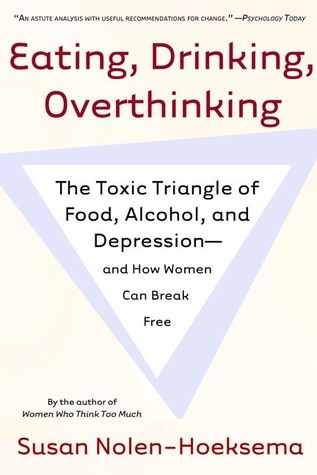
A noted expert on women and depression offers a guide to balancing women's relationship to eating, alcohol, and overthinking
Based on extensive original research, Eating, Drinking, Overthinking is the first book to show women how they can navigate the often painful and destructive worlds of the title.
While it is widely known that women suffer from depression in disproportionately large numbers, what is less well known is the extent to which many women use food and alcohol to regulate their moods. Integrating the insights of her popular first book, Women Who Think Too Much, Yale psychologist Susan Nolen-Hoeksema has written a pathbreaking and highly readable account of the ways in which eating, drinking, and overthinking, can wreak havoc on women's emotional well-being, physical health, relationships, and careers.
As Eating, Drinking, Overthinking reveals, the coping strategies that lead women into the "toxic triangle" can be turned around to guide them out of it. Instead of letting negative thoughts gain the advantage, Nolen-Hoeksema provides exercises to help women manage their thoughts and maintain a balanced perspective.
Dr. Susan Nolen-Hoeksema was born on May 22, 1959, in Springfield, Ill., to John and Catherine Nolen. Her father ran a construction business, where her mother was the office manager; Susan was the eldest of three children.
Susan Nolen-Hoeksema, psychologist and writer, helped explain why women are twice as prone to depression as men and why such low moods can be so hard to shake. Dr. Nolen-Hoeksema, a professor at Yale University, began studying depression in the 1980s.
She entered Illinois State University before transferring to Yale. She graduated summa cum laude in 1982 with a degree in psychology. After earning a Ph.D. in psychology at the University of Pennsylvania, she joined the faculty at Stanford. She later moved to the University of Michigan, before returning to Yale in 2004.
Along the way she published scores of studies and a popular textbook. In 2003 she became the editor of the Annual Review of Clinical Psychology, an influential journal.
Her studies, first in children and later in adults, exposed one of the most deceptively upsetting of these patterns: rumination, the natural instinct to dwell on the sources of problems rather than their possible solutions. Women were more prone to ruminate than men, the studies found, and in a landmark 1987 paper she argued that this difference accounted for the two-to-one ratio of depressed women to depressed men.
She later linked rumination to a variety of mood and behavior problems, including anxiety, eating disorders and substance abuse.
Dr. Nolen-Hoeksema wrote several books about her research for general readers, including “Women Who Think Too Much: How to Break Free of Overthinking and Reclaim Your Life.” These books described why rumination could be so corrosive — it is deeply distracting; it tends to highlight negative memories — and how such thoughts could be alleviated.
I thought this was going to be more academic. The words "the toxic triangle" take up half this book. It's a pretty shallow view of how society impacts women and from an expert on the topic I had higher expectations.
Drinking game idea: drink every time the author says “toxic triangle”.
I kid, I kid.
Although this book offered me some new insight, I did not enjoy it. I listened to the audiobook and the narrator overdramatized the text. This made it sound hokey.
The ridiculous "case studies" throughout the book were so overblown and pathetic I wanted to throw my Kindle out the window. Apparently all women have to drink wine and eat lasagne at 2am after a fight with their husband because of the 'toxic triangle'. Oh, and starve themselves.
The author calls the cycle the Toxic Triangle. Many women spend all week carefully keeping themselves in check. They work hard at their jobs all day making sure that they don't say or do the wrong thing. After work, they continue to control their actions by only choosing healthy food in just the right quantities and abstaining from alcohol.
By Thursday or Friday, however, the frustration, pressure, and cravings becomes too much. These same controlled seemingly put together women decide to just have one glass of wine to unwind or just a few potato chips. This simple action starts a chain of excess which is turn fuels the desire to control which turns into a never-ending cycle.
Eating, Drinking, Overthinking brings this cycle of self abuse to light showing women what they are really doing to themselves, likely without even knowing it. The author uncovers the real reasons behind these actions and shows woman healthy ways that they can deal with both their emotions and their unreal expectations of themselves.
Sorta disappointing. There were two or three mindfulness exercises that might be interesting to try, but otherwise this was hyperfocused on the societal pressures of women and how they’re hard on themselves, which, at this point in history: no shit?
If you think you may have trouble with any of these issue and if you're ready to take a truly honest look at your behavior then this is a great book. I came away feeling annoyed and uncomfortable only because a lot of it is true about my own behavior.
This book was really amazing for me and put myself outside of my confort zone when thinking about my life. I identified with so many of the scenarios she laid out and I feel she has a good grasp on those who are on the borderline of everything, but not full blown and the serious effects on your life. I feel she was honest and caring and truly wants women to understand the influence of so many things that can have negative impact on your life.
I not a big self help reader, but a friend of mine is going through a rough patch, and suggested that I read this to understand her better. Not an easy read and very repeative. The major point of the book is to address overeating, alcohol abuse and depression. Big surprise the things are linked and can stack on each other. My biggest gripe about this book is that it could have been reduced to a five page pamphlet in my doctor’s office.
This honestly read like a high school textbook. The information was somewhat basic. I found myself wondering when the new information was going to hit, or the next helpful tip. I think the most helpful thing that was said was something along the lines of “if your partner is aggressive towards you, seek professional help.”
Nothing groundbreaking here, but the author does have some useful insights about unhealthy patterns many women find themselves in. I appreciated the advice to make approach-oriented goals, framing goals in terms of positive steps you can take instead of proscriptions. And she describes some useful mindfulness exercises. It is strange, though, that the author assumes that most/all readers have children, and the chapter on raising girls to avoid unhealthy patterns seemed a little out of place.
There is not much here. The author repeats “The Toxic Triangle” so much it’s half the book. The first section is really just saying women are stressed for a variety of very obvious reasons. Then we eat, drink, or overthink because of those things. Well, yeah, we already know that. Lastly, she tries to halfway explain how to use mindfulness to not be as bothered by these very obvious things so you won’t want to eat or drink or overthink so much. I’ve had more insight in a 1200 word article than from here.
Because I read this for a specific academic reason, I found this a book of two halves. I enjoyed the first half which explained why women, in particular, are set up by modern culture to fall into the 'toxic triangle'. I enjoyed the second half less as it started to sound a bit 'New Age'-y. Rating: 3 stars for the first half.
2.5 i don’t think anyone has read this book in the past 5 years but i feel like the concept was good but the execution was lacking but then again this was published before i was born so whatever!!
Look, it's very basic in lots of ways. The premise is that treating your stress with food or alcohol doesn't help and may exacerbate your problems. Not new.
But I'm rating it five stars because it was so nice to feel "seen." She provides stories of women who are, as she puts it, sub-clinical for any of the three disorders that make up the "toxic triangle" - not alcoholics, but their doctors would probably tell them to drink less, not binge eaters, but definitely turn to food when stressed, not depressed, but struggling sometimes - and Holy. Fuck. Did I feel called out. Recognizing that behavior that may not be clinically defined may still be distressing and exacerbating other issues is pretty useful.
Her advice was similar to advice you cant find in many CBT or mindfulness books.
And she defines all of these behaviors as "self-focused" coping. That instead of making others uncomfortable by asking them to change their behaviors - even if that's the best way to handle a problem - these people attempt to change themselves, even where they aren't the root of the problem. And even in coping, they turn inward to handle the emotions that are causing them distress, even if the proper purpose of that feeling should be outward (i.e. anger at being treated unfairly, but having to "be nice" results in women not speaking up about it, and not talking to another person about it, instead going home and eating to get food-coma-endorphins instead so that NOBODY ELSE IN THE WHOLE WORLD is "annoyed" by these feelings, just the woman at the center).
So her identification of a problem was very helpful for me. Her solutions were now very common mindfulness tools, which doesn't make them less beneficial. Still, five stars since it's easier to be mindful when you have language for it!
I was hoping this would share some ideas or connections with me that I didn't already know, but it was a very dry version of things you already know (pressure to be perfect, prioritize others emotions over your own, pressure to be thin, and the use of alcohol and eating and a way to numb the pressure/disappointment of not living up to all the expectations. It's probably a good book for people in the early phases of their journey for living with more optimal health and habits, but if you're further along in this journey, it's not really worth the investment (even at only 3.5 hours long)
Extremely disappointing. A very generic, run of the mill "self help book" full of filler, anecdotal stories and repetitive content. What annoyed me the most was the generalized language- certainly not every woman all encounter the same experiences which lead to exact same patterns in this "toxic triangle".
Where were the references to refereed studies or papers?
It was clear which demographic of woman this was intended for as well. Class, income and societal disparities were not considered.
This book was recommended in a fitness group I am in. I'm not sure why. Between outdated ideas ( women needing to be thin like in the magazines and expected to be quiet and be good) and the constant reference of "the toxic triangle" it was painful. It was not at all what I was looking for. It does touch base on mindfulness and meditation but only shortly and I'm sure there are better books for that.
I've never realized there was a toxic triangle as I've only noticed problems with certain people. The author points out that we target what we can see and you can't always tell people have problems with depression. I really liked her tips on how to talk with friends and family and what to do if someone is pressuring you to drink. She gives good pointers on journaling and the whole book seems very encouraging.
This book sucks. Do not read if you're not in a good place with these subjects. It's filled with shame and guilt. One of the main points is to forgive your abusers in order to change your own behaviors around these subjects. It's only made for cis-het, Christian, rich, skinny, white women who already have a support system. If that's you, it may be useful, but I have a feeling if you're in that situation, you already know everything this book says.
Was excited with the title but this was not helpful. If there was good advice I would no longer be able to hear it because by half way through the book I wanted to puncture my ear drums every time they said “toxic triangle”. It makes gut be useful for some people but it didnt have insight for me. It doesn’t seem to address overthinking at all. I might be able to use my hate of the term “toxic triangle” to modify my chocolate eating.
Dr. Hoeksema mentioned that one of the gaps in the toxic triangle is trying to medicate them separately; however, in most cases they are interrelated. The case studies are providing a better understanding of how eating, drinking, and overthinking related to each other; their effects on women's well-being and the approaches for self-medication. Liked it!
This was mostly about anorexia and bulimia. I listened about halfway hoping that it would get into the overthinking and how they all co-inside more, then gave up. There may have been further explanation later on.
Pretty much just a vague overview of the societal pressures put on women to be a certain way. Includes a couple mindfulness techniques but mostly too general to be of help. Really pushes the “toxic triangle” term though.
The stories are a great way that the examples of real life situations are explained. I personally found the very last chapter of the book to be the most helpful.