Jump to ratings and reviews
Rate this book

The Herbal Alchemist's Handbook: A Complete Guide to Magickal Herbs and How to Use Them

Rate this book
An herbal magick grimoire of philtres, elixirs, essential oils, incense, and formulas with dozens of recipes from a trusted author.

Herbs have been used for medicine, magic, and ritual for centuries. The ancient arts of herbal alchemy and herbal magick combine the healing and energizing effects of herbs (roots, leaves, flowers, resins, and essential oils) with the cycles of the natural world—the astrological movement of the stars and planets, and the cycles of the earth's seasons.

In this easy-to-use compendium of herbs and their energy associations, master herbalist and magick practitioner Karen Harrison offers formulas anyone can use to obtain courage, creativity, lasting health, prosperity, and enhanced psychic and spiritual powers.

Harrison shows how to select herbs based on their astrological associations as well as their medicinal properties. With a materia magica of more than 150 herbs and a multitude of recipes, listeners will learn how to blend incense, ceremonial oils, bath salts, herbal amulets, fluid condensers, and herbal philtres and how to use them in meditation, ritual, or energy work.

Audiobook

First published April 1, 2020

Loading...
Loading...

About the author

Karen Harrison

40 books6 followers

Ratings & Reviews

What do you think?
Rate this book

Friends & Following

Create a free account to discover what your friends think of this book!

Community Reviews

5 stars
67 (43%)
4 stars
50 (32%)
3 stars
28 (18%)
2 stars
7 (4%)
1 star
1 (<1%)
Displaying 1 - 12 of 12 reviews
Profile Image for Coco Carré.
23 reviews
May 15, 2021
I went into this liking this book and finding the correspondences for herbs and crystals helpful, but once it starts to get into the types of things to make with those herbs, I started finding multiple issues with safety and health in the recipes for philters and elixirs - including items that were made to be ingested. For example, it recommends using ashes of burnt herbs in an elixir to be added to tea later. Even with the helpful information, I can't ethically recommend this to other people interested in magic or herbalism because of that; if you do read this, be sure to double check and cross reference everything.
Profile Image for Erika.
39 reviews4 followers
April 26, 2026
I don't write very many negative reviews. But this book has so many 4+ star reviews that I feel like I need to ground it. This is probably also the most disappointing read I've had in a very long time.

The Editing: Was it?
The copyright page lists editors. However, this book doesn't seem to have been edited, or if it was, minimally.

Words running together:


"The way that Paracelsus used the term Signature was to signify and organize eachherb according to its specific appearance, geographical location, and the physical effects of the herb on the human system." pg xviii (see eachherb)
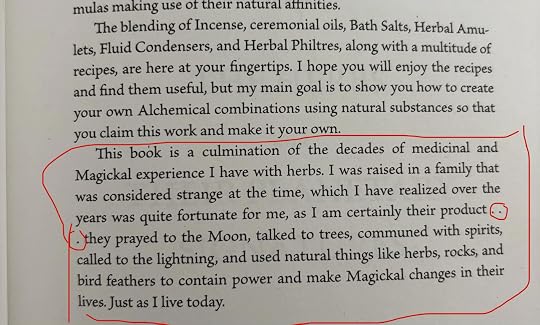

Ellipse running to the next line and incomplete thoughts as a conclusion:


Strange use of punctuation and/or hard-to-follow sentences:
For example, he placed herbs that affected the heart; were primarily golden in color; thrived in sunny areas; and promoted a sense of well-being, success, and confidence in an individual under the dominion or rulership of the Sun.
- Pg xviii


Maybe it's me, but the semicolons seem odd here (my grammar checkers agree) - and I think that is partly why I had to reread this sentence 3 times before I knew what it was saying. Also, this sentence will be repeated in the first chapter that follows. I wish the author had picked a different planet because it being so close made it feel (is) repetitive.

You can also see a very oddly worded sentence in the "ellipsis" image. You'll notice that the red paragraph consists of 3 total sentences - 2 short ones and a very long one. The ellipse used here is also very odd. There are many run-on sentences throughout the book.

“The composition of Incense is not difficult and can be done with a minimum of equipment and space.” pg 62

This should be “minimal equipment and space.”

The Information

Unorganized
The biggest frustration with this book is its lack of organization. For example, the moon chapter discusses the physical descriptors of the herbs associated with the moon. This begins on the first page. THEN you will find the chapter ENDS with more physical descriptors - in this case, colors - that also describe moon herbs.

"Several Lunar herbs bear marked resemblances to the Moon in her various phases, both in color and shape of the plant, fruit, and flower." pg 7

Then it describes shapes such as oblong and crescent. This is the start of the second paragraph of this chapter. The Paragraph following this discusses fluidity on page 8 and states that it impacts menses.

We don't hear about further descriptors until the last sentence of this chapter:
"Moon herbs are often white or pale in color, night-flowering, and soothing to the senses." pg 9


Why would the physical descriptors not be talked about together? This chapter, and the others, bounce around from physical appearances to bodily impact, to magickal impact, etc. And points for each are scattered like ground pepper flakes in a bowl. No flow. Hard to follow thoughts.

Repetative
Let's look at the Moon (chapter 2).

"The Energies of the Moon affect the activities of the subconscious mind, the intuition and psychic centers, reproductive system, dreamwork, and the emotions." pg 7


"Magickally speaking, herbs of the Moon affect the subconscious mind. They aid in the development of intuition and psychic gifts." pg 9


We already know this because "subconscious mind" and "psychic" are mentioned 3 times, twice on page 7 (under energies and in the above quote), and again on page 9, in what I assume is an attempt to be a conclusive paragraph. Meanwhile, intuition isn't even listed under "energies" at the beginning of the chapter where it lists all the attributes.

This isn't exclusive to the moon chapter either.

No Sources/Footnotes
"We are all aware of how the Moon cycles affect the rhythms of the female system and menses." pg 8

*Are* we? Where is the footnote or source for this? You can't just make a statement like this without providing evidence. I wouldn't list this as "common sense," which is the only time attribution isn't needed. I did manage to find a single article on the topic, and my concern with the study mentioned here is that it only has 22 people. Additionally, the sync described in that correlates with age and is under 15%. It also mentions additional studies that show and don't show a correlation with the moon cycle. This means it's inconclusive - at least for humans.

It has been established that the scents of specific herbs and oils stimulate a predictable response in the brain receptors-whether it be sexual, meditative, or relaxing.” pg 61


Again, where is the footnote here? This is also misleading because, while some scents may be associated with various emotions or states, it’s highly personal. What it should have mentioned was that scents trigger emotions and memories for individuals. See this article.

Unclear
In each chapter, a Number is listed for a planet. Do you know what that number is? Apparently, it's the planet's numerology number. Where is that described? Page 102. Yes, all the way in chapter 17. Perhaps this one is a nitpick, but it was really weird to me.

Questionable Terms or Unfleshed out ones
The terms Condenser and Philtre are perhaps an odd choice. Philtre is a magickal potion, BUT primarily a love potion. Why not just call it Infusion? Since...that's what it is. Want to know about condensers? Try this book.

Signature could have been more neatly defined than it is in this book.

"The way that Paracelsus used the term signature was to signify and organize eachherb according to its specific appearance, geographical location, and the physical effects of the herb on the human system." pg xviii (and no, that's not a typo, it is eachherb - one word).


Perhaps we could have simply written something more like:
A signature is the collection of attributes that make up an herb, including its life cycle, magickal/medicinal properties, geographic location, and physical appearance. - me


In fact, I would argue that the first chapter in this book should have described more of the history and what signatures are, rather than relegating it to an introduction that not everyone chooses to read. It could have provided a template for creating our own signatures and explained whether there are similarities or differences between herbal signatures and monographs.

Fluff
I highlighted information of interest, then condensed it into notes, and again when I realized my notes were dotted with repeated information. How do I mean?

Let's take a look at chapter 1: the sun.

Apart from the top section, which gives energies, metals, colors, etc. I distilled the 2.5 pages into this:


Plant Signature
Blossoms/Matures: Summer Solstice
Physical Attributes: gold/yellow/orange in color
Body: primarily handles the heart and circulatory system
Energetics: Warm, Dry (my assumptions - not mentioned in the book)

Description
Herbs of the sun aim to balance and restore health/vitality.

The sun represents the ego, personality, or our true selves. Like Leo, it promotes self-confidence, personal success, and self-expression. It uses self-confidence to empower.


Why is this disappointing?
- It doesn't describe anything about the planets
- It mentions the Leo zodiac in the chapter, which helped me glean more information than was present in the book
- The information about success, ego, etc., can be found in the list blurb - so this is still repetitive
- The chapter could have easily been a "Planetary Monograph" without the need for all the disjointed thoughts scribbled in the paragraphs
- It feels like a collection of essays that were written without an outline

Chapter Formula
Reference at the top. Blurbs of information, scattered. List some herbs and their effects on the body. More blurbs of information. A recipe written in paragraphs instead of bulleted ingredients and numbered steps for clarity.

In Summary
This never should have been a full book. It needed additional editing. The information is questionable at best, assertions at worst.

The formula of the book should have been "Planetary Monographs," where it told me:
- Description of planets and their energies
- What the plant signatures are when under the umbrella of this heavenly body, including physical appearance, blossom/maturation timing, herbal energetics (since it claims western herbalism), and what part of the body it primarily impacts - listed
- a brief description of what makes an herb fall under this specific planet
- well-researched and safe herbal instructions for the beginning practitioner with no herbal knowledge

I am genuinely confused by all the high ratings and recommendations. And this isn't to trash the author. She clearly has some knowledge, but it just didn't translate well into this book for me and the members of our book club, who shared in my frustration. We all DNFed this book because of the above.
Profile Image for Bri.
18 reviews13 followers
October 20, 2020
I've been eyeing this book for a while, so I was super ecstatic when Weiser sent me a copy to review. Honestly? I was very much expecting this to not be a positive review, as I made the mistake of assuming it was overhyped. Yet, this has been not only one of the most informative, but also one of the most inspiring books I've read this year.

Harrison has a charismatic and traditional tone that reminds me a lot of Cunningham's Encyclopedia of Magical Herbs, one of the first books I purchased back in the day as a baby witchling. Except as you dive into this book, Harrison provides an entirely different realm of expertise in regards to the importance of planetary correspondences and how creating in accordance with astrological events really impacts our craft. Her chapters and explanations are thorough and detailed, leaving just enough room for the reader to walk away feeling curious and eager about their work.

There are 3 major sections of the book: planetary signatures, the creation of different kinds of herbal mixtures, and creating custom formulas. Each section builds upon the last, providing a comprehensive understanding of how to work with and combine herbs in a manner that fulfills a purpose. Plus, there are a whopping 8 appendixes at the back of the book for quick use when you're looking for a specific correspondence. I adore having multiple appendixes that make the book super easy to utilize.

If you are interested in working with herbs at all, I highly suggest adding this book to your shelf. There is so much information in here, helpful charts that Harrison uses to break herbs into different groups, and so many ideas for concrete rituals you can try to get more familiar with specific herbs. I might even go so far to say that this book might be helpful for anyone from beginner to intermediate to even advanced witches. There is just so much packed into these pages that I believe everyone will find something useful. Definitely (and surprisingly) one of my top books of the year!
43 reviews
September 15, 2020
This is a Fascinating book I will be studying this book for a long time. Karen Harrison has included many thought provoking elements to the the world of herbal study
1 review
May 21, 2026
Despite not being 100% finished with the book, I've already noticed a few things that are a little weird. The first being what other people have mentioned: neptunian herbs and some of the dangerous uses she described in the book. Second, she doesn't give any important discretionary information concerning plants like the High John Root, which is closed to Hoodoo (usage of it in spirituality practice). Lastly (a minor personal issue), it would've been better if, when going over the ruling planets of the signs, she listed the primary rulers using traditional astrology versus the modern ones. Still a decent book for information, just cross reference the bs.
20 reviews
March 19, 2024
For a book published in 2020, this book uses some cringe-worthy terms and ideas that are pretty out of date.

From the use of spelling magic with a "ck" to using the term "smudging" without any reference to First Nation's cultures AT ALL...get with the times, please.

Also of note: reference to the threefold law as like a be-all-end-all.

There's some good information in here, but you need to ignore the BS.

Also its incredibly repetitive and has the same information in 3 and sometimes 4 places throughout the book.
Profile Image for Edric Unsane.
789 reviews42 followers
May 6, 2020
A fairly good book on understanding and messing around with herbs in a magical sense and using planetary correspondences. The book is short, but does cover most of what a person would need to know to get their herbal practice off the ground.

I enjoyed learning what this book had to offer, and am excited to put the information to use come harvest time.
77 reviews1 follower
July 13, 2022
What a great fun book to delve into as a beginner.

This book has inspired me in my craft. I've also learned alot.
123 reviews
November 22, 2024
Lots of solid information on common herbs, the planetary alignment and good recipes.
Profile Image for Diana Brosiu.
35 reviews6 followers
February 14, 2025
Such a good overview for anyone interested in learning more about magical herbs
Displaying 1 - 12 of 12 reviews