The exile's compass, the slave's revenge.
I have followed Kay through the Sarantine Empire, across the plains of Al-Rassan, and into the courts of Kitai. Each time, I have emerged feeling as though I had lived a second life. All the Seas of the World is no exception. It is classic Kay: a slow-burning, deeply humane novel set in his signature "quarter turn to the fantastic" version of the Renaissance Mediterranean. It is a story of vengeance, power, and love, but more than that, it is a story about what it means to be exiled; from your homeland, from your faith, from your own past.
What it is:
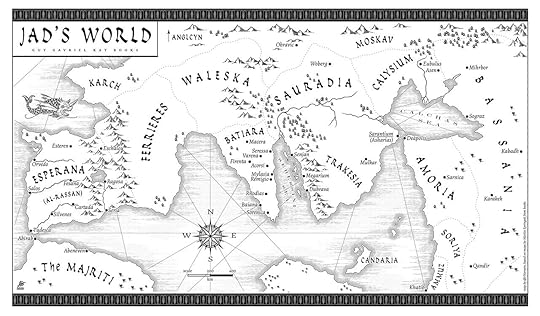
The year is roughly equivalent to the late 15th century, just after the fall of Sarantium (Kay's Constantinople). On a dark night along a lonely coast, a small ship sends two people ashore. Their purpose is assassination. They have been hired by two of the most dangerous men alive to alter the balance of power in the world. One of them is Rafel ben Natan, a Kindath (Jewish analogue) merchant who remembers being exiled as a child from Esperaña (Spain) for his faith. The other is a woman who calls herself Nadia bint Dhiyan, a former slave, abducted by corsairs as a child, trained to kill, and bent on revenge.
The assassination does not go as planned. But Rafel and Nadia escape with treasures that make them wealthy enough to build their own warship. This early windfall is not a happy ending. It is Kay's way of freeing his characters from the tyranny of survival. Their choices, from now on, will be driven not by necessity, but by conscience. And conscience, in Kay's world, is a dangerous thing.
The novel follows them as they navigate a web of politics, piracy, pilgrimage, and war. They cross paths with returning characters from A Brightness Long Ago: the fearsome mercenary commander Folco d'Acorsi, who gains new depth here, and the haunted courtier Guidanio Cerra. Their journey takes them from the markets of Dubrava to the palaces of the khalif, from the decks of corsair ships to the councils of kings. And through it all, Kay asks: can two people who have lost everything find a way to reclaim themselves?
Why it works (and why it lingers):
1. The theme of exile is the beating heart of the novel. Rafel carries the weight of his family's expulsion. Nadia carries the weight of her enslavement. Both are haunted by what they have lost, and by the question of whether they can ever belong again. Kay does not offer easy answers. He shows you the prejudice that the Kindath face: required to display visible markers of their faith, treated as second-class citizens, never fully accepted no matter how successful they become. He shows you Nadia's struggle with her own trauma, the hatred she nurses for her Osmanli captors, and the slow, painful process of letting go. "Lives change, turn, pivot on small things, accidents of timing," the novel reminds us. Exile is not a single event. It is a thousand small cuts.
2. The treatment of the Kindath is among Kay's most powerful work. Kay has written about religious strife before; the wars between Jaddites (Christians) and Asharites (Muslims) are a constant backdrop. But here, he turns to the Kindath, his analogue for the Jewish people. They are a people who achieve their victories through survival, navigating a hostile world without endangering their community. They try to assimilate, only to learn that true assimilation is impossible. They seek security in success, only to find that success makes them targets. When Rafel makes a decision, he carries the weight not just of his own life, but of his entire community. The novel does not preach. It simply shows you the cost of being a stranger in every land.
3. The returning characters add depth without overwhelming the new story. Folco d'Acorsi, the mercenary commander, is a fearsome warrior with a reputation for cruelty. But Kay gives him interiority. He is thoughtful, humane, and capable of unexpected gentleness. Guidanio Cerra, whose voice haunted A Brightness Long Ago, returns as a man still carrying the weight of his past. They are not cameos. They are anchors, connecting this novel to the larger tapestry of Kay's world.
4. The prose is elegant and reflective. Kay's sentences are not rushed. He lingers on a sunset, a conversation, the creak of a ship's timbers. The pace is contemplative, proceeding at a less frenetic speed than some readers might expect. But the suspense is there, baked into the plot. The novel builds toward a confrontation that could tip the balance of power in the world. And when it arrives, it is not a clash of armies. It is a choice. A single, terrible choice that will define the rest of the characters' lives.
5. The ending is not neat, but it is true. Kay does not give you a tidy resolution. The world is still unjust. The Kindath are still persecuted. Nadia still carries her scars. But there is hope, a small, stubborn hope that resilience can win out, that two individuals can vanquish their demons in spite of all the powers arrayed against them. The final image is not of victory. It is of a ship, sailing toward an uncertain horizon. That is enough.
Where it might lose some readers (honest, even as a fan):
1. The pace is slow. Very slow. Kay spends pages on a meal, a conversation, the weight of a memory. If you need constant action or a ticking clock, this will frustrate you. I loved the pace. It matches the rhythm of a world where ships take weeks to cross the sea, and grudges take generations to settle.
2. The cast is large, and some characters appear only briefly. Kay has always written ensemble novels. Here, he introduces figures who vanish for hundreds of pages, only to reappear at crucial moments. Some readers find this immersive. Others find it disorienting.
3. It helps to have read A Brightness Long Ago. You can read All the Seas of the World as a standalone. But the returning characters carry more weight if you know their histories. For newcomers, these echoes are pleasant but not essential.
Who should read this:
Lovers of historical fiction who enjoy a "quarter turn to the fantastic".
Readers who appreciate morally complex characters and slow-burn storytelling.
Anyone who has ever felt like a stranger in their own home.
Fans of The Lions of Al-Rassan, A Brightness Long Ago, and Children of Earth and Sky.
Who might skip it:
If you need fast-paced action and clear heroes and villains.
If you dislike large casts and multiple points of view.
If you prefer your fantasy heavy on magic and light on politics.
Final verdict:
All the Seas of the World is not Kay's most famous book. Tigana has the name recognition. The Lions of Al-Rassan has the critical acclaim. But this novel might be his most timely. It is a book about exile, about prejudice, about the weight of history on individual lives. It is a book about people who have been pushed to the margins and must find a way to survive, and to be more than survivors.
Rafel and Nadia are not heroes. They are people who have been broken and have chosen to keep moving. Their journey is not a straight line from loss to redemption. It is a meandering path, full of setbacks and small victories. And that, Kay suggests, is the only kind of journey there is.
I finished this book feeling not exhausted, but enlarged. Like I had sailed across that sea myself, felt the salt spray on my face, and understood, a little better, what it means to be a stranger in a strange land.
Five stars. For the exiled merchant. For the slave who reclaimed her name. For the ship that sails toward an uncertain dawn. And for the reminder that home is not always a place. Sometimes, it is a person.