An account of a lynching that took place in New York in 1892, forcing the North to reckon with its own racism.
On June 2, 1892, in the small, idyllic village of Port Jervis, New York, a young Black man named Robert Lewis was lynched by a violent mob. The twenty-eight-year-old victim had been accused of sexually assaulting Lena McMahon, the daughter of one of the town's well-liked Irish American families. The incident was infamous at once, for it was seen as a portent that lynching, a Southern scourge, surging uncontrollably below the Mason-Dixon Line, was about to extend its tendrils northward. What factors prompted such a spasm of racial violence in a relatively prosperous, industrious upstate New York town, attracting the scrutiny of the Black journalist Ida B. Wells, just then beginning her courageous anti-lynching crusade? What meaning did the country assign to it? And what did the incident portend?
Today, it’s a terrible truth that the assault on the lives of Black Americans is neither a regional nor a temporary feature, but a national crisis. There are regular reports of a Black person killed by police, and Jim Crow has found new purpose in describing the harsh conditions of life for the formerly incarcerated, as well as in large-scale efforts to make voting inaccessible to Black people and other minority citizens. The “mobocratic spirit” that drove the 2021 attack on the U.S. Capitol―a phrase Abraham Lincoln used as early as 1838 to describe vigilantism’s corrosive effect on America―frightfully insinuates that mob violence is a viable means of effecting political change. These issues remain as deserving of our concern now as they did a hundred and thirty years ago, when America turned its gaze to Port Jervis.
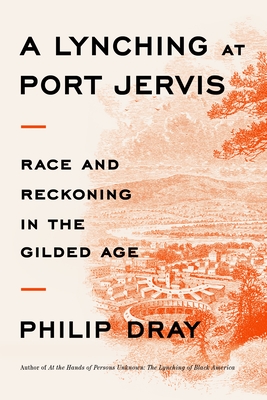
An alleged crime, a lynching, a misbegotten attempt at an official inquiry, and a past unresolved. In A Lynching at Port Jervis , the acclaimed historian Philip Dray revisits this time and place to consider its significance in our communal history and to show how justice cannot be achieved without an honest reckoning.
The northeast United States likes to think of itself as fair-minded and humane. Unfortunately, history shows otherwise. According to Philip Dray, who focuses on racial discrimination, the two largest slave auctions in the country were in New York City and Albany, the state capital. In A Lynching at Port Jervis, Dray has assembled a compendium of coverage and intrigue surrounding the hanging of Robert Lewis, who, as is often the case in such things, probably committed no crime at all. In this case, it is worthy of a soap opera. And Dray provides all the lurid details from the media and local historical societies – and more.
Port Jervis, New York was a boomtown of rail, canal, and manufacturing. It employed thousands at its peak. The town was named for the Chief Engineer of the Delaware and Hudson canal and rail line, which brought coal from Pennsylvania to ravenous New York City though Port Jervis. Some twenty trains a day passed through, connecting New York to Chicago. Industry popped up to take advantage of the strategic shipping availability. A lively press reported all the latest personal news about everyone in town. Crime was low, letting the town maintain a tiny police force.
On June 2, 1892, the young woman who ran a candy store claimed to have been assaulted by a mysterious Black man while she was reading a book in the park along the Neversink River, a mile or so above where it meets the Delaware River. At this point both rivers turn sharply south, defining the outlines of New York, New Jersey and Pennsylvania. Some boys figured out who it must have been and went after him. He was simply walking along the canal tow path on his way to a job, when they caught up with him and offered him a lift on their boat. They captured him (and his fishing knife) and brought him back to town. A huge crowd of nearly a quarter of the population of 9000 prevented the police from bringing him inside. The mob pushed, kicked and beat him uphill on Sussex to Main St, where they turned right and strung him up on a big old maple tree, somewhere between Sussex and Fowler.
No one was arrested. At the inquest in Goshen (NY), all these neighbors, who all knew everyone else’s business, which was how the mob formed, suddenly didn’t know a single person in the crowd of 2000. They recognized no faces or voices, couldn’t remember who said what, who put the rope over Lewis’s neck, who pulled him up, or who demanded his death. As Dray puts it “The mob acquitted itself.”
Somehow, those who tried to stop it all were recognized and exonerated, including the mayor, a doctor and a judge, all of who lived right where the hanging took place. It was the teenage son of the town’s most prominent lawyer who held a match to the victim’s face, confirmed his name and identified him as the perpetrator. That was the go-ahead for the mob to lynch him.
The police were both incompetent and ineffective. Only one officer seemed to at least try to stop it all, but was trampled for his efforts. Naturally, the worst of them got promoted.
As usual in these events, the mob tore at the victim, ripping away bits of his clothing, stealing his shoes and such for sellable souvenirs. In other lynchings, even body parts were torn off for later sale, and a big business emerged in souvenir postcards commemorating the event. Such was life in Jim Crow America.
It instantly put Port Jervis on the map, making headlines globally. Every newspaper had something to say about it, often quite ugly. Dray says: “A Monticello sheet served up the odious ‘consolation’ that despite all that was wrong with Lewis’s murder, ‘there is deep in the breasts of thousands of parents, husbands, brothers, and lovers—warm-hearted, noble Christian men they are too—a feeling of serene satisfaction that the earth is no longer encumbered with this animal in human form.’’
Another paper claimed the woman McMahon sickened, faded and died from the attack. The Allentown (PA) Morning Call reported that “Lewis hid behind a tree until the young woman came up and then jumped out and seized her … Some boys … heard her outcry and crept up on Lewis but he heard the underbrush crackling, and, jumping to his feet, drew a drew a murderous looking revolver from his pocket.” He then threatened to blow her brains out, and on and on with no basis in fact whatsoever.
Across the river in Pennsylvania, they said no one did anything wrong: “The Honesdale Citizen mocked the notion that its neighbor Port Jervis had to apologize as ‘nothing but maudlin snivel.’”
As for the inquest: “In their silence and collective mendacity, Port Jervians had chosen to stand squarely behind lynching. ‘They cannot force grand jurors to regard as a crime the wild justice of mob law,’ the (Middletown NY) Argus concluded, ‘when the jurors feel in their hearts that the mob did the county a service by ridding it of a villain too vile for earth. The law is as powerless to punish the men who strung up Bob Lewis as is the ghost of their victim.’”
Reading all this, an aggressive New York City lawyer named Rufus Perry Jr., didn’t want the town to get off scot-free, and sued it for wrongful death. He claimed $20,000 for Lewis’s surviving family, notably his mother, a laundry woman in Paterson, New Jersey. This led to more vituperative analysis, such as The Newburgh (NY) Press which declared this was: “A case where a negro is worth $20,000 more dead than alive.“
The leading light of Port Jervis was Stephen Crane, an extremely gifted young writer, whose Red Badge of Courage has never been out of print, according to Dray. He listened to civil war stories from veterans around town and put together a horrific book of war, without ever having served, witnessed or even lived in its era. He was not in town the day of the lynching, but wrote a story called Monster that is a thinly disguised description of Port Jervis at the time. It is about a Black man, horribly disfigured by a fire in which he saved his employer’s son, at his own great cost. The town rewarded him by banning, shunning and taunting him for his now frightening countenance.
Crane was an adventurer, to his existential cost. He picked up tuberculosis in New York’s Bowery the year after the lynching, followed by malaria in Florida three years later. He then went to live in a drafty, unheated old mansion in damp England, continuing to smoke all along. He died from it all while still in his 20s.
There were about 200 Blacks among the 9000 in Port Jervis, not nearly enough to pose any kind of threat to the vast majority of whites. Enormously little was written about them or their views on the events of the day or those leading to it. Ida B. Wells came to write it up, and even she focused on the soap opera aspects rather than the Black community.
And what a soap opera it was. Lena McMahon was a 22 year old candy store operator. She was an adopted child from New York City, and chafed at her domineering parents. Phil Foley was a good-looking drifter, who was at first approved by her parents, but later forbidden as a ne’er do well, stealing food, jewelry, not paying his rent and on and on. A judge in Middletown (NY) released him on his promise never to set foot in Port Jervis again. But as soon as he left the courtroom, he headed right back there, eventually working in a bar downtown.
Lena ran away a couple of times, never able to explain what happened on her disappearances and which her clearly bizarre, made-up stories could never justify. Rumor had it she had an abortion one time. The lovers were in the park by the river one day, when Foley had to go. McMahon stayed and read a book. It was at that point that Robert Lewis approached her, verbally assaulted her and grabbed her. She cried out and he just walked away. She drew the attention of some boys and other women, and the race to find Lewis was on.
However.
When Foley returned, he was not the least surprised by her disheveled clothes and minor cuts on her face, which was at very least odd. Rather than take her to her doctor or bring her to the police station, he soon left her there again and went for a drink. Although she claimed not to know the strange Black man, he seemed to know everything about her, speaking to her in very personal terms. It later turned out both Foley and McMahon had been using him to run messages between them, so Foley could avoid her parents. And most bizarrely, Foley had paid him the large sum of five dollars to rough her up. Several other Black men said they turned down the five dollars, fearing, well, a lynching.
As soon as he was stopped, Lewis commented on what trouble Foley was about to get him into. But Foley denied ever knowing Lewis. Then, all kinds of rumors about Lewis, who was a bus driver for a hotel by the railroad tracks, began circulating big time. They, naturally, made him out to be a thief and a rude assaulter of women, fired by the hotel for offending its patrons, etc.
The truth never came out. Foley finally left town after months in jail, unable to post bail. An anonymous benefactor eventually paid the $500 to spring him. McMahon tried to pick up where she left off, but drifted away, changing her name several times, giving birth and abandoning a baby in a hotel room in Jersey City (NJ) and dying 35 years after the lynching. Lewis was buried in Laurel Grove cemetery, but his grave is unfindable, probably succumbing to a severe flood that washed away many stones and coffins.
Why Foley wanted her roughed up was never determined. What his plans for them were was never determined. Port Jervis was soon bypassed in every way. The two railways became a very minor one, the Chicago trains soon stopped, and the canal fell into disuse. The final nail was Interstate 84, which allowed vehicle traffic to avoid the town completely.
Dray finishes the book with a lengthy analysis of lynchings before and since. There have been about 4000 of them. It wasn’t until the 1960s that prosecutions of them started to succeed. But what remains with readers is the shock of just how thin a veneer covers American society when it comes to white womanhood and Black men. Even in thriving Port Jervis.
This book was especially interesting to me as I grew up in Port Jervis. In fact, the tree the lynching was held in was on the street directly in view of my childhood bedroom window! Yet; until this book--I had never heard of this. A testament to the lack of attention that racial and civil rights education gets in our public school system. Dray discusses the people of PJ, and the families, in a very familiar way. I recognized locations and names that are still in Port Jervis to this day. I was riveted.
Every educator needs to take the time to read A Lynching at Port Jervis: Race and Reckoning in the Gilded Age. It won’t be easy. Not because of poor writing (the writing brings to mind Erik Larson) or gruesome details (lynching needs little explaining). No, the reader’s unease will come from the gentle prodding and poking at our conscious.
We find ourselves questioning how we would react in a similar situation today. Although lynch law seems like a dirty page in history, the past decade has revealed a festering wound we as a nation have never reckoned with.
Dray produces a page-turning historical account as well as an invitation to readers to examine their hearts. What hidden prejudices and racist attitudes linger within? How do those prejudices and attitudes manifest themselves?
The current problems plaguing our country come from a whitewashed version of history (the one I grew up with) which still pits the North against the South. Many Americans don’t understand how different kinds of racial prejudice have played out in every section of the country. No section remains blameless. Unless we work together to bring this to light, we won’t think we need healing and reconciliation.
I’m from a Southern California beach town. I had white, Asian, Latinx friends growing up but no blacks lived in my town - perhaps because, as I didn’t learn until my 60th year, the KKK ran black property owners out of town early in the 20th century, disrupting their property rights and stole their wealth under threat of harm. By the way, I made my first black friend at university in 1968. That’s not dissimilar to prevailing attitudes reported in this book set in Port Jervis, New York, a place that thought racism only existed in the South, until they lynched a black citizen most white residents knew and many liked. Perhaps the only way whites like me can approach understanding of our black fellow citizens is to take racism from the abstract to the personal … this story is very personal. As long as white people think, “ it’s not my problem,” racism, cutting in all directions, will continue to poison us all. I’ve been in Port Jervis, NY. Perhaps sharing this true story of quick, illegal judgment is that small town’s gift of understanding about how insidious blind hatred can be. This is an important read.
Philip Dray’s book “A Lynching at Port Jervis” unearths the history of an 1892 murder of a Black man at the hands of a white mob.
On June 2, 1892, a white mob seized a Black man and hanged him from the high branch of an old maple tree in Port Jervis, N.Y. Several days later, a jury took all of an hour to deliver its verdict on what had happened: “Robert Lewis came to his death in the village of Port Jervis on June 2nd by being hanged by his neck by a person or persons unknown.”
The language for the verdict was passive and ungainly — a sentence that has to tie itself into knots in order to bear such moral contortions. Lewis was the victim of a lynch mob that attacked him after hearing rumors that he had sexually assaulted a white woman. The lynching had been witnessed by 2,000 people, yet nobody was held responsible for Lewis’s murder. By killing a man and not being punished for it, the mob had thereby achieved two goals — absolute power and absolute impunity. As Philip Dray puts it in his new book, “A Lynching at Port Jervis,” “The mob had not only ‘convicted’ and summarily executed Robert Lewis; it had now literally acquitted itself.”
Dray is also the author of “At the Hands of Persons Unknown” (2002), a comprehensive history of lynching in the United States. The title for that earlier book suggested how typical it was for lynch mobs to cultivate a pointed anonymity. In addition to serving the practical purpose of protecting lynchers from arrest and prosecution, the sense of collective irresponsibility had a symbolic function, too. “The lynching was seen as a conservative act, a defense of the status quo,” Dray wrote in “At the Hands.” “No persons had committed a crime, because the lynching had been an expression of the community’s will.”
What distinguished the Port Jervis lynching was where it happened. Of the 1,134 recorded lynchings of Black people in the United States between 1882 and 1899, it was the only one to take place in New York State. Port Jervis was a thriving town just 65 miles from Manhattan — a rail and manufacturing hub that prided itself on being the first municipality in the area to install electric street lamps. Dray describes how the crowd that attacked Lewis had paused beneath those street lamps — “the very symbol of Port Jervis’s most progressive aspirations” — sizing them up to decide whether they were sturdy enough for a hanging. Northerners who wanted to see lynching as a Southern problem couldn’t comfort themselves with their own pretensions to enlightenment. A newspaper headline the next day stated simply: SOUTHERN METHODS OUTDONE.
Although this meticulously researched and well-written book is primarily an account of a horrific lynching that took place in Port Jervis, New York, in 1892, it ventures much further into the history of racial prejudice and attacks against black people, making it a disturbing and chilling read on so many levels. In June of that year, a young black man was abducted from jail by a violent mob and lynched. This terrible event and what led up to it is chronicled in great detail and a sorry tale it is too. But then the author moves away from this localised incident to explore the prevalence of lynching in the US in general and explains that although usually associated with the south, such “punishments” actually occurred all over the United States. What makes the book even more disturbing is its timeliness. Racism and mob rule has become institutionalised to such an extent in America that we still see “lynchings” even today, often perpetrated by the very people who should be protecting against it. It’s a timely book indeed, and a must read for anyone interested in racism both historically and today, and I found it a shocking read, sadly one still so relevant.
In the summer of 1980, I was a camp counselor at Camp Koinonia in Highland Lake, NY. At the end of each session, we counselors would go into Port Jervis, NY to wash our clothes and have some beers. I remember the town well and was drawn to the book because of it. The lynching that took place in this book happened in June 1892 when a local black man, Robert Lewis, got caught up in tryst between a local white woman, Lena McMahon, and a visiting white salesman, Phil Foley. While lynching was common in the South at this point in time, there was little of it happening in the North, but Port Jervis got caught up in it in this instance. Dray has written a very thorough history of the events in Port Jervis and tied them to the national picture at the time, and even relates it to the racial events taking place currently. A book well-worth reading despite its grim topic.
This book told the very important story of the lynching of Robert Lewis in Port Jervis in the late 1800s. A thing I found important to take away from this book is the way that people denied their participation in the lynching of Lewis. So many people in this community had joined the mob, but when it came time to talk to the witnesses, people claimed that they only saw it, and didn't participate, or that the ones committing the horrendous crime were thieves from out of town. In the aftermath, for the most part, people didn't blame Lewis as much as they did Foley, and instead shared that they wished Foley would have been hung instead. This book does a great job of showing the aftermath of these lynchings that occurred, and the differences in people from the lynching they participated in, and the way they reflect on what they did.
This was an interesting episode in northern history I was not familiar with. It's always so fascinating to me with northerners say they didn't have these problems up north and yet this was here. I feel the author did a fair job putting together what information he was able to about this topic. I just feel like the last two chapters were a little messy and disjointed. Overall it was a good book.
This was an interesting and deeply disturbing read about a lynching in New York. The author makes some powerful connections to the legacy of lynching today such as the murder of George Floyd. There is a little too much time speculating about whether the victim of the lynching was guilty of an alleged crime- because why does that matter?
Morbid but page-turning read about one of the few, if only, recorded lynchings in the state of New York during the late 1800s. This history is swept under the rug by locals but well-recorded in national papers. Dray skillfully weaves in factual history with local lore to tell this important and very sad story.
A short but well written book about a little known 1892 lynching in New York. As this was Stephen Crane's (the famous author) home town there are some interesting literary facts relating to what happened. It is a frightening story but surrounded by mystery, even so many years later. The author illuminates a number of interesting ideas, historical and modern. Well worth the read!
Packed with fascinating (and horrifying) historical detail, it brings the place, time, people, and events it covers to vivid life (and death) , gives them ample context, and ties them, tragically and irrefutably, to the present day.
Author Philip Dray provides a "Bibliographical Essay" as opposed to a true bibliography documenting the sources of specific statements and assertions. The book, which I appreciated, would carry considerably more journalistic authority with an actual bibliography.
An important addition to a less understood period of U.S. history-the ubiquity of lynching throughout the U.S. from Reconstruction through most of the 20th century. The description of the trial itself is particularly revealing and harrowing.
It’s important to tell the stories of northern lynchings. But way too much of this book is pure speculation due to the many unknown facts about the case and the people involved.