

What do you think?

Diego Garcia
Edinburgh, 2014: N. and L., two writer friends arrive from London, a city they believe killed L.'s brother. Every day they try to get to the library to write their blocks, but every day they get distracted, bickering over everything from whether or not it's going to rain, to their Bitcoin tanking, trying and failing to resist the sadness which follows them as they drift around the city.
It's on a day like this that they make a new friend, Diego. They go out drinking and swap stories. Diego tells them he is named after his mother's island in the Indian Ocean, part of the Chagos Archipelago, which she and her community were forced to leave by armed soldiers in 1973. The writers become obsessed with this shameful episode in British history and the continuing exile of the Chagossian people.
Angry and sad and funny, this collaborative fiction set in Edinburgh, London and Brussels is about grief and friendship, and about trying to work out how, as a writer, you share a story that needs to be heard if it is not your story to tell.
But ultimately Diego Garcia a novel about the true fact of a collaborative fiction authored by the US and British governments, created to maintain military power and to dispossess a people of their homeland.
It's on a day like this that they make a new friend, Diego. They go out drinking and swap stories. Diego tells them he is named after his mother's island in the Indian Ocean, part of the Chagos Archipelago, which she and her community were forced to leave by armed soldiers in 1973. The writers become obsessed with this shameful episode in British history and the continuing exile of the Chagossian people.
Angry and sad and funny, this collaborative fiction set in Edinburgh, London and Brussels is about grief and friendship, and about trying to work out how, as a writer, you share a story that needs to be heard if it is not your story to tell.
But ultimately Diego Garcia a novel about the true fact of a collaborative fiction authored by the US and British governments, created to maintain military power and to dispossess a people of their homeland.
278 pages, Paperback
First published May 25, 2022
Ratings & Reviews
Friends & Following
Create a free account to discover what your friends think of this book!
Community Reviews
Displaying 1 - 30 of 60 reviews

July 2, 2022
Diego Garcia is a radical project, a performative piece that challenges us to rethink the novel form. It is also a blow against the idea of the novel as a self-contained world between the covers. The backdrop is the expulsion of the Chagossian people from their homeland by the British government in collaboration with the United States, an event that was in violation of international law. The novel is part of a larger collaborative project by Natasha Soobramanien and Luke Williams, which includes blogging and supposed publicity on the discredited and faux-obscure tumblr platform. Chapters of this work have also been published in places like White Review, BOMB, Semiotext(e), and Book Works, which cater to a certain demographic. The invisibility and exclusivity of the publicity project seems to be a commentary on the invisibility of the Chagossian people and their legal plight - and perhaps a commentary on the futility of certain forms of traditional activism. In 2019 the International Court of Justice issued a ruling against the United Kingdom, holding that the UK does not have sovereignty over the Chagos Islands. The UK's decision to ignore that ruling has received shockingly little attention by the media and public. The Soobramanien/Williams collaboration is thus a commentary on the entirety of the issue, a bit of performance art, cosplay as a form of activism. The novel itself is innovatively written with levels of meta-awareness imbedded within: it is primarily a novel about writing a novel, and it grapples with themes like invisibility, displacement, public distrust in institutions, conspiracy projects (e.g., Bitcoin trading), and how to write a story about the plight of other people. Ultimately, the book is part of a larger dialogue around the displacement of the Chagossian people and perhaps an even more expansive dialogue around the continued practice of colonialism and the role of international law. The more a reader engages in conversation outside the confines of the book, the richer the experience will be. Opinions may well differ on the success of this type of project and its cultivated obscurity/exclusivity, but despite moments of tedium I found it to be exciting and altogether different from anything else I've read.

October 15, 2022
A fitting but flawed winner of the 2022 Goldsmith’s Prize.
It has at its heart the underreported injustice in the 1960s-1970s to the Chagossian people, forcibly deported from their archipelago which the British authorities partitioned from Mauritius immediately prior to the latter being granted its independence by the UK, making it a supposedly unpopulated new colony - the British Indian Ocean Territory as part of a decision to grant the US a cold war and later war-on-terror base on Diego Garcia.
My overall conclusion on the book is that it is an excellent fit for the Goldsmith’s Prize and Goldsmith’s University and a welcome challenge to past Goldsmith Prize practices – but did not quite work for me
It is a great fit for the Goldsmith’s Prize which looks to “reward fiction that breaks the mould or extends the possibilities of the novel form ……. [books that are] deemed genuinely novel and which embodies the spirit of invention that characterizes the genre at its best.” - as it has plenty of inventive elements not least in its treatment of its joint authorship – with two authorial stand in narrators, a melding of perspective and voices between he/she/we and at one stage literally side-by-side narratives of a day when the two characters part ways (other elements like email exchanges or transcribed interviews are I think more hackneyed).
It is a great fit for the Goldsmith’s University – known for its championing/celebration of (for its fans) thrillingly confrontational or (for its detractors) rather self-consciously parodiable performative art with a clear left-wing bias. For me this was most memorably signified when two weeks prior to a Goldsmith’s Prize shortlist announcement 30 tonnes of carrots were dumped beside the University “to provoke a discussion about the discord between rural and City life”. Here we have a novel which itself has layers of performative art – with the authorial stand-in narrators discussing the project which lies behind the book we are reading and whether performative art can really capture the experience of others but more so as the novel itself is only part of a wider project of tumblr performances, extract publications and so on.
The narrators seem to think the best way to fight injustice is to invent new nouns (honger, tubes, screens and blocks for hunger, cigarettes, smartphones and books) while doing no work at all, believing in wild conspiracy theories about the imminent collapse of the financial system and performing some desultory trading in bitcoins – all while complaining about a lack of money of course.
And the book is also a challenge to past practices of a Goldsmith Prize which in its previous 9 year history has shown a shocking lack of racial diversity in judging panels and shortlist/winner choices – with an excellent section in which one of the authorial stand-ins comments in amusing fashion on identical similar biases in a magazine prize for experimental writing.
But in terms of my own experience - it is telling that (due to a very long flight and overseas trip) I completed two books over the 24-36 hour period at which I started this one: one another of the Goldsmith shortlistees, the other a fictional account of the exact same historical injustice which fuels this book (and which incidentally even mentions this novel): both of those I devoured and hugely enjoyed.
This book despite being the intersection of the two forms - took me well over a week to read and even then I was flicking through pages – a combination I think of jet lag and my own disintetest in performative art and slight boredom with Wikipedia/fiction mashups which seems to have become too much of a trope in the more experimental end of literary fiction.
For, in my view, a more concise and focused treatment of the Chagossian read Philippe Sands “The Last Colony: A Tale of Race, Exile and Justice from Chagos to The Hague” – my review here (https://www.good reads.com/review/show/5033337136). Interestingly and rather nicely Sands actually references this novel in his book.
And for a more enthusiastic and insightful review of the undoubted strengths of this novel read Paul’s review here (https://www.goodreads.com/review/show...)
It has at its heart the underreported injustice in the 1960s-1970s to the Chagossian people, forcibly deported from their archipelago which the British authorities partitioned from Mauritius immediately prior to the latter being granted its independence by the UK, making it a supposedly unpopulated new colony - the British Indian Ocean Territory as part of a decision to grant the US a cold war and later war-on-terror base on Diego Garcia.
My overall conclusion on the book is that it is an excellent fit for the Goldsmith’s Prize and Goldsmith’s University and a welcome challenge to past Goldsmith Prize practices – but did not quite work for me
It is a great fit for the Goldsmith’s Prize which looks to “reward fiction that breaks the mould or extends the possibilities of the novel form ……. [books that are] deemed genuinely novel and which embodies the spirit of invention that characterizes the genre at its best.” - as it has plenty of inventive elements not least in its treatment of its joint authorship – with two authorial stand in narrators, a melding of perspective and voices between he/she/we and at one stage literally side-by-side narratives of a day when the two characters part ways (other elements like email exchanges or transcribed interviews are I think more hackneyed).
It is a great fit for the Goldsmith’s University – known for its championing/celebration of (for its fans) thrillingly confrontational or (for its detractors) rather self-consciously parodiable performative art with a clear left-wing bias. For me this was most memorably signified when two weeks prior to a Goldsmith’s Prize shortlist announcement 30 tonnes of carrots were dumped beside the University “to provoke a discussion about the discord between rural and City life”. Here we have a novel which itself has layers of performative art – with the authorial stand-in narrators discussing the project which lies behind the book we are reading and whether performative art can really capture the experience of others but more so as the novel itself is only part of a wider project of tumblr performances, extract publications and so on.
The narrators seem to think the best way to fight injustice is to invent new nouns (honger, tubes, screens and blocks for hunger, cigarettes, smartphones and books) while doing no work at all, believing in wild conspiracy theories about the imminent collapse of the financial system and performing some desultory trading in bitcoins – all while complaining about a lack of money of course.
And the book is also a challenge to past practices of a Goldsmith Prize which in its previous 9 year history has shown a shocking lack of racial diversity in judging panels and shortlist/winner choices – with an excellent section in which one of the authorial stand-ins comments in amusing fashion on identical similar biases in a magazine prize for experimental writing.
But in terms of my own experience - it is telling that (due to a very long flight and overseas trip) I completed two books over the 24-36 hour period at which I started this one: one another of the Goldsmith shortlistees, the other a fictional account of the exact same historical injustice which fuels this book (and which incidentally even mentions this novel): both of those I devoured and hugely enjoyed.
This book despite being the intersection of the two forms - took me well over a week to read and even then I was flicking through pages – a combination I think of jet lag and my own disintetest in performative art and slight boredom with Wikipedia/fiction mashups which seems to have become too much of a trope in the more experimental end of literary fiction.
For, in my view, a more concise and focused treatment of the Chagossian read Philippe Sands “The Last Colony: A Tale of Race, Exile and Justice from Chagos to The Hague” – my review here (https://www.good reads.com/review/show/5033337136). Interestingly and rather nicely Sands actually references this novel in his book.
And for a more enthusiastic and insightful review of the undoubted strengths of this novel read Paul’s review here (https://www.goodreads.com/review/show...)

June 4, 2022
Winner of the 2022 Goldsmiths Prize - a book which, when I read it in June, I immediately labelled as a strong contender if the Prize was fine with two authors (which it is and the Booker Prize wasn't)
I thought that what I was writing was a kind of ghostwriting but actually what is it to ghostwrite the story of someone who never asked you to tell their story in the first place. Is that hauntwriting.
Diego Garcia is a collaborative work by the author(s) Natasha Soobramanien & Luke Williams, inspired by the ongoing plight of the Chagossians people, forced to leave their home islands in the Chagos Archipelago in 1973, by British soldiers, so that the US could establish a military base on the island of Diego Garcia. A base that has been associated with the CIA's rendition programme, while the territory of the British Indian Ocean Territory, established to facilitate the removal of the territory from Mauritius before independence, is also associated with the .io domain, notionally assigned to the territory but in practice privately operated and used for tech startups, online games and at least one crypto-based pyramid scheme.
A genuine diplomatic cable from 1966 which refers to the island's inhabitants as: "unfortunately, along with the birds go some few Tarzans and Man Fridays whose origins are obscure and who are hopefully being wished on to Mauritius".
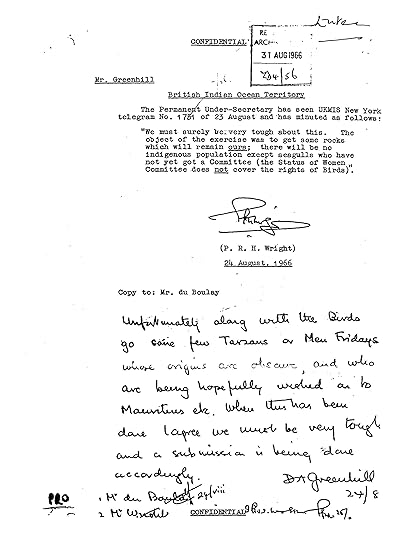
The novel is based around the characters of Damaris Caleemootoo, London-born but of Mauritian origins, and Oliver Pablo Herzberg, also English born but largely Scottish resident, each with some (but only some) biographical resemblance to each author. The story opens as follows with the language of the narration, and the narrative perspective, flipping between the plural first person we and third-person he/she, and with a shared slang of tubes (cigarettes), screens (mobile phones) and blocks (books), and an obsession, particularly his, with The Emergency (what he expects to be the near-term collapse of the global monetary system):
This is the story of our book we are still writing.
Edinburgh, July 2014. The sluggishness of early afternoon. The sky clouding over, a slight chill in the air. The same uninterrupted sadness, a kind of listlessness that went with everything we did. We’d made it to the Meadows. It had taken him a while to get her out of bed but he'd persisted, offering to buy us a coffee from the Swedish cafe and one of those cardamom buns we liked so much if she would come to the library. We noticed how people passing noticed us. She noticed how much thinner he was now than in London, joggers slipping down on his hips, constantly tugging at the waistband. We slowed our pace. Before the Meadows there was the chance she might change her mind. We were still talking about the morning as if something out of the ordinary had happened when really we'd spent it the way we spent every morning, him coming to her room with coffee, her accusing him of switching the heating off, him denying this. He’d told her, We really must get up earlier. It won't help to stay in bed. This was because we sometimes spent entire days in bed. In the kitchen she lit a tube, picked the raisins out of his cereal, milk still unpoured, put them with the other raisins extracted from other breakfasts. Currency she said, They’ll see us through The Emergency. She ate. We stared at his opened screen. We argued about whether or not to cycle to the library. But the sky seemed unsettled and unusually close from up here, on the sixth floor. We decided to walk. The billboard above ScotMid still read ‘Straight Talking Money Wonga'.
Damaris and Oliver Pablo have moved from London to Edinburgh after the latter's brother, Daniel, died in London (hence the sadness). In Edinburgh, they meet Diego, a poet, his self-chosen name after the island of Diego Garcia, from which his mother was forced to leave and move in Mauritius in 1973.
After an initial encounter Diego vanishes, but the two writers decide to take up his story, investigating the plight of the Chagos people, and the various artists that have told it, or rather Damaris does, while Oliver Pablo tries to support their finances by trading bitcoin.
Part of the novel's theme, as the opening quote suggests, is around the permission but also the responsibility to tell someone else's story, one that haunts you, and the book quotes from Eve Tuck and C. Ree, A Glossary of Haunting
In Luke Williams's words, the authors' colloboration is just one aspect of an approach that is seeking to think through, and enact, what it means to write a novel at this point in time:
Which is an ambitious and admirably creative project, but does mean that approaching this from the other end, as a reader of the physical, 'complete book' some of this approach to opening out the production of the novel is rather lost with its conventional publication (in a similar way to Joanna Walsh's Seed - see my review). Although the author(s) are keen to emphasise that the novel is simply part of a work in progress, so this very incompleteness is part of the artistic effect.
And the hybrid form of the work stands out, for example, this chapter, Enn Gramaten, from the work in progress published separately by Book Works in their Dialecty series, which doesn't appear to have made it in to the final novel. Other elements include:
- the we vs. he/she mixed style of narration shown above which mirrors the way the novel was written;
- extensive quotations from other works, typically not cited as such in the text but acknowledged in the appendix;
- extracts from the website of the UK Chagos Support Association;
- two parallel columns when the two argue and (temporarily) go their separate ways;
- an interview with an (imaginary) artist, Diego's sister;
- later email exchanges between the two writers about their project;
- extensive references to other artists, which the reader can follow up, extending the scope of the work, such as the novel Le Silence des Chagos by Shenaz Patel, the music of the band Big Joanie and the paintings of Clement Siatous on the Chagossian creole topic of 'sagren', a key theme of the novel.
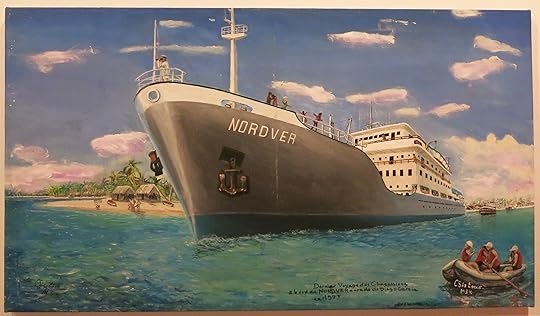
Clement Siatous, Dernier Voyage des Chagossiens a bord du Nordvar anrade Diego Garcia, en 1973
This would be an strong Goldsmiths contender other than the fact that few literary prizes allow collaborative works other than translations. Natasha Soobramanien writes about their collaboration here, noting that:
And interestingly, the first collaboration between the two came with Williams' debut novel The Echo Chamber, for which he had received an advance, but asked Soobramanien to write two chapters, although (it's suggested at the publisher's request) this is only acknowledged in the afterword. Indeed the two writers in the novel share a common experience:
After your world-famous agency had read the full manuscript and you'd revealed by contribution they expressed unease. Your publisher reacted similarly: what if I wanted my name on the cover...? Would I want paying? What about the terms and conditions for literary prizes
A slight irony that this appears in a book by Fitzcarraldo Editions, champions of translated literature but stubbornly resistant to naming the writers of the words, the translator, their due accord on the front cover of their books.
Highly worthwhile. 4.5 stars.
I thought that what I was writing was a kind of ghostwriting but actually what is it to ghostwrite the story of someone who never asked you to tell their story in the first place. Is that hauntwriting.
Diego Garcia is a collaborative work by the author(s) Natasha Soobramanien & Luke Williams, inspired by the ongoing plight of the Chagossians people, forced to leave their home islands in the Chagos Archipelago in 1973, by British soldiers, so that the US could establish a military base on the island of Diego Garcia. A base that has been associated with the CIA's rendition programme, while the territory of the British Indian Ocean Territory, established to facilitate the removal of the territory from Mauritius before independence, is also associated with the .io domain, notionally assigned to the territory but in practice privately operated and used for tech startups, online games and at least one crypto-based pyramid scheme.
A genuine diplomatic cable from 1966 which refers to the island's inhabitants as: "unfortunately, along with the birds go some few Tarzans and Man Fridays whose origins are obscure and who are hopefully being wished on to Mauritius".
The novel is based around the characters of Damaris Caleemootoo, London-born but of Mauritian origins, and Oliver Pablo Herzberg, also English born but largely Scottish resident, each with some (but only some) biographical resemblance to each author. The story opens as follows with the language of the narration, and the narrative perspective, flipping between the plural first person we and third-person he/she, and with a shared slang of tubes (cigarettes), screens (mobile phones) and blocks (books), and an obsession, particularly his, with The Emergency (what he expects to be the near-term collapse of the global monetary system):
This is the story of our book we are still writing.
Edinburgh, July 2014. The sluggishness of early afternoon. The sky clouding over, a slight chill in the air. The same uninterrupted sadness, a kind of listlessness that went with everything we did. We’d made it to the Meadows. It had taken him a while to get her out of bed but he'd persisted, offering to buy us a coffee from the Swedish cafe and one of those cardamom buns we liked so much if she would come to the library. We noticed how people passing noticed us. She noticed how much thinner he was now than in London, joggers slipping down on his hips, constantly tugging at the waistband. We slowed our pace. Before the Meadows there was the chance she might change her mind. We were still talking about the morning as if something out of the ordinary had happened when really we'd spent it the way we spent every morning, him coming to her room with coffee, her accusing him of switching the heating off, him denying this. He’d told her, We really must get up earlier. It won't help to stay in bed. This was because we sometimes spent entire days in bed. In the kitchen she lit a tube, picked the raisins out of his cereal, milk still unpoured, put them with the other raisins extracted from other breakfasts. Currency she said, They’ll see us through The Emergency. She ate. We stared at his opened screen. We argued about whether or not to cycle to the library. But the sky seemed unsettled and unusually close from up here, on the sixth floor. We decided to walk. The billboard above ScotMid still read ‘Straight Talking Money Wonga'.
Damaris and Oliver Pablo have moved from London to Edinburgh after the latter's brother, Daniel, died in London (hence the sadness). In Edinburgh, they meet Diego, a poet, his self-chosen name after the island of Diego Garcia, from which his mother was forced to leave and move in Mauritius in 1973.
After an initial encounter Diego vanishes, but the two writers decide to take up his story, investigating the plight of the Chagos people, and the various artists that have told it, or rather Damaris does, while Oliver Pablo tries to support their finances by trading bitcoin.
Part of the novel's theme, as the opening quote suggests, is around the permission but also the responsibility to tell someone else's story, one that haunts you, and the book quotes from Eve Tuck and C. Ree, A Glossary of Haunting
Haunting is the cost of subjugation. It is the price paid for violence, for genocide. Horror films in the United States have done viewers a disservice in teaching them that heroes are innocent, and that the ghouls are the trespassers. In the context of the settler colonial nation-state, the settler hero has inherited the debts of his forefathers. It is is difficult, even annoying to those who just wish to go about their day.
In Luke Williams's words, the authors' colloboration is just one aspect of an approach that is seeking to think through, and enact, what it means to write a novel at this point in time:
• We’re asking, for instance: How can a novel appeal to readers who read with 34 nested browser tabs open simultaneously?
• And, for that matter, what kind of novel gets written by novelists who spend increasing amount of their own time reading words off screens?
• This process is reflected in the novel stylistically: the text is an amalgam of the casual, scholarly, the statistical, personal, and quoted, with the use of research to animate its fictions, and fiction to interrogate research.
• Part of our interrogating the novel form involves not just our writing it but our approach to its publication
• It will be published as a complete book by Fitzcarraldo Editions
• But before that, as each chapter is completed, it is published in various journals and magazines (we’ve published chs in White Review, BOMB, Semiotext(e), Book Works, and others)
• After each chapter comes out we put it on our tumblr and give a series of performances from the work in progress, which we consider part of the publication strategy
• Part of the result of the performances is that they create a kind of social encounter with the text and invite discussion
• We see the project in terms of trying to rethink how we might approach the novel form for our times is also about trying to collapse the distinction between its production its finished form.
• To open out the novel to a kind of continuous practice of writing, writing collaboratively, of living and working together.
Which is an ambitious and admirably creative project, but does mean that approaching this from the other end, as a reader of the physical, 'complete book' some of this approach to opening out the production of the novel is rather lost with its conventional publication (in a similar way to Joanna Walsh's Seed - see my review). Although the author(s) are keen to emphasise that the novel is simply part of a work in progress, so this very incompleteness is part of the artistic effect.
And the hybrid form of the work stands out, for example, this chapter, Enn Gramaten, from the work in progress published separately by Book Works in their Dialecty series, which doesn't appear to have made it in to the final novel. Other elements include:
- the we vs. he/she mixed style of narration shown above which mirrors the way the novel was written;
- extensive quotations from other works, typically not cited as such in the text but acknowledged in the appendix;
- extracts from the website of the UK Chagos Support Association;
- two parallel columns when the two argue and (temporarily) go their separate ways;
- an interview with an (imaginary) artist, Diego's sister;
- later email exchanges between the two writers about their project;
- extensive references to other artists, which the reader can follow up, extending the scope of the work, such as the novel Le Silence des Chagos by Shenaz Patel, the music of the band Big Joanie and the paintings of Clement Siatous on the Chagossian creole topic of 'sagren', a key theme of the novel.
Clement Siatous, Dernier Voyage des Chagossiens a bord du Nordvar anrade Diego Garcia, en 1973
This would be an strong Goldsmiths contender other than the fact that few literary prizes allow collaborative works other than translations. Natasha Soobramanien writes about their collaboration here, noting that:
Collaboration in the field of literary fiction is rare, though common enough in genre writing (leaving aside for the moment the argument that literary fiction is itself a genre). But collaboration is, of course, standard practice in many other art forms. An assessment of why this should be the case and what this might reveal about the state of contemporary literary fiction is not my intention here.
And interestingly, the first collaboration between the two came with Williams' debut novel The Echo Chamber, for which he had received an advance, but asked Soobramanien to write two chapters, although (it's suggested at the publisher's request) this is only acknowledged in the afterword. Indeed the two writers in the novel share a common experience:
After your world-famous agency had read the full manuscript and you'd revealed by contribution they expressed unease. Your publisher reacted similarly: what if I wanted my name on the cover...? Would I want paying? What about the terms and conditions for literary prizes
A slight irony that this appears in a book by Fitzcarraldo Editions, champions of translated literature but stubbornly resistant to naming the writers of the words, the translator, their due accord on the front cover of their books.
Highly worthwhile. 4.5 stars.

November 10, 2022
Winner of the Goldsmiths Prize 2022
This is the last book I will read from this year's Goldsmiths list before tonight's announcement, and I would not be at all surprised to see it win, as it is probably the most innovative book on the list, not least because it is a genuine collaboration in which who wrote what is a matter of guesswork, and to some degree it tells a fictionalised version of its own creation. The central theme is the displacement of the islanders from the Chagos Islands in the Indian Ocean when the main island Diego Garcia was made into an American military base in the 1970s. I am not sure that it makes for a coherent whole, but it is an interesting read.
This is the last book I will read from this year's Goldsmiths list before tonight's announcement, and I would not be at all surprised to see it win, as it is probably the most innovative book on the list, not least because it is a genuine collaboration in which who wrote what is a matter of guesswork, and to some degree it tells a fictionalised version of its own creation. The central theme is the displacement of the islanders from the Chagos Islands in the Indian Ocean when the main island Diego Garcia was made into an American military base in the 1970s. I am not sure that it makes for a coherent whole, but it is an interesting read.

June 12, 2022
There are lots of intriguing and fascinating things about this book. And I don’t know in which order to talk about them! Here goes…
The novel is about a topic that I was completely ignorant of. In 1973, the people of the Chagos Archipelago, which includes the titular Diego Garcia, in the Indian Ocean were forced to leave their islands by the British so that the US could establish a military airbase on Diego Garcia. The ripples that spread out from that action are explored in the novel and none of them seem very good. I learned a lot about this whilst reading this book which is one the one hand a very positive thing but on the other hand not really in line with my taste in novels given the amount of factual information included which makes the book read like a text book a lot of the time. I don’t know why I’ve always struggled with works of fiction that include so much non-fiction and I don’t know at what the point the balance is tipped for me because I read a lot of books that have a non-fictional component.
Anyway, to continue with the intriguing and fascinating.
The book is a collaboration between two authors. Natasha Soobramanien and Luke Williams have worked together before this book with Soobramanien contributing two chapters to Williams’ first novel. Collaboration like this is unusual in literary fiction.
And related to this idea of collaboration, the narrative style is unusual, possibly even unique. It reflects the way the two authors have worked together on the novel and it switches seamlessly from third person singular to first person plural as can be seen in this quote which is the opening of the book:
The two narrators of the book are Damaris Caleemootoo and Oliver Pablo Herzberg. These two characters bear a striking resemblance to Soobramanien and Williams, further emphasising the unusual narrative voice.
And this narrative voice isn’t the only unusual element of the book, although I think some of the other notable structural things have been done before: long quotations from other works, email exchanges between the two narrators, quotations from websites, multiple references to other works which any interested reader can follow up (I spent quite a bit of time on Google but also on Spotify following up some of the musical references). There are also chapters where the text is laid out in two parallel columns during periods of the book when the two narrators have temporarily separated.
So, overall, this was, as I say, an intriguing and fascinating book to read. My only reservation is the very high proportion of quotes pulled from other sources which means that sometimes it does feel a bit like you are reading a Wikipedia article rather than a novel. I think this is largely my personal taste coming into play and I don’t think this will bother a lot of readers. I’m glad I read this for the insight it gives into a topic I knew nothing about. And the narrative style makes for a very interesting reading experience.
The novel is about a topic that I was completely ignorant of. In 1973, the people of the Chagos Archipelago, which includes the titular Diego Garcia, in the Indian Ocean were forced to leave their islands by the British so that the US could establish a military airbase on Diego Garcia. The ripples that spread out from that action are explored in the novel and none of them seem very good. I learned a lot about this whilst reading this book which is one the one hand a very positive thing but on the other hand not really in line with my taste in novels given the amount of factual information included which makes the book read like a text book a lot of the time. I don’t know why I’ve always struggled with works of fiction that include so much non-fiction and I don’t know at what the point the balance is tipped for me because I read a lot of books that have a non-fictional component.
Anyway, to continue with the intriguing and fascinating.
The book is a collaboration between two authors. Natasha Soobramanien and Luke Williams have worked together before this book with Soobramanien contributing two chapters to Williams’ first novel. Collaboration like this is unusual in literary fiction.
And related to this idea of collaboration, the narrative style is unusual, possibly even unique. It reflects the way the two authors have worked together on the novel and it switches seamlessly from third person singular to first person plural as can be seen in this quote which is the opening of the book:
Edinburgh, July 2014. The sluggishness of early afternoon. The sky clouding over, a slight chill in the air. The same uninterrupted sadness, a kind of listlessness that went with everything we did. We’d made it to the Meadows. It had taken him a while to get her out of bed but he'd persisted, offering to buy us a coffee from the Swedish cafe and one of those cardamom buns we liked so much if she would come to the library. We noticed how people passing noticed us. She noticed how much thinner he was now than in London, joggers slipping down on his hips, constantly tugging at the waistband. We slowed our pace.
The two narrators of the book are Damaris Caleemootoo and Oliver Pablo Herzberg. These two characters bear a striking resemblance to Soobramanien and Williams, further emphasising the unusual narrative voice.
And this narrative voice isn’t the only unusual element of the book, although I think some of the other notable structural things have been done before: long quotations from other works, email exchanges between the two narrators, quotations from websites, multiple references to other works which any interested reader can follow up (I spent quite a bit of time on Google but also on Spotify following up some of the musical references). There are also chapters where the text is laid out in two parallel columns during periods of the book when the two narrators have temporarily separated.
So, overall, this was, as I say, an intriguing and fascinating book to read. My only reservation is the very high proportion of quotes pulled from other sources which means that sometimes it does feel a bit like you are reading a Wikipedia article rather than a novel. I think this is largely my personal taste coming into play and I don’t think this will bother a lot of readers. I’m glad I read this for the insight it gives into a topic I knew nothing about. And the narrative style makes for a very interesting reading experience.

January 16, 2023
Four takeaways from the book
• Form. Different. But very choppy and often in note form. It won the niche Goldsmith Prize for innovative fiction in2022. It doesn’t make for smooth prose or especially enjoyable reading. There’s a large dollop of meta fiction in which the dual authors (itself very unusual if not unique, for a novel), Damaris and Oliver, inhabit their own book and describe their writing process. The duo muse at one point : “what about the terms and conditions for literary prizes” (223)
Some of the words used are baffling. Books are referred to as ‘blocks’; cigarettes as ‘tubes’; I’ve absolutely no idea why this is.
• Chagos islands. The book shines further light on a dispute which is largely kept out of sight. They are not the first to spotlight the callous, and illegal, actions of the British in separating the Chagos islands from Mauritius as part of decolonisation. The book becomes a bibliography analysis as multiple works of non fiction are described relating to the ongoing fate of the Chagossians. Telling human stories (in a semi fictional wrap) gives the author the opportunity to engage the reader in ways that a work of non-fiction cannot
• Themes/essence of a displaced population. The concept of ”sagren recurs through the book.
(derived from the French chagrin, or regret. Sagren, to the Chagos refugees, signifies a mix of nostalgia, desperation and overwhelming sorrow – a sickness for home so intense it can be lethal. https://www.theguardian.com/artanddes...)
The idea of writing ‘outside’. Sabrina Jean is a determined “public writer”, writing for people who can’t read.
(Sabrina Jean (born 1973) a second-generation Chagossian and activist for the Chagossian community to return home).
• Conflation of Causes.
o Women; Race, I’m not sure that I get these first two linkages. Men and women were equally affected. Geographical accident rather than skin colour was surely the motive behind the displacement actions.
o Claudia Rankine/ Beth Loffreda On Whiteness and the Racial Imaginary
o Detention, military bases. The eerie, covert, presence of military bases is a chillingly interesting extended topic
Yarl's Wood Immigration Removal Centre is a detention centre for foreign nationals prior to their deportation from the United Kingdom, one of 10 such centres currently in the UK. The authors reflect on issues of migration and home in the Uk and make a comparison with Chagos islands.
Faslane nuclear base at Cove on the Clyde in Scotland. A similar comparison is made regarding protected and secretive in the Uk and the American bases on Diego Garcia
One other connection identified by the authors between the UK and Chagos, is a clever one, surrounding dogs.
Overtoun Bridge, Scotland ("Dog Suicide Bridge”.)
“Since the 1950s, numerous reports of dogs either falling or jumping from the bridge have been reported. With the incidents often resulting in serious injury or death upon landing on the rocks some 50 ft (15 m) below, the bridge has been nicknamed the
This is compared to the fate of the many dogs exterminated by the British in the Chagos islands
This is an interesting book in many ways and I’m not certain whether it is a book that would create greater impact on the reader if you were oblivious to the facts surrounding the Chagos Islands. Coupled with Philippe Sands’s the Last Colony , the two books present a human tragedy and a fascinating insight into a piece of geopolitics that has existed below the radar for many years.
• Form. Different. But very choppy and often in note form. It won the niche Goldsmith Prize for innovative fiction in2022. It doesn’t make for smooth prose or especially enjoyable reading. There’s a large dollop of meta fiction in which the dual authors (itself very unusual if not unique, for a novel), Damaris and Oliver, inhabit their own book and describe their writing process. The duo muse at one point : “what about the terms and conditions for literary prizes” (223)
Some of the words used are baffling. Books are referred to as ‘blocks’; cigarettes as ‘tubes’; I’ve absolutely no idea why this is.
• Chagos islands. The book shines further light on a dispute which is largely kept out of sight. They are not the first to spotlight the callous, and illegal, actions of the British in separating the Chagos islands from Mauritius as part of decolonisation. The book becomes a bibliography analysis as multiple works of non fiction are described relating to the ongoing fate of the Chagossians. Telling human stories (in a semi fictional wrap) gives the author the opportunity to engage the reader in ways that a work of non-fiction cannot
• Themes/essence of a displaced population. The concept of ”sagren recurs through the book.
(derived from the French chagrin, or regret. Sagren, to the Chagos refugees, signifies a mix of nostalgia, desperation and overwhelming sorrow – a sickness for home so intense it can be lethal. https://www.theguardian.com/artanddes...)
The idea of writing ‘outside’. Sabrina Jean is a determined “public writer”, writing for people who can’t read.
(Sabrina Jean (born 1973) a second-generation Chagossian and activist for the Chagossian community to return home).
• Conflation of Causes.
o Women; Race, I’m not sure that I get these first two linkages. Men and women were equally affected. Geographical accident rather than skin colour was surely the motive behind the displacement actions.
o Claudia Rankine/ Beth Loffreda On Whiteness and the Racial Imaginary
o Detention, military bases. The eerie, covert, presence of military bases is a chillingly interesting extended topic
Yarl's Wood Immigration Removal Centre is a detention centre for foreign nationals prior to their deportation from the United Kingdom, one of 10 such centres currently in the UK. The authors reflect on issues of migration and home in the Uk and make a comparison with Chagos islands.
Faslane nuclear base at Cove on the Clyde in Scotland. A similar comparison is made regarding protected and secretive in the Uk and the American bases on Diego Garcia
One other connection identified by the authors between the UK and Chagos, is a clever one, surrounding dogs.
Overtoun Bridge, Scotland ("Dog Suicide Bridge”.)
“Since the 1950s, numerous reports of dogs either falling or jumping from the bridge have been reported. With the incidents often resulting in serious injury or death upon landing on the rocks some 50 ft (15 m) below, the bridge has been nicknamed the
This is compared to the fate of the many dogs exterminated by the British in the Chagos islands
This is an interesting book in many ways and I’m not certain whether it is a book that would create greater impact on the reader if you were oblivious to the facts surrounding the Chagos Islands. Coupled with Philippe Sands’s the Last Colony , the two books present a human tragedy and a fascinating insight into a piece of geopolitics that has existed below the radar for many years.

May 2, 2025
I have mixed feeling about this book.
Whilst I applaud it's approach to narration by having a dual narrator (reflecting the co-authors) and the subject matter (the eviction of the Chagos islanders by the British government in the 1970s to make way for the US the develop a huge military base on the island), I didn't like the fragmented nature of the narrative and the focus as much on the minutiae of the narrators' everyday lives which distracted from the plight of the exiled Chagossians.
Whilst I applaud it's approach to narration by having a dual narrator (reflecting the co-authors) and the subject matter (the eviction of the Chagos islanders by the British government in the 1970s to make way for the US the develop a huge military base on the island), I didn't like the fragmented nature of the narrative and the focus as much on the minutiae of the narrators' everyday lives which distracted from the plight of the exiled Chagossians.

October 6, 2024
I decided it was time to read Diego Garcia after seeing that the UK government finally agreed to hand back the Chagos Islands. However the agreement does not cover Diego Garcia, the island this novel is named after, and the Chagossian people were not consulted on it. The narrative revolves around the injustice of Diego Garcia: all its residents were expelled more than forty years ago by the UK so their home could be used as a massive US/UK military base. This story is told indirectly, by two novelists trying to understand and write about the Chagossian people's experience of being dispossessed. Diego Garcia is a novel about writing fiction, featuring fictions within fictions. I liked its linguistic experimentation and intertextuality, which draws upon a rich variety of other books. The playful formatting also works very nicely in a lovely Fitzcarraldo Edition. (They use better, thicker, more pleasingly textured paper than other publishers.)
Quite a bit of Diego Garcia follows the protagonists around Edinburgh in 2014, which I enjoyed as the locations were sweetly familiar. Literally so whenever they went into Soderberg for a bun. The city is evoked vividly; perhaps its familiarity helped to make the rest of the book so convincing. As I understand it, the genuine story of Chagos is told via fictional characters. The narrative itself grapples with how useful this fiction can be as a tool of activism. Amid the many horrific injustices of the world, Chagossians struggled to bring attention to their plight. I hope that the UK government's agreement will help them, but the exclusion of Diego Garcia seems to belie that.
Considering that it is, I guess, highbrow experimental literary fiction, I found Diego Garcia highly readable, compelling, and moving. The melange of textual styles works impressively well as an interrogation of writing about an injustice the writer didn't experience themself. I found the reading experience new and interesting, not quite like anything else. It is undoubtedly a clever and rewarding novel. Also, to reiterate, Fitzcarraldo Editions are wonderfully designed physical objects. They're not sponsoring me and I found Diego Garcia in a charity shop. It's just that among the many books I read, this particular publisher's have the nicest texture, scent, size, and heft.
Quite a bit of Diego Garcia follows the protagonists around Edinburgh in 2014, which I enjoyed as the locations were sweetly familiar. Literally so whenever they went into Soderberg for a bun. The city is evoked vividly; perhaps its familiarity helped to make the rest of the book so convincing. As I understand it, the genuine story of Chagos is told via fictional characters. The narrative itself grapples with how useful this fiction can be as a tool of activism. Amid the many horrific injustices of the world, Chagossians struggled to bring attention to their plight. I hope that the UK government's agreement will help them, but the exclusion of Diego Garcia seems to belie that.
Considering that it is, I guess, highbrow experimental literary fiction, I found Diego Garcia highly readable, compelling, and moving. The melange of textual styles works impressively well as an interrogation of writing about an injustice the writer didn't experience themself. I found the reading experience new and interesting, not quite like anything else. It is undoubtedly a clever and rewarding novel. Also, to reiterate, Fitzcarraldo Editions are wonderfully designed physical objects. They're not sponsoring me and I found Diego Garcia in a charity shop. It's just that among the many books I read, this particular publisher's have the nicest texture, scent, size, and heft.

November 8, 2022
Diego Garcia is one of those books which is a one of a kind read but it also, for me, falls into the ‘admire but not love’ category.
The titular main character is a person that a couple meet in a library. We find out that Diego is named after an island in the Chagos archipelago, which is near Mauritius and was part of a British colony and had a turbulent history.
The couple then want to atone for this gross chapter in history and want to tell the story, yet this brings up a paradox as it’s technically not their story to tell, which is where the book goes into a lot of interesting territories.
Using interviews, simultaneous conversations and reports. Natasha Soobramanien and Luke Williams create a mind warping read which surprises the reader with each page turn. On top of that there’s a lot of references to both popular and underground bands ( kudos for mentioning Big Joanie, who released a new album the week I read Diego Garcia).
Unfortunately the book didn’t grab me. I understand it is a post modern look at colonialism and it is definitely a unique read but I just couldn’t get invested and got bored quite a few times. I know it’s just me and it’s a pity as there’s a lot to admire here.
The titular main character is a person that a couple meet in a library. We find out that Diego is named after an island in the Chagos archipelago, which is near Mauritius and was part of a British colony and had a turbulent history.
The couple then want to atone for this gross chapter in history and want to tell the story, yet this brings up a paradox as it’s technically not their story to tell, which is where the book goes into a lot of interesting territories.
Using interviews, simultaneous conversations and reports. Natasha Soobramanien and Luke Williams create a mind warping read which surprises the reader with each page turn. On top of that there’s a lot of references to both popular and underground bands ( kudos for mentioning Big Joanie, who released a new album the week I read Diego Garcia).
Unfortunately the book didn’t grab me. I understand it is a post modern look at colonialism and it is definitely a unique read but I just couldn’t get invested and got bored quite a few times. I know it’s just me and it’s a pity as there’s a lot to admire here.

November 3, 2022
This cowritten novel is both a story of literary collaboration and social commentary on a lesser-known episode of history. The two protagonists, Damaris and Oliver, are writers living in Edinburgh in 2014. They meet Diego Garcia, who has named himself after a (real) island in the Chagos Archipelago. Diego tells the pair of his Mauritian mother’s forced expulsion from her home in 1973. She and the other residents of Diego Garcia were deported to Mauritius and the Seychelles so that a joint US/UK military base could be built on the island. In conjunction with Diego’s story, we also learn of Oliver’s brother’s suicide after a stay in a mental health facility.
I appreciated learning more about the history of Diego Garcia. It inspired me to go looking for more information. However, the structure of this book is a hot mess. The narrative is presented in a combination of formats, including interviews, emails, diary entries, and what appear to be Wikipedia excerpts. The styles are also mixed, expressed in lengthy run-on sentences, dual columns on a single page, and short choppy fragments. It is filled with obscure (to me) cultural references.
I found the varieties in formats distracting. Other than being “artsy” there seemed to be little point. I can appreciate the desire to bring to light a lesser-known example of colonialism at a time when these types of takeovers were supposedly in the distant past, but it is told in such a disjointed way that it was difficult to enjoy the reading experience.
I appreciated learning more about the history of Diego Garcia. It inspired me to go looking for more information. However, the structure of this book is a hot mess. The narrative is presented in a combination of formats, including interviews, emails, diary entries, and what appear to be Wikipedia excerpts. The styles are also mixed, expressed in lengthy run-on sentences, dual columns on a single page, and short choppy fragments. It is filled with obscure (to me) cultural references.
I found the varieties in formats distracting. Other than being “artsy” there seemed to be little point. I can appreciate the desire to bring to light a lesser-known example of colonialism at a time when these types of takeovers were supposedly in the distant past, but it is told in such a disjointed way that it was difficult to enjoy the reading experience.

April 14, 2022
Excuse my ignorance, but I fully hold my hands up and say, I knew absolutely nothing -zero, zilch, nada, about Diego Garcia, nor Britains (or the US) involvement with the abhorrent and unjust depopulation, of said island.
Diego Garcia; the novel, is a (literal) collaborative blend of history and fiction. Uniquely (and rather unusually when it comes to the books form and writing style) exploring themes of grief, politics, friendship, and the importance of how, as a writer, you are able to share and experience a story that needs to be heard and shared, especially when it’s not necessarily your story to tell.
Believe it or not, this is my first Fitzcarraldo Edition. Of which, would you also believe, I was sent an advanced proof copy of (so huge shout out of thanks to FE for that !)
However, although I was initially incredibly intrigued (and excited) I think I let my (let’s face it, v high) expectations overtake, and ultimately get the better of me.
Interesting in premise, but deeply flawed in execution. This is a book that, like many out there, suffers from the ol’ “style over substance” debacle.
Where at once, the almost omniscient synthesis, of the first person plural and third person narration, felt deeply intimate and emotionally animated, no sooner became a far too chaotic, and frankly overwhelming reading experience.
2 stars
Diego Garcia; the novel, is a (literal) collaborative blend of history and fiction. Uniquely (and rather unusually when it comes to the books form and writing style) exploring themes of grief, politics, friendship, and the importance of how, as a writer, you are able to share and experience a story that needs to be heard and shared, especially when it’s not necessarily your story to tell.
Believe it or not, this is my first Fitzcarraldo Edition. Of which, would you also believe, I was sent an advanced proof copy of (so huge shout out of thanks to FE for that !)
However, although I was initially incredibly intrigued (and excited) I think I let my (let’s face it, v high) expectations overtake, and ultimately get the better of me.
Interesting in premise, but deeply flawed in execution. This is a book that, like many out there, suffers from the ol’ “style over substance” debacle.
Where at once, the almost omniscient synthesis, of the first person plural and third person narration, felt deeply intimate and emotionally animated, no sooner became a far too chaotic, and frankly overwhelming reading experience.
2 stars
June 6, 2023
4.5⭐️
October 21, 2023
I absolutely loved this one. Political, personal, sensitive and a full-blown accusation of the imperial British government. What's not to love?!
“The coalition emerges out of your recognition that it’s fucked up for you, in the same way that we’ve already recognized that it’s fucked up for us. I don’t need your help. I just need you to recognize that this shit is killing you, too, however much more softly, you stupid motherfucker, you know?”
-- Fred Moten
What really really touched me, are the questions at the heart of the book, which made the book endlessly inspiring to me. The book through a mixture of auto-fiction and faction ruminates about how to write in solidarity and how to share a story that is not yours.
In this case, the story Natasha and Luke (try to) share, is the underreported atrocity suffered by the Chargossian people, who were forcibly displaced from their homes in the Chargos archipelago in the Indian Ocean by the UK and US government to build a Navy base on the biggest island in the Archipelago: Diego Garcia. The Indian Ocean islands were part of Mauritius, then a UK colony. To do so, the UK government split the Chagos Archipelago from Mauritius, creating a new colony, the British Indian Ocean Territory (BIOT). So that it would not have to report to the United Nations about its continued colonial rule, the UK falsely declared that Chagos had no permanent population. The book is a response to this fiction. The foreword in this regard is so damn beautiful.
Similar questions have been in my mind. How do you write in service of the people or politics, sharing a story that is not told enough or a version that has actively been silenced by powerful governments, while crediting the voices of those who have suffered this and without taking the story and running with it? I think the book, through highlighting so many of the voices that have, and still do, actively advocate for legal reparations, documentary footage and own positionalities, managed to share a very sensitive engagement.
Reading the book, I saw many parallels to Maui Nui, still part of France, and the nuclear tests by the US on atolls in the Pacific Ocean, which still has a massive environmental and health impact on many - if not all - inhabitants of Maui Nui.
This book won the Goldsmith prize for innovative fiction, I think you can really tell, based on all I said before, but additionally, I think it's very experimental in other regards. For example, I loved how the first part of the book is written in such a way that it responds and activates Fred Moten and Stefano Harney's conception of individuation and incompleteness through the 'we', the unity, that foregrounds any sentences that develop into she/he. And the mixture of different voices that start as a 'we' and slowly disintegrate into distinct different voices.
There's something odd and special about reading a book by people you've talked at length about writing with. Many of these conversations came back to life and gained more detail and context for me reading this book.
“The coalition emerges out of your recognition that it’s fucked up for you, in the same way that we’ve already recognized that it’s fucked up for us. I don’t need your help. I just need you to recognize that this shit is killing you, too, however much more softly, you stupid motherfucker, you know?”
-- Fred Moten
What really really touched me, are the questions at the heart of the book, which made the book endlessly inspiring to me. The book through a mixture of auto-fiction and faction ruminates about how to write in solidarity and how to share a story that is not yours.
In this case, the story Natasha and Luke (try to) share, is the underreported atrocity suffered by the Chargossian people, who were forcibly displaced from their homes in the Chargos archipelago in the Indian Ocean by the UK and US government to build a Navy base on the biggest island in the Archipelago: Diego Garcia. The Indian Ocean islands were part of Mauritius, then a UK colony. To do so, the UK government split the Chagos Archipelago from Mauritius, creating a new colony, the British Indian Ocean Territory (BIOT). So that it would not have to report to the United Nations about its continued colonial rule, the UK falsely declared that Chagos had no permanent population. The book is a response to this fiction. The foreword in this regard is so damn beautiful.
Similar questions have been in my mind. How do you write in service of the people or politics, sharing a story that is not told enough or a version that has actively been silenced by powerful governments, while crediting the voices of those who have suffered this and without taking the story and running with it? I think the book, through highlighting so many of the voices that have, and still do, actively advocate for legal reparations, documentary footage and own positionalities, managed to share a very sensitive engagement.
Reading the book, I saw many parallels to Maui Nui, still part of France, and the nuclear tests by the US on atolls in the Pacific Ocean, which still has a massive environmental and health impact on many - if not all - inhabitants of Maui Nui.
This book won the Goldsmith prize for innovative fiction, I think you can really tell, based on all I said before, but additionally, I think it's very experimental in other regards. For example, I loved how the first part of the book is written in such a way that it responds and activates Fred Moten and Stefano Harney's conception of individuation and incompleteness through the 'we', the unity, that foregrounds any sentences that develop into she/he. And the mixture of different voices that start as a 'we' and slowly disintegrate into distinct different voices.
There's something odd and special about reading a book by people you've talked at length about writing with. Many of these conversations came back to life and gained more detail and context for me reading this book.

July 20, 2022
A few short passages from Diego Garcia:
*
Colette said that writers should look closely at what pleases them, and closer still at what gives them pain.
*
Are you still not writing? I feel now that you refusing to write felt like you refusing whiteness.
Daniel’s refusing to live feels now like Daniel refusing whiteness.
Q: What does it say about extreme depression that it engenders a kind of ‘feminized’ behaviour – passiveness, quietness, etc and what does that say about patriarchy.
A: nothing we didn’t know.
*
Writing is a practical skill, writing is the most practical thing I can do.
But what to do with it?
How to use it?
What I call writing is me trying to grab the questions that come at me. And when I can’t do anything with them I can’t do anything.
*
I don’t care how much fuckin ‘magic’ is in a book, if it doesn’t attempt to reimagine the structures of our world but with every word enforces them, it’s about as magic as a breezeblock.
*
How as a writer do you tell a story that needs to be shared, if it is not your story?
*
[For me, this was one of the best books I've read in a very long time.]
*
Colette said that writers should look closely at what pleases them, and closer still at what gives them pain.
*
Are you still not writing? I feel now that you refusing to write felt like you refusing whiteness.
Daniel’s refusing to live feels now like Daniel refusing whiteness.
Q: What does it say about extreme depression that it engenders a kind of ‘feminized’ behaviour – passiveness, quietness, etc and what does that say about patriarchy.
A: nothing we didn’t know.
*
Writing is a practical skill, writing is the most practical thing I can do.
But what to do with it?
How to use it?
What I call writing is me trying to grab the questions that come at me. And when I can’t do anything with them I can’t do anything.
*
I don’t care how much fuckin ‘magic’ is in a book, if it doesn’t attempt to reimagine the structures of our world but with every word enforces them, it’s about as magic as a breezeblock.
*
How as a writer do you tell a story that needs to be shared, if it is not your story?
*
[For me, this was one of the best books I've read in a very long time.]

March 28, 2024
Great book. Not immediately engaging and quite slow paced, but interestingly/ethically self-reflexive. Merges and toes the line between fiction/non-fiction/memoir. Intertextual as it should be. Big fan.

June 7, 2023
4.5 ⭐️

August 3, 2022
Hmm interesting book!! I was completely ignorant of the fact of the chagossians struggle before this book. It not only makes their struggle visible but it interrogates our own motivations for getting drawn into a story or a political movement when it is not ours. Of course the answer is not indifference but rather the question is how to add energy. I think it’s funny that a book that is so concerned with writing (the process, what is can/does/doesn’t mean or do, how to write together/apart etc) would be great to write about. It’s odd in that there are many parts to the book with different vibes, the end feels very Chris Krausesque but the beginning does not at all.
November 17, 2022
First 1/3 was intriguing, maybe even sad and beautiful(?). But then it just got a bit dry and chaotic and distracting...

December 12, 2022
4.5⭐️ Soooo fascinating, the intersections of the fragments!!!
August 4, 2022
Inadvertently I keep reading novels by writers about writers - they’re so complex, so interesting, so clever, don’t you know - and it is an absolutely joyless affair. No fictional character should think this much about literary theory.
Just because the author stand-ins are thinking loudly about colonialism this time round doesn’t make it less masturbatory. 1/5.
Just because the author stand-ins are thinking loudly about colonialism this time round doesn’t make it less masturbatory. 1/5.
November 12, 2022
Yazarların ne yapmaya çalıştığını anladıktan sonra hayran kaldım ama bu hayranlık kitabı sevdiğim anlamına gelmiyor.

Read
November 24, 2024Shoutout to the editor at the LA Printed Matter festival last year who gave me this book for free; I lugged it to Durham and back to NYC without reading it (or the Cookie Mueller book I actually paid for). Perhaps for the best — I think this would have made completely zero sense to me had I not read it post-thesis/Intimacies class. Divine timing! I think the experimentation in form is smart, although I understand how that which makes it an exercise in multiplicity also contributes to its destabilizing nature. But I think its a productive tension when the story itself is about two writers and friends navigating that thin line between 'knowing' and 'owning' (each other, each other's histories, others' histories) that arises in both intimacy and writing (to talk at/over, as Damaris puts it) -- the harms of fiction, the harms of intimacy. When you "consent not to be a single being" do you give yourself away? do you give your history away? who can claim it? then arises the really great empathy vs. solidarity in fiction discussion, as well as what it means to be a "public writer."
--
"We were learning to be kind to one another, and to Daniel, trying to understand one another's language better. Living — trying to live — without consent to being single beings, as Edouard Glissant and Fred Moten said they wanted to do."
"What if you could put your whiteness into the service of refusing whiteness. Is that possible? Is writing for you a process of interiorizing, of individualizing — of burying yourself alive in your white man's body? ... If so, what if there is a way to write outside yourself?"
"Fiction as a political tool for putting possibilities into language. I didn't understand theory till I realized it must be read as poetry."
"The first time I took acid I invented a word but didn't know its meaning. The beginning of a new language. The second time I took acid I remembered this word and realized its meaning was: 'here I am again'. It was in my recollection of it that this word acquired its meaning."
"What does a fiction of solidarity look like? ... Maybe translation is one of the purest forms of writing as solidarity ... Solidarity requires us to get over ourselves. Outside ourselves."
"From the inside. So perhaps solidarity is to write from the inside. Back to prepositions again... Trinh T. Minh-ha, and 'speaking nearby.'... NB 'nearby,' not 'beside.' The difference between solidarity and empathy."
--
"We were learning to be kind to one another, and to Daniel, trying to understand one another's language better. Living — trying to live — without consent to being single beings, as Edouard Glissant and Fred Moten said they wanted to do."
"What if you could put your whiteness into the service of refusing whiteness. Is that possible? Is writing for you a process of interiorizing, of individualizing — of burying yourself alive in your white man's body? ... If so, what if there is a way to write outside yourself?"
"Fiction as a political tool for putting possibilities into language. I didn't understand theory till I realized it must be read as poetry."
"The first time I took acid I invented a word but didn't know its meaning. The beginning of a new language. The second time I took acid I remembered this word and realized its meaning was: 'here I am again'. It was in my recollection of it that this word acquired its meaning."
"What does a fiction of solidarity look like? ... Maybe translation is one of the purest forms of writing as solidarity ... Solidarity requires us to get over ourselves. Outside ourselves."
"From the inside. So perhaps solidarity is to write from the inside. Back to prepositions again... Trinh T. Minh-ha, and 'speaking nearby.'... NB 'nearby,' not 'beside.' The difference between solidarity and empathy."

April 17, 2023
A terrific book that sheds light on one of the great lesser known outrages of colonialism – the forced displacement of the entire population of the Chagos Islands in the Indian Ocean, engineered by Britain in favour of the establishment of an American airbase that is still there today. This ingeniously co-authored volume tackles the topic in both direct and indirect fashion via two narrators living in Edinburgh, Brussels and London throughout the 2010s and into the pandemic era.
It is elegantly written and the fragmentary structure recalls other volumes published by the increasingly revolutionary Fitzcarraldo editions from the likes of Svetlana Alexievich and Olga Tokarczuk, sharing those authors’ sense of political urgency as well as deeply moving personal topics. The book’s literariness is up front and unashamed with major name checks to the work of Theodor Adorno and Fred Moten as well as some evidence of sublime music taste (Life without Buildings, Neu, Big Joanie). That said, this arty (for want of a better word) approach to bringing such outrages to light is unlikely to cause more than a ripple of a wave on the consciences of the UK and US governments, especially given the former have already ignored a ruling from an international court that the Chagossians should be allowed to return.
It is elegantly written and the fragmentary structure recalls other volumes published by the increasingly revolutionary Fitzcarraldo editions from the likes of Svetlana Alexievich and Olga Tokarczuk, sharing those authors’ sense of political urgency as well as deeply moving personal topics. The book’s literariness is up front and unashamed with major name checks to the work of Theodor Adorno and Fred Moten as well as some evidence of sublime music taste (Life without Buildings, Neu, Big Joanie). That said, this arty (for want of a better word) approach to bringing such outrages to light is unlikely to cause more than a ripple of a wave on the consciences of the UK and US governments, especially given the former have already ignored a ruling from an international court that the Chagossians should be allowed to return.

July 8, 2025
4.5*
fitzcarraldo always publishes the goods.
very playful with form, exploring forms of fiction/poetry/art depicting disappearance/grief, the grief of a community forced into exile from their home (Diego Garcia, the largest foreign US military base, created in the 70s by Britain forcing Chagosians to leave) accompanied with on of the characters/writers reflections of his brothers death.
the novel itself is a commentary on the creation of this novel, which could sound kind of pretentious/arty - but ultimately is touching; the creation of a novel as a way of connecting these two writer characters and continuing the dialogue of the themes/stories that are the foundations to their friendship.
books like this make me happy, even if the content can be sad.
have a blessed day xx
fitzcarraldo always publishes the goods.
very playful with form, exploring forms of fiction/poetry/art depicting disappearance/grief, the grief of a community forced into exile from their home (Diego Garcia, the largest foreign US military base, created in the 70s by Britain forcing Chagosians to leave) accompanied with on of the characters/writers reflections of his brothers death.
the novel itself is a commentary on the creation of this novel, which could sound kind of pretentious/arty - but ultimately is touching; the creation of a novel as a way of connecting these two writer characters and continuing the dialogue of the themes/stories that are the foundations to their friendship.
books like this make me happy, even if the content can be sad.
have a blessed day xx
Read
November 3, 2023more books should be written by collectives. the first part of this was absolutely electric, i loved it, but then it sort of figured out what it was about and got a little less good. which i feel bad about saying because the less good bits are the bits about the plight of a displaced people
March 26, 2026
An interesting read due to both the content and the form. I do feel that it was clunky in this annoying pretentious way but thinking about the book as a whole after finishing it actually makes for a nice complete package showcasing a sort of "evolution of style". Indeed, less innovative than I would have hoped!

March 15, 2023
Strangely enough I came across the Chagos ICJ case and this book at the exact same time.
The emails (especially those sent by damaris) were so beautiful so perfect
The emails (especially those sent by damaris) were so beautiful so perfect
August 1, 2025
WOW i love…….
Did Not Finish
March 15, 2026waste of time. Besides making it unreadable, the postmodern and overly self-indulgent writing does a violence to the topic … Although I suppose I’m glad the book exists generally

September 7, 2025
4.5⭐
beautiful beautiful book.
despite being quite factual/academic, the book is a very personal intimate read as you learn about the chagossian exile alongside the two main characters while they grapple with how to tell a story that isn't theirs. the plight of the chagossian people is told alongside the (often mundane) details of their lives (not described in mundane way tho!) and their relationship while dealing with loss.
not quite five stars as some of the more academic passages went over my head
beautiful beautiful book.
despite being quite factual/academic, the book is a very personal intimate read as you learn about the chagossian exile alongside the two main characters while they grapple with how to tell a story that isn't theirs. the plight of the chagossian people is told alongside the (often mundane) details of their lives (not described in mundane way tho!) and their relationship while dealing with loss.
not quite five stars as some of the more academic passages went over my head
Displaying 1 - 30 of 60 reviews