Discover the many faces of the Moon Knight! Mercenary. Werewolf hunter. Millionaire playboy. Cab driver. Super hero? Moon Knight is many things to many people, and he has the multiple personalities to match! Follow Marc Spector, the earthly Fist of Khonshu, as he battles to fi nd his place in the Marvel Universe - and builds the strangest rogues' gallery in all of comics. Prepare yourself for the deadly Bushmaster! Arsenal, the one-man army! Stained Glass Scarlet, the nun with a crossbow! And more! Featuring iconic stories by Doug Moench and Bill Sienkiewicz! COLLECTING: WEREWOLF BY NIGHT (1972) 32-33; MARVEL SPOTLIGHT (1971) 28-29; DEFENDERS (1972) 47-50; PETER PARKER, THE SPECTACULAR SPIDERMAN (1976) 22-23; MARVEL TWO-IN-ONE (1974) 52; MOON KNIGHT (1980) 1-20; MARVEL TEAM-UP ANNUAL (1976) 4; AMAZING SPIDER-MAN (1963) 220; material from HULK MAGAZINE (1978) 11-15, 17-18, 20; MARVEL PREVIEW (1975) 21
Doug Moench, is an American comic book writer notable for his Batman work and as the creator of Black Mask, Moon Knight and Deathlok. Moench has worked for DC Comics, Marvel Comics, Dark Horse Comics and many other smaller companies; he has written hundreds of issues of many different comics, and created dozens of characters, such as Moon Knight. In 1973, Moench became the de facto lead writer for the Marvel black-and-white magazine imprint Curtis Magazines. He contributed to the entire runs of Planet of the Apes, Rampaging Hulk (continuing on the title when it changed its name to The Hulk!) and Doc Savage, while also serving as a regular scribe for virtually every other Curtis title during the course of the imprint's existence. Moench is perhaps best known for his work on Batman, whose title he wrote from 1983–1986 and then again from 1992–1998. (He also wrote the companion title Detective Comics from 1983–1986.)
Moench is a frequent and longtime collaborator with comics artist Paul Gulacy. The pair are probably best known for their work on Shang-Chi: Master of Kung Fu, which they worked on together from 1974–1977. They also co-created Six from Sirius, Slash Maraud, and S.C.I. Spy, and have worked together on comics projects featuring Batman, Conan the Barbarian and James Bond.
Moench has frequently been paired with the artist and inker team of Kelley Jones and John Beatty on several Elseworlds Graphic Novels and a long run of the monthly Batman comic.
This omnibus collects all of Moon Knight's early appearances up through the first 20 issues of his own comic. Some of these like the backup stories from The Hulk! magazine are absolutely fantastic and hard to find. They aren't even on Marvel Unlimited.
Werewolf by Night #32-33 - Doug Moench & Don Perlin Moon Knight's first appearnace. Spector is a mercenary here who gets his costume from the Committee. He's hired to capture the Werewolf by Night, Jack Russell. (I still can't believe they named the Marvel character after a dog breed. Funny stuff!) No mention of Khonshu at all. Frenchie does appear as Moon Knight's pilot.
Marvel Spotlight #28-29 - Doug Moench & Don Perlin Moon Knight gets his various identities along with the rest of his supporting cast of helpers, Marlene, Gena, and Crowley. He fights a cheesy villain called Conquer-Lord who tries to frame the mayor with his own Watergate.
Defenders #47-50 - David Kraft, John David Warner & Keith Giffen Moon Knight teams up with the Defenders when a friend of theirs is kidnapped by Scorpio. Scorpio is Nick Fury's brother, suffers from depression and constantly offers friends and foes alike Schlitz beer. It's hilarious and strange. Giffen's art is very Kirbian
Spectacular Spider-Man #22-23 - Bill Mantlo, Mike Zeck & Jim Mooney This was terrific. I'm going to need to check out more of Mantlo's run after reading this. Spidey and Moon Knight team up to fight the Maggia.
Marvel Two-in-One #52 - Steven Grant, Jim Craig & Pablo Marcos Moon Knight teams up with the Thing when Crossfire captures them and attempts to brainwash the two. Yes, Steven Grant wrote Steven Grant.
The Hulk! Magazine #11-14 - Doug Moench, Gene Colan, Keith Pollard & Bill Sienkiewicz Bill Sienkiewicz's first work at Marvel. Moon Knight goes on the hunt for a missing Egyption antiquity and finds a plot to blow up NYC with a nuclear bomb. Moon Knight gets his full cape.
The Hulk! Magazine #15 - Doug Moench & Bill Sienkiewicz First a crossover of sorts with the same story told from two different perspectives as Moon Knight and the Hulk cross paths without realizing it. Great stuff.
The Hulk! Magazine #17-18 - Doug Moench & Bill Sienkiewicz This was awesome! Moon Knight is on the trail of Hatchetman, a serial killer attacking nurses. This is really dark and gets even darker as Marc realizes who the Hatchetman is. Sienkiewicz's Hatchetman looks like Eddie from the Iron Maiden covers and is the stuff nightmares are made of. Great stuff!
The Hulk! Magazine #20 - Doug Moench & Bill Sienkiewicz A night on patrol with Moon Knight. These backup stories are the hit of this collection. They are the best!
Marvel Preview #21 - Doug Moench & Bill Sienkiewicz Marc Spector gets pulled into his old CIA days when an old MK Ultra project rears its head.
Moon Knight #1-20 - Doug Moench & Bill Sienkiewicz Moon Knight finally gets his own comic. His origin gets retconned into the origin we all know with Bushman killing Marc Spector after Spector tries to stop him from murdering captives and is then resurrected by Khonshu, even though Khonshu is just a statue so it could all be in Moon Knight's head. We also see how Marc met Marlene. The Midnight Man and Bushman show up as foisl for Moon Knight. Moench deals with MK's origin from Werewolf by Night fixing it to fit in with his new and much better origin. For the most part, Moench decides to ground Moon Knight and keep him out of the world of superheroes and villains. Almost all of the stories are one and done until the end which has a 4 part story about a terrorist organization that wants to destroy all the governments of the world (but has nothing to do with ULTIMATUM.)
Marvel Team-Up Annual #4 - Frank Miller, Herb Trimpe & Mike Esposito Moon Knight teams up with Spider-Man, Daredevil, Power Man and Iron Fist to stop the Purple Man. Actually sets up the recent Devil's Reign very well.
Amazing Spider-Man #220 - Michael Fleisher & Bob McLeod Moon Knight turns evil to win a contest to become the new secretary of the Syndicate which will give him access to a microfilm listing all of the members' names. Yeah, the premise is stupid, but the comic was fun with good art.
There's also some neat essays from back in the day along with a bunch of house ads. All in all, this is a great collection if you want to read Moon Knight's early comics, many of which are obscure and hard to find. Some of them add quite a bit to the MK story as well.
It is a general principle that superheroes have a dichotomous alter ego, a secret identity to go with the masks they wear. Moon Knight is different; whereas superheroes wear the mask to protect their identities from possible repercussions to their families, Moon Knight suffers from a multiple personality disorder that borders on the schizophrenic. Moon Knight is not just a silver and jet garbed hero but he is also Marc Spector, a mercenary soldier-of-fortune that stumbled upon the Egyptian God of Death, Khonshu, and Steven Grant, the millionaire playboy that finances the toys that make Moon Knight's evenings possible. There is also Jake Lockley, a fourth personality that shares the same corporeal self with the others. Jake is a cab driver, who collects information to focus the adventures with a clear objective and end. With such warring personalities, obviously there is room for a great deal of story rife with drama and action. The Omnibus collects WEREWOLF BY NIGHT (1972) 32-33; MARVEL SPOTLIGHT (1971) 28-29; DEFENDERS (1972) 47-50; PETER PARKER, THE SPECTACULAR SPIDER-MAN (1976) 22-23; MARVEL TWO-IN-ONE (1974) 52; MOON KNIGHT (1980) 1-20; MARVEL TEAM-UP ANNUAL (1976) 4; AMAZING SPIDER-MAN (1963) 220; material from HULK MAGAZINE (1978) 11-15, 17-18, 20; MARVEL PREVIEW (1975) 21, disparate artwork by the various artists and a Who's Who of villains and helpers. Of note is the absolutely incredible artwork of Bill Sienkiewicz which underwent a drastic change over the course of his run which will be more noticeable in the second volume of the Omnibus. Even though this is a Graphic Novel in Trade Paperback format, I will count this as my #1 of 3, 1000+ page books for the year 2023.
With all Omnibus you always get some bad with good. However, as a whole, this was SO much fun.
So the Moon knight omnibus actually starts with Moon Knight being a villain of sorts. Or least hunting down the werewolf character who is a hero in the marvel universe at the time. He's hired to do so and does it well, but by the end he betrays the society and helps the wolf hero. It's simple but effective way to introduce Moon Knight. We get a Defenders team up after, which is alright. Then we get a few single issues inside the Hulk Magazine published at the times, which contain some of the best Moon Knight stories including a horrific tale of him having to face his brother to the death.
Then the second half of the book gets the first 20 issues of Moon Knight's main run. It's a single writer/artist combo so it feels refreshing in this day and age of switch ups. I also really enjoyed these early adventures of Marc switching between Steven Grant and his other personalities to tackle the missions he was on. Some were violent killers he had to stop, or a mystical group of warriors, a ghost in a home, or even a racist son of a bitch who dresses up as a rat.
Overall, this is very 70's-80's but also darker at points, and really showcases loss in a interesting way. I feel like we have stakes, and although the dialogue can be wooden due to the time period, it's not insufferable or overly done like some comics during this era.
It's not perfect but it's honestly a blast to read. I liked it so much just bought the 2nd Omnibus right away.
3.5 stars. Finally got to read and learn about Moon Knight. This was pretty solid. There’s a lot in here. Hell, you don’t even get to MK ongoing series until halfway through the book. It starts off with his first appearance in Werewolf by Night 32-33. Pretty decent beginnings. The the two marvel spot light issues were really cool. First time you get to learn about Marlene, Frenchie and how they all operate. Plus how he uses the multiple identities to keep people off his secret. I guess eventually that becomes a split personality problem. Then we get the 4 Defenders issues. These were decent. Didn’t really know much about the villain or why this team of Defenders was together as these issues were in the 40s of an ongoing run. But it was cool to see MK mixing it up with the likes of Valkyrie, Hulk and Hellcat. Then the 8 big Hulk magazines that had a ongoing MK story in the back. These were really good. Had a lot of fun with these. I think it was the last of these issues where the Hulk did something that had me cracking up. Then we get into the MK ongoing series starting at issue #1. Most of these adventures were one issue and done with some of them spanning 2 issues. Although they were a mixed bag, none of the issues were bad and there were a lot of good ones. I got to really like his team with Frenchie and Marlene. Even liked Gena and her kids. I hope Frenchie and company make an appearance in the Disney plus show and his helicopter. Bill Sienkiewicz held down art duties and was on point for the most part. The 2nd omnibus drops at the top of next month. Hopefully I can get it delivered and read before the show starts. Looking forward to it.
I came into this with a bit of cynicism. Having never read this early stuff, my perception of Moon Knight is that he was just a Batman knock-off. His more modern interpretations (Ellis, Lemire) are decidedly different but still didn't grab me. Also, I was aware that the character may actually be crazy and it having something to do with this god that he believed in.
Well scratch most of that. Is he a rich guy in a cape running around fighting crime? Yeah, but that's about where the similarity to the Bat ends. His origin is different and what I find most interesting about him is that he has multiple identities which he uses to gather information, etc. The idea that he may have a mental disorder is hinted at and even talked about with the supporting characters and that's more intriguing to me. Sure, you could argue that Bruce Wayne is really two identities and this is just more of that.
The early issues, Werewolf by Night, Marvel Spotlight are a little wonky, fumbling through his origin and even seemingly back-stepping on a little of it. Issues where he guest stars with other Marvel characters like Spider-Man, the Defenders, Hulk and Thing, feel more generic. He reads as just another "hero", but in a different costume who fights crime. No real depth to him.
Once his solo series begins, Moench gives the stories a very different tone. He still fights crime but less street crime, and not the usual costumed super-villain types either. Sometimes it's a local murder mystery, or a thriller, or espionage (James Bond style). The last arc in this volume is a multi-part, international, terrorist plot involving Specter's past. It's probably the highlight of the book. By this point, I'd like to know more about him, how he met Frenchie, etc. but there isn't a lot of background given. Hopefully later issues will start to fill this in.
Apparently this is the book/character that Sienkiewicz cut his teeth on. His storytelling is excellent. The art is a far cry from his later work and every few issues he has a different inker, each giving a slightly different feel to his work. Sometimes a little more "sketchy", while others offer a cleaner look. By the end of this omnibus though, you can see he starts to experiment with different panel shapes and layouts. And if anyone questions his drawing ability, take a look at the different plates he did for a Moon Knight Portfolio that are pencils only. Phenomenal!
I usually enjoy Doug Moench, but I couldn’t even finish this. Half the problem is half the book is completely random, out-of-context, grabbed from other Marvel issues where M.K. appears, like jumping into an almost-finished movie over and over.
The other problem is, the writing is just boring, the dialog is cheesy but somehow flat. M.K. should be interesting—an undead Egyptian-sponsored vigilante—but he’s just not. And he has too many alter egos. Unlike Batman who operates out of revenge, I don’t even know why M.K. gets up in the morning. Unless you’re diehard Marvel, this is a hard pass.
-- So I buy a lot of big comic collections. They're my longest collecting vice. I've been reading several here that I held onto for years before reading. This one is new - released on 1/6, amongst the first big batch of new Marvel collections. Moon Knight is a character I've been aware of and read about on occasions for my 20-year comic book journey but never dug into. This 1,200 page volume was pretty tempting: the Omnibus line, my preferred way of reading Marvel books. Its success, and Moon Knight's forthcoming Disney+ Show, means the publisher has finally dug into this B-list hero (at best) to release his first appearances plus the first twenty issues of the definitive Moench / Sienkiewicz series.
Omnibus editions are great for two things: collecting the definitive chronology of a series or character's development (like the Uncanny X-men Omnibus editions I read a few months ago), or binding together the totality of a specific long-running story (like the Age of Apocalypse book).
This is a bit of both. The first half are his Guest spots in Werewolf by Night (an Omnibus I wish I'd gotten when it was cheap, now that I'm falling into 70's Marvel Horror shit), Spectacular Spider-Man, Hulk, etc. These are fine - fun to read, but nothing to really write home about. The pleasure comes from occasional notes by Moench & co., explaining how this or that story changed Moon Knight as an idea.
The back half are the first 20 issues of his first solo ongoing. Like most, the first 5 or 6 issues are the team finding their sea legs. After that it becomes an action-packed, often strange chronicle of a hero whose core concept is a bit too complex, whose villains are just not very cool...but whose adventures are so gorgeous, pulpy, and weird.
If you're unfamiliar, Moon Knight is a former mercenary, Marc Spector. He dies in Egypt and is raised by the Egyptian God Konshu, God of Vengeance or whatever. He comes home to NYC to fight crime, aided by his beautiful girlfriend Marlene, his buddy / pilot Frenchie, and 3 separate civilian identities: marc spector, steven grant, and jack locksley. Grant is a billionaire; Locksley is a working class cabbie; Spector, his true fact, is a mercenary with a lot of guilt. Moon Knight is the most solid identity, the one they each share. While ostensibly disguises, the lines start to blur between them. It's clear Marlene, who loves Grant, puts up with it because she believes him to be the true face.
Later stories featuring Moon Knight have given him multiple personality disorder or eschewed the extra identities; all of them depict him as 'crazy' in some fashion. This run was too early for any of that. The late 70's and early 80's didn't have much time for those stories. But Moench still gets a lot of subtext about living, and loving, someone who is suffering. It's not a perfect product, but it has legs. I was, at times, moved.
But mostly I was entertained. These are some fun action comics and Moon Knight's character is so massive. He has a Helicopter! He's...it's just out of scale with the Marvel Universe itself in so many ways. Moon Knight will probably always be B-stringer character, but I understand his cult following better now and I'm glad I bought this book as a gift to myself
I have mentioned before that I often struggle to get the same satisfaction from graphic novels as I do from regular novels. It is only recently that I have discovered why; I've been reading them wrong my entire life.
Moon Knight marks one of the few occasions that I have dedicated myself to a character and their catalogue of stories rather than just lifting one storyline iut of context and the pay off is so worth the time invested. My understanding of the characters is stronger, the themes are clearer and the overarching narratives tease their way out fantastically constantly building on what's come before and teasing what's to come but never to the detriment of the whole. I don't know why it has taken me so long to understand that reading one storyline of a comic book run is the equivalent of reading a single chapter from a novel. Wild.
This collection marks the very first appearance of Moon Knight as well as a haphazard collection of adventures that he appeared in before landing his own slot in Hulk magazine and then eventually his own series. These early stories are not bad for the most part but as soon as he starts appearing in his own plot threads in Hulk and beyond the stories just go from strength to strength. No one in these early days could write Moon Knight like Moench it seems and no one could nail the artwork for him as well as Sienkiewicz. They are a powerhouse of a team when it comes to bringing these stories and characters to life. One thing I love so far about this character and his original run is that you never know what you're going to get. Gritty crime and serial killers, the supernatural and were wolves, a ghost story, political thrillers, all of the above appear at some point in the stories and never feel out of place. The narrative in the long run makes you feel attached to not only Moon Knight and his various alter egos but also the strong supporting cast that he surrounds himself with, woth many of them getting their own time to shine throughout with stories tailored around them. And throughout the whole thing there is the recurring thread of the main characters mental stability hinting at the mental health themes that are yet to come. It is simply fantastic writing and world building all brought to life through fantastic artwork that fits the mood nearly every time.
In conclusion, reading entire runs and not just individual runs is the way to read comic books and, although the collection of individual appearances make for a difficult start, Moench and Sienkiewicz original run on Moon Knight is nothing short of brilliant. Well, at least the first half of it. To be continued...
Moon Knight is one of those heroes who seems to get reinvented every time a new writer gets his hands on the character. There have been some great runs - Ellis and Bendis and some interetsing ones Lemire - but here we go back to the start. Doug Moench does almost all of the writing (barring a horrid 4 issue Defenders guest appearance) and Bill Sienkeiwicz does most of the art. When Siekeiwincz is inking his own stuff this is 5/5. His art starts with a Neal Adams flavour but gradually finds its way to the more experimental style Bill has become associated with. But whenever he inks his own stuff the art is breathtaking. When others ink it? Not so much. The stories range in quality but most fall into mediocre. Doug is a solid writer and above average for most of his peers at the time and he does a great job fleshing out the side character around Moon Knight and giving character driven stories. The "failing" is Moon Knight never gets a villain worthy of him and if I know anything about comics it is that - a hero is only as interesting as the villains he fights. Moon Knight has none. The best story is actually when he borrows Daredevil's villain (The Jester). We get a lot of fun adventures and I love Moon Knight as a character but to elevate these stories, Doug needed to come up with better villains. I think Doug wanted to ground Moon Knight in reality and tell more relatable stories so Moon Knight fights mercenaries and common terrorists but in the four colour world of comics - it makes a lot of the stories a bit bland.
Overall - I still recommend this collection as a great example of late 70's early 80's comics, but prefer the X-Men or Spider-man who embraced the fact they were super heroes and fought colorful villains to match.
A thorough accounting of Moon Knight's scattered appearances starting from 1975 all the way until the character gets an ongoing series in 1980. Collecting Werewolf by Night (1972) #32-33, Marvel Spotlight (1971) 28-29, Defenders (1972) #47-50, Peter Parker, the Spectacular Spider-Man (1976) #22-23, Marvel Two-In-One #52, Moon Knight (1980) #1-20, Marvel Team-Up Annual (1976) #4, Amazing Spider-Man (1963) #220, and material from Hulk Magazine (1978) #11-15, 17-18, 20 and Marvel Preview (1975) #21. Not all of this material is necessary towards understanding who and what Moon Knight is, but for the comprehensive collector/reader, this is a great collection to have.
Moon Knight makes his debut in the pages of Doug Moench's Werewolf by Night, where mercenary Marc Spector is tasked by the clandestine group known as the Committee to capture Jack Russell, AKA Werewolf by Night. Spector is introduced as a powerful adversary clad in an entirely silvery white armor and flowing white cape. Don Perlin, the artist for the title at this time, does a great job translating Moench's own ideas of an all-white Batman into something a bit more novel. Here, Moon Knight sports a set of spiked cestus, a truncheon and is aided by his handy helicopter pilot, Frenchie. Though it's apparent that Moon Knight is designed as a inversion of Batman's iconic aesthetic, Perlin introduces enough leeway for future artists to make their stamp with the character. Though Moon Knight is originally presented as an antagonist in Werewolf by Night #32, the character makes a rapid flip in the following issue and shows that despite his stoic demeanor, he does care about the little guy. From then on, Moon Knight would make sporadic collaborations with other Marvel characters like the Defenders, Spider-Man, Daredevil, the Thing, Luke Cage, Iron Fist and others. The early Marvel Spotlight issues do add a little to his backstory - whereby we learn of Moon Knight's use of an alter ego like Steven Grant and his relationship to Marlene.
It's not until Moon Knight gets backup stories in Hulk Magazine that the character more recognizable by contemporary standards comes to be. The stories here are darker, but the tone is really set by the debut of Bill Sienkiewicz as the artist. Though he doesn't immediately redesign Moon Knight, the stage is set for him to get the big job penciling the ongoing series that was to begin shortly. Though Sienkiewicz's early designs are reminiscent of Neal Adams (particularly Adams' Batman work on Detective Comics), it doesn't take long for Sienkiewicz to begin experimenting. Just look at the progression of his cover designs on the 1980 Moon Knight series and it is evident.
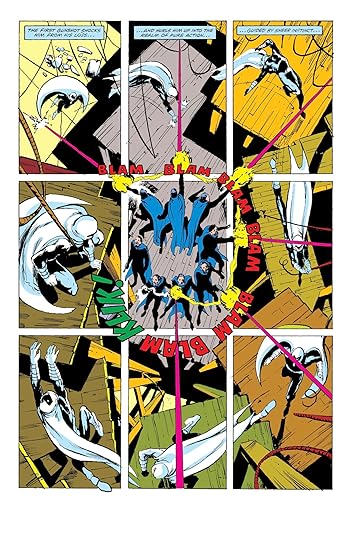
Though the real shift to abstract designs wouldn't come until Sienkiewicz's tenure on Claremont's New Mutants, the dynamic designs became readily apparent as the series continued. A showdown with the recurring villain known as the Midnight Man just shows how exhilarating his layouts could be:
Doug Moench serves as the prominent writer to cultivate the early lore for the character. The first issue of the ongoing run serves as the definitive origin for the character - Marc Spector served as mercenary under the command of the ruthless Bushman. When a job near the Sudanese/Egyptian border goes afoul, Bushman leads Spector for dead in the desert. Spector drags himself into a buried Egyptian tomb belonging to the moon god Khonshu and is revived. Feeling burdened by guilt for having been complicit in the murder of Marlene's father, Spector dons the persona of Moon Knight as he takes down Bushman and begins his war on crime.
Developed early into the series are some of his major accomplices - Frenchie, his confidant/pilot/wheelman, Marlene, his moral compass and lover, and Gena and Crawley, his associates who serve as eyes on the street. But the original run also does seed the idea of multiple personas for Moon Knight, as we are introduced to the idea of three different identities taken on by the Crescent Crusader. He maintains high social status and connections as the wealthy Steven Grant, he deals with his day to day as Marc Spector, the retired mercenary, and prowls the streets at night as the cabbie Jake Lockley. Though Dissociative identity disorder isn't spelled out here, Moench does a decent amount to lay out the groundwork for future comic runs to build off of. The storytelling is undeniably ambitious, with Moench developing an intriguing cast of villains like Midnight Man, Randall Spector, Morpheus, Crossfire and more. But undeniably the best antagonist (appearing in the best issue, Moon Knight #14) in the series is Stained Glass Scarlet. While most of Moench's writing can feel a bit heavy handed, when it's good it is really good. The story of Stained Glass Scarlet serves as demonstration for the classic film noir aesthetic that defined the best issues of the series. It wasn't always perfect, but there were more hits than there were misses, making Moench my personal favorite writer for the character. Moench used a similar formula for his phenomenal Master of Kung Fu run which began earlier but had a decent overlap with this series, whereby a minor Marvel character was allowed to develop a rich history by cordoning them off in their own separate adventures. Indeed, the best Moon Knight stories remain the ones where he isn't interacting with other Marvel characters, which was exactly how the majority of the first twenty issues collected here unfolded. The crossovers that are collected in this omnibus are fun, but overall do not really fit in tone with the robust foundations set by the first ongoing run.
Though it probably doesn't get the same level of attention as other Bronze Age titles, Moench and Sienkiewicz crafted a fantastic run that definitely stands the test of time. It's a fundamental read and great starting point for any new Moon Knight reader.
One of my favorite classic Marvel characters that I recently discovered. I always knew who this guy was, but never read any of his comics growing up. The only art in this collection I didn't like was one issue by Denys Cowan. But the vast majority of the art is from a very young Bill Sienkiewicz. He is still finding his style here, as it can change from one panel to the next. Early issues look like Neal Adams, but later issues are distinctive. Really love the issues of Hulk magazine. They have "deluxe" color and the subject matter is a little grittier since they're bypassing the comics code. Can't wait until later issues give more detail on his origin and really nail down the schizophrenic thing. Those things are kind of glossed over in these early issues.
Not every book is going to be the best, but this turned out to be a lot of fun reading about all of Moon Knights different personalities (Jake Lockley, Marc Spector and Steven Grant) and the way he uses them.
It starts with Moon Knights appearances, which were enjoyable but nothing notable. It wasn't until he was featured in his own backup stories to the HULK! on going series where it started to get really good. But the bulk of this book and when it really gets going is when he get his own on going series.
This is where you see the true origin of Moon Knight and how he meets Marlene and you can't forget his arch enemy Raoul Bushman.
I'd give this an easy 4 / 5. Definitely Excited to read Vol. 2
(This is a review of Moench's entire Moon Knight run, not just the issues contained in this collection)
Moon Knight is in a unique spot in Marvel's stable of characters: a loner by nature with the exception of a handful of supporting characters who have come and gone over the years and some brief periods spent with the Avengers that feel inconsistent with his usual characterization and tone, he is a street-level vigilante with ties to the supernatural with just enough readership to justify having an ongoing title while not enough popularity to be subject to editorial meddling. This makes Moon Knight the perfect place for creators to express themselves while working for a major publisher and getting the chance to incorporate Marvel's other characters into their work every so often if they so desire.
In the early issues, it is clear that Moench is still setting the stage for what Moon Knight will be and only beginning to form what will soon become key concepts for the title. Marc's DID (dissociative identity disorder) only comes into play around halfway through the run, as his exhaustion from maintaining several different facades throughout increasingly long and difficult days of crimefighting and childhood trauma become the explanation for his condition. His relationship to Khonshu is presented here as a devotion to a god who may or may not exist and who may or may not be watching over him; this does not make Marc any less dependent on Khonshu and his perceived presence. This ambiguity is carried on for decades because of how powerful of a storytelling device it is and how the mystery can draw readers in, a testament to Moench's decision to leave it up to readers to decide for themselves what they believe.
As the run progresses and the key concepts are established, Moench can then focus his attention on recurring villains, themes, and on telling stories beyond "villain of the month" stories. The final arc centering on Marc's father and his relationship to spirituality and religion as the son of a rabbi who serves an ancient Egyptian god is particularly poignant and is a great capstone. Similarly, the art takes some time to find its footing, but later issues finally manage to play more with shadows and the use of Moon Knight's costume and its distinctive color to contrast with his surroundings.
This run is not the best Moon Knight material to have been published, but it still excellent and holds an essential place in the title's history and has been respected by all of the most revered subsequent runs because they are timeless concepts. Essential reading for anyone looking to get to know the character and pick up any of the more recent runs like Ellis', Lemire's, or Mackay's.
(Zero spoiler review) Hot damn, I would say this is the most deflated I had felt at a Marvel book in some time, although that statement would be about as honest and as credible as those for whom allude to the fact that Moon Knight is basically Marvel's version of Batman. Maybe that's how Marvel would like to spin it, hoping to capitalise on the popularity of the Dark Knight, although apart from the most miniscule and tacit of comparisons, Moon Knight is about as far from the Caped Crusader as I am. If anything, the idea behind Moon Knight sounds even cooler than Batman, and the names behind this book certainly led me to believe this would be a rollicking good read. Doug Moench clearly knows how to write a comic, and the man clearly did great work after this. Though there are plenty of good and skilled writers who couldn't tell an interesting an engaging story if their lives depended on it. And apart from the handful of pulpish issues collected from The Hulk monthly mag before Moon Knight got his own title proper (which were pretty damn good), there is nothing here of worth, unless you find yourself a hopeless apologist for middling 70's era comics. They might be preferrable to the talentless dross they are churning out now, but that doesn't actually make them good. Despite Moench not doing anything memorable here, the main target of my indignation had to be Bill Sienkiwiec, who despite his talent and a decades long career in the industry, has turned in some of the worst art I've ever seen. The scratchy, scrawly mess that passes for art (again, except for the pulp issues) are absolutely dreadful. Even if the stories were pretty forgettable fare, I might have stuck with it longer if the art was anything decent to look at. It made his New Mutants run look good by comparison, and I really didn't like his New Mutants run. Of course when we finally get an omnibus with a single creative team, it had to be one that did absolutely nothing for me. Despite having oodles of potential, this ultimately fell flat. I read about half of this and skimmed the rest. It all looked the same levels of forgettable. I can only help things improved drastically with volume two, although given the similar scores on this site, it looks like I'll be pissing into the wind on that one. Not for me. 2/5
I started this book in preparation for the television series. I didn't know much about Moon Knight except the very basics and the very little I saw of him when he appeared in books I was reading (mostly Spider-Man, IIRC). I knew he had multiple identities, he had some kind of Egyptian backstory, and he was often ridiculed as an obvious knockoff as Marvel's answer to Batman.
The fun aspect of reading these older stories from the Bronze Age of comics is seeing the character as a "work in progress" when it comes to their conception. Moon Knight didn't start out fully formed into what we know him to be today. Actually, he was introduced as a werewolf-hunting mercenary... and only became a vigilante on his own in a back-up pages of a Hulk comic. And while people tease him as a kind of Batman analogue, his multiple identities and band of helpers put me more in the mind of The Shadow.
What's interesting to see as the book develop is to see them insert a backstory rooted in Egyptian mythology and only later begin teasing the fact that Marc Spector's constant juggling betweeen two other identities (three if you count Moon Knight!) was leading to the development of distinct multiple personalities. The focus of the series, once he gets one, is more interesting in a lot of the preoccupations of comics set in the NYC of the 1970s ad 1980s: serial killers, drugs, and the other elements of the seedy underbelly of the era's city.
The stories are okay, though I don't think Marc, Steven, Jake, or Moon Knight are actually all that compelling in the way classic Marvel characters like Peter Parker, Logan, or Ben Grimm are. And because the focus is often on a case and the nature of his psychology is often just gestured to, the one interesting element feels sidelined to mostly boiler plate comic tropes. It was only until recently that the comics focused on his dissociative identity disorder, those stories being the focus of the show.
Nice to see the character evolve over five years of storytelling, but I wish the stories popped a little bit more.
This omnibus collects all of Moon Knight's appearance from his debut in Werewolf By Night #32 through the first 20 issues in his own series. The first half of the book acts as a bit of a curiosity as we follow the character's growth through guest spots and back-up stories in Hulk! Magazine until he finally gets his own series. It doesn't take long for Doug Moench and Bill Sienkiewicz to start cooking with gas and the stories (and art) get progressively better with each issue.
Halfway through the book I was thinking of giving it a three star rating. A few issues into the main series I decided to upgrade it to four star. By issue #20, I was all in with five stars.
From a comic’s history perspective, this omnibus is phenomenal as it allows readers to grasp the evolution of Moon Knight from his debut appearance in Werewolf by Night into the first 20 issues of his solo series. For pleasure reading, however, a collection this large cannot help but meander when there is not a clear expanded story carrying across all issues. This does, however, show off the complex characterization that makes Moon Knight a compelling character and far more distinct that the Batman comparisons that are sometimes thrown his way. Readers expecting a more supernatural Moon Knight, however, are set up for disappointment as, even if the character sometimes encounters supernatural beings, this Moon Knight barely interacts with Konshu at all. Individually there are some brilliant stories here, especially crossovers, but there are also numerous points where a reader could easily set the book down and move onto something else.
A huge fan of Moon Knight, the mix of where he started and their later explanation were a bit iffy, but overall, his multiple personalities and his mix of crime fighting and his background along with all the people who support him is refreshingly different--even though in reality he is cross between Spider-Man, Daredevil, and Batman. The connection of the Egyptian God Khonshu hasn't been fulling developed yet in this first 35 or so issues of his backstory, so I am waiting for that to play a more significant role in his depth and uniqueness that I have come to love about Moon Knight.
I am however still miffed at Marvel for not putting the series Marc Spector, Moon Knight into any kind of collection - be it Epic or Omnibus or just Complete Collected volumes. It is a shame that most everything else in his history is available, but not those 60 plus issues that are not available anywhere except as back issues.
It's taken me quite a bit of time to get through this omnibus, unlike some others such as Gerber's Man-Thing, Brubaker's Captain America and my old favourite Claremont's X-Men.
I just didn't find it very compelling, and I never got to the end of an issue thinking "I can't wait to find out what happens in the next one!". Some issues I couldn't even be bothered to read in one sitting.
I have been reading Marvel superhero comics since the early 90s but never went back to old Moon Knight stuff until now, and what a treat! Far from the Batman knockoff I'd expected, this omnibus collects the weird horror, crime, detective, spy thriller journey through a grim New York City the way only Sienkiewicz could draw it. It's wild. At one point, Moon Knight fights a dog by swinging another dog at it. This book was a trip.
Moon Knight's early appearances are an interesting look into how a character, their setting and a great comic artist develops in real time. There's nothing completely awful in here, but a lot of the early stuff is warmed-over Neal Adams Batman and it takes quite a while for Moon Knight to find his legs. Only at the very end does everything start to come together.
It's worth it to see Sienkiewicz's art grow with every issue. Some of the stories felt a little flat, but making the character have multiple personality disorder was a stroke of genius. Moon Knight gets his @$$ handed to him a lot in this book. There were times when I thought, "How did he match fists with Daredevil? He gets trashed every issue."