3.5/5
Concept: 5/5
Execution: 3/5
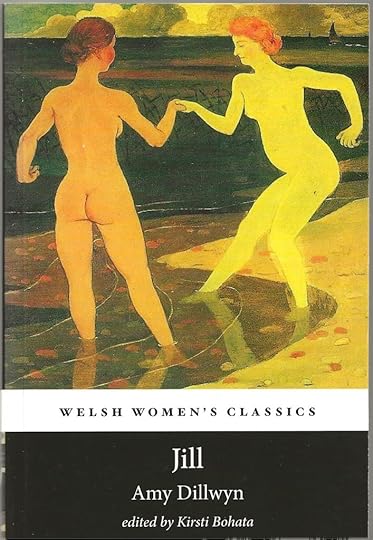
I had high hopes for this Victorian Sapphic novel and it was more subtle and coded than I would have liked, but still an interesting read. To be fair, Jill does seem to genuinely love Kitty, and later, Sister Helena, and I was impressed by the way she was not jealous of Kitty’s love interest, and actually felt sympathy and sadness on Kitty’s behalf when rejected by Captain Norroy, rather than vindictively and selfishly celebrating. On the other hand, Jill can be quite egotistical and manipulative, and instinctively would rather put Kitty at risk than not be with her. What I found unfulfilling about the story was the plot/content and how the relationship played out; yes it is unrequited love, but also Kitty is not developed at all as a character or object of desire, and we don’t see much of a complex relationship (of any kind) between Kitty and Jill, as we are so limited by Jill’s insular perspective.
In her introduction, Kirsti Bohata draws a comparison between ‘Jill’ and Dante’s ‘La Vita Nuova’ (randomly one of my favourites!) and I can see why. In both the cases of Dante/Beatrice and Jill/Kitty, the narrator initially meets the other person from afar and yearns for them despite (or, perhaps, because of) their distance and lack of actual connection in life. So in that sense there is something interesting being done here in the tradition of high romance, but it is just not compelling to read. I like Dante for other reasons than how he writes about Beatrice.
The mistress/maid dynamic interests me; this reminded me of the relationship between Roxana and her maid Amy in Defoe’s ‘Roxana’, and also (a little) the dynamics in ‘Olivia’ by Dorothy Strachey. As in ‘Roxana’, the class dynamic is significant in establishing an imbalance of power, but ultimately Jill is an upper class woman in disguise as a servant, and her privilege remains stable and unthreatened by the end of the novel. There is something unsettling about Jill’s moments of pride in her true family name and heritage, and I could not tell whether Dilwyn wanted us to condemn her for this or not.
'Jill’ also shares with ‘Roxana’ an interest in how identity can be constructed through names. The narrator was named Gilbertina at birth, and this was shortened to Jill, but (upon her mother’s wishes) ‘Jill was condemned and Ina substituted, as a more graceful and aristocratic manner of shortening my name’ (p.5), however ‘Jill was the name to which I afterwards returned’, which hints at her reclaiming a more masculine, un-‘graceful’ identity.
There are a few other things I really liked, such as the iconic moment when Kitty refuses to wear a corset, and says, “one must draw a line somewhere […] and I draw it at having my internal arrangements shoved out of their places. Not even to possess a small waist will I endure that!” (p.218) I was very impressed by this empowered rejection of harmful body ideals, and even more incredible is Kitty’s nuanced self awareness; she confesses, “I am not a whit more deficient in vanity and care for my personal appearance than the rest of my sex” (p.219) and yet manages to resist this one convention.
Also, I really enjoyed the part where Jill is an invalid in hospital, and feels that one Nurse (Mary) is mistreating her, and craves mothering and attention and validation from Sister Helena (once again homoerotic desire is implicit). I think Dilwyn was great at illustrating the psychology of illness and being a patient in what seems to be a hostile and controlling system (the hospital), but is of course only viewed from one privileged perspective. I almost wish that the novel had started with the hospital episode and then been about Jill and Sister Helena, rather than Jill and her mistress Kitty.
The final thing I want to mention is the brief discussion of the voracious and overly-imaginative female reader, which is a trope I am becoming interested in and seeing everywhere. Jill retrospectively describes herself as a child, uncritically reading ‘a large number of juvenile story-books of the exaggerated sentimental and goody kind’ (p.8), which ‘I devoured greedily without perceiving how morbid and exaggerated they were, and without doubting their being faithful representations of human nature’ (p.9) Jill sort of falls into the trope of the girl who reads too much fiction and then expects/constructs fictional narratives within her life, like Arabella in ‘The Female Quixote’ and Catherine in ‘Northanger Abbey’. Jill is not the only reader like this; Kitty also ‘greedily devoured as many [French novels, e.g. Zola] as she could lay hold of’ under the pretence of ‘the laudable object of keeping up her French’ (p.126). Jill immediately makes use of this observation to claim closeness and insight – ‘I knew better than that’ – which reminds us that Jill was also this kind of reader.
So there are many wonderful things about this book. Why do I rate it mediocrely? It just isn’t that fun to read, and the emotional stakes are not high. I do like Dilwyn’s sarcastic, matter-of-fact voice (sometimes it reminded me of George Eliot) but I didn’t find her to be a very good storyteller. I always felt too aware that a story was unfolding and a plot being furthered. Still I would definitely recommend this as there is much interesting stuff to be found in it.