

What do you think?

The Fraud Squad
"Crazy Rich Asians meets The Devil Wears Prada in this millennial women's fiction novel by debut author Kyla Zhao about a working class woman who infiltrates Singapore's high society to fulfill her dreams, only to lose herself in the process. For as long as she can remember, Samantha Song has dreamed of having her own byline in a high-society magazine-and she'd do anything to get there. But the constant struggle to help her mom make ends meet and her low social status make her dream feel like a distant fantasy. Now, Sam finds herself working at a drab PR firm. The closest she'll get to that life is living vicariously through her socialite coworker, Anya Chen. Then she meets Timothy the disillusioned son of one of Singapore's elite families, and Sam's one chance at infiltrating the high society world to which she desperately wants to belong. To Sam's surprise, Tim and Anya both agree to help her make a name for herself in Singapore's socialite scene. The borrowed designer clothes and plus-ones to every party and major event can only get her so far; the rest is on Sam, and she's determined to make an impression on the editor-in-chief of Singapore's leading high society magazine. But the deeper Sam wades into this fraud, the more she fears being exposed, forcing her to reconcile her pretense with who she really is before she loses it all"--
352 pages, Kindle Edition
First published January 17, 2023
About the author
Kyla Zhao
4 books408 followersKyla Zhao’s books have been spotlighted by CBS, NBC, Good Morning America, Vogue, Elle, Buzzfeed, South China Morning Post, and more.
She has also been recognized as a Forbes 30 Under 30 honoree, named a Tatler Leader of Tomorrow, and awarded a Certificate of Recognition by the California State Assembly for her contributions to Asian media representation.
Across genres and age groups, Kyla’s stories center women and girls of color who explore ambition, identity, and belonging in vibrant settings.
She has also been recognized as a Forbes 30 Under 30 honoree, named a Tatler Leader of Tomorrow, and awarded a Certificate of Recognition by the California State Assembly for her contributions to Asian media representation.
Across genres and age groups, Kyla’s stories center women and girls of color who explore ambition, identity, and belonging in vibrant settings.
Ratings & Reviews
Friends & Following
Create a free account to discover what your friends think of this book!
Community Reviews
Displaying 1 - 30 of 766 reviews

November 14, 2022
i truly believe, from the bottom of my heart, that at any given time i could make a fortune via heists and scams.
i also believe i could do it with a hell of a lot of more charm and likability than every character in this book combined.
welcome to the fraud squad, a work of fiction following the lives of the worst people in the world.
i was excited for this book because i love schemes and misadventures and i hate capitalism, but these people are the worst. and not even the worst due to the usual character crimes, like "they annoy me" or "i personally do not care for them," which are, as we all know, unforgivable. the worst for their actual behavior!
in all honesty none of the so-called "villains," who are uniformly shunned / condemned / thrown into an old-timey cellar to perish by the end of the book, do anything worse than the main characters. you know, the ones we're supposed to support and root for and like.
and honestly i think they actually are better! they have, at least, traceable motivations, and sometimes even show regret or a hint of character development, something none of our main characters can even begin to claim. our protagonist in particular got off unbearably easy for lying to everyone, being very shallow, using her boyfriend, being entitled, treating her mom terribly, and actively competing in the world's worst friend competition.
but what do i know.
bottom line: this wasn't what i expected. or what it said it would be.
(thanks to the publisher for the e-arc)
i also believe i could do it with a hell of a lot of more charm and likability than every character in this book combined.
welcome to the fraud squad, a work of fiction following the lives of the worst people in the world.
i was excited for this book because i love schemes and misadventures and i hate capitalism, but these people are the worst. and not even the worst due to the usual character crimes, like "they annoy me" or "i personally do not care for them," which are, as we all know, unforgivable. the worst for their actual behavior!
in all honesty none of the so-called "villains," who are uniformly shunned / condemned / thrown into an old-timey cellar to perish by the end of the book, do anything worse than the main characters. you know, the ones we're supposed to support and root for and like.
and honestly i think they actually are better! they have, at least, traceable motivations, and sometimes even show regret or a hint of character development, something none of our main characters can even begin to claim. our protagonist in particular got off unbearably easy for lying to everyone, being very shallow, using her boyfriend, being entitled, treating her mom terribly, and actively competing in the world's worst friend competition.
but what do i know.
bottom line: this wasn't what i expected. or what it said it would be.
(thanks to the publisher for the e-arc)

August 8, 2022
Wow! Such a great start and fascinating debut! It presents great portraits of Singapore’s high society. The angsty romance between Tim and Sam and the outcome of their story also made me turn the pages faster, getting easily connected with those characters.
The dues you have to pay to be the part of socialite scene may cost more than Samantha Song has imagined. She comes from poverty, burying her head into magazine pages to forget the meaning of debt. And now she’s trapped in a PR job, barely making her ends meet as her poor mother still works in a nail saloon even though she still suffers from illness affecting her ability to use her hands properly.
When Samantha’s posh colleague Anya Chen invites her a trendy restaurant that you have to wait for months to have reservation, she sees this invitation as an opportunity. They’ll meet Anya’s wealthy and broken hearted friend Timothy and help him to get over his problems with his girlfriend.
When they meet at the place, Sam realizes Timothy comes from one of the most powerful and elegant families. But he detests to work at family business. His father let him have one year sabbatical. He decides to use this opportunity to work in another industry, creating something meaningful and artsy. There is still three months to end of his sabbatical but his family already started putting pressure on him to go back to family business and his traitor girlfriend supports his family’s decision.
Sam listens Tim’s predicament and remembers how she wanted to have a career as a writer reporting high society’s life style. She makes an offer to Tim that they can get both benefited.
Tim wants to convince his family that he shouldn’t be determined by the background he was born just like Sam who comes from working class needs to have a chance to turn into a socialite. They have only three months to achieve their goals.
Pretending a socialite may be more challenging than Samantha expected especially a secret gossip columnist is out there to dig out more dirt, watching her as a vulture, waiting for her to make a mistake.
Overall: this is fast pacing, captivating, easy read for me! I loved the way how the author wrapped things up. I’m looking forward to read more works of the author in near future.
Many thanks to NetGalley and Berkley Publishing for sharing this digital reviewer copy with me in exchange my honest thoughts.
The dues you have to pay to be the part of socialite scene may cost more than Samantha Song has imagined. She comes from poverty, burying her head into magazine pages to forget the meaning of debt. And now she’s trapped in a PR job, barely making her ends meet as her poor mother still works in a nail saloon even though she still suffers from illness affecting her ability to use her hands properly.
When Samantha’s posh colleague Anya Chen invites her a trendy restaurant that you have to wait for months to have reservation, she sees this invitation as an opportunity. They’ll meet Anya’s wealthy and broken hearted friend Timothy and help him to get over his problems with his girlfriend.
When they meet at the place, Sam realizes Timothy comes from one of the most powerful and elegant families. But he detests to work at family business. His father let him have one year sabbatical. He decides to use this opportunity to work in another industry, creating something meaningful and artsy. There is still three months to end of his sabbatical but his family already started putting pressure on him to go back to family business and his traitor girlfriend supports his family’s decision.
Sam listens Tim’s predicament and remembers how she wanted to have a career as a writer reporting high society’s life style. She makes an offer to Tim that they can get both benefited.
Tim wants to convince his family that he shouldn’t be determined by the background he was born just like Sam who comes from working class needs to have a chance to turn into a socialite. They have only three months to achieve their goals.
Pretending a socialite may be more challenging than Samantha expected especially a secret gossip columnist is out there to dig out more dirt, watching her as a vulture, waiting for her to make a mistake.
Overall: this is fast pacing, captivating, easy read for me! I loved the way how the author wrapped things up. I’m looking forward to read more works of the author in near future.
Many thanks to NetGalley and Berkley Publishing for sharing this digital reviewer copy with me in exchange my honest thoughts.

January 10, 2023
Like Matthew McConaughey would say LADIES (buy this book and) FROST YOURSELVES.
Clearly, 2000s Matthew is the kind of man who would read and rec The Fraud Squad.
Anyways, this was glitz, glam and escapism at its finest. It swallowed me right up.
Clearly, 2000s Matthew is the kind of man who would read and rec The Fraud Squad.
Anyways, this was glitz, glam and escapism at its finest. It swallowed me right up.
Read
July 5, 2021Hi world!

January 25, 2023
An engaging debut! As someone who is interested in all things fictionally related to Singapore’s wealthiest, I had a blast following Samantha’s journey in trying to fit in with a class she has never belonged to. The characters were fun to follow, and I enjoyed the slight mystery with the gossip column alongside the tension between Timothy and Sam. Some of the dialogue did feel a little off, and the middle part stalled just a bit, but overall a slam dunk for me. If you’re looking for a quick, juicy read, this is it!
*Many thanks to the publisher for providing my review copy.
*Many thanks to the publisher for providing my review copy.

January 30, 2023
This being sold like Crazy Rich Asians meets Gossip Girl is fraud.

January 22, 2023
In hindsight, there was no chance I would have ever loved this book.
Tell me something. When you've been pitched a story as "Asian Anna Delvey teams up with an exiled socialite and a billionaire heir to fool Singaporean high society", do you imagine... oh, I don't know. Identity fraud? Scams? A single hint of illegal activity? Maybe I'm being unfair, but when you compare your book to a woman who scammed millions of dollars while pretending to be a high-class socialite, I feel like I am due a little bit of crime.
Tell me something else. When you hear that the story is set in Singapore, do you expect the setting to... feel like Singapore? No? Are my standards too high? Apparently so, because this book is getting rave reviews and praise for representing the Asian community with a 'diverse' setting when the only times I'd remember we were in Singapore were when the author replaced coffee with kopi and mentioned that her hair got frizzy in the humidity.
Alright, let's get the disclaimers out of the way before I get accused of being a hardass who doesn't know what she's talking about. I am a twenty-something woman living in Singapore. I've dabbled in Singaporean high society (I hated every minute of it, which probably contributed to why this book would have never worked for me, but I digress).
I'm Asian, I was born here, I know what I'm talking about. Are we good? Good. Let's begin.
We'll split this review into three general groupings: the story, the writing, and the absolute lack of effort in incorporating the Singapore setting while at the same time using it to leverage yourself and market yourself as 'different'. And, as a special treat, I'll probably be cultivating my own little thesis along the way that says something along the lines of this: diversity is not a shield for a terrible fucking story.
“Lauren,” you ask, “if you hated this book so much, why didn’t you just DNF it?”
Because I am, at my very core, a hater. I enjoy writing rant reviews, and I know there are pedantic little contrarians that will pounce on me DNFing a book to use it as evidence that I couldn’t definitively know the whole book was absolutely trash. So I finished it. And now I can definitively type this review with a sadistically feverish pace and let all of you know that this book was, indeed, absolute trash.
Enjoy the ride.
1. The story
I’ll admit, I have a particular sensitivity to pacing and general structure. It bothers me when it’s even slightly off-kilter, so you can imagine the amount of eye-twitches I had to suffer through while reading this book.
Simply put, the pacing was shit. The last act lacked the needed resolution to all the subplot threads because the first part of the book was way too long. Somehow, this book managed to bleed an infiltration into high society of any entertainment it could have had, reining back the scheming and backstabbing to avoid sully the precious characters likeability. This resulted in any real scheming to be delegated to the Evil Ex Girlfriend Who is Also Super Hot And Bitchy, which is a trope that is so sexist I can’t believe exists in a book that seems to champion the girlbossery of the main character.
While the first two acts dragged on for forever, the story somehow managed to deliver none of the important information through real-time scenes, and instead had to scramble to fill in the gaps between exposition dumps and brief flashbacks in between filler scenes.
We'd time skip over the OTP bonding and then get informed, in hindsight, that something important to the plot happened *right* after the page break. A dinner at the start of the book is going badly and *just* when it almost seems salvageable, we skip to a week later, and get told in post that actually it was a great time and everyone was impressed by our dear MC.
Which brings us to— Samantha was a horrible protagonist to follow. Now, I’m willing to admit that I tend not to like MCs that are desperate to join the ‘popular’ group, which is why I sucked it up. I knew the Mean Girls arc. Until I didn’t?? Until the author turns it on the head and (vague spoiler) during the climax makes literally everyone else the villain except for her???? And Samantha barely has to apologize or make reparations to the people SHE hurt because boohoo we can't have an unlikeable MC in a story like this, can we? Oh no she has to be the one who's betrayed (the betrayal was barely a betrayal?? Because it was basically just their plan from the start???) so we feel sympathy for her.
In fact, I hated everyone here. Every single character was terribly cliche: jealous ex, jealous side character. Everyone was two dimensional in a way that completely undercuts the subtleties of high society politics. If they were rich, they were Evil except for an Indonesian socialite named Daisy (we’ll get to that), who was so painfully written to be the 'cool' rich girl that didn't care about anything, and the love interest. When Samantha’s cardboard FeMiNiSt best friend calls out how the boyfriend always gets a resolution when the female friends do not not doesn’t give you a pass from doing exactly what your own character criticized in your own book.
Onto the romance. Listen, I like cheesy stories. I like romcoms. It's really not that hard for me to be sold on a ship, or at least *neutral* on a ship, but this managed to surpass my expectations and deliver the most cardboard romance I’ve read in at least two years. Nothing disgusts me more than an OTP with no chemistry calling each other babe, and boy, when I tell you that that is all they call each other, I mean it. There’s a moment where our MC is outed about doing something mildly shitty and the LI is torn up about it for the grand total of two pages before he professes his love for her and they… make out? Every opportunity we could’ve had to flesh out their relationship or give me insight into their dynamic was cut out due to the aforementioned pacing Decisions, capital D.
I also just did not like Timothy at all. The disillusioned rich kid trope is a tricky balance to get right, and this twat was too busy sulking about wanting to pursue the arts that he missed the very obvious solution that was in front of him from the start. I feel like the author watched the Devil Wears Prada, got the idea that Nate is the villain and then made her love interest the Villain, but then decided that he was too hot to be an ACTUAL villain so gave him a quick redemption at the end for a HEA.
As a conclusion to this section, the foundational conceit of the story is ridiculous and shows a complete ignorance in the workings of Asian cultures. I am absolutely gobsmacked that this author was born and raised in Singapore because there is NO way any Asian would've thought that the plan to get Tim's parents on board with following his dreams would've worked. Why on earth would his parents care that he gave a girl a makeover? Why on earth would a girl making it in the fashion industry, which is stereotypically dismissed as being ‘useless’, convince them to let their only child and heir to their entire multimillion corporate empire pursue his dreams in art?
We typically run into the problem of having, for the sake of a rounded story arc, the ethnic elders warming up to Western sensibilities unrealistically fast, but this story didn’t even pretend to have a struggle. This story breaches our suspension of disbelief by building a plot on the knowledge that everything has to work out at the end, thus rendering any tension null and void.
2. The writing
This is the fun part. Here are some really wacky sentences that made me do a double take. it’s also worth noting that every description of clothing is more of label dropping than any actual phrases. (They are mostly going to be romance lines because they were uh. Not good.)
“Heads turned as Anya strutted the short distance from her desk to Samantha’s like it was her personal catwalk, wearing a denim minidress belted with a brightly patterned Dior scarf that violated Arrow Public Relations’ corporate dress code in half a dozen ways and made Samantha wish she had kept her leather jacket on despite how it stuck to her skin.” (All one sentence???)
“A hot flush of pleasure ran through Samantha. Timothy’s eyes darkened as they traced the blush spreading from her cheeks down to her chest.”
“The smile in his voice wrapped around Samantha like a comforting hug. She nodded, her eyes tracing the amber rims in Timothy’s.”
“Mm-hmm?” Timothy muttered, nibbling on the plump flesh of her lower lip.”
“Timothy drew back to look her in the eye, but kept his forehead pressed against hers.”
And then we’re going to cap it off with this just absolutely bizarre show of “I’m a feminist hell yeah” girl power I’ve seen in a while:
“As Samantha neared the duo, she could hear Daisy saying, “You’re totally rocking the girl power vibe with your pins. What do you think of Dior’s We Should All Be Feminists collection?”
“I think it’s cool that such a big brand is talking about such an important issue,” Raina said. “But it feels kind of like slacktivism to me. Catchy slogan, but doesn’t make up for the fact that Dior’s still only using size zero models. Pretty skewed sense of female empowerment if you ask me.”
Daisy nodded. “Totally! It’s so performative. One guy I know straight up told me he only wears Dior’s feminist collection to ‘impress the chicks.’”
3. Everything else
First of all, I despise how most stories depict contemporary high society. Second of all, I despise contemporary high society, and I blame myself for reading a book about a MC whose only dream is to join high society. (Again, I thought it would she would be less obsessed with being prom queen and more invested in scamming the fuck out of them, but apparently I overestimated this book's ability to deliver an entertaining story.)
To prove that this could be any American state in summer with Asian names slapped on top like those stickers that never get off book covers, let’s talk about the names first. As someone else pointed out in another review, the surnames used are Asian but aren't common Singaporean ones, from May "Le" to Genie "Tsai" or even Samantha "Song". The first names aren’t much better. As mentioned before, there is an Indonesian heiress named Daisy that comes in about halfway through the book. I am Indonesian. My mom grew up in Bandung. Both of us has never, not once, met an Indonesian from Indonesia named Daisy. Which once again begs the question: did the author have a concussion and forget everything about Singapore? She lived here. How did she fuck up the simplest, most basic worldbuilding tool to utilize?
Back to Daisy. She’s Indonesian Chinese (which I happen to be), with a ‘dark-skinned’ Indonesian father. It is said, explicitly in the text, that magazines are trashing her image because of her Indonesian father, insinuating that she is an outsider in socialite Singapore. This makes no sense narratively because immediately after this is dropped, her engagement party is the biggest event of that season, and everyone wants to be there. So one can assume that this was dropped in to say, “Hey, racism exists here too”. Which it does. But we are not the fucking USA, and you can’t apply the same concept of racism to Singapore without considering the context.
Singapore is strategically kept ethnically diverse. Our public holidays account for several different religions, and even though English is commonly spoken and Chinese is the majority race, Malay is our official language. I don’t know how to break it to people, but outwardly snipping at an Indonesian heiress for not being pale would spell an instant death to any magazine company. Any racism would be behind closed doors, not published for five million people— with at least half of them being ‘dark-skinned’— to read.
The fact that none of these rich people know anything about local Singaporean is absurd. Once again, it’s not untrue that the expatriates are much more removed from the street level, but what would be more interesting than these rich people being confused about local food would be to explore that actually, rich people in Singapore like to make kampong dishes, “but better”. Better ingredients, better cooking methods, better displays of the food. Anything to show off how much more elevated and sophisticated they are from the locals. I’m not saying that this book had to go into the nuances of the Singaporean class divide, but the use of the country that the author has lived in as a setting that was mediocre at best and downright humiliating at worst.
So. What’s up? I’ve spent some time thinking about this, and I came to the conclusion that either the publishing house forced her to make these absurd decisions, stripping the setting of anything that would help ground it to real life Singapore, or the author consciously chose to omit these details. Either way, when one looks at their marketing campaign for this book and notices how so much of it leans on being set in Asia for #diversity, it looks malicious.
Regardless of intent, it's clearly written and catered to a Western audience looking for a check off their representation bingo cards. And the worst part is that none of them will notice. No one can notice, because no one lives here, and wow, isn’t it neat that Singapore is basically run the same way the USA and the Kingdom of Genovia is run?
The problem is that if we are so desperate to read anything diverse for the sake of seeming more worldly, we are limiting ourselves. Diversity does not equate to quality. It shouldn’t equate to quality. And by turning uncommon representation into fads and trends, we’re settling for trash stories and really only proving the people who critique ‘the wokeness’ of this generation right.
I have spent entirely too much time on this review. If you’re looking for a book that also coincidentally overlapped with my niche wheelhouse, If You Could See the Sun by Ann Liang was incredible. (Disclaimer: the cover, title, and synopsis make it sound very literary. It isn’t.)
My last is that the first line was my favorite of the entire book, because I too am suicidal and wear a leather jacket every day.
Tell me something. When you've been pitched a story as "Asian Anna Delvey teams up with an exiled socialite and a billionaire heir to fool Singaporean high society", do you imagine... oh, I don't know. Identity fraud? Scams? A single hint of illegal activity? Maybe I'm being unfair, but when you compare your book to a woman who scammed millions of dollars while pretending to be a high-class socialite, I feel like I am due a little bit of crime.
Tell me something else. When you hear that the story is set in Singapore, do you expect the setting to... feel like Singapore? No? Are my standards too high? Apparently so, because this book is getting rave reviews and praise for representing the Asian community with a 'diverse' setting when the only times I'd remember we were in Singapore were when the author replaced coffee with kopi and mentioned that her hair got frizzy in the humidity.
Alright, let's get the disclaimers out of the way before I get accused of being a hardass who doesn't know what she's talking about. I am a twenty-something woman living in Singapore. I've dabbled in Singaporean high society (I hated every minute of it, which probably contributed to why this book would have never worked for me, but I digress).
I'm Asian, I was born here, I know what I'm talking about. Are we good? Good. Let's begin.
We'll split this review into three general groupings: the story, the writing, and the absolute lack of effort in incorporating the Singapore setting while at the same time using it to leverage yourself and market yourself as 'different'. And, as a special treat, I'll probably be cultivating my own little thesis along the way that says something along the lines of this: diversity is not a shield for a terrible fucking story.
“Lauren,” you ask, “if you hated this book so much, why didn’t you just DNF it?”
Because I am, at my very core, a hater. I enjoy writing rant reviews, and I know there are pedantic little contrarians that will pounce on me DNFing a book to use it as evidence that I couldn’t definitively know the whole book was absolutely trash. So I finished it. And now I can definitively type this review with a sadistically feverish pace and let all of you know that this book was, indeed, absolute trash.
Enjoy the ride.
1. The story
I’ll admit, I have a particular sensitivity to pacing and general structure. It bothers me when it’s even slightly off-kilter, so you can imagine the amount of eye-twitches I had to suffer through while reading this book.
Simply put, the pacing was shit. The last act lacked the needed resolution to all the subplot threads because the first part of the book was way too long. Somehow, this book managed to bleed an infiltration into high society of any entertainment it could have had, reining back the scheming and backstabbing to avoid sully the precious characters likeability. This resulted in any real scheming to be delegated to the Evil Ex Girlfriend Who is Also Super Hot And Bitchy, which is a trope that is so sexist I can’t believe exists in a book that seems to champion the girlbossery of the main character.
While the first two acts dragged on for forever, the story somehow managed to deliver none of the important information through real-time scenes, and instead had to scramble to fill in the gaps between exposition dumps and brief flashbacks in between filler scenes.
We'd time skip over the OTP bonding and then get informed, in hindsight, that something important to the plot happened *right* after the page break. A dinner at the start of the book is going badly and *just* when it almost seems salvageable, we skip to a week later, and get told in post that actually it was a great time and everyone was impressed by our dear MC.
Which brings us to— Samantha was a horrible protagonist to follow. Now, I’m willing to admit that I tend not to like MCs that are desperate to join the ‘popular’ group, which is why I sucked it up. I knew the Mean Girls arc. Until I didn’t?? Until the author turns it on the head and (vague spoiler) during the climax makes literally everyone else the villain except for her???? And Samantha barely has to apologize or make reparations to the people SHE hurt because boohoo we can't have an unlikeable MC in a story like this, can we? Oh no she has to be the one who's betrayed (the betrayal was barely a betrayal?? Because it was basically just their plan from the start???) so we feel sympathy for her.
In fact, I hated everyone here. Every single character was terribly cliche: jealous ex, jealous side character. Everyone was two dimensional in a way that completely undercuts the subtleties of high society politics. If they were rich, they were Evil except for an Indonesian socialite named Daisy (we’ll get to that), who was so painfully written to be the 'cool' rich girl that didn't care about anything, and the love interest. When Samantha’s cardboard FeMiNiSt best friend calls out how the boyfriend always gets a resolution when the female friends do not not doesn’t give you a pass from doing exactly what your own character criticized in your own book.
Onto the romance. Listen, I like cheesy stories. I like romcoms. It's really not that hard for me to be sold on a ship, or at least *neutral* on a ship, but this managed to surpass my expectations and deliver the most cardboard romance I’ve read in at least two years. Nothing disgusts me more than an OTP with no chemistry calling each other babe, and boy, when I tell you that that is all they call each other, I mean it. There’s a moment where our MC is outed about doing something mildly shitty and the LI is torn up about it for the grand total of two pages before he professes his love for her and they… make out? Every opportunity we could’ve had to flesh out their relationship or give me insight into their dynamic was cut out due to the aforementioned pacing Decisions, capital D.
I also just did not like Timothy at all. The disillusioned rich kid trope is a tricky balance to get right, and this twat was too busy sulking about wanting to pursue the arts that he missed the very obvious solution that was in front of him from the start. I feel like the author watched the Devil Wears Prada, got the idea that Nate is the villain and then made her love interest the Villain, but then decided that he was too hot to be an ACTUAL villain so gave him a quick redemption at the end for a HEA.
As a conclusion to this section, the foundational conceit of the story is ridiculous and shows a complete ignorance in the workings of Asian cultures. I am absolutely gobsmacked that this author was born and raised in Singapore because there is NO way any Asian would've thought that the plan to get Tim's parents on board with following his dreams would've worked. Why on earth would his parents care that he gave a girl a makeover? Why on earth would a girl making it in the fashion industry, which is stereotypically dismissed as being ‘useless’, convince them to let their only child and heir to their entire multimillion corporate empire pursue his dreams in art?
We typically run into the problem of having, for the sake of a rounded story arc, the ethnic elders warming up to Western sensibilities unrealistically fast, but this story didn’t even pretend to have a struggle. This story breaches our suspension of disbelief by building a plot on the knowledge that everything has to work out at the end, thus rendering any tension null and void.
2. The writing
This is the fun part. Here are some really wacky sentences that made me do a double take. it’s also worth noting that every description of clothing is more of label dropping than any actual phrases. (They are mostly going to be romance lines because they were uh. Not good.)
“Heads turned as Anya strutted the short distance from her desk to Samantha’s like it was her personal catwalk, wearing a denim minidress belted with a brightly patterned Dior scarf that violated Arrow Public Relations’ corporate dress code in half a dozen ways and made Samantha wish she had kept her leather jacket on despite how it stuck to her skin.” (All one sentence???)
“A hot flush of pleasure ran through Samantha. Timothy’s eyes darkened as they traced the blush spreading from her cheeks down to her chest.”
“The smile in his voice wrapped around Samantha like a comforting hug. She nodded, her eyes tracing the amber rims in Timothy’s.”
“Mm-hmm?” Timothy muttered, nibbling on the plump flesh of her lower lip.”
“Timothy drew back to look her in the eye, but kept his forehead pressed against hers.”
And then we’re going to cap it off with this just absolutely bizarre show of “I’m a feminist hell yeah” girl power I’ve seen in a while:
“As Samantha neared the duo, she could hear Daisy saying, “You’re totally rocking the girl power vibe with your pins. What do you think of Dior’s We Should All Be Feminists collection?”
“I think it’s cool that such a big brand is talking about such an important issue,” Raina said. “But it feels kind of like slacktivism to me. Catchy slogan, but doesn’t make up for the fact that Dior’s still only using size zero models. Pretty skewed sense of female empowerment if you ask me.”
Daisy nodded. “Totally! It’s so performative. One guy I know straight up told me he only wears Dior’s feminist collection to ‘impress the chicks.’”
3. Everything else
First of all, I despise how most stories depict contemporary high society. Second of all, I despise contemporary high society, and I blame myself for reading a book about a MC whose only dream is to join high society. (Again, I thought it would she would be less obsessed with being prom queen and more invested in scamming the fuck out of them, but apparently I overestimated this book's ability to deliver an entertaining story.)
To prove that this could be any American state in summer with Asian names slapped on top like those stickers that never get off book covers, let’s talk about the names first. As someone else pointed out in another review, the surnames used are Asian but aren't common Singaporean ones, from May "Le" to Genie "Tsai" or even Samantha "Song". The first names aren’t much better. As mentioned before, there is an Indonesian heiress named Daisy that comes in about halfway through the book. I am Indonesian. My mom grew up in Bandung. Both of us has never, not once, met an Indonesian from Indonesia named Daisy. Which once again begs the question: did the author have a concussion and forget everything about Singapore? She lived here. How did she fuck up the simplest, most basic worldbuilding tool to utilize?
Back to Daisy. She’s Indonesian Chinese (which I happen to be), with a ‘dark-skinned’ Indonesian father. It is said, explicitly in the text, that magazines are trashing her image because of her Indonesian father, insinuating that she is an outsider in socialite Singapore. This makes no sense narratively because immediately after this is dropped, her engagement party is the biggest event of that season, and everyone wants to be there. So one can assume that this was dropped in to say, “Hey, racism exists here too”. Which it does. But we are not the fucking USA, and you can’t apply the same concept of racism to Singapore without considering the context.
Singapore is strategically kept ethnically diverse. Our public holidays account for several different religions, and even though English is commonly spoken and Chinese is the majority race, Malay is our official language. I don’t know how to break it to people, but outwardly snipping at an Indonesian heiress for not being pale would spell an instant death to any magazine company. Any racism would be behind closed doors, not published for five million people— with at least half of them being ‘dark-skinned’— to read.
The fact that none of these rich people know anything about local Singaporean is absurd. Once again, it’s not untrue that the expatriates are much more removed from the street level, but what would be more interesting than these rich people being confused about local food would be to explore that actually, rich people in Singapore like to make kampong dishes, “but better”. Better ingredients, better cooking methods, better displays of the food. Anything to show off how much more elevated and sophisticated they are from the locals. I’m not saying that this book had to go into the nuances of the Singaporean class divide, but the use of the country that the author has lived in as a setting that was mediocre at best and downright humiliating at worst.
So. What’s up? I’ve spent some time thinking about this, and I came to the conclusion that either the publishing house forced her to make these absurd decisions, stripping the setting of anything that would help ground it to real life Singapore, or the author consciously chose to omit these details. Either way, when one looks at their marketing campaign for this book and notices how so much of it leans on being set in Asia for #diversity, it looks malicious.
Regardless of intent, it's clearly written and catered to a Western audience looking for a check off their representation bingo cards. And the worst part is that none of them will notice. No one can notice, because no one lives here, and wow, isn’t it neat that Singapore is basically run the same way the USA and the Kingdom of Genovia is run?
The problem is that if we are so desperate to read anything diverse for the sake of seeming more worldly, we are limiting ourselves. Diversity does not equate to quality. It shouldn’t equate to quality. And by turning uncommon representation into fads and trends, we’re settling for trash stories and really only proving the people who critique ‘the wokeness’ of this generation right.
I have spent entirely too much time on this review. If you’re looking for a book that also coincidentally overlapped with my niche wheelhouse, If You Could See the Sun by Ann Liang was incredible. (Disclaimer: the cover, title, and synopsis make it sound very literary. It isn’t.)
My last is that the first line was my favorite of the entire book, because I too am suicidal and wear a leather jacket every day.

November 28, 2022
Random update: Don't read this and tell me you "learnt so much about Singapore culture" thank you.
I'm Singaporean and have been lusting over this book forever, so it pains me that it didn't quite live up to my anticipation or expectations. My biggest issue is that it lacks the cultural representation I'd been so looking forward to. Instead, it's clearly written and catered for a Western audience. The Fraud Squad could have been set in anywhere else and it wouldn't have made a difference.
The good:
I was totally onboard with the plot of a woman fighting the system and doing what it takes to survive, because who doesn't love a good girlboss story? The author did a great job in exploring elitism, classism and the cut-throat world of high society through the eyes of a spunky protagonist worth rooting for. I also enjoyed all glitz and glamour as well as the name-dropping of luxury brands and fashion labels, they were super fun to read!
The blah:
I'd been expecting a juicy, propulsive and tantalising read similar to Counterfeit and Cover Story, but this was far from the case. The Fraud Squad is disappointingly basic and predictable, especially with how low stakes everything seemed. I also felt lukewarm about the romance and relationships, except for that one scene with Sam and her mother.
Neither was the writing the best. The dialogue in particularly felt extremely stilted and unnatural, like the author was struggling to retain the Singlish + authenticity of how people in Singapore speak while making the book readable and palatable for an international audience.
What's weird to me:
- The Christian Dada store that Sam visits has been closed for good for quite some time. It's also not a popular brand here among us locals.
- A character describes Singapore as "a country where food courts reign supreme", but this is untrue. Our coffee shops and hawker culture have that honour (and are even on the UNESCO list), while food courts are on the pricier side. However, coffee shops in the West are a completely different thing (what we call cafes) so I assume the author is trying to avoid confusion.
- The surnames used are Asian but aren't common Singaporean ones, from May "Le" to Genie "Tsai" or even Samantha "Song" (despite Sam claiming otherwise). In fact, they sound like foreigners. Not sure why the author isn't using more common last names such as Tan or Lee — are there no born-and-bred Singaporeans in upper-class society? (Kim Lim and Jamie Chua would beg to differ)
Overall:
It took me a week to finish this book because I paused at 30% and didn't feel compelled to continue. The last 1/3 was a vast improvement. I liked how everything unfolded and ended. The kopi scene between Sam and Tim was the one thing that I finally felt was accurate representation of my culture, but it was too little and too late.
These are just my personal takeaways; I'm not saying that I'm right and in no way am I invalidating the author's experiences. I'd just imagined a vastly different book and can't help but feel that cultural liberties have been taken to make it more appealing and sellable to the international market.
Definitely not one I would recommend if you want to learn more about Singapore or its culture and identity. We have so much more to offer.
Thank you to Berkley Publishing and Netgalley for an ARC of this book.
I'm Singaporean and have been lusting over this book forever, so it pains me that it didn't quite live up to my anticipation or expectations. My biggest issue is that it lacks the cultural representation I'd been so looking forward to. Instead, it's clearly written and catered for a Western audience. The Fraud Squad could have been set in anywhere else and it wouldn't have made a difference.
The good:
I was totally onboard with the plot of a woman fighting the system and doing what it takes to survive, because who doesn't love a good girlboss story? The author did a great job in exploring elitism, classism and the cut-throat world of high society through the eyes of a spunky protagonist worth rooting for. I also enjoyed all glitz and glamour as well as the name-dropping of luxury brands and fashion labels, they were super fun to read!
The blah:
I'd been expecting a juicy, propulsive and tantalising read similar to Counterfeit and Cover Story, but this was far from the case. The Fraud Squad is disappointingly basic and predictable, especially with how low stakes everything seemed. I also felt lukewarm about the romance and relationships, except for that one scene with Sam and her mother.
Neither was the writing the best. The dialogue in particularly felt extremely stilted and unnatural, like the author was struggling to retain the Singlish + authenticity of how people in Singapore speak while making the book readable and palatable for an international audience.
What's weird to me:
- The Christian Dada store that Sam visits has been closed for good for quite some time. It's also not a popular brand here among us locals.
- A character describes Singapore as "a country where food courts reign supreme", but this is untrue. Our coffee shops and hawker culture have that honour (and are even on the UNESCO list), while food courts are on the pricier side. However, coffee shops in the West are a completely different thing (what we call cafes) so I assume the author is trying to avoid confusion.
- The surnames used are Asian but aren't common Singaporean ones, from May "Le" to Genie "Tsai" or even Samantha "Song" (despite Sam claiming otherwise). In fact, they sound like foreigners. Not sure why the author isn't using more common last names such as Tan or Lee — are there no born-and-bred Singaporeans in upper-class society? (Kim Lim and Jamie Chua would beg to differ)
Overall:
It took me a week to finish this book because I paused at 30% and didn't feel compelled to continue. The last 1/3 was a vast improvement. I liked how everything unfolded and ended. The kopi scene between Sam and Tim was the one thing that I finally felt was accurate representation of my culture, but it was too little and too late.
These are just my personal takeaways; I'm not saying that I'm right and in no way am I invalidating the author's experiences. I'd just imagined a vastly different book and can't help but feel that cultural liberties have been taken to make it more appealing and sellable to the international market.
Definitely not one I would recommend if you want to learn more about Singapore or its culture and identity. We have so much more to offer.
Thank you to Berkley Publishing and Netgalley for an ARC of this book.

December 16, 2022
poor girl faking her way to the top?? we love to see it
thank you Netgalley for the arc !!
i thought this was a wonderful debut book. the writing was addicting, the characters were easy to love, the plot was exciting, and so much more. i can't speak on if Singapore was portrayed accurately in the book, but based on a couple of reviews i read, the writing was cratered for a Western audience (which i definitely got that vibe, don't ask me how lol)
i did think this book would be more high stakes but it was pretty low most of the time. i was just WAITING for her to get caught, faking to be a socialite. BUT that didn't take away my enjoyment reading it !! it was juicy and i was rooting for our mc so hard. another thing was that our mc had to our rich boy (the one on the cover) over here, that helping her get into high society would help him convince his parents to let him follow his own passions... I DON'T GET HOW THAT WOULD HELP IN ANY WAY BUT OKAY. again, i didn't mind overlooking that bit but it really didn't make sense !!
overall, this was a sweet and quick read i think many would get a kick out of ♡
thank you Netgalley for the arc !!
i thought this was a wonderful debut book. the writing was addicting, the characters were easy to love, the plot was exciting, and so much more. i can't speak on if Singapore was portrayed accurately in the book, but based on a couple of reviews i read, the writing was cratered for a Western audience (which i definitely got that vibe, don't ask me how lol)
i did think this book would be more high stakes but it was pretty low most of the time. i was just WAITING for her to get caught, faking to be a socialite. BUT that didn't take away my enjoyment reading it !! it was juicy and i was rooting for our mc so hard. another thing was that our mc had to our rich boy (the one on the cover) over here, that helping her get into high society would help him convince his parents to let him follow his own passions... I DON'T GET HOW THAT WOULD HELP IN ANY WAY BUT OKAY. again, i didn't mind overlooking that bit but it really didn't make sense !!
overall, this was a sweet and quick read i think many would get a kick out of ♡

August 17, 2022
Right out of the gate I'm going to say that I'm a very biased individual. I have a preference about books like this one. I like narratives that follow regular degular people like Samantha trying to scheme their way into high society. I will say that Samantha was at least doing it for a job; sure there were perks like clothes and access that came with it, but Samantha was just trying to secure the bag so that her and her mother could stop grinding and that added an element to the story that I thought was universally relatable. I also just have a soft spot for authors that have written for magazines turning to write books. I can't quite put my finger on what it is about the writing, but there's something. It's a little secret sauce that really adds to my general enjoyment of the text.
As for the book itself. I really like Samantha. I liked what was happening with her and Timothy and Anya's plan to get her into the society pages to boost her career prospects. I liked her regular friend Raina that was battling her jealousy but also trying to be the voice of reason. Daisy as a socialite friend that Samantha made along the way, all very strong characters that I enjoyed getting to see on the page.
My biggest issue was how time was handled. At some parts of the book the narrative started to feel a little choppy and less cohesive. The romance arc between two characters definitely wasn't giving... If anything it was serving made for TV movie realness, so on a certain level it was charming? When I read those scenes from the angle of the story being adapted it definitely felt cinematic, but in the context of the book it did throw me. Not only because had I deluded myself into thinking that there would be a love triangle with a different character, but it did just kind of feel like the romance became a focal point without the buildup I would require.... The book quickly returned to focusing on Samantha's aims and less on the romance, and when we got to the third act I could see why Zhao had built that up.
I will say the end of the book really did gag me. As a person that has made it my goal to read this story so many times, a lot of the socialite, messy rich people problems did feel a little been there done that, but the third act? I was gagged. The execution of that trope? Excellent.
I think this book dropping in the middle of the winter is the wildest thing ever, but I guess when that seasonal depression hits and you're aching for something that you can devour that will be a good time you'll have this to pick you up. I had a good time, I think that when the book finally comes out a lot of other readers will also have a good time and really that's what matters.
As for the book itself. I really like Samantha. I liked what was happening with her and Timothy and Anya's plan to get her into the society pages to boost her career prospects. I liked her regular friend Raina that was battling her jealousy but also trying to be the voice of reason. Daisy as a socialite friend that Samantha made along the way, all very strong characters that I enjoyed getting to see on the page.
My biggest issue was how time was handled. At some parts of the book the narrative started to feel a little choppy and less cohesive. The romance arc between two characters definitely wasn't giving... If anything it was serving made for TV movie realness, so on a certain level it was charming? When I read those scenes from the angle of the story being adapted it definitely felt cinematic, but in the context of the book it did throw me. Not only because had I deluded myself into thinking that there would be a love triangle with a different character, but it did just kind of feel like the romance became a focal point without the buildup I would require.... The book quickly returned to focusing on Samantha's aims and less on the romance, and when we got to the third act I could see why Zhao had built that up.
I will say the end of the book really did gag me. As a person that has made it my goal to read this story so many times, a lot of the socialite, messy rich people problems did feel a little been there done that, but the third act? I was gagged. The execution of that trope? Excellent.
I think this book dropping in the middle of the winter is the wildest thing ever, but I guess when that seasonal depression hits and you're aching for something that you can devour that will be a good time you'll have this to pick you up. I had a good time, I think that when the book finally comes out a lot of other readers will also have a good time and really that's what matters.

March 21, 2023
This story is one that’s been done a time or twelve in the past. I’m sure you know it – the girl from the wrong side of the tracks gets a looky at how much greener the grass is on the other side courtesy of . . . .
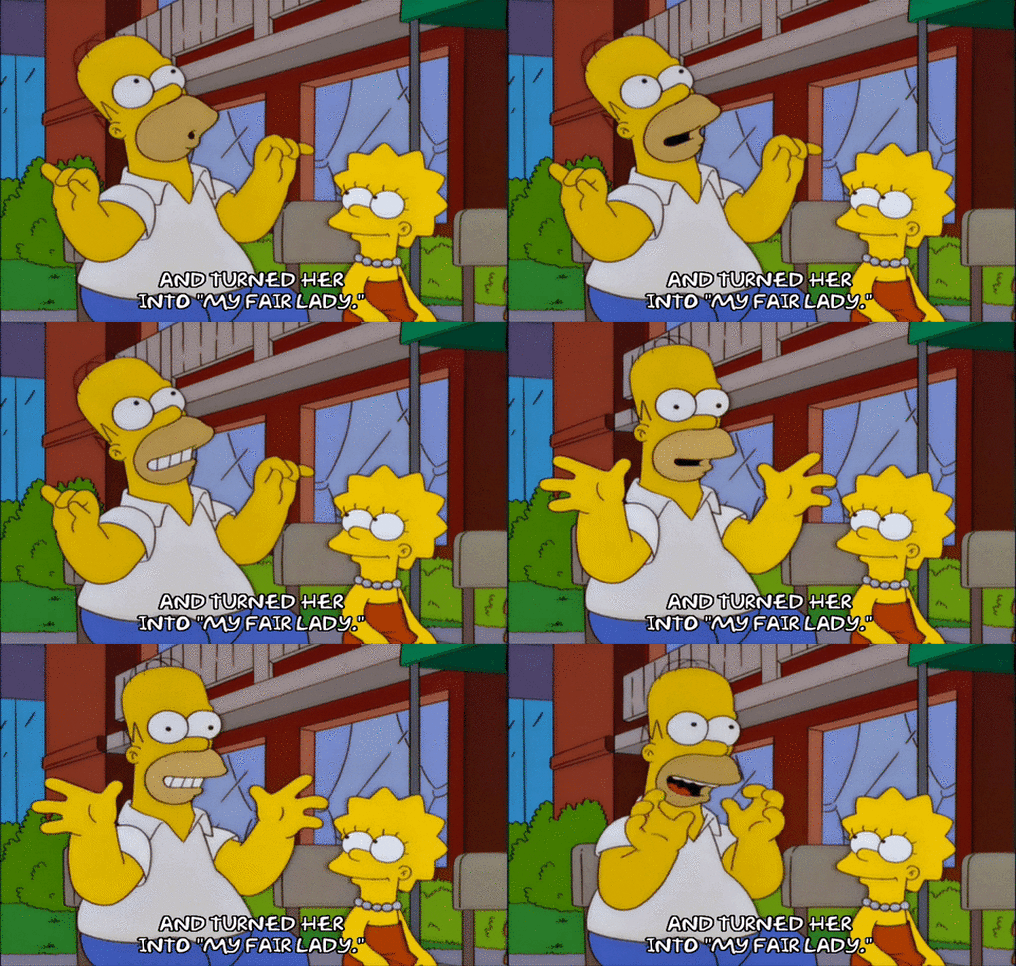
This time around our leading lady is not Eliza Doolittle, but Maddie – entry level in the PR world, Maddie dreams of hobnobbing with high society folks and writing for the illustrious “S” magazine. With help from her friend Anya and Anya’s billionaire heir friend Tim, Maddie’s dreams might just come true as she fakes it ‘till she makes it as an “It Girl.”
I’m sure there’s an audience out there for this one, but sadly it wasn’t me. This was sooooooo juvenile and the writing was simply not great. More than anything, the pacing was a real disaster. Weeks and weeks are skipped over (when the entire story has a firm expiration date of three months) while pages upon pages are spent on each detail of the superficial things like clothing and food. None of the characters were likeable or taken to task for being so – and of course everything ends up with a happily ever after for all.
Blah.
ARC provided by the publisher in exchange for an honest review.
This time around our leading lady is not Eliza Doolittle, but Maddie – entry level in the PR world, Maddie dreams of hobnobbing with high society folks and writing for the illustrious “S” magazine. With help from her friend Anya and Anya’s billionaire heir friend Tim, Maddie’s dreams might just come true as she fakes it ‘till she makes it as an “It Girl.”
I’m sure there’s an audience out there for this one, but sadly it wasn’t me. This was sooooooo juvenile and the writing was simply not great. More than anything, the pacing was a real disaster. Weeks and weeks are skipped over (when the entire story has a firm expiration date of three months) while pages upon pages are spent on each detail of the superficial things like clothing and food. None of the characters were likeable or taken to task for being so – and of course everything ends up with a happily ever after for all.
Blah.
ARC provided by the publisher in exchange for an honest review.

June 25, 2022
this book is exactly like if gossip girl crashed and burned. it felt very abysmally unoriginal, an amateur fanfiction: which was just so disappointing because the cover and the synopsis are actually so intriguing it feels unfair to see it executed so poorly.
i could’ve forgiven the icky reverse derena-esque plotline if, at the very least, the writing was done well, but even that came off as entirely too artificial and robotic. the characters were odd, one dimensional, and a lot of the things happening felt a little too fluid and on the nose for me. i really have no idea why this has so many 5 stars ratings since i cannot find a single good thing to say about it, besides being somewhat blandly entertaining. thank you to berkley for the arc (1.5/5).
i could’ve forgiven the icky reverse derena-esque plotline if, at the very least, the writing was done well, but even that came off as entirely too artificial and robotic. the characters were odd, one dimensional, and a lot of the things happening felt a little too fluid and on the nose for me. i really have no idea why this has so many 5 stars ratings since i cannot find a single good thing to say about it, besides being somewhat blandly entertaining. thank you to berkley for the arc (1.5/5).

January 11, 2023
“Sometimes, we read things because we see ourselves in them, but other times, it’s because they give us a temporary escape from our own lives.”
Rating: 4.5/5.0
★★★★★
Perfect for fans of Crazy Rich Asians and Devil Wears Prada, The Fraud Squad by Kyla Zhao is a dazzling read that takes you into elite singapore, through columns of gossip and glamour, featuring complicated asian families, richer friends, so! much! fashion!, frauds and schemes.
If you've ever wanted to read something that's so indulgent and fashionable, The Fraud Squad just might be the perfect choice for you! with characters like Samantha, Anya, Timothy, Daisy and Raina, you'd never want to miss out this terrific debut.
Besides, with all the gleaming descriptions of all the outfits and galas, this filled my little heart with all those visual imagery. Featuring ambitious, headstrong and characters who can definitely go wrong, The Fraud Squad is the one for you!
Thank you NetGalley and Berkley Publishing Group, for presenting me with an ARC of this book. All opinions are my own. All quotes in this post are from an Advanced Review Copy and are subjected to change.

January 7, 2023
I’m giving this debut 4 stars! I really liked Sam! She was easy to root for because of her commitment to her mom and her drive, even if she did get sidetracked along the way. The story had good pacing and length of chapters. I enjoyed it.
If you like Crazy Rich Asians and The Devil Wears Prada, you should pick this up!
If you like Crazy Rich Asians and The Devil Wears Prada, you should pick this up!
January 27, 2023
3.5/5 🌟
The third act alone sealed the deal. I have not been satisfied by my picks with contemporary fiction but I enjoyed reading this. Using a scam, Kyla Zhao displayed her handy knowledge on social hierarchy, art, fashion and brands. All of which are my interests as well. Think Anna Delvey but low stakes.
The third act alone sealed the deal. I have not been satisfied by my picks with contemporary fiction but I enjoyed reading this. Using a scam, Kyla Zhao displayed her handy knowledge on social hierarchy, art, fashion and brands. All of which are my interests as well. Think Anna Delvey but low stakes.

July 3, 2021
This book is full of fashion, glamour, DRAMA, swoony romance, and most importantly, a beautiful story about a young woman trying to figure out her career, identity, and duty as a daughter. It's such a poignant, hilarious, and wildly fun read!!!! YOU WON'T REGRET READING IT!

January 12, 2023
This was fun! I loved the Singapore setting and learning about Singapore culture and society. I also really enjoyed the concept, a modern twist on My Fair Lady. more review to come.

September 12, 2022
Thank you so much to Berkley Pub for providing me with an ARC in exchange for an honest review!
This book definitely had all the Crazy Rich Asians and The Devil Wears Prada vibes. I enjoyed following Sam on her journey to become a Singaporean socialite to secure her spot in the fashion magazine world, even if I could foresee The Fraud Squad's plan not working out in the end. I enjoyed seeing Samantha spew her knowledge about the different fashion and lifestyle trends among Singapore's rich and famous, but the middle portion of the novel felt a little repetitive as Sam went from one event to another trying to fake her way into becoming a socialite. The romance was also sweet but didn't really draw me in much. I felt that Tim was still really involved with Lucia, his ex, even if he claimed he wasn't, so it was hard for me to root for him and Sam.
I think my favorite aspect of the novel is definitely Sam's relationship with her mother. As the daughter of immigrant parents, I definitely was able to relate to Sam's mother working tirelessly to ensure her daughter had a secure and safe life, while Sam felt an internal struggle of letting her old life behind while embarking on this journey with the Fraud Squad. This was a solid debut from Kyla Zhao, and I'm interested to see her future works. 3.5 stars rounded up.
Follow me on TikTok | Instagram | Twitter for more book reviews & recommendations!
This book definitely had all the Crazy Rich Asians and The Devil Wears Prada vibes. I enjoyed following Sam on her journey to become a Singaporean socialite to secure her spot in the fashion magazine world, even if I could foresee The Fraud Squad's plan not working out in the end. I enjoyed seeing Samantha spew her knowledge about the different fashion and lifestyle trends among Singapore's rich and famous, but the middle portion of the novel felt a little repetitive as Sam went from one event to another trying to fake her way into becoming a socialite. The romance was also sweet but didn't really draw me in much. I felt that Tim was still really involved with Lucia, his ex, even if he claimed he wasn't, so it was hard for me to root for him and Sam.
I think my favorite aspect of the novel is definitely Sam's relationship with her mother. As the daughter of immigrant parents, I definitely was able to relate to Sam's mother working tirelessly to ensure her daughter had a secure and safe life, while Sam felt an internal struggle of letting her old life behind while embarking on this journey with the Fraud Squad. This was a solid debut from Kyla Zhao, and I'm interested to see her future works. 3.5 stars rounded up.
Follow me on TikTok | Instagram | Twitter for more book reviews & recommendations!
December 22, 2022
The Fraud Squad is a book I picked up to read on a whim because I was looking for something fun, fast-paced and light — and it delivered on all three fronts. While I didn’t necessarily fall head over heels for these characters, I did really have a fun experience with this story up until the end.

Read
January 11, 2023Whoops, I finished this a long time ago, but it was fun! Felt like reading a prequel to Crazy Rich Asians, in a good way.

January 6, 2024
hey what if gossip girl was set in singapore and the main character was an insufferable version of jenny humphrey except none of the plot feels relevant or makes sense?
it's been a while since i've read a book with such an unlikeable main character. sam is just so deeply annoying and ungrateful at every turn while somehow also getting so unbelievably lucky at everything??
okay so maybe i'm crazy but i kind of felt like the premise to this book doesn't make sense, but i was drawn in by the elements in the summary anyway. i was expecting this scrappy working class girl to work her way up through high society with her wits and some trickery, even if the end goal didn't seem like a long term attainable goal. what was her plan once she got "to the top"? the only possible outcome seemed like lying to the rest of the socialites forever? did sam not think that once she made all these connections they would be so taken with her that they would just overlook her lies? granted, it's not like she actually lied (only through omission) but clearly she knew that she had to lie bc otherwise they wouldn't accept her, so once again i have to ask, what was the plan girl???
even beyond that, from the very beginning this plan seemed extremely weighted in sam's favour. how is this plan supposed to benefit tim? "to prove that people should be able to do anything they want in life regardless of the circumstances of their birth"? girl be so fucking for real right now. comparing the constraints of tim's life with the constraints of sam's is unbelievably tone deaf; yes i understand how stifling tim's life is but you're comparing this man WHO IS A BILLIONAIRE'S SON whining about being unable to pursue his artsy life's passion to sam's mother who is literally drowning in debt to loan sharks. i don't understand how sam's first reaction to tim's problems is "omg we're so same same!" like girl he canNOT be that sexy. anyway how was tim turning sam into a socialite supposed to prove anything to his parents? wouldn't his parents just get mad at him for lying to them? WHICH THEY DO??
i'm truly trying to figure out why half of the shit in this book even happened bc i swear for most of the story it felt like each scene was just a non-sequitur from the last. first of all, there is no scrappy working class girl climbing the ranks with her devious and deceptive wit; in fact, theres not social climbing at all, because sam starts the book already knowing anya. through anya she meets tim, who is literally already at the top of the social ladder, he's so powerful and influential that sam technically didn't need to do all that work networking, tim literally could've just called some ppl and pulled strings and sam could've gotten her s-gala invite from DAY ONE. he literally was already besties with missy!!! what was the point of any of this if he could've just helped her get a job from the beginning!!! all that nepo baby guilt and THIS is what he decides to put his energy towards????
i'm having such a hard time formulating my thoughts because the more I think about it, the more I have criticisms for literally every single thing that happened.
One of the most glaring things that stuck out at me from the beginning, was how seemingly easy it was for Sam to "infiltrate" the socialite circle. She didn't actually make any friends besides Daisy, and even that was later. the entire time she stays close to Anya or Tim, and she manages to make it quite far in her social climbing journey even without making other close friends, which is further proving my point that she didn't need anyone else because she already had Tim! but it honestly should not be that easy to get into the socialite circle because I swear Sam has one nice conversation with whoever it is that she's trying to impress and they just instantly offer her whatever it is that she wants from them, and like, I'm pretty sure they wouldn't do that? like I fully understand being at a social function and just assuming that everyone else there is at the same social status as you, so I don't blame the people that she's trying to schmooze for assuming that she is also rich, but I DO find it hard to believe that in a setting where people are supposedly obsessed with who you are and how much money you have that they wouldn't ask who Sam's connections are.
another big thing that stood out to me was how much this book loves the bourgeoisie. it was giving big bootlicker energy, yknow? Like this sort of story generally has a plot that it's supposed to follow, it's the Mean Girls formula: loser girl wants to infiltrate the cool crowd, but then ends up getting way too into it and has to remember her roots as to not get swept away by the glamour of being in the in crowd. it's a tried and true formula for a reason. instead Sam is literally just drinking the Kool-Aid, and even Tim, who supposedly has been very critical of high society through his secret gossip column (WHICH BASICALLY MAKES HIM DAN HUMPHREY BY THE WAY BUT WE DONT HAVE TIME TO TALK ABOUT ALL THAT), never actually has any serious criticisms about the issues with the privileges of the upper class.
like there's so much genuinely interesting discourse about class disparity, and the wealth gap in singaporean society that could've been addressed here that was just completely swept under the rug for the most shallow surface level commentary; I swear every event that Sam went to her internal monologue was just about how she's not from this world, or comments about how much money everything costs, and how something is five times the monthly salary her mother makes or whatever. i already KNOW it's all expensive; could I bother you for a crumb of actual discourse instead of the milquetoast commentary we ended up with? again, with the Mean Girls formula the reader understands that by the end of the story, Sam is meant to learn that all of the effort of pretending to be upper class is not worth it if she loses herself in the process. that is definitively not what happens here. instead she gets rewarded for her efforts, ONCE AGAIN through Timothy pulling strings on her behalf like the simp he is, and other people cover for her ass and she gets the job she wants in the end. What am I supposed to take away from that? that all of this was worth it in fact because high society is good, actually? i'm all for glamour, escapism, capitalist fantasy, etc., but at least make it feel worth it. where's the scheming? where are the scams and hijinks? where's the fraud? WHERE'S THE CRIME? none of these 'important' people feel actually important because all of them just give Sam exactly what she wants like immediately after meeting her additionally, none of them are mean to her? Like being mean is not a prerequisite for being rich obviously, but the way the socialite circle is described is clearly meant to be exclusive and insular, when actually basically everyone was nice to her?? I thought it was supposed to be a cutthroat socialite world; is the cutthroat socialite world in the room with us??
even Lucia, who was supposed to be the villain and who was at times cartoonishly evil, got a monologue towards the end of the book during which she displays actual humanity and we get to learn her motivations behind her actions this entire book. it actually makes her a lot more likeable and as a reader you understand why she acted the way she did. She's clearly meant to be a foil to Sam, both as a love interest for Tim and also in the different ways that she and sam approach playing the socialite game. Lucia could've been a really great character to show the different ways people choose to play the cards they've been dealt; throughout the entire story, Sam insists on being independent and constantly pushes back against her mother's wishes for her to get a rich husband, because she wants to have success on her own two feet. on the flip side, you have Lucia who was born into wealth, but as a girl her traditional parents judge her value by how successfully she can bag a husband of good social standing. it's not that Lucia is ditzy or shallow or stupid, it's just that she has decided to play the game with the tools at her disposal; she knows that in her world the only way she'll get far is if she learns how to be a good trophy housewife. that's a great foil to Sam's character and I would've loved for that to be expressed more, but unfortunately, Sam is too shallow and shortsighted of a character to recognise Lucia's humanity even when Lucia is trying to explain it to her, because the only thing that Sam takes away from Lucia's speech is that she thinks Lucia is callous and was pretending to be in love with Timothy. Lucia even explains to her that it's not about how much she loved Tim but that they both understood any relationship they had would always have some degree of transactionality which is again, A VERY INTERESTING AVENUE TO EXPLORE.
I know I'm reading way too deep into this, because I know this was just supposed to be a lighthearted cinderella-esque story yadda yadda, but I feel like there were so many interesting things that could've been done here and just were never touched on at all. Sam gets so close when she talks about how she used her obsession with magazines about the rich and famous as escapism in her childhood from the poor living conditions that she and her mother had to struggle through, and that's why she's always chasing this dream of working at S so that she can be in closer proximity to the socialites. what I would've loved is to have seen Sam get up close and personal with the socialites and realise that the real events behind the scenes were not as nice as the magazine features (I recognise that she does have this experience with Anya and Tim and even to some extent Daisy, but again, she already had access to Anya and Tim, which kind of defeats the point of infiltrating high society if she already knew these people), because while Sam is in her socialite cosplay she just seems to venerate the socialites even more, putting distance between herself and her mother and her best friend, but once again, there's no critical discourse around it. with both her mother and Raina, she keeps blowing them off because she's busy, but I just think it would've been really interesting to analyse the shame that she feels around the circumstances of her birth that causes her to be cruel to the people that she loves. I was just so surprised that resentment as an emotion was never brought up in the fights that she has with her mother or Raina, because I can imagine that Sam might feel resentment towards either one of them just for being poor and the resulting shame that comes from that resentment. I certainly think that Sam does resent her mother based on the way that she treats her in the book, all the little snipes and cruel throwaway comments that Sam directs at her mom are way too frequent for them to just continuously be an accidental slip of the tongue. every loaded interaction Sam had with her mom seemed to skirt around this unspoken resentment and I think that would've been a really interesting avenue of their relationship to explore especially with her mother's continued insistence for Sam to get a rich husband. they both suffered in different ways from the death of Sam's father and the resulting debt that he left them in and I think that it would've been interesting to dig into the different ways they coped with that grief because it feels like there's just so much there; instead we get a very surface level "sorry I was mean to you mom" scene.
I kind of don't even want to touch Anya and Tim (I'm going to because I hate myself), but like, we need to talk about the fact that they are essentially the same, except only Tim gets forgiven by the end while Anya is cut off. at the core of it, both of them are stinking rich yuppies who have never known anything besides the cushion extreme wealth, but who both have complexes surrounding the specific social status and expectations demanded of them by society. that in itself is fine because I can understand how they would feel those pressures, but also both of them were selfish in the way that they treated Sam as a pawn through which they both wanted to act out their own agendas: Anya wanted to use Sam as a pet project and ego boost to make herself feel better about her unstable high society status, and Tim wanted to use Sam as a pet project to assuage his nepo baby guilt about being handed the job that she desperately wanted. I get that Anya was more duplicitous at the end because she tries to cover up what she did, but she also was genuinely remorseful and tries to apologise to Sam after she realises the harm she's caused. from the moment that Tim realises what's going down at the gala, he starts trying to apologise to her, and that's great at all, but it's also so baffling to me that Sam doesn't recognise that both Anya and Tim committed the same sin of treating Sam like a play thing, and like she's disposable. it ultimately ends up being an attitude thing; at the end of the day, neither Anya or Tim have ever encountered a problem that they couldn't solve by throwing money at it. Sam gets so close to recognising this as well because she says "I can't be bought" but then she DOES get bought?? Tim ends up selling his soul to his parents and bailing her out of this PR crisis, effectively throwing money at the problem until Sam gets to keep the job that she wants. and she just forgives him! because he's sexy! and rich! while writing Anya off entirely even though they did the exact same shitty thing!
okay I've already talked about this book for way too long so I need to stop before my brain explodes, but basically all of the characters in this book are horrible selfish people and the only person I liked at all was Sam's poor mother who worked her ass off for her entire life and just wants her daughter to not have to suffer from the same financial insecurity as she has, and Sam is so ungrateful towards her the entire book. justice for mom and EAT THE RICH
where was the fucking FRAUD smh
it's been a while since i've read a book with such an unlikeable main character. sam is just so deeply annoying and ungrateful at every turn while somehow also getting so unbelievably lucky at everything??
okay so maybe i'm crazy but i kind of felt like the premise to this book doesn't make sense, but i was drawn in by the elements in the summary anyway. i was expecting this scrappy working class girl to work her way up through high society with her wits and some trickery, even if the end goal didn't seem like a long term attainable goal. what was her plan once she got "to the top"? the only possible outcome seemed like lying to the rest of the socialites forever? did sam not think that once she made all these connections they would be so taken with her that they would just overlook her lies? granted, it's not like she actually lied (only through omission) but clearly she knew that she had to lie bc otherwise they wouldn't accept her, so once again i have to ask, what was the plan girl???
even beyond that, from the very beginning this plan seemed extremely weighted in sam's favour. how is this plan supposed to benefit tim? "to prove that people should be able to do anything they want in life regardless of the circumstances of their birth"? girl be so fucking for real right now. comparing the constraints of tim's life with the constraints of sam's is unbelievably tone deaf; yes i understand how stifling tim's life is but you're comparing this man WHO IS A BILLIONAIRE'S SON whining about being unable to pursue his artsy life's passion to sam's mother who is literally drowning in debt to loan sharks. i don't understand how sam's first reaction to tim's problems is "omg we're so same same!" like girl he canNOT be that sexy. anyway how was tim turning sam into a socialite supposed to prove anything to his parents? wouldn't his parents just get mad at him for lying to them? WHICH THEY DO??
i'm truly trying to figure out why half of the shit in this book even happened bc i swear for most of the story it felt like each scene was just a non-sequitur from the last. first of all, there is no scrappy working class girl climbing the ranks with her devious and deceptive wit; in fact, theres not social climbing at all, because sam starts the book already knowing anya. through anya she meets tim, who is literally already at the top of the social ladder, he's so powerful and influential that sam technically didn't need to do all that work networking, tim literally could've just called some ppl and pulled strings and sam could've gotten her s-gala invite from DAY ONE. he literally was already besties with missy!!! what was the point of any of this if he could've just helped her get a job from the beginning!!! all that nepo baby guilt and THIS is what he decides to put his energy towards????
i'm having such a hard time formulating my thoughts because the more I think about it, the more I have criticisms for literally every single thing that happened.
One of the most glaring things that stuck out at me from the beginning, was how seemingly easy it was for Sam to "infiltrate" the socialite circle. She didn't actually make any friends besides Daisy, and even that was later. the entire time she stays close to Anya or Tim, and she manages to make it quite far in her social climbing journey even without making other close friends, which is further proving my point that she didn't need anyone else because she already had Tim! but it honestly should not be that easy to get into the socialite circle because I swear Sam has one nice conversation with whoever it is that she's trying to impress and they just instantly offer her whatever it is that she wants from them, and like, I'm pretty sure they wouldn't do that? like I fully understand being at a social function and just assuming that everyone else there is at the same social status as you, so I don't blame the people that she's trying to schmooze for assuming that she is also rich, but I DO find it hard to believe that in a setting where people are supposedly obsessed with who you are and how much money you have that they wouldn't ask who Sam's connections are.
another big thing that stood out to me was how much this book loves the bourgeoisie. it was giving big bootlicker energy, yknow? Like this sort of story generally has a plot that it's supposed to follow, it's the Mean Girls formula: loser girl wants to infiltrate the cool crowd, but then ends up getting way too into it and has to remember her roots as to not get swept away by the glamour of being in the in crowd. it's a tried and true formula for a reason. instead Sam is literally just drinking the Kool-Aid, and even Tim, who supposedly has been very critical of high society through his secret gossip column (WHICH BASICALLY MAKES HIM DAN HUMPHREY BY THE WAY BUT WE DONT HAVE TIME TO TALK ABOUT ALL THAT), never actually has any serious criticisms about the issues with the privileges of the upper class.
like there's so much genuinely interesting discourse about class disparity, and the wealth gap in singaporean society that could've been addressed here that was just completely swept under the rug for the most shallow surface level commentary; I swear every event that Sam went to her internal monologue was just about how she's not from this world, or comments about how much money everything costs, and how something is five times the monthly salary her mother makes or whatever. i already KNOW it's all expensive; could I bother you for a crumb of actual discourse instead of the milquetoast commentary we ended up with? again, with the Mean Girls formula the reader understands that by the end of the story, Sam is meant to learn that all of the effort of pretending to be upper class is not worth it if she loses herself in the process. that is definitively not what happens here. instead she gets rewarded for her efforts, ONCE AGAIN through Timothy pulling strings on her behalf like the simp he is, and other people cover for her ass and she gets the job she wants in the end. What am I supposed to take away from that? that all of this was worth it in fact because high society is good, actually? i'm all for glamour, escapism, capitalist fantasy, etc., but at least make it feel worth it. where's the scheming? where are the scams and hijinks? where's the fraud? WHERE'S THE CRIME? none of these 'important' people feel actually important because all of them just give Sam exactly what she wants like immediately after meeting her additionally, none of them are mean to her? Like being mean is not a prerequisite for being rich obviously, but the way the socialite circle is described is clearly meant to be exclusive and insular, when actually basically everyone was nice to her?? I thought it was supposed to be a cutthroat socialite world; is the cutthroat socialite world in the room with us??
even Lucia, who was supposed to be the villain and who was at times cartoonishly evil, got a monologue towards the end of the book during which she displays actual humanity and we get to learn her motivations behind her actions this entire book. it actually makes her a lot more likeable and as a reader you understand why she acted the way she did. She's clearly meant to be a foil to Sam, both as a love interest for Tim and also in the different ways that she and sam approach playing the socialite game. Lucia could've been a really great character to show the different ways people choose to play the cards they've been dealt; throughout the entire story, Sam insists on being independent and constantly pushes back against her mother's wishes for her to get a rich husband, because she wants to have success on her own two feet. on the flip side, you have Lucia who was born into wealth, but as a girl her traditional parents judge her value by how successfully she can bag a husband of good social standing. it's not that Lucia is ditzy or shallow or stupid, it's just that she has decided to play the game with the tools at her disposal; she knows that in her world the only way she'll get far is if she learns how to be a good trophy housewife. that's a great foil to Sam's character and I would've loved for that to be expressed more, but unfortunately, Sam is too shallow and shortsighted of a character to recognise Lucia's humanity even when Lucia is trying to explain it to her, because the only thing that Sam takes away from Lucia's speech is that she thinks Lucia is callous and was pretending to be in love with Timothy. Lucia even explains to her that it's not about how much she loved Tim but that they both understood any relationship they had would always have some degree of transactionality which is again, A VERY INTERESTING AVENUE TO EXPLORE.
I know I'm reading way too deep into this, because I know this was just supposed to be a lighthearted cinderella-esque story yadda yadda, but I feel like there were so many interesting things that could've been done here and just were never touched on at all. Sam gets so close when she talks about how she used her obsession with magazines about the rich and famous as escapism in her childhood from the poor living conditions that she and her mother had to struggle through, and that's why she's always chasing this dream of working at S so that she can be in closer proximity to the socialites. what I would've loved is to have seen Sam get up close and personal with the socialites and realise that the real events behind the scenes were not as nice as the magazine features (I recognise that she does have this experience with Anya and Tim and even to some extent Daisy, but again, she already had access to Anya and Tim, which kind of defeats the point of infiltrating high society if she already knew these people), because while Sam is in her socialite cosplay she just seems to venerate the socialites even more, putting distance between herself and her mother and her best friend, but once again, there's no critical discourse around it. with both her mother and Raina, she keeps blowing them off because she's busy, but I just think it would've been really interesting to analyse the shame that she feels around the circumstances of her birth that causes her to be cruel to the people that she loves. I was just so surprised that resentment as an emotion was never brought up in the fights that she has with her mother or Raina, because I can imagine that Sam might feel resentment towards either one of them just for being poor and the resulting shame that comes from that resentment. I certainly think that Sam does resent her mother based on the way that she treats her in the book, all the little snipes and cruel throwaway comments that Sam directs at her mom are way too frequent for them to just continuously be an accidental slip of the tongue. every loaded interaction Sam had with her mom seemed to skirt around this unspoken resentment and I think that would've been a really interesting avenue of their relationship to explore especially with her mother's continued insistence for Sam to get a rich husband. they both suffered in different ways from the death of Sam's father and the resulting debt that he left them in and I think that it would've been interesting to dig into the different ways they coped with that grief because it feels like there's just so much there; instead we get a very surface level "sorry I was mean to you mom" scene.
I kind of don't even want to touch Anya and Tim (I'm going to because I hate myself), but like, we need to talk about the fact that they are essentially the same, except only Tim gets forgiven by the end while Anya is cut off. at the core of it, both of them are stinking rich yuppies who have never known anything besides the cushion extreme wealth, but who both have complexes surrounding the specific social status and expectations demanded of them by society. that in itself is fine because I can understand how they would feel those pressures, but also both of them were selfish in the way that they treated Sam as a pawn through which they both wanted to act out their own agendas: Anya wanted to use Sam as a pet project and ego boost to make herself feel better about her unstable high society status, and Tim wanted to use Sam as a pet project to assuage his nepo baby guilt about being handed the job that she desperately wanted. I get that Anya was more duplicitous at the end because she tries to cover up what she did, but she also was genuinely remorseful and tries to apologise to Sam after she realises the harm she's caused. from the moment that Tim realises what's going down at the gala, he starts trying to apologise to her, and that's great at all, but it's also so baffling to me that Sam doesn't recognise that both Anya and Tim committed the same sin of treating Sam like a play thing, and like she's disposable. it ultimately ends up being an attitude thing; at the end of the day, neither Anya or Tim have ever encountered a problem that they couldn't solve by throwing money at it. Sam gets so close to recognising this as well because she says "I can't be bought" but then she DOES get bought?? Tim ends up selling his soul to his parents and bailing her out of this PR crisis, effectively throwing money at the problem until Sam gets to keep the job that she wants. and she just forgives him! because he's sexy! and rich! while writing Anya off entirely even though they did the exact same shitty thing!
okay I've already talked about this book for way too long so I need to stop before my brain explodes, but basically all of the characters in this book are horrible selfish people and the only person I liked at all was Sam's poor mother who worked her ass off for her entire life and just wants her daughter to not have to suffer from the same financial insecurity as she has, and Sam is so ungrateful towards her the entire book. justice for mom and EAT THE RICH
where was the fucking FRAUD smh
This entire review has been hidden because of spoilers.

January 21, 2023
3.5/5 stars
overall, this is a solid debut! i appreciate how the author handles how pretentious and fake the world of rich people are and some of the commentaries in it. the characters are messy but not in a way that i can root for them, even samantha. i wish we get more closure for the entire classism issue and also for the side characters, because there is so much from them that's left unresolved.
tldr: stan sam's mother, raina, and daisy, the only unproblematic queens!
overall, this is a solid debut! i appreciate how the author handles how pretentious and fake the world of rich people are and some of the commentaries in it. the characters are messy but not in a way that i can root for them, even samantha. i wish we get more closure for the entire classism issue and also for the side characters, because there is so much from them that's left unresolved.
tldr: stan sam's mother, raina, and daisy, the only unproblematic queens!

February 8, 2023
This was…fine. It really felt like a story that needed more time with the author to deepen and acquire additional layers. The book as it is felt very paint-by-numbers to me, like the author wanted to write and publish something as quickly as possible. Spoiler alert for what follows.
There are good bones here — fraud is always in season, as is gawking at the super rich. This book does pretty well by giving us a lovable underdog to guide us through the world of designer brands, blank checks, and fancy galas with appropriate shock and awe. But Sam couldn’t really hold my interest. Despite what the title says, she’s not an actual scammer — no true fraud occurs. Which is a damn shame! It could have been really interesting to see Sam get really ruthless. Instead, she barely owns up to the bad stuff she does and then gets incredibly mad at everyone else for not living up to her idea of what’s acceptable. I’m very annoyed that the author intrigued me by mentioning that Raina’s working on a divorce case involving expensive art. My interest was piqued immediately — possible money laundering! Potential for scams and grifts galore! But no, the art divorce has literally nothing to do with the rest of the extremely boring and predictable plot. Rip!!
It was frustrating to me that Lucia and Anya kind of got thrown under the bus as evil rich girlies, while Tim gets off practically scot-free and Daisy and Raina are perfect saints. The reading guide at the back of the book talks about how the characters are morally gray, but idk if I would make that the selling point of the book as the characterization throughout is not super strong. (Side note: I HATE the term “morally gray characters” with a passion. ALL CHARACTERS are morally gray unless you’re writing like…a religious fable or something? Smh!!!) I felt like Anya especially deserved more. She was interesting — the truest example of “morally gray” in the book. And yet there is zero discussion of redemption for her, while it’s obvious Tim is going to be forgiven. Once her part in everything is uncovered, we never see her again or hear anything about how she might be trying to scrape her way up from the bottom.
Going back to Tim — the romance with him was the worst part of this book. I could see what the author was trying to do, but I felt absolutely nothing reading Sam and Tim’s interactions. I only even knew they were supposed to have romantic feelings for each other because I was straight up told that; there was no feeling of an organic spark or a chemistry between them. It was legit painful to read the parts where they got together and made up at the end, and the decision to have Samantha refuse him at the end was just…*eyeroll.* I will say I felt a bit of something during their blowout fight at the gala — the mean things Sam said to him were VERY mean, and that’s always fun.
Overall, this book felt like more of a Freeform Original Movie in book form than a novel in its own right. It’s a quick commercial read with very little substance. There are other books doing the same thing better.
There are good bones here — fraud is always in season, as is gawking at the super rich. This book does pretty well by giving us a lovable underdog to guide us through the world of designer brands, blank checks, and fancy galas with appropriate shock and awe. But Sam couldn’t really hold my interest. Despite what the title says, she’s not an actual scammer — no true fraud occurs. Which is a damn shame! It could have been really interesting to see Sam get really ruthless. Instead, she barely owns up to the bad stuff she does and then gets incredibly mad at everyone else for not living up to her idea of what’s acceptable. I’m very annoyed that the author intrigued me by mentioning that Raina’s working on a divorce case involving expensive art. My interest was piqued immediately — possible money laundering! Potential for scams and grifts galore! But no, the art divorce has literally nothing to do with the rest of the extremely boring and predictable plot. Rip!!
It was frustrating to me that Lucia and Anya kind of got thrown under the bus as evil rich girlies, while Tim gets off practically scot-free and Daisy and Raina are perfect saints. The reading guide at the back of the book talks about how the characters are morally gray, but idk if I would make that the selling point of the book as the characterization throughout is not super strong. (Side note: I HATE the term “morally gray characters” with a passion. ALL CHARACTERS are morally gray unless you’re writing like…a religious fable or something? Smh!!!) I felt like Anya especially deserved more. She was interesting — the truest example of “morally gray” in the book. And yet there is zero discussion of redemption for her, while it’s obvious Tim is going to be forgiven. Once her part in everything is uncovered, we never see her again or hear anything about how she might be trying to scrape her way up from the bottom.
Going back to Tim — the romance with him was the worst part of this book. I could see what the author was trying to do, but I felt absolutely nothing reading Sam and Tim’s interactions. I only even knew they were supposed to have romantic feelings for each other because I was straight up told that; there was no feeling of an organic spark or a chemistry between them. It was legit painful to read the parts where they got together and made up at the end, and the decision to have Samantha refuse him at the end was just…*eyeroll.* I will say I felt a bit of something during their blowout fight at the gala — the mean things Sam said to him were VERY mean, and that’s always fun.
Overall, this book felt like more of a Freeform Original Movie in book form than a novel in its own right. It’s a quick commercial read with very little substance. There are other books doing the same thing better.
This entire review has been hidden because of spoilers.

March 21, 2024
For as long as she can remember, Samantha Song has dreamed of writing for a high-society magazine—and she would do anything to get there. But the constant struggle to help her mom make ends meet and her low social status make her dream feel like a distant fantasy.
Now, Sam finds herself working at a drab PR firm. The closest she will get to that life is living vicariously through her socialite coworker and friend, Anya Chen. Then she meets Timothy Kingston: the disillusioned son of one of Singapore’s elite families—and Sam’s one chance at infiltrating the high society world to which she desperately wants to belong.
To Sam’s surprise, Tim and Anya both agree to help her make a name for herself on Singapore’s socialite scene. The borrowed designer clothes and plus-ones to every glamorous event can only get her so far; the rest is on Sam, and she is determined to make an impression on the editor-in-chief of Singapore’s poshest magazine. But the deeper Sam wades into this fraud, the more she fears being exposed, forcing her to reconcile her pretense with who she really is before she loses it all.
I loved the concept of this book, of a woman infiltrating high society and doing what it takes to survive. Zhao did a great job in exploring elitism, classism and how pretentious and fake the world of rich people are. Samantha (Sam) is a very strong main character. She is a very relatable to the average young adult who are working towards achieving a dream while trying to stay afloat. But as her story goes on, I am unsure of some of her decisions, which was just unjustified. I also found the ending a bit disappointing after all the work Sam put in to be a socialite. As for the supporting characters, they were really cliche and unrelatable. But I did enjoy the themes of the book especially how it showed that women in different circumstances still face a lot of issues and old fashioned stereotypes are forced on them. The ending of the book still did came together pretty well and is a pretty decent debut. I cannot wait to see what Zhao's next book will be.
Rating: 3.5/5
Now, Sam finds herself working at a drab PR firm. The closest she will get to that life is living vicariously through her socialite coworker and friend, Anya Chen. Then she meets Timothy Kingston: the disillusioned son of one of Singapore’s elite families—and Sam’s one chance at infiltrating the high society world to which she desperately wants to belong.
To Sam’s surprise, Tim and Anya both agree to help her make a name for herself on Singapore’s socialite scene. The borrowed designer clothes and plus-ones to every glamorous event can only get her so far; the rest is on Sam, and she is determined to make an impression on the editor-in-chief of Singapore’s poshest magazine. But the deeper Sam wades into this fraud, the more she fears being exposed, forcing her to reconcile her pretense with who she really is before she loses it all.
I loved the concept of this book, of a woman infiltrating high society and doing what it takes to survive. Zhao did a great job in exploring elitism, classism and how pretentious and fake the world of rich people are. Samantha (Sam) is a very strong main character. She is a very relatable to the average young adult who are working towards achieving a dream while trying to stay afloat. But as her story goes on, I am unsure of some of her decisions, which was just unjustified. I also found the ending a bit disappointing after all the work Sam put in to be a socialite. As for the supporting characters, they were really cliche and unrelatable. But I did enjoy the themes of the book especially how it showed that women in different circumstances still face a lot of issues and old fashioned stereotypes are forced on them. The ending of the book still did came together pretty well and is a pretty decent debut. I cannot wait to see what Zhao's next book will be.
Rating: 3.5/5

December 1, 2025
reading the fraud squad gave me the exact feeling i got when i watched crazy rich asians for the first time. i had such a great time reading this and following samantha on her journey navigating the craziness that is the high society of singapore. honestly this would be such a perfect tv series and i would pay good money for that. i looved kyla's writing and i can't wait to read more from her!!!

November 4, 2024
I went into The Fraud Squad hoping for some Crazy Rich Asians meets Gossip Girl flair, but honestly? It missed the mark. Samantha Song is hustling to break into Singapore’s high-society scene, borrowing designer dresses, snagging plus-ones, and leaning on her well-connected friends to get closer to her dream. And yes, there’s a lot of glitz and glam, but it feels like surface-level sparkle without much heart underneath.
In all honesty, none of the so-called “villains” here are any worse than Samantha and her crew. By the end, it’s hard to feel like anyone should win. The “bad guys” are condemned and cast out, but their sins don’t seem any darker than those of the main characters we’re supposed to root for! Samantha’s determination to climb the social ladder makes sense, but the more she dives into the high-society life, the more unlikeable everyone becomes—including the people we’re meant to cheer for.
The premise sounds juicy, but this one just didn’t deliver. If you’re expecting Crazy Rich Asians levels of charm or Gossip Girl’s delicious drama, this book doesn’t quite live up to that hype.
In all honesty, none of the so-called “villains” here are any worse than Samantha and her crew. By the end, it’s hard to feel like anyone should win. The “bad guys” are condemned and cast out, but their sins don’t seem any darker than those of the main characters we’re supposed to root for! Samantha’s determination to climb the social ladder makes sense, but the more she dives into the high-society life, the more unlikeable everyone becomes—including the people we’re meant to cheer for.
The premise sounds juicy, but this one just didn’t deliver. If you’re expecting Crazy Rich Asians levels of charm or Gossip Girl’s delicious drama, this book doesn’t quite live up to that hype.

June 16, 2024
The Fraud Squad unfolds at a satisfying pace, and the characters are well-developed and engaging. Timothy has an intriguing presence – sweet towards Sam, yet a simmering tension hangs between them, leaving you to wonder if his motives might be more complex. In contrast, Sam's friendship with Raina is so genuine. Their bond is refreshingly free of drama, built on open communication and mutual support.
The passion Kyla pours into her writing is evident throughout the novel. I really enjoyed how the story progressed and kept me engrossed. (it was so hard to put down, I sacrificed sleep reading this) So to say she had excelled at weaving realistic elements into its fictional world. This creates a sense of comfortable escapism, where the familiar becomes the backdrop for an engaging story.
One particular line resonated with me: "For the past few weeks, you've been booking it out of the office at six on the dot every day." This simple sentence captures the guilt of Singapore's long working hours – a reality that I relate to all too well.
A discovery by the Index Measures by Telus Health published here proves this point. Singapore's society undeniably struggles with high stress levels. The survey results highlighting a lack of motivation and feelings of undervaluement are experiences shared by many in reality such as Sam in the story.
Overall, The Fraud Squad is a captivating novel that offers a relatable Singaporean setting, well-developed characters, and a heartwarming story. With its realistic portrayal of work culture and a dash of escapism, this book is a must-read for anyone seeking a captivating and thought-provoking story.
The passion Kyla pours into her writing is evident throughout the novel. I really enjoyed how the story progressed and kept me engrossed. (it was so hard to put down, I sacrificed sleep reading this) So to say she had excelled at weaving realistic elements into its fictional world. This creates a sense of comfortable escapism, where the familiar becomes the backdrop for an engaging story.
One particular line resonated with me: "For the past few weeks, you've been booking it out of the office at six on the dot every day." This simple sentence captures the guilt of Singapore's long working hours – a reality that I relate to all too well.
A discovery by the Index Measures by Telus Health published here proves this point. Singapore's society undeniably struggles with high stress levels. The survey results highlighting a lack of motivation and feelings of undervaluement are experiences shared by many in reality such as Sam in the story.
Overall, The Fraud Squad is a captivating novel that offers a relatable Singaporean setting, well-developed characters, and a heartwarming story. With its realistic portrayal of work culture and a dash of escapism, this book is a must-read for anyone seeking a captivating and thought-provoking story.

February 17, 2023
The Fraud Squad es la historia de Samantha, una chica de la clase media a la que un día se le ocurre una gran idea: ¿Y si se hace pasar por una socialité para conseguir el trabajo de sus sueños? Así que con la ayuda de dos amigos que sí son parte de la élite de Singapur va a elaborar un plan para hacerse notar entre este grupo de personas. Pero, ¿hasta dónde es capaz de fingir por lograr lo que quiere?
La verdad es que desde el inicio me enganchó el chismecito de gente millonaria. Se siente como leer Gossip Girl desde el punto de vista de Jenny en las primeras temporadas. Me gustó mucho la manera en la que ambos mundo chocan entre ellos, cómo vamos conociendo tanto de la vida de Sam como de los otros personajes, y el mensaje final, que puede sonar muy cliché, pero terminó sintiéndose bastante bonito.
Las relaciones entre los personajes están bien trabajadas, incluso las que no salían bien. Me ha entretenido mucho ver la amistad entre Sam, Tim y Anya y cómo poco a poco se va abriendo más caminos según lo que va pasando.
Pero lo que más me ha gustado del libro ha sido la relación entre Sam y su mamá, quienes, a pesar de haber perdido mucho con la muerte de su padre, buscan salir adelante y tener una mejor vida. Me quedo con la manera en la que Sam siempre pensaba en conseguir un trabajo y una vida en la que su mamá no tuviera que trabajar más, que pudiera cuidarse, y pudieran ser felices a pesar de todo lo malo que habían pasado. Eso es lo más importante del libro para mí.
La verdad es que desde el inicio me enganchó el chismecito de gente millonaria. Se siente como leer Gossip Girl desde el punto de vista de Jenny en las primeras temporadas. Me gustó mucho la manera en la que ambos mundo chocan entre ellos, cómo vamos conociendo tanto de la vida de Sam como de los otros personajes, y el mensaje final, que puede sonar muy cliché, pero terminó sintiéndose bastante bonito.
Las relaciones entre los personajes están bien trabajadas, incluso las que no salían bien. Me ha entretenido mucho ver la amistad entre Sam, Tim y Anya y cómo poco a poco se va abriendo más caminos según lo que va pasando.
Pero lo que más me ha gustado del libro ha sido la relación entre Sam y su mamá, quienes, a pesar de haber perdido mucho con la muerte de su padre, buscan salir adelante y tener una mejor vida. Me quedo con la manera en la que Sam siempre pensaba en conseguir un trabajo y una vida en la que su mamá no tuviera que trabajar más, que pudiera cuidarse, y pudieran ser felices a pesar de todo lo malo que habían pasado. Eso es lo más importante del libro para mí.

December 14, 2022
3.5⭐️The Fraud Squad is a fantastic debut the explores Singapore’s high society and what it takes to be a socialite. It follows Samantha Song, a working class journalist, who teams up with her two wealthy friends, Anya and Timothy. Together, they create a false identity that will allow Samantha to make a name for herself in the industry. However, the more absorbed she gets by the glitz and glamor, the more she gets lost in it.
Overall, this was a fast-paced and captivating book that was truly a mix of Crazy Rich Asians, Gossip Girl and a Devil Wears Prada. Zhao vivid descriptions transported me right to the streets of Singapore, and I loved learning about the fashion and lifestyle trends, the media industry, local/traditional foods, and the social classes. While there is romance in the story, it certainly not the focal point, so I would know that going in. What made this story special was all the other relationships explored, particularly the relationship between her and her mom and her and her friends. While I primarily read this book, I listened to a few chapters on audio and was truly impressed by Siho Ellsmore and how well she depicted each character.
Read if you like:
-Singapore setting
-Fashion/media
-Character growth
-Devil Wears Prada/ Crazy Rich Asians
Thank you Berkley, PRH Audio, and Lets Talk Books. Pub Date 1/17/22
Overall, this was a fast-paced and captivating book that was truly a mix of Crazy Rich Asians, Gossip Girl and a Devil Wears Prada. Zhao vivid descriptions transported me right to the streets of Singapore, and I loved learning about the fashion and lifestyle trends, the media industry, local/traditional foods, and the social classes. While there is romance in the story, it certainly not the focal point, so I would know that going in. What made this story special was all the other relationships explored, particularly the relationship between her and her mom and her and her friends. While I primarily read this book, I listened to a few chapters on audio and was truly impressed by Siho Ellsmore and how well she depicted each character.
Read if you like:
-Singapore setting
-Fashion/media
-Character growth
-Devil Wears Prada/ Crazy Rich Asians
Thank you Berkley, PRH Audio, and Lets Talk Books. Pub Date 1/17/22

December 12, 2022
Thank you to Netgalley and the publisher for providing me with a free eARC in exchange for an honest review!
I love the concept of this book, of a woman infiltrating high society and showing the truth behind elitism and classism, but unfortunately it just felt quite predictable. The dialogue was very stilted and was constantly bringing me out of the story because it was not flowing and felt very unnatural. It left the characters feeling quite one-dimensional and not real; I couldn't connect to them and found no connection between them either, which left the romance feeling very lacklustre and I just didn't care about it. There was a fun ending of backstabbing and betrayal and I enjoyed the drama of that, but for the first half/two thirds of the book, there were very low stakes considering it's supposed to be such a risky thing that Samantha is doing. Overall this had great potential, but it just fell flat for me.
I love the concept of this book, of a woman infiltrating high society and showing the truth behind elitism and classism, but unfortunately it just felt quite predictable. The dialogue was very stilted and was constantly bringing me out of the story because it was not flowing and felt very unnatural. It left the characters feeling quite one-dimensional and not real; I couldn't connect to them and found no connection between them either, which left the romance feeling very lacklustre and I just didn't care about it. There was a fun ending of backstabbing and betrayal and I enjoyed the drama of that, but for the first half/two thirds of the book, there were very low stakes considering it's supposed to be such a risky thing that Samantha is doing. Overall this had great potential, but it just fell flat for me.
Displaying 1 - 30 of 766 reviews