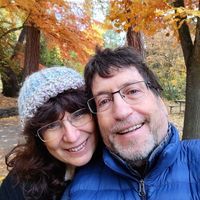
Irving Lubliner’s parents both survived Nazi concentration camps. After his mother’s death he discovered many stories written by his mother, Felicia Bornstein Lubliner, about her time in Polish ghettos and two concentration camps, Auschwitz and Gross-Rosen. This book is a compilation of his mother’s writings for which her son, Irving, wrote the foreword, afterword, and editor's notes.
I found "Only Hope" to be breathtaking in its beauty. The small daily-life vignettes of Felicia Bornstein Lubliner, collected by her son, share an insider's view of several terrible years of human history - told in a personal and insightful way. The moments offered in this memoir neither shrink from the horror of the holocaust, nor leave the reader numb. Instead, they bring this experience into understandable, relatable terms seen through everyday experiences of what it was to live through that time as one of the intended victims of Nazi Germany. I felt like I had walked alongside and heard the real voice of someone who was there. I was not scolded, nor frightened, nor exhorted - but led, humbly and gently by Felicia's hand. It was good knowing, at least for this one companion on the journey, that there would be an end to the experience as evidenced by this candid narrative of having traveled such a dark road. I highly recommend this work for anyone with a heart.
An absolutely incredible and unforgettable book - gripping, terrifying, inspirational and at times uplifting. Felicia's incredible courage and resilience shine through in her writing. I am not verbose enough to do justice to this book in this review, but want to share my appreciation of it, in hope that it may help someone else decide to read this this raw and unimaginable account of a horrible and defining time in mankind's history.
This book really stuck with me. It isn’t just another Holocaust book. It feels personal. Real. It’s made up of speeches, letters, and memories from Felicia (Fela), a Holocaust survivor, and it’s all put together by her son after she passed. He didn’t write the book, exactly. He just organized her words -the timeline of her life, her talks, her unedited notes, even the Q\&As she had with students -and gave it space to exist.
What makes it powerful is that Fela actually did a lot of presentations during her life, but even then, it’s like her true story never really came out. Not fully. Not like it does here. Maybe it was just too painful. Maybe she didn’t want to drag her sons into the world she came from. Either way, this book lets her speak freely in a way she hadn’t before.
She and her husband, Abram, did what they could to give their kids a normal life after the war, even though they carried so much trauma. And now, reading her story through her son’s eyes, especially after she’s gone, you feel the weight of the question: Should I have asked more while she was alive? That one hit me hard. How many stories from our parents or grandparents are we missing just because we assumed there’d be more time?
The book also makes you think about antisemitism, injustice, and how slowly the world reacted during the Holocaust. I get that the Depression was going on, but was that more important than people being killed in gas chambers? Or worked to death for no reason? Jews weren’t just targeted - they were dehumanized, made to feel like they weren’t even people.
One part that’s stuck in my head is when Fela comes face to face with one of the women who used to beat her in the camps. They actually hand her a whip and tell her she can get revenge. And she refuses. She doesn’t take it. That says everything about who she was. Her strength wasn’t just in surviving. It was in not becoming like the people who hurt her. That’s what real power looks like. That’s what change looks like.
And here's the thing: I read these books because we need to always remember, but more importantly ask ourselves:
Would you speak up if you saw someone being wronged? Would you stand up for what’s right, even if it’s hard or uncomfortable? Are we too quiet when it really matters?
Fela’s story makes it impossible to ignore those questions. And I think that’s the point.
its a quick easy ready: definitely recommend!
This entire review has been hidden because of spoilers.
This book is remarkable because Felicia Bornstein Lubliner's writing is especially engaging and eloquent. Her voice clearly conveys wisdom and resilience and, most of all, hope in the face of the deprivation, brutality and horror of the Polish ghetto and Nazi concentration camps. Irving Lubliner has compiled his mother's stories thoughtfully and, with his own fine writing, added the context of another generation, also reflective of loss, inspiration and hope--his mother's legacy.
Only Hope was personally satisfying and enriching. The author relates experiences that were shame and anxiety inducing and painful. I heard similar stories from my late mother, whose history and timeline in the Lodz ghetto, the Auschwitz/Birkenau camp, the Zeilsheim displaced person’s camp near Frankfurt, immigration to America, and settlement in the San Francisco Bay Area were similar to Felicia’s. I admired her courage to speak publicly about her experiences as early as 1967, a mere two decades after liberation. My mother related her own history privately to family members and over drinks and cigarettes with the survivor crowd – lots of smoking – but never to strangers and certainly not in a public forum. What bravado! I can only imagine Felicia’s nervousness in anticipation of such presentations and the catharsis she must have experienced while speaking and afterwards in contemplation of her talks. Felicia was more articulate in English less than 20 years after immigrating to America than was my mother ever, who lived 89 years. Felicia’s command of English was impressive and her willingness and ability to share shameful and painful feelings laudable.
I feel this book is valuable both to the Shoah crowd, who know the stories of the survivors, and to the general public, who will access details of painful stories too raw to display in video entertainment. There is no comparison between a personal narrative, such as Felicia’s, and any Holocaust/Shoah movie I have viewed.
My favorite chapter was The Reunion, a story of returning home after the war. In light of the protagonist being named Dora, rather than the author’s own name of Felicia, her editor son wonders whether or not the story was real or imagined. I feel it doesn’t matter. The feelings described of finding a stranger in one’s childhood home after having been violently wrenched from it years earlier were moving and rich with pathos. This chapter brought tears to my eyes. Some of the most touching conversations between my parents were those about not having returned home. To this day, my father at 97 speaks wistfully of his regret at not having had the opportunity to return home after the war.
I commend this book to anyone with an interest in history, human suffering, the Shoah, or the indomitable human spirit. I am grateful to the author for speaking and writing and to her son for laboring to gather and publish Felicia’s memories. I’ll remember her always.
I bought a Kindle edition and found no defects or omissions. All the photos were clear and easy to enlarge for close viewing on my Kindle Fire HDX 8.9 (3rd Gen).
An enlightening introduction to Auschwitz and humanity.
“Follow me into Auschwitz” Felicia Bornstein Lubliner invites her audience to share in her horrible but life affirming experience, “Only Hope, A Survivors’ Stories of the Holocaust.” After surviving six years in ghettos and concentration camps, Mrs. Bornstein married Abram Lubliner in a camp for displaced persons, eventually settling in California. She dealt with the trauma by sharing it with others writing articles and speaking in public. He dealt with it by keeping it inside – as do many survivors with PTSD. After her passing, their son dealt with his own distress as a survivor’s child with many questions asked too late, by compiling her stories into this short book. As intended, her brief essays draw one into the experiences: A “Package of Hope” arriving in the ghetto, the initial shocking arrival at the camp and the degradation of daily life, then a startling reminder of humanity when after liberation, the former inmates have to deal with their tormentors; and finally, can one really return to the home they were driven from so many tragic years before.? Along the way, she deals with the fiction that Jews did not resist. He son provides brief but essential context to the events MS Lubliner describes so vividly. This is an excellent introduction to this essential subject; I highly recommend it to high-school students.
Only Hope gets 1 additional star for its actual story. Felicia Lubliner's recollections of her survival of the Holocaust ARE an interesting, and poignant read.
Do you want to read them 3 times in a row?
This book could have, and SHOULD have been 1/3 of the length. The author does a foreword, summarizing everything you are about to read later. (In fact, there are VERBATIM lines of text that you will read multiple times over throughout the book.) He explains the who, the what and the why, and then leads you to what are actually his mothers words; (transcribed from an audio recording.) In those recordings: the exact same stuff you just read in the first part. Again, VERBATIM. It's like he copied and pasted most of his mothers words and used them in HIS part of the book. But, whatever.....even that you can probably forgive, if he didn't follow up at the END, and do it again! ANOTHER summarization of the events you just read about TWICE already!
I was BLOWN. AWAY. by the amount of people giving this book 5 stars. I can only assume it is because no one wants to be the person that 1-stars the subject matter. It's like the Holocaust gets an automatic glowing review. And seriously, if you JUST read the middle part of this book, it's 3 1/2 stars. She tells her story very raw and emotionally. But as a BOOK, this thing is hogwash. I know that this was a labor of love from a son to his mother, but it could not have been done in a worse way.
I'm not telling you to not read this account of the facts; I'm telling you to not read this BOOK as it is intended. If you get this book, go straight to Mrs. Lubliners words and then put it down when you're finished.
Reading about the Holocaust is difficult. It must be even more difficult writing about the Holocaust when you are sharing stories and seeing pictures about your Mother. The history books are filled with facts about this horrific tragedy, but actual writings and presentations from the author brings you closer to her experiences.
I had the wonderful experience of attending a lecture from the Author’s son, Irving Lubliner, through the University of Minnesota’s Life Long Learning Institute and it did not disappoint. Mr. Lubliner shared pictures of the actual writings of his mother and read several excerpts. We also heard Mrs. Lubliner, in her own voice, when she presented to the San Francisco State University.
If your class or Book Club would like to learn more about this, I highly recommend it. You will be enlightened and not disappointed in the presentation.
An inspiring insight into the harrowing experiences which a Holocaust survivor went through. The way in which she imparted her her experiences to various people (especially young adults) after her liberation from Auschwitz is remarkable. You are left with a very clear impression of just how important Hope was in her fight to survive the camp. The way in which she talked about her Camp experiences and describing her life before the War help the reader to understand her thinking. The explanation of how this book came about is an insight into just how different this book is. I have read many many books about the Holocaust and the survivors, but this book is very different and leaves the reader with a realisation of just how important it is to have Hope and to not let hatred consume your life.
I have ready many books on the Shoah, So many books by so many survivors who are just not here any more, So the events of the Shoah are now told by 2nd and Third generation children of the Shoah survivors, This book was brilliant on a par with biographies from Primo Levi and Eli Wiesel , Felicia in her recording gives a description and a narrative, that you can feel her emotions, The pain she feels is very evident in her words, You can almost feel her hunger, her sadness, and her fear, but you can also feel her hope, her will to survive her captors, and she did survive and went on to have children, who had children. That is her victory over tyranny. We must never ever forget the Shoah , that is also a victory against tyranny, please read this book , then read it to your older children.
Only Hope: A Survivor’s stories of the Holocaust is written by Felicia Bornstein Lubliner and edited by her son Irving Lubliner. This unusual memoir is told mainly through her own writings. She loved to tell her story, especially to university students. Her stories were recorded and her son uses these to tell her story. Her family contained seven sisters, two brothers, and their parents. After the war was, only Felicia. Her ordeal as a WWII survivor does allows us to get a glimpse of her ordeal and her survival. The book is wonderful and is easy to read, although the subject matter is hard to take.
This book moved me the way Elie Wiesel’s NIGHT did. How does a human being survive such degradation without succumbing and losing one’s own humanity and hope? This woman did! Thankfully her son put her writings and speeches into this book to give us hope - hope that this never happens again and hope that humanity is better than what she experienced. The most moving chapter of the book, The Choice, showed us that she chose to rise above what had been dealt to her, as fellow survivors urged her to beat one of their former tormentors. Thank you to all the Holocaust survivors who have given us hope and to those who preserve this history for future generations. Sandy G. Wood
Such an incredible story of the horrors of war, the pain of survival in concentration camps where every day you did not know if you would be selected to go to the crematories or if you had the chance to live another day. This is the story of one woman’s survival at Auschwitz. To read of the atrocities and the depths of the spirit of humans to do all they can to survive, especially when so many did not. I could not put this book down. I read it through. I cried for the cruelties and for the final victories of being freed. A story that will touch the heart and make us never forget, and to see that it never happens again.
What a remarkable narrative story written by her son about the voice of his mother’s story that she describes her life in the pabianice ghetto and Auschwitz. Irving describe each story with many photos in the book which I have enjoyed reading and I couldn’t put it down. I recommend anyone reading this book.
Thank you so much for sharing your mothers thoughts with us. Thank God that she was one of the ones who wanted to share her experience with the world. It helps so much to try and understand evil at work and to say never again. She and your father are heros and due to their life and the lives of you and your brother....their life goes on and on.
“Accusations have been made that Jews behaved cowardly and let themselves be slaughtered by the millions without resistance. This is not true. There was resistance—not only desperate, armed, and heroic, as in the case of the Warsaw Ghetto, but day-by-day resistance and a will to withstand, to outlive.”
I am a voracious reader and have enjoyed reading Holocaust books since I was a young lady. (I am an old lady now, but I still am very interested in the Holocaust). Ms. Lubliner is a talented writer, who told of the horrible events she lived through. I hope to see additional books by this author!
This book Walker me through what it felt like to be a victim of a concentration camp. However, its so hard for me to imagine such cruelty, its so hard to comprehend. My heart goes out to survivors and the lives lost. Thank you for sharing Felicia's experience.