“Entertaining, informative, thought-provoking, mysterious, poetic. Men who read it will surely learn much about themselves, and women—particularly those who are unfortunately misled into thinking of men as “the enemy”—will find it a real eye-opener.”—Ruth Tiffany Barnhouse, M.D., Th.M., Harvard University
Robert A. Johnson's classic work exploring the differences between man and woman, female and male—newly reissued.
What does it really mean to be a man? What are some of the landmarks along the road to mature masculinity? And what of the feminine components of a man's personality?
Women do not really know as much about men as they think they do. They have developed, over the centuries, considerable expertise in the technique of adapting to men, but that is not the same as truly understanding them. Women often labor under the delusion that life is really pretty easy for men, at least when compared to their own lot, and they have no idea what a complicated struggle is really involved in the transition from male childhood to real manhood.
As timely today as when it was first published, He provides a fascinating look into male identity and how female dynamics influence men.
Robert A. Johnson was a noted lecturer and Jungian analyst in private practice in San Diego, California. He studied at the Jung Institute in Switzerland and at the Sri Aurobindo Ashram in India.
This was like looking through a kaleidoscope submerged in water: I can see there's a pattern of bright colors and shapes at the end of the cylinder, but it just won't come into focus.
I appreciate the Jungian psychological concepts symbolizing the masculine life's journey, including man's quest for the grail, his fight with dragons and knights along the path, the hermit years, and of course the various feminine characters and complexes represented at every stage of life. The tale of Parsifal battling his demons, saving his damsel in distress, and joining King Arthur's court is interesting provided its historical emergence from France in the 12th Century and its subsequent appearance in other societies through similar but distinctive versions.
The problem for me is the author's tendency to say "Here is this story, and this part means this and that part means that," but without ever providing context or giving much reason why. The reason is just because the author says so. For example, Parsifal encounters and defeats the Red Knight, which represents some initial battle the boy must face on his way toward knighthood, i.e. manhood. However, what that is in fact is neither made clear nor do we learn how we know that's what the story was intended to mean (aside from some sort-of examples such as Dr. Jung's traumatizing childhood experience with a teacher who declared his homework assignment must have been plagiarized). Parsifal meets the damsel in the castle who has not smiled for six years but upon seeing him spontaneously begins to laugh. This is meant to represent the inner feminine side of Parsifal which detracts him from his mission and instils in him for the first time doubt about his own abilities. That's all well and good, and may even be true, I just have no idea how the author was brought to that conclusion.
Throughout this and other books by Robert Johnson there seems to be a mixture of theology, philosophy, numerology and mythology. Towards the end of the book in the next to last chapter, Johnson extols the Catholic Church's doctrine of the late 1940s placing the Virgin Mary among the Trinity in heaven, and explains that the number four is more holy and inclusive than three -- after all, it can include three but three cannot contain four -- citing only to Dr. Jung's years exploring the symbolism of the numbers three and four. Shouldn't that mean that five is yet even more holy? And what about six? While I am not certain, I believe the author was pleased to see femininity included with the Holy Trinity because it is fundamental to our psychology, although he makes no statement on the theological significance or why in the end four is better than three. (I'm more of a three guy myself.)
Some ideas in this book do ring true and are quite appealing if perhaps familiar, such as that in the process of converting ego into self, happiness is a state of mind and being rather than a destination. Also, there are aspects of femininity that man must face and reconcile to succeed in his life's journey. Male psychology I believe does largely follow the patterns alluded to here, and I don't doubt the author has many profound perspectives that are useful. But instead what I feel is exhaustion as though I've been treading water in a sea of symbols and numbers and mysticism when really I had hoped to be led to stand on firmer ground with a deeper understanding of principles that are concrete.
It may well be that with another reading I would come to a higher understanding. Three readings would be divine, but why let it end there?
This review was brought to you by the number four.
I'm just astonished by the implications of this short mythopoeic narrative of masculine psychology—I learned so much! Added to Books-Men-Must-Read-List—which I'll be adding to from now on...
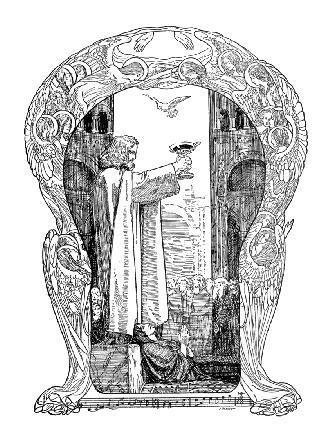
Johnson employs the myth of The Fisher King and his unlikely hero, Parsifal, in capturing the psychological ascent and descent of man in the course of life.
Growth begins when man seizes the Sword from the Red Knight and embarks on his heroic quest. Next step is when he meets the Fairy Damsel, whom he is not allowed to seduce nor be seduced by—he's only to embrace her. She's only there to remind him of the Flower within, his own femininity.
Our man goes through the ups and downs, minor successes and setbacks, until he reaches FORTY. Only then he's allowed to remain in the Grail Castle, forever nourished by the cornucopia of the Grail— the cornucopia of Life itself.
Hint: all the characters and objects in the story are to be understood as psychological content within man's psyche.
Here are some gems I've found on the way:
"In our myth Parsifal and Blanche Fleur make a perfect example of the correct relationship of man and inner woman. They are close to each other, each warms the other and makes life meaningful for the other; but there is no seduction. This is a sublime definition of man and inner woman; but if it were taken as example of man and flesh-and-blood woman it would be a ridiculous boy scout story."
"Inner relationships have their own inexorable laws of conduct; outer relationships have their own equally explicit laws. Do not mix the two."
"These people know the art of happiness, contentment with what is. Their happiness is what happens. If you can not be happy at the prospect of lunch it is not likely you will be happy over anything."
"Even a good mood costs one relationship. All ability to relate, objectivity and creativity, come to an end when mood takes control. In Hindu terminology, serving the goddess Maya (the equivalent of our anima moods) costs one all reality and substitutes a vaporous unreality in its place ... One literally sells one’s birthright for a mess of illusion."
Robert A. Johnson is a Jungian analyst. His book answers positively to the questions: can old myths describe today's man/woman behavior... and psychological development?...and help in psychological healing?
The main myth he's referring to is the quest of Parsifal for the Holy Grail. But also the Wounded Fisher King (applying to man, or the masculine side) and the Handless Maiden (applying to woman, or the feminine side)...and other myths.
Interestingly, even in Tolkien (Lord of the Rings) the myth appears: the ring (of power) is restated to where it should, and withdrawn from those who would use it to destroy the world.
This book doesn't speak to me at all. I agree with Robert A. Johnson that legends and myths, as well as great works of literature, correspond to the human condition--after all, that's what makes them resonate with generations of readers. However, I don't see the usefulness of picking one and elevating it to a grand statement and prescriptive account of the life journey of every man. His interpretation of the Parsifal myth lacks concrete examples from actual human experience. If you accept his premise, you might find great meaning here, but I didn't swallow it for a minute. As an atheist, I also found his emphasis on Christianity to be useless.
میخواستم بفهمم توی مغز و احساس پسرا چی میگذره، که حقیقتش بازم هیچی نفهمیدم. اما یه نکته جالب ازش یاد گرفتم. همیشه یه چیزی توی وجود بعضی از پسرای بزرگتر میدیدم که نمیدونستم چیه، ولی چیز باحال و جذابی بود. الان فهمیدم احتمالا اون چیز باحاله، حاصل از صلحشون با زن درونشونه که متفاوت از جنس مخالف بیرونیه. توی یه جاهایی از کتاب هم خودمو دیدم، که احتمالا ناشی از مرد درون خودمه.
rarely do i read a book in one night, even a short one like this. but its mythological/archetypal/mystical power was too strong to let me take a break. if you're going to read a book like this, you should realize it's by a Jungian analyst - so don't expect "scientifically true" statements. but that mystical aspect is what i love about some writing - it's really the only way i can connect on a deep, meaningful level.
"The object of life is not happiness, but to serve God or the Grail. All of the Grail quests are to serve God. If one understands this and drops his idiotic notion that the meaning of life is personal happiness, then one will find that elusive quality immediately at hand. [...] Such a dilemma! If you ask the Grail to give you happiness, that demand precludes happiness. But if you serve the Grail and the Grail King properly, you will find that what happens and happiness are the same thing. A play on words becomes the definition of enlightenment."
I’m not a trained medievalist but I spent some time both with Malory and Old French. More to the point, I am an older man and a bit of a Jungian. So I found the author’s understanding of men’s psychology and development in terms of the Grail Legend fascinating and provocative, but not quite persuasive. Too many of the connections and parallels (like Blanche Fleur = Anima) could seem arbitrary to the unbeliever. But then I’m a Jungian because for me it works. Some might find similar insights in Robert Bly, though expressed in a quite different idiom.
He: Understanding Masculine Psychology is a pretty interesting book for philosophically and psychologically inclined people. Johnson relates masculine psychology to the myth of Parsifal and the Fisher King.
The Fisher King was severely wounded and unfortunately, his kingdom suffered because of this. The cure for his wound would come when a fool entered the Grail kingdom and asked a specific question. Parsifal, the fool, was very fond of his mother, but broke her heart when he left home to become a knight. He held on to an old garment that she made him, which symbolized his inability to detach and free himself from immaturity and boyhood. Once he reached the Grail Kingdom, he defeated the Red Knight and gained his horse and armor. He unexpectedly met and saved a young woman named Chastity, which became his motivation and gave him a sense of strength. He found out that not only is his mother now deceased, but that he failed to ask the question that would cure the king and feels extremely guilty. He continued to feel useless and meaningless until he finally reached the Grail Kingdom a second time. He asked the question, the king was cured, and the kingdom was restored.
Johnson correlates the journey to the Grail Kingdom to a man's experiences throughout life. The process of maturity from boyhood to manhood and the rude awakening of life's brutality that young men encounter is compared to Parsifal's realization of the death of his mother and the guilt that he felt when he failed to cure the Fisher King. His elaboration of the masculine ability to abuse the femininity within himself is interesting, but a bit confusing to me. He also deals with the need for a woman's femininity for a man to gain sight of positivity in dark and disheartening times of his life.
Coming from a young woman's perspective, I was pretty bored with at least 50% of this book. I understood the concepts within the book, but I wasn't amazed or intrigued by it. Whether it may be due to a lack of attentiveness or relativity, I wasn't really captivated by the book like I was with She: Understanding Feminine Psychology. I've found that its actually common for men to prefer He and for women to prefer She, so there's no need to be alarmed if you like one book and not the other. Despite my experience with reading it, this book is a good one to read, especially for class or book club discussions and debates.
I loved some parts of the myth which do really apply to real life and I can relate to. But in some parts, i felt the author pushing and squeezing the story and moral to a different direction, a direction that he wants. The academic background or the scientific (psychological) part of the story is weak over all. The myth is O.K and his explanation is o.k but trying to put one on top of the other has failed. p.s: I might lack knowledge about the original myth. This should be a point for the author as I am not biased or have a previous assumption about the myth but he failed in making a strong point.
Any male who has attempted to project his anima onto a real flesh-and-blood woman in the real world, without doing his own inner spiritual work, will find this book to be an eye opener.The anima can be identified as the totality of the unconscious feminine psychological qualities that a male possesses. CG Jung said that "the encounter with the shadow is the 'apprentice-piece' in the individual's development...that with the anima is the 'masterpiece'". Jung viewed the anima process as being one of the sources of creative ability.
Though there are some interesting commentaries about the legend of Parsifal in relation to late XXth century psychology, the material loses quality due to the medieval thinking of the writer himself. Robert A. Johnson demonstrates a heavily sexist mindset and absolutely no understanding of women at all (Which he himself seems to not be aware of) and seems to be even more medieval than the myth of Parsifal itself. Though there are some things that can be learnt from this work, I advise the readers to take it with a handful of salt, specially everything relative to women, be it psychologically or socially. Robert A. Johnson's mentality is a nearly medieval one and shouldn't be emulated by anyone in modern times, SPECIALLY when refering to a conjugal life.
This is a somewhat different reading experience than I expected. The cover of the edition I read displayed a marble statue of a Greek hero and the back cover referred to C. G. Jung's ideas about universal archetypes at the root of all religions and mythologies. Ergo I expected Robert A. Johnson's "He" to be a work aspiring to recover a primordial truth at the core of every mythology and religion, that had been either forgotten or neglected by people living in traditionally Christian countries during modernity. What I found within the pages of "He" turned out to be somewhere along those lines in certain regards, but divergent from that in others.
Most of "He" is concerned with conventional literary criticism with a narrow focus on Arthurian mythology. To be more specific: Robert A. Johnson analyses the process of individuation that the knight Percival goes through as part of his Grail Quest in Chrétien de Troyes' telling, especially in his interactions with the Fisher King, and what that says about the story's commentary on gender roles.
There are many interesting observations to be found here. A good example is Johnson noticing that the male supporting characters (Sir Kay, Gornemant, The Fisher King) represent different sides of Percival's own personality that he needs to either defeat or reconcile in order to grow as a man and a human. Johnson's analysis of the female characters are also intriguing, like his identification of the Loathly Lady with the unrealistic idealised image of Percival's mother that he needs to break with, or Blanchefleur representing his own feminine side which he needs to develop a healthy relation to. Overall it looks like Johnson describes the Grail Quest as representing the process of overcoming an initially traumatising encounter with the divine in adolescence in order to comprehend the numinous on its own terms. To say nothing of the Fisher King's identity as the true keeper of the Grail, and the questions that Percival needs to ask him in order to find the Grail and heal the Fisher King, always being within plain sight but somehow Percival fails to realise the obvious truth in front of him for most of the story. This message is one I find find very relevant to the human condition today.
So far, so good... why only 3 and not 4 stars? Well, when Johnson starts analysing what lessons modern Westerners in the 20th century can learn from all this - I think his conclusions lean very close to those of C. G. Jung whom I find hit-and-miss. I myself used to find a lot of Jung's advice downright harmful earlier in life, but half a year ago I decided to re-read Jung just to comprehend his influence on modern Western occultism and I now find that Jung's methods do achieve the desired results but his explanations for why they work in the first place I often find unsatisfying. So whether or not Robert A. Johnson's conclusions in here will be effective for the reader depends on the challenges they face in life right now, and the "priming" they have received from the surrounding society. And that is before we start pondering whether the gender role norms that 12th century French authors projected unto 6th century Welshmen as exemplars of a lost golden age are those that people of any culture in the 21st century really need!
To Johnson's credit, he does not identify Percival's heroic journey with some universal human condition. Instead, Johnson points out that in mediaeval literature from various Asian cultures he's read (China, India, Japan, Korea, Vietnam etc) he does not recognise any of those narratives or individuation processes found in Arthurian myth. One thing I can say is that whether or not the type of advice he gives is useful at all, is in my experience far from certain.
At least "He" has rekindled my interest in Arthurian legends, so I have gotten something out of this book and I can't give it below average either. Ergo, 3/5 it is.
اسطوره ی جام مقدس سفر روحانی مرد امروز برای رسیدن به جام مقدس و کشف آنیمای درون و به وحدت رسیدن با عنصر شفا بخش درونی است. در این اثر از داستان نمادین سفر پارسیفال برای دستیابی به جام مقدس و نجات پادشاه ماهیگیر زخمی برای بیان مطلب استفاده شده است. در این اثر از زخم های انسان به عنوان آبستن یک تولد تازه و یک گام به کمال آگاهی سخن گفته شده است. آنچه مرد را با عمق وجودش مرتبط می کند بخش زنا نه ی اوست در واقع انیما پلی به عمق خویشتن مرد است. دیدن زخم اولین قدم در راه شفا است ولی فرایند شفا خرد هوشیاری و چاره اندیشی ویژه خود را می طلبد. در این داستان سفر درونی مرد از دوران جوانی تا میانسالی برای دست یابی به ایزد بانوی درونی شرح داده شده و این وحدت را عامل آرامش حقیقی و سعادت انسان می داند. پ ن : در این کتاب اشارات فراوانی به زنان و ارتباط آنها با زن درون و مرد درون نیز شده است که البته کتاب دیگری از این نویسنده به زن و سفر درونی او اختصاص دارد.
"He" takes the story of a man's life from boyhood to adulthood and finds through the Parsifal myth the metaphor to describe the maturing process. Johnson, a Jungian psyhologist, tells the story with the death of Parsifal's father and brother and the knights he encounters along the way. We find our first love, the idea that feast table is set for us, when it is not, and becoming loyal to a "king" who at first makes us a page and then a knight. The knight in us then must search for the Holy Grail. The question asked is "Where does the Holy Grail reside?" Once we know the answer the boy becomes a true man. I found this book imporant on a personal level and as a professor, I wanted my male students to have as part of their education.
This book should be required reading for every man young or old. If you are interested or paying attention to the works of Jung, Campbell, and our modern day Jordan Peterson, this short read will have you asking questions about yourself, and giving answers, that even the good books rarely do. Can’t recommend it enough. I read it twice in one week.
This was really good, but the only reason I gave it 3 stars instead of my typical 4 is because a lot of it was covered in the last R.A. Johnson book that I read (Balancing heaven and earth). I recommend this book as a great, detailed analysis of the Fisher King and the Holy Grail
I found it far more interesting and insightful than She, mostly because the myth seemed more detailed so there was more of a symbolic framework for the narrative to operate in. I found some of his claims about gender very dualistic and limiting (ex: Creativity is an inherently feminine force. I think it's a human or divine force and not something that can be gendered). Not being a man, I'm not sure how accurate or helpful this book is. I found it interesting, but not always pertinent to my own development. I've lent it to a guy friend and am excited for him to read it so that I can get his take on it. Interesting and possibly worth recommending to adult men in your life.
First, I cannot emphatically root for Robert A. Johnson more so than with jazz hands and a happy dance--he totally nails the psychology of men and with his additional book on the psychology of woman. He's great, and I'm a tougher critic. Don't walk, run, to get ANYTHING written by this gifted psychologist.
Robert A. Johnson packs an impressive amount of depth into a very small book. Using the Arthurian legend of Parsifal and the Holy Grail as his lens, Johnson interprets the stages of masculine psychological development with both clarity and brevity — distilling what could easily become dense Jungian theory into something genuinely accessible.
What resonates most is the concept of the Fisher King wound: the idea that men carry an unhealed psychological injury and spend much of their lives trying to soothe it through superficial means — consumption, vice, distraction. It’s a concept rooted in medieval romance, yet it describes something unmistakably modern. If anything, the cultural noise of today makes the wound harder to see and easier to feed.
4/5 stars and I loved seeing the notes from the previous owner in my copy.
Thanks to my really hot, creative and hardworking girlfriend who still finds the time to send me the best books in the mail, such as “He”.
Short and sweet. Interesting if you’re versed in and in the headspace for Jungian symbolic interpretation. Written at the outset of our current era in the 70s, Johnson interprets the mediaeval myth of Parsifal and the Fisher King as a parable of men’s inner lives. In this sense it’s one of leaving the psychic childhood home and setting off in the long process towards maturity. In an important sense it’s a wholesale reinterpretation to bring it down to the experience boys and men experience in modern American life. Like a lot of the psychoanalytic literature, you can only really enjoy the story if you drop your resistances and go for the ride.
He; Understanding Masculine Psychology, deconstructs the myth of Parsifal's search for the Holy Grail, and applies it to a man's search for meaning in modern society. The myth itself is worth knowing, if it has not already been consumed in its original form, and this is a suitable vehicle to pin down its basics. Author Johnson's use of Jungian pyschology posits the basic conclusion that just as Parsifal ultimately finds meaning by sacrificing for the King instead of focusing on his own needs, a modern man finds meaning by sacrificing for his higher self rather than has more basal materialistic desires.
Two compelling ideas arise from this book, one belongs to the author, the other is my personal (though not uncommon) observation. First, Johnson makes a distinction between a feeling and a mood. A feeling is a true reaction to outside stimulus. A mood is the stirring of emotion based on one's internal sentiment. A feeling is real and purposeful. A mood is a self-made construction and thus has no basis in external reality. A mood is the representation of the anima in man, it serves to impede his musculine drive, and ultimately is an obstruction to all advancement. Moods are not real, and yet I know from personal experience, they are all too easy to get stuck in.
But the more compelling idea that strikes me in reading this very brief book, is the universiality of myth in our lives. It is the luxury of being a writer that we spend our days applying mythic structure to our characters' lives, and through that effort combined with the gentle prodding of Johnson's analysis, it becomes almost reflexive that we beging to acknowledge the mythic structure in our own lives. This is a profound gift, as it perhaps describes one's future more clearly than could ever be discerned by other means.
Uses the medieval myths of the Fisher King and Parsifal to analyze the archetypal stages of the development of masculine psychology. In some ways it's an example of the self-helpification of Jung's analytical psychology which seems to have begun with Joseph Campbell, and which I find somewhat distasteful. At times Johnson's interpretations seem hamfisted, but on the more general points about the woundedness of male adolescence, the quest for self-mastery, and the reconciliation of the unconscious feminine, it is accurate and useful.
In this book the Jungian analyst Robert A Johnson uses the French version of the myth of Parsifal's search for the Holy Grail taken by a poem by Chretien de Troyees. I found this book to be entertaining at the most as I do any writings on masculine psychology I felt like I was reading a Philosophers view of a mans journey and this book came off merely someone's theory of mans search for his feminine self.
Was recommended this book by a therapist because he said it would be a good way to understand what it means to be a man in the modern world. This is very false and the book is pretty archaic and does not represent the type of man I want to be. Also that therapist was trying to convince me that becoming a pickup artist is the way to find happiness in dating, so I said no way bro I’m outta here ✌️
A good little book for a man in search to better understand the path of the search and perhaps take comfort in his place on the path. The book simply explores the mythology of boyhood to manhood to soulhood and is a short and easy read for anyone interested in mythical self exploration.
This book was short but sweet. It explained the points of influence and change that occur in the life of any man. It granted clarity and helped a person to identify and explain the events that happen to us all in one way or another.
The only gripe I had with it was that it was indeed overly focused on explaining things to the point where I felt the ideas got slightly convoluted.
Jungian bir analist olan Robert Johnson’un eril bireyin doğumla birlikte olgunlaşma sürecini mitlerle bağlantılı olarak açıkladığı bu kitap jung severler için Türkçe iyi bir kaynak niteliği taşımakta. Sahip olabileceğiniz en tatmin edici mitolojik deneyim bir mitin kendi psikolojik yapınızda nasıl yaşadığını görmektir diyerek başlayan kitap; “Kutsal Kase” miti, “Balıkçı Kral Yarası” ve diğer arketiplerle birleştirilerek Parsiyal’in yaşadıkları ekseninde bize sunuluyor. Kısacık, okuması yormayan, anlatımı ve anlaöı oldukça güçlü. Psikanalizle özellikle de Jung ile ilgilenen kişiler tarafından belki de birkaç kez okunmalı.