For fans of Ducks, Newburyport and Rivka Galchen’s Atmospheric Disturbances, a day-in-the-life of a plumber whose troubles are all coming to a head.
In an addictive, interior-monologue lyric novel, we meet Joseph. Back on the job after a long leave, he’s not at all sure he’ll make it through the day.
Bad thoughts keep creeping in. He believes that his son, suffering from a condition in which he believes someone close to him has been replaced by an imposter, has tried to kill his wife. And that he’ll try again. And that his wife is planning to leave him.
Meanwhile, he’s fixing a sink for his wife’s friend.
Insignificance unfurls over the course of a single day. Placing the reader inside the head of the struggling Joseph, it works double time, as a portrait of the uncertainty and awkwardness of one vulnerable man and his relationship with the world, and also as a tense, emotional, and gripping drama.
In this deeply human and highly inventive story, we have a novel that portrays the thoughts of one working man on his own terms, without artifice or condescension. James Clammer pries open the head of a plumber to reveal the portrait of a fracturing mind taking us closer and closer to the edge.
"Hands down the best novel about a plumber changing a water tank – and, incidentally, dealing with matters of grave and threatening existential weight – I have ever read." —Stephen Sparks, Point Reyes Books
"In this short and powerful novel author James Clammer places readers inside the mind of Joe Forbes, a delightfully perceptive, middle-aged plumber who is trying to recover from a mental breakdown precipitated by his son’s criminal conviction. Joe is very much an 'everyman,' yet his way of looking at the world and his circumstances is far from ordinary. With writing full of wit and sensitivity, Clammer’s blue-collar hero goes back to work, longing to once again be strong, healthy, and confident – fully engaged within a society that stigmatizes weakness and mental illness. Insignificance is an absolute marvel, and one of the best books that I’ve read in quite some time." —Lori Feathers, Interabang Books
“A brilliant look at family, mental health, and mid-life, Insignificance is a marvel. Tender, moving, and written with subtle humour, Clammer's novel takes the reader through a single day in the life of Joe Forbes, reluctant plumber and anguished father. A superb novel that hits all the right notes. I couldn't put it down.” —Mark Haber, bookseller at Brazos Bookstore and author of Reinhardt’s Garden
Edward had been allotted a single word, demon. Joseph’s words were several: man without authority. Uncomplaining. Elderly. Cannon fodder.
James Clammer’s Insignificance, the latest novel from the wonderful Norwich based small press Galley Beggar and the next book from the Republic of Consciousness Book Club, is narrated largely from the perspective of Joseph Forbes, a 44-year old man.
The novel opens, early on an oppressively hot day:
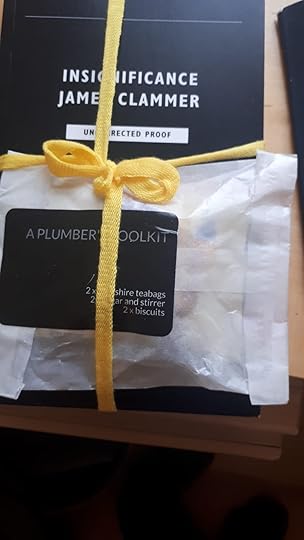
Still when the man Joseph turned his vehicle from the tarmac of the road onto the brick-paved driveway at the far-end corner of Lysander Close there was early morning’s coolness in the air. … The door opened and he caught a glimpse of baby-blue dressing gown. Down soon said the dressing gown, in reality Amanda Margaret Hollander. I wasn’t expecting you yet, you are bad Joe Forbes coming this early, that was how she said it then she pounded upstairs. See you in a minute, go in there. From the kitchen where he had been instructed to wait the man Joseph examined cursorily the tea, coffee and biscuits laid out that were Amanda Margaret’s thoughtful contribution to the sustenance he would need throughout the day, which was also his first day back and not something he was very much looking forward to.
The novel’s events all take place over the 24 hours until the following dawn.
Joseph is a plumber, but trying his first job after an extended hiatus due to a psychological breakdown. Amanda, an old friend of his wife Alison, has a boiler in need of servicing, and the two women see this as a way to ease Joseph back into work.
Much of the first part of the novel describes Joseph’s plumbing maneuvers in detail, a focus on the processes of work reminiscent of Magnus Mills, and with exactitude reminiscent of Simon Okotie, but ultimately a voice very distinct from both:
He removed the left-hand one and placed it on a high shelf in the airing cupboard, again he strained at the valve, that was better, in old money it closed perhaps a sixteenth of an inch, another sixteenth, another sixteenth, backwards, forwards, freer it turned, his hand hurt, again he had to re-rack, such is the life of a labouring man, day after day his adversary is a thing, an inanimate object with its own peculiarities, then it’s another, then it’s another, the conflict commences without dialogue, progresses without dialogue, ends without dialogue, rarely does it intrude into the cloisters of literature. … As regards our insistence upon these lengthy and somewhat technical descriptions, let’s deal with it by saying that while objections are anticipated our narrator hesitates on the cusp of apology – the peculiarities of the life of the man Joseph granting, perhaps, special dispensations.
But as he works, and entertains cliched fantasies about the visiting-plumber scenario involving Amanda Margaret, we also learn of the physical manifestation of his troubles (a tendency for his fingers to cut easily, rather inconvenient in his profession) as well as the root-cause:
There was a certain wisdom in keeping things on the surface (not that he believed it for a minute), the manner in which she’d cured her curiosity about Edward’s current life might even be admirable, but he couldn’t do the trick. And then she’d had help, hadn’t she, her job to keep her distracted, her religion, the not-being-lapsed any more, that bitch Colleen, no it wasn’t fair to call her a bitch, still she’d made trouble, a do-gooder that’s what she was, what good ever came of a do-gooder. At least she was out of the picture now. Which only left the other one, the Special Friend who bolstered Alison’s resilience and there wasn’t much Joseph could do about him, after all how can you exclude from your household someone who’s been dead for two thousand years.
His son Edward was imprisoned 7 year ago and he has not seen him since. Suffering from Capgras syndrome he believed Alison was not his real birth mother but a substitute and tried to poison her with antifreeze. Alison herself found refuge in a religious faith, rekindled by a hospital visitor, Colleen, from the local Catholic church, while Alison was being treated.
Joseph’s rather unsuccessful plumbing is abandoned when, unexpectedly, Edward arrives at the house, and the rest of the novel alternates between Joseph’s and, more briefly, Alison’s perspectives as we learn how they have each dealt with Edward’s actions, and the implications for their own relationship.
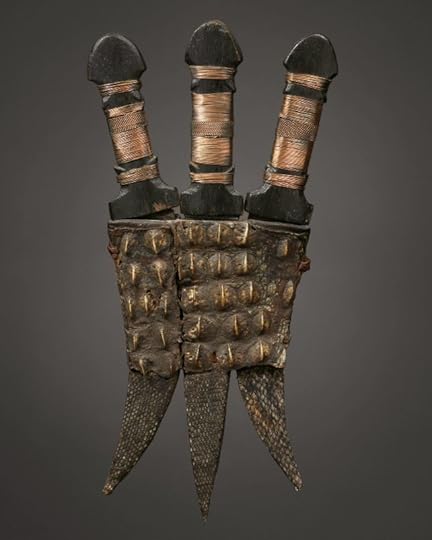
A Madhi knife plays something of a Macguffin role (picture from author’s Twitter) and there are some explicit links to Graham Greene’s The Heart of the Matter (perhaps too explicitly spelled out).
A quietly impressive novel albeit not particularly groundbreaking and the second half, after Joseph leaves the house and the PoV becomes more diffuse, was, for me, less striking that the first.
And one key reservation is that Alison’s religiously motivated reaction to Edward seems rather out of keeping in a faith built on both forgiveness and prayer, albeit otherwise her beliefs are handled sensitively.
This book is published by the Norfolk based multi-award winning small press Galley Beggar, run by Elly Miller and Sam Jordison - whose past books include the all superb (and widely recognised) “Ducks, Newburyport”, “We That Are Young”, “Lucia” and “A Girl is a Half Formed Thing” among many others.
In the Guardian’s 2020 literary preview (this book had originally been scheduled to be published in October before the post lockdown bulge rather pushed it out of the market) the author was quoted as saying “The middle classes have always been given a lot of space to write literary books… I think the working classes should be given a bit of space to navel gaze, too.”
And, in perhaps a Ulysses tradition, the book is effectively a “day in the life” novel – albeit with a largely straightforward prose style with a rather fourth-wall-breaking, often amusing and omniscient narrator rather than a stream-of-consciousness experimental fiction.
On the subject of the narrator, I particularly enjoyed an episode where the narrator breaks off part way through a description of a forest scene with “the general picture is a familiar one, we shan’t go on, the last thing anyone needs is more nature writers”.
The main character is Joe(seph) Forbes – a plumber in his mid 40s who has returned to his self-employed work (on something of a trial basis – doing a boiler replacement for one of his wife Alison’s friends) after a period off suffering from some form of combination of breakdown accompanied by physical effects like headaches and frequently-bleeding fingers.
The first part of the book allows us to gradually understand Joe’s state of mind interspersed with extremely and deliberately detailed descriptions of the plumbing activities.
I was reminded here: a little of Ian McEwan’s writing on more middle class pursuits for example brain surgery; with a trace of Simon Okotie’s highly detailed physical descriptions in the Absalon trilogy (but without the exacting precision and slowing of time to an almost standstill); and even of Magnus Mills writing about manual work (albeit without the rather Kafkaesque elements of his novels).
The book takes an abrupt and much more character and emotion filled turn when Joseph and Alison’s son Edward rather unexpectedly turns up – Joseph still believing him in prison after a nasty and personally terribly hurtful action years previously, one caused by Edward’s condition of Capgras Syndrome (when you believe someone close to you is an imposter).
Much of the rest of the short book explores the different ways that Joseph (a man who rather allows life to happen to him – “there was nothing he had to tell .. any of them here except the story of his life which was insignificant”) and Alison (who has taken consolation in a discovered and deeply growing Catholic faith) have chosen to deal with Edward’s actions – and the resulting rift that has grown between them.
In Alison’s faith and the change she is contemplating as a result of it, and Edward’s effective incomprehension of (and resentment of) religion I was reminded of Bernard MacLaverty’s “Midwinter Break” albeit I think that book had more insight into faith and depth in its treatment of distance within marriage. While much of Alison’s faith is portrayed sensitively (at least for me the atheism of Joseph seems tragically hopeless by contrast) I struggled a little with the Catholic Faith than Alison discovers. It is explicitly said to be devoid of any discussion of sin (not a usual comment on Catholicism), but then seems to major on demonic actions. But there is seemingly no discussion of either forgiveness or even prayer against possession.
The author and book though draw much more explicitly on Graham Green’s “Heart of the Matter” – starting with the oppressive summer heat and continuing through, to Alison being given a copy of the book and Joseph finding a passage in it (although I feel this could have been better simply been left as an epigraph to the novel rather than included in the text as a rather forced coincidence).
Overall though an interesting and worthwhile read - 3.5* rounded up.
I read this book in a single day back on Monday, but I am still not sure how to review it. I would have preferred to read it completely "blind", with no knowledge of the story beforehand, but without mentioning those plot points, there is little left to say, except that it is a moving story of a day in the life of an ordinary man dealing with extraordinary circumstances. The narrative voice is interesting, at times deceptively simple but at others reminiscent of Marias or Saramago, particularly when he steps slightly outside the story to discuss authorial decisions.
Another fine book, thanks to Galley Beggar for introducing me to another interesting writer.
On the surface, this is the story of a plumber re-entering the workforce after a serious bout of depression. In truth it is substantially deeper and broader than that description implies. Joseph Forbes is both uniquely himself and Everyman. Over the course of 180 pages, the tension gradually increases until the menace is high. The very act of turning the page is sometimes harrowing.
This is also a book best approached without further detail. And I strongly suggest that you read it rather than listen to any audiobook version that might be produced. Clammer has crafted his story for the page, using careful word choices, punctuation, and paragraph blocks. What unfolds lends itself to introspection and contemplation. I think sitting with the book in hand will prove much more conducive to such an experience.
(4.5) Desperately sad yet very impressive portrait of a shattered family, led by plumber Joseph Forbes, his God-saved wife Alison and deranged, just-released from prison son Edward.
Plumbing the Depths Review of the Galley Beggar Press black cover limited edition (May, 2021)
Insignificance was a compelling read due to its gradual pacing that slowly reveals the background to the various torments of a father, mother and son, each of whom are dealing with a different mental health issue. Plumber Joseph is making a slow start back to work after a depression / breakdown caused by the son's poisoning attack on the mother. The mother is drifting into a religious fanaticism which may cause her to run off into missionary work. The son is on prison release and may be in some sort of business association with a rare weapons & artefacts dealer (or it may be a scam).
From its simple beginnings with a rather detailed description of a plumbing job (the author has worked in the business in the past) there is already an insidious edge revealed as Joseph lusts after his wife's girlfriend for whom he is doing the work. He daydreams of a possible affair while going through the mechanics of the labour. There is interference from a neighbour and other events, including a meeting with the son, which intrude upon his day. Eventually he makes his way back home in the evening*. Although this was in the experimental stream-of-consciousness / long paragraph style (admittedly sometimes a chore to get through), I found it to have a great deal of dramatic tension which therefore kept me engaged throughout.
I read Insignificance in its limited edition release available to supporters of the Galley Beggar Press' Galley Buddy subscription program.
* It wasn't long before while reading this book that I started thinking of its parallels to James Joyce's Ulysses, but I didn't want to go too far in making comparisons. Still, if you are reading this on June 16th, Happy Bloomsday!
Trivia and Link Insignificance is told over the course of a 24-hour day, and is thus a so-called "circadian" novel. Author James Clammer assembled a list of Top 10 Novels Told in a Single Day.
This is definitely a case of “it’s not you, it’s me”. I think there’s probably a good book in here somewhere but I found the narrative voice so annoying that I almost gave up after the first sentence and then spent the rest of the novel reading sentences out loud to my wife in something approaching despair. I’m not going to go into detail about this because it’s a personal reaction and I don’t want to put ideas into people’s heads when they read the book.
Instead, you should read the three existing reviews (at the time of writing) which are far more positive, from Paul, Gumble’s Yard and Hugh:
The opening paragraphs of James Clammer’s first novel for adults may seem to live up to the title. After all it’s about a plumber fixing a water geyser and wanting a secret fling with the lady who greets him. Then the reader begins to discover that things are not so insignificant after all.
Insignificance is one day in the life of Joseph Forbes. Other than being a plumber, we readers find out that he has slowly returned to the profession after a breakdown, that his son Edward tried to poison his wife, Alison due to the fact that he suffers from Capgras syndrome (believe that a familiar person has been replaced by an imposter) and was sent to prison. Plus when Alison was recovering she befriended Colleen, who got her into religion. Hardly insignificant at all.
As Joseph is struggling with his current plumbing job, his son finds him, asks for money, to which he complies and they spend the afternoon together. I won’t go into details but Edward leaves behind a Madhi knife, which has a role in the story.
Insignificance could be seen as a person’s battle against faith. Joseph is already does not like the fact that his wife is into religion and is further disturbed to find out that Alison believes that her son does not suffer from a condition but is evil incarnate. This makes Joseph worry that he is aiding the devil, after all the name Joseph does mean ‘he who gives’ and he definitely lived up to his names. Coincidentally Edward means guardian. however is he a guardian of good or evil?
The last section of the book is about Joseph trying to release himself from his life situation, whether he succeeds or not is up for the reader to find out. The only thing I will say is that Alison’s name means nobility and her future plan involves Joseph healing completely, which may be seen as noble?? (although this action is VERY subjective)
This leads again to the question of insignificance – are we all insignificant in the grand scheme of things? even if crazy events that happen to us? Joseph may say no but Alison may say yes and this religious dichotomy is present throughout the novel.
Like most books from Galley Beggar Press, the overall story is rich but the language is an added bonus. Clammer’s prose uses an omniscient narrator who makes side comments, little observations about his own preferences in the process and does not distinguish between conversation and narration, which may give the impression that this story is told in a bar or round a group of friends at a social event. It’s kind of what Patrick McCabe does.
Insignificance is excellent. GBP have a knack of signing authors who write interesting books which work on many levels. and this meaty 170 page novella is no exception.
‘Een man die simpelweg alles overkwam’, dat leest hoofdpersoon loodgieter Joseph Forbes aan het eind van een héle lange dag in een romannetje over een loodgieter die Forbes heet. Hierna is de man Joseph tot weinig meer in staat dan de hele nacht op de bank zitten. Nadat je als lezer zijn werkdag in Van geen betekenis hebt gevolgd, snap je wel waarom. Een etmaal lang brengt James Clammer je het levensverhaal van de man Joseph en de vrouw Alison (meermaals zo aangeduid) dicht op de huid, totdat je er af en toe een beklemmend gevoel van krijgt. Je hebt snel door dat de loodgieter voor het eerst aan het werk gaat na een lange inzinkingsperiode (‘laat ik het toch maar benoemen’) maar dat de simpele boilerklus eigenlijk te veel vraagt van hem (‘de vernedering van de vraag of hij hét wel áánkon’). Precies die dag komt tot overmaat van ramp zijn zoon Edward weer op de proppen, die blijkbaar de reden van de inzinking en verstoorde relatie met Alison is.
De verteller van het boek past een bijzondere vertelstijl toe die an sich om een letterkundige analyse vraagt. Ik wil niet alles kapotduiden maar er zitten wat trucjes in het verhaal die maken dat je enerzijds in het hoofd van de personages bent en tegelijk de wereld om hen heen van verschillende kanten beziet (auctoriaal perspectief, vertellers-/persoonstekst door elkaar). Deze manier van schrijven heb ik overigens niet ervaren als trucje, het las vrij soepel – mede doordat de verteller spreekt over “we” en je dus meeneemt in zijn relaas. Namen van gereedschap vliegen je om de oren, gevolgd door een loodgietersverhaal met een vervelende klant waarna je Joseph ineens door de ogen van de vrouw ziet bij wie hij een boiler moet vervangen. Een grote levensgebeurtenis staat naast het kleinzerige leed van vingersneetjes met wel een buitensporige reactie: ‘Dit verwachtte je niet van je lichaam, je verwachtte dat het je zonder schade en klachten bijstond tot aan bijna het einde.’
Van geen betekenis telt precies 200 pagina’s, waar vertaler Hans Kloos vermoedelijk allerlei creativiteit in kon toepassen. Een groot compliment dat hij er een goed leesbare tekst van heeft gemaakt. Op de achterflap staat dat James Clammer eerder een bekroonde ya-roman publiceerde; Van geen betekenis is zijn debuut voor volwassenen. Lezen dus, want ik zie het nog veel te weinig in het Nederlands voorbij komen!
“What he was going to do next he hardly knew but so much was happening inside that reacting to exteriorities seemed unnecessary for the time being, a mass of thoughts, emotions, and memories were on the move like parts of a cityscape turned by earthquakes, the heat roiling down on him cook together all these constituent parts until presently out of the hot storm came simplification, two possibilities, he could either pay attention to the pressure that was building inside, the sinewy bag containing the secret that was threatening to blow already, or he could inflate the bag further, artificially pump it up, swamp the explosion when it came then surrender and prostrate himself before oceanic self-pity. Suddenly he leapt into the golden air, this pressure had to come out one way or another, the explosion it was intolerable, he needed to blow out, a blow job, yes that was it, a spiritual, emotional, or psychological blow job, maybe even a simple sexual one, where to get it from he had no idea.”
This is a short novel of the suburban uncanny. It takes places over the course of a single day. The writing is like a stream of unconsciousness- the sentences run on and blend together with dialogue out of quotations.
At times it is unclear what is happening, or if it is happening at all. It leaves the reader disoriented. I mistakenly thought this took place in the 1960s, only to read a reference to a text later in the novel. It’s also unclear what country this takes place in; there’s several references to various European countries, but the characters talk like Americans. (I’ve ultimately decided this must be Canada, mainly because of a single reference to a maple leaf.)
The story is told by an unknown narrator, mainly from the point of view of Joseph. However there are also sections from the POV of his wife, Allison, and son, Demon Edward. It’s a nice contrast between the three- all different versions of the “insane”. One experiencing extreme stress and delusions, one in complete denial of the past and submitting to a Christian cult, and another cold premeditated murderer with a neurological disease.
There is ultimately no resolution to this tale, other than the realization that parenthood will turn you into a ghost of your former self, although there are a couple fun revelations regarding past memories that occur towards the end.
Lijkt heel erg Brits, maar de zon schijnt in dit verhaal, dus iets klopt hier niet.
Vreemd geschreven. Er is een verteller die maar heel af en toe opduikt, waardoor je z’n bestaan continu vergeet en telkens in de war raakt van dit soort passages:
‘Een toon van bitterheid is ons verhaal binnengeslopen, daar was niet om gevraagd maar laten we er niet van uitgaan dat de werkelijke stand van zaken het volmaakte tegenwicht vormde van de geheel eigen, sombere stemming van de man Joseph.’
De woorden ‘de man Joseph’ komen veelvuldig terug en zonder een verklaarbare reden irriteerde ik me daar echt mateloos aan.
Weet niet zo goed wat ik hiervan vond, maar blij dat-ie eindelijk uit is.
Although I had purchased a copy of this when it first appeared, on the strength of many GR friends' reviews, I hadn't gotten to it till just now, as one of the final 'Read Harder' Challenges from my Indie Buddy Reads GR book group - to wit, to read a book recommended by that member whose reading profile most aligns with yours using the GR algorithm. So thanks to David for getting my butt in gear to finally read this unusual and thought-provoking novel.
I initially had some problems with the first third, which minutely details a plumber at work - I was somewhat bored and antsy for something resembling a plot to form. But slowly, strange hints of other things impeding upon the lives of the plumber, Joe Forbes, and his family begin creeping in - until the book moves off in several intriguing directions encompassing faith, delusion, and even one's ultimate place in the universe.
I can't say it overwhelmed me - the writing sometimes got a little difficult to parse - but am ultimately glad I read it.
Eerst en vooral mijn complimenten aan de vertaler Hans Kloos. Hij brengt het verhaal in een ritmisch Nederlands, dat van erg bevreemdend in de openingszin ('Nog heerste toen de man Joseph zijn wagen van het straatasfalt de bakstenen oprit op draaide aan het uiteinde van Lysander Close vroege-ochtendkoelte in de lucht.') overgaat naar licht bevreemdend de verdere roman naar een unieke stem die je wil koesteren. Ik kan er mijn vinger niet helemaal opleggen, maar de zinnen staan van de eerste tot de laatste telkens op openbarsten, ook als ze heel gewoon zijn. Ze willen poffen, als kastanjes of mais, maar het gebeurt maar niet. Beter kan ik de stilistische spanning niet omschrijven. Ik zie wel een verband tussen mijn metafoor en het slot van de roman. En ik ben blij dat ik geen recensent van dit boek ben, want dan zou het niet gepast zijn om te schrijven dat ik er persoonlijk door geraakt werd. Tegelijk ga ik wel een recensententruc toepassen en niets over dat einde vertellen. Ik zeg enkel dat je de man Joseph volgt, een loodgieter die na een depressie zijn eerste job heeft. En ook zijn vrouw Alison, die zich tot het geloof heeft gekeerd nadat haar zoon – ja neen ook dat ontdek je beter zelf al lezende. Je volgt de man Joseph een dag lang. Wat een nieuwe start zou moeten zijn wordt al snel een helletocht waarbij alles wat hij had en kan van onder zijn voeten wordt weggeschoven. Zijn werk. Zijn zoon. Zijn vrouw. De heilige drievuldigheid van de gewone man. Het is een boek over ouderschap, maar ook over menszijn in een wereld met zeven miljard mensen. Over het zoeken naar wat-te-doen en het schipperen van betekenis naar betekenis om er uiteindelijk geen grijpbare te vinden. Enige bemerking: het verhaal focaliseert vanuit Joseph en soms vanuit Alison. Maar ook komt de alwetende verteller nu en dan tussen en eerlijk gezegd stoorde hij me dan meestal. Misschien ervaren anderen hem als een adempauze, maar ik had hem, denk ik, niet nodig.
This is an astonishing psychological novel hot day in British suburbia, in which two parents, one with a solid faith and one without, come to terms with an attempted matricide.
It opens with the father, the man Joseph, meticulously carrying out a plumbing job Despite all the carefulness he cuts himself. While starting with an image of precision and control, there is a sense of lucid madness unfolding throughout the novel, and you honestly don’t know who is crazier: it is the son, imprisoned for seven years (and now seemingly free) for trying to poison his mother believing her an imposter after a few “insignificant” incidents involving buried mannikins and ominous messages stuck in her Bible? Is it Alison, the mother, who is convinced that her son is the devil and has sought shelter in a religious zeal that protects her no matter what? Or Joseph who is all intent on his first job after recovering from a nervous breakdown when, as he indulges in erotic fantasies involving the landlady, the doorbell rings and Edward shows up with a knife, unrepentant after years in prison? While he understands his wife’s retreating into religion, he harbours a quiet rage toward her faith and the meddling friends of the church group, but he is determined to shelter Alison after all she has gone though.
I devoured this little masterpiece with its shifting truths and where little is what it seems. Clammer masterfully manipulates his characters’ perspectives and effectively manages to draw us in the story creating a convincing first person plural narrator and metanarrative moments in which he comments upon the nature of the story he is weaving. Tense and disorienting like a Hitchcock movie, partly inspired by Graham Greene’s The Heart of the Matter with its exploration of faith but that reminded me of the Turning of the Screw for the psychological analysis.
Thanks to the author and publisher for an advanced copy to review; all opinions are my own.
A really good premise that could have been well served by the overwrought stream-of-consciousness, but not only is it mundane, it's not as effective as it should be. The writing style doesn't lend itself to excitement, so when I learn something big like, I'm not shocked or horrified, I'm a little bored and hoping it'll speed up.
I can tell what it wants to be: a deep dive into the life of an average plumber who's experienced deep tragedy and loneliness; but it can't decide if it wants to focus on the "average plumber" part or the "deep tragedy" (which, while maybe not unbelievable, is unrelatable and thus hurt the "average plumber" premise deeply) and this lack of focus hurts the whole story (
Joseph Forbes is a plumber returning to work after a nervous breakdown:
For hours hereon there would be no softness but only the sharp edges of the tools and of the job itself. Almost always it became a battle of one sort or another. He did not yet dare to touch the airing cupboard door and confront the cylinder within, instead he opened the hard plastic case of the toolbox, he would put the gloves on then spend a moment familiarising himself with the things inside, what was this fear, this reluctance, you would think he’d never handled these tools before or learned what each one did.
There’s a wonderful sense in this book that James Clammer knows the precise weight of his prose and what it’s doing. The writing has a mechanistic tone, long paragraphs that break down into their component parts – fitting for a protagonist who works with his hands.
It seems to me that Insignificance creates a space where Joseph can become (or be seen to be) a doer who’s also a thinker – action blurs into thought in this style of writing. Joseph is also faced with two characters who think in ways he doesn’t understand: his son Edward, who tried to poison his mother Alison; and Alison herself, who has found religion.
Clammer’s novel takes place over the course of a single day, and the tension ramps up as you start to wonder where this day is going to go. Add in that prose, and it’s a compelling piece of work.
In short: a Greek tragedy in miniature, saved from unconscionable bleakness by the protagonist's (and narrator's) ironic humour and pragmatic attitude, set in the contemporary moment somewhere outside of London, the action being set in a 48-hour period in the life of a blue-collar tradesman.
A unique narrative voice (plural first person), the effect of which makes the reader feel they are on a guided tour, and the novel's central concerns of three different mental health struggles together give the impression that the world we're exploring in this novel is one the author intended to be put under forensic literary examination.
It's not just the mental health of the son that is examined, but the relationship between each parent and their child, the relationship between the married adults, and then also how those relationships are involved in questions of competence, love, desire.
The form of the novel is experimental in syntax and punctuation, with no markers used to indicate speech interior or direct, and with an unorthodox use throughout of the comma where semi-colons, full stops, or dashes would be expected. Personally, I love a challenge to expected forms, but I reckon the editor faced some challenges of their own, resulting in some misjudged usages being left in the text. I'm a tolerant reader and don't let these things put me off a publisher, but I've got a friend who bristles at even the most simple of typos. So, it's probably worth raising this point.
This entire review has been hidden because of spoilers.
There was something compelling about the writing that made me carry on with each new chapter, even when not much was happening. I didn’t mind the 50 pages of hot plumbing action (not a metaphor) and really the more unusual turns towards the end were more dramatic but less interesting somehow. I did have a problem with the unpleasant ‘mental illness = violence’ trope, and that the condition being discussed was not medically sound - it really doesn’t occur on its own, only in the context of something else (like psychosis, head injury or dementia). Overall it was one of those books I’m not entirely sure why the author set out to write, but it looks like others have found more to get excited about so good on them!
This small publisher also brought us Ducks, Newberryport and the book did read as if somewhat from the same family - not sure if they’re all in this style but I’m interested in their subscription model.
Really refreshing to read a story that isn't confined to the formulaic fashion the market seems to demand (or maybe receive or prefer or embrace or favour). The story is told with a very present omniscient narrator, whose company we enjoy for the duration of a very sad tale.
Joseph's day and his life, though triggered by an unusual incident, are very realistic. Of course it was fiction but it could easily have been a docu-drama of a true story.
As for the ending, is he suicidal or just philosophical? I'd like to think the latter. Perhaps this will be a turning point for him. He's seen sunsets, green summer skies and roadside flowers. He's loved and known what it is to love a child. He's existed in the grand scheme of things and decided nothing matters. Well done, Joseph. Don't take on so. Life can be shit but when you accept it doesn't matter either way in the end, well, maybe the trauma of existence is easier to cope with.
As for Allison and her faith - well, it's a timely commentary at a time when religious fervour and escapism are alive and well. Perhaps it's always that time ....
And given all the references to The Heart of the Matter by reviewers and in the book itself, that will now be added to my reading list.
Can married people join a convent? I thought not, but maybe things have changed. Something to google.
The book is wilfull and has a sense of depth which creeps up on the reader Initially I was put in mind of mezzanine possibly thr only Nicholson Baker novel I enjoyed but it moves from that . The novel feels arch the narration is funny yet serious they work feels at times like a fever dream .
There is no great conclusion because sadly life is like that there is a sense of unreality as what is real and what is not is hard to define .
The Graham greene quote should have tipped me off but my brain wasn't working fully
Enjoyed is not the right word but it may have to do .
James Clammer’s engrossing novel, Insignificance, takes place over the course of 24 fraught hours in the life of Joseph Forbes, a plumber, father of Edward and husband to Alison. Before eight o’clock in the morning, in the midst of a punishing heat wave, Joseph arrives at the home of Amanda Margaret Hollander, a close friend of his wife. His mission: to replace the water heater in the upstairs bathroom. But Joseph is not quite himself, only just recovering from a vaguely described spell of mental exhaustion that has kept him out of action for several months. This is his first day back at work, and he suspects the assignment was cooked up by Alison and Amanda to nudge him back into the real world. Is he up to the job? He’s not sure but forges ahead in the hope that he hasn’t lost his touch. Inevitably, the job turns out to be more complicated than he thought, and his work is slowed when he suffers a cut on his finger and another on his thumb. But Joseph’s day is about to get a lot worse. Clammer’s narrative resides mostly in Joseph’s mind, and Joseph’s mind is awash in doubt, anxiety and guilt. About seven years earlier, Edward, 18 at the time and suffering delusions, tried to poison his mother. For this offense Edward was dispatched to prison and Joseph was left to nurse Alison back to health. But it was all too much, and by the time Alison was fit enough to return to work, Joseph suffered a breakdown. Joseph, not surprisingly, regrets keenly the unfortunate turn events took, constantly second-guessing himself and wondering if he might have done something to prevent the situation with Edward from escalating. Another pressure point for Joseph is his marriage: specifically, the emotional void that has opened between him and his wife. During her recovery, Alison became involved with a Christian group, and under their influence her pious tendencies grew into devoutness, and later in the story when the narrative shifts to her perspective, we learn that she is considering leaving her husband in order to devote herself to the service of God. Meanwhile, back at the house, Joseph, sensing the onset of a migraine caused by the heat, is struggling to finish up with Amanda’s water heater when Edward, recently paroled, shows up out of the blue asking for money. The writing is dense; Clammer immerses the reader in the minutae of Joseph’s thoughts and actions (and, for a time, Alison’s). The story begins with a mundane event (the plumber arrives at the job site), but there are early hints that all is not well when Joseph indulges in fantasies of a sexual fling with Amanda. Clammer builds the tension slowly, doling out details about the past one by one until the ruins of Joseph’s life are laid bare, his day has spiraled out of control, and we witness him stray from a rational path and show himself to be unequal to the problems that plague him. The author crams a lot into this compact but thoroughly engaging narrative. James Clammer’s novel of one man’s struggle to make sense of life and love is gripping and poignant.
Joseph is a middle-aged plumber in an unnamed, cookie-cutter English suburb. Having recovered (partially, at least) from a nervous break-down in the wake of his teenage son, Edward - who suffers from Capgras delusion, attempting to poison Joseph's wife, Alison.
In an attempt to ease him back into work, Alison has arranged for Joseph to repair her friend Amanda's boiler. But what should have been a straightforward job reveals the multiple fronts on which Joseph's life has been assailed. To begin, he's immediately distracted from his purpose for visiting Amanda by his sexual desire towards her - a byproduct of Alison's newfound religious devotion which he feels has pushed him out of his marriage. A developing medical condition that has literally made his skin thinner results in blood being drawn almost immediately once he's begun working on the boiler. And most significantly, his newly freed son appears to ask for money under the assumed threat that he will return to finish what he started.
Joseph spends the rest of the day attempting to make sense of a gift Edward has left in his workvan and, ultimately, of his own 'significance'.
The book is told in a stream-of-consciousness series of run-on sentences but is no less readable for it. If you have the time, you could certainly polish it off in one sitting.
This is the first of Clammer's books that I've read and I will definitely be interested in looking into his work further.
“Upon Joseph’s head the rays of the sun fell, in all upward directions hung bluish-whitish sky, the early tiers of cloud had dispersed like smoke.” James Clammer’s Insignificance is an extraordinarily potent novel, a-day-in-the-life packed into 160 beautifully written, vastly meandering pages. Its protagonist is Joseph Forbes, a plumber trying to complete a job on his first day back to work, after suffering a nervous breakdown. But this simple job is not so easy — like Job, the universe seems to test him arbitrarily, out to harm him in body and spirit, to force him to relive the circumstances of his breakdown: namely his son, Edward, in prison for trying to kill Alison — his mother, Joseph’s wife, who Edward believes to be an imposter. Of Edward, he thinks: “the trouble was he’d always had this strangeness about him, [...] it was like he had iced-over patches where others had depths, or perhaps there was nothing iced-over, perhaps there was only surface, the more frightening possibility.” Nothing is straightforward, not Joseph’s mind, not Alison’s past, an incident from Edward’s childhood, nor her future, the calling she feels from the religion she embraced recovering in hospital. The narration is fascinating, a third-person voice that frequently refers to Joseph as a narrator; moving through “distortions of the glass” to “the first grey light of dawn [...] this dawn insubstantiality”, Clammer conjures a dark, compelling read for a single sitting.
I read this (a lot of it skim read) last night with another bout of early hours insomnia.
Jesus, can someone explain to James Clammer how to write a book?!!
It sounded like a six year old was writing for the first section, "the man Joseph went down the stairs, the man Joseph got into his van, the man Joseph......." Kin ell, we get it Clammer, the protagonist is a man named fucking Joseph!! Then we get a detailed and I mean DETAILED rundown of his plumbing job, really???? If I wanted to read about plumbers, I'd have read a fucking trade magazine.
You know why I'm mad? The premise was amazing, a kid has Capgras syndrome and thinks his mother has been replaced by an impostor. He poisons and nearly kills her, leading her to become overly religious whilst his father (aforementioned man Joseph) has a complete nervous breakdown. In capable hands, this story could have been brilliant. In Clammer's hands, this felt like a runny, smelly pile of dog shite, which I'm gutted I spent money on.
Funnily enough, the publishers of this tripe also published Ducks, Newburyport, another steaming pile of horse turd, figures!!
Life hasn't been so good for Joseph Fobes, this past while. Both life and his job as a plumber have got Joe into some very awkward and uncomfortable places. Then there's his wife, Alison, who has for some time been infatuated by another man. A man with long hair and a beard, if you can believe the pictures (although Jesus never looks like a man from Bethelem in any of those pious paintings).